Posted originally on CTH on December 15, 2025 | Sundance
The blue slip process has been a part of the Senate’s judicial nomination procedure since at least 1917. When a President nominates an individual for a U.S. circuit or district court judgeship, the chairman of the Senate Judiciary Committee sends a blue slip —a form colored blue— to the two Senators representing the nominee’s home state. This form allows the Senators to express their opinions about the nominee.
Positive Response: If a home-state Senator has no objections, they return the blue slip with a positive response, indicating support for the nominee. Negative Response or Withholding: If a Senator objects, they may either return the slip with a negative response or choose not to return it at all. In both cases, this is treated as a lack of support for the nominee, which halts the nomination process.
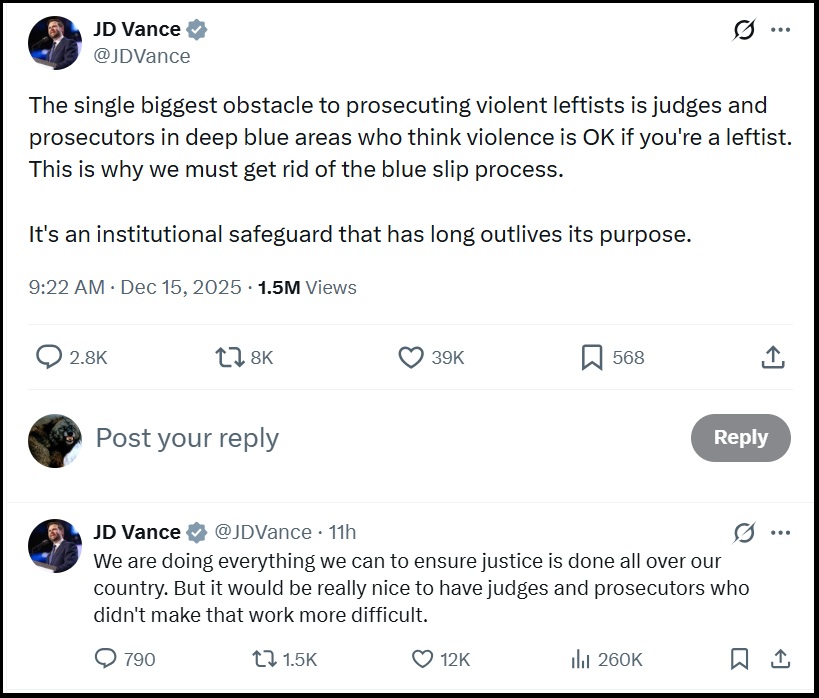
JD Vance notes this process is being used to manipulate the appointments of Judges in leftist states. This creates a dual justice system; one of the core issues within our extremely divided nation.
JD Vance is not wrong. However, as with all things corrupted within the state of our Republic, if the blue slip process is removed the next leftist President can corrupt the judiciary within Republican states.
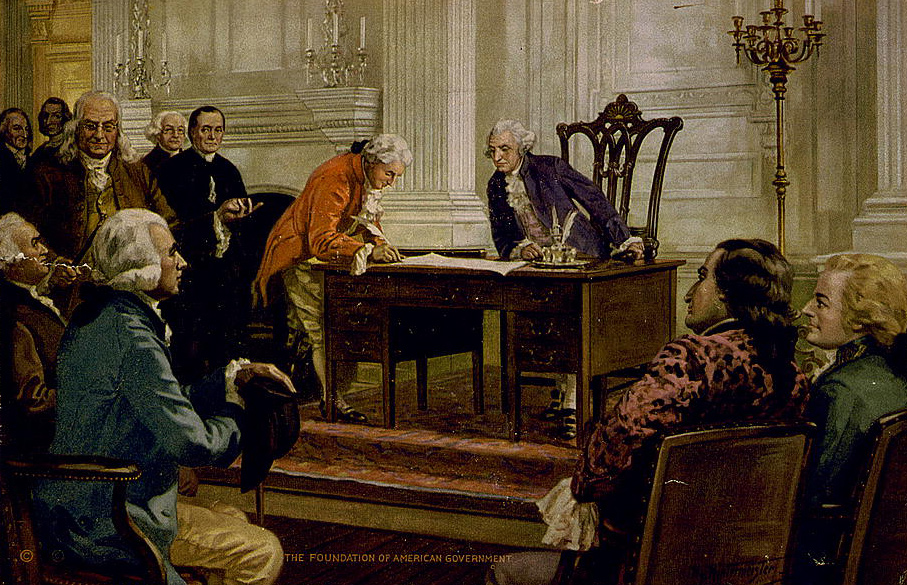
Of course, all of this is an outcome of the 17th Amendment, which stopped the state legislatures from having control over their senators. Under the original constitutional framework, the Senate was designed to represent the interests of the state, as the Senators were appointed by state legislature, not popular votes. The Sea Island assembly destroyed this cornerstone when they triggered the 17th Amendment.
Repeal the 17th Amendment, and just about everything in federal government changes.
Machiavelli said, “It must be remembered that there is nothing more difficult to plan, more doubtful of success, nor more dangerous to manage than a new system. For the initiator has the enmity of all who would profit by the preservation of the old institution and merely lukewarm defenders in those who gain by the new ones.” A prescient and oft repeated quote that is pertinent to the situation.
When our founders created the system of government for our constitutional republic, they built in layers of protection from federal control over the lives of people in the states. Over time, those protections have been eroded as the federal bureaucracy has seized power. One of the biggest changes that led to the creation of the permanent political class was the 17th Amendment.
Our founders created a system where Senators were appointed by the state legislatures. In this original system, the Senate was bound by obligation to look out for the best interests of their specific states. Under the ‘advise and consent‘ rules of Senate confirmation for executive branch appointments, the intent was to ensure the presidential appointee -who would now carry out regulatory activity- would not undermine the independent position of the states.
The nucleus of corruption amid every element of the federal institutions of government is the United States Senate. The U.S. Senate, also known as the “upper chamber,” is the single most powerful elected element in modern federal government.
The Intelligence Branch is the most powerful branch of government. However, the U.S. Senate is the most powerful assembly of federally elected officials. We pretend the IC branch doesn’t exist; that’s part of our problem. At least we admit the Senate exists.
All other elected federal corruption is dependent on a corrupt and ineffective Senate. If we correct the problems with the Senate, and reconnect the representation within the chamber to the state-level legislative bodies, we will then see immediate change. However, there would be ZERO institutional allies in this effort.
When the 17th Amendment (direct voting for Senators) took the place of state appointments, the perspective of ‘advise and consent’ changed. The Senate was now in the position of ensuring the presidential appointee did not undermine the power of the permanent bureaucracy, which is the root of power for the upper-chamber.
Senate committees, Homeland Security, Judiciary, Intelligence, Armed Services, Foreign Relations, etc. now consists of members who carry an imbalanced level of power within government. The Senate now controls who will be in charge of executive branch agencies like the DOJ, DHS, FBI, CIA, ODNI, DoD, State Dept and NSA, from the position of their own power and control in Washington DC.
In essence, the 17th Amendment flipped the intent of the constitution from protecting the individual states to protecting the federal government.
Almost every source of federal issue: ex. spending, intervention and foreign assistance, conflict with the states, burdensome regulation, surveillance and spying on American citizens, the two-tiered justice system and the erosion of liberty & individual rights (see COVID examples), can be sourced back to the problem created by the 17th Amendment.
Because of the scale of their power, the Senate will not give up control easily; and every institution of society and government will actively work to block/stop We The People from taking back control of the upper chamber. Every entity from Wall Street to multinational corporations, big tech, banks, foreign governments and world organizations would align against us. When you truly understand the epicenter of the corruption, then you are able to see the tentacles extending from it.
It would be easy to say “repeal the 17th Amendment;“ it is ‘another kettle of fish’ entirely to walk through the process to make that happen. Yes, ultimately, we do need a full repeal of the 17th Amendment and return the selection of the senators from each state with a nomination and appointment process within the state legislature. [Common Explainer Here]
Seventeenth Amendment- “The Senate of the United States shall be composed of two Senators from each State, elected by the people thereof, for six years; and each Senator shall have one vote. The electors in each State shall have the qualifications requisite for electors of the most numerous branch of the State legislatures.
When vacancies happen in the representation of any State in the Senate, the executive authority of such State shall issue writs of election to fill such vacancies: Provided, That the legislature of any State may empower the executive thereof to make temporary appointments until the people fill the vacancies by election as the legislature may direct.” (link)
Prior to the 17th Amendment, there was significant state level corruption as business interests, and Senate candidates worked in power groups with party officials to attain the position. Politicians seeking Senate seats began campaigning for state legislative candidates in order to assemble support.
The state legislative races then became a process of influence amid powerful interests seeking to support their Senate candidate. Get the right people in the State legislature, and you can get the Senator appointed.
Those state-level entities, bankers, wealthy people of influence, later became the permanent K-Street lobbying groups once the 17th Amendment was ratified. In essence, they just shifted the location of their influence operation from the state to an office in Washington DC. [Those same power groups, albeit much larger, now write the physical legislation we see in congress.] Additionally, prior to the 17th Amendment, there were issues of vacancies in federal senate seats as state legislatures could not agree on an individual Senator.
The biggest issue following the passage of the 17th Amendment became Senators who were no longer representing the interests of their state. Instead, they were representing the interests of the power elite groups who were helping them fund the mechanisms of their re-election efforts.
A Senator only needs to run for re-election every six years. The 17th Amendment is the only amendment that changed the structure of the Congress, as it was written by the founders.
Over time, the Senate chamber itself began using their advice and consent authority to control the executive and judicial branch. The origination of a nomination now holds the question: “Can this person pass the Senate confirmation process?”
The Senate now abuses this power to ensure no one challenges them. Additionally, the Senate began using their oversight capacity to control elements within the executive branch and judicial branch. The full scope of that issue in modern form is OUTLINED HERE – which is the cornerstone of the Intelligence Branch of Government.
If we could repeal the 17th Amendment and return the selection to the state legislature, you can see where the background work of Tactical Civics and Extreme Federalism begin to take on importance. [NOTE: Within the repeal effort, we would need to include a recall process for states to reach out and yank back their Senator if they go astray; the ability to recall was missing in the original construct of the framers; it would need to be added.]
◊ PATH ONE is the primary platform of the presidential candidate…. a visible and emphasized mandate that includes: “vote me into office and you are voting to repeal the 17th Amendment “. This specific election issue would need to be the #1 priority of the candidate and spoken at every event.
This approach gives a presidential candidate the mandate to demand congress to act if he won the 2024 election. We need a warrior of epic strength, resolve and fortitude.
◊ PATH TWO is the parallel path built along with the election platform path and put into place in the event that Congress refused to accept the mandate.
Obviously, this would be an ugly battle. The second path is a convention of states.
The ‘convention of states‘ would need to be detailed, strategically planned, and the future schedule determined during the GOP convention preceding the November election (assuming the right candidate wins). That way, if Congress refuses to act on their own, within say the first 100 days of the new administration, the state legislatures will then assemble a convention for the singular and limited purpose of one action item: “repeal the 17th Amendment “. That’s it. Full Stop. Nothing more. Nothing else entertained.
There is a lot more to this, and a lot more to cover in discussion of this. However, this is the path that can resolve most of the issues we face with an out-of-control federal government. The shift in power would kneecap the Intelligence Branch of Government by re-instituting genuine oversight and control. A repeal of the 17th Amendment stops Senators from campaigning, needing to raise money and puts them directly into the accountability position as a steward for the interests of their state.
The people within each state would then have a mechanism to address any negative federal action by contacting their state legislative representative. In a worst-case scenario, a rogue Senator could be removed within days if they support any federal legislative activity that is not in alignment with the state interest. This approach also wipes out most of the power amid the Senate Majority Leader, as he/she could also be recalled by the state and would be less likely to work against the interests of the majority in the chamber.
The House of Representatives was created to be the voice of the people, ie, “The Peoples’ House.” However, the U.S. Senate was structurally created to be the place where state government had representation in the federal government decision-making. The 17th Amendment completely removed state representation, and we have been in an escalating battle over state’s rights ever since.
Overlay that DC structural issue with the fact that almost all of the bureaucracy created by this skewed DC system is now in place to defend itself from any outside effort to change it, and you get this UniParty problem that Donald Trump fully exposed.
Repeal the 17th Amendment, and we would see the most significant restoration of freedom, liberty and social balance in our lifetime.
Posted originally on CTH on December 7, 2025 | Sundance
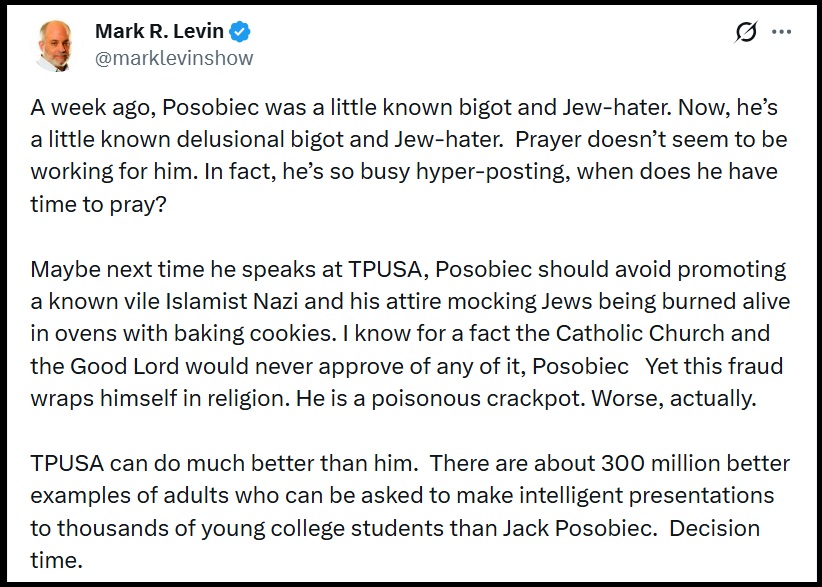
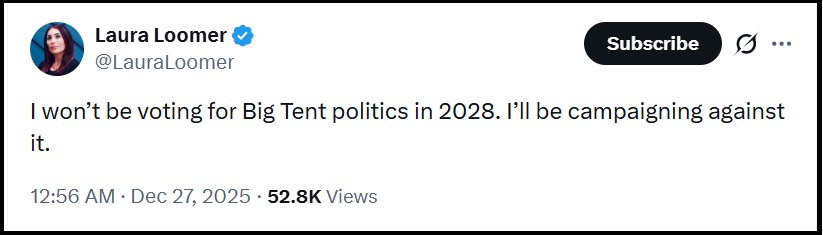
Tucker Carlson is attending a conference in Doha along with a series of U.S. and EU political pundits and people within the geopolitical world including Donald Trump Jr. This conference has people like Mark Levin and Laura Loomer going bananas as the Qatar vs Israel influence operation reaches new political levels of antagonism.
In the interview below Tucker Carlson is interviewing Qatar’s Prime Minister and Foreign Minister Sheikh Mohammed bin Abdulrahman Al Thani on the Israel–Gaza war, U.S. foreign policy toward Israel, Qatar’s long and ongoing role in mediation with Hamas, and the surge of propaganda targeting Doha.
The discussion includes how various administrations have asked Qatar for assistance, and the issue of Israel attacking Qatar amid the active peace talks. Tucker Carlson also tackles the issue of U.S. voices calling him a propagandist for Qatar head on. WATCH:
.
As previously noted, Donald Trump Jr also attended the Doha, Qatar, conference. His remarks are below.
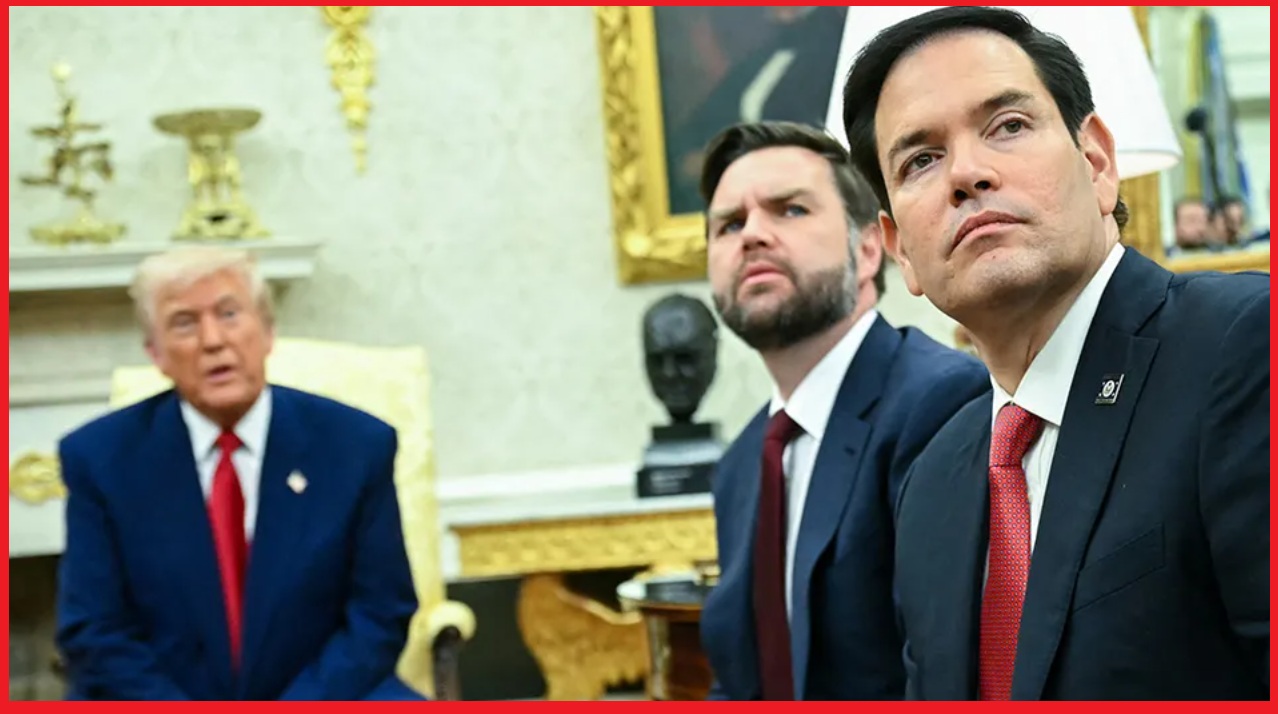
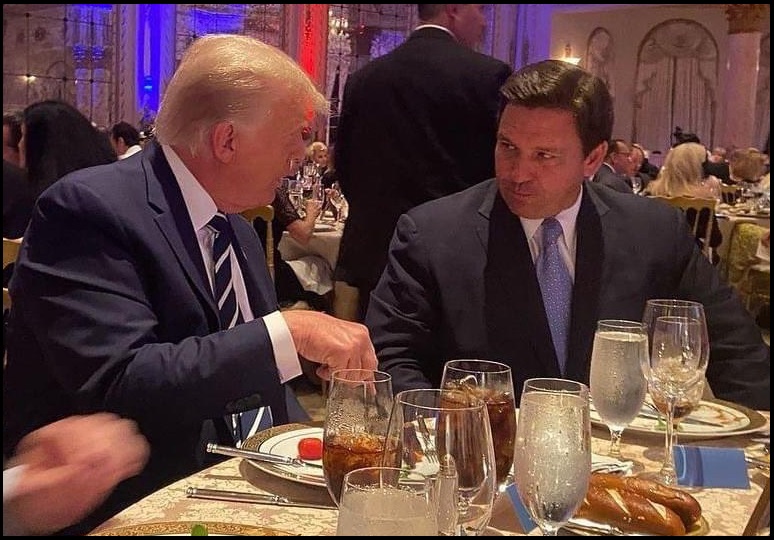
The Qatar vs Israel influence battle, seems to be -essentially- the JD Vance vs Ron DeSantis pre-battle and influence operation. I’ll keep watching it unfold, because the transparency of the objectives is interesting.
Posted originally on CTH on November 23, 2025 | Sundance
President Trump is calling attention to a recent podcast interview conducted by Lara Logan with Gary Berntsten and Ralph Pezzullo, surrounding the new book “Stolen Elections” as authored by Pezzullo. [TRUTH SOCIAL]
Several people have also sent me information related to this *video interview with strong recommendations to watch it and review the content. The interview is over 2 hours long, and I know everyone’s time has value. I have only just begun to review the content, but I am sharing for those with interest. WATCH:
*Keep in mind, underneath all of the discussion is an intent to sell a book. Out of respect for those who sent it to me, I will finish watching it.
CHAPTERS: (0:00:00) – Exposing the True Power Players (0:04:34) – The Stolen Elections Investigation (0:10:04) – Foreign Influence (0:20:12) – Uncovering Election Fraud Networks (0:30:12) – Persecuted Christians
(0:35:41) – Revealing Evidence (0:39:42) – Foreign Election Interference (0:44:13) – Foreign Influence in US Intelligence (0:58:08) – Global Election Fraud Networks (1:06:33) – The Cartels’ Global Influence (1:11:42) – Infiltration of American Institutions (1:23:04) – Uncovering Election Fraud (1:31:51) – Chinese Hybrid Warfare in US Elections (1:44:47) – Investigating Election Fraud Networks (1:55:24) – Father-Son Diplomatic Bond (2:01:13) – State Department Covert Actions (2:10:09) – The Fight to Save America (2:15:56) – Cartel Connections
Posted originally on CTH on November 22, 2025 | Sundance
BUMPED: I see the efforts to divide the MAGA base are in full swing. I remind everyone to be prudent in your discernment of who is antagonizing, what topics and processes they are using, and ultimately who benefits from it. Remember, “there are trillions at stake!”
On March 3rd through March 6th, 2016, the Republican presidential primary was at the precipice of a key inflection point (Super Tuesday) when a large group of political leadership, tech titans, bankers and political influence agents assembled at the AEI summit in Sea Island, Georgia.
In the decade that passed, you have seen me reference this Sea Island group frequently, because the origin of where we are today can only be understood if you followed the outcome of that 2016 Sea Island meeting and the decade of activity therein.
In 2016 the agenda of the group, though they gently denied it at the time, was to figure out a way to remove the disruption Donald Trump represented from the business model of DC politics. The Sea Island confab discussed how to stop him, or at the very least manage the potential damage he could deliver to the system – specifically, to the Republican wing of the UniParty apparatus.
Here in 2025, we are currently witnessing an outcome of activity from essentially the same group. For this phase, the intention is to fracture the baseline of support that underpins President Trump’s movement; what is reasonably called MAGA and the America-First movement.
What follows below is a review that might help people understand what exactly is behind the various pressure narratives we see being introduced into this narrative operation. The attacks against Tucker Carlson, Candace Owens, various iterations of Qatar vs Israel as espoused by voices like Mark Levin, the claims of antisemitism shouted against any voice that doesn’t put the interests of the Israeli government at the forefront, and the various alignments therein.
In the biggest picture, this is not a battle against individual voices, but rather the positioning of interests to maintain the same objective that was discussed in the aforementioned Sea Island confab.
A few points are needed for context as this discussion enlarges. First, I am only 80% finished with the year-long tracking of the participants; however, due to the severity of the issue and the urgency therein, this is one of the few times I will outline something that is not yet fully developed.
Second, this is not the first rodeo for this activity. After the Tea Party rose in 2010, we saw this same institutional response from almost identical participants to control the threat of a leaderless organic grassroots movement. President Obama, the DNC/RNC and the Republican power apparatus all opposed the Tea Party, as they do MAGA for exactly the same reason.
The need for control is a reaction to fear.
You might remember supporters of the various patriot or Tea Party grassroots organizations being targeted by the Obama DOJ and IRS. Simultaneously John McCain, Lindsey Graham and Mitch McConnell labeled Tea Party supporters as political jihadists, extremists and hobbits. The targeting operations to isolate, ridicule and marginalize the movement was both a DNC and an RNC operation.
Republicans and Democrats worked together to eliminate the Tea Party, and Republicans were more than willing to lose elections to stop Tea Party supported candidates from winning. This is important to remember, because that type of activity both evidences the UniParty apparatus and the opposition to the modern iteration of the Tea Party in the larger MAGA voting base. In short, the DC professional political apparatus hates all versions of the same uncontrollable electorate regardless of label.
When they departed Sea Island, eventually the professional Republicans (GOPe) ended up settling on supporting Hillary Clinton, because Donald Trump could not be defeated within the confines of the party apparatus and became the presumptive nominee. The tech group from Sea Island was already part of the Hillary Clinton alignment, and the “political influence agents” also saw Hillary as the comfortable, predictable and non-disruptive candidate. The key underpinning all of them was “anyone but Trump.”
Hillary then walked toward November with party Democrats, party Republicans, tech, Silicon Valley and the never-Trump conservatives. However, Hillary encountered a major minus in the electorate when the Bernie Sanders group discovered the origin of the DNC control operation. Hillary Clinton gained the party Republicans, but Hillary Clinton lost a lot of Bernie voters; many of them went to Trump.
[NOTE: It’s a little funny, but the five-year-long RNC -vs- TP/MAGA fight is essentially what we are now watching within the other wing of the UniParty, the DNC wing. The grassroots left against the DNC professionals. The “progressives” or “socialist democrats” are taking Democrat scalps the same way the grassroots right took down Republicans. The old guard Democrats are quitting.]
All of this is said to frame the context for 2025, and the objectives of the political influence agents to break up the MAGA movement into smaller digestible pieces. The wedge issue is not accidentally Israel.
Israel has been selected as a wedge issue to divide MAGA, because Israel-First influencers viewed themselves in a vulnerable position. This too needs context.
♦ QATAR. All year long I have been watching the Qatar vs Israel battle surface on social media. At first it was a very odd dynamic to watch, because it did not make sense. Then a few things became more visible that made it evident why the U.S-Israel groups were concerned.
In the decade that preceded 2025, you cannot find too many examples of Qatar ever having a positive headline outside the praise from Barack Obama and Joe Biden. While Obama had always embraced Qatar (ex. bank for the Muslim Brotherhood), it was Joe Biden who labeled Qatar a major non-NATO ally. The Obama/Biden administration liked Qatar, the first Trump administration not so much.
Prior to 2025, Qatar had a history of bad influence operations, where “bad” is defined as them doing really bad things; like funding radical Islamic extremists (creating the Arab Spring), giving safe haven to the exiled Islamist Egyptian leadership, financing Al-Jazeera, shipping covert CIA/State Dept weapons to the al-Qaeda operatives in Libya and Syria, being the bankers for Iranian money, supporting Hamas leadership, etc.
In the first Trump term, President Trump confronted Qatar and told the Gulf Cooperation Council (Egypt, Bahrain, UAE and Saudi Arabia) to maintain pressure on Qatar. So, it was quite a reversal to see the second Trump term reverse course entirely and begin praising Qatar. However, if you think about the issue of the Israeli war in Gaza, and how that changed the landscape, things begin to take on a new context.
This new 2025 positive-Qatar vibe created anxiety for the pro-Israel elements inside the USA. It wasn’t a matter of direct policy that seemed to unnerve them, but rather a change in influence priority. Influence is a tenuous game of position.
In early 2025, Israel-first voices started to seem visibly worried their White House influence operation may be diminished by a positive Trump message toward Qatar. In my opinion, that influence fear was actually substantive, and yet part of an intentional Trump foreign policy agenda; akin to a soft brushback pitch against the U.S-Israel influence shop who had become very comfortable taking their Trump influence for granted.
Friendly messaging toward Qatar’s influence shop was viewed by U.S-Israeli voices as a betrayal. However, given the nature of the Trump transition team having former lobbyists for Qatar, the friendly messaging was understandable; however, x2, that set of facts didn’t make it palatable for the Israeli coalition. Ergo, an influence battle began very early in the Trump administration, and the internecine Qatar vs Israel issue was visible to those of us who watch things closely.
Keep in mind, historically within the GOPe apparatus, this was a lucrative financial tug-of-influence game. The neocon/intelligence wing (Bolton/McCain) had one foot in pro-Qatar and one foot in pro-Israel, with ¹both sides funding for influence and delivering affluence. So much so that their interests from a USA viewpoint were virtually indistinguishable, see Libya. Additionally, behind this financial set of motives, this confab of influence beneficiaries was/is the core of that Sea Island meeting.
[¹President Obama played this dynamic brilliantly to the benefit of his Muslim Brotherhood allies.]
♦ THE RACE – At this point in the analysis, it is worthwhile dropping the traditional viewpoint of U.S. politicians as “candidates” and start thinking about them in the more accurate term as “horses.” The horses race in the Kentucky Derby, but it is the owners who win the prize money.
When you view U.S. politicians as horses in the various races, we start to think more clearly about who their owners are. This is the key to understanding U.S political candidates.
You might be able to remember the name of the horse who won the Triple Crown, you might even remember the jockey who rode the horse, but less likely you remember who owned it. In U.S. politics, it’s the owners within the political races who control the horses not the horses who control the owners.
Donald J. Trump represented a serious threat to this dynamic. Trump is a horse who is also his owner; this is a major disruption in political sport.
The owners assembled in Sea Island, March 2016, to discuss this disruption.
By the time we get to 2020, the ‘anyone but Trump’ theme was clearly at play. The Intelligence Community assisted, Big Tech assisted, corporate media assisted, our ever-predictable Republicans were once again purposefully and willfully blind, and with mail-in ballots all the rage, Trump was all alone against the entire apparatus with only voters trying to offset the American political control operation. In the aftermath of the ridiculous outcome, all of the participants circled the wagons, and Nancy Pelosi provided the literal fence.
In 2021, the Big Tech sub-segment of the Sea Island confab then went full combat against MAGA elements, banning, deplatforming, demonetizing and removing any countervailing voices. Meanwhile, anyone associated with Trump was targeted by the collaborating government mechanisms, DOJ/FBI and the media once again ran cover.
In the 2023 version of ‘anyone but Trump,’ 43 billionaires together with an assist from Sea Island attendee, Elon Musk, tried to launch Ron DeSantis as a MAGA alternative. However, the Tea Party-hardened MAGA voters looked at their scars, and when they saw the $100 bill on a fishing line being dragged through the MAGA community, they refused to chase it.
By then, the 2016 Cruz Crew had switched to 2024 Alligator emojis, but even the “Evangelicals” with unlimited funding couldn’t fuel the DeSantis starship.
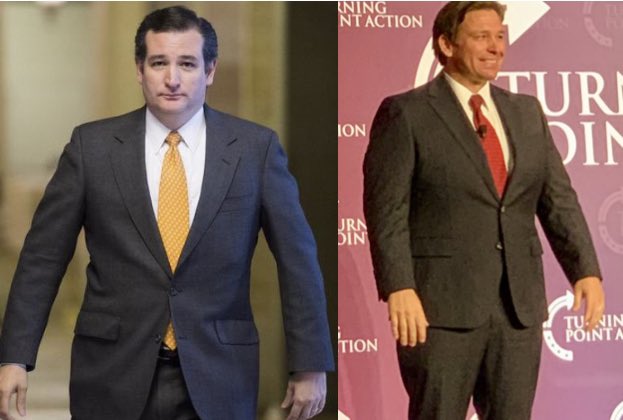
The Ron launch was as wobbly as DeSantis’ head during speaking engagements; and Casey wearing Melania’s heels, Duck Dynasty skinny pants and Sarah Palin’s ‘Grizzly Mama’ T-shirt couldn’t compensate.
What a hot mess.
The MAGA alternative was as structurally inauthentic as Ron’s boots, even with the lifts.
Hey, be thankful. No one has ever accused the Republican consultant class of accurately assessing the political landscape around them.
Their inauthenticity is what helps us to know who they are. It’s a net positive.
I would make the argument that if Ron’s owners had somehow pulled it off, Biden would have been yanked fast and replaced with Newsom, and we’d be looking at the “future in hindsight” right now.
♦ 2025 – That Sea Island crew doesn’t quit. The “anyone but Trump” operation is back in full swing despite the 2024 victory message.
Step #1 in the control process is to lose the 2026 election and put the Republican wing of the uniparty bird back into the minority. Again, this isolates our people’s president.
However, they can’t just lose 2026 and call it a day. They still need to manage the problem that President Trump represents for another three years. There are Trump policies to undermine, Trump executive orders to let sit non-legislatively supported, and all of this inaction must take place while Trump supporters are distracted with maximum shiny things.
This is where the “political influencers” come into play as mercenaries and advanced operative messengers for a very useful dynamic to emphasize – the operation that began as Qatar vs Israel.
Tucker Carlson representing the face of JD Vance’s support network becomes a target for Mark Levin et al. Candace Owens is labeled as the female face of Nick Fuentes, who, for some odd reason, is being algorithmically boosted by the same tech platforms that banned his account as an identified racist, extremist and antisemitic content producer.
This Fuentes boosting, again not coincidentally by the same elements who attended that 2016 Sea Island confab including Google, began in July 2025, about a month prior to TPUSA head Charlie Kirk telling his pro-Israel friends (billionaire Bill Ackman) that the content messaging on behalf of the Netanyahu government was backfiring amid Gen-Z. To wit, Netanyahu said, ‘not to worry’ my good friends of Israel, Larry Ellison and David Ellison, have things under control with TikTok, Twitter and Paramount. CBS’s Bari Weiss announced shortly thereafter.
While the inside White House influence game continues, all of these various 2025 interests again find their origin in Sea Island, Georgia, at the March 2016 AEI conference. Remember, think “owners” not “horses.”
♦ HORSES:
• Vice President JD Vance – Heir apparent to the MAGA endorsement of President Donald Trump. Groomed from the stable of billionaire influence agent and one time (no more) friend of President Trump, Peter Thiel. A more libertarian co-founder of Palantir, a skyrocketing AI software platform creator with billions in new federal contracts and likely more to come. Palantir CEO Alex Karp, a key industrialist applying the very best of AI creator systems to the merging targeting and identity tracking technology of the future.
Without Peter Thiel, there is no Senator JD Vance in 2022. Without Senator JD Vance there is no VP nominee in 2024. Oh, and despite their stealth separating in 2017, Elon Musk and Peter Thiel remain BFF influencers in 2025. And without Larry Ellison in 2022, there is no liquidity Musk to capture the Twitter Platform, which not coincidentally became a launch vehicle for the Ron effort shortly after Ellison said he would not allow Musk to fail.
So, where does that put JD Vance’s collar? Who knows? We’ll keep watching as Mr Ellison, having successfully moved beyond the X operation, now moves to the TikTok/Paramount phase while simultaneously owning the Oracle system operation that X utilizes.
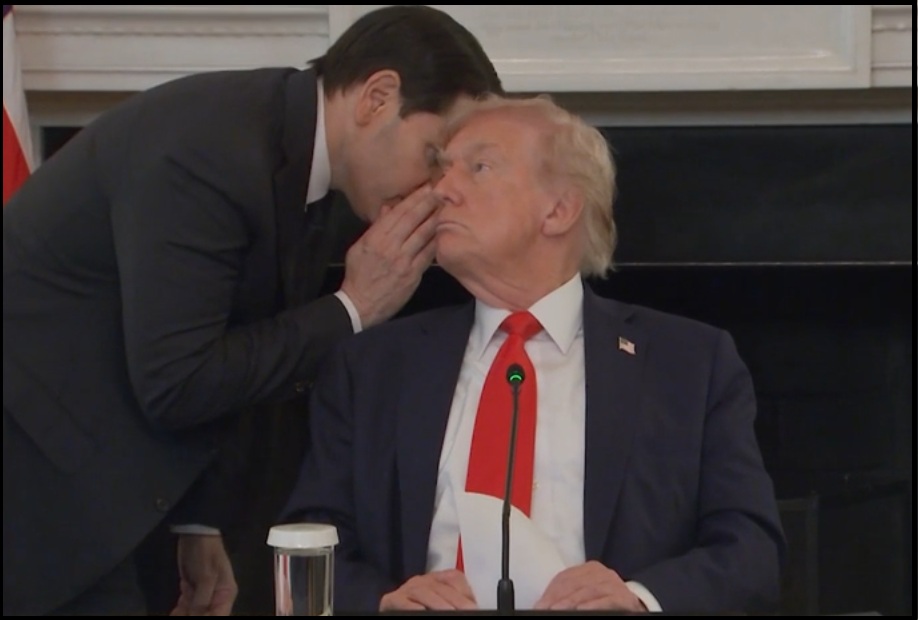
• Secretary of State Marco Rubio – For the first time in his political career, Marco is in a position where he is not directly accountable to voters. Having risen through the Florida legislature, state house and on to a federal Senate seat representing Florida, for the first time Rubio is applying himself without any election worries. His constituent base consists of President Trump.
Rubio is seemingly giving the appearance of having turned Maverick, having fun poking back at his previous owners, while running amuck in the free-range of Trump’s well-manicured landscape. Is Rubio required to return to a previously designated stable? Again, who knows. It’s super fun to watch this new less groomed, yet well maintained, stallion running in the wild. However, his pedigree is as trained as a Lipizzaner stallion. Will he tire of the free-range? We’ll keep watching.
• Governor Ron DeSantis – The one constant political hot mess in an ever-consistent GOPe playbook.
You might say that DeSantis could never stand a chance given his failure to launch in 2024. However, do not underestimate the stupidity of the professional consultant class who have a way of convincing owners that horse can run.
Ron’s only problem is he needs very narrow blinders and can’t turn corners. Other than that, he’s solid in the straights when all the obstacles are removed and the track is groomed specifically for his platformed shoes.
The issue for Sea Island, with DeSantis, is that despite his extremely managed exteriors, and despite the massive amount of money spent on the influence operations and appearances, only a specific type of Jockey can fit that little saddle.
[I mean someone had to tell Casey what to wear in Iowa the last time, and, well, think about it…. They both looked in the mirror that morning and thought, “Awesome – this will get em’.” How’d that work out?]
SUMMARY: Underneath all of what we are visibly seeing and witnessing, especially the outrage du-jour, is an underlying political background that consistently tries to control outcomes through various methods. This effort to split the MAGA base, using Israel or (insert_next_thing_here) as a wedge issue within the America First movement – only benefits one larger apparatus, the Sea Island billionaire control system.
This billionaire control system, a public-private partnership, previously deconstructed and co-opted the Tea Party returning the system to status quo.
The billionaires in finance and tech are set; their influence operation only varies slightly depending on the challenge, because they know they can purchase every horse in the race, and they are working earnestly through various iterations of the same owner playbook, with the end goal the same – control.
Posted originally on CTH on November 11, 2025 | Sundance
On March 3rd through March 6th 2016, the Republican presidential primary was at the precipice of a key inflection point (Super Tuesday) when a large group of political leadership, tech titans, bankers and political influence agents assembled at the AEI summit in Sea Island, Georgia.
In the decade that passed, you have seen me reference this Sea Island group frequently, because the origin of where we are today can only be understood if you followed the outcome of that 2016 Sea Island meeting and the decade of activity therein.
In 2016 the agenda of the group, though they gently denied it at the time, was to figure out a way to remove the disruption Donald Trump represented from the business model of DC politics. The Sea Island confab discussed how to stop him, or at the very least manage the potential damage he could deliver to the system – specifically, to the Republican wing of the UniParty apparatus.
Here in 2025, we are currently witnessing an outcome of activity from essentially the same group. For this phase, the intention is to fracture the baseline of support that underpins President Trump’s movement; what is reasonably called MAGA and the America-First movement.
What follows below is a review that might help people understand what exactly is behind the various pressure narratives we see being introduced into this narrative operation. The attacks against Tucker Carlson, Candace Owens, various iterations of Qatar vs Israel as espoused by voices like Mark Levin, the claims of antisemitism shouted against any voice that doesn’t put the interests of the Israeli government at the forefront, and the various alignments therein.
In the biggest picture, this is not a battle against individual voices, but rather the positioning of interests to maintain the same objective that was discussed in the aforementioned Sea Island confab.
A few points are needed for context as this discussion enlarges. First, I am only 80% finished with the year-long tracking of the participants; however, due to the severity of the issue and the urgency therein, this is one of the few times I will outline something that is not yet fully developed.
Second, this is not the first rodeo for this activity. After the Tea Party rose in 2010, we saw this same institutional response from almost identical participants to control the threat of a leaderless organic grassroots movement. President Obama, the DNC/RNC and the Republican power apparatus all opposed the Tea Party, as they do MAGA for exactly the same reason.
The need for control is a reaction to fear.
You might remember supporters of the various patriot or Tea Party grassroots organizations being targeted by the Obama DOJ and IRS. Simultaneously John McCain, Lindsey Graham and Mitch McConnell labeled Tea Party supporters as political jihadists, extremists and hobbits. The targeting operations to isolate, ridicule and marginalize the movement was both a DNC and an RNC operation.
Republicans and Democrats worked together to eliminate the Tea Party, and Republicans were more than willing to lose elections to stop Tea Party supported candidates from winning. This is important to remember, because that type of activity both evidences the UniParty apparatus and the opposition to the modern iteration of the Tea Party in the larger MAGA voting base. In short, the DC professional political apparatus hates all versions of the same uncontrollable electorate regardless of label.
When they departed Sea Island, eventually the professional Republicans (GOPe) ended up settling on supporting Hillary Clinton, because Donald Trump could not be defeated within the confines of the party apparatus and became the presumptive nominee. The tech group from Sea Island was already part of the Hillary Clinton alignment, and the “political influence agents” also saw Hillary as the comfortable, predictable and non-disruptive candidate. The key underpinning all of them was “anyone but Trump.”
Hillary then walked toward November with party Democrats, party Republicans, tech, Silicon Valley and the never-Trump conservatives. However, Hillary encountered a major minus in the electorate when the Bernie Sanders group discovered the origin of the DNC control operation. Hillary Clinton gained the party Republicans, but Hillary Clinton lost a lot of Bernie voters; many of them went to Trump.
[NOTE: It’s a little funny, but the five-year-long RNC -vs- TP/MAGA fight is essentially what we are now watching within the other wing of the UniParty, the DNC wing. The grassroots left against the DNC professionals. The “progressives” or “socialist democrats” are taking Democrat scalps the same way the grassroots right took down Republicans. The old guard Democrats are quitting.]
All of this is said to frame the context for 2025, and the objectives of the political influence agents to break up the MAGA movement into smaller digestible pieces. The wedge issue is not accidentally Israel.
Israel has been selected as a wedge issue to divide MAGA, because Israel-First influencers viewed themselves in a vulnerable position. This too needs context.
♦ QATAR. All year long I have been watching the Qatar vs Israel battle surface on social media. At first it was a very odd dynamic to watch, because it did not make sense. Then a few things became more visible that made it evident why the U.S-Israel groups were concerned.
In the decade that preceded 2025, you cannot find too many examples of Qatar ever having a positive headline outside the praise from Barack Obama and Joe Biden. While Obama had always embraced Qatar (ex. bank for the Muslim Brotherhood), it was Joe Biden who labeled Qatar a major non-NATO ally. The Obama/Biden administration liked Qatar, the first Trump administration not so much.
Prior to 2025, Qatar had a history of bad influence operations, where “bad” is defined as them doing really bad things; like funding radical Islamic extremists (creating the Arab Spring), giving safe haven to the exiled Islamist Egyptian leadership, financing Al-Jazeera, shipping covert CIA/State Dept weapons to the al-Qaeda operatives in Libya and Syria, being the bankers for Iranian money, supporting Hamas leadership, etc.
In the first Trump term, President Trump confronted Qatar and told the Gulf Cooperation Council (Egypt, Bahrain, UAE and Saudi Arabia) to maintain pressure on Qatar. So, it was quite a reversal to see the second Trump term reverse course entirely and begin praising Qatar. However, if you think about the issue of the Israeli war in Gaza, and how that changed the landscape, things begin to take on a new context.
This new 2025 positive-Qatar vibe created anxiety for the pro-Israel elements inside the USA. It wasn’t a matter of direct policy that seemed to unnerve them, but rather a change in influence priority. Influence is a tenuous game of position.
In early 2025, Israel-first voices started to seem visibly worried their White House influence operation may be diminished by a positive Trump message toward Qatar. In my opinion, that influence fear was actually substantive, and yet part of an intentional Trump foreign policy agenda; akin to a soft brushback pitch against the U.S-Israel influence shop who had become very comfortable taking their Trump influence for granted.
Friendly messaging toward Qatar’s influence shop was viewed by U.S-Israeli voices as a betrayal. However, given the nature of the Trump transition team having former lobbyists for Qatar, the friendly messaging was understandable; however, x2, that set of facts didn’t make it palatable for the Israeli coalition. Ergo, an influence battle began very early in the Trump administration, and the internecine Qatar vs Israel issue was visible to those of us who watch things closely.
Keep in mind, historically within the GOPe apparatus, this was a lucrative financial tug-of-influence game. The neocon/intelligence wing (Bolton/McCain) had one foot in pro-Qatar and one foot in pro-Israel, with ¹both sides funding for influence and delivering affluence. So much so that their interests from a USA viewpoint were virtually indistinguishable, see Libya. Additionally, behind this financial set of motives, this confab of influence beneficiaries was/is the core of that Sea Island meeting.
[¹President Obama played this dynamic brilliantly to the benefit of his Muslim Brotherhood allies.]
♦ THE RACE – At this point in the analysis, it is worthwhile dropping the traditional viewpoint of U.S. politicians as “candidates” and start thinking about them in the more accurate term as “horses.” The horses race in the Kentucky Derby, but it is the owners who win the prize money.
When you view U.S. politicians as horses in the various races, we start to think more clearly about who their owners are. This is the key to understanding U.S political candidates.
You might be able to remember the name of the horse who won the Triple Crown, you might even remember the jockey who rode the horse, but less likely you remember who owned it. In U.S. politics, it’s the owners within the political races who control the horses not the horses who control the owners.
Donald J. Trump represented a serious threat to this dynamic. Trump is a horse who is also his owner; this is a major disruption in political sport.
The owners assembled in Sea Island, March 2016, to discuss this disruption.
By the time we get to 2020, the ‘anyone but Trump’ theme was clearly at play. The Intelligence Community assisted, Big Tech assisted, corporate media assisted, our ever-predictable Republicans were once again purposefully and willfully blind, and with mail-in ballots all the rage, Trump was all alone against the entire apparatus with only voters trying to offset the American political control operation. In the aftermath of the ridiculous outcome, all of the participants circled the wagons, and Nancy Pelosi provided the literal fence.
In 2021, the Big Tech sub-segment of the Sea Island confab then went full combat against MAGA elements, banning, deplatforming, demonetizing and removing any countervailing voices. Meanwhile, anyone associated with Trump was targeted by the collaborating government mechanisms, DOJ/FBI and the media once again ran cover.
In the 2023 version of ‘anyone but Trump,’ 43 billionaires together with an assist from Sea Island attendee, Elon Musk, tried to launch Ron DeSantis as a MAGA alternative. However, the Tea Party-hardened MAGA voters looked at their scars, and when they saw the $100 bill on a fishing line being dragged through the MAGA community, they refused to chase it.
By then, the 2016 Cruz Crew had switched to 2024 Alligator emojis, but even the “Evangelicals” with unlimited funding couldn’t fuel the DeSantis starship.
The Ron launch was as wobbly as DeSantis’ head during speaking engagements; and Casey wearing Melania’s heals, Duck Dynasty skinny pants and Sarah Palin’s ‘Grizzly Mama’ T-shirt couldn’t compensate.
What a hot mess.
The MAGA alternative was as structurally inauthentic as Ron’s boots, even with the lifts.
Hey, be thankful. No one has ever accused the Republican consultant class of accurately assessing the political landscape around them.
Their inauthenticity is what helps us to know who they are. It’s a net positive.
I would make the argument that if Ron’s owners had somehow pulled it off, Biden would have been yanked fast and replaced with Newsom, and we’d be looking at the “future in hindsight” right now.
♦ 2025 – That Sea Island crew doesn’t quit. The “anyone but Trump” operation is back in full swing despite the 2024 victory message.
Step #1 in the control process is to lose the 2026 election and put the Republican wing of the uniparty bird back into the minority. Again, this isolates our people’s president.
However, they can’t just lose 2026 and call it a day. They still need to manage the problem that President Trump represents for another three years. There are Trump policies to undermine, Trump executive orders to let sit non-legislatively supported, and all of this inaction must take place while Trump supporters are distracted with maximum shiny things.
This is where the “political influencers” come into play as mercenaries and advanced operative messengers for a very useful dynamic to emphasize – the operation that began as Qatar vs Israel.
Tucker Carlson representing the face of JD Vance’s support network becomes a target for Mark Levin et al. Candace Owens is labeled as the female face of Nick Fuentes, who, for some odd reason, is being algorithmically boosted by the same tech platforms that banned his account as an identified racist, extremist and antisemitic content producer.
This Fuentes boosting, again not coincidentally by the same elements who attended that 2016 Sea Island confab including Google, began in July 2025, about a month prior to TPUSA head Charlie Kirk telling his pro-Israel friends (billionaire Bill Ackman) that the content messaging on behalf of the Netanyahu government was backfiring amid Gen-Z. To wit, Netanyahu said, ‘not to worry’ my good friends of Israel, Larry Ellison and David Ellison, have things under control with TikTok, Twitter and Paramount. CBS’s Bari Weiss announced shortly thereafter.
While the inside White House influence game continues, all of these various 2025 interests again find their origin in Sea Island, Georgia, at the March 2016 AEI conference. Remember, think “owners” not “horses.”
♦ HORSES:
• Vice President JD Vance – Heir apparent to the MAGA endorsement of President Donald Trump. Groomed from the stable of billionaire influence agent and one time (no more) friend of President Trump, Peter Thiel. A more libertarian co-founder of Palantir, a skyrocketing AI software platform creator with billions in new federal contracts and likely more to come. Palantir CEO Alex Karp, a key industrialist applying the very best of AI creator systems to the merging targeting and identity tracking technology of the future.
Without Peter Thiel, there is no Senator JD Vance in 2022. Without Senator JD Vance there is no VP nominee in 2024. Oh, and despite their stealth separating in 2017, Elon Musk and Peter Thiel remain BFF influencers in 2025. And without Larry Ellison in 2022, there is no liquidity Musk to capture the Twitter Platform, which not coincidentally became a launch vehicle for the Ron effort shortly after Ellison said he would not allow Musk to fail.
So, where does that put JD Vance’s collar? Who knows? We’ll keep watching as Mr Ellison, having successfully moved beyond the X operation, now moves to the TikTok/Paramount phase while simultaneously owning the Oracle system operation that X utilizes.
• Secretary of State Marco Rubio – For the first time in his political career, Marco is in a position where he is not directly accountable to voters. Having risen through the Florida legislature, state house and on to a federal Senate seat representing Florida, for the first time Rubio is applying himself without any election worries. His constituent base consists of President Trump.
Rubio is seemingly giving the appearance of having turned Maverick, having fun poking back at his previous owners, while running amuck in the free-range of Trump’s well-manicured landscape. Is Rubio required to return to a previously designated stable? Again, who knows. It’s super fun to watch this new less groomed, yet well maintained, stallion running in the wild. However, his pedigree is as trained as a Lipizzaner stallion. Will he tire of the free-range? We’ll keep watching.
• Governor Ron DeSantis – The one constant political hot mess in an ever-consistent GOPe playbook.
You might say that DeSantis could never stand a chance given his failure to launch in 2024. However, do not underestimate the stupidity of the professional consultant class who have a way of convincing owners that horse can run.
Ron’s only problem is he needs very narrow blinders and can’t turn corners. Other than that, he’s solid in the straights when all the obstacles are removed and the track is groomed specifically for his platformed shoes.
The issue for Sea Island, with DeSantis, is that despite his extremely managed exteriors, and despite the massive amount of money spent on the influence operations and appearances, only a specific type of Jockey can fit that little saddle.
[I mean someone had to tell Casey what to wear in Iowa the last time, and, well, think about it…. They both looked in the mirror that morning and thought, “Awesome – this will get em’.” How’d that work out?]
SUMMARY: Underneath all of what we are visibly seeing and witnessing, especially the outrage du-jour, is an underlying political background that consistently tries to control outcomes through various methods. This effort to split the MAGA base, using Israel or (insert_next_thing_here) as a wedge issue within the America First movement – only benefits one larger apparatus, the Sea Island billionaire control system.
This billionaire control system, a public-private partnership, previously deconstructed and co-opted the Tea Party returning the system to status quo.
The billionaires in finance and tech are set; their influence operation only varies slightly depending on the challenge, because they know they can purchase every horse in the race, and they are working earnestly through various iterations of the same owner playbook, with the end goal the same – control.
Posted originally on CTH on November 2, 2025 | Sundance
The Republican Jewish Coalition (RJC) annual leadership summit was held in Las Vegas, Nevada. This year’s event has gained additional, perhaps purposefully boosted, attention due to the organized effort by the RJC to defend the Israeli government from any American criticism. The need for control is a reaction to fear.
Well known conservative voices like Mark Levin and Ted Cruz, emphasized the RJC message that support for the government of Israel was a key component to their definition of the Make America Great Again (MAGA) movement.
Young conservatives from the Turning Point USA organization were used during a speech by Florida Congressman Randy Fine to highlight his speech theme, “Tucker Carlson is Not MAGA,” a theme that was also emphasized by Officer Brandon Tatum.
President Donald Trump did not attend the leadership summit but sent a televised speech for the audience in lieu of a keynote address. WATCH:
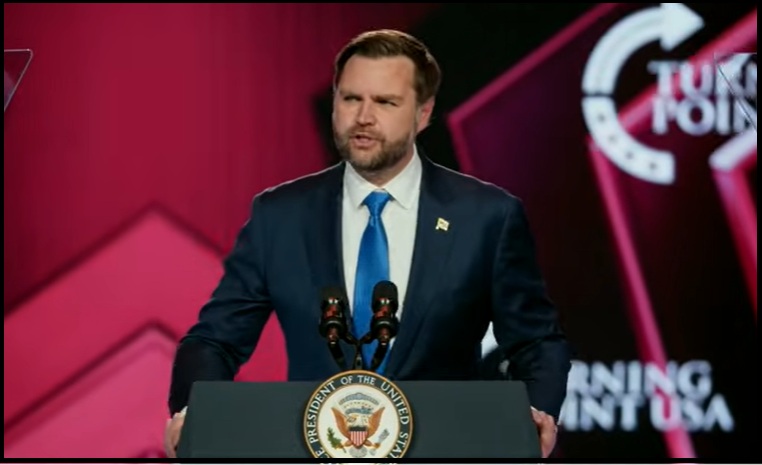
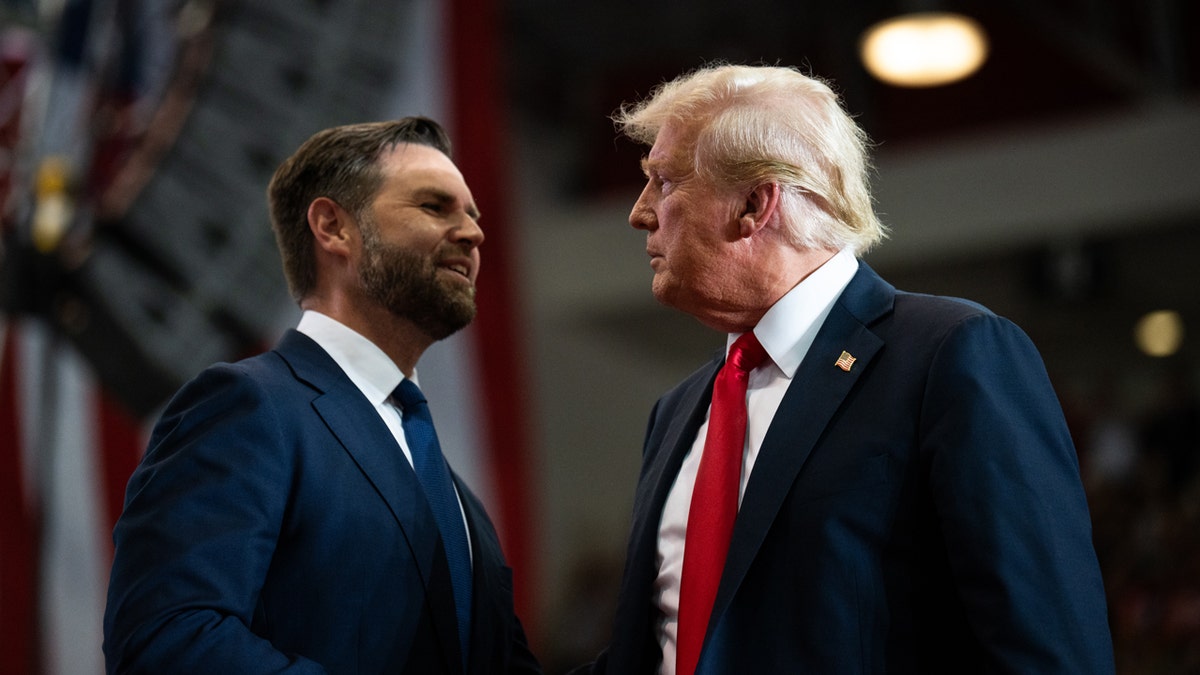
A few days ago, Florida Governor Ron DeSantis took up lead position toward enlisting the TPUSA political movement for his future aspirations. Vice President JD Vance quickly responds by attending a TPUSA at the University of Mississippi. This is JD Vance’s first campaign rally for 2028.
The full remarks as well as the question-and-answer period are transcribed below the video.
[Transcript] – JD Vance (00:14): “Ole Miss, I got a question. Are you ready? Wow, that was impressive. They told me that would be impressive and they were exactly right. So, let me say a few words of thank you first to my dear friend and the widow of my dear friend Charlie Kirk. Erika, you have been such an amazing inspiration to the entire country. How much do we love Erika Kirk? She’s done a hell of a job. We have a couple of Mississippi senators here. We have both Senator Roger Wicker and Senator Cindy Hyde-Smith. Thank you guys for being here. We have the governor of Mississippi with us. We got an all star crowd here. Governor, thank you for being here. And most importantly, we have got over 10,000 students from across Mississippi.
(01:35) We are proud to have you and we know that you are the future of Charlie Kirk’s legacy, so thank you for being here. I got this whole speech written and I’m not going to deliver any of what I had written. I’m just going to speak from the heart, because that’s what Charlie would so often do. When I think about what we lost six weeks ago, it feels like forever ago when I was in a meeting in the West Wing, and one of my staff members came in and said that Charlie had been shot. And then I looked at my phone, and I saw all the text messages and realized that my dear friend had been very seriously injured. Now, in the West Wing at that time, we actually thought that Charlie had a chance. We didn’t know that he was eventually going to pass away.
(02:31) There were initial reports from the medical team that maybe things were going okay. And of course, eventually Charlie took his last breath, and went home to be with his Lord and Savior. I remember thinking at that moment, first, of course, about Erika and the children. They’ve got their oldest. Their daughter is very similar in age to our youngest child. And I remember thinking, what a terrible tragedy for that family. And the second thing that I thought was what a terrible tragedy for the United States of America, because Charlie wasn’t just a political figure. He wasn’t just a guy who went around campus, and said very interesting things and hosted all of these debates. He was a person who particularly to the young people of this country, to all of you, he had the very best advice.
(03:19) And I think that’s the most important way for me to honor Charlie, which is to repeat that advice. Something I found true in my own life. Charlie wanted all of you, whatever life path you chose, whatever career you chose, whatever you ultimately did for a living, Charlie wanted you more than anything to invest in the things that were worth having to build a life that was worth building. And that started. The most important advice he ever gave you was fall in love, get married, and start a family. And I can’t honor Charlie without repeating that most important advice. Now, most of you are probably too young to have found the person you’re going to spend the rest of your life with. Some of you are lucky enough to have found that person already.
(04:11) But I will tell you, if you’re as lucky and blessed as I have been, it hits you like a ton of bricks. And I found that person in my lovely wife, Usha, our second lady who is here with us today. She’s sitting in the audience somewhere. I don’t know where. But I love you, honey. And have children, that’s something Charlie also always told. I grew up in a generation. I’m 41 years old. I’m a millennial. And if you’re being uncharitable, you would call me a geriatric millennial, which I really hate. I really hate being called a geriatric millennial. But here I am at 41, talking to all of you like I’ve got great wisdom.
(04:51) Here’s the thing: The one regret, the only regret that I really have in my entire life, and I’ve made plenty of mistakes. But the one regret that I have is that frankly, I wish we had started having kids sooner. Because when you’re a young father, you realize what an incredible blessing they are, but they’re also very exhausting. And I know here at Ole Miss, we like to party a lot. And I know at Ole Miss, occasionally some of you will have a few drinks on a Friday or Saturday, or hopefully not a Tuesday night, but I’m sure that happens from time to time here in SEC Country. But here’s the thing, when you go out until 3:00 in the morning and wake up at 6:00 AM for class, the thing that I’ve learned in my old age is that incredible energy, God actually meant it for another purpose. And that purpose was to help take care of a family. So, while you’re young, have those babies if you’re able to. That’s something Charlie said all the time.
(05:57) But if you think of that advice, if you think of that advice, Charlie wanted you to get married. He wanted you to fall in love. He wanted you to build a family. He wanted you to find a vocation. That was the advice that he gave on campuses, but that’s not just about you. That’s also about our country and about our government. Because while you have the freedom to live life as you so choose, I have got a responsibility as your vice president to make the American dream as accessible as possible. And this is why, my friends, this is why we care about all the things that we care about. Why do I care so much about having a secure border in the United States of America? It’s because I believe that when you let in a flood of illegal immigration, what it does is it drives down the wages of young people and makes housing unaffordable for the entire American population. That’s why we closed down the border.
(06:58)The left will say our immigration policy is about hating immigration, hating immigrants. We don’t hate anybody. We love our fellow citizens. And because we want them to have the American dream, we shut that border down the very first day that Donald J. Trump was the President of the United States. I care about you being able to afford a home, which is why we fought so hard to fix the broken policies of the Biden administration. I want a lot of you… I’m sure there are military veterans in this room right now. I’m sure there are a lot of people who will join the military in the future. And we’re proud of you. But part of America First is ensuring that we never ask you to go and do the American people’s business, unless it is in the interest of the United States of America. And that’s how we honor the sacrifice of our truths. And that’s why, my friends, that’s why we care so much about free speech, as Charlie lived and died for the basic principle that we ought to be able to talk about our differences. We ought to be able to debate them. And we ought to have faith that the best way to make sure that the best idea wins is to actually just have a discussion. And that is what this event is all about. That is what Turning Points USA is all about. And I’m so proud. And most of all, I’m so grateful to each and every person, whether you’re a Republican or a Democrat, for coming out and honoring one of the most important parts of Charlie’s legacy, because we’re going to have a discussion tonight. And that’s what Charlie would want us to do.
(08:52)Now, I want to get to questions and I want to leave plenty of time for questions, but I want to make just a couple of final points about Charlie’s legacy and politics. The most important thing about Charlie is that he was a great husband and a great father. Erika told me probably 12 hours after Charlie had been pronounced dead, she was just absolutely devastated. If you’ve ever known anybody who’s grieving, sometimes they’re unable to even hold a single thought for more than a few seconds. And what Erika told me, and I’m going to get a little emotional, is that she said that Charlie never yelled at her, he never cussed at her. And that to me is a great legacy to leave as a husband and a father, for your wife to be able to say that my husband was always good to me. And Charlie was a good man.
(09:47)But he also had the legacy of believing in political debate. And he was the most effective person in politics that I have ever seen. And by the way, that’s not because Charlie always agreed with me and the president’s policies. I remember one time in particular where Charlie Kirk called me, and guys, he was mad. It was I wouldn’t say the last conversation that I had with him, but it was in the last few months of his life. And he called me and he said, “JD, I’m really worried. I’m really worried that what’s going on in the Middle East right now is going to lead the United States into a protracted military conflict.” I’ve never told anybody that, that Charlie was really worried about that in the final months of his life.
(10:33)Now here’s the thing, Charlie was so effective, and he was so trusted by both me and the President of the United States, that when Charlie made that phone call, I didn’t say, “Screw you. You don’t know what you’re talking about.” I listened to him. And I really believe that one of the reasons why the President of the United States knocked out the Iranian nuclear facilities, but never got the United States into a protracted military conflict, and never lost a single American in a Middle Eastern conflict, is because we had the wisdom and the good sense to recognize that the American people are done with American troops dying in unnecessary foreign conflicts. But Charlie Kirk reminded me of that. Charlie Kirk.
(11:26)So, that was a great moment for our country. It was a great moment for my friendship with Charlie Kirk, because friendship is not just about telling everybody what they want to hear. It’s not just about agreeing with everybody all the time. It’s about having the trust in another human being, that you can tell them they’re wrong and actually encourage them to change their mind. Or in that case, not necessarily even tell us that we were wrong, but make sure that we were thinking about all the options. And of course, under the president’s leadership, we were doing exactly that, but Charlie was so good at that. And I think that’s one of the ways in which I want all of you to honor your legacy. Obviously, you care about our great nation or you wouldn’t be here.
(12:08)A lot of you will go on to become future leaders in business or in politics. A lot of you will run campaigns. A lot of you will work on campaigns. A lot of you will be future leaders. There might even be a lowly future Vice President of the United States in this very room. But here’s the thing that I want all of you to remember. Charlie wasn’t effective just because he had opinions. A lot of people have opinions. Charlie was effective because he was courageous, because he worked very hard, and because he made his vision a reality. And so, if you care about this country, as I know all of you do, don’t just complain about social media. Get up and get involved in a campaign.
(12:56)If you want a better policy outcome, even from an administration that you voted for, then get out and get involved in making your voice heard. If you care about this country, love it enough to get involved in the process in how we govern it. That is the only way we are going to save the United States of America. And that is perhaps the greatest contribution that you can make to Charlie Kirk’s legacy is getting involved and saving this country. I’m in the fight and I know every single one of you are with me. God bless you and thank you for having me. Thank you. Thank you. Hey, please, I appreciate that, but we’re not even halfway done. I don’t know what you’re saying, but it sounds awesome. Let’s not get ahead of ourselves, ladies and gentlemen. What we’re going to do next is actually take some questions. And I remember one of my favorite things about Charlie, not that there aren’t going to be some questioners who agree with me. But if you disagree with me, I would ask that you come to the front of the line, because we want to talk to people we agree with. We also want to hear from people we disagree with. It is hard for me to see, because the spotlights are very bright. But whoever’s in line, go ahead and ask your question. Oh, there we go. Okay, now I can see you. How you doing?
Speaker 1 (14:43):Hi, Mr. Vice President. Thank you so much for being here. My name’s Lucy.
Speaker 2 (14:47):And I’m Ellie. And we’re with the Turning Point chapter for this question.
JD Vance (14:51):Thank you, guys.
Speaker 2 (14:52):Yes. Can you tell us how your faith helps you in your role as vice president?
JD Vance (14:57):Well, I appreciate that. That is a very good question. And this is another way in which Charlie has affected my life. I would say that I grew up, again, in a generation where even if people had very deep personal faith, they didn’t talk about their faith a whole lot. And I grew up in a country where you just didn’t hear political leaders talk about their faith. But the reason why I try to be the best husband I can be, the best father I can be, the reason why I care so much about all the issues that we’re going to talk about, is because I believe that I’ve been placed in this position for a brief period of time to do the most amount of good for God and for the country that I love so much.
(15:37)And that’s the most important way that my faith influences me is we all get a limited opportunity to make a difference. And if you believe as we believe, you believe that God, you believe that Jesus Christ has a plan. And sometimes we don’t understand that plan. By the way, one way I don’t understand that plan is why my friend lost his life six weeks ago. Sometimes I get pissed off about that. But what I remind myself is that there is a deeper rhythm, that Jesus Christ is the author of the fate of human history.
(16:07)And we are charged to do everything that we can to effectuate that vision, to make our country a more virtuous place, a more prosperous place, where people can raise a family and not be persecuted for their faith, but teach their children their faith. That recognition that all of us have a duty. And I have two very important duties as Vice President of the United States, to the American people and to God. And that’s the most important influence my faith has on me. Thank you.
Speaker 3 (16:42):I understand your view on illegal immigration is it should be a top priority, strengthening our southern borders and fighting the massive drug trafficking that’s taken place while securing jobs for the working class Americans. Also, deporting every single person who’s invaded our country illegally, which I 100%
Speaker 3 (17:00): Agree on. My question to you is what is your view on legal immigration. Personally, I have a girlfriend who’s studying in America off of visa. Our hope is eventually getting a Green Card. So what is your view on legal immigration? Should we reduce it? Also, what is your plan for a merit-based system?
JD Vance (17:17): Yes, sir. Well, I appreciate the question and, look, my honest view is that, right now, America, thanks in part to the Biden border invasion, but also thanks in part to a lot of bad immigration policy, right now, we have let in too many immigrants into the United States of America. That is just a fundamental reality. Now, look, legal immigration is complicated, because we let in about a million legal immigrants into the United States of America every single year, and I think the evidence is pretty clear that a lot of those immigrants are actually undercutting the wages of American workers. It’s one of the reasons why the President of United States, and a lot of us in the administration, have encouraged H-1B reform. Because if you look at the H-1B visa, what it’s supposed to be, what it’s supposed to be, is that you have a super genius who’s studying at an American university who’s working at a great company, you want that super genius to stay in the United States of America and not go somewhere else.
(18:16) What it’s actually used to do is hire an accountant at a 50% discount to an American citizen. I don’t think that we should be hiring accountants from foreign countries when we’ve got accountants right here in the United States that would love to work for a good wage. Now, you asked about, I think your girlfriend, you said, and I obviously don’t know the full details about your situation, but my view is, look, there are people who want to come to the United States of America, and some of them, I’m sure, can enrich the United States of America by coming here, but we have got to get our overall numbers way, way down. Too many people have come into the United States of America. I am married to the daughter of immigrants who came to the United States in the 1980s. I do believe that some immigrants, many immigrants, do in fact enrich the United States of America. But here’s the problem. We don’t even know how many illegal aliens we have. We don’t even know. The best guess is probably 25, 30 million people. I’ve heard estimates as high as 50 million. When something like that happens, you’ve got to allow your own society to cohere a little bit, to build a sense of common identity for all the newcomers to assimilate, the ones who are going to stay, to assimilate into American culture. Until you do that, you’ve got to be careful about any additional immigration, in my view. Thank you, sir.
Speaker 3 (19:43): Thank you.
Speaker 4 (19:49): Hello. I have a question about Israel and Trump’s policy towards it. Do you think it’s a conflict of interest for Miriam Adelson, an Israeli donor, to give millions of dollars to his campaign, and then Trump have pro-Israeli policies?
JD Vance (20:07): Well, if you’re asking, do I think the President of the United States has a conflict of interest? No, I do not, because I know how the President of the United States makes his decisions, and I see it behind the scenes. Now as the president himself has said, Miriam Adelson, who, by the way, I know and I have a very good relationship with her, she is very clear about the fact. She doesn’t hide the fact that she really loves Israel, and that is part of what motivates her political giving. That is a reality. At the same time, the President of the United States is America First through and through. And let me give you just a couple of examples of this.
(20:37) Number one, we have heard from some pro-Israel voices, some people who really love the state of Israel, that they don’t want us to have a relationship with certain Middle Eastern countries. Well, the president, his attitude is we need to build relationships with any country where we have shared interests, and he’s going to do it if it’s in the interest of the American people, and he’s done exactly that. Number two, there were people, and I remember this criticism of the President of the United States, I just raised it in the context of a conversation that I had with Charlie. I remember when people said that the President of the United States was going to get us into a multi-hundred thousand troop regime change war for Israel. This was four months ago. This was six months ago.
(21:20) Now the people who accused the President of the United States of wanting to get us into a regime change war for Israel, I wonder if they stepped back and said, “You know what? We were wrong about that, because the President of the United States did not want to get us into a regime change war for any other country, he wanted to knock out a nuclear facility and get everybody back home, and that’s exactly what he did.” So I understand there’s some frustrations out there, but I think the President of the United States, more than any president of my lifetime, is willing to stand up to anybody if he thinks it puts the interest of the American people first. Thank you.
Speaker 5 (21:58): Hello, Vice President Vance.
JD Vance (21:59): How you doing?
♦ Speaker 5 (22:02): Good. I have a question. Do you condone large private corporations, such as Palantir, hoarding data caches on US citizens?
JD Vance (22:09): No, I don’t condone it. And here’s the thing. So I get asked about Palantir a lot, because there’s this internet meme out there that somehow I am super in bed with Palantir. And here’s the thing that I’d say about this. Palantir is a private company. They sometimes do a useful service, and sometimes they’re going to do things that we don’t like. You should be demanding that your representatives do two things when it comes to Palantir or when it comes to any other technology company.
(22:36) Number one, protecting your data. What’s going on with artificial intelligence is going to mean that there are massive inducements to steal your data, to harvest it, and to use it against you to sell digital advertisements. That is not what I believe in, and I’ve been fighting against it, whether it’s Palantir or any other technology company, literally before I ran for office. When ran for office, I was criticized by Republicans in my Republican Senate primary, because I was talking then about Google and Facebook harvesting our data. It’s unacceptable. I don’t care who does it, I don’t want them to do it.
(23:10) Number two, and this is also very important. What’s going on with artificial intelligence we got to be worried about large scale surveillance. Okay? Everything … you asked about Palantir. Do you know that every time you make a credit card transaction, the credit card companies are collecting data on how you spend your money? Do you know that every time you linger over a link on the internet for more than a half second, the search engines are collecting data on you so that they can sell you advertisements? One of the biggest questions for American policy over the next 10 years is how to ensure that you are a sovereign citizen. And you cannot be a sovereign citizen if any private corporation or any government can steal something from you that belongs to you.
Speaker 5 (23:56): Yes, sir.
JD Vance (23:56): Thank you.
Speaker 5 (23:56): Thank you.
Speaker 6 (24:02): Vice President JD Vance. Good evening.
JD Vance (24:05): Thank you.
Speaker 6 (24:06): My question is the Republican Party, they stand for the right to bear arms, a lot of things the Founding Fathers really made a priority. And I feel as if requiring Christianity in public schools goes against the Founding Fathers wish of freedom of religion. What do you think about that?
JD Vance (24:26): Well, I guess … who is saying that we require Christianity in public schools?
Speaker 6 (24:32): Just from what I’ve seen on the media and the news, it seems like the Trump Administration had wanted to make praying in schools and Christian values incorporated.
JD Vance (24:44): Well, look, I think Christian values are a good thing, and I’ll talk to you about why I think that’s a good thing. But that’s separate from forcing people to pray, which I don’t think that anybody, certainly no Christian that I know, would ever support or ever endorse. And let me just say something generally about all the people, I see there’s a big line, and I hope I can get to everybody’s question. I remember when I was a sophomore in high school, I went to an event at my church, which was a book signing with Oliver North and Sean Hannity, the Fox News host. And this was back before … I mean, this was I guess 25 years ago.
(25:18) And so, neither of these guys was maybe as big as they are today. And I remember standing in line and I’m about to say hello to Oliver North and Sean Hannity, and I remember thinking to myself, I was so nervous, all I need to do is shake my hand or shake their hand, give them a firm handshake, and tell them my name. That’s what I’m thinking. Firm Handshake. Tell them my name. Firm Handshake. Tell them my name. And I get to the front of the line and Sean Hannity looks at me and he says, “How are you doing?” And I totally panic, and I go, “JD,” because I had rehearsed shaking and saying my name. My point is I admire your guys’ courage, and please don’t be nervous. If you need to work through a question, think about it, speak it. We’re all here to have a nice conversation and we’re all supportive of it.
(26:04) Here’s the thing, when you talk about forcing, let answer your question, forcing Christianity, forcing people to pray. There’s a liberal idea out there that I think is wrong, and that’s that liberalism is the source of freedom of religion. And actually, if you go back to the original Founding Documents of the United States of America, if you go back to the Anglo-legal tradition, well before there was ever a United States of America, what you find is that freedom of religion is actually a Christian concept. And the reason it’s a Christian concept is very simple. Because Christianity, Imago Dei, the idea that we are all made in the image of our Creator, means that we must respect the free will of every single person.
(26:59) Now, part of that is you have a conversation with people, having free will doesn’t mean that you’re not allowed to encourage somebody, that you’re not allowed to talk to somebody about your faith, that you’re not allowed to talk about certain values in school. When our founders talked about freedom of religion, they didn’t mean you weren’t allowed to say a Christian prayer in a public school or that you weren’t allowed to talk about Jesus Christ in a public forum, they just meant that nobody could force you to profess the Christian faith. That had to come from your own free will. And I believe that, and I think every Christian who I’ve ever spoken to believes that the source of your faith, the Christian understanding, must be your own free will.
(27:39) But here’s the thing about Christian values. There are a lot of Christian values out there that I think that we’ve just sort of assumed and we’ve, in fact, taken for granted. Christian values are the idea that you should respect every single person as an individual, whatever the color of their skin created in the image of God, that’s a Christian concept. And, in fact, it was a Christian Empire, Great Britain, that abolished slavery to begin with. The idea that we should eliminate child sacrifice. What did the Christian settlers find when they came to the new world? They found a lot of civilizations that were murdering babies in weird religious rituals. It was Christianity that said, “We don’t kill children just because they’re somehow inconvenient to people.” A lot of the things … human rights. The very idea that human beings have rights are a Christian concept.
(28:34) And so, I’d ask you, my assumption, based on the question, is that you’re skeptical of Christianity or at least of certain public professions of Christianity. One of my favorite Bible verses is by your fruits, ye shall know them. And I think that the fruits of the Christian faith are the most moral, the most just, and the most prosperous civilization in history. I make no apologies for believing that Christianity is the pathway to God, I make no apologies for thinking that Christian values are an important foundation of this country, but I’m not going to force you to believe in anything, because that’s not what God wants and that’s not what I want either.
Speaker 6 (29:13): So.
JD Vance (29:14): Go ahead.
Speaker 6 (29:16): The school system, do you agree that there should be Christian implementation or do you think that school system should be neutral and be focused on science, literature, reading, writing, arithmetic?
JD Vance (29:26): Well, I reject the idea that anything is purely neutral. Okay? There are, for example, let’s take a basic scientific fact. And this is a little spicy, I’m not trying to make this too controversial, but take the basic scientific fact of can you take a pill to change your biological gender? Now that’s something that 15 years ago, quite literally, every single scientist in the Western world would’ve said, “Absolutely not. That’s crazy.” And now people will.
(29:57) I actually, I think the premise of your question, I don’t totally share it, because I don’t think perfect neutrality is possible. What is [inaudible 00:30:05] … you talk about history. Was Christopher Columbus a great explorer or was he a guy who committed genocide against the native populations? These debates, I’m happy to have them, but I reject the idea that there are truly neutral debates. Anybody who’s telling you their view is neutral, likely has an agenda to sell you. And I’m, at least, honest about the fact that I think the Christian foundation of this country is a good thing. Next.
Speaker 6 (30:31): Okay, thank you. Thank you. And for the pill you were talking about, what do you mean specifically? Are you talking about testosterone, estrogen?
JD Vance (30:39): Yeah, I’m talking about hormone replacement therapy. That’s what I’m talking about. Just to be respectful, let’s keep it going. Thank you.
Speaker 6 (30:44): Yes, thank you. Have a good night.
JD Vance (30:45): You too.
Speaker 7 (30:49): Hello, Mr. Vice President. Thank you so much for giving this opportunity to talk here today. I did not agree with many of the things that you said right ahead of this, but I don’t think that’s my point to discuss here. What I want to ask is-
JD Vance (31:03): It’s okay.
Speaker 7 (31:04): … you are married to a woman who is not Christian. In her Wikipedia, I mean, I just looked that up, I wanted to know what her faith was, I didn’t know this before, but she still calls herself Hindu. You are raising two kids, three kids, in intercultural, racial, religious household. How are you maintaining, or how are you teaching your kids not to keep your religion ahead of their mother’s religion? Or how are you teaching them that your kind, they’re Dad kind, who got here just few years or few decades ago, is different or is better, than your mom’s kind who got here just a generation before? How are you balancing that?
(31:56) And when you talk about too many immigrants here, when did you guys decide that number? Why did you sell us a dream? You made us spend our youth, our wealth in this country, and gave us a dream. You don’t owe us anything. We have worked hard for it. Then how can you, as a vice president, stand there and say that we have too many of them now, and we are going to take them out, to people who are here, rightfully so. By paying the money that you guys asked us, you gave us the path, and now how can you stop it, and tell us we don’t belong here anymore? And one more thing. I’m sorry. One more thing. Do you have to be-
JD Vance (32:43): There’s a lot there. I don’t know if I’m going to remember all this, but I will try.
Speaker 7 (32:46): I’m sorry. I’m sorry. I had to say all of this and please take it with due … I mean, I’m saying all of this with due respect.
JD Vance (32:51): Of course. No, no, go ahead. Please. Thank you.
Speaker 7 (32:52): I have no intention of causing a scene here or anything, but –
JD Vance (32:55): We’re not close to causing a scene. Don’t worry.
Speaker 7 (32:56): But we talked about Christianity, all of this. I’m not even Christian, and I’m here standing to so support, why are we making Christianity one of the major thing that you have to have in common to be one of you guys, to show that I love America just much as you do? Why is that still a question? Why do I have to be a Christian or-
JD Vance (33:23): Okay, so there was a lot there, and I’m going to try to respond to as much of it as I can. So on the question of immigration. So first of all, I can believe that we should have lower immigration levels, but if the United States passed a law and made a promise to somebody, the United States, of course, has to honor that promise. Nobody’s talking about that. I’m talking about people who came in violation of the laws of the United States of America, and I’m talking about in the future, reducing the number, reducing the number of people … sorry, what?
Speaker 7 (00:00):
Speaker 8 (34:00): May I continue on that? Because when you just said you are not stopping with the people who came here legally, right? But you are pushing out policies that hurt us, and these policies are not even solving the problems. These policies are just creating chaos.
JD Vance (34:18): No ma’am. Okay, so again, I’m going to finish answering the question, and then if I’ve answered all nine of your questions in less than 15 minutes, then we can keep on going. We got to have a little fun, right? Here’s the thing. I can believe that the United States should lower its levels of immigration in the future, while also respecting that there are people who have come here through immigration, lawful immigration pathways that have contributed to the country. But just because one person, or 10 people, or 100 people came in legally and contributed to the United States of America, does that mean that we’re there by committed to let in a million or 10 million or 100 million people a year in the future? No, that’s not right. We cannot have … I’ll go and finish. We cannot have an immigration policy where what was good for the country 50 or 60 years ago binds the country inevitably for the future. There’s too many people who want to come to the United States of America, and my job as vice president is not to look out for the interest of the whole world, it’s to look out for the people of the United States. Now, you asked a personal question about our interfaith household, and yes, my wife did not grow up Christian. I think it’s fair to say that she grew up in a Hindu family, but not in a particularly religious family in either direction. In fact, when I met my wife, we were both, I would consider myself an agnostic or an atheist, and that’s what I think she would have considered herself as well. Everybody has to come to their own arrangement here. The way that we’ve come to our arrangement is, she’s my best friend, we talk to each other about this stuff. So, we’ve decided to raise our kids Christian, our two oldest kids who go to school, they go to a Christian school. Our eight-year-old did his first communion about a year ago. That’s the way that we have come to our arrangement, but thank you. My eight-year-old was also very proud of his first communion. Thank you guys. I’ll tell him that Ole Miss wishes him the best. But I think everybody has to have this own conversation when you’re in a marriage. I mean, it’s true for friends of mine who are in Protestant and Catholic marriages, friends of mine who are in atheists and Christian marriages, you just got to talk to … The only advice I can give is you’ve just got to talk to the person that God has put you with, and you’ve got to make those decisions as a family unit. For us, it works out.
(36:52) Now, most Sundays Usha will come with me to church. As I’ve told her, and I’ve said publicly and I’ll say now in front of 10,000 of my closest friends, do I hope eventually that she is somehow moved by the same thing that I was moved in by church? Yeah. I honestly do wish that. Because I believe in the Christian gospel, and I hope eventually my wife comes to see it the same way. But if she doesn’t, then God says, “Everybody has free will.” And so, that doesn’t cause a problem for me. That’s something you work out with your friends, with your family, with the person that you love.
(37:25) Again, one of the most important Christian principles is that you respect free will. Usha is closer to the priest who baptized me than maybe I am. They talk about this stuff. My attitude is, you figure this stuff out as a family, and you trust in God to have a plan and you try to follow it as best as you can. And that’s what I try to do.
(37:45) I want to make a final point. I don’t want to cut you off. I want to be respectful to all the people behind you in line, but I want to make this point about immigration. If you ask the question, “What is the exact right number of immigrants for the United States to let in?” It is just very specific on the context. If you go back to the 1920s, the United States passed an Immigration Reform Act that effectively cut down immigration to close to zero for 40 years in this country. And what happened over those 40 years? The many, many people, who had come from many different foreign countries and different foreign cultures, they assimilated into American culture. And there was an expectation that they would assimilate into American culture.
(38:29) I think we have two problems in our immigration system today, and my guess is you’re probably a slightly more leftist political persuasion, liberal political persuasion. Maybe not. But here’s the thing. I remember back in my establishment GOP days when I was still very early getting involved in Republican politics, I remember a conservative think tank person who told me that one of the reasons why immigration was really good is that if you had enough diversity in a country, people would mistrust each other and they wouldn’t join labor unions.
(39:04) Okay? So, when I see a lot of left-wing people who theoretically support organized labor saying, “We need to flood the country with a limitless number of immigrants,” they’re unwilling to set any limitations on it, my response to that is, you’re destroying the very social trust on which American freedom and prosperity was built, and that is really important to me. So, the honest answer to your question, ” What is the exact number of immigrants America should accept in the future?” Right now the answer is, far less than we’ve been accepting. We have got to become a common community again. And you can’t do that when you have such high numbers of immigration, which is one of the reasons why we have the immigration policy we do. Thank you. Next.
Speaker 9 (39:56): Good evening, Vice President Vance. I just want to say it’s an honor to actually be able to talk to you.
JD Vance (40:00): It’s an honor to be here. Thank you.
Speaker 9 (40:01): Thank you. One of my biggest questions is I feel like one of the biggest problems that America is facing today is that ever-growing social-political divide, and we’re seeing this on the Republican and Democratic side. But we’ve seen that a refusal to cooperate with the other side has led to some major issues, including right now the government shutdown. And I wonder, as the party empower, what are your plans to address that issue towards reaching that olive branch out to the other side to actually come to an agreement on how to go forward with our government?
JD Vance (40:38): Look, it is a very good question, and let me just say on the government shutdown in particular. The reality here is that there’s a very simple bill that just reopens the government. It does it through pretty much the end of the year. That got every single Republican in The House of Representatives to support it, and then it got 52 Republicans in the Senate and three Democrats in the Senate to support it. But because of weird senate procedural rules, it requires a 60-vote threshold. So, on that issue in particular, when you have every single Republican, with two exceptions in both Houses of Congress, I feel pretty confident. I know that I’m partisan. I know I have an R next to my name, but I feel pretty good saying the shutdown is the Democrat’s fault, because we voted again and again to open it.
(41:21) Now, look, there’s a broader question there, and I think most Americans, whatever their political persuasion, would actually like the country’s political parties to work together better to solve the problems. And look, and I agree with that. And my approach when I was in the United States Senate was to try to find some issues where we could agree with the other side on and try to work with them on it.
(41:46) And let me give you one example. I really worry about concentration in the corporate sector. I worry about big corporate monopolies. I worry that when you have only one or two companies dominating an entire sector, it’s bad for liberty and it’s bad for prosperity. So, you may be shocked to hear this, but I actually worked with Elizabeth Warren on some anti-monopoly stuff when I was in the United States Senate. But here’s the problem. The problem is, there is actually a lot of things where we could work across the aisle. There are a lot of … President Trump is, in my view, you haven’t seen organized labor ever get behind a Republican at least in 100 years like they have behind Donald J. Trump.
(42:28) There are a lot of areas of common ground on that question. The problem is, as reasonable as some of these people can be in private, in public the current obsession of the Democratic Party in leadership, I’m not saying every Democrat in the country. But the current obsession of every Democrat in Congress is, “Get President Trump, fight President Trump, attack President Trump.” It is impossible for us to work across the aisle, unless a person is willing to put down their partisan sword, shut the hell up about fake scandals related to Donald Trump and actually work with us. That’s the way you make this happen. Next, thank you.
Speaker 9 (43:12): Thank you.
JD Vance (43:13): Next, I want to try to get through as many as possible guys. Thank you.
Speaker 10 (43:18): Good evening, Mr. Vice president.
JD Vance (43:20): Hello.
Speaker 10 (43:20): Hi. I actually drove here all the way from Memphis, Tennessee. Go Tigers. I’m sure everyone here is aware of the Memphis Safe Task Force that has been in the city for about a month now, and I checked a little earlier, as of this morning, I believe they’ve arrested 1,700 people, and seized about 300 illegal guns. I want to ask, how does this law enforcement objective jive with Attorney General Pam Bondi’s pledge to make the Department of Justice a more pro-Second Amendment Department of Justice? Because I’m sure most people in here support the Second Amendment, so how can Republicans and this Department of Justice use the current gun laws that are on the books that a lot of pro-Second Amendment advocates disagree with that we wanted to overturn in the Big Beautiful Bill, but we didn’t get it?
JD Vance (44:32): Yeah, so I understand the question, and by the way, I supported some of those changes in the Big Beautiful Bill, I know the President of the United States did too. We didn’t have the votes to get them in there, and that’s as simple as that. But I know exactly what you’re talking about, because there were a couple of issues in particular, I talked to some of my Second Amendment friends. But here’s the basic issue. We don’t want people who have violated the law, who have committed felonies, the Second Amendment like every other amendment, it’s about due process. It’s that you don’t have your rights violated, unless there is due process of law. If you’re a person who’s committed four felonies and a court has lawfully ordered that you shouldn’t have a gun and you’re running around with a firearm, I don’t have any problem with law enforcement saying, “You don’t get to have that firearm that is illegally possessed, illegally obtained.” I think that’s basic law and order.
(45:17) Now, again, if you had somebody come in and say, “Well, we don’t think that person should have a firearm, but they haven’t violated any law,” that’s a totally separate question. That’s not what we’re focused on. What we’re focused on is violent crime and people who have violated the bodily autonomy of another human people, a person who has committed an act of violence against one of their fellow citizens. We’re going to clean up the streets, get those people off the streets, and make America safe for the American citizens again. That is our entire law and order policy, and I think we’re doing a pretty good job at it. Thank you.
Speaker 11 (46:01): Thank you for the opportunity to speak. I’m a Christian man, and I’m just confused why there’s this notion that we might have owed Israel something, or that they’re our greatest ally, or that we have to support this multi $100 billion foreign aid package to Israel to cover this, to quote Charlie Kirk, “Ethnic cleansing in Gaza.” I’m just confused why this idea has come around, considering the fact that not only does their religion not agree with ours, but also openly supports the prosecution of ours.
JD Vance (46:42): Yeah, so let me, let’s say things, a few things about this. First of all, when the President of the United States says America first, that means that he pursues the interests of Americans first. That is our entire foreign policy. Now, that doesn’t mean that you’re not going to have alliances, that you’re not going to work with other countries from time to time, and that is what the President believes. Is that Israel, sometimes they have similar interests to the United States, and we’re going to work with them in that case, sometimes they don’t have similar interests to the United States. This example, the most recent Gaza Peace Plan that all of us have been working on very hard for the past few weeks, the President of the United States could only get that peace deal done by actually being willing to apply leverage to the State of Israel.
(47:31) When people say that Israel is somehow manipulating or controlling the President of the United States, they’re not controlling this President of the United States, which is one of the reasons why would it be able to have some of the success that we’ve had in the Middle East. Now, you ask about sort of Jews disagreeing with Christians on certain religious ideas. Yeah, absolutely. It’s one of the realities is that Jews do not believe that Jesus Christ is the Messiah. Obviously, Christians do believe that. There are some significant theological disagreements between Christians and Jews. My attitude is, let’s have those conversations. Let’s have those disagreements when we have them. But if there are shared areas of interest, we ought to be willing to do that too. For example, I really care about, one thing I really, really care about is the preservation of the Church of the Holy Sepulcher in Jerusalem. Christians believe that that is the site where Jesus Christ was crucified, and also that his tomb is right there as well.
(48:29) My attitude is, if we can work with our friends in Israel to make sure that Christians have safe access to that site, that’s an obvious area of common interest, I’m fine with that. What I’m not okay with is any country coming before the interest of American citizens, and it is important for all of us, assuming we’re American citizens, to put the interest of our own country first. That’s what we’re going to do. That’s what we try to do every single day, I promise you. Thank you.
Speaker 12 (49:01): Hi, Mr. Vice President. I’m the president of our pro-life organization here at Ole Miss, Rebels for Life. And I myself as the president am 100% pro-life, and I know you’ve stated you being Catholic, that in the past you’ve stated that you’re 100% pro-life, but since joining the presidential campaign as the VP, you’ve kind of wavered how you see abortion. I’m just wondering what your stance is right now, and do you think that someone else’s right to liberty trumps someone else’s right to life?
JD Vance (49:43): Well, first of all, I appreciate your question and I appreciate the work that you do. You asked the question, “Do I think somebody else’s right to liberty trumps somebody else’s right to life?” No, I do not. I, in fact, do not believe that. Now, you said, and I’m going to take issue with something you said, just the premise of the question, which is that I’ve wavered on the pro-life issue. I really do believe that the President has been the most pro-life president in the history of the United States of America.
(50:08) Now, that said, there are two things that I think we have to keep in mind here. Now, one is the very, very hard question of, when we talk about our abortion policy, there are some very, very difficult education. There are cases where you’ve got an 11-year-old girl, who was raped, who it would be unsafe for her to bring the baby to term. You’ve got situations where bringing a baby to term would cause serious bodily harm, maybe death for the mother. That’s one of the reasons why we believe in the exception in these cases where you have, again, they’re edge cases, they’re rare. I think the pro-abortion community would have you believe that’s 90% of abortions. That’s not true, but we’ve got to be honest about the fact that there are some edge cases.
(50:51) The second thing I’d say about this is that we have to be prudential and practical in what can get accomplished. And there may be disagreements about what exactly that is,
JD Vance (51:00): … is, but if you look at the pro-life victories that the President of the United States has been able to achieve, he’s been able to achieve them because he has worked within the system that we have. If your attitude is, you are going to pursue the most aggressive pro-life option, even if it means you lose every election and every outcome, means that you’re going to be in a situation where the Democrats have abortion on demand up to the moment of birth to the very end. You’ve got to work within the political constraints that we have. Now here, let me just say something about this, and somebody asked me earlier about my Christian values. And one of the points I made is that when the Settlers came to the new world, they found a very widespread child sacrifice. I imagine there are some people who don’t agree with my view on the pro-life issue.
(51:49) Let me just make an observation. If you go to historical archeological sites where there were brothels, and the two oldest businesses in the world are gambling and prostitution, so there were brothels even in very ancient civilizations. If you go back to ancient brothels and you dig up the bones of the women who were working in these places, you will very often find a lot of children who were buried with them. And the answer is that whenever a society decides to discard Innocent babies, they also don’t treat their women very well. And whenever a society mistreats its women, it is very often the babies who come right after that. There is a reason why Christian civilization ended the practice of child sacrifice all over the world, and it’s one of the great accomplishments of Christian civilization. I believe that we should try to be protecting every unborn life. There’s a question of exactly how we do it, but I would never say that anyone’s right to life should be sacrificed. Thank you, ma’am.
Speaker 13 (53:02): First, I just have to say I am thrilled to hear you articulate Christian values on a stage like this, and to remind us that things we take for granted and things we value so much have a Christian origin. So thank you for that, I really mean that. However-
JD Vance (53:15): So much of liberalism, by the way, so much of the far-left is a sort of, if you really pay attention to it, it’s a kind of perverted version of Christianity. There’s nothing wrong, of course, with focusing on people who are disenfranchised, for example. That’s the focus of liberalism. But if you completely separate it from any religious duty, any civic virtue, then that can actually become, for example, an inducement to lawlessness. You can’t just have compassion for the criminal. You also have to have justice too, which is why I think that a properly rooted Christian moral order is such an important part of the future of our country. But sorry, I interrupted you. Go ahead.
Speaker 13 (53:56): Amen, absolutely. Now, as much as I hope and pray that we can be a nation of Christians, the idea of a Christian nation scares me. So I’d like to hear your feedback on a pretty nuanced argument here, that perhaps there should be a wall of separation, as at least one of our founders advocated, for between church and state at the national level. However, that line can and should get blurrier as we descend to the community level. And perhaps that is actually the system, the structure that our founders gave us when they said Congress shall make no law establishing a religious body. However, states did have close relationships with churches at that time.
JD Vance (54:37): Yeah.
Speaker 13 (54:37): Do you think that that is a rationale that works? Do you think that that is the way we should implement on the ground, these Christian values?
JD Vance (54:43): So this is a very nuanced point, and I want to just make sure that everybody’s kind of on the same page here. So if you go back to the first Amendment, it doesn’t say separation of church and state, it says Congress shall make no law respecting an establishment of religion. But if you go back to the founding time, there were actually a number of states that had formally recognized churches. So there was the Anglican Church of Virginia, that was the official state church of Virginia. Maryland at the time was the only majority Catholic colony or at least had a significant Catholic representation of the original 13 colonies. There’s a lot there. And yes, I do think that what happened is the Supreme Court interpreted Congress shall make no law respecting an establishment of religion, to effectively throw the church out of every public space at the federal, state, and local level. I think it was a terrible mistake and we’re still paying for the consequences of it today. But if, and I think this is your point, if you were to undo that, if you were to get back to a system actually meant by the founders where Congress is not setting up an established religion, but people in their local communities can kind of do whatever it is that they want to do, I think that would be a better system than what we have today. But I think the most important principle that we have got to remember, is you do not have to completely kick God out of the public square, which is what we’ve done in modern America. It’s not what the founders wanted, it’s not good for the United States of America. And anybody who tells you it’s required by the Constitution is lying to you. Thank you.
Speaker 14 (56:18): Hello, JD. How you doing today, man?
JD Vance (56:19): Good. How you doing?
Speaker 14 (56:20): In the wise words of Ricky Bobby? I don’t know what to do with my hands.
JD Vance (56:29): Don’t feel bad. Neither do I, half the time, man.
Speaker 14 (56:33): Okay. Okay. First off… Yeah, laugh it up, laugh it up. Okay. First off, I just want to say, I’m a huge supporter of the Trump administration. I was three months too late to vote for you guys, but if I could have, I would have. So I’m huge supporter of you guys before I make my argument, but there is something you guys are doing that is kind of disturbing me a little bit.
JD Vance (56:55): Okay, go ahead.
Speaker 14 (56:56): Thank you. You guys have sent the military into Washington DC and a few other cities that I can’t think of off the top of my head, which first off, they’ve had wonderful results. No one can deny the results of that. It’s wonderful. Some might even say the greatest. I’m a comedian.
JD Vance (57:18): I like this guy. Who is this guy?
Speaker 14 (57:22): Thank you, JD. I like you too.
JD Vance (57:24): Now he’s going to ask the question about all the shit that we did wrong, but that’s okay, go ahead and ask your question.
Speaker 14 (57:29): But yeah, I’m just wondering… Well, it’s not necessarily something you did wrong, but it’s what could someone else do wrong? Let’s say we get a complete tyrant in office, and let’s say Turning Point USA is having a huge protest against something really bad that we don’t like, and let’s say a president is saying that it’s getting violent. I’m trying to think. My mind’s gone blank.What is the difference between what you’re doing, and how could we prevent someone from abusing that power?
JD Vance (58:01): Yeah. So look, I understand where the question is coming from, and I think it’s a fair question. And it’s going to sound like I’m being sarcastic, and it really is not meant in any offense, but when you talk about what could another administration do, to take a wild, hypothetical example, totally off the top of my head, what if Joe Biden sent the Federal Bureau of Investigation to start arresting his political opponents? Okay? So here’s something that I want conservatives, I want every conservative to remember, it’s an important part of my entire political philosophy, is we cannot be afraid to do something because the left might do it in the future. The left is already going to do it, regardless of whether we do it. That is the takeaway of the last 40 years.
(58:53) And in particular, if you look at what we’re doing, if Joe Biden wanted to deploy the National Guard to a red state in a place where the murder rate was twice what it is in third world countries, to actually go after murderers, that would be a great use of the National Guard. Unfortunately, I don’t think Joe Biden would use it like that. What I’m worried about, frankly, is what the far left already did with American law enforcement, and that is the thing that we have to prevent against. And the answer to that question, is you make sure that people who did it face penalties for using the federal power against American citizens. And by the way, that’s exactly what we’re trying to do. Thank you.
Speaker 15 (59:42): This will be the last question.
JD Vance (59:44): Ricky Bobby, 2048, that’s who I’m voting for. This is the last… Oh, wow, we’ve been here over an hour, that’s amazing. Okay, I’m sorry, those of you who didn’t get to answer a question. I tried to be as quick as I could. Go ahead.
Speaker 15 (01:00:00): Mr. vice president, I’m humbled and honored to be here. Recently, President Trump endorsed a candidate to run against Republican representative Thomas Massie, who has opposed and criticized some of the Trump administration’s aims. How would you address those who fear that principal disagreement or independent thinking is discouraged within the party because of how it can be framed as a betrayal, instead of as internal accountability or an opportunity for debate and negotiation?
JD Vance (01:00:26): So it’s a very good question, and let me say, this one is hard for me. And the reason it’s hard for me is because Thomas Massie and I, he’s one of the first people that ever reached out to me about my book or about political office. I’ve known Thomas Massie well before I ever got involved in politics. Thomas’ wife died, well, maybe it was a year and a half ago, two years ago, it was a little while ago. She died very unexpectedly, was a very sweet and kind woman, and I was probably one of the first people that called Thomas to offer my condolences. I think the problem with Thomas, and I’ve told him this in private, and now I guess I’ll say it in public, is it’s one thing to disagree with the party on a particular issue. It’s one thing to have your independent stand on a number of questions. And by the way, some of the stuff where Thomas Massie has been independent against the Republican Party, I’ve agreed with him with.
(01:01:17) Thomas and I worked together during 2023 where I was trying to stop the limitless flow of American money to Ukraine, and Thomas was one of the people I was working closest with it. But that’s one thing. Being independent, having your own opinions is one thing. Voting against the party on every single issue, you’re eventually going to make too many enemies. And that is the problem that Thomas has had. It’s not one issue, it’s not three or four issues. It’s that every time that we’ve needed Thomas for a vote, he has been completely unwilling to provide it. That is why the President of the United States has trained his ire on Thomas Massie. It’s because we can never count on him for some of the most difficult votes. I wish that that weren’t the case. I say that as somebody who’s known Thomas well before I got into politics, but politics is politics. And when you always vote against the party, you can’t expect the party to actually back you. That’s the reality.
(01:02:14) So let me say just a couple of final things before I hit the road here. And one, it has been such an amazing honor to be with all of you this evening. I want to say two things. I want to say two things. Number one, when I was back in my agnostic days and I was thinking about returning to my faith, I remember talking to a friend of mine and actually talking about a number of things. And he said something to that was really interesting, and I was talking about all the things that were going wrong. I was looking to the future, I was talking about everything that was broken in the world. And I said to him, I said, “Things are just really, really dark.” And he said, and he stopped me in my tracks, he said, “JD, you’re right. There are a lot of things that are really dark out there, but despair is a sin.”
(01:03:14) Now, I know not all of you are Christians, but for the Christians out there, I think that it is very important to remember that despair is actually a sin. It’s okay to disagree, it’s okay to criticize, it’s okay to think that things aren’t going well with a particular issue, but we are called to never give up hope. But I think one of the critical lessons of Charlie Kirk’s life, to his dying breath, this was a man who never lost hope in his creator and never lost hope in the United States of America. So let’s remember that and carry that forward as a way to remember him.
(01:03:47) And the second thing that I want to say is in line with despair being a sin. Look, I can tell most of you apparently agree with a lot of what I said. I’m sure that a lot of you disagree with some of the things that I’ve said. That’s okay. We don’t need in our political movement, people who agree with us on every single issue. We got a couple of questions about Israel, we got a couple of questions about the National Guard deployments. We don’t need somebody who agrees with us on every single question or every single issue. What we need is people of good faith who love the United States of America and are willing to work hard to save it.
(01:04:32) So when you look at all the accomplishments, you look at the accomplishments of the last nine months, we inherited the worst border crisis in the history of the United States of America, we shut down the border, and net immigration is two and a half million lower today than it was in nine months. That means the total number of people that have been sent out of this country is two and a half million. We have two and a half million fewer illegal immigrants than we had. That’s a great accomplishment. We inherited a terrible affordability crisis from Joe Biden, and I’m not going to tell you everything’s perfect because it was a real bad situation that we inherited, but inflation is consistently below economists’ expectations, and we are chipping away at it every single day. We inherited an economy where we had the largest trade deficit in the history of the United States of America. In nine months, Donald Trump’s tariff policies have cut the American trade deficit by over half. That means we’re making more of our own stuff and we’re actually employing American workers to do it.
(01:05:43) And all that is to say that very often Charlie Kirk would call me and he would say, not “Attaboy,” but he would say, “Do more, do more, do more.” And I listened to Charlie because he was a dear friend and because I knew that he loved this country. My point is, the best way in your life to honor Charlie Kirk’s legacy, it’s not to despair, but to hope in the future of this country. If you disagree with something, then get involved in the movement to save this country. If you think that we could be doing more, then pick up the phone and get involved in the effort to change our minds and change the future of the United States of America in the process. My friends, the Rebels of Ole Miss, despair is a sin, do not give into despair, let’s keep fighting to save the United States of America.
I have created this site to help people have fun in the kitchen. I write about enjoying life both in and out of my kitchen. Life is short! Make the most of it and enjoy!
This is a library of News Events not reported by the Main Stream Media documenting & connecting the dots on How the Obama Marxist Liberal agenda is destroying America