
EXHIBIT SIGN:
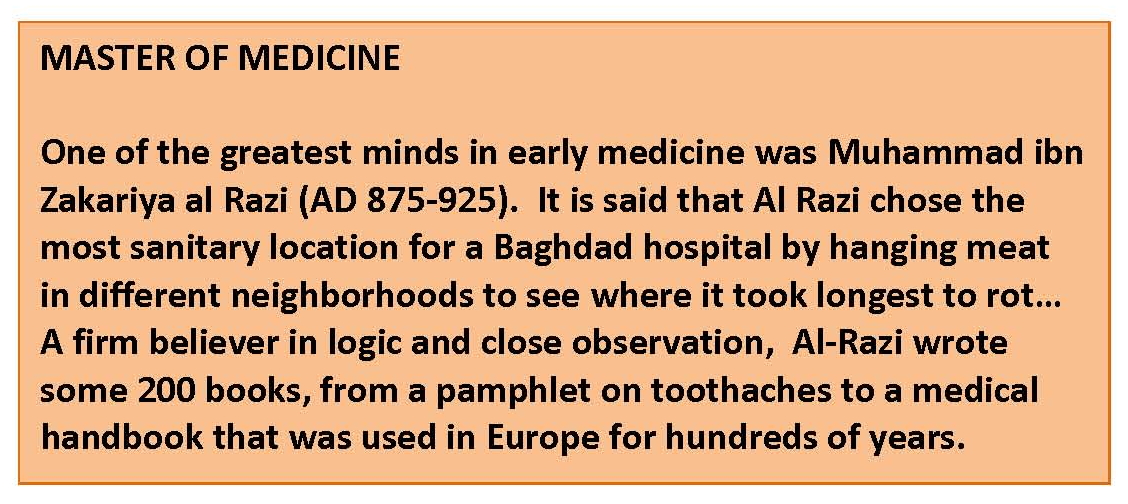
MEDICINE – FACTS
1. The history of Arabic science is that the scientists were among the Jews who were forced to convert to Islam. The Arabs had no scientific traditions as they rampaged into the near East, Egypt, and Libya in 694. The Jews had been long established in North Africa; eight Berber tribes converted to Judaism and, under their heroic Queen Kahena, liberated Libya. The Arab troops of 60,000 prevailed; 50,000 Jews and Berbers were massacred, and the descendants of the converted (not of the illiterate invaders) became “Arabic” philosophers and scientists.
2. A great physician, Isaac Israeli of Kairouan, was an Egyptian Jew who had immigrated to West
Africa, and brought his science with him. Known to Europe as Isaac the Jew, his surviving works include logic, On Definitions, and Aristolian physics, On the Elements; his work on Pharmacology, De Gradibus Simplicum, (translated into Latin) became the standard for medical history.
3. It was from Isaac Israeli that the greatest of “Arab” scientists, Avicenna (980-1037) drew inspiration. He was regarded as Arabic because he wrote in Arabic. He was known as the Aristotle of the East and became a vizier in Persia, but he was born near Bokhara, then heavily populated by Jews, and was probably of Jewish origin. Avicenna’s work reached Europe through translations by Jewish scholars in Spain, Italy, and Provence. The great physician Maimonides was an admirer of Avicenna, and recommended the Jews study his works in The Guide to the Perplexed. (at right)

http://en.wikipedia.org/wiki/File:Guide_for_the_Perplexed_by_Maimonides.jpg
4. Avenzoar was likewise a Moslem scientist of Jewish origin, “and may thus be included among the great Jewish physicians of history (Roth, 170). His great work, Taysir, was one of the most widely read medical treatises of the century, not least because it was translated early on into Hebrew, “the language of the author’s ancestors.” Johannes of Capua, a converted Jew, in collaboration with another physician from Padua, translated it into Latin in 1280. It was likewise at Padua that the great work of Avicenna, The Colliget (General Rules of health), was translated into Latin by the Jew Bonacosa. The book became a standard medical treatise; it continued to be published after the printing press was invented several centuries later … and there were others. Physicians who attended the lords and kings of Islam and Christendom were largely Jews, a convincing indication of the major role that Jews continued to play in the science of medicine.
DENTISTRY – FACTS
5. The first known mention of tooth decay and toothache occurs on a Sumerian clay tablet now referred to as the “Legend of the worm.” Recovered from the Euphrates valley, it was written in cuneiform, and dates from around 5000 BC. The belief that tooth decay and dental pain were caused by “tooth worm” is found in ancient India, Egypt, Japan and China, and persisted until the Age of Enlightenment.
6. The word antisepsis comes from the Greek words, anti (against) and sepsis (decay). Antiseptics prevent infection and other changes in living tissue by destroying or slowing the growth of germs (microorganisms that cause disease). The nature and use of anti-septics was not fully understood until the discovery of bacteria.
7. Physicians and healers have been aware of the anti-infective and anti-spoilage properties of certain substances since ancient times. Egyptian embalmers (people who preserved and prepared bodies for burial) used resins (an organic substance taken from plants and trees), naphtha (a liquid hydrocarbon often used as a solvent or diluting agent), and liquid pitch, along with vegetable oils and spices. The effectiveness of this mixture is shown in the fine state of preservation of Egyptian mummies. Persian laws instructed people to store drinking water in bright copper vessels. The ancient Greeks and Romans recognized the antiseptic properties of wine, oil, and vinegar for dressing wounds, dating back to the Greek physician Hippocrates (460 – 377 BC).
8. Ancient China is responsible for contributing much to the modern world, including many innovations to dentistry, and methods of treating tooth diseases – treating toothaches with arsenic, AD 1000, and developing silver amalgam for fillings. They were advanced in the observation of the oral cavity, specifically to mastication and deglutition, systemic diseases and their connection to oral manifestations, such as early detection of measles. Other studies included tooth extraction, abscesses, tumor removal and repair due to trauma, early repair of cleft palates, lip and other congenital defects, and the instruments required to perform such tasks.
TCP We Know Light
Jones Day
Anne and Dan Palmer
RAV Financial
Margaret W Wong &Y Associat5es Co., LPA
Anthony Y Yen
Cleveland Asian Festival
ClevelandPeople.com
Confucius Institute at CSU
Discount Drug Mart
Federation of India Community Associa5tions of Northeast Ohio
Global Cleveland
In June 2014, UNESCO designated the Chang’an-Tianshan corridor of the Silk Road
MEET THE CURATORS
Mark Norell
Mark A Norell, curator and chair of the Division of Paleontology at the Museum, has been a team leader of the Joint American Museum of National History/Mongolian Academy of Sciences expeditions to the Gobi Desert, with interests and books written on invertebrate fossils and dinosaur species. I found nothing to suggest that he had any in-depth interest in or discoveries about the Silk Road.
Denise Leidy
Denise Leidy’s bio indicated a deep interest in Asian art and culture, and that she has traveled widely on the Silk Road. A specialist in Chinese sculpture and decorative arts in the Buddhist traditions, there was little or nothing of this included in the exhibit. The majority information focused on Islam. Further, if she curated several exhibitions of Glimpses of the Silk Road, is she not aware of the early stages and the cultures that were responsible for this massive development and progress that affected civilization? Surely some due diligence would have uncovered the facts that are available to all who are willing to delve for accurate attribution.
William Honeychurch
William Honeychurch’s expertise falls into the category of the archaeology of ancient nomadic politics of Mongolia, and the Silk Road of the Steppes region. There was no inclusion of the Silk Road into Mongolia. I question its exclusion and concentration on Islam.

 Centinel2012
