
Posted originally on Jul 1, 2026 by Martin Armstrong |
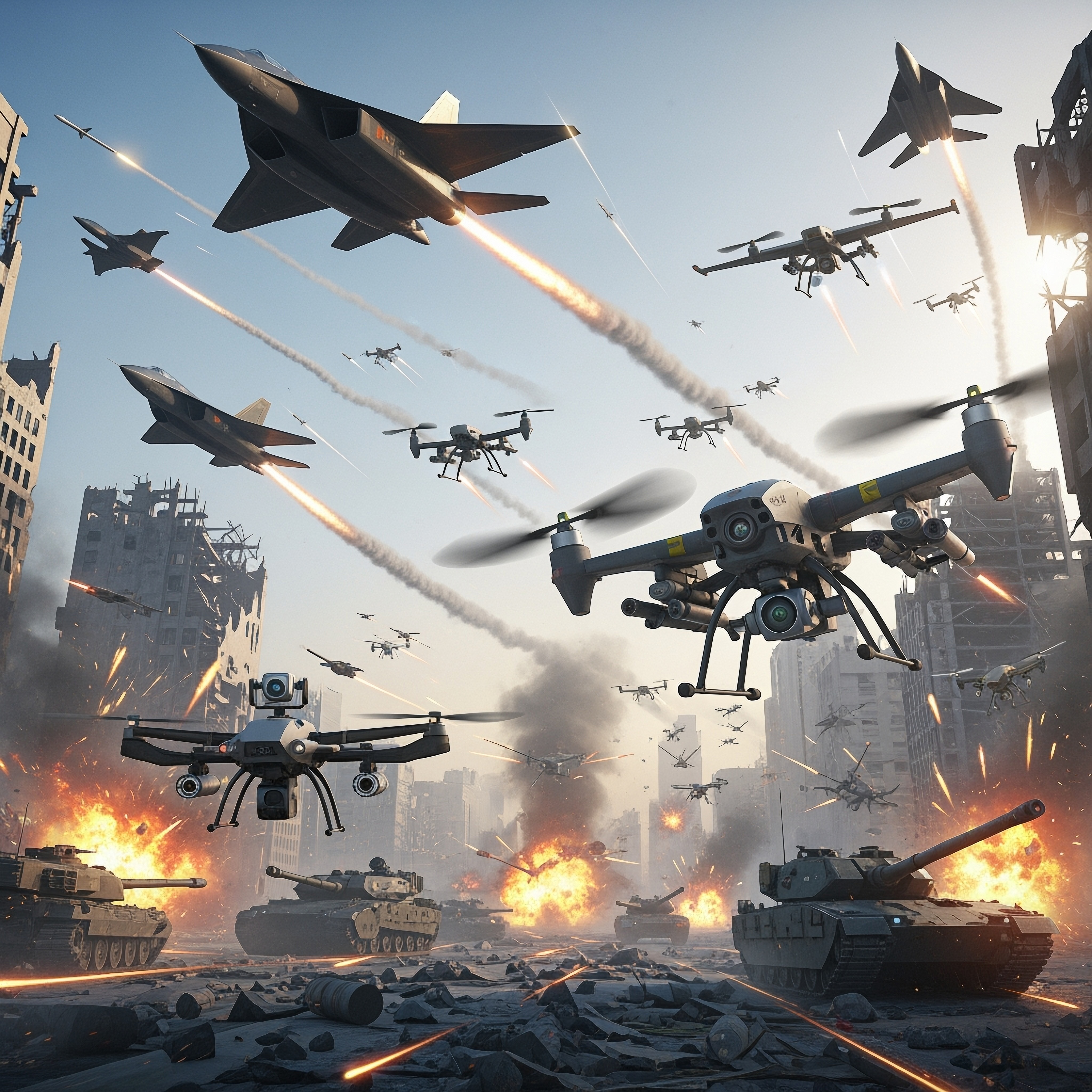
Military strategists are still fighting the last war while the battlefield has already changed. Every major conflict throughout history has been defined by a technological revolution. Gunpowder ended the age of castles. Tanks transformed World War II. Precision missiles reshaped modern warfare. Now we have entered the age of the drone. The military that cannot dominate the skies with unmanned systems will lose, regardless of how many tanks, aircraft, or soldiers it possesses.
South Korea has reached the same conclusion. Its Defense Ministry announced that it will train approximately 500,000 soldiers, sailors, airmen, and marines as “drone warriors.” Defense Minister Ahn Gyu-back said every service member should become as proficient with drones as they are with their personal weapons. The plan calls for procuring 11,000 commercial drones by the end of 2026, expanding to 60,000 training drones by 2029, while also acquiring more than 20,000 low-cost combat drones by 2030. Seoul is accelerating production of loitering munitions, AI-enabled drone swarms, laser weapons, and microwave systems designed to destroy incoming drones.
They are responding to the lessons of Ukraine, where inexpensive FPV drones costing only hundreds or thousands of dollars routinely destroy tanks worth millions. The battlefield has become saturated with unmanned aircraft. Ukraine plans to manufacture roughly 7 million military drones in 2026 after producing about 4 million in 2025. According to Ukrainian officials, drones now account for the overwhelming majority of battlefield strikes, fundamentally changing military doctrine. Entire branches of both the Ukrainian and Russian militaries are now dedicated solely to unmanned systems.
A modern drone operator can eliminate armor, artillery, supply convoys, or individual soldiers from miles away while sitting in relative safety. Fiber-optic drones have largely defeated electronic jamming. AI-assisted targeting is reducing operator workload. Swarm attacks can overwhelm traditional air defenses that were designed to intercept aircraft, not hundreds of inexpensive autonomous systems arriving simultaneously. Ukraine has even developed interceptor drones whose sole mission is to hunt other drones, creating an entirely new layer of aerial combat.
South Korea is not alone. Russia formally established its Unmanned Systems Forces, with Ukrainian military estimates claiming the branch could expand from roughly 80,000 personnel today to more than 165,000 during 2026 and perhaps over 200,000 by 2030. NATO countries are pouring billions into drone production, counter-drone technologies, autonomous weapons, and electronic warfare. The United States, China, Israel, Turkey, and Europe are all racing to build domestic drone industries because they understand the next war will not be won by the side with the largest army. It will be won by the side that can produce, replace, and innovate faster than its opponent.
This is precisely why I have warned that the War Cycle is changing the global economy. Wars no longer require decades to build fleets of battleships or thousands of heavy tanks. A nation with sufficient manufacturing capacity can produce tens of thousands of drones every month. The barriers to entry have collapsed. Software updates now matter as much as ammunition. Engineers have become as important as infantry.
The defense industry is no longer limited to traditional contractors producing aircraft carriers and fighter jets. Semiconductor manufacturers, AI companies, battery producers, optics firms, communications specialists, robotics companies, and rare-earth miners have all become part of the defense sector. This is why governments are scrambling to secure critical minerals, expand chip production, and protect supply chains. They are preparing for a world where industrial capacity determines military survival.
Our computer has consistently projected that 2026 marks the acceleration of the international War Cycle. The military transformation unfolding before our eyes confirms that forecast. The next great conflict will not resemble Iraq, Afghanistan, or even the opening stages of Ukraine. It will be fought by autonomous systems, artificial intelligence, electronic warfare, and millions of inexpensive drones operating continuously across every battlefield. The drone has become what the machine gun was in World War I and what the tank became in World War II. Anyone who fails to recognize that reality is preparing for a war that no longer exists.

