Posted originally on Nov 12, 2025 by Martin Armstrong |
The Federal Reserve quietly pumped $125 billion into the repo market during the last week of October. Red flags have been raised that the banks are in desperate need of liquidity, but there is a deeper issue at play—the entire system is under stress.
In a special report for institutional clients, I detailed the progression of the Liquidity Crisis we had forecast would erupt at our Rome World Economic Conference, come September 2019. The early warning signs were right there in our face if you just looked. The next stage emerged into the Repo Crisis, and the third stage will unfold as the Mother of all Financial Crises.
The central bank stepped into the repo market in 2019 and has not injected an amount this large since the 2020 pandemic. This move comes as bank reserves drop to a four-year low of $2.8 trillion and liquidity is certainly a valid concern. More importantly, the Fed wants banks to trade US debt for cash and force the private sector to absorb the debt. The Fed does not want to publicly provide a bail out so they inject money into the standing repo facility and lend against Treasuries.
The public must have confidence in the banks, and the banks must have confidence that the Federal Reserve will always catch them before they fall. We’ve seen several smaller banks go under in 2025, yet they were small enough not to raise concerns. The Fed fears panic more than it fears inflation. Powell knows that the central bank lost the ability to control inflation, but for now, it can control panic.
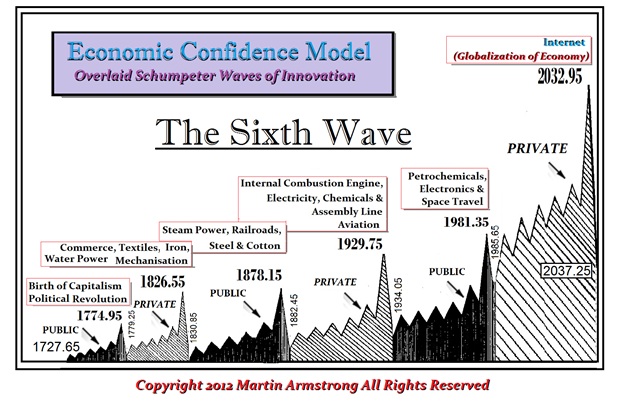
The cycle cannot be prevented. The systemic issues are too far gone for repair. As we move closer to 2032, the banks will impose heavy regulations and capital restrictions. Eventually, the banks will lose trust in the Fed, and the people will lose confidence in the banks.
Posted originally on Nov 11, 2025 by Martin Armstrong |
Belgium abolished mandatory military service in 1995, operating with an all-volunteer military force. The defense department has been keenly interested in recruiting young men to join since it became apparent that Belgium would become involved in the Russia-Ukraine-NATO war. Defense Minister Theo Francken issued a message on X: “All 17-year-olds in the country are encouraged to learn about the Ministry of Defence and, in particular, to volunteer for military service. Let’s get started!”
Clearly, there is a reason for concern. The military recently implemented a voluntary program aimed at young men aged 18 to 25, offering a monthly salary of 2000 euros for enrollment. The defense department is hoping to recruit 500 new soldiers in the short term, but plans for a full-scale military expansion of 7,000 new troops.
The youth cannot find jobs; Belgium has one of the highest rates of youth unemployment among EU members at 16.75%. Employment opportunities are extremely limited on a regional basis as well. The Brussels-Capital area has a youth unemployment rate a bit above 17%, but places like Wallonia exceed 20%, and in Flanders, over 30% of the youth cannot find employment. The average salary in the nation across all sectors was 3,700 EUR, but the average soldier is taking home 57,860 EUR. The youth can find secure stable employment within the military, earning 35,520 EUR annually with no prior experience. Governments historically have a far easier time building their militaries when youth unemployment is high.
Russian drones have infiltrated Belgium’s airspace on several occasions this past year. The neighboring nations have had formal diplomatic ties for over 165 years with strong bilateral trade. Yet, Belgium is beholden to Brussels and NATO. The EU has been pressuring Belgium to break ties with Russia, demanding that it implement sanctions and use frozen Russian assets to finance Ukraine. Belgium need not pick a side as it is already aligned with two globalist organizations that override national sovereignty.
Posted originally on Nov 11, 2025 by Martin Armstrong |
Texas is open for business—permanently—as the state solidifies business-friendly measures in its constitution. Texas is signaling to businesses and institutions that it is safe to relocate, as the state will not be vulnerable to massive political regulatory shifts.
The Texas Stock Exchange (TXSE) is poised to open in Dallas next year.Y’all Street has been rapidly booming in popularity as Wall Street refugees flee south. There are already nearly 400,000 financial professionals in the area and institutions like Goldman have plans to create new facilities nearby. To ensure that businesses continue to flee south, Texas has permanently issued a ban on securities transaction taxes. By law, the state may not impose taxes on payroll transactions or financial trades.
Conduct business in Texas, and Texas will not extort your earnings. New modifications to the Constitution prohibit any taxes on capital gains. Texas will not profit from the sale of real estate, capital assets, the sale of investments. Businesses can rest easy in knowing that there will not be a tax on success at the state level. Let us not forget that the Biden Administration wanted to slap a 44.6% tax on capital gains federally. There have been proposals at both the state and federal levels to tax unrealized gains—a sure way to financial suicide.
Again, wealth is not a punishable offense in Texas. The third constitutional amendment bans inheritance and estate taxes. Inheritance Taxes are Marxist and highly destructive economically. Suppose you have a company worth $100 million; your children must pay 40% taxes. They have to fire people and sell assets to cover the tax. Heirs have been forced to sell their family businesses or farms to pay inheritance/death taxes. It is a Marxist assault on property and passing on family wealth. The tax itself disincentives entrepreneurs from creating a legacy. No one aims to work their lives away only to pass on their earnings to the state.
CAPITAL MUST BE ATTRACTED. Capital cannot be strangled or confined. Hunting down capital causes it to flee for safety, a safety that can now be found in Texas.
Posted originally on Nov 11, 2025 by Martin Armstrong |
President Donald Trump has proposed a $2,000 tariff “dividend” to every American. Reminiscent of the stimulus checks provided during COVID-19, the payment comes at a time of low public confidence in government and government policy.
Tariffs generated $151 billion between April and October, according to the Committee for a Responsible Federal Budget. Treasury Secretary Scott Bessent believes duty collections will reach half a trillion per year.
This does not simply mean that the US federal government has a few extra billion lying around to disperse to the public. America has over $37 trillion in debt that is expanding by the second. Tariffs are an indirect tax paid by consumers through higher prices, not a penalty absorbed solely by foreign producers. A “dividend” payment to Americans would offset that indirect tax. This is not inflationary in itself, rather, it is merely shifting money from importers and consumers back to individuals. It’s a redistribution, not a monetary expansion.
“The $2,000 divided could come in lots of forms,” Treasury Secretary Scott Bessent said. “It could be just the tax decreases that we are seeing.” Also reminiscent of the COVID stimulus checks, these payments likely would not go to Americans earning over a certain threshold. The US does not need to stimulate spending at this time. Consumer spending remains high amid inflation. Consumer sentiment is low, but that does not correlate with spending; however, it does correlate with confidence.
The nation recently witnessed the celebration of a socialist politician, Zohran Mamdani, who became the mayor of NYC through free offerings. The public has its hand out and is waiting for the government to fix the cost-of-living crisis. The premise is more of a political stimulus rather than a monetary one.
The public always demands government do something, and politicians respond with short-term gimmicks to preserve power. But the underlying problem is systemic. We’re witnessing the end of Keynesian economics. The idea that government can endlessly manage the economy through fiscal manipulation is dying.
Posted originally on Nov 11, 2025 by Martin Armstrong |
QUESTION: Mr. Armstrong, I am new to your site. I have a question. I understand you are a trader, not an academic. That is the only reason I do read you. Why are academics incapable of ever forecasting the economy?
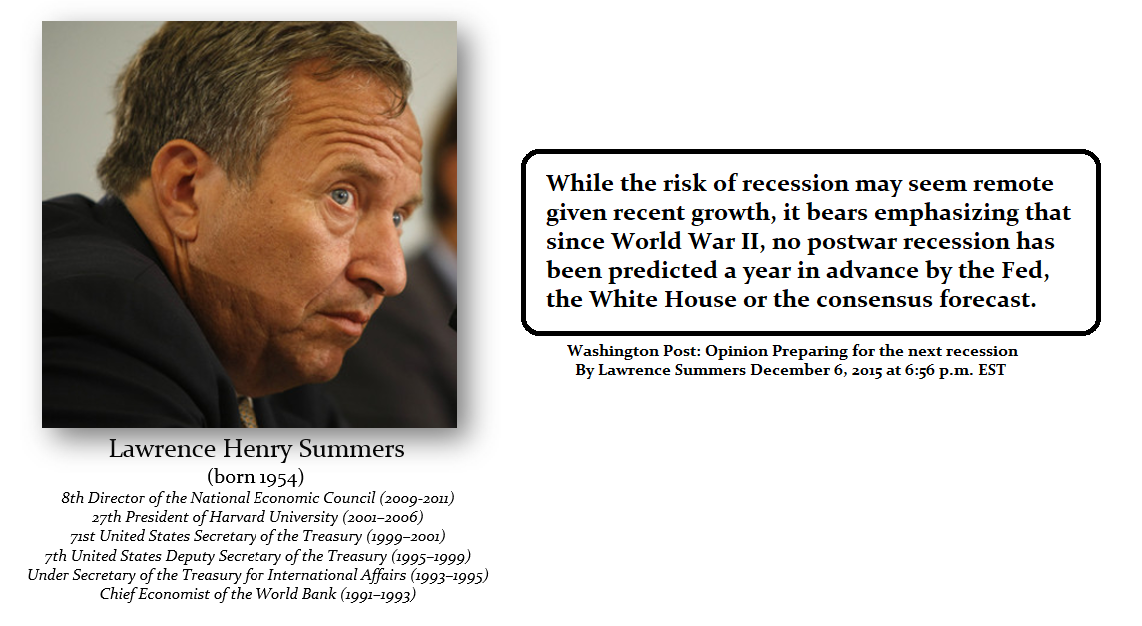
ANSWER: If you just listen to the interview of Larry Summers on forecasting, you will see that they do not believe you can forecast anything because it is complex like , so weather if your forecast come true, it is only because of influence – not some model forecast. This is why they have hated me so much. They refuse to accept that there can even be a model or cyclical analysis.
Posted originally on Nov 10, 2025 by Martin Armstrong |
The next report is now in the portal for those attending the WEC November 21-23 in Orlando. This is going over the various aspects of the model and it deals with the post-2032 period as well as between here and there. I put a lot of work into this report to deal with the big questions ahead.
Posted originally on Nov 10, 2025 by Martin Armstrong |
QUESTION: Do you see the world coming to the brink of nuclear war or the collapse of governments? How do we survive?
LQ
ANSWER: We are headed into a major change politically on a global perspective. That is NOT the end of the world. This is an opportunity for us to reset government and let us just once learn from the past and make the necessary corrections. This is a big change, just as overthrowing the monarchy was the last time.
As far as nuclear war, Europe is the real risk. They are pushing for war rather than reform just to retain power. They honestly believe that they can conquer Russia and that save the European Union. Sorry, that is a failed idea. If NATO invades Russia, then expect at least tactical nukes.
I am doing my best to try to keep the USA out of this mess. I cannot prevent war, the best I hope is that I can reduce the amplitude. We will make it through these confusing times. If you understand what is coming, then you can duck. If not, then you get sucker-punched.
originally on Posted Nov 10, 2025 by Martin Armstrong |
American household debt has reached a new all-time high after rising by $197 billion in Q3 to $18.59 trillion. American consumers, the breadbasket of the national economy, are overleveraged. The economy is less likely to absorb shocks from trade disruptions or shifting interest rates.
Two-thirds of US GDP is based on consumer spending. Trade was bountiful in this consumer economy as other nations lined up to sell to the American consumers. Manufacturing was once a strong point, but it has since flattened, now in an eight-month consecutive contraction. Government, institutions, businesses, and now the consumer are drowning in debt—confidence in the future has vanished.
The situation is dire, multiplying in scope since the pandemic. Overall debt has spiked $4.4 trillion since the end of 2019. Mortgage balances have reached $13.07 trillion, up $137 billion from last quarter. People are holding onto their pandemic-era mortgage rates for dear life. The over-asking price bidding wars are over as real estate is firmly in a buyers’ market. The younger generation cannot enter the housing market.
Student loan debt is now calculated in overall household debt. Millions believed the last administration’s promise that their debt would be forgiven. Student loan debt reached a record high of $1.65 trillion, rising $15 billion from last quarter. Nearly 10% of all student debt has been reported as 90 days delinquent.
Credit card balances went up $24 billion in Q3 to $1.23 trillion. Interest and principal may be flowing from households to banks and financial institutions, for now, but the softening labor market indicates that delinquencies will continue to rise.
Debt servicing costs will rise as lenders aim to offset any additional losses. Consumer spending has been steady broadly speaking but consumers are spending more on less. With the U.S. consumer heavily leveraged, the capacity to absorb shocks from trade disruptions, rising interest rates, or global capital shifts is reduced. If the American consumer hurts, the entire economy feels the pain.
Posted originally on Nov 10, 2025 by Martin Armstrong |
The US workforce saw a brief bump in hiring this October, coupled with a steep rise in firings. The Bureau of Labor Statistics will likely not publish job data again this year due to the government shutdown. The Federal Reserve’s preferred gauge of the US workforce is unavailable, but what we do have is independent data from the ADP and Challenger, Gray & Christmas.
On one side, the private sector scored its first notable month of hirings since July 2025. The ADP estimates that employers brought on 42,000 new employees last month, exceeding expectations. Mega corporations led in new hires for the month. Trade, transportation, and utilities added 47,000 new jobs, followed by education and health care at 25,000. Professional business services experienced a 15,000 loss, information positions were cut by 17,000, and leisure and hospitality shed 5,000 jobs.
Pay increased at a 4.5% annual rate. Some see the ADP data as promising, considering the 29,000 positions lost in September.
However, Challenger, Gray & Christmas found that firings in October peaked at a 22-year high. Job cuts for the month surged 183% from September to 153,074, also marking a 175% annual rise. This is the highest reading for layoffs in October since 2003. The agency found that 2025 has seen the steepest layoffs since the Great Recession era of 2009.
“Like in 2003, a disruptive technology is changing the landscape,” said Andy Challenger, workplace expert and chief revenue officer at the firm. “At a time when job creation is at its lowest point in years, the optics of announcing layoffs in the fourth quarter are particularly unfavorable.”
Nonprofit agencies shed 27,651, a 419% annual rise. The agency reported that 27,651 jobs in the tech sector, an area that is rapidly shrinking, with total layoffs coming in six times higher than in September.
AI replacement is fueling the workforce contraction that was ignited by a loss of confidence. Lower rates did not entice companies to expand their workforce last month, as they see no growth in the future. Companies will continue to replace jobs with AI or outsource to India where possible. Cities requiring a high minimum wage will begin moving to AI immediately.
There have been over 1.1 million layoffs in 2025, a 65% increase from the same time period in 2024. The economy has not seen such a “softening” since the world shutdown in 2020. Our computer models indicate that this is, unfortunately, the beginning of a trend, and we will see companies continue to downsize in 2026.
Posted originally on Nov 10, 2025 by Martin Armstrong |
I have written about how in 260AD, Emperor Valerian (253-260AD) led the Roman army against the Sassanian Persian Empire, ruled by King Shapur I. At the Battle of Edessa, the Roman army was decisively defeated, and Valerian was taken prisoner. This was an unprecedented and catastrophic event—a Roman Emperor had been captured alive on the battlefield. That was the first time in history. That set off a financial panic.
When Valerian was captured and Rome could not rescue him, the confidence in the Empire began to collapse. People were even suddenly skeptical about accepting Roman coins. Would they still be worth anything since they were valued over and above their actual metal content?
A document from Egypt has survived illustrating the financial crisis that was unleashed. It is from Aurelius Ptolemaeus who is the strategus of the Oxyrhynchitenome. The public officials gathered and accused the bankers of closing their doors on account of their unwillingness to accept the divine coins of the Emperors. It became necessary that an order had to be issued to all the owners of the banks directing them to open and accept and exchange all coins except the absolutely spurious and counterfeit. It was also directed that all who engaged in business transactions who refused to comply would be penalized. (POxy 1411 260AD, cited by Burnett 1987: p104)
Valerian’s capture was a massive propaganda victory for Shapur. Persian inscriptions and rock reliefs (like at Naqsh-e Rostam and Bishapur) show Valerian humiliated—submitting to Shapur on his knees, or being held captive by the king. This is what Iran has turned into a statue.
Valerian’s body was never returned to Rome and his son, Gallienus couldn’t rescue his father because the entire Roman world was on fire, and leaving the heart of the empire undefended would have meant its immediate collapse. While Valerian was in the East, Gallienus was fighting for his life in the West.
Massive invasions by the Germanic tribes, the Alamanni and Franks, had broken through the Rhine frontier, penetrating deep into Gaul, Raetia, and even reaching as far as Italy and Spain. The Goths and other tribes were launching devastating seaborne raids across the Black Sea and the Aegean, attacking the Balkans and the coast of Asia Minor. If Gallienus had marched the bulk of his army east to Persia, there would have been nothing to stop these Germanic tribes from overrunning Italy and sacking Rome itself.
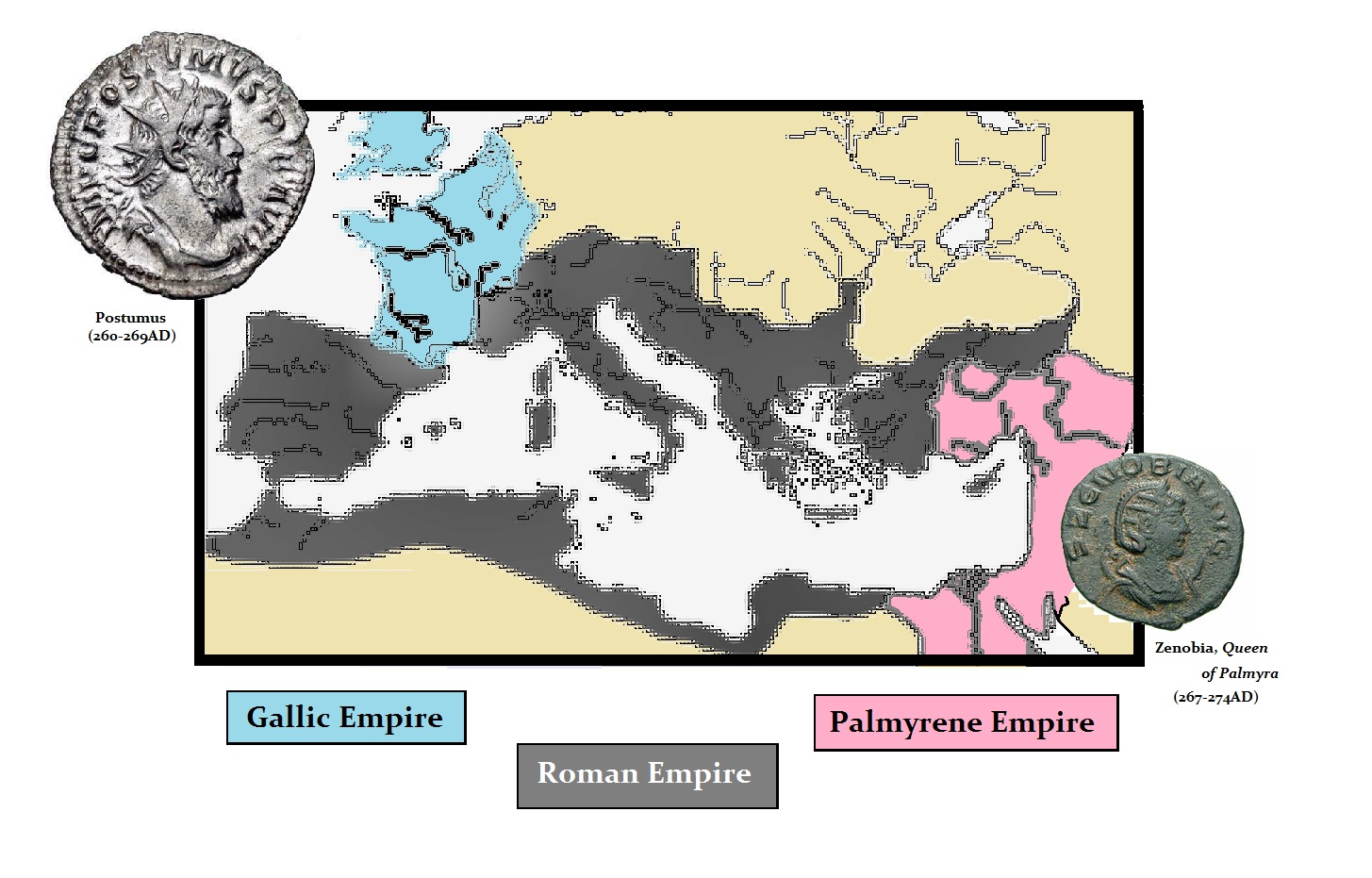
The capture of Valerian created a power vacuum and a perception of weakness that immediately led to rebellion also within the Roman Empire. Just after Valerian’s capture, the military commander Postumus was proclaimed emperor in the West. He seized control of Gaul, Germania, Britannia, and Hispania, creating a separate, breakaway empire that would last for 14 years. Gallienus spent the next several years fighting Postumus in a civil war, unable to dislodge him.
In the East, the Sasanian Persian King Shapur I, who had previously captured Roman Emperor (Valerian), invaded the eastern Roman provinces. With the central Roman government in crisis (the period known as the Crisis of the Third Century), it fell to Zenobia’s Palmyrene forces to defend the region. Zenobia’s brilliant general, Zabdas, was the primary military commander in these campaigns. The Palmyrene army soundly defeated the Persians, pushing them back and even securing territories like much of Roman Arabia and parts of Egypt.
This period saw a revolving door of emperors and usurpers. Gallienus himself had to deal with at least eighteen known usurpers during his reign. Marching east would have been an open invitation for another general to seize Italy. This is where the legend comes in. The most gruesome account comes from the later Roman historian Lactantius, a Christian writer who was deeply hostile to the pagan emperors who had persecuted Christians (Valerian was one of them). He claims that Valerian died in captivity, King Shapur had his body flayed (skin removed). The skin was then tanned and dyed with vermilion (a red pigment). This preserved, red-colored skin was then stuffed with straw and put on display in a Persian temple as a permanent war trophy and a symbol of the Persian victory over Rome. Most assume that this account was invented as a powerful piece of moralizing propaganda piece as the fate of pagans.
Iran Resurrecting this Historical Event is to show that Iran defeated even the Roman Empire
I have created this site to help people have fun in the kitchen. I write about enjoying life both in and out of my kitchen. Life is short! Make the most of it and enjoy!
This is a library of News Events not reported by the Main Stream Media documenting & connecting the dots on How the Obama Marxist Liberal agenda is destroying America













 Centinel2012