Posted originally on Jan 30, 2026 by Martin Armstrong |
Physical bank branches are disappearing along with relationship banking. The Office of the Comptroller of the Currency (OCC) files state that the US lost a net total of 339 bank branches in December 2025. The S&P Global and Federal Reserve found that the US has been losing, on average, 1,600 bank branches per year.
Santander announced that it would be shuttering 44 branches in Q1 2026, noting a move toward digital banking. TD Bank plans to close 51 branches across 13 states as it aims to cut 10% of its brick-and-mortar locations. JPMorgan Chase announced 66 branch closures in late 2025. US Bank, Wells Fargo, PNC, Bank of America, Citizens Bank, Flagstar, and every other major banking chain are moving away from physical banking as people favor online convenience, and the government favors online monitoring.
Digital banking will continue to grow. Branches will continue to close. But do not confuse a trend with a solution. Convenience is being sold as innovation, yet what is really happening is the consolidation of financial power and the reduction of public access points.
Relationship banking was built on human judgment. Transactional banking is built on algorithmic approval. This is something I have warned about for years.
Under relationship banking, they lent you money but monitored your business and ability to repay. This imposed some rational constraints. Under the new transactional banking model, the New York bankers sought to repeal Glass-Steagall, and they have transformed into brokers, packaged loans, and resold them. They no longer cared about the borrower, for the motive is how they can sell it.
Under relationship banking, your local banker knew who you were. They understood your business, your family, your reputation, and your history in the community. Loans were not always granted because a formula said yes. They were granted because character and long-term trust mattered. The system was decentralized in practice, even when imperfect. Now you are reduced to a data profile.
A banker could vouch for a person based on their relationship and push through loan approval. With transactional banking, a model can reject the loan, and that’s the end of the discussion. One is local, and the other is centralized.
As governments move toward tighter financial surveillance, digital currencies, and automated reporting, relationship banking becomes an obstacle. It introduces flexibility into a system that regulators want to be rigid.
Posted originally on Jan 30, 2026 by Martin Armstrong |
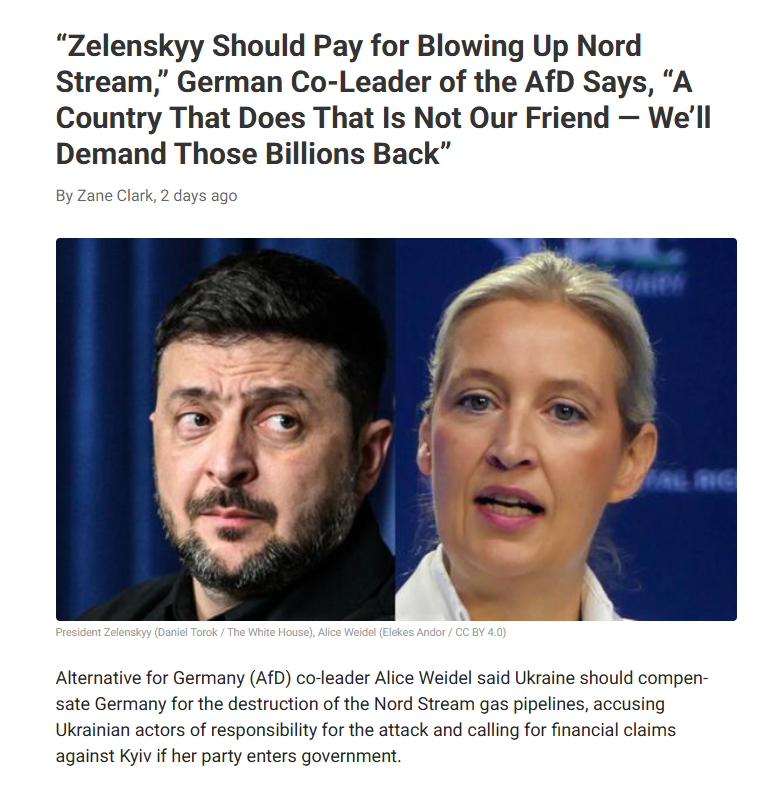
Perhaps there is no greater example of how the EU elite couldn’t care less about the people who constantly support their hand-picked puppet Zelensky, yet turn a blind eye to his blowing up of Nord Stream. Every European leader who supports Zelensky should be thrown in prison for treason. ONLY the AFD in Germany has stood for law and order and recently said:
“Zelenskyy Should Pay for Blowing Up Nord Stream”
Zelensky does not care for anyone but himself. He has destroyed German jobs to try to hurt Russia and does not care what he does to anyone else. Any European that supports Ukraine is a traitor to the people of Europe.
Video Player
00:00
02:15
From the outset, just 3 months into the war, I reported that Ukraine lost 100,000 soldiers. Some instantly accused me of put out Russian propaganda because they love to listen to the Neocon propaganda. It turns out that was classified information. Ursula von der Leyen, the head of the EU, had released a video and then edited it deleting that very information I reported at the request of Zelensky. All this is to hide the fact that Ukraine has been losing the war. With its armed forces down at least one-third in the first few months.
There is absolutely NOTHING that Zelensky has said that has proven to be true. In Italy, he claimed Russians were capturing children and torturing them. This was another outrageous lie. That allegation vanished. He says whatever he can to get money. He could have just complied with the Belgrad and Minsk Agreements but he is determined to lead the world into war. Trump, according to sources, has told him he must surrender the Donbas to get security guarantees.
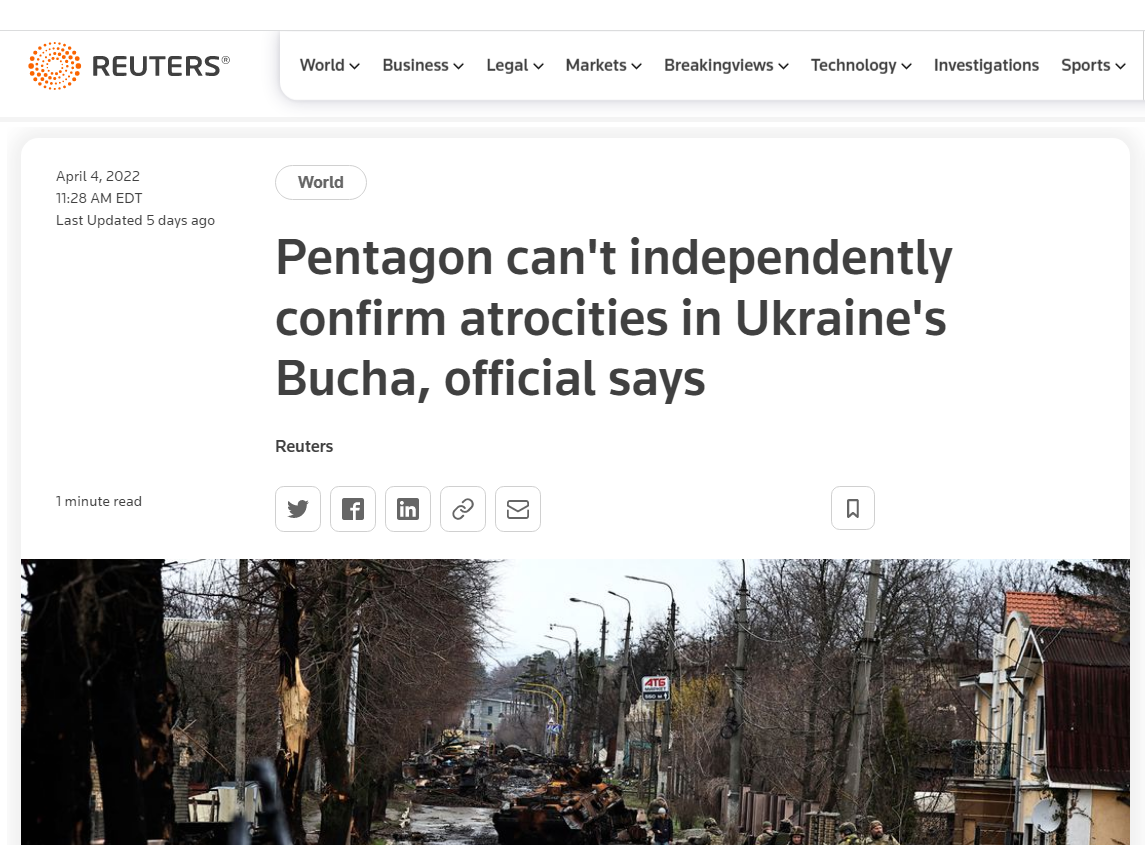
The US Pentagon has come out and even said that they CAN NOT independently verify what took place in Bucha. There is no way to verify anything in Bucha and there are videos that show people laying in the street pretending to be dead with no blood and then there are videos showing they get up when the camera passes.
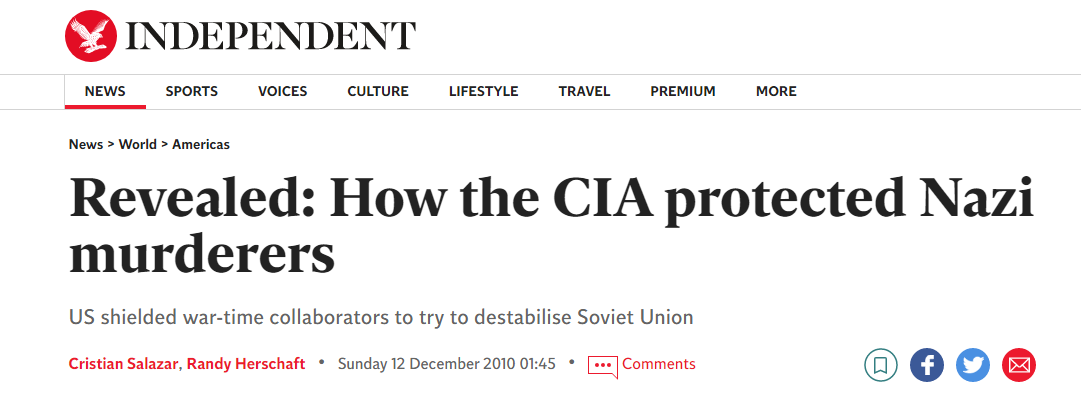
I have videos that are too horrible to even post of Ukrainian taking captured Russian soldiers, crucifying them, and then burning them alive. Ukraine is the motherland of ethnic cleansing. That is why the CIA protected them because they were killing Russians.
Anyone who thinks this I am Putin supporter, I will pay for your ticket to Ukraine and even buy you a gun. Go put your manipulated beliefs to the test.
Posted originally on Jan 29, 2026 by Martin Armstrong |
We are witnessing an unmistakable shift in the US housing market, not a bubble pop like 2008, but a market regime change characterized by buyers retreating as inventory rises and affordability remains strained. Recent data from Redfin shows that roughly 40,000 US home-purchase agreements were canceled in December, representing about 16.3% of homes that went under contract–the highest level for that month since at least 2017.
Excess demand and historically low mortgage rates drove the housing market until around 2023. Trends that cannot continue forever eventually break down when the cyclical structure turns. The peak in housing demand, much like in equities or commodities, eventually lost momentum as mortgage rates climbed and affordability deteriorated.
We also saw a mass exodus out of states like New York and California due to policy, first surrounding COVID restrictions followed by excessive taxation. The political landscape has remained relatively stable on a state-wide basis and both people and corporations have settled in their respective states.
Even as longer-term bond yields and mortgage rates have slightly pulled back, with average 30-year mortgage rates near their lowest point in over three years, they remain elevated compared with the ultra-low era of the early 2020s. Higher rates are pushing monthly payments beyond what buyers are able to afford. Sellers now outnumber buyers by record margins, a dynamic unseen in the recent boom years when over-ask bidding wars were commonplace.
In a boom market, buyers panic, compete, and push prices higher. In a cooling market with more listings, they withdraw when the deal doesn’t meet their financial reality. This is the behavior captured in the cancellation data provided by Redfin. Inspections and contingencies come with a high price tag and can cause buyers to walk away as every aspect of maintaining a home comes with a high price tag.
The problems in 2008 stemmed from systemic financial excess, predatory lending, adjustable-rate resets, and a lack of vetting. It was not an organic situation, but rather, conditions manufactured by credit expansion by financial institutions and rating agencies. We are not witnessing defaults because buyers are choosing to walk away before the purchase. Buyers and lenders are both evaluating risks and stopping deals in their tracks.
Wage growth, while improving, hasn’t kept pace with housing cost inflation over the last decade, especially after the dramatic increases in home prices since 2020. Combined with mortgage rates above long-term averages and elevated property taxes and insurance, the effective cost of homeownership has climbed faster than incomes for many.
Affordability is of particular concern with younger demographics who have been priced out of the market. Starter homes are not what they once were.
The market is recalibrating and corrections are occurring before systemic debt defaults. All participants are making choices based on affordability and the heightened risk of not being able to make payments. It is almost difficult to call this a buyer’s market as no one feels they are walking away with a great deal.
Posted originally on Jan 29, 2026 by Martin Armstrong |
Jerome Powell came out to defend the integrity and sovereignty of the Federal Reserve. “The point of independence is not to protect policymakers or anything like that. It is just that every advanced economy and democracy in the world has come around to this common practice. It’s just an institutional arrangement that has served the people well, and that is to have a separation between — to not have direct elected official control over the setting of monetary policy,” he said.
“The reason is that monetary policy can be used, you know, through an election cycle to affect the economy in a way that will be politically worthwhile,” Powell said. “If you lose that, it’s going to be hard to retain it, and we haven’t lost it. I don’t believe we will… it’s enabled central banks generally not to be perfect, but to serve the public well.”
I do not agree with Trump that political leaders should control the Federal Reserve or dictate monetary policy. That would be a serious mistake. Politicians operate on short election cycles and will always favor policies that produce immediate results, regardless of the long-term consequences. However, that does not mean the Federal Reserve is genuinely independent, nor does it mean that its structure has “served the people well,” as Powell claims.
The Federal Reserve is appointed by politicians, confirmed by politicians, and ultimately exists to support government financing. Its primary function today is to ensure that government debt can be issued and serviced. If it were truly independent, it would refuse to accommodate endless deficit spending. It does not. Instead, it responds to fiscal excess by monetizing debt and then pretending inflation is something mysterious beyond its comprehension.
The Fed was created in 1913 as a regional system precisely because capital flows change with the seasons. Crops are planted, money flows one way; harvest arrives, it flows another. That design worked because it was decentralized. What destroyed that structure was not politicians meddling in interest rates, but war. World War I forced the Fed to abandon its original mandate and become a funding arm of government debt. From that moment forward, independence ended.
The Fed today is appointed by politicians, confirmed by politicians, and operates entirely to accommodate government borrowing. If it were truly independent, it would refuse to monetize debt. Instead, it has enabled the largest expansion of government liabilities in human history while claiming neutrality. This is why the entire debate between “Fed independence” and “political control” is a distraction that neither can control inflation, and confidence itself is eroding.
Posted originally on Jan 29, 2026 by Martin Armstrong |
Microsoft provided the FBI with Bitlocker encryption keys. It should come as no surprise that a US-based cloud storage service provided US intelligence with backdoor access. Encryption is only as strong as the one who controls the key to lock it.
Microsoft, the world’s dominant provider of desktop and enterprise systems, complied with an FBI warrant and handed over BitLocker recovery encryption keys. This provided the FBI with access to the encrypted hard drives of laptops seized in a fraud investigation tied to pandemic unemployment benefits.
By default, modern Windows installations tied to a Microsoft account store the BitLocker recovery key in Microsoft’s cloud infrastructure. This is sold as convenience: you forget your password, Microsoft can help you get back in. What few users appreciate is that this convenience places the key into the custody of a third party, and once a third party holds that key, it is subject to the legal and political pressures of every legal jurisdiction in which that company operates.
Encryption only works if the key is inaccessible to outside parties. The moment a third party holds a copy of that key and the encryption itself becomes only symbolic. It still scrambles the data, but the lock no longer belongs exclusively to the individual.
When Apple famously resisted the FBI’s demand to unlock an iPhone a decade ago, the tech world broadly supported the notion that encryption keys should remain private. Government will always overpower the private sector. The US immediately used the “national security” plea and drafted legislation to ensure that intelligence agencies had backdoor access to all online activities. Everyone government has demanded access to online user data; companies are forced to comply.
Last February, the United Kingdom’s deep state demanded that Apple create a back door for them to retrieve all the content any Apple user worldwide has uploaded to the cloud, which would be an unprecedented erosion of online privacy and civil liberties. This works because once the UK seizes your data, they can hand that to the Feds in the states, and your Constitutional rights are NOT violated because the US government did not illegally seize it without a warrant.
I refuse to store anything on a digital cloud that could be compromised by the government. Under no circumstances ever store ANYTHING in the cloud, for you have no constitutional rights, and they can claim whatever they desire. The government can add items to your cloud and send you to prison.
Privacy erosion has shifted power to the state and corporations over the individual. It should come as no shock that the government demanded cloud access. The real concern is digital IDs and currency; governments are pushing to move everything digital for complete control. In my article “How to make a mint: the cryptography of anonymous electronic cash,” I discuss the NSA’s role in the digital financial system. Governments access everything you do online, on your phone, and through your bank account. Governments can justify physical searches without warrants. Nothing is sacred; your privacy rights were eliminated long ago.
Posted originally on Jan 28, 2026 by Martin Armstrong |
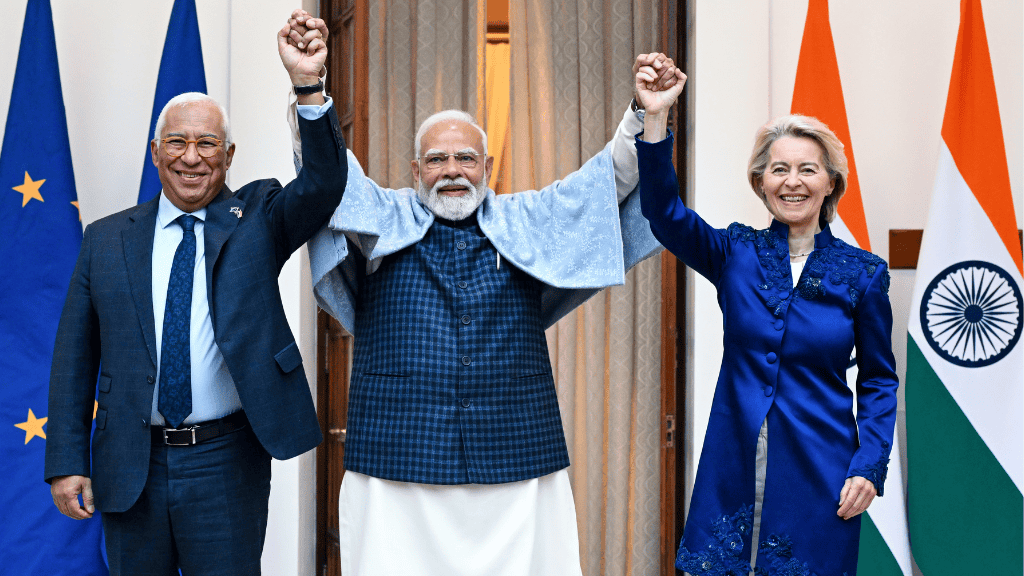
Deemed the “mother of all deals” by Commission President Ursula von der Leyen, India and the European Union signed a historic trade agreement that will permit near free trade between the two economies. The EU plans to phase out tariffs on Indian goods by up to 95% over a multi-year period. India will begin phasing out tariffs on EU-dominated imports. The proposed India–EU trade agreement is being promoted as a strategic breakthrough, but in reality it reflects Europe’s growing isolation rather than strength.
Total services between the two economies have been rapidly increasing from the €26 billion spent in 2023 to the estimated €120 billion today. Reduced restrictions will permit services to continue expanding. The EU primarily imports machinery and electrical equipment, chemicals, and transport equipment to India.
The EU has angered its top trading partner in the process. “The U.S. has made much bigger sacrifices than Europeans have. We have put 25% tariffs on India for buying Russian oil. Guess what happened last week? The Europeans signed a trade deal with India,” US Treasury Secretary Bessent told ABC News Sunday.
China came out earlier in the week to publicly praise its relations with India. India’s neutrality politically has caused it to become indispensable in the global marketplace. Most nations turned to India to bypass Russian energy sanctions, and now, they are turning to India to bypass tariffs and political uncertainty.
From India’s perspective, this deal is about leverage, not partnership. India gains access where it wants it, while carefully protecting its domestic industries. Europe, meanwhile, is trying to replace what it lost with Russia and China by pivoting to India without changing the policies that caused the damage in the first place. Europe’s problem is not a lack of trade agreements. The problem is that confidence in government is collapsing, and capital follows confidence.
Non-tariff barriers, regulatory obstacles, carbon taxes, ESG compliance, and digital rules are all designed to protect Europe’s internal market while demanding open access abroad. India noted that these areas have made preliminary discussions extremely difficult. You cannot tax, regulate, sanction, and militarize your economy and then expect trade deals to reverse capital flight.
The Economic Confidence Model has consistently warned that Europe would fracture economically before it ever unified politically. The EU can now sell in India, but so can other economies that may have a competitive advantage due to a lack of regulatory and political pressures from a centralized control powerhouse. India has come out on top yet again.
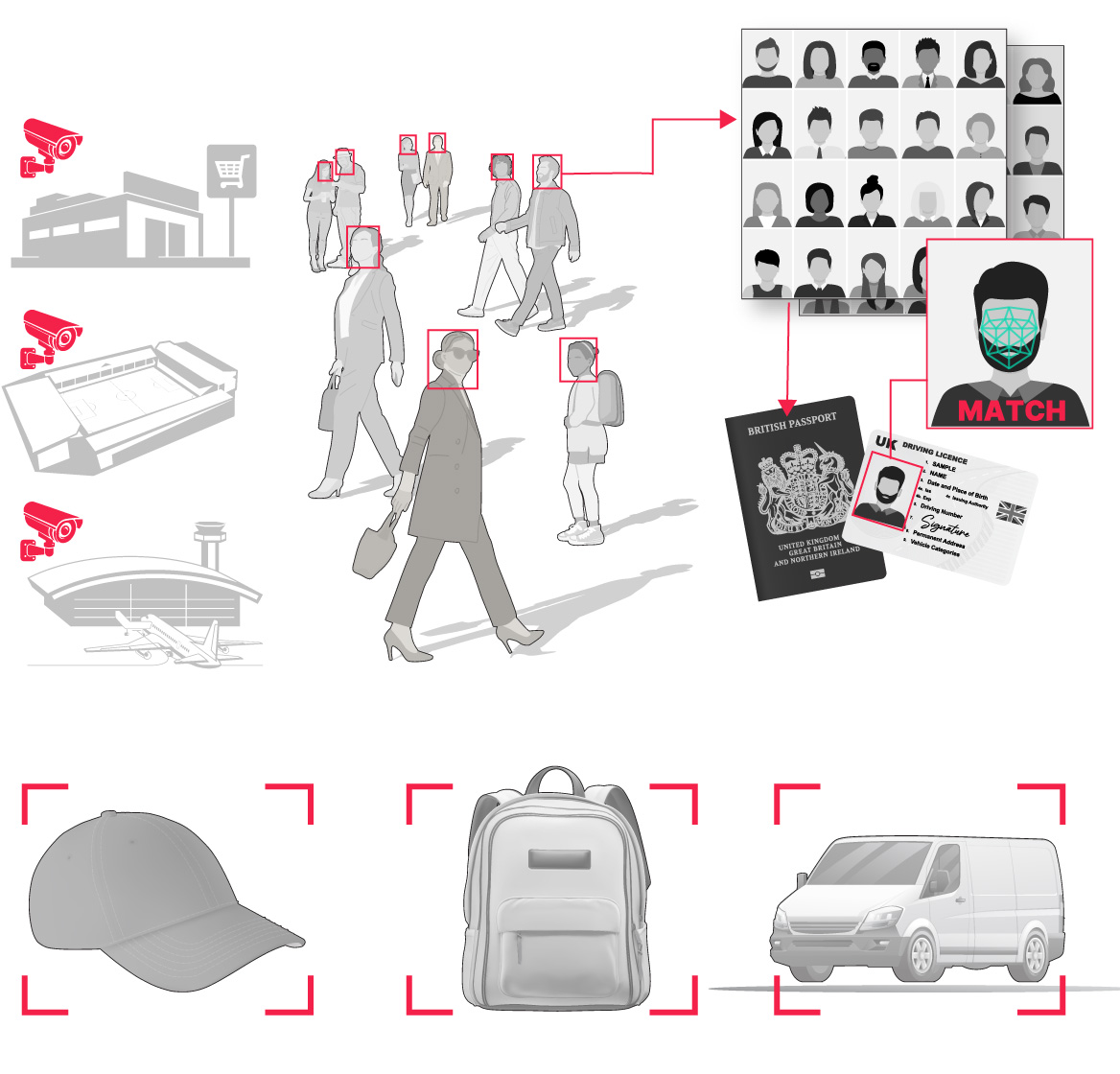
UK Home Secretary Shabana Mahmood announced the largest national AI surveillance program, using Live Facial Recognition (LFR) technology, to be deployed in cameras across England and Wales. “You can’t enjoy any of your liberties if you’re not safe,” she warned.
Police.AI is the new artificial intelligence branch of security that cost the government 140m pounds to develop. “For 20 years we’ve been talking about Big Brother societies, maybe for even longer than that, I just really reject that analysis. I think that law-abiding citizens going about their daily business can do so in security, nothing about that will change,” she decided, later adding, “We have seen what happens when facial recognition technology is rolled out without clear safeguards: children are wrongly placed on watchlists, and black people are put at greater risk of being wrongly identified.”
The AI branch of policing will rapidly analyze CCTV, phone, doorbell, and other sources of footage to pinpoint citizens based on their clothing, vehicles, and of course, facial recognition. The AI system can transcribe phone calls and sift through hours of information, constantly monitoring the public. Government claims it will equate to six million policing hours annually, or the workload of 3,000 officers.
The ethics behind such measures present a challenge. Who has access to this wealth of data? Individual organizations in the UK must obtain permission and be transparent about their policies, but no such restrictions exist for the government. We have seen countless data breaches in recent years, with independent hacker groups infiltrating every supposedly secure data center. Civil liberties groups believe the government is infringing upon human rights by spying on their every move, but governments no longer permit individual freedoms.
Everyone is a potential criminal—your face and likeness exist within a government database, and your file is ever-expanding. The Home Office has even stated it would monitor citizens’ emotions and body languageat known suicide hot spots.
Live cameras are monitoring the public at all times. Both the private and public sector have access to your whereabouts at all times. This is one of the reasons why the UK is implementing a digital ID system, which will later become linked to digital payment systems and CBDC. At the final stage, everything will be linked to a social credit score that includes each citizen’s water and carbon footprint. The plans are well-documented but sound too dystopian for the public to accept, but this is not a conspiracy—they are watching you.
Posted originally on Jan 28, 2026 by Martin Armstrong
US consumer confidence has plunged to its lowest level since 2014. The Conference Board’s index fell sharply in January to 84.5 — well below expectations and even below the depths reached during the pandemic panic.
Consumer confidence is a quantifiable measure of the public’s willingness to engage in economic activity. When confidence drops, consumers tighten their spending, postpone big purchases, and shift from growth-oriented to survival-oriented behavior. And where consumers go, capital inevitably follows.
“All five components of the Index deteriorated, driving the overall Index to its lowest level since May 2014 (82.2) — surpassing its Covid-19 pandemic depths,” Dana Peterson, chief economist at The Conference Board, said in a release. “References to prices and inflation, oil and gas prices, and food and grocery prices remained elevated.”
Grocery aisles, energy costs, health insurance premiums, and rent have not retreated to historic norms. Consumers are not just fearful of future inflation; rather, they are learning to manage the ever-increasing cost of living. This is a sign that real wages and purchasing power are under stress. The price of essentials never meaningfully waned from the worldwide lockdown, and the world is beginning to accept that high prices are the new norm.
Hiring has slowed, and households don’t feel secure. Corporations began mass layoffs last year and the trend is continuing. Right now, the cost of living is through the roof, jobs are scarce, and geopolitical tensions are high. Confidence has evaporated and will only improve when people see consistent improvement in their own finances.
Posted originally on Jan 28, 2026 by Martin Armstrong |
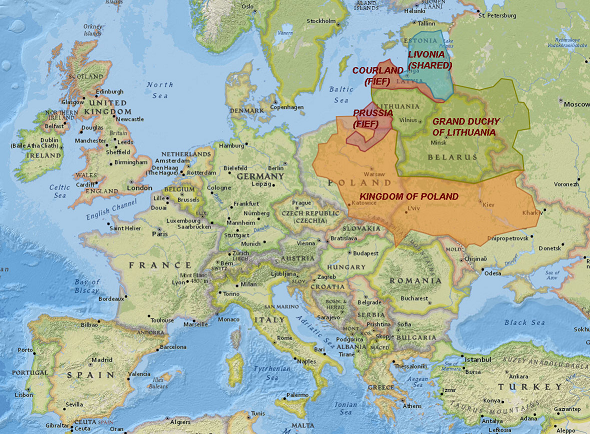
The idea that Europe always tries to conquer Russia is a common historical fact. To be accurate, there have been several major conflicts initiated by European powers against Russia, driven by specific geopolitical, ideological, and strategic reasons. It’s not a constant effort by a monolithic “Europe,” but rather a series of distinct invasions from different Western powers at different times; the goal has always been to capture Russian wealth. They consistently rewrite history to justify their endless greed to conquer Russia. The truth about the January 1863 Uprising against Russia, it was the Polish-Lithuanian Army that invaded and even occupied Moscow until the Russian people staged an uprising to take their country back.
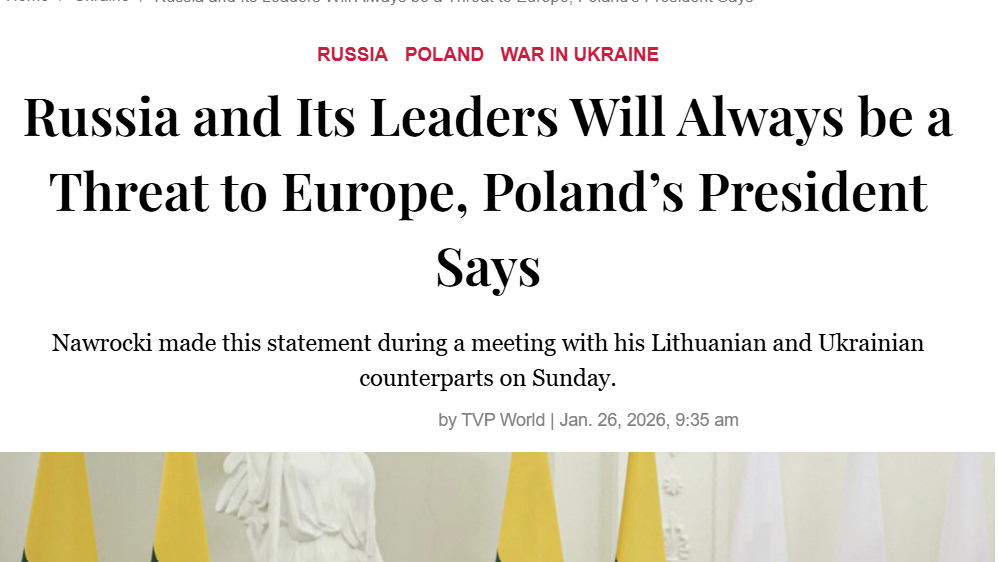
Ukraine’s President Volodymyr Zelensky, Lithuania’s President Gitanas Nauseda, and Poland’s President Karol Nawrocki met to commemorate the 1863 January Uprising against Russian rule. They have declared their hatred for Russians and boldly stated “Russia will ALWAYS be a threat.”
The January Uprising is a central symbol of Polish resistance and the fight for independence, and its memory is honored for its heroism and sacrifice. However, this is also a one-side revision of history.
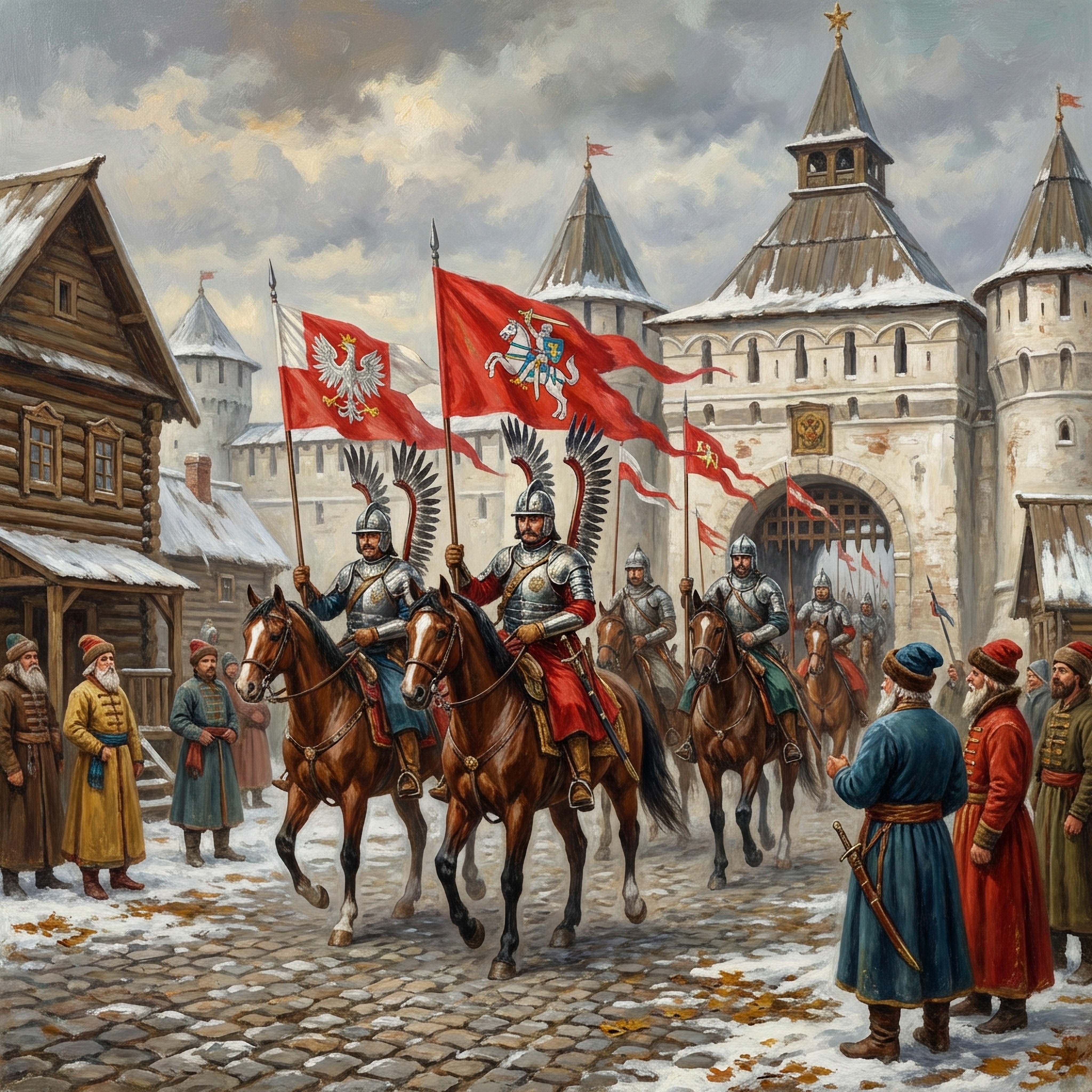
The January Uprising of 1863 was not a war, it was a major Polish-Lithuanian rebellion against the Russian Empire that ended in a decisive defeat for the rebels. What they omit from their history books is the blunt fact that the Polish-Lithuanian Commonwealth invaded Russia during a period of profound crisis known as the Time of Troubles (c. 1598-1613). This was not a single, clear-cut war but a complex series of interventions and campaigns driven by Polish-Lithuanian ambition to conquer Russia for its wealth taking advantage of internal Russian instability. So to be historically correct, they sought to conquer Russia, lost, were then occuppied, and celebrate this 1863 uprising as if they were the victims of an invasion they launched and lost.
The Dimitriads (1605-1612) This refers to Polish-backed campaigns by pretenders to the Russian throne, known as False Dmitrys. False Dmitry I (1605-1606) with the support of Polish magnates, invaded Russia, gained support from disaffected Russians, and briefly seized the throne in Moscow. His rule ended with his assassination.
False Dmitry II (1607-1610) was a second pretender, also backed by Polish-Lithuanian forces and Cossacks, set up an alternate court near Moscow. His campaign further destabilized the country.
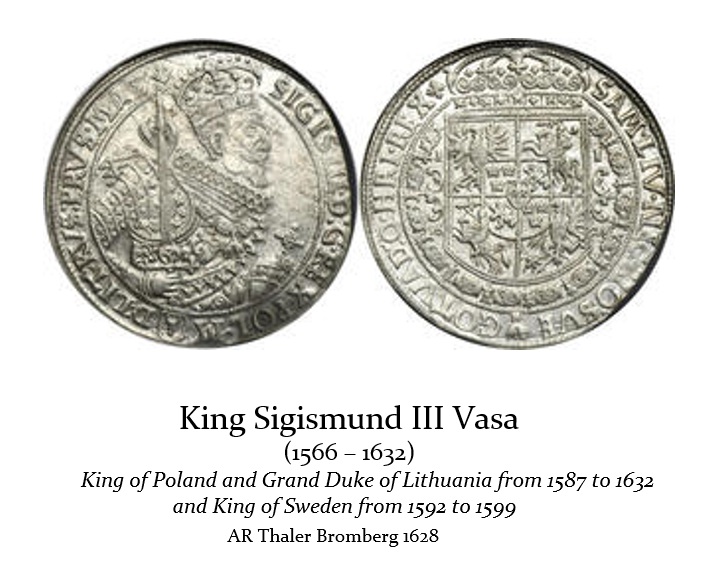
Then came the Polish-Muscovite War (1609-1618). As the chaos continued, King Sigismund III Vasa of Poland-Lithuania shifted from covert support for pretenders to an open, royal invasion with the goal of conquering Russia and placing his son (or himself) on the throne.
The Polish-Lithuanian army besieged and captured the key fortress city of Smolensk (1609-1611) after a long and brutal 20-month siege. A decisive Polish-Lithuanian victory over a much larger Russian-Swedish army took place at the Battle of Klushino in 1610. This opened the road to Moscow.
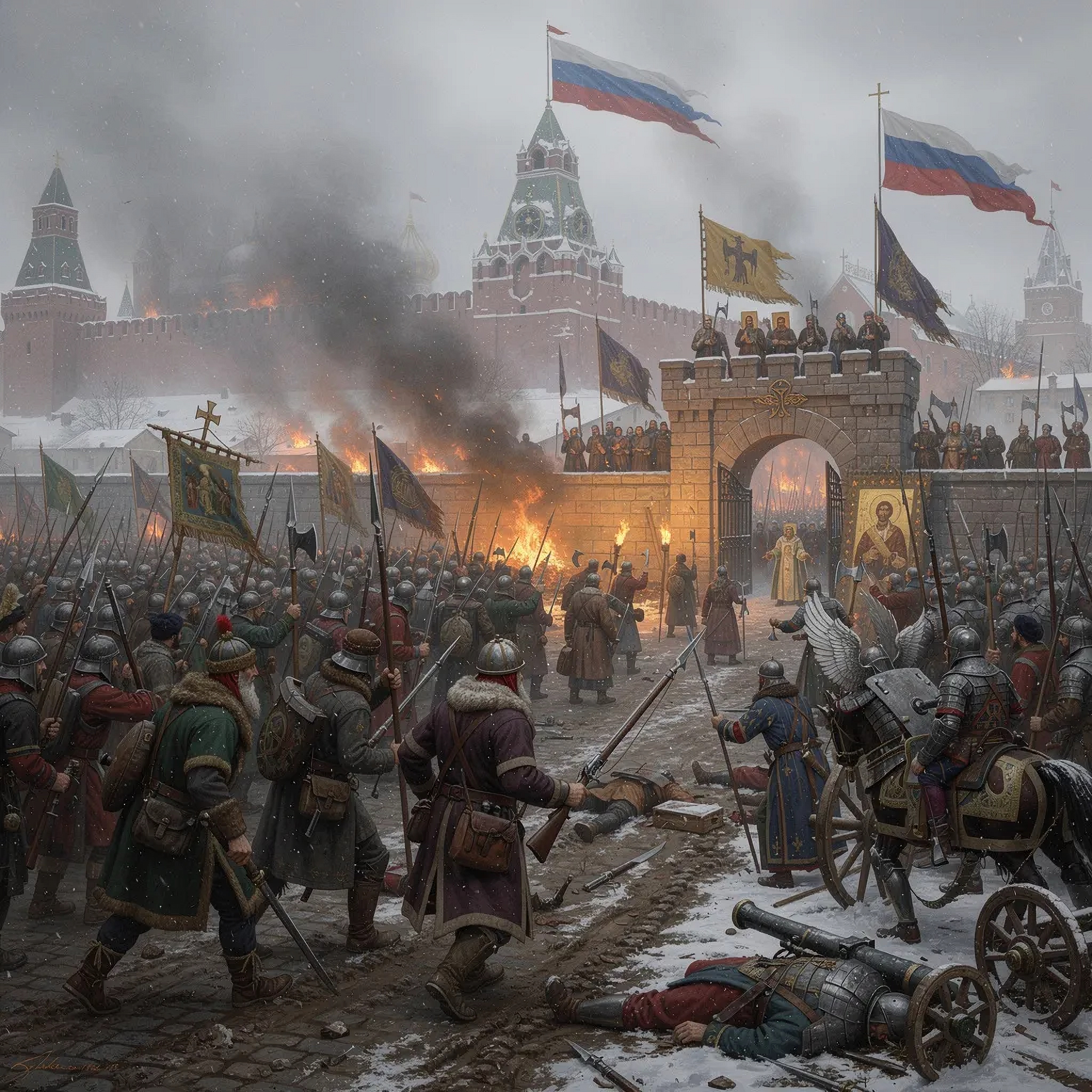
Polish Occupation of Moscow the took place 1610-1612. Following Klushino, a group of Russian boyars invited the Polish prince Władysław IV Vasa to become Tsar, on conditions including his conversion to Orthodoxy. Polish-Lithuanian troops entered and garrisoned the Moscow Kremlin. However, King Sigismund insisted he should be Tsar, negotiations broke down, and the occupation turned into a hostile siege from within the Kremlin itself.
A Russian national uprising, led by Kuzma Minin and Prince Dmitry Pozharsky, formed a militia and besieged the Polish garrison in the Kremlin. In November 1612, the starving Polish forces surrendered, ending the occupation. This event is now commemorated in Russia as National Unity Day.
The war officially ended with the Truce of Deulino (1618), which granted the Commonwealth significant territorial gains, including the Smolensk region. However, the primary goal of placing a Polish king on the Russian throne had failed.
The Polish invaded Russia during a civil war. The Commonwealth exploited Russia’s internal collapse (dynastic crisis, famine, peasant uprisings). It ultimately failed yet the Commonwealth gained territory, the core ambition of political control over Russia was defeated by a national uprising.
In Russia, this period is remembered as a patriotic struggle against foreign invaders. In Poland, it is seen as the zenith of the Commonwealth’s power and a “lost opportunity” to dominate Eastern Europe.
This invasion was a pivotal moment that deepened the long-standing rivalry between the two powers, setting the stage for future conflicts (like the Smolensk War and The Deluge) and contributing to a mutual distrust that shaped Eastern European history for centuries.
To this day, celebrating the January Uprising of 1863 is a revision of history for Russia has NEVER invaded Europe even once, whereas there have been five attempted conquests of Russia sll based on the fact that to this day, Russia is still the richest country on Earth from a natural resource perspective. In 1917, Russia had the largest gold reserves in the world. Someone hid them so the Communists would not get them, and they have never been found since.
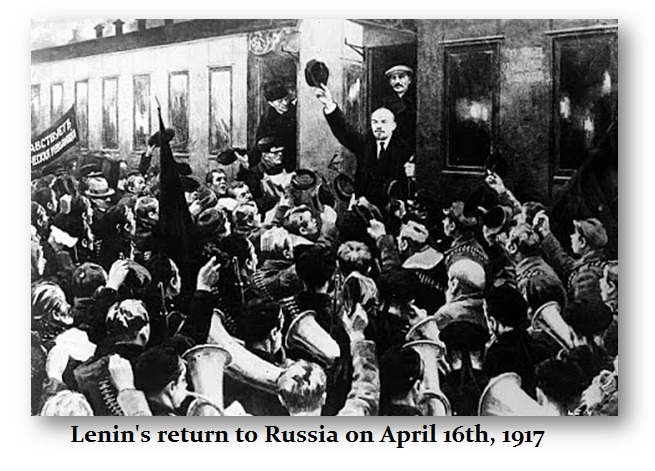
The German Emperor Wilhelm II Imperial Government actually feared that Russia would enter World War I. The rising communist movement in Russia was anti-war. Germany saw a chance for victory in Europe if it kept Russia out of the war. Hence, Germany supported the Communist anti-war sentiment of the Bolsheviks in Russia. Germany permitted Vladimir Lenin (1870-1924) to travel in a sealed train wagon from his place of exile in Switzerland through Germany, Sweden, and Finland to Petrograd. Since the start of the February Revolution in Russia, Lenin was trying to figure out a way to get back into Russia. Germany aided his return assuming he was anti-war and would thus keep Russia out of World War I. Lenin returned to Russian on April 16th, 1917. Within months of arriving, Lenin led the October Revolution in Russia and the Bolsheviks seized power and indeed Russia withdrew from the world war. According to Leon Trotsky, the October Revolution would not have succeeded without Lenin.
The West has been abscessed with Russia for centuries. They are painted as evil and the excuse always changes. Before Gorbachev, it was that Russia was Communist and wanted to spread communism and conquer Europe. Communism collapsed all by itself, but the claim that Russia wants to still invade Europe remains. It does not matter who is the head of state in Russia, they will always change the narative to justify the conquest of Russia no matter what.
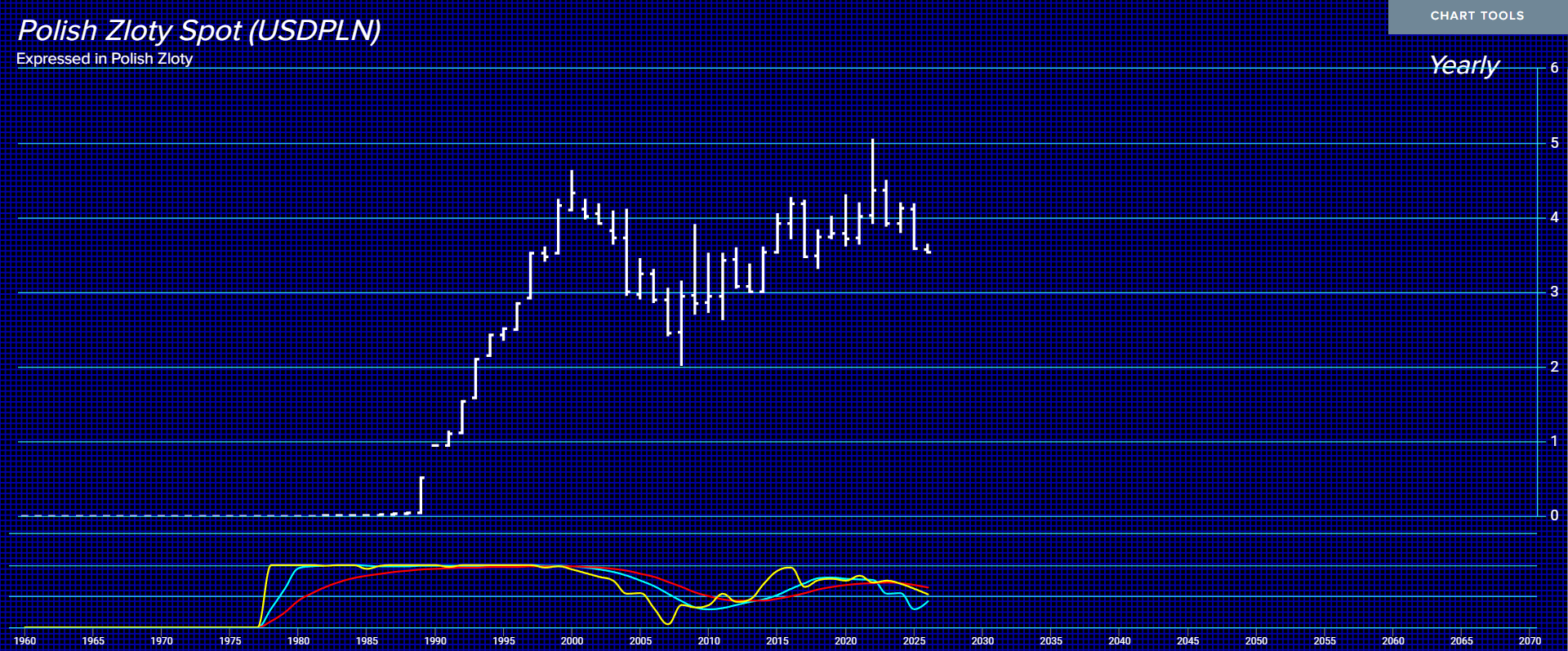
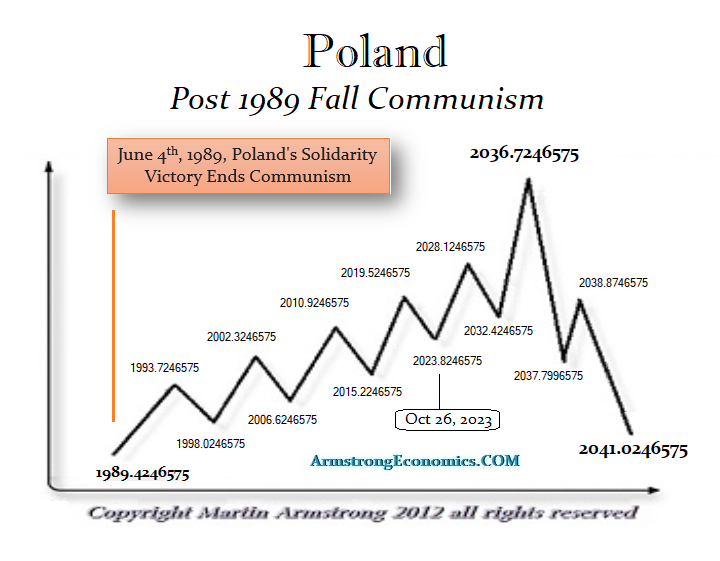
As one of our readers from Poland noted, the October 26th 2023 turning point was the precise day that President Duda called for a new Polish parliament to convene after the October 15th elections. Our models show a Directional Change in 2027 and that volatility in Poland was due to start rising here in 2026 all the way into 2034.
Europe seems to have a death wish because the EU experiment is failing. Instead of addressing the issues, they prefer to live in the past, assume they can conquer Russia and the 6th time will be the charm, celebrate with $75 trillion in assets, free gas for all, and the EU will rise to lead the world, which is why Carney is taking Canada into the arms of the EU.
Posted originally on Jan 27, 2026 by Martin Armstrong |
QUESTION: Marty, you always criticized the gold bugs for claiming gold rises with inflation. You are the only one who projected $5,000 gold, and you said it would be on geopolitics. I think you also said it could reach $10,000 by 2032. You also said we were headed into a global recession, but it would be stagflation because of shortages. Well, we have silver shortages, but buy prices are $15+ below spot. I just saw you on Russia Today talking about Germany recalling its gold from the United States and explaining the rift between the US and EU and the Indian trade deal how Russia can sell its oil to India, they refine it, and send it to Europe circumventing Trump’s tariffs. Can you shed any light on this crazy world?
Pete
ANSWER: In gold, the next major resistance level is at 7600. Yes, by 2032, that target was $8,350 to $10,000. The crisis in the Euro has not changed. We still see that in 2029. Now, as far as the discount in silver if you try to sell, the dealers are flooded. The refineries are so backed up that it can take 2 to 3 months to get paid. That is the reason for the discount. Plus, a lot of silver is being sold on the market by people who have held it for decades. I was told today that they are not even buying 90% silver coins because they cannot refine anything right now.
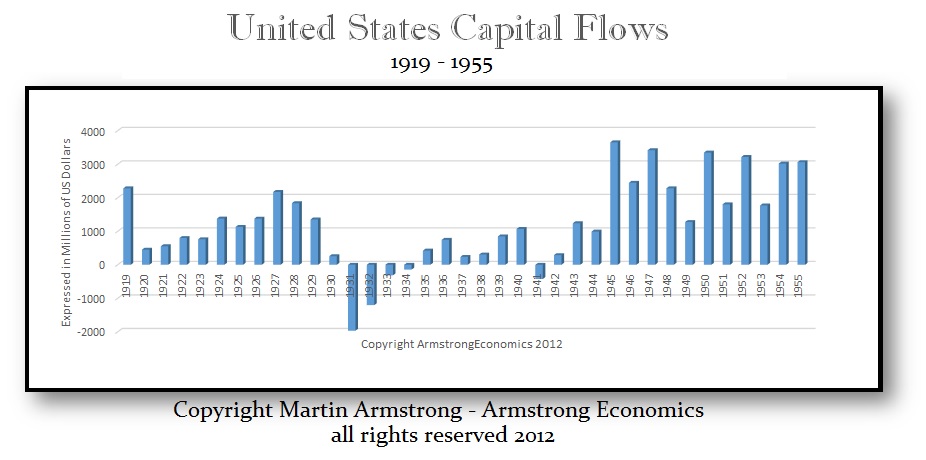
The problem with the Euro is the underlying economic crisis, which is the entire reason for instigating war with Russia. This is all becoming chaotic. The EU is turning its back on the US, as is Canada, and of course India. NYSE (U.S.) has a capitalization of $28–30 trillion in market value. All of the European Exchanges (combined) have only a capitalization of $18–20 trillion in market value. With war becoming inevitable in Europe, the capital flows to the dollar will unfold once again as it did for World War I and II. Between now and 2032, this is going to be chaotic period to say the least.
I have created this site to help people have fun in the kitchen. I write about enjoying life both in and out of my kitchen. Life is short! Make the most of it and enjoy!
This is a library of News Events not reported by the Main Stream Media documenting & connecting the dots on How the Obama Marxist Liberal agenda is destroying America









 Centinel2012