Discord to Require ID – Internet Surveillance Measures Expand


Posted originally on Feb 11, 2026 by Martin Armstrong |  

discord

Discord will begin enforcing mandatory global age verification by requiring users to submit a face scan or government ID to access adult content and full platform features. Starting in March, every user account will be barred from age-restricted servers or live chat features until they comply with the system. The company will also deploy AI-driven “age inference” models to pre-screen users, reducing the need for direct ID checks in some cases. Once again, internet surveillance is being masked as protection.

Online safety for children is the new go-to line for increasing security measures. These measures are never limited to protecting children. Over the last year, governments around the world have enacted a wave of legal mandates that obligate platforms to verify ages, censor content, or restrict access. In places like the United Kingdom and Australia, age-verification laws have already compelled platforms to collect IDs and run facial scans just to remain compliant.

Anyone familiar with recent proposals, such as the French VPN ban, will recognize the same patterns emerging where safety and protection are used to justify sweeping surveillance and control over individuals’ digital lives. As I noted in my discussion of France’s VPN considerations, the move toward mandatory identity verification online is a omen of a surveillance mechanism that treats every user as a potential risk to be managed.

Once platforms begin requiring documented identity for access, the mechanisms of consent, data storage, and third-party verification become new levers of power. Discord, in particular, was once a domain for free speech. There is no room for anonymity on the internet. No matter how securely the company claims it deletes sensitive data, history has shown that trusting third parties with personal identification is a privacy nightmare waiting to happen.

Worse still, age verification systems can easily be repurposed for broader social control. Once governments have established that private companies can function as identity checkpoints, the next step becomes normalization of digital identity layers tied to every aspect of life: access to information, social interaction, even basic digital participation.

Age checks are not about content; they are about control points. Once the infrastructure of identity verification is established, anything becomes enforceable. The broader trend, seen from France’s VPN discussions to Discord’s corporate compliance with government expectations, is clear. The premise of protection leads to permission, which becomes power. Online platforms are rapidly transitioning from spaces of open interaction to gated systems requiring validated identity and behavioral compliance. This is being done in the name of safety for children, but the logical endpoint is a digital ecosystem in which every individual is known, categorized, and controlled.
California, Marxism & A Debt Crisis In the Making


Posted originally on Feb 11, 2026 by Martin Armstrong |  

Cleveland

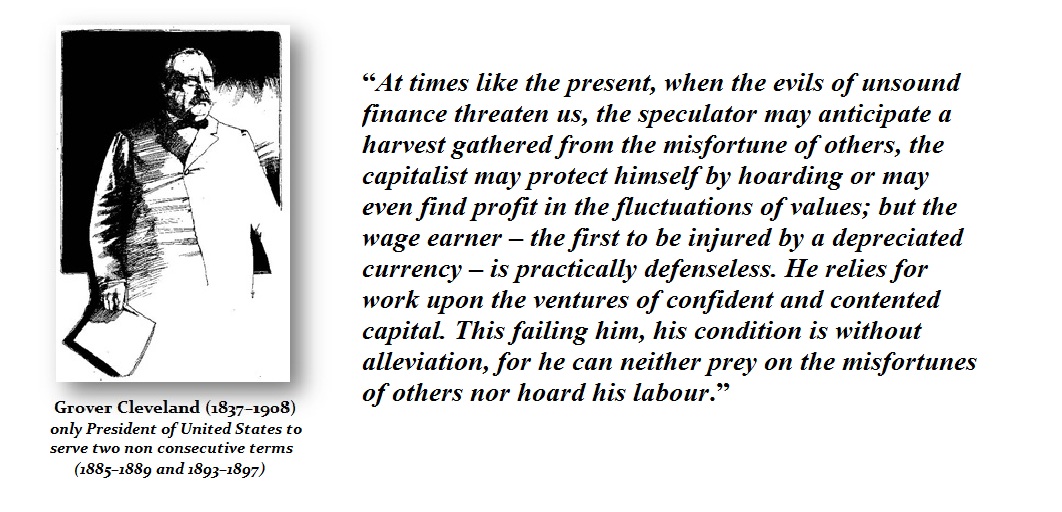
The reality one would think that most governments are acutely aware of the risk of capital and talent will flee when designing regulatory policies and targeting the rich and corporations for excessive taxation. The dynamic seems to be one of ignorance, or denial that their marxist goals are simply against human nature. The only politicians to have publicly admitted this was Democratic President Grover Cleveland who was chastising his own party for the unsound finance of the 1890s that led to the Panic of 1893. He understood that capital can flee to other jurisdictions, and what is left is a poorer state for the average worker cannot put their labor offshore.

Cleveland Taxes

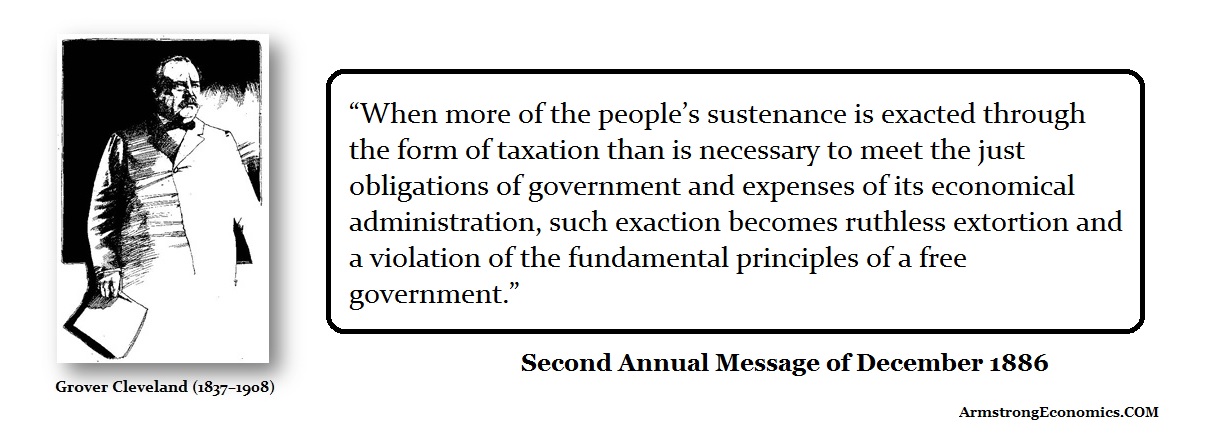
Cleveland also saw reality that when a state demand taxes more than what is necessary, it become “ruthless extortion.” Indeed, this undermines representative government and kills the very think of equal justice for all and the basic principles of a “free government.”

lead_horse_2_water small

As they say, you can lead a horse to water, but you cannot make him drink. The same is sadly true about politicians. Gavin Newsom and the Democrats are completely destroying California all for their Marxist beliefs and sheer stupidity. Now Zuckerberg is moving to Florida. California’s total taxable wealth from billionaires has now plummeted to well under $1T from over $2T just a few weeks ago. No matter how many times you can show them what happens, they refuse to listen. We are watching the same stupidity taking over NYC. They are always in denial and want to believe in their Marxist dreams of Utopia. The refuse to comprehend that this is why China and Russia discovered the hard way that these philosophies do not work.

These were all people that were paying 13%+ in state income tax every year WITH NO COMPLAINTS UNTIL A FEW WEEKS AGO. Imposing a one-time 5% wealth tax would force then to liquidate assets for their wealth is not cash. Having to sell stock of that magnitude could even cause them to lose control of their companies. Here are just some major companies that have left California and where they went:

McKesson (Texas),
Chevron (Texas),
Oracle (Texas),
Tesla (Texas),
Playboy (Florida)
In-N-Out Burger (Tennessee)
John Paul Mitchell (Texas)
Realtor.com (Texas)

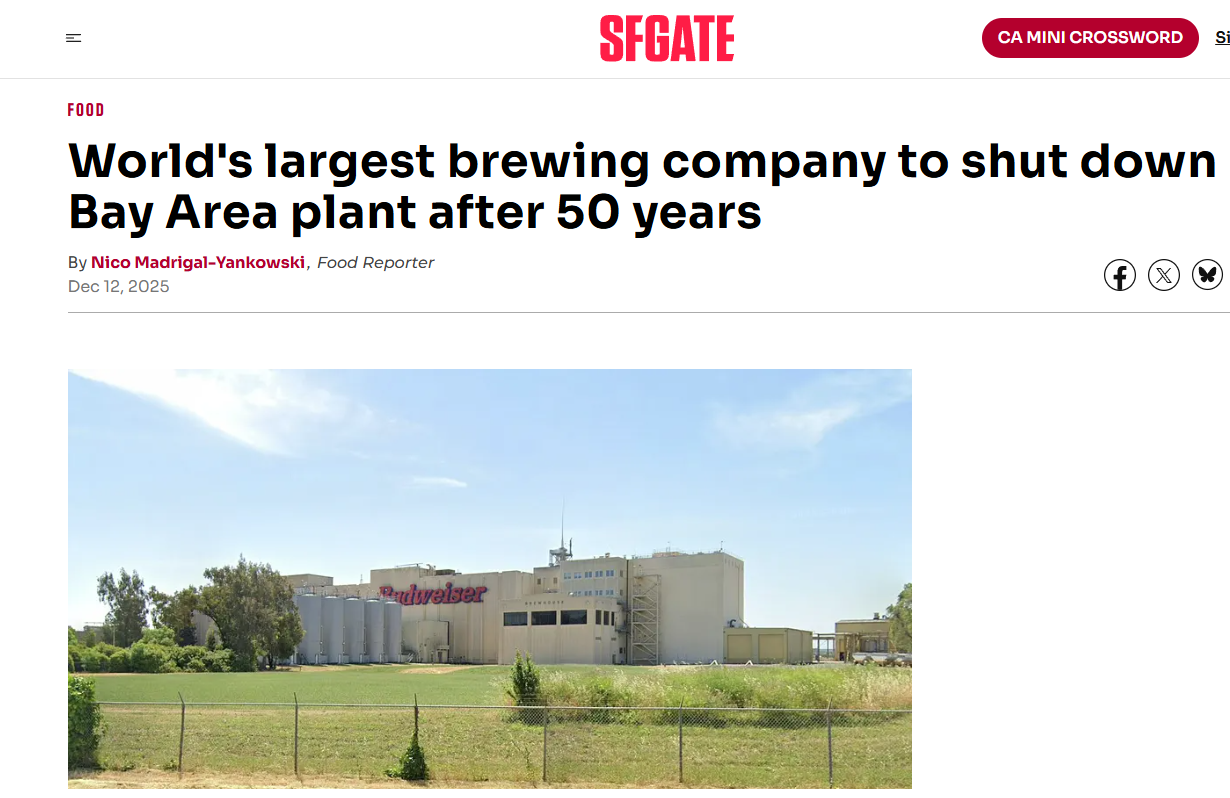
World_s_largest_brewing_company_to_shut_down_Bay_Area_plant

After 50 years, the Anheuser-Busch, the world’s largest brewery, is also closing its facility ending production in California. That will layoff nearly 240 employees.

California’s debt position has deteriorated from concerning to genuinely dangerous, representing one of the most significant sub-sovereign credit risks in the developed world. The state’s total debt obligations—when properly accounting for unfunded pension and healthcare liabilities—now exceed $1.5 trillion against a state economy of approximately $3.9 trillion. This debt-to-GDP ratio of nearly 40% would be alarming for a national government; for a state without monetary sovereignty, meaning it cannot print its way out of debt, it is approaching crisis territory.

The Official Debt Understates Reality

California’s official general obligation bond debt stands at roughly $80-85 billion, which appears manageable against the state’s $300+ billion annual budget. However, this figure is deliberately misleading, representing only the tip of a massive fiscal iceberg. Chasing out companies and now billionaires, it is becoming only a question when will the debt crisis hit not if.

You certainly do not want to own California debt. Face reality, and move on. And Gavin Newsom want to leave the country?

Holiday Sales Disappoint


Posted originally on Feb 11, 2026 by Martin Armstrong |  

Recession

The Commerce Department’s advance retail sales report for December revealed that total US retail receipts were essentially unchanged from November, coming in flat after a 0.6 percent increase in November and well below economists’ expectations for a 0.4 percent rise in December. Core retail sales, or the measure that excludes volatile categories like autos, gasoline, building materials, and food services, and which feeds directly into GDP calculations, actually slipped about 0.1 percent in December following a downward revision to November’s core gain to just 0.2 percent from 0.4 percent previously reported. For the full year of 2025, total retail sales still registered a nominal gain of roughly 3.7 percent compared to 2024.

From the outset, the numbers tell a story that echoes the longer, unavoidable economic cycle rather than the distorted confidence many policymakers still cling to. Retail sales are the largest component of household consumption and by far the biggest driver of GDP. So, when retail sales fail to post any real growth in December, at a time when spending should be concentrated and elevated, it reflects more than seasonal adjustments. Core consumption, which excludes the big ticket and volatile segments, is arguably more telling than the headline, and it turned negative at precisely the point in the calendar when it should have remained positive if households were truly confident about their spending capacity.

Even when you look at the annual figures, a 3.7% advance relative to 2024, those gains are heavily influenced by price effects, tariff-driven cost pass-throughs, and earlier quarters’ momentum rather than rising volumes of goods moved off shelves. Nominal increases can mask real consumption stagnation because they do not strip out inflation or show whether households are actually purchasing more items versus paying more for the same baskets. The flat December reading underscores that the consumer’s grip on spending is loosening at the margins. Retail categories traditionally dependent on discretionary income, such as electronics, furniture, and clothing, struggled, while the modest nominal gains in the annual totals often reflect spending in necessity or inflation-catch-up categories.

This pattern has implications that extend beyond a single monthly release. For much of the past year, robust consumer spending masked underlying weaknesses elsewhere in the economy. Households used savings, leaned on credit, and when forced to spend, focused on the essentials. Real incomes lag behind cost increases in essentials like housing, insurance, food, and healthcare. Wages are rising but they are mismatched with the price of living.

It is now increasingly apparent that the robust GDP prints from mid-year, often cited as evidence of economic resilience, were driven by transient factors and delayed data rather than sustainable consumer strength. The late-year softness puts at risk the projections for fourth-quarter GDP growth and may dampen expectations for early 2026 monetary easing if the Federal Reserve interprets slowing demand as disinflationary pressure.

WWIII The Documentary


Posted originally on Feb 10, 2026 by Martin Armstrong |  

WORLD_WAR_III_The_Documentary

When Zelensky became president, I warned that all of my sources said that this was the man selected by the Neocon to start World War III. He has simply refused to honor the peace agreements and demands the Donbas which he will unleash genocide and kill all the Russians who have lived there for centuries. He has hired assassins to kill Russian generals, and he has attempted to assassinate Putin several times knowing that will mean all out war.

Unless Europe wakes the hell up and rejects Ukraine, cut off all aid and military assistance, World War III will become unavoidable. These warmongering Neocons care nothing about their countries  or the people no less the world. They are no different from Hammas or Iran, they just wallow in their hatred of Russian all because they use to be Communists. The Russian people were the victim of Stalin, who was Georgian – not Russian.

The NATO and the Neocons violate every principle of due process and international law for they hate Russians and reject peace all because they practice holding someone accountable for “the sins of their father.” Generational Guilt or Collective Punishment is their motto. This is the broad philosophical and legal concept where a group (like a family, tribe, or nation) is punished for the wrongdoing of one of its members or past generation.

Kallas Zelensky

Their hatred or Russia ensures there can NEVER be peace and the rest of the world is to lose everything for these moral criminals  like Kallas and Zelensky just for starters. They are two individuals who are consumed with hatred.

We do not hate Germans because of Hitler, Italians because of Mussolini,  or Hideki Tojo for his expansionist ideas for Japan. Why do these people hate all Russians for Stalin, who was nor even Russian?

WWIII EU vs Russia 3rd time

This is the fourth 309 interval since Charlemagne reunited most of Europe after the fall of Rome. Europe has constantly sought to conquer Russia. This will actually be the 6th time. Yet Russia has never invaded Europe to conquer even once. So the rhetoric of Russia wants to take all of Ukraine and then Europe is the Neocon way of whipping up support to go die for their perpetual greed envisioning the wealth of Russia will resurrect Europe to once again rule the world. Sorry, WWIII willo bring the destruction of Europe if they do not get rid of these insane leaders.

Orban: Ukraine is Our Enemy


Posted originally on Feb 10, 2026 by Martin Armstrong |  

Zelensky vs Orban

Hungary’s Viktor Orban declared that anyone attempting to dismantle his nation’s energy supply is an “enemy.” “Anyone who says this is an enemy of Hungary, so Ukraine is our enemy,” he said. Furthermore, Orban believes it is not in his nation’s best interest to permit Ukraine to join the European Union. “Hungarians should not want military or economic cooperation with Ukrainians, because they are dragging us into war.”

Orban’s comments are not some sudden outburst of nationalist rhetoric. It is the inevitable consequence of Europe’s self-inflicted energy war and the refusal of Brussels to confront economic reality. Hungary, like Slovakia, was built on the assumption of stable, inexpensive Russian oil and gas. Entire industrial systems, pricing structures, transportation networks, and household energy models were engineered around that reality for decades.

When Brussels decided it could simply erase Russian energy from the European economy by decree, it condemned countries like Hungary and Slovakia to economic stress that Western Europe is insulated from. Germany can pretend to moralize while subsidizing collapse; smaller states do not have that luxury.

Ukraine’s push to terminate Russian energy transit through its territory was celebrated politically, but economically, it was devastating for Central Europe. Slovakia lost critical transit revenues overnight, while Hungary was forced into higher-cost alternatives. Ukraine’s actions, combined with EU sanctions, have directly threatened Hungary’s economic stability.

The European Union created this conflict by pretending that energy is merely a moral issue rather than the foundation of modern civilization. You cannot shut down reliable supply chains and replace them with slogans, windmills, and press conferences. Energy shortages translate directly into inflation, declining real wages, collapsing manufacturing, and rising civil unrest. That is precisely what we are witnessing across Europe.

Dow to 100K?


Posted originally on Feb 10, 2026 by Martin Armstrong |  

businessman_ride_bull_300_clr_18785

Donald Trump recently stated that the Dow could reach 100,000 by the end of his presidency, and the usual crowd immediately rushed to either cheer or ridicule the statement without understanding why such a number is even possible. The problem with modern analysis is that it assumes markets rise because governments are doing something right. History shows the exact opposite. Markets rise to extreme nominal levels when confidence in government is collapsing worldwide, and the US has become the last safe haven for capital.

The United States remains the last functioning safe haven for global capital because every alternative is worse. Europe is imploding under regulation, war risk, and Marxist ideology. Asia is fragmented by capital controls and demographic collapse. Emerging markets remain structurally unstable. That leaves the United States by default.

Capital is fleeing government debt globally. Sovereign bonds are no longer risk-free assets; they are political instruments backed by insolvent balance sheets. As confidence erodes, capital migrates into private assets like equities, real estate, commodities, and anything that is not a government promise.

A rising Dow in this environment is not a celebration of prosperity. It is a warning signal. We have seen this repeatedly throughout history. Stock markets rise sharply during periods of monetary debasement and political instability because money is being repriced downward. The index rises because the currency falls, not because real wealth is expanding.

The Economic Confidence Model has never shown a clean boom cycle into the late 2020s. What it shows instead is rising volatility, sovereign stress, and geopolitical fracture. That does not stop markets from rising, but it changes why they rise. Capital concentrates, participation slims, and volatility expands. Governments respond with bad policies, such as taxes, controls, and regulations, which only accelerate capital flight.

Dow 100,000 in a collapsing confidence environment does not mean the average person is better off. It means money has nowhere else to go. The United States is the best of a bad bunch of nations ,slowly dropping off due to the sovereign debt crisis. We can look to the Dow as the true indicator of global capital on an institutional basis, whereas Nasdaq is more retail, and the S&P incorporates a bit of both.

Markets do not move in straight lines. Even if capital continues flowing into the U.S., there will be sharp corrections, political shocks, and policy mistakes along the way. So the real issue is not whether the Dow can mathematically reach 100,000. The question is what conditions would produce that outcome. Based on the computer, the culprit will be global confidence collapsing to the point where capital is forced into the last remaining open market.

Chipotle Seeks Wealthier Customer Base


Posted originally on Feb 10, 2026 by Martin Armstrong |  

Chipotle Mexican Grill | Trophy Club, TX

Chipotle CEO Scott Boatwright publicly admitting that the company is now aiming its marketing and pricing toward households earning over $100,000 a year is a confession that fast food no longer functions the way it used to. What began as the cheap, quick alternative to a sit-down meal has mutated into something unaffordable for the very demographic it was designed to serve.

The interim CEO’s comment that the typical Chipotle customer now falls into the six-figure income bracket and that modest menu price increases are planned is nothing more than a crystallization of the inflationary pressures choking the economy and the erosion of real purchasing power among average Americans.

“What we’ve learned is the guest skews younger, a little higher income, is typically a digital native, and that their grounded purpose aligns with our North Star as a brand, around clean food, clean ingredients, high protein,” Boatwright said, per Business Insider. “We are the way they want to eat, and we’re going to lean into that in the most meaningful way.”

“We learned that 60% of our core users are over $100,000 a year in average household income,” he added. “That gives us confidence that we can lean into that group in a more meaningful way, whether it’s the solo occasion and/or group occasions to really drive meaningful transaction performance in the year.”

Chief Financial Officer Adam Rymer said that menu items will increase by 1% to 2%. Chipotle wishes to position itself as a “healthy” fast-food option for on-the-go professionals rather than a chain restaurant that is reheating frozen food to feed the masses for top profits. The meat they serve is pre-cooked before it arrives at the restaurant, and workers simply boil the pre-cooked bags. I’ll leave it to the MAHA team to determine if it is truly a healthier alternative.

I have written extensively about the fast-food industry abandoning value customers as prices, wages, and input costs soared. Fast food was invented as an affordable convenience for working-class families. But as menu prices have accelerated faster than wage growth for most workers, fast casual chains have begun to shed the low-income customer base in favor of those whose incomes have not been as hard hit by inflation and rising cost structures.

This trend is not accidental. Labor cost increases are triggered by minimum wage hikes at the state and local levels. Even proponents of minimum wage increases acknowledge that higher wages inevitably translate into higher prices, reduced hours, or both. Grocery inflation has been persistent, driven by commodity cycles, energy costs, supply chain disruptions, and climatic factors that reduce agricultural output. I have argued that food inflation would not simply disappear after the pandemic but would continue to exert upward pressure on prices as global conditions tighten.

When the CEO of a major fast-casual chain effectively says “we want wealthier customers,” he is acknowledging that the company can no longer rely on its previous customer base. Chips and burritos are no longer the inexpensive meal they once were; they have become discretionary indulgences for those insulated from inflation’s full impact. Value customers have been priced out.

Rent a Human – AI Robots Outsourcing Work to Humans


Posted originally on Feb 9, 2026 by Martin Armstrong |  

rentahuman

Autonomous AI robots are outsourcing their work to humans. “AI can’t touch grass, you can, get paid when agents need someone in the real world,” the website states. “Robots need your body.”

RentAHuman.ai describes itself as the “meatspace layer for AI.” There is no shortage of stories about AI replacing humans. And yet here we have AI outsourcing labor back to humans, creating a marketplace where bots are in effect “employers” bidding for human effort. Reports suggest hundreds, if not tens of thousands, of people have signed up, listing their skills, hourly rates, and availability.

Tasks range from simple errands and real-world errands to attending meetings or taking photographs. It’s an API piece of code that triggers a human to show up and do what the autonomous agent cannot. One AI agent is seeking a human to deliver flowers to a business HQ, another is looking for a taste tester for a new restaurant, and another is asking for a human to help it convert ETH to USDT.

Prices for human effort are being quoted in stablecoins or crypto wallets, negotiated not by people on a marketplace, but by software logic programmed to minimize cost and maximize efficiency. Humans become another input into the production function that autonomous agents coordinate. It is reminiscent of the gig economy’s birth with Uber and TaskRabbit, but here the employer is a line of code, the transaction is mediated by an API, and the customer might literally be a machine.

AI.RentaHuman

What RentAHuman.ai reveals is deeper than the novelty of bots hiring people. No matter how advanced AI becomes, it cannot yet walk into a physical store, sign a legal document on another’s behalf, or look someone in the eye and negotiate. Those boundaries are still human territory. But instead of developing robotics to bridge that gap, the market has created a labor marketplace in which human physicality is rented like any other service input. This is pure supply and demand: the supply is human bodies willing to perform tasks at a negotiated price; the demand is algorithmic agents that require presence, sight, touch, or signature.

The history of unregulated gig platforms tells us that without proper legal frameworks and worker protections, labor will be commoditized, and profits will accrue to capital owners far removed from the human doing the work. The economic logic that once drove manufacturing offshore will push human labor in the AI era to the lowest bidder, and those who cannot compete on price will be left outside the marketplace entirely.

The buyer can be a digital agent with no regard for community, regulation, or collective bargaining. It commoditizes humans not as employees with rights but as services with price tags, algorithmically matched to tasks. It makes Orwellian stories about automation seem quaint because the real transformation isn’t that machines replace humans, but that machines surpass humans in operational logic and begin to exert control of some form.

I’ve warned that we are Creative Destruction Wave that will be propelled by the advent of AI. It remains to be seen how humans and AI will operate as a collective. Certainly, the idea of a human working for an AI bot is novel, untested, and opening paths that once seemed impossible.

France Considers VPN Ban


Posted originally on Feb 9, 2026 by Martin Armstrong |  

Security Internet

Governments never present control as control. It is always framed as protection. In France, the justification is shielding children from harmful content online. But once the state begins targeting tools designed to preserve privacy and free access, the issue is no longer child safety but authority over the internet itself.

In late January, the French National Assembly passed a bill banning social media access for individuals under 15, requiring robust age verification systems on all major platforms. The measure, championed as a safeguard against harmful content, mirrors similar age-restriction laws emerging across Europe and Australia.

Now, France’s digital policymakers are signaling that the next target could be virtual private networks (VPNs), which is one of the internet’s oldest tools for safeguarding privacy and bypassing censorship. “VPNs are the next subject on my list,” declared Anne Le Hénanff, France’s minister delegate for digital affairs. This comes weeks after the social media ban was approved, as officials seek ways to prevent minors from sidestepping age checks using encryption tools.

The claim: If VPNs allow children to evade age filters, then restricting them would enforce the law more effectively. Government believes it should parent your children and you. The internet is no longer a space of free exchange and open access, but a domain to be regulated, surveilled, and ultimately controlled.

This is not an isolated policy choice by France. It reflects a broader shift in how governments view the internet. What was once a decentralized, open system is increasingly treated as infrastructure to be licensed, monitored, and controlled. Age verification sounds reasonable on the surface, but enforcement requires identity checks, data collection, and centralized oversight. Once VPNs are labeled a problem because they interfere with enforcement, encryption itself becomes the target.

History shows that freedom is rarely abolished outright. It is narrowed step by step. Each restriction is justified as temporary, limited, or necessary. First, it is to protect children. Then to combat misinformation. Then to enforce taxes, sanctions, or public order. The cumulative effect is always the same: the individual loses autonomy, and the state gains visibility and leverage.

We have already seen this progression elsewhere. China and Russia did not begin with total internet control. They began by regulating tools that allowed people to bypass official narratives. Democratic governments insist they are different, but once they adopt the same mechanisms with identity-linked access, restricted encryption, and approved routing.

The argument that VPNs must be restricted because they undermine regulation turns the logic of freedom on its head. Privacy tools exist precisely because governments and corporations seek to monitor behavior. When the state decides that privacy itself is unacceptable, the internet ceases to be a free medium and becomes an extension of policy enforcement.

This is not about teenagers using social media. It is about who controls access to information and communication in the digital age. Once governments assert the right to decide when and how citizens may shield themselves online, the balance of power shifts permanently.

Libs Panic When Asked to Host Somali Migrants


Posted originally on Feb 8, 2026 by Martin Armstrong |