Posted ordinally on Oct 7, 2026 by Martin Armstrong
Earlier this year, as the energy crisis sent gasoline prices soaring, Washington began waiving the very fuel regulations it had insisted were necessary. The government relaxed summer-blend requirements, expanded the ability to sell ethanol blends, and eventually acknowledged that the country faced “extreme and unusual” fuel supply circumstances. Now diesel has surged to around $6.50 per gallon, and suddenly Washington is scrambling again, this time allowing broader use of dyed diesel that is normally restricted to farms, construction equipment, and other off-road uses.
The EPA acknowledged in August that U.S. operable refining capacity was about 800,000 barrels per day LOWER than in January 2020. Refinery utilization ran above 96%, meaning there was very little spare capacity when something went wrong.
Diesel is far more economically dangerous than expensive gasoline because it is embedded in virtually everything you buy. The consumer may never personally purchase a gallon of diesel, but he pays for it every time something has to be grown, manufactured or transported.
There is already confusion over what dyed diesel actually means. The red dye itself is not some inferior fuel that will suddenly destroy a diesel engine; it is primarily a marker used so authorities can identify fuel that was sold without the highway taxes normally imposed on road diesel. If the underlying fuel meets the same ultra-low-sulfur specifications, the dye itself is not the problem. If government can suddenly waive restrictions when diesel becomes scarce and expensive, how much of the barrier was absolutely necessary in the first place, and how much was simply another layer of taxation and regulation that consumers were forced to pay for when energy was plentiful?
Now we have “blue diesel,” as if another government classification somehow creates more fuel. Red, blue, taxed, untaxed, renewable, off-road, the bureaucracy has turned diesel into a regulatory maze. When an energy crisis hits, they suddenly waive their own rules because trucks still have to move and farms still have to operate. You cannot regulate energy into existence. You either have the fuel or you don’t.
That is why this feeds directly into stagflation. A trucking company paying dramatically more for fuel does not simply absorb that cost forever. Neither does the warehouse, construction company, farmer, or distributor. Those costs work their way through the economy until they eventually appear in groceries, building materials, deliveries and virtually everything else consumers purchase. Meanwhile, businesses facing higher transportation and financing costs begin postponing investment and hiring.
Washington’s answer is now to change the rules again. President Trump has expanded access to dyed diesel and allowed federal excise taxes on its highway use to be deferred through the end of the year. Several states had already begun relaxing restrictions, suspending fuel taxes or changing transportation regulations in an effort to get more fuel into the system. The G7 has also announced plans to release 100 million barrels of diesel.
The government even temporarily relaxed hours-of-service restrictions for fuel truck drivers in September, allowing them to operate longer in an effort to move gasoline and diesel through the system faster. Think about what that tells you. The government is now dismantling regulations one by one because the energy infrastructure does not have enough slack to withstand geopolitical disruption.
There is also something almost comical about watching government waive its own regulations whenever the consequences become unbearable. If these rules can suddenly be suspended because fuel is too expensive, then perhaps someone should ask how much those regulations were costing consumers before the emergency. Government imposes the cost when energy is plentiful, then takes credit for temporarily removing part of that cost when the system begins breaking down.
The energy crisis is exposing something far larger than the price displayed outside the gas station. America has lost refining capacity while geopolitical instability is increasing and governments continue assuming that regulation can substitute for production. It cannot. You can manipulate taxes, blending requirements and trucking rules all you want, but eventually somebody has to produce the fuel.
First, Washington watered down the gasoline regulations because the system was under stress. Now it is scrambling to find diesel wherever it can while prices sit near record levels. The politicians can change the rules overnight, but they cannot repeal supply and demand, and every time they are forced to abandon their own policies in an emergency they are admitting what the free market has been telling them all along: you cannot regulate scarcity away.
Posted Originally on Oct 7, 2026 by Martin Armstrong |
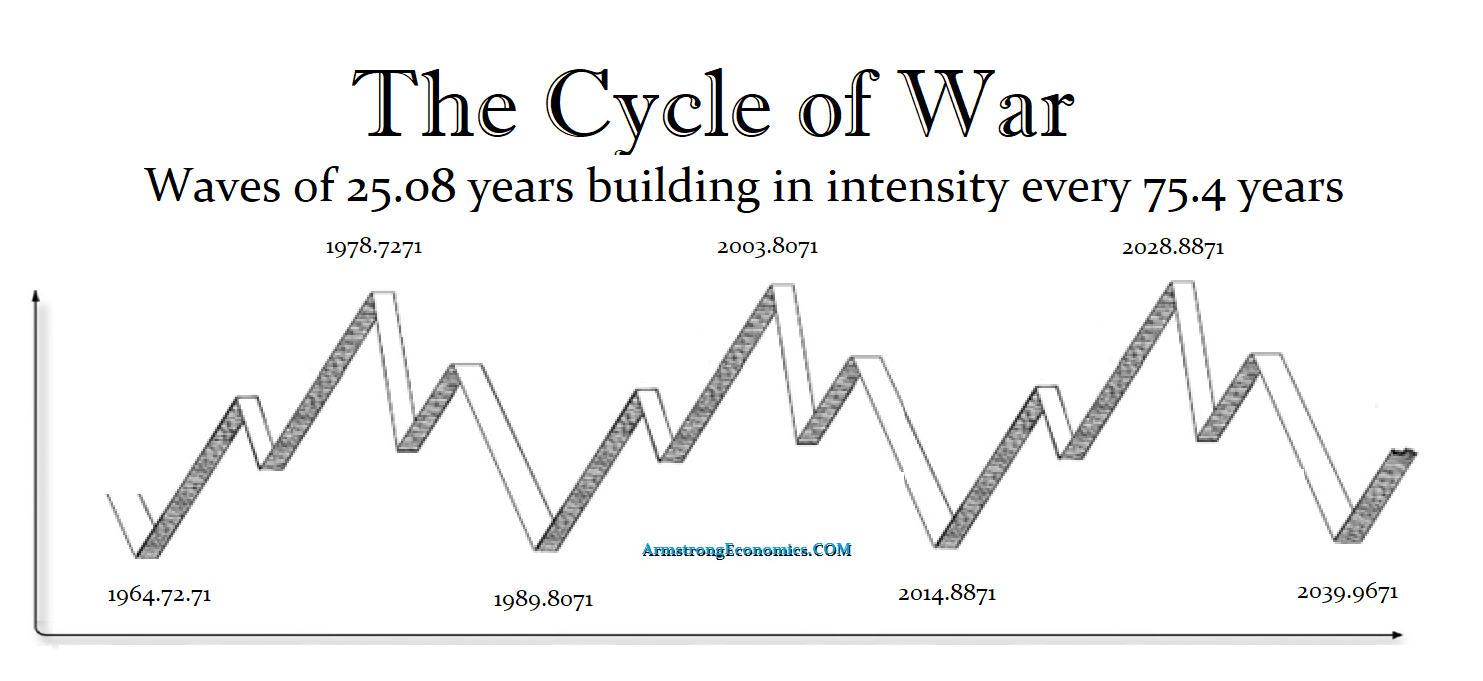
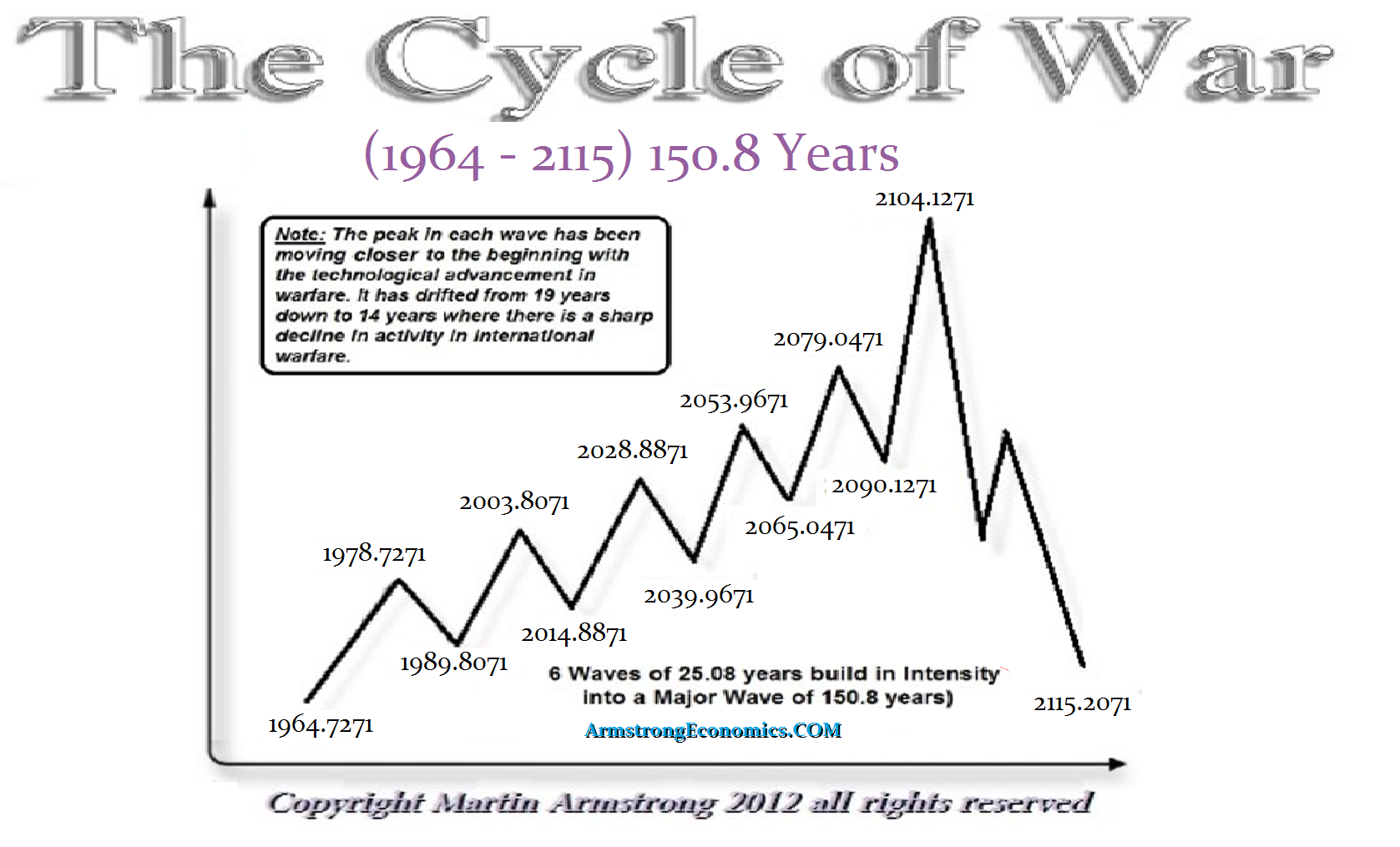
We have been watching October 5 on the War Cycle, and what has unfolded around that date deserves attention. This is no longer simply Russia and Ukraine trading artillery across a battlefield. The geographical footprint of this war is expanding, commercial shipping is being hit in the Black Sea, NATO aircraft are being scrambled, air defense is being moved closer to the front, and Europe is openly discussing nuclear deterrence. Nobody needs to invent World War III or exaggerate every drone that crosses a radar screen. What matters is the trend, and the trend is moving in precisely the wrong direction.
On October 5, a commercial vessel caught fire and sank outside Romanian territorial waters after leaving the Ukrainian port of Izmail. Two people died. Zelensky attributed the event to “a horrific strike by two Russian drones on a civilian vessel,” although Romanian authorities did not confirm the cause. Then on October 6, two more commercial vessels were attacked by drones inside Bulgaria’s exclusive economic zone. One sank and another caught fire, forcing the evacuation of 18 crew members, two of whom were seriously injured. Bulgaria has NOT established where those drones came from. These attacks cannot honestly be called deliberate Russian attacks on NATO territory based on the evidence presently available. Nevertheless, civilian shipping is now being dragged directly into the military confrontation around NATO’s Black Sea flank.
“This is an unacceptable attack in Bulgaria’s exclusive economic zone. It is a blatant violation of international law and maritime law,” Prime Minister Rumen Radev said.
At the same time, NATO aircraft are being forced into action. Two Spanish F-18s stationed in Romania under NATO command were scrambled after radar detected aerial targets operating in Ukrainian airspace close to the Romanian border. They did not enter Romanian airspace and there was no interception, but Romanian authorities issued warnings to civilians because of the danger of falling objects. These incidents are becoming routine, and that is precisely the problem. Wars expand through mistakes, miscalculations, and reactions to events that politicians insist nobody intended.
Ukraine has meanwhile launched an extraordinary drone assault deep into Russia. Russian authorities claim nearly 900 Ukrainian drones were intercepted overnight across Russia, occupied Crimea, and the Sea of Azov. Moscow’s mayor said 650 drones were directed toward the capital region overnight, followed by dozens more during the day. Two people were killed, while reports emerged that a major fuel installation in the Moscow region was burning. The fuel strike has not been independently confirmed. Zelensky is now warning that intelligence indicates Russia is preparing a massive retaliatory aerial attack. Each side responds to the last attack with something larger, and eventually somebody crosses a line that cannot be uncrossed.
Sweden announced that it will send Patriot air-defense systems and roughly 100 troops to Poland to protect the Rzeszow logistics hub, the primary artery through which Western military aid reaches Ukraine. Lithuania has now advanced a constitutional amendment that would remove its prohibition against nuclear weapons and foreign military bases. Lithuania borders both Belarus and Russia’s Kaliningrad exclave. This does NOT mean American nuclear weapons are suddenly being stationed in Lithuania, and another parliamentary vote is required. But Moscow has already warned that moving NATO military infrastructure and potentially nuclear weapons closer to Russia will be regarded as escalation.
Then France test-fired its new M51.3 submarine-launched ballistic missile on October 6. The missile carried no nuclear warhead, and the test was part of the certification of France’s strategic deterrent, so this should not be falsely portrayed as France preparing to attack Russia. Europe is increasingly talking about deterrence, nuclear capability, military readiness, and preparing populations for confrontation rather than negotiating an end to this madness.
Wars do not require somebody sitting in a room deciding that Tuesday morning would be a wonderful time to start World War III. The First World War emerged from alliances and mobilizations that transformed a regional crisis into a continental catastrophe. Politicians create commitments they believe will deter the other side, the other side responds with commitments of its own, and eventually everyone becomes trapped by the very deterrence system they created.
There is much concern over recent developments in the Black Sea. Commercial shipping cannot continually be attacked without consequences. Romania and Bulgaria are NATO members. Poland is becoming increasingly fortified as the principal logistics corridor supporting Ukraine. Lithuania is reconsidering restrictions on nuclear deterrence. Europe is pulling every move to prepare for war.
The War Cycle was never about predicting that politicians would formally declare World War III on a particular day. Cycles identify periods when geopolitical pressure and the probability of conflict rise. What has emerged around October 5 is therefore worth watching very closely. We have commercial vessels sinking, an unprecedented drone assault aimed deep into Russia, NATO fighters launching in response to approaching aerial targets, Patriot batteries moving into Poland, Lithuania opening the door to expanded NATO deterrence, and Russia warning that the continued movement of Western military infrastructure toward its borders will have consequences.
Watch the Black Sea. Watch Poland and Lithuania. And above all, watch what Russia does in response to this enormous Ukrainian drone attack. If the next retaliation spills deliberately onto NATO territory or kills NATO personnel, we will have moved into an entirely different phase of this war.
Posted originally on Oct 7, 2026 by Martin Armstrong |
Germany’s own intelligence service is now warning that the confrontation with Russia is entering a far more dangerous phase. Martin Jäger, head of Germany’s BND foreign intelligence service, told parliament on October 5 that Germany risks becoming embroiled in a violent conflict with Russia. He described what is taking place across Europe as a Russian “shadow war” that has entered a “new, more dangerous dimension.”
October 5, on that very date, Germany’s intelligence chief is warning that the confrontation with Russia is moving beyond Ukraine. Germany points to drones, cyberattacks, sabotage, espionage and attacks against infrastructure throughout Europe. German authorities have accused Russia of involvement in an attempted drone attack against a Ukrainian transport aircraft at Leipzig airport. Moscow denies conducting such a campaign and insists it has no intention of attacking NATO.
Jäger declared that “Russia is our most dangerous adversary.” He said the danger of attacks against German targets remains “real and imminent” and accused Moscow of testing Germany to see how far it can push. Perhaps most alarming was his warning about what comes next: “Russia could engage in low-intensity military activities, particularly in the Baltic states.” Germany is openly talking about a conflict that could creep across NATO’s borders without beginning with some formal declaration of war.
What concerns me most is that Jäger openly discussed the possibility of Russia conducting limited operations against the Baltic states to test NATO. Not necessarily thousands of tanks rolling across a border, but something deliberately ambiguous enough to determine whether NATO actually has the political courage to respond. What constitutes an attack today? A drone entering NATO airspace? A commercial vessel destroyed in the Baltic? The lines that once separated war from peace have become dangerously blurred.
Germany’s military is issuing much the same warning. Major General Christian Freuding, who oversees Germany’s support for Ukraine, has warned against assuming Europe has years before a confrontation with Russia. He said the question of when Russia might be capable of attacking NATO is becoming almost irrelevant because Moscow already possesses forces and weapons that could be used against the alliance today. “Russia already has the capabilities to attack NATO territory now,” Freuding warned. That does not mean Germany believes Putin is preparing to invade tomorrow, but this constant rhetoric matters. German intelligence warns of a shadow war, its generals say Russia can attack NATO now, and Berlin is simultaneously rearming at a pace not seen in generations. The danger is that Europe is no longer preparing for some theoretical war in 2029. Its own military leadership is telling the public that the confrontation could come much sooner.
Europe helped create this situation by pretending it could wage an unlimited proxy war against a nuclear power while keeping everything neatly contained inside Ukraine. Germany supplies weapons to Kyiv and has become one of Ukraine’s largest supporters. Poland is rapidly militarizing. Finland and Sweden have joined NATO. Lithuania sits beside Kaliningrad and is moving to remove its prohibition on nuclear weapons. Russia responds by strengthening its own defenses, and Europe then points to that response as evidence that Moscow is preparing to attack.
The Baltic is becoming perhaps the most dangerous pressure point. Russia has already warned that any attempt to attack or isolate Kaliningrad could produce a response involving nuclear weapons. Jäger is now warning NATO not to simply wait for 2029, the timeframe often discussed for when Russia could become capable of a larger confrontation with the alliance. Something smaller could happen first.
The War Cycle does not mean someone declares World War III on a particular day. It marks periods when geopolitical pressure intensifies and governments become increasingly aggressive. Europe says it is preparing for war to prevent war. Russia says precisely the same thing. Eventually, with this many weapons, drones, troops and intelligence operations rubbing against one another, all it takes is one mistake to set off something nobody can control. Germany’s intelligence chief is effectively admitting we are getting dangerously close to that point.
Posted Originally on Oct 7, 2026 by Martin Armstrong |
Merz does not care about the fate of Germany or its people. Here we are on precisely the week of October 5th and Merz is saying that Russia staged some armed attack on Leipzig airport. He is publicly stating that Germany is effectively at war with Russia. The EU is crumbling and the AfD has beaten Merz to a pulp, so its now time to go out with a bang and declare war has already begun.
Here is Merz declaring that Brussels is indeed very concerned about the rise of of what they call far-right parties that are anti-EU with the common thread being their migrant policies. The nature of that concern has also now shifted significantly. The current anxiety in EU institutions is not just about the imminent “exit” threat, but also I hear they fear a growing strategic objective by these parties to weaken and obstruct the EU from the inside.
They are concerned that instead of a demand for an immediate exit that they can regi such elections as they did in Hungary and Romania, they are now also looking at the draft strategy document of the AfD lawmakers which are moving away from demanding an immediate German exit from the EU and eurozone, proposing instead, to prioritize reforming the EU into a “union of sovereign nations” and advocate for a referendum on membership only if those reforms fail.
This shift is partly pragmatic. The AfD is currently isolated in the European Parliament, and more moderate right-wing parties, like Marine Le Pen’s National Rally, have openly criticized the AfD’s “anti-European” stance. Dropping the exit demand makes the AfD a more palatable ally for these larger far-right groups.
This strategic change creates a more difficult problem for the EU than a simple exit campaign that they can fight with rigged elections. Here, a referendum requires a party to convince a majority to take a radical step. In contrast, internal disruption only requires enough power to block, dilute, and redirect policy from within the system. The EU’s existing tools, which were designed to reassure citizens about the benefits of membership, are ill-suited to counter this kind of internal gridlock. This is why they rigged both the Romanian and Hungarian elections.
Parties like the AfD and Hungary’s Fidesz can exploit unanimity rules to veto EU-wide decisions. For example, Hungary has blocked crucial sanctions and loans for Ukraine, and the far-right Patriots for Europe group has worked to dilute the Green Deal and the Migration Pact. This dysfunction then becomes campaign material for these parties, who position themselves as defenders of national interests against a “paralyzed” Brussels. This was why the Hungarian government has repeatedly accused Ukraine of interfering in its elections to remove Orban. Sources in Washington reveal that Ukraine is also interfering in US elections funding the opposition of anyone in Congress who is against sending money to Ukraine. Israel has been doing the same.
The European Commission is aware of the broader threat posed by anti-Brussels movement. Its response has focused on security and rule of law, rather than direct political confrontation. Through Europol and the EU Knowledge Hub, the Commission is coordinating cross-border efforts to combat anti-EU protests and sharing information on proscribed groups.
The Commission has proposed reforms to its next long-term budget that would make EU funding conditional on member states respecting the rule of law. This is designed to impose financial costs on governments allowing the people to vote for organizations like the Afd. This is a very anti-democratic position but this is what governments do to retain power.
In short, Brussels’ concern is focused on a more subtle and persistent threat of a coordinated effort by these anti-EU parties to hollow out the EU’s ability to function from within its own institutions.
This is why the EU faces a rising threat that will dissolve the centralized government returning sovereignty to individual member states, or start World War III with Russia not just as a distraction, but to forge a unity bond with the classic rally around the flag.
The World Economic Forum (WEF) was trying to create the one-world government some call globalization, where the pandemic some believed would create the unity to create this globalization. However, the manufactured pandemic actually accelerated pre-existing trends toward deglobalization, nationalism, and the “balkanization” of technology. WEF discussions acknowledged that globalization was “already under attack before COVID” and that the pandemic posed new questions about nationalism that were exactly opposite of the expected unity. The WEF’s stated concern was that a retreat from globalization and that multilateralism damaged their efforts to create their communistic form of government where you own nothing and you’ll be happy.
Here war is being used to create the UNITY with the Rally around the flag in an effort to defeat the agenda of AfD and others and in the process solidify the EU as a permanent European federal government.
Posted Originally on Oct 6, 2026 by Martin Armstrong |
France is burning again, and at some point we have to stop pretending this is normal. As many as 500 high schools are closed or partially closed because the government cannot guarantee their security. Twenty-four schools have reportedly been burned or ransacked and 78 education employees injured. In Paris, hooded individuals piled combustible material against the entrance of a school and set it on fire. When masked thugs are setting schools on fire, you are watching the breakdown of civil society.
The radical left has helped turn legitimate frustration into another excuse for confrontation with the state. What began with complaints about teachers and education spread through disadvantaged Paris suburbs before exploding into a nationwide movement, with authorities saying violent groups infiltrated demonstrations. This is the same political sickness we keep seeing across Europe: every grievance becomes justification for occupying something, smashing something, burning something, or attacking the police, while politicians are terrified to call it what it is because they have spent years romanticizing radicalism whenever it serves their political interests.
Then there is the immigration crisis that the French establishment has spent decades refusing to discuss honestly. France permitted large-scale immigration while failing miserably at integration in parts of the country. It allowed segregated suburbs to develop where poverty, unemployment, crime, alienation and distrust of the state became entrenched across generations. Immigration does not make someone violent, and the government has not established that migrants are responsible for all these attacks, but denying the enormous integration crisis surrounding many French banlieues has become absurd. You cannot import people indefinitely without ensuring they become part of the society they are entering and then act surprised when parallel communities emerge.
France has already seen where this road leads. The 2005 riots spread across the country as thousands of vehicles were burned and public buildings attacked. The 2023 riots produced another wave of arson, looting and destruction after the police killing of Nahel Merzouk. Now we are watching schools burned and hundreds more closed because authorities fear additional violence. How many times does the same country have to erupt before politicians admit there is a structural problem?
France is also running directly into the financial wall. The country has one of Europe’s largest welfare states, persistent deficits, enormous public debt, and rising borrowing costs. Yet every social failure produces demands for still more government spending. More teachers, more housing, more welfare, more policing, more subsidies, more integration programs and more reconstruction after the next riot. Nobody ever asks where the money comes from because the political class has spent generations pretending debt is free.
This is where uncontrolled immigration and sovereign debt eventually collide. Every additional person requires housing, schools, healthcare, transportation and infrastructure. A successful immigration policy expands the productive economy alongside the population and integrates newcomers into the nation. A failed policy increases demands on systems that are already strained while refusing to acknowledge capacity limits. France chose ideology over arithmetic and is now discovering that calling critics names does not create another classroom, apartment or hospital bed.
The radical left will blame capitalism, inequality, the police, austerity or whatever slogan is fashionable this week, but burning schools will not produce another teacher. Destroying public property will not improve education. Setting fire to the institutions your own community depends upon is not resistance. It is self-destruction.
Now children cannot even go to school because these idiots think they have some God given right to burn, smash and destroy an entire community whenever they are angry. They torch a school, destroy a bus stop, smash a storefront or burn somebody’s car and somehow imagine they have punished “the government.” The government does not reach into its own pocket and clean up the mess. The TAXPAYER does. The shopkeeper whose windows were smashed pays. The worker whose car was burned pays. The parents whose children are sitting at home because their school is closed pay. Then the same fools who destroyed their own neighborhoods complain that there are not enough teachers, services, or opportunities, as if money magically falls from the sky to rebuild everything they just burned. This is not protest and it is not some noble rebellion against the system. It is sheer stupidity, and the innocent people trying to work, raise families and send their children to school are being forced to pay for it.
Posted Originally on Oct 6, 2026 by Martin Armstrong |
Chile is back in the streets, and this is how it always begins. More than 20,000 students, teachers, workers and union members marched through Santiago against President José Antonio Kast’s 2027 budget. Then came the rocks, bottles, tear gas, arrests, and water cannons. Everyone will argue about who threw what first and whether the police overreacted, but they are missing the point. The government created a system of promises, the economy can no longer comfortably carry all of them, and now people are furious because politicians suddenly discovered arithmetic.
Chile’s unemployment rate is already 9.6%, and Kast came into office promising to cut the fat from government. His proposed budget increases overall spending by only 1.5%, the smallest expansion in two decades outside the post-COVID adjustment. His government reviewed 632 programs across 23 ministries and effectively asked a question that should have been asked decades ago: what are taxpayers actually getting for this money? Naturally, everyone receiving the money suddenly believes civilization will collapse if they remove one peso.
This is the insanity of government. Politicians create programs when times are good because buying votes with somebody else’s money is the easiest profession on earth. They hand out benefits, subsidies and promises without ever asking how they will be financed 10 or 20 years later. Eventually those temporary political gifts become permanent RIGHTS. Then somebody finally looks at the books and realizes the numbers do not work, and suddenly there are 20,000 people marching through the capital demanding that the money continue flowing.
Kast has already backed away from some of the reductions and insists free higher education for more than 600,000 students will remain. The government says the structural education budget is not being destroyed. It almost does not matter anymore because confidence is the real issue. The students do not trust the government, the government does not trust the previous spending structure, and everybody believes somebody else should pay the bill.
Chile should know where this road leads because it lived through 2019. That explosion supposedly began over a small increase in Santiago metro fares. It was never really about the metro fare. That was merely the match tossed onto years of accumulated frustration over pensions, wages, education, inequality, and the cost of living. Once the psychology changed, people were not arguing about thirty pesos anymore. They were burning metro stations.
This is what the academics never understand about civil unrest. They sit there looking for some neat mathematical explanation after everything is already on fire. People tolerate deteriorating conditions for years until suddenly they don’t. One tax, one price increase, one spending cut, one police incident or one stupid statement from some politician becomes the spark, and everyone acts surprised when decades of resentment explode at once.
Politicians created this mess because they NEVER tell people the truth when they make these promises. They do not say, “We can give you this benefit today, but there may not be enough money to maintain it forever.” They pretend government possesses some magical bottomless bank account. Then the economy turns, unemployment rises, tax revenues disappoint, debt costs increase, and suddenly the same government tells everyone sacrifices must be made.
Sacrifices by whom?
Certainly not the political class. The people are always told they must accept less, pay more taxes, retire later, surrender another subsidy, or watch another public service deteriorate. That is when confidence begins to crack because people realize government spent the money years ago and left them with the bill.
The civil unrest we are seeing around the world is not occurring in a vacuum. Governments are running into fiscal constraints at precisely the same time younger generations are struggling with housing, employment and the cost of living. These people are being handed debts they did not create and promises governments can no longer afford to honor.
The Economic Confidence Model is about precisely this transition in human behavior. Civil unrest does not begin because somebody publishes a bad GDP number. It begins when enough people finally conclude that the people running the system have absolutely no idea what they are doing. Once that confidence breaks, every tax increase, spending cut and political decision becomes another potential match.
Chile is back in the streets because government once again made promises without considering tomorrow. Now tomorrow has arrived, the arithmetic no longer works, and politicians are discovering that taking away what government once handed out is far more dangerous than giving it away in the first place. This is how political systems begin to fracture, not because everyone suddenly becomes a revolutionary, but because the people finally realize the promises were written by politicians who never intended to be around when the bill came due.
Posted J. Edgar HooPosted Oct 6, 2026 by Martin Armstrong |
QUESTION: I just watched Genius on Albert Einstein. Beyond the fact that I can see why people compare you to him—driven by your research and curiosity rather than money, which is also why you don’t sell advertising or flood inboxes with 50 solicitation emails a day—what also struck me was how obsessed J. Edgar Hoover was with bringing Einstein down. He even carried out illegal searches and used what he found to manipulate both judges and the press against him. They manipulated the press during COVID too. Is there any way to ever get an honest government?
KL
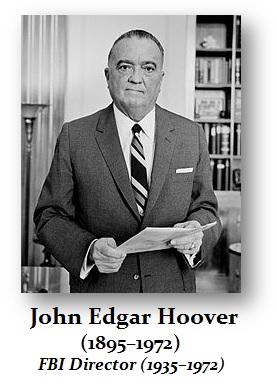
ANSWER: Historians and researchers who have examined the declassified FBI files describe J. Edgar Hoover’s campaign against Albert Einstein as a personal vendetta or a “secret war” fueled by ideological suspicion. While there’s no evidence of a personal slight between the two men, Hoover’s deep distrust of Einstein’s politics drove a two-decade effort to discredit him.
Hoover used the FBI for his personal para noia. He maintained a massive file on Einstein from his arrival in the U.S. in 1933 until his death in 1955, eventually reaching over 1,400 pages. Hoover personally ordered investigations and the Bureau employed aggressive tactics, including tapping his phone, opening his mail, and searching his trash.
Hoover’s obsession was rooted in Einstein’s outspoken activism against war, not just his science. The FBI director labeled him an “extreme radical” and Hoover suspected him of being a communist or even a Soviet spy as he also maintained files of just about every member of Congress and presidents. This suspicion was driven by Einstein’s public stances against racism, nationalism, and nuclear weapons, as well as his friendships with controversial figures like Paul Robeson.
Hoover was desperate to deport or discredit him. Hoover’s personal war against Einstein was extremely intense and was revealed by its objectives. Hoover tried for years to link Einstein to a Soviet espionage ring, hoping to have him arrested or deported. In 1950, he launched an intensified effort to gather “derogatory information” specifically to discredit Einstein at all costs where he acted no different than a communist state he pretended to hate so much. Hoover ignored all rights of Einstein and ignored all constitution restraints on his power.
The allegations the Hoover pursued were often absurd, including claims that Einstein was plotting to kidnap the Lindbergh baby, had invented a “death ray,” or was the mastermind of a Communist plot to take over Hollywood. Ultimately, Hoover failed to prove any of these claims or limit Einstein’s public influence during his lifetime.
I was personally told years ago by member of Congress that he would assemble a file on a politician, walk into his office, say this is what they found, your opponent could use this. He would claim to bury it and then you owed him a favor.
This is the prosecutor I faced who kept me in contempt desperate to find anything. They knew I advised on many takeovers and investigated even my family assuming I had to have some hidden account somewhere for inside trading. His #2, Brian Code, wanted to go after the bank, but someone did not let him. He told my lawyer “we know he didn’t take anything.” At that reverse proffer, Owens told me he would not drop any changes, and just said you are “one smart” SOB because they could find anything.
They never got it. When you have offices arpund the world, you have to comply with the laws around the world. The lawyer said plainly, the only way I could possibly comply worldwide was I could not even have a stock account. I was paid big bucks BECAUSE I had no conflict of interest. People in such positions seem to have to assume everyone is guilty and rotten to the core just so they can look at themselves in the mirror and pretend they are defending society. I have seen this pattern not just in my case, but so many.
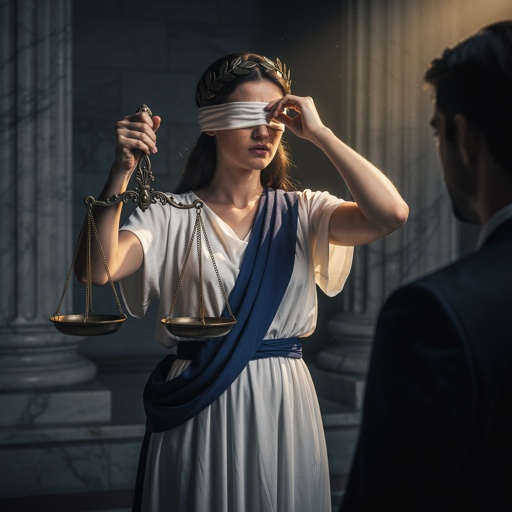
There should be an independent panel of PRIVATE lawyers that rotate. No indictment should ever be allowed to be the product of a single prosecutor. Their personal ego and career get wrapped up it. They all look to take down a famous person like Rudy Guiliani took down John Gotti of the NY Mafia and used that to become Mayor. Just look at how many politicians were former prosecutors right down to Christopher James Christie the governor of New Jersey. Until the authority to craft a charge against anyone is put before an independent panel, there will never be true honest government.
The Rule of Law is everything. Without it, there can be no investment and no economy.
We have to start there or all is lost.
Categories:Rule of Law Oct 6, 2026 by Martin Armstrong |
QUESTION: I just watched Genius on Albert Einstein. Beyond the fact that I can see why people compare you to him—driven by your research and curiosity rather than money, which is also why you don’t sell advertising or flood inboxes with 50 solicitation emails a day—what also struck me was how obsessed J. Edgar Hoover was with bringing Einstein down. He even carried out illegal searches and used what he found to manipulate both judges and the press against him. They manipulated the press during COVID too. Is there any way to ever get an honest government?
KL
ANSWER: Historians and researchers who have examined the declassified FBI files describe J. Edgar Hoover’s campaign against Albert Einstein as a personal vendetta or a “secret war” fueled by ideological suspicion. While there’s no evidence of a personal slight between the two men, Hoover’s deep distrust of Einstein’s politics drove a two-decade effort to discredit him.
Hoover used the FBI for his personal para noia. He maintained a massive file on Einstein from his arrival in the U.S. in 1933 until his death in 1955, eventually reaching over 1,400 pages. Hoover personally ordered investigations and the Bureau employed aggressive tactics, including tapping his phone, opening his mail, and searching his trash.
Hoover’s obsession was rooted in Einstein’s outspoken activism against war, not just his science. The FBI director labeled him an “extreme radical” and Hoover suspected him of being a communist or even a Soviet spy as he also maintained files of just about every member of Congress and presidents. This suspicion was driven by Einstein’s public stances against racism, nationalism, and nuclear weapons, as well as his friendships with controversial figures like Paul Robeson.
Hoover was desperate to deport or discredit him. Hoover’s personal war against Einstein was extremely intense and was revealed by its objectives. Hoover tried for years to link Einstein to a Soviet espionage ring, hoping to have him arrested or deported. In 1950, he launched an intensified effort to gather “derogatory information” specifically to discredit Einstein at all costs where he acted no different than a communist state he pretended to hate so much. Hoover ignored all rights of Einstein and ignored all constitution restraints on his power.
The allegations the Hoover pursued were often absurd, including claims that Einstein was plotting to kidnap the Lindbergh baby, had invented a “death ray,” or was the mastermind of a Communist plot to take over Hollywood. Ultimately, Hoover failed to prove any of these claims or limit Einstein’s public influence during his lifetime.
I was personally told years ago by member of Congress that he would assemble a file on a politician, walk into his office, say this is what they found, your opponent could use this. He would claim to bury it and then you owed him a favor.
This is the prosecutor I faced who kept me in contempt desperate to find anything. They knew I advised on many takeovers and investigated even my family assuming I had to have some hidden account somewhere for inside trading. His #2, Brian Code, wanted to go after the bank, but someone did not let him. He told my lawyer “we know he didn’t take anything.” At that reverse proffer, Owens told me he would not drop any changes, and just said you are “one smart” SOB because they could find anything.
They never got it. When you have offices arpund the world, you have to comply with the laws around the world. The lawyer said plainly, the only way I could possibly comply worldwide was I could not even have a stock account. I was paid big bucks BECAUSE I had no conflict of interest. People in such positions seem to have to assume everyone is guilty and rotten to the core just so they can look at themselves in the mirror and pretend they are defending society. I have seen this pattern not just in my case, but so many.
There should be an independent panel of PRIVATE lawyers that rotate. No indictment should ever be allowed to be the product of a single prosecutor. Their personal ego and career get wrapped up it. They all look to take down a famous person like Rudy Guiliani took down John Gotti of the NY Mafia and used that to become Mayor. Just look at how many politicians were former prosecutors right down to Christopher James Christie the governor of New Jersey. Until the authority to craft a charge against anyone is put before an independent panel, there will never be true honest government.
The Rule of Law is everything. Without it, there can be no investment and no economy.
Posted Originally on Oct 5, 2026 by Martin Armstrong
Economists keep pointing to consumer spending as proof that the American economy remains strong. Americans spent 0.9% more in August, and naturally this is being celebrated as the resilient American consumer. But real disposable income did not increase AT ALL, while the personal savings rate fell to just 4.1%. Americans are spending more while their inflation-adjusted income is going nowhere and savings are being depleted to maintain their standard of living.
The cost-of-living crisis is showing up in the numbers. Consumer spending can rise during inflation simply because everything costs more. If your grocery bill rises from $150 to $200, you increased consumer spending by 33%, but you did not become wealthier or eat 33% more food. You simply handed over more dollars for the same necessities.
Personal consumption expenditures increased by $190.8 billion in August while personal income increased only $66.6 billion. Real consumer spending rose 0.6%, but real disposable income was flat. You can maintain that imbalance temporarily by reducing savings or borrowing, but you cannot maintain it forever.
This is what Washington never understands about inflation. They tell people inflation has fallen because the RATE of increase is lower than it was at the peak. That does not mean prices went back down. Consumer prices are roughly 30% higher than at the end of 2019. Something that cost $100 then costs roughly $130 today. Lower inflation merely means prices are rising more slowly from an already elevated level.
This is why consumer confidence can collapse while spending remains strong. The Conference Board’s Consumer Confidence Index plunged to 81.9 in September, its lowest reading since 2014. The University of Michigan’s sentiment index fell to 48.1 and is now 15% below January. People are continuing to spend because they must continue living, but they are increasingly worried about what comes next.
The University of Michigan reports that consumers’ expectations for inflation over the next year climbed to 4.6% in September, up from 3.4% in February. Consumers’ assessments of both their current and expected personal finances also deteriorated. The paycheck may still be coming in, but it simply does not stretch as far as it once did. Americans feel the conditions of the economy daily.
Even if inflation fell to 2% tomorrow, today’s elevated price level would remain. Prices would simply continue increasing from that higher base. This is how inflation quietly destroys the middle class. Savings decline, debt rises, homeownership becomes harder, young people delay families, and retirees discover that their savings purchase far less than expected.
The American consumer has kept this economy moving, but there is a limit to how long households can spend faster than their real incomes grow. You cannot raid savings forever, increase credit-card balances forever, or finance your standard of living indefinitely.
Strong consumer spending therefore does not necessarily mean the consumer is strong. Sometimes it means the consumer is paying substantially more simply to remain in the same place. Americans are still spending, but real disposable income has stalled, savings are falling, confidence has collapsed, and prices remain roughly 30% above where they stood before the pandemic-era inflation surge. Washington can call that resilience if it wants, but ordinary people know the difference between spending more because they are becoming wealthier and spending more because life itself has become more expensive.
Posted Originally on Oct 5, 2026 by Martin Armstrong |
The September jobs report should put an end to the fantasy that the American economy can absorb rising prices indefinitely without eventually hitting employment. The economy added only 29,000 jobs when economists expected roughly 84,000, while unemployment increased to 4.2%. Worse still, July was revised from a gain of 21,000 jobs to a LOSS of 10,000, and August was revised down from 162,000 to 133,000. Those revisions erased another 60,000 jobs from what we were previously told was a stronger labor market.
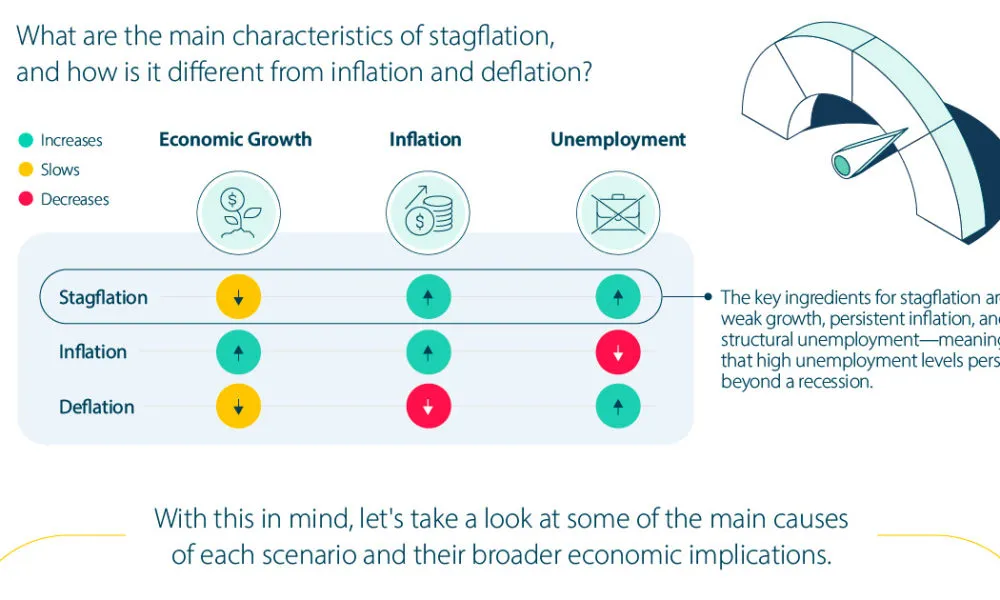
This is the stagflationary squeeze I have been talking about. Prices remain elevated while economic growth and employment begin to weaken. Average hourly earnings increased only 0.1% in September and 3.0% over the past year. Consumer inflation has been running above that pace, meaning workers can receive a nominal raise while still losing purchasing power. You can have a job, earn more dollars, and still become poorer in real terms.
The labor market is not collapsing, and that distinction matters. Initial unemployment claims remain low and the unemployment rate has stayed between 4.1% and 4.3% since March. But the direction underneath the headline is deteriorating. There are now 7.1 million unemployed Americans, 1.9 million have been unemployed for at least 27 weeks, and 4.5 million are working part-time for economic reasons because they cannot find full-time work or their hours have been reduced.
This is precisely the environment that traps the Federal Reserve. Raise rates to fight inflation and you place additional pressure on employment, housing, business investment, and debt service. Lower rates to support employment and you risk feeding inflation that is increasingly being driven by energy, tariffs, supply constraints, government deficits, and geopolitical disruptions that interest rates cannot solve. The Fed cannot print oil, manufacture raw materials, or clear a manufacturing backlog.
The average American gets crushed from both sides. Confidence is already falling because people see their cost of living rising while they become less certain about their employment. A household can survive expensive groceries when wages are rising and jobs are plentiful. It becomes an entirely different economic environment when groceries remain expensive, wage growth falls behind prices, and employers stop hiring.
That is why September’s 29,000 jobs matter. It is not evidence of some sudden depression, but it is another warning that the economy is losing momentum while the cost-of-living problem has not disappeared. Stagflation does not require 1970s-style double-digit inflation and unemployment before people feel the pain. The squeeze begins when prices remain stubbornly high while employment opportunities, real wages, and confidence begin moving in the wrong direction at the same time.
Posted Originally on Oct 5, 2026 by Martin Armstrong |
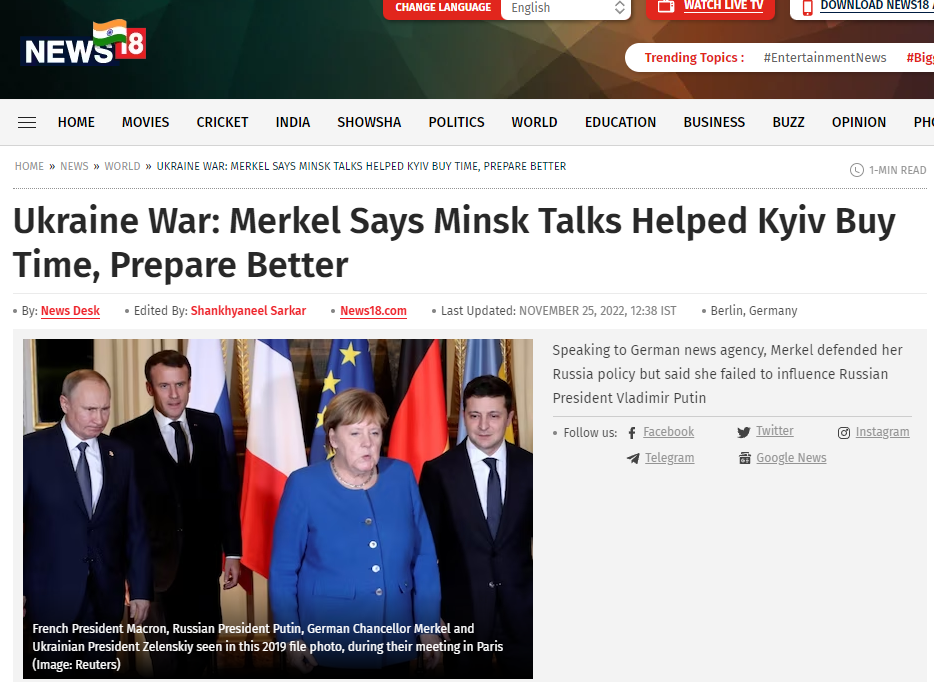
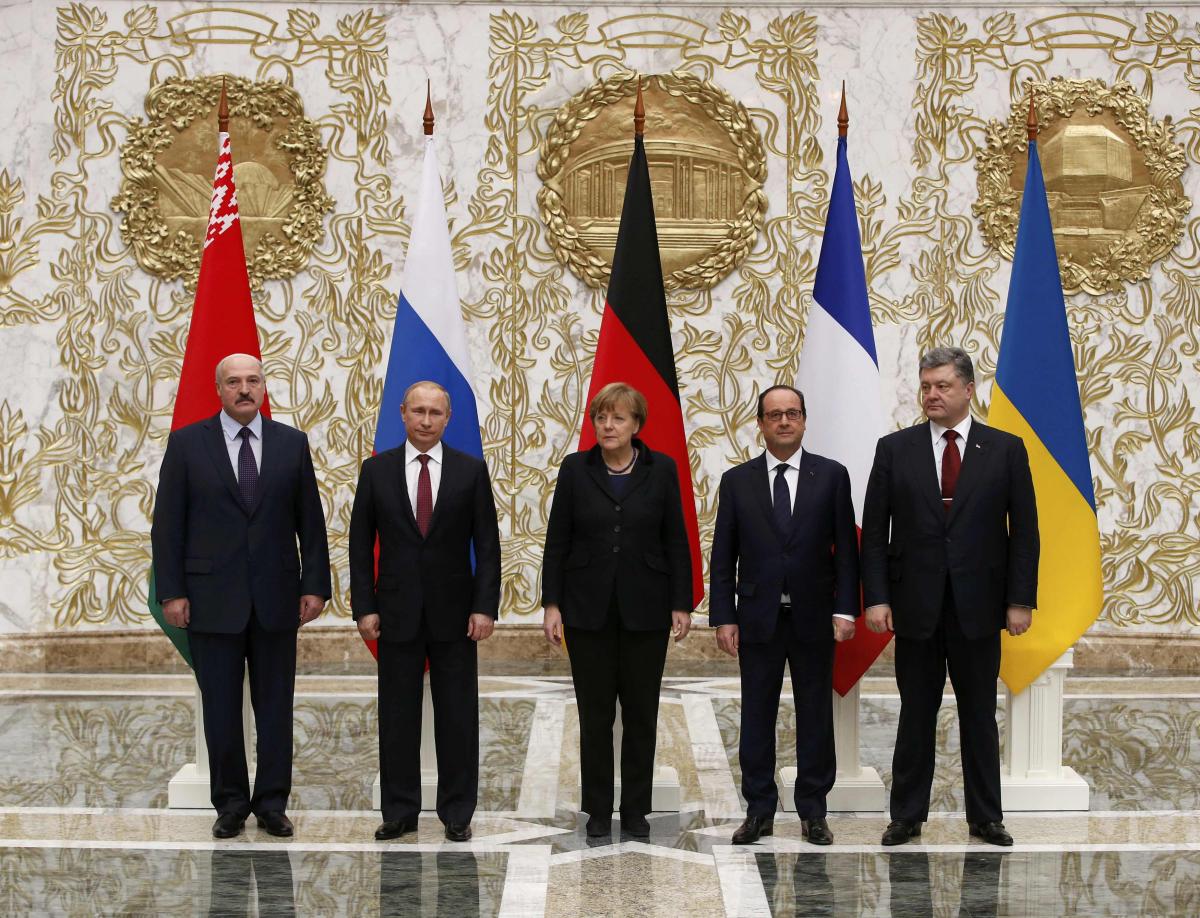
What is interesting is how the West has always dealt with Russia. They always LIE and have proven themselves outright untrustworthy. Not only did they sign a legally binding Minsk Agreement to allow the Donbas to vote on separating from Ukraine, but then they simply played Russia for a fool, with Merkel publicly admitting that they never intended to honor that agreement; they were buying time for Ukraine to build an army to obviously start this war.
The Minsk II agreement, formally known as the “Package of Measures for the Implementation of the Minsk Agreements,” was signed on February 12, 2015. A separate Minsk Protocol (“Minsk I”) was signed on September 5, 2014.
Whether these agreements are legally binding remains highly contested and unresolved. No universal consensus exists on their legal status, and the answer depends heavily on which legal analysis or political position you consult. This is like going to a bank for a mortage and then claiming you never intended to actually make payments and the house is now yours.
The Case That They Are Legally Binding Proponents of binding force, including Russia and China, argue that UN Security Council Resolution 2202 (2015), which “endorsed” the Package of Measures, elevated the agreements to a legally binding status under international law. This view holds that all UN member states are obligated to comply with Security Council resolutions. From this perspective, the Minsk agreements became the “only valid legal basis” for a settlement.
The Case That They Are Not Legally Binding Opponents, including many Western legal scholars and Ukrainian officials, argue that Resolution 2202 was purely advisory and did not trigger the binding obligations of a Security Council “decision” under Article 25 of the UN Charter. The resolution’s language used terms like “endorses” and “welcomes,” which carry political approval rather than legal compulsion. Furthermore, the resolution was not adopted under Chapter VII of the UN Charter, which is required for enforcement measures.
A detailed 2021 legal analysis by the German Bundestag concluded that the agreements were political commitments, not binding international treaties. It noted that UN Security Council resolutions are only binding if the language and context indicate a “decision” rather than a “recommendation,” and Resolution 2202 did not meet this threshold. Other legal analysts have described the Minsk documents as “political agreements” or even a “private-law contract” with no formal international legal force.
The Minsk agreements are a political framework with intentio0nal ambiguous legal standing. They posed for pictures and touted this as a major event, and that means they not only lied to Russia, they lied to the press and the people. While Russia and China assert they are legally binding due to UN endorsement, most Western legal analyses conclude they were political commitments that lacked the formal characteristics of a binding international treaty. This unresolved legal ambiguity is a central reason why the agreements ultimately collapsed. Why would China or Russia agree to any peace agreement when the West never tells the truth and act like like some used car salesmen?
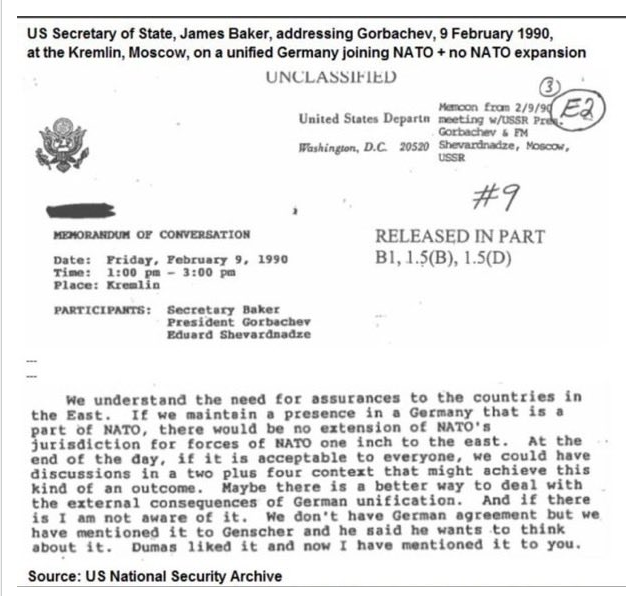
The deception and lies did not begin with the Minsk Agreement. There is substantial evidence that U.S. Secretary of State James Baker gave Soviet leader Mikhail Gorbachev assurances in February 1990 that NATO would NOT expand eastward. However, whether those assurances amounted to deliberate deception has been long debated. The declassified documents establish that the assurances were made. What they do not conclusively establish is that Washington deliberately intended to deceive Moscow when they were given. The distinction is important because the dispute involves three separate issues: what was promised, whether those promises were binding, and whether American officials knew they would eventually violate them. There is NO QUESTION that James Baker actually made that promise in February 1990. On February 9, 1990, Secretary of State James Baker met Soviet leader Mikhail Gorbachev in Moscow to discuss German reunification and the possibility of a united Germany remaining in NATO. Baker proposed that NATO’s jurisdiction would not move one inch eastward if Moscow accepted German reunification within NATO.
The American memorandum of the meeting records Baker saying:
“There would be no extension of NATO’s jurisdiction for forces of NATO one inch to the east.”
This was not merely a casual remark. Baker was exploring a diplomatic arrangement designed to secure Soviet acceptance of German reunification. The following day, West German Chancellor Helmut Kohl also discussed NATO’s future with Gorbachev. Again, he offered similar assurances as was the case with other Western officials during the reunification negotiations.
The declassified American and Soviet records confirm the exchange. Baker also told Soviet Foreign Minister Eduard Shevardnadze that there would need to be firm guarantees against NATO’s eastward movement.
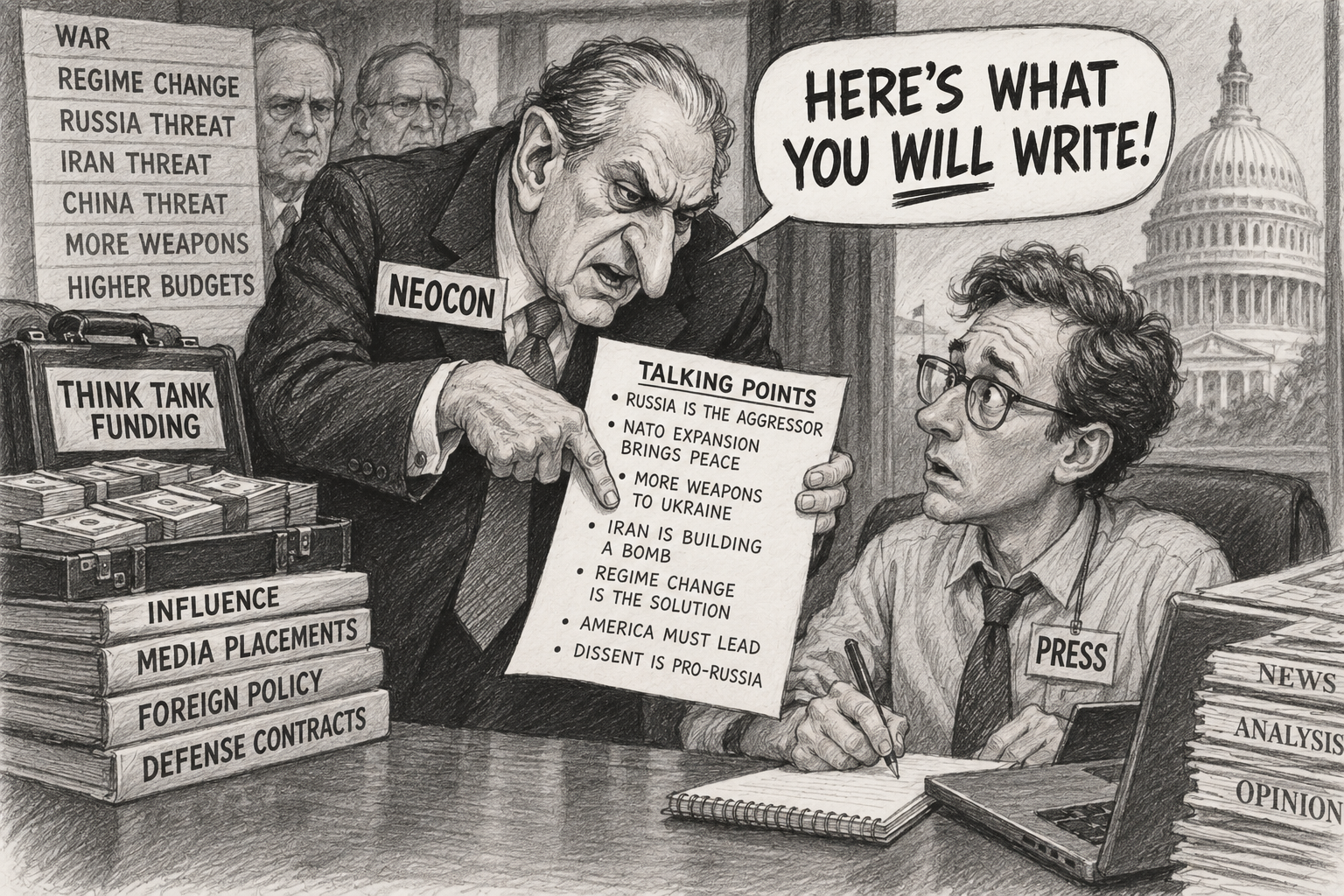
The conventional dishonest American argument pushed by the Neocons is that Baker’s statement concerned the deployment of NATO forces into the former East Germany, not a permanent prohibition on admitting Poland, Hungary, Czechoslovakia or other Eastern European countries. However, the declassified records complicate that interpretation. On January 31, 1990, West German Foreign Minister Hans-Dietrich Genscher proposed that NATO should rule out expansion toward Soviet borders. Then on February 6, Genscher discussed with British Foreign Secretary Douglas Hurd the possibility of Poland leaving the Warsaw Pact and subsequently joining NATO. He argued that the Soviets needed assurances that this would not happen immediately.
The discussions therefore extended beyond the territory of East Germany. The Neocons never care about anything other than their thirst for world domination. Make no mistake, these people have usurped American foreign policy and are leading the world to its destruction.
In December 2017, the National Security Archive at George Washington University published a collection of declassified American, Soviet, German, British and French documents under the title NATO Expansion: What Gorbachev Heard.
Its researchers concluded that Soviet complaints about being misled had a substantial documentary foundation.
Was it intentional Neocon deception?
The case for deliberate deception laid out that Baker was an experienced diplomat who understood the importance of his words. His assurances were repeated, and other Western officials made similar statements. They assumed this was the US position. These assurances helped persuade the Soviet leadership to accept German reunification within NATO. The argument is that Western governments obtained a major strategic concession from Moscow and subsequently abandoned the assurances that had helped secure it. That is hard to just dismiss.
The case against deliberate deception presented by the warmongering-Neocons, rests on the February 1990 discussions they claim were part of an evolving negotiation, not a completed agreement. President George H. W. Bush’s administration subsequently moved away from Baker’s initial proposal as the Neocons directed. The final German reunification settlement, signed in September 1990, imposed specific military restrictions on the former East Germany but did NOT prohibit NATO from admitting other countries. Furthermore, the Soviet Union still existed in February 1990. Its dissolution in December 1991 fundamentally transformed the European security environment. So they argue the USSR no longer existed so anything they promised was to an old government. This is a favorite tactic to default on sovereign debt. The new government is not obligated to pay the debt of the previous. There is insufficient documentary evidence to establish that Baker already intended in February 1990 to encourage NATO’s later expansion while knowingly making a false promise to Gorbachev. Historian Joshua Shifrinson’s research, published in International Security, nevertheless supports the conclusion that the United States made genuine non-expansion offers during the 1990 negotiations.
Unclassified documents have surfaced confirming that actually Putin is correct — NATO had promised not to move one inch eastward and that Eastern Europe was to be a buffer zone of neutrality. NATO has been the agressor and they are NOT ever interested in peace because if there was really peace, then there is no need for NATO and all those people would lose jobs. Of course, mainstream media just read the Neocon script and keep propelling us into World War III. They do not care about the country or the people. Investigative journalism is gasping its last breaths.
This leaves a dangerous precedent. How can any peace agreement ever be taken seriously when the West wiggles out of enat they agreed to?
An independent French Journalist Anne Laure Bonnel was reporting on the Donbass in 2015. No one wanted to listen, if you do, watch this. The film she made is called DONBASS. If after watching this you believe Ukraine are the good guys… pic.twitter.com/8iEOeAUbF8
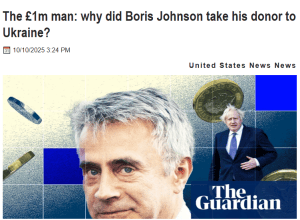
Christopher Harborne is a British defense contractor. He is a major shareholder in QinetiQ, a UK defense technology company that holds Ministry of Defence (MoD) contracts. He donated £1 million pounds, the largest donations to any PM of Britain in history. The Boris took him to introduce him to officials in Ukraine.
Based on leaked documents from Johnson’s private office, the two-day visit took place from 8 September 2023. Harborne was officially registered as an “adviser, Office of Boris Johnson” for the high-level Yalta European Strategy (YES) forum in Kyiv.
The trip included meetings with top Ukrainian officials and a visit to Lviv. Notably, the itinerary mentioned a closed meeting at a military-tech R&D center, an area where Harborne has business interests as the largest shareholder in the British defense firm QinetiQ.
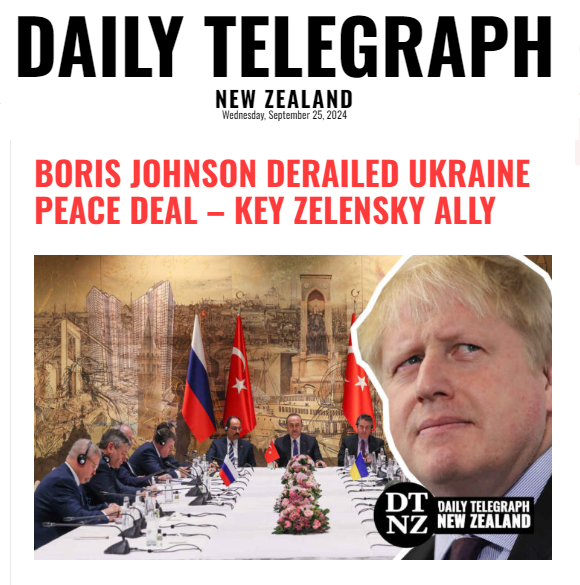
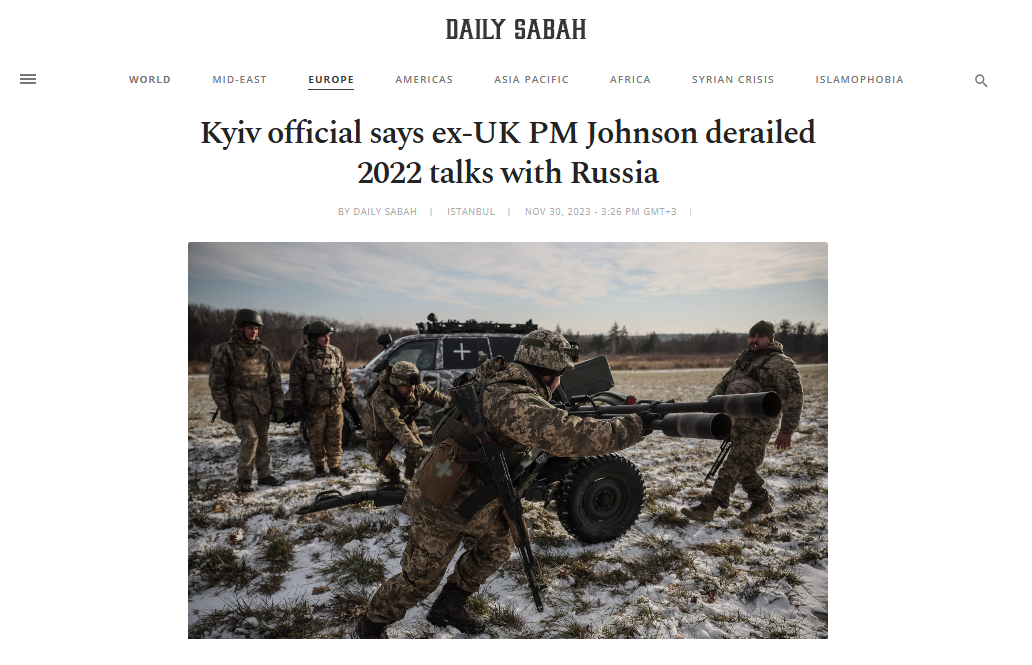
Context of the Relationship This visit occurred less than a year after Harborne donated £1 million to a private company Johnson set up after resigning as Prime Minister. Leaked files also indicate the two had a prior call in January 2023 labeled as a “Ukraine readout”. By September 2024, Boris Johnson flew to Ukraine to stop any peace deal.
Ukraine has been buying or receiving war materials from QinetiQ. The available evidence points to two main channels: direct supply of military equipment through UK aid packages, and indirect funding that allows Ukraine to purchase from the company.
QinetiQ’s products are included in the UK’s military aid packages to Ukraine. According to reports analyzing internal British government documents, QinetiQ is among the key beneficiaries of these contracts.
Specific Products: Its flagship products, including Banshee drones, advanced reconnaissance systems, and TALON robots (used for mine clearance and urban combat), are part of Britain’s military aid to Ukraine.
Drone Supply: Multiple sources confirm that QinetiQ has supplied drones to the Ukrainian armed forces, with one report explicitly labeling the company as a “supplier of drones to Kyiv”.
Beyond direct gifts from the UK government, Ukraine can also use international loan funds to make purchases from QinetiQ.
EU Loan Package: In July 2026, the UK joined a €90 billion EU loan package for Ukraine. Under this agreement, Ukraine can use the funds to purchase weapons and ammunition from British defence companies, with QinetiQ explicitly named as one of the eligible suppliers.
These purchases are part of a broader UK support effort that has seen the delivery of over 85,000 drones in a six-month period.
Boris Johnson first visited Ukraine in April 2022, specifically on April 9, 2022. This was an unannounced visit to Kyiv, making him the first leader of a G7 country to visit Ukraine following the full-scale Russian invasion.
Johnson made several follow-up visits during his time as Prime Minister:
June 2022: He made a second surprise visit to Kyiv.
August 2022: He visited Kyiv for a third time, coinciding with Ukraine’s Independence Day.
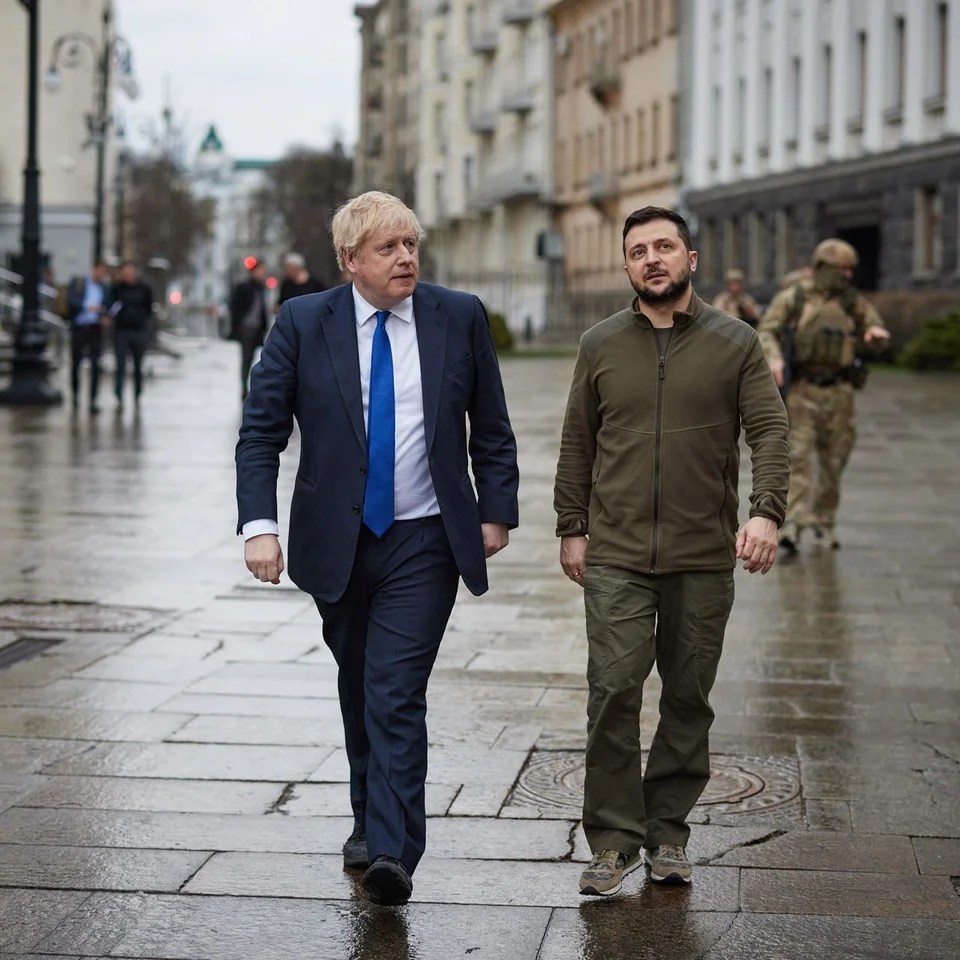
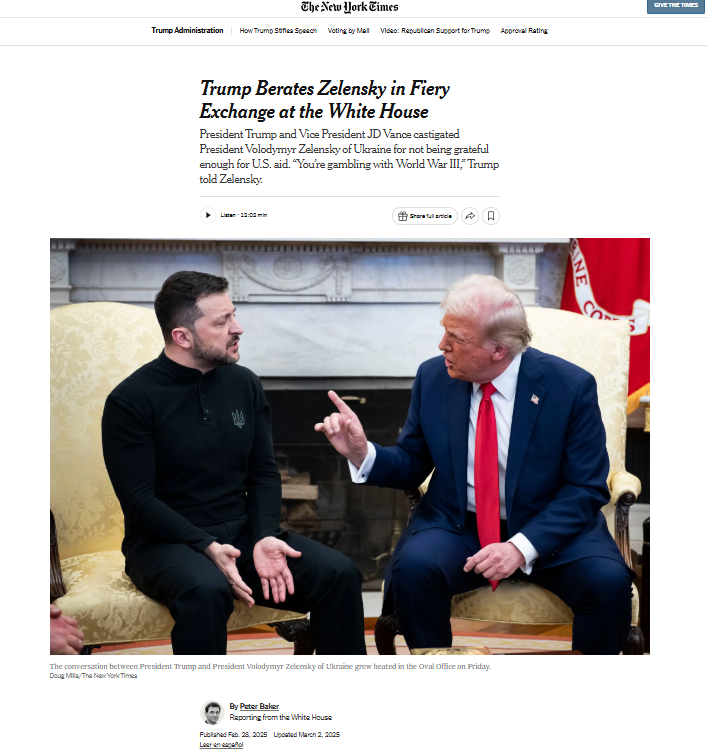
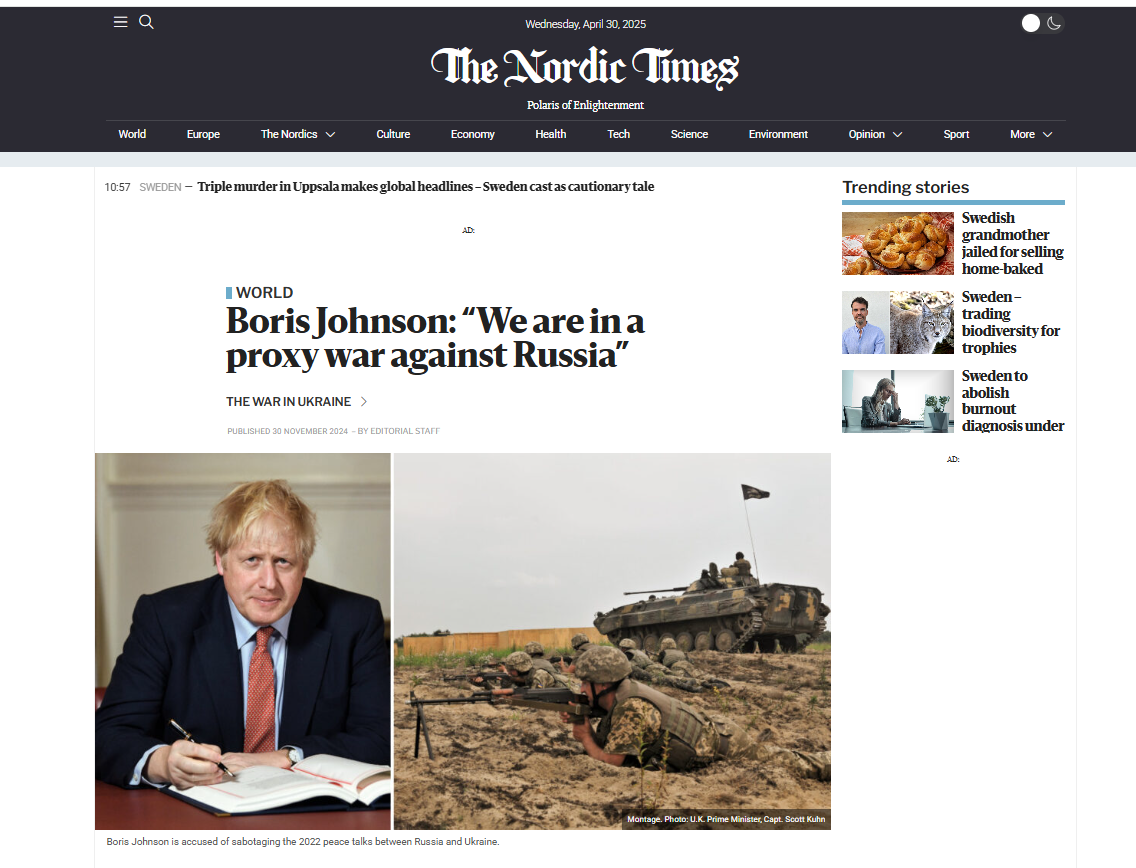
My sources in Ukraine informed me that Boris had just flown to meet with Zelensky informally to instruct him not to sign anything on rare earths with USA in Kiev, and to embarass Trump publicly into keep fund the war by insisting that the meeting should be at the White House. I warned the White House of the info I had received. Indeed, that is what took place and Zelensky follow his orders That was the spectacle on TV in February 2025. It has been Boris who has pushed Ukraine to total destruction. He is always there constantly to ensure war, and it seems his is paid to do so.
Johnson declared that Britain was in a proxy war with Russia back in November 2024. “It has been pathetic… Let’s face it: We’re waging a proxy war but not giving our proxies the ability to do the job. For years now, we’ve been allowing them to fight with one hand tied behind their backs, and it has been cruel,”
Video Player
00:00
01:08
Here is a video of Polish FM Sikorski which is a huge NEOCON saying:
“Kremlin’s assets frozen in Europe and never going back to Russia”
“They can be used [the assets] now to help prevent further destruction and make future reconstruction cheaper”
“If the war ends tomorrow, Russia will remain a threat. We cannot afford to once again underestimate the danger of Moscow’s militarism.”
This last one reminds me of what they told Reagan after communism fell, “You can never trust a Russian”. This confirms it is personal hatred. This is why World War III is inevitable. They just hate Russians and are punishing all the people for their leaders who took them as hostages into a communist wonderland. Today, we have socialists who have undermined Europe’s economy with the very same theories of “material equality” and the rise of progressives in the USA and Canada all with the same dream of robbing the rich to create their would of equality.
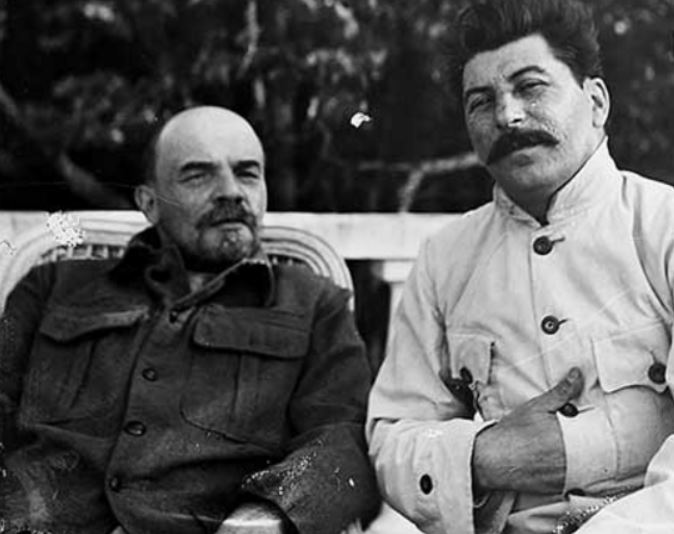
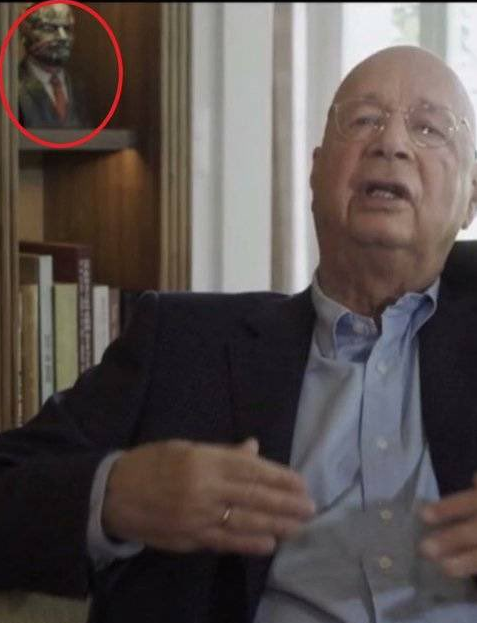
Kalus Schwab, an academic, even had a bust of Lenin on his bookshelf. He too popularized: “You will own nothing and be happy.” These European leaders who are consumed with hatred of the Russian people, like the American South against the blacks because they lost the war with the North, are following the very same path that Lenin took Russia. End of free speech is always the first to go.
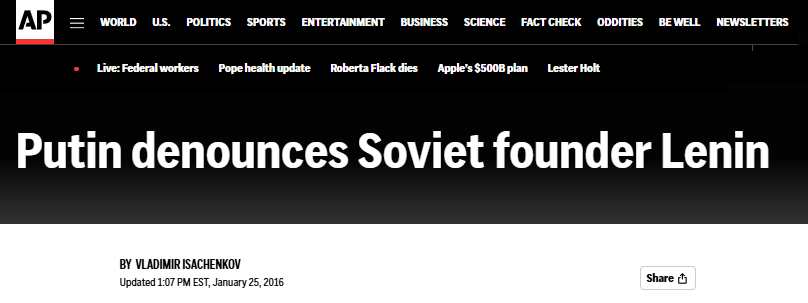
They overlook that Putin was particularly critical of Lenin and said he was not a statesman but just a Bolshevik in 2016. He said that Lenin created “a time bomb under our state.” He also denounced Stalin for massive purges that killed millions but noted his role in defeating the Nazis in WW II. Putin also blasted the Bolsheviks for making Russia lose World War I in their quest for power, making Russia suffer defeat by Germany and cede large chunks of territory just months before it lost World War I. “We lost to the losing party, a unique case in history,” Putin said.
Putin criticized the Communist ideology, noting that while promises of a fair and just society in the Communist ideology “resembled the Bible quite a lot,” the reality was different. “Our country didn’t look like the City of the Sun,” envisaged by socialist utopians, he said. Regarding Lenin’s tomb, Leon Trotsky, Lev Kamenev, and Nikolai Bukharin famously opposed the idea of Lenin’s embalming, while his late wife, Nadezhda Krupskaya, wrote for the Pravda newspaper in the year of his death: “Do not build for him monuments, castles in his name, (hold) opulent receptions in his memories etc. To all of this he assigned such little significance in life and it saddened him so.”
Vladimir Putin had denounced Lenin and his Bolshevik government for their brutal repressions and accused him of having placed a “time bomb” under the state. The criticism of Lenin, who is still revered by communists and many others in Russia, is unusual for the Russian president, who in the past carefully weighed his comments about the nation’s history to avoid alienating some voters. At the same time, he signalled that the government had no intention of taking Lenin’s body out of his Red Square tomb, warning against “any steps that would divide society.”
Putin’s assessment of Lenin’s role in Russian history during Monday’s meeting with pro-Kremlin activists in the southern city of Stavropol was markedly more negative than in the past. He denounced Lenin and his government for brutally executing Russia’s last tsar along with all his family and servants, killing thousands of priests and placing a time bomb under the Russian state by drawing administrative borders along ethnic lines.
As an example of Lenin’s destructive legacy, Putin pointed to Donbass, the industrial region in eastern Ukraine where a pro-Russia separatist rebellion flared up weeks after Russia’s March 2014 annexation of Crimea. More than 9,000 people have been killed in the conflict since April 2014, and clashes have continued despite a February 2015 peace deal.
He said Lenin’s government had whimsically drawn borders between parts of the USSR, placing Donbass under the Ukrainian jurisdiction in order to increase the percentage of proletariat in a move Putin called “delirious.”
They were against Reagan’s meeting with Gorbachev. I can tell you this because I was in a discussion in DC at the time. The Neocons tried to prevent that meeting, telling Reagan, “You can never trust a Russian.” These people are no different than the Southerners who blamed the blacks for the Civil War and transformed it into racism. They are evil and disgusting people who should be locked up in an insane asylum to save humanity. These people are EXTREMELY dangerous because they weasel their way into government to carry out a policy coup to wage war and destroy their perceived enemy and they do not care how many people die on the front lies for their objectives. They will ALWAYS reject peace. They are too consumed with personal hatred and that is the dark side of humanity.
While the Neocon twisted this into Putin wanted to retake Eastern Europe, this only showed their hatred of the Russian People. Putin enjoyed overwhelming support because he had NO INTENTION of return to Communism or restore the only USSR. He has been there since 1999. That Neocon propaganda to get funding for their warmongering policies has proven wrong.
If the United States collapsed, the same problem would emerge. American would be stranded from Okinawa to the Middle East. That is what has happened in the old USSR. The Neocons have used the Donbas to manufacture World War III to satisfy their personal hatred of the Russian people. Unfortunately, it is not Russia we need to defeat, we need to purge governments of this cancer within that will NEVER accept peace just as you just heard that Polish official.
Video Player
00:00
07:08
The World Economic Forum is a globalist threat to humanity. They think a one world government is the answer. That was the idea behind the EU. That has failed. The Russians owned nothing, and they were NOT happy. I think this is our fate. Perhaps this time when we crash and burn and the future of our posterity has been consumed by a dark cloud created by these Neocons, just maybe, post 2032 we will reconstruct a government that wages war not by a few people who are unelected hiding in a back closed room, but adopt a real Democracy where
Must vote on taxes and war.
Thomas Paine’s Common Sense hit the nail on the head. These Neocons usurp power, alter our foreign policy, and the assume that they represent the people.
I have created this site to help people have fun in the kitchen. I write about enjoying life both in and out of my kitchen. Life is short! Make the most of it and enjoy!
This is a library of News Events not reported by the Main Stream Media documenting & connecting the dots on How the Obama Marxist Liberal agenda is destroying America