JULIE PICKREN: Getting Rid Of The Lies In Texas Education Standards Was Not Enough; We Had To Replace It With Patriotism And The Truth!


Posted originally on Rumble on Bannon War Room on: April 13, 2026

JACK DYER: On April 21st, 56 Of Our Rural Counties Here In Virginia Are Silenced. We Have No Voice Anymore. Our Representation Will Come Out Of Fairfax County


Posted originally on Rumble on Bannon War Room on: April 13, 2026

CAPTAIN JAMES FANELL: This Is All About China, And It’s A Reordering Of The Global Energy System So That The United States Is No Longer Dependent On The Persian Gulf And The Arabian Gulf As We Have Been Since The Early 70s


Posted originally on Rumble on Bannon War Room on: April 13, 2026

France – Farmers and Energy Costs Push Toward Confrontation


Posted originally on Apr 13, 2026 by Martin Armstrong |  

France is once again approaching a familiar breaking point, and energy is at the center of it. Diesel prices across Europe have surged sharply in 2026 as geopolitical tensions in the Middle East disrupted supply routes, pushing Brent crude back above key resistance levels and filtering directly into transport and agricultural costs. In France, non-road diesel, which is critical for farming, has risen substantially over the past year, eroding already thin margins in agriculture. At the same time, electricity costs remain elevated compared to pre-2022 levels, despite government intervention, leaving producers exposed to sustained input inflation.

The agricultural sector has been particularly vocal. France has roughly 400,000 farms, and many operate on margins that cannot absorb double-digit increases in fuel and fertilizer costs. Fertilizer itself is heavily energy-dependent, linking natural gas prices directly to food production costs. When energy rises, food prices follow, and this has already been reflected in EU food inflation, which peaked above 15% in recent cycles and remains structurally elevated. The knock-on effect is that farmers face higher input costs while consumers resist higher prices, compressing profitability from both sides.

Protests are building along these fault lines. Farmer unions and independent groups have threatened renewed blockades of highways, logistics hubs, and wholesale food markets if the government fails to provide further relief. France has a long-standing pattern of escalation where tractors are used to shut down key transport arteries, and authorities are well aware of how quickly localized demonstrations can become national disruptions. Previous rounds of protests have already forced Paris to roll out billions in subsidies and tax concessions, but those measures have not resolved the structural issue, which is energy dependence combined with policy constraints.

The French government continues to attempt targeted relief, including fuel rebates and caps on electricity prices, but these interventions are temporary by design. They do not change the underlying exposure to global energy markets. Once those supports are reduced or removed, the pressure returns immediately. That is why these protests tend to recur in waves rather than dissipate entirely.

Energy costs are no longer viewed as an external shock but as a failure of domestic policy to shield the population from volatility. When that perception takes hold, protests move beyond sector-specific demands and begin to question the direction of national leadership itself.


ELIZABETH MITCHELL: Senator Rick Scott Warns OPT Program Gives Advantage to China, Harms U.S. Graduates


Posted originally on Rumble on Bannon War Room on: April 13, 2026

CAPTAIN JAMES FANELL: It Was Just Reported That The USS George H.W. Bush Has Gone Through The Strait Of Gibraltar, Raising The Number Of Aircraft Carriers In The Theater Of Operations To Three


Posted originally on Rumble on Bannon War Room on: April 13, 2026

JOHN SOLOMON: As Soon As President Trump Was Cleared On Russia Collusion, A CIA Analyst Filed A Complaint Based On COMPLETE HEARSAY And On A Whistleblower That Was CAUGHT LYING


Posted originally on Rumble on Bannon War Room on: April 13, 2026

EP 5294: War Enters The 6th Week Of The War; Trump Puts Naval Blockade On The Strait Of Hormuz Cont.


Posted originally on Rumble on Bannon War Room on: April 13, 2026

The Quiet Rise of Capital Controls in America


Posted originally on Apr 14, 2026 by Martin Armstrong 

Capital Controls 2

What most people fail to understand is that governments do not lose control overnight. They lose it gradually, and then they respond in stages. First comes rising debt. Then comes higher taxation. When that fails to produce the expected revenue, the next step is not reform. It is restriction.

We are now entering that phase where governments begin tightening their grip on capital. It starts subtly. Expanded IRS reporting requirements. Increased scrutiny on bank transactions. Lower thresholds for what is considered “suspicious activity.” These are not random policy decisions. They are part of a broader shift toward monitoring and ultimately controlling the movement of money.

The justification is always the same. Prevent tax evasion. Combat financial crime. Ensure fairness. But behind that narrative is a much deeper problem. Governments are facing structural deficits that they cannot resolve through growth alone. When spending exceeds revenue and debt continues to rise, they must either cut spending, raise taxes, or prevent capital from escaping. Historically, they choose the latter two.

We are already seeing early signs of this shift. Discussions around taxing unrealized gains, proposals for wealth taxes, and increased enforcement efforts all point in the same direction. These policies assume that capital is static, but once people begin to move their money or themselves, the response changes. Governments begin looking for ways to stop that movement.

Digital infrastructure is what makes this possible today in a way it never was before. Every transaction is tracked. Every account is monitored. The banking system itself becomes the enforcement mechanism. You no longer need physical barriers when financial barriers can be imposed instantly.

The danger is not a single sweeping policy. It is the accumulation of smaller measures that gradually remove financial freedom. By the time people realize what has changed, the system is already in place.Posted Apr 14, 2026 by Martin Armstrong 

Sovereign Debt Crisis & the Middle East


Posted originally on Apr 13, 2026 by Martin Armstrong |  

Sovereign Debt Crisis Middle East 2026

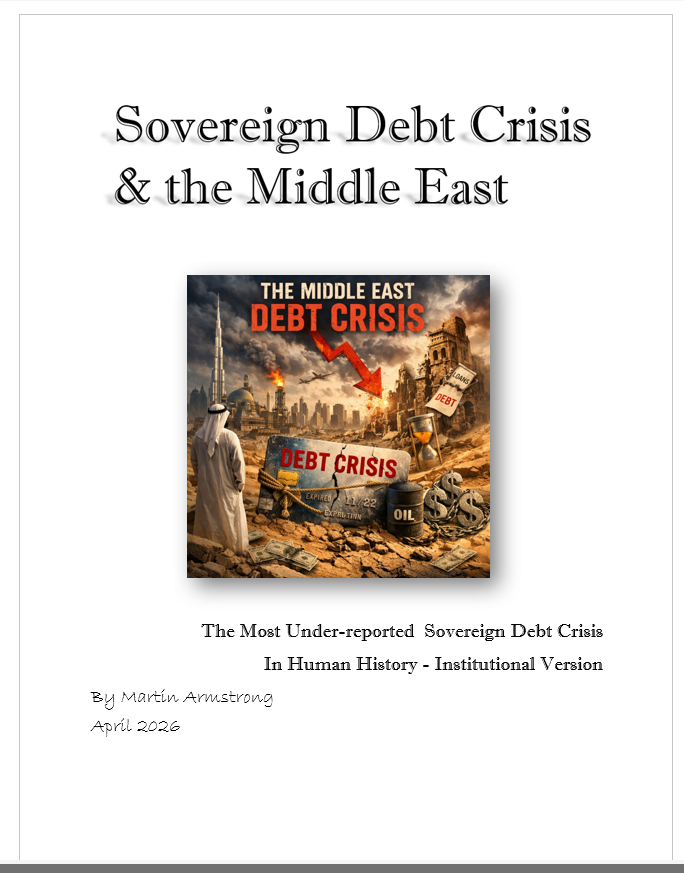
The Sovereign Debt Crisis and the Middle East is the most under-reported financial crisis in Human History. It has been accelerated by the clever Weaponization of Debt that nobody seems to have even contemplated. We are dealing with the Illusion of Perpetual Wealth, combined with the Illusion of a Great Dollar Crash, in which, in both cases, people are completely distracted from the real crisis brewing behind the curtain around the globe, which is about to explode and take the world by surprise.

Neocon staring into the Eyes of Death

We are staring into the eyes of a massive financial crisis that culminates in a confrontation between Public and Private Assets. The computer has been right on projecting the event and the timing. The energy crisis is already unleashing civil unrest around the globe, which our computer forecast would coincide with international war. The shortage of fertilizer combined with the shortage of diesel fuels are also impacting the shortage of food. Add to this mess, the Sovereign Debt Crisis

Sovereign Debt Crisis and the Middle East

Because of the Importance of This Institutional Report that would normally be $1500, we are making this available to our entire readership at only $500

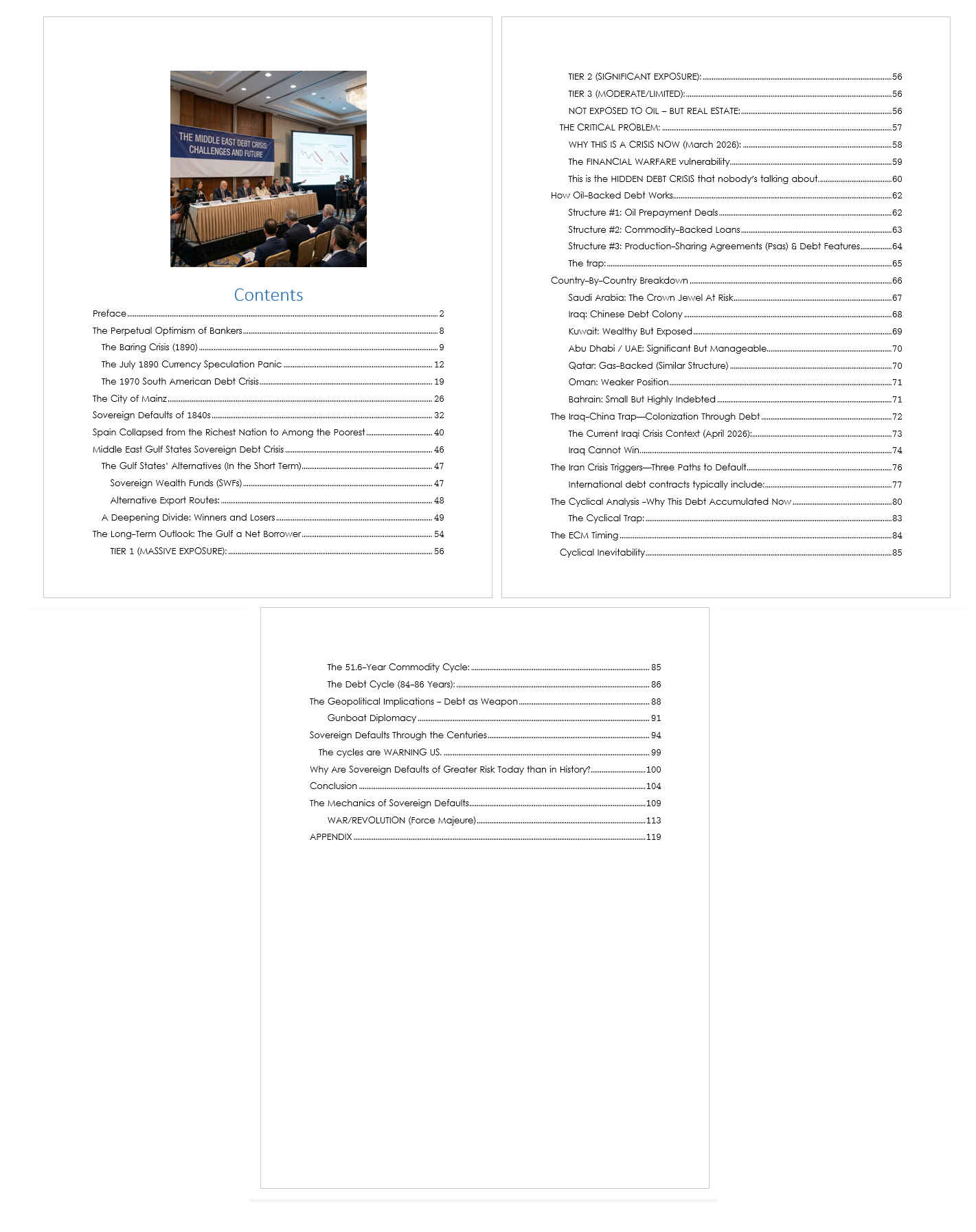
Sovereign Debt Crisis Middle East 2026 INDEX