Georgia State Election Board Holds First Meeting After FBI Raid In Fulton County


Posted originally on Rumble on Bannon War Room on: February 18, 2026

BEN BERGQUAM: The Only Way The Democrats Win Is By Stealing Elections. We Have To Get Election Fraud Out Of Our Systems! We Don’t Have A Country If We Don’t Have Sovereign Elections!!


Posted originally on Rumble on Bannon War Room on: February 18, 2026

HARRY HAURY: They’re Waging A Scorched-Earth Battle To Block Access To Paper Receipts, But Even Electronic Records Show Massive Tampering! The Main Problem That We’ve Had Is That The Judiciary Itself Is Afraid Of This Matter!!


Posted originally on Rumble on Bannon War Room on: February 18, 2026

JOE HOFT: The Left Wants To Bankrupt And Silence Us For Writing The Truth, And They Will Do Anything To Get It Done


Posted originally on Rumble on Bannon War Room on: February 18, 2026

Georgia State Election Board Meeting


Posted originally on Rumble on Bannon War Room on: February 18, 2026

BANNON: The Left Desperately Wants To Get The Ballots From The 2020 Election Back. If They Get Them Back This Time, They’re Going To Destroy Them


Posted originally on Rumble on Bannon War Room on: February 18, 2026

BANNON: If The Democrats Take The House, They’re Going To Put Massive Pressure On Corporate America To Turn Against President Trump


Posted originally on Rumble on Bannon War Room on: February 18, 2026

Switzerland to Vote on Population Control Measures


Posted originally on Feb 19, 2026 by Martin Armstrong 

Swiss Flag

Switzerland is now preparing to vote on a proposal to cap its population at 10 million by 2050, and the entire debate is being framed in the press as merely an immigration issue. That is far too simplistic. What this really reflects is a rising global tension between economic reality, demographic trends, and political narratives about sustainability and population management.

Under the initiative, once the population approaches 9.5 million, the government would be required to tighten immigration, residency, and asylum policies, and potentially even renegotiate agreements with the EU on free movement if the cap is exceeded. Switzerland already has about 9.1 million residents, with a large share foreign-born, largely from EU countries.

Supporters argue the cap would protect resources, housing, and social systems, while critics warn it could trigger labor shortages and harm economic growth in a country heavily dependent on foreign workers.

I have written many times that the concept of “population control” is not always presented directly. It is often framed as sustainability, climate targets, migration limits, or resource protection. The terminology changes, but the underlying policy direction becomes increasingly centralized and authoritative. Politicians believe they must begin managing how many people can live, move, and work within a system. That is a very dangerous trend because it expands government authority over the most fundamental aspect of society: demographics.

Switzerland has seen a surge of migrants from Islamic nations, which has led to cultural clashes. The “No to 10 Million Switzerland” initiative acknowledges the downfalls of mass migration as the Swiss People’s Party (SVP) openly wants to close the border and is considered “far-right” for its beliefs. Reframing population control as an issue for the environment and resources would allow the left to jump on board without being demonized for recognizing that certain cultures cannot assimilate to European life.

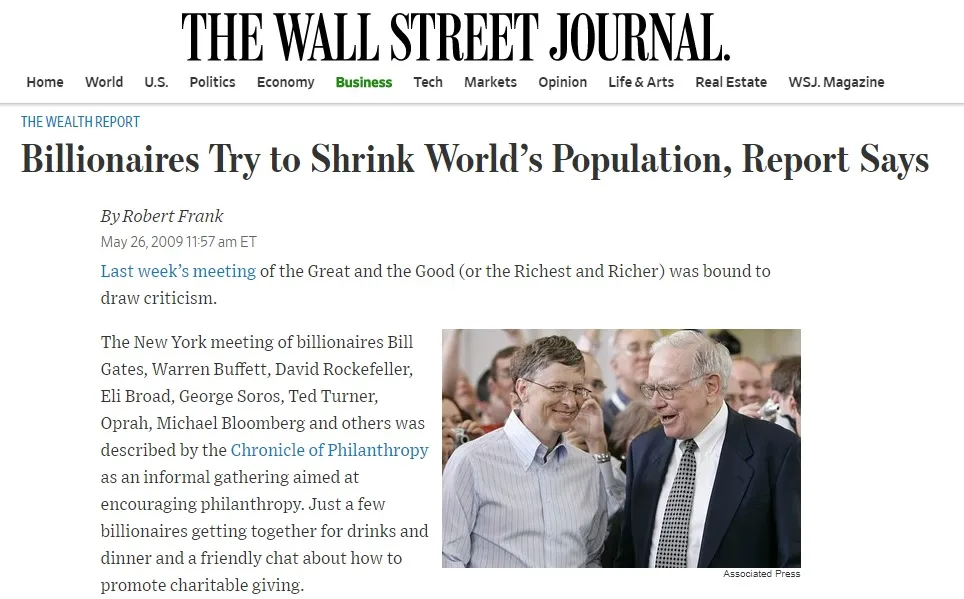
WSJ 2009 Shrink Population
Gates Population

Globalist figures like Bill Gates have openly spoken about population growth in the context of sustainability and resource allocation. I have repeatedly warned that population control is rarely presented bluntly; it is framed as climate policy, public health, sustainability, or infrastructure capacity. The danger is not in any single proposal, but in the normalization of the idea that governments and unelected institutions should “manage” population levels as an economic variable.

Switzerland is particularly important because it is not an EU member yet is deeply integrated into the European economic system. If a population cap forces restrictions on immigration or free-movement agreements, it will not just be a domestic policy shift. It would signal fragmentation in the European labor and capital framework.

The Swiss are in favor of the proposal. The LeeWas research institute conducted a poll in November 2025: 48% are in favor, 41% are against, and 11% are undecided. Yet we know the wishes of the people are never truly acknowledged. The bureaucrats must believe that the measures would benefit them directly.

Nations begin to look inward during times of instability. Tighter immigration control, capital control discussions, increased surveillance of movement and finances—these are all par for the course. Once governments normalize the idea that population levels must be administratively managed for sustainability, it opens the door to broader regulatory control over society.

US Home Buyers Shift from Luxury to Practicality


Posted originally on Feb 19, 2026 by Martin Armstrong |  

Housing Property Real Estate 1

Zillow is now openly acknowledging a shift in the US housing market that most analysts are still refusing to properly interpret. They are framing it as a “trend change” in homebuyer preferences toward smaller, adaptable, and more functional homes rather than large status properties, but this is not a lifestyle trend. It is an economic consequence of declining affordability and a structural shift in purchasing power.

During the peak years of cheap money, the housing market was driven by excess liquidity. Low interest rates inflated asset prices and encouraged buyers to stretch into larger homes, oversized layouts, and high-maintenance properties that projected wealth. Now that mortgage rates remain around 6% instead of the artificially suppressed levels of the pandemic era, the entire psychology of the housing market is changing.

Zillow notes that monthly mortgage payments are already about 8.4% lower than a year ago as rates eased slightly, yet affordability remains constrained. What they are describing as buyers prioritizing “adaptable” and “functional” homes is, in reality, the market adjusting to the end of an artificially inflated cycle. When carrying costs rise from insurance, taxes, maintenance, and utilities, then buyers tend to see big homes as big liabilities.

“Homes featured dramatic two-story foyers, arched doorways, decorative columns and complex rooflines designed to project prosperity from the street,” Zillow wrote. “Listings highlighted formal living rooms and formal dining rooms, spaces reserved for special occasions rather than everyday use. Home theaters were status upgrades: the bigger the screen, the better,” Zillow continued. “Oversize primary suites, Jacuzzi tubs and walk-in closets were must-haves, while energy efficiency and climate resilience were rarely mentioned.”

This fits perfectly with historical real estate cycles I have discussed in my reports and in Real Estate Outlook. Real estate does not crash immediately after a bubble; it transitions into a stagnation phase where prices stabilize, inventory rises, and buyer behavior shifts toward practicality.

Luxury Home

Zillow also expects only modest home value growth in 2026 ,roughly in the low single digits, while mortgage costs still consume a large share of household income. When buyers begin prioritizing resilience, efficiency, and flexibility over luxury, it signals uncertainty about the future.

We must also understand the demographic and economic layer beneath this shift. Millennials and younger buyers are entering the market with significantly higher debt loads, higher insurance costs, and elevated living expenses. Starter homes are less practical. Entering the housing market in general is a stretch for many young potential buyers.

At the same time, older homeowners are locked into low mortgage rates and are reluctant to sell. This creates a supply distortion that keeps prices firm even as demand weakens. That is more of a classic stagnation model rather than a 2008-style collapse.

Zillow’s narrative that homes will become more “intuitive, personal, and adaptable” over the next 20 years is essentially a polite way of saying the era of excess housing consumption is ending. Consumers are concerned that larger purchases will lead to “house poor” finances.


Mamdani to Drain Rainy Day Fund AND Raise Taxes


Posted originally on Feb 19, 2026 by Martin Armstrong |  

Here we go again. A city runs expansive social programs, expands spending, promises benefits, and then suddenly discovers a “budget crisis” that requires raiding reserves, tapping rainy day funds, drawing from retiree trusts, and raising property taxes to maintain so-called fiscal stability. New York City’s latest proposal openly admits it may withdraw nearly $1 billion from its rainy day fund, hundreds of millions from retiree health benefit trusts, and consider a roughly 9.5% property tax increase to close a multibillion-dollar deficit. This is not an emergency measure. This is the predictable outcome of policy trends I have repeatedly warned about, particularly in cities dominated by progressive and socialistic fiscal models.

I have written before about how politicians like Gavin Newsom and other liberal Democrats have also tapped rainy day funds during periods of economic stress while simultaneously expanding long-term obligations. The pattern is always the same: spend during the boom, blame external factors during the slowdown, and then drain reserves to avoid immediate political consequences. Rainy day funds are supposed to be buffers for recessions or crises, not routine financing tools to sustain structurally imbalanced budgets. Once governments normalize using reserves during periods of growth or mild deficits, they remove the very cushion needed when a true economic downturn arrives.

The mayor’s own budget framework acknowledges a significant fiscal gap and presents two paths: higher taxes on wealth and corporations or shifting the burden through property taxes and reserve withdrawals. You cannot continuously expand spending commitments while assuming tax revenues will keep pace indefinitely. That is not how economic cycles work. Capital is highly mobile, and as taxation rises, the tax base erodes.

Socialistic policy prioritizes redistribution and government expansion under the assumption that taxation can permanently fund rising obligations. In reality, economic confidence is the key driver of revenue. If policies discourage investment, business expansion, and high-income residency, the very tax base required to fund social programs begins to contract. Then governments are forced into the exact scenario we are seeing higher property taxes, reserve depletion, and political pressure for more state aid. Property taxes rise, services expand, costs escalate, and reserves shrink until a cyclical downturn exposes the imbalance.

Socialistic policies promoted by many progressive and socialist-leaning Democrats rest on the assumption that government can endlessly expand, redistribute, and intervene without consequence, as if economic cycles no longer apply. In the end, it is not markets that fail these systems, but the policy belief that government control can permanently override the business cycle.