
Posted originally on CTH on June 1, 2025 | Sundance
Treasury Secretary Scott Bessent appears on CBS News to counter the false information being spread by Margaret Brennan on behalf of Wall Street corporations. The topics of interest surround China and tariffs.
Let me clarify for the audience that does not follow closely. Tariffs are paid by the importer based on the wholesale price of the product as delivered by the exporting country depending on the exporters’ tariff rate. Tariffs are NOT LEVIED/PAID based on the retail price of the product as sold to the consumer.
Example: A pair of Denim Jeans made in China for Guess Brand. The Chinese manufacturer sells the jeans to Guess Brand for $10 a pair manufactured. Guess sells the jeans at retail in the USA for $100 (a $90 gross profit).
A 50% tariff on China means the jeans cost Guess Brand $15 instead of $10 (an $85 gross profit). A 50% tariff on Guess brand jeans, that retail for $100, changes the cost to the retail brand by $5.
Multinational corporations who have off shored their production and manufacturing to China are the ones screaming about tariffs. Ultimately in the final analysis, President Trump is exposing corporatism, multinational corporate vultures; he is not necessarily just exposing China.
In the example above the company makes $85 gross profit as opposed to $90 gross profit on the pair of jeans if they do not raise the retail price. They don’t raise the price because their profit margins are already ridiculous, and that’s why consumer prices do not go up. A 50% direct tariff on Chinese goods only marginally hits the multinational corporation. American consumers need to understand this dynamic better. WATCH:
[TRANSCRIPT] – MARGARET BRENNAN: Good morning and welcome to ‘Face the Nation.’ We begin today with Treasury Secretary Scott Bessent. Good morning and thank you for being here.
SECRETARY SCOTT BESSENT: Morning, Margaret.
MARGARET BRENNAN: There’s so much to get to. I want to start with China, because the Defense Secretary just said there’s an imminent military threat from China to Taiwan. Days earlier, Secretary Rubio said he’d aggressively revoked Chinese student visas. On top of that, you have curbing exports to China. Trade talks you said with Beijing are stalled, and President Trump just accused China of violating an agreement, and now says no more, ‘Mr. Nice Guy.’ Are you intentionally escalating this standoff with Beijing?
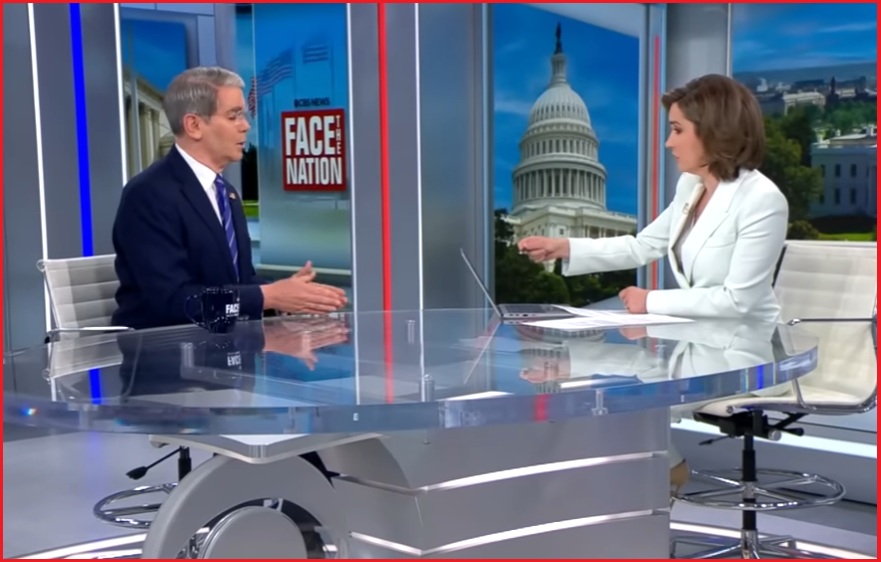
SEC. BESSENT: Well, I don’t think it’s intentional. I- I think that what Secretary Hegseth did was remind everyone that during COVID, China was an unreliable partner, and what we are trying to do is to de-risk. We do not want to decouple Margaret, but we do need to de-risk, as we saw during COVID, whether it was with semiconductors, medicines, the other products we are in the process of de-risking.
MARGARET BRENNAN: Making the United States less reliant on China, but at the same–
SEC. BESSENT: –Well, and the whole world. The whole world, because what China is doing is they are holding back products that are essential for the industrial supply chains of India, of Europe, and that is not what a reliable partner does.
MARGARET BRENNAN: So is that like- what specifically is President Trump saying when he says they are violating an agreement? Because it was the one you negotiated in Geneva earlier this month. And what’s the consequence for that?
SEC. BESSENT: Well, we will see what the consequences are. I am confident that when President Trump and party Chairman Xi have a call, that this will be ironed out. So- but the fact that they are withholding some of the products that they agreed to release during our agreement- maybe it’s a glitch in the Chinese system, maybe it’s intentional. We’ll see after the President speaks with party chairman.
MARGARET BRENNAN: That’s critical minerals, rare earths. Is that what you’re talking about?
SEC. BESSENT: Yes.
MARGARET BRENNAN: So, the President has said a few times that he was going to speak to President Xi, but he hasn’t since before the inauguration. Beijing keeps denying that there was any contact. Do you have anything scheduled?
SEC. BESSENT: I believe we’ll see something very soon, Margaret.
MARGARET BRENNAN: Do you have a conversation with your counterpart or Lutnick with his counterpart at the commerce level?
SEC. BESSENT: Well, I think we’re going to let the two principles have a conversation, and then everything will stem from that.
MARGARET BRENNAN: JP Morgan CEO, Jamie Dimon, spoke this week at an economic forum, and he gave this read on Beijing.
[SOT]
JAMIE DIMON: I just got back from China last week. They’re not scared, folks. This notion they’re gonna come bow to America. I wouldn’t count on that. And when they have a problem, they put 100,000 engineers on it, and they’ve been preparing for this for years.
[END SOT]
MARGARET BRENNAN: Have you underestimated the Chinese state’s backbone here?
SEC. BESSENT: Again, Margaret, I hope it doesn’t come to that. And Jamie is a great banker. I know him well, but I would vociferously disagree with that assessment, that the laws of economics and gravity apply to the Chinese economy and the Chinese system, just like everyone else.
MARGARET BRENNAN: But when you were last here in March, we were trying to gauge what the impact of the standoff with China and with the tariffs on the rest of the world would do for American consumers here at home. At that time, you told us you were going to appoint an affordability czar and council to figure out five, you said, or eight areas where there will be some pain for working class Americans. Where are you anticipating price increases?
SEC. BESSENT: Well, thus far- we wanted to make sure that there aren’t price increases, Margaret. And thus far there have been no price increases. Everything has been alarmist, that the inflation numbers are actually dropping. We saw the first drop of inflation in four years. The inflation numbers last week, they were very- the- pro-consumer. We’ve–
MARGARET BRENNAN: Right, but you listen to earnings calls just like we do. You know what Walmart’s saying, what Best Buy’s saying and what Target are saying of what’s coming–
SEC. BESSENT: But Margaret, I also know what Home Depot and Amazon are saying. I know what the South China Morning Post wrote within the past 24 hours that 65%- 65%- the- of the tariffs will likely be eaten by the Chinese producers.
MARGARET BRENNAN: So are there five or eight areas that you have identified, as you said back in March, where American consumers will be able to have lower prices, or should be warned of higher prices?
SEC. BESSENT: Well, a lot of it’s already working its way through the system. So we’ve seen a substantial decrease in gasoline and energy prices. So that’s down 20% year over year. We’ve seen the food prices go down, these notorious egg prices. Through the good work of President Trump and Secretary Rollins, egg prices have collapsed. So we’re seeing more and more. And what we want to do- the- is even that out across the all sections of the economy. So inflation has been very tame. Consumer earnings were up 0.8% last month, which is a gigantic increase for one month. So real earnings minus low inflation is great for the American people, and that’s what we’re seeing.
MARGARET BRENNAN: But you know, because when you met with the Chinese earlier this month and you went down from the 145% tariff down to about- it’s like 30%. 30%’s not nothing, that tax on goods coming in here. Retailers are warning of price hikes–
SEC. BESSENT: Well, so–
MARGARET BRENNAN: When you go back to school shopping, things are going to cost more.
SEC. BESSENT: But Margaret, some are and some aren’t. Home Depot and Amazon said they’re not.
MARGARET BRENNAN: Home Depot and Amazon aren’t where you go for your back school shopping, when you buy your jeans, when you buy your crayons, and you buy all those things that parents–
SEC. BESSENT: I don’t know about you, but I do it online at Amazon. This isn’t an advertisement for Amazon. And guess where most of the Halloween costumes in America get bought? At Home Depot. So that’s just not right. There’s a wide aperture here. Different companies are doing different things. They are making decisions based on their customers, what they think they’re able to pass along to their customers, what they want to do to keep their customers. And I was in the investment business for 35 years, Margaret, and I will tell you earnings calls- they have to give the worst case scenario, because if it- if they haven’t and something bad happens, then they’ll be sued.
MARGARET BRENNAN: It’s not always the worst case. It’s the most probable case–
SEC. BESSENT: –No, no, no–
MARGARET BRENNAN: as well–
SEC. BESSENT: –No, no, no. No, they have to give the worst case.
MARGARET BRENNAN: So Walmart- there was just a piece published with the conservative strategist Karl Rove. I’m not asking about politics, because he is a political strategist, but he went in on the math here. And he points out that Walmart has a profit margin of less than 3%. He says, ‘If it does what Mr. Trump says, eat the tariffs, it can’t break even. It can’t absorb the cost of an imported pair of kids jeans with a 46% tariff on Vietnam, a 37% tariff for Bangladesh, or 32% tariff on sneakers from Indonesia. Other companies are in the same pickle.’ So should companies cut back on the amount of goods they have on their shelves or just on their profitability?
SEC. BESSENT: That- that’s a decision company by- by company, Margaret. And I had a long discussion with Doug McMillon, the CEO of Walmart, and they’re going to do what’s right for them.
MARGARET BRENNAN: But for consumers, the reality is there will either be less inventory or things at higher prices, or both.
SEC. BESSENT: Margaret, when we were here in March, you said there was going to be big inflation. There hasn’t been any inflation. Actually, the inflation numbers are the best in four years. So why don’t we stop trying to say this could happen, and wait and see what does happen.
MARGARET BRENNAN: Just trying to gauge for people planning ahead here, one of the things the President said on Friday is that he’s going to double the tariffs on steel and aluminum up to 50%, effective June 4. How much will that impact the construction industry?
SEC. BESSENT: Well, I think- I was with the president at the U.S. Steel Plant in Pittsburgh on Friday, and I will tell you that the President has the- reignited the steel industry here in America. And back to the earlier statements on national security. There are national security priorities here for having a strong steel industry.
MARGARET BRENNAN: But do you have a prediction on how much it’s going to impact the construction industry, for example?
SEC. BESSENT: Well, I have a prediction on how much it’s going to impact the steel industry, and you know, again, we- we’ll see there are a lot of elasticities that- you know this is a very complicated ecosystem. So is it going to impact the construction industry, maybe. But it’s going to impact the steel industry, the- in a great way. The steel workers, again, were left on the side of the road after the China shock, and now they’re back that the- they are Trump supporters. And when I tell you that it was magic in the arena, or it was actually at the steel plant that night, that these hard working Americans know their jobs are secure, there’s going to be capital investment, and the number of jobs is going to be grown around the country, whether it’s in Pittsburgh, whether it’s in Arkansas, whether it’s in Alabama.
MARGARET BRENNAN: I want to ask you about this big tax bill that worked through the House, is going to the Senate next. In it is increase or suspension to the debt limit that you need delivered on by mid-July. How close of a brush with default could this be, given how massive some of the Senate changes are expected to be to the other parts of the bill?
SEC. BESSENT: Well, first of all, Margaret, I will say the United States of America is never going to default. That is never going to happen. That- we are on the warning track and we will never hit the wall.
MARGARET BRENNAN: You have more wiggle room if they don’t deliver this by mid-July? I mean, how hard of a date is this?
SEC. BESSENT: That- we don’t give out the X date because we use that to move the bill forward.
MARGARET BRENNAN: Sometimes deadlines help force action, as you know, particularly in this town, sir, that’s why I’m asking. The President did say he- he expects pretty significant changes to this bill, though, so that affects the timing of it moving. What would you like Republican lawmakers to keep? What would you like them to alter?
SEC. BESSENT: Again, that’s going to be the Senate’s decision. Leader Thune, who I’ve worked closely with during this process, has been doing a fantastic job. And Margaret, I’ll point out, everyone said that Speaker Johnson would not be able to get this bill out of the house with his slim majority. He got it out Leader Thune has a bigger majority, and this is with President Trump’s leadership. So–
MARGARET BRENNAN: –There’s no red lines for you in there of just don’t touch this you can, you know, tinker with that.
SEC. BESSENT: Well, I- I think that they’re not necessarily my red lines. The President has the- his campaign promises that he wants to fulfill for working Americans. So no tax on tips, no tax on overtime, no tax on Social Security, deductibility of auto loans for American made automobiles.
MARGARET BRENNAN: So those have to stay in.
SEC. BESSENT: Those have to stay in.
MARGARET BRENNAN: JP Morgan’s Dimon also predicted a debt market crisis. ‘Cracks in the bond market’ was what he said. You are considering easing some regulations, you’ve said, for the big banks. How do you avoid that bond market crisis he’s predicting, spreading and really causing concern, particularly with all of the worries about American debt right now?
SEC. BESSENT: So again, I’ve known Jamie a long time and for his entire career he’s made predictions like this. Fortunately, none of them have come true. That’s why he’s a banker- a great banker. He tries to look around the corner. One of the reasons I’m sitting here talking to you today and not at home watching your show is that I was concerned about the level of debt. So the deficit this year is going to be lower than the deficit last year, and in two years it will be lower again. We are going to bring the deficit down slowly. We didn’t get here in one year. We didn’t get here in one year, and this has been a long process. So the goal is to bring it down over the next four years, leave the country in great shape in 2028.
MARGARET BRENNAN: You know that the Speaker of the House estimates this is going to add four to five trillion dollars over the next 10 years, and there’s that debt limit increase.
SEC. BESSENT: Well again, Margaret, that’s CBO scoring.
MARGARET BRENNAN: That’s the Speaker of the House.
SEC. BESSENT: No, no, no.
MARGARET BRENNAN: He said it last Sunday on this program.
SEC. BESSENT: The- he said that’s the CBO scoring. Let me–
MARGARET BRENNAN: –No, he said that sounds right.
SEC. BESSENT: Let me tell you what’s not included in there, what can’t be scored. So we’re taking in substantial tariff income right now, so that there are estimates that that could be another 2 trillion that we are the- pushing through savings. So you know my estimate is that could be up to another 100 billion a year. So over the 10 year window, that could be a trillion. President has a prescription drug plan with the pharmaceutical companies that could substantially push down costs for prescription drugs, and that could be another trillion. So there’s the four.
MARGARET BRENNAN: Treasury Secretary Bessent, we’ll be watching closely what happens next. ‘Face the Nation’ will be back in a minute, so stay with us.
[END TRANSCRIPT]









 Centinel2012