Posted originally on Nov 10, 2025 by Martin Armstrong |
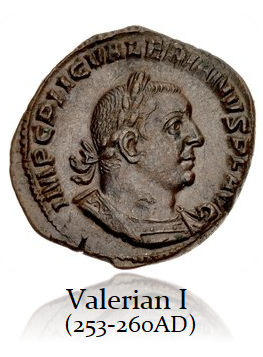
I have written about how in 260AD, Emperor Valerian (253-260AD) led the Roman army against the Sassanian Persian Empire, ruled by King Shapur I. At the Battle of Edessa, the Roman army was decisively defeated, and Valerian was taken prisoner. This was an unprecedented and catastrophic event—a Roman Emperor had been captured alive on the battlefield. That was the first time in history. That set off a financial panic.
When Valerian was captured and Rome could not rescue him, the confidence in the Empire began to collapse. People were even suddenly skeptical about accepting Roman coins. Would they still be worth anything since they were valued over and above their actual metal content?
A document from Egypt has survived illustrating the financial crisis that was unleashed. It is from Aurelius Ptolemaeus who is the strategus of the Oxyrhynchitenome. The public officials gathered and accused the bankers of closing their doors on account of their unwillingness to accept the divine coins of the Emperors. It became necessary that an order had to be issued to all the owners of the banks directing them to open and accept and exchange all coins except the absolutely spurious and counterfeit. It was also directed that all who engaged in business transactions who refused to comply would be penalized. (POxy 1411 260AD, cited by Burnett 1987: p104)
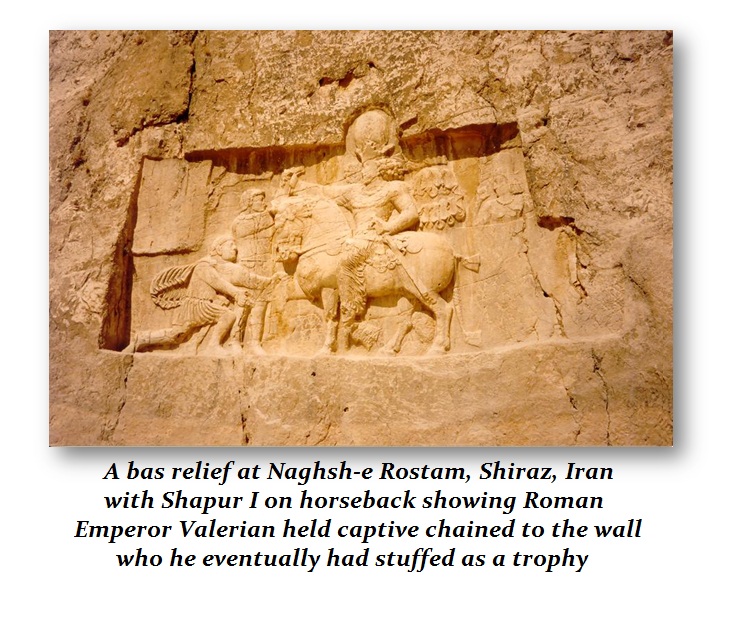
Valerian’s capture was a massive propaganda victory for Shapur. Persian inscriptions and rock reliefs (like at Naqsh-e Rostam and Bishapur) show Valerian humiliated—submitting to Shapur on his knees, or being held captive by the king. This is what Iran has turned into a statue.
Valerian’s body was never returned to Rome and his son, Gallienus couldn’t rescue his father because the entire Roman world was on fire, and leaving the heart of the empire undefended would have meant its immediate collapse. While Valerian was in the East, Gallienus was fighting for his life in the West.
Massive invasions by the Germanic tribes, the Alamanni and Franks, had broken through the Rhine frontier, penetrating deep into Gaul, Raetia, and even reaching as far as Italy and Spain. The Goths and other tribes were launching devastating seaborne raids across the Black Sea and the Aegean, attacking the Balkans and the coast of Asia Minor. If Gallienus had marched the bulk of his army east to Persia, there would have been nothing to stop these Germanic tribes from overrunning Italy and sacking Rome itself.
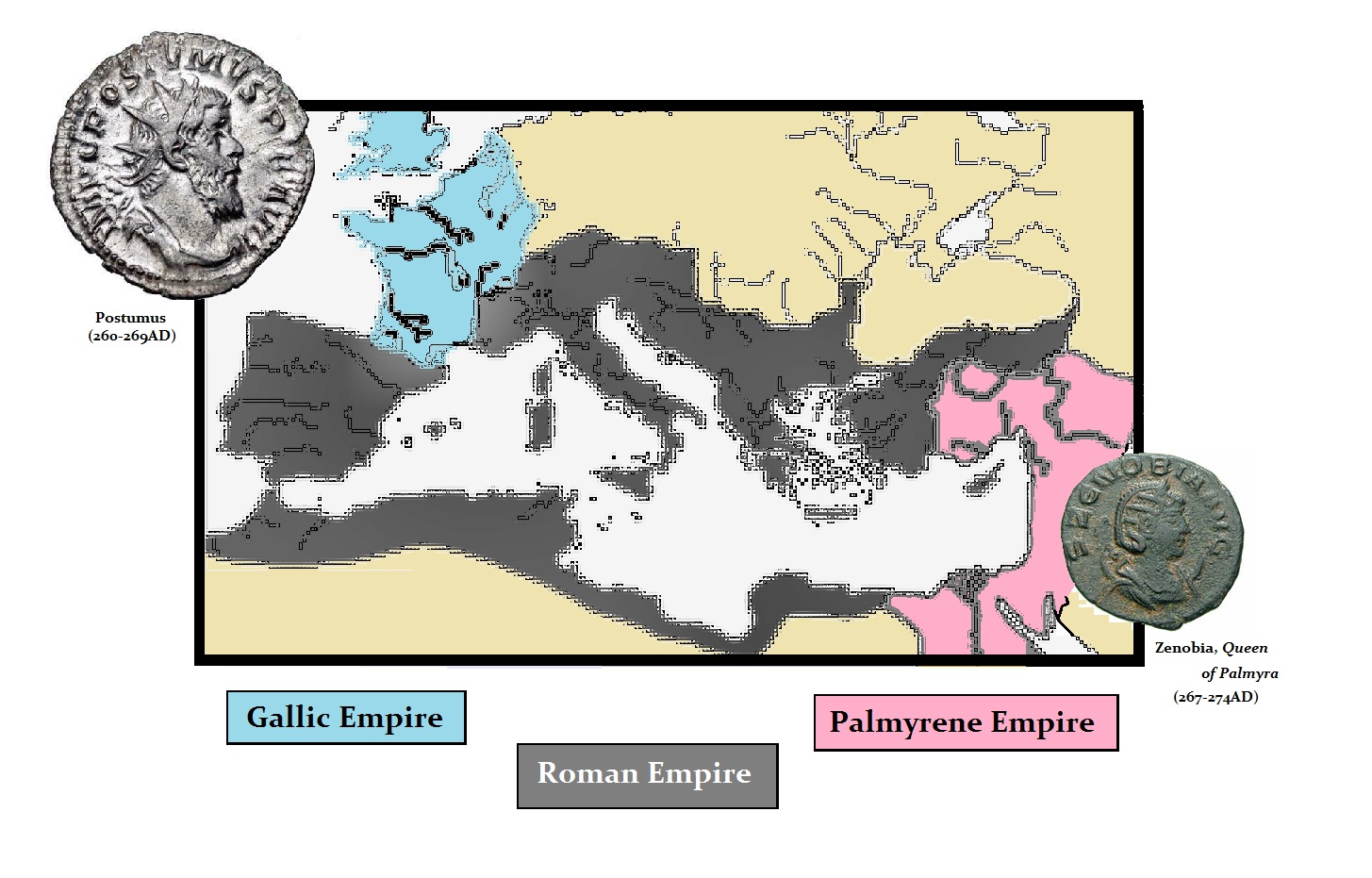
The capture of Valerian created a power vacuum and a perception of weakness that immediately led to rebellion also within the Roman Empire. Just after Valerian’s capture, the military commander Postumus was proclaimed emperor in the West. He seized control of Gaul, Germania, Britannia, and Hispania, creating a separate, breakaway empire that would last for 14 years. Gallienus spent the next several years fighting Postumus in a civil war, unable to dislodge him.
In the East, the Sasanian Persian King Shapur I, who had previously captured Roman Emperor (Valerian), invaded the eastern Roman provinces. With the central Roman government in crisis (the period known as the Crisis of the Third Century), it fell to Zenobia’s Palmyrene forces to defend the region. Zenobia’s brilliant general, Zabdas, was the primary military commander in these campaigns. The Palmyrene army soundly defeated the Persians, pushing them back and even securing territories like much of Roman Arabia and parts of Egypt.
This period saw a revolving door of emperors and usurpers. Gallienus himself had to deal with at least eighteen known usurpers during his reign. Marching east would have been an open invitation for another general to seize Italy. This is where the legend comes in. The most gruesome account comes from the later Roman historian Lactantius, a Christian writer who was deeply hostile to the pagan emperors who had persecuted Christians (Valerian was one of them). He claims that Valerian died in captivity, King Shapur had his body flayed (skin removed). The skin was then tanned and dyed with vermilion (a red pigment). This preserved, red-colored skin was then stuffed with straw and put on display in a Persian temple as a permanent war trophy and a symbol of the Persian victory over Rome. Most assume that this account was invented as a powerful piece of moralizing propaganda piece as the fate of pagans.
Iran Resurrecting this Historical Event is to show that Iran defeated even the Roman Empire
Jesus went out with his disciples across the Kidron valley to where there was a garden, into which he and his disciples entered. Judas his betrayer also knew the place, because Jesus had often met there with his disciples.
So Judas got a band of soldiers and guards from the chief priests and the Pharisees and went there with lanterns, torches, and weapons. Jesus, knowing everything that was going to happen to him, went out and said to them, “Whom are you looking for?” They answered him, “Jesus the Nazorean.” He said to them, “I AM.” Judas his betrayer was also with them. When he said to them, “I AM, “ they turned away and fell to the ground. So he again asked them, “Whom are you looking for?” They said, “Jesus the Nazorean.” Jesus answered, “I told you that I AM. So if you are looking for me, let these men go.” This was to fulfill what he had said, “I have not lost any of those you gave me.” Then Simon Peter, who had a sword, drew it, struck the high priest’s slave, and cut off his right ear. The slave’s name was Malchus. Jesus said to Peter, “Put your sword into its scabbard. Shall I not drink the cup that the Father gave me?”
So the band of soldiers, the tribune, and the Jewish guards seized Jesus, bound him, and brought him to Annas first. He was the father-in-law of Caiaphas, who was high priest that year. It was Caiaphas who had counseled the Jews that it was better that one man should die rather than the people.
Simon Peter and another disciple followed Jesus. Now the other disciple was known to the high priest, and he entered the courtyard of the high priest with Jesus. But Peter stood at the gate outside. So the other disciple, the acquaintance of the high priest, went out and spoke to the gatekeeper and brought Peter in. Then the maid who was the gatekeeper said to Peter, “You are not one of this man’s disciples, are you?” He said, “I am not.” Now the slaves and the guards were standing around a charcoal fire that they had made, because it was cold, and were warming themselves. Peter was also standing there keeping warm.
The high priest questioned Jesus about his disciples and about his doctrine. Jesus answered him, “I have spoken publicly to the world. I have always taught in a synagogue or in the temple area where all the Jews gather, and in secret I have said nothing. Why ask me? Ask those who heard me what I said to them. They know what I said.” When he had said this, one of the temple guards standing there struck Jesus and said, “Is this the way you answer the high priest?” Jesus answered him, “If I have spoken wrongly, testify to the wrong; but if I have spoken rightly, why do you strike me?” Then Annas sent him bound to Caiaphas the high priest.
Now Simon Peter was standing there keeping warm. And they said to him, “You are not one of his disciples, are you?” He denied it and said, “I am not.” One of the slaves of the high priest, a relative of the one whose ear Peter had cut off, said, “Didn’t I see you in the garden with him?” Again Peter denied it. And immediately the cock crowed.
Then they brought Jesus from Caiaphas to the praetorium. It was morning. And they themselves did not enter the praetorium, in order not to be defiled so that they could eat the Passover. So Pilate came out to them and said, “What charge do you bring against this man?” They answered and said to him, “If he were not a criminal, we would not have handed him over to you.” At this, Pilate said to them, “Take him yourselves, and judge him according to your law.” The Jews answered him, “We do not have the right to execute anyone, “ in order that the word of Jesus might be fulfilled that he said indicating the kind of death he would die. So Pilate went back into the praetorium and summoned Jesus and said to him, “Are you the King of the Jews?” Jesus answered, “Do you say this on your own or have others told you about me?” Pilate answered, “I am not a Jew, am I? Your own nation and the chief priests handed you over to me. What have you done?” Jesus answered, “My kingdom does not belong to this world. If my kingdom did belong to this world, my attendants would be fighting to keep me from being handed over to the Jews. But as it is, my kingdom is not here.” So Pilate said to him, “Then you are a king?” Jesus answered, “You say I am a king. For this I was born and for this I came into the world, to testify to the truth. Everyone who belongs to the truth listens to my voice.” Pilate said to him, “What is truth?”
When he had said this, he again went out to the Jews and said to them, “I find no guilt in him. But you have a custom that I release one prisoner to you at Passover. Do you want me to release to you the King of the Jews?” They cried out again, “Not this one but Barabbas!” Now Barabbas was a revolutionary.
Then Pilate took Jesus and had him scourged. And the soldiers wove a crown out of thorns and placed it on his head, and clothed him in a purple cloak, and they came to him and said, “Hail, King of the Jews!” And they struck him repeatedly. Once more Pilate went out and said to them, “Look, I am bringing him out to you, so that you may know that I find no guilt in him.” So Jesus came out, wearing the crown of thorns and the purple cloak. And he said to them, “Behold, the man!” When the chief priests and the guards saw him they cried out, “Crucify him, crucify him!” Pilate said to them, “Take him yourselves and crucify him. I find no guilt in him.” The Jews answered, “We have a law, and according to that law he ought to die, because he made himself the Son of God.” Now when Pilate heard this statement, he became even more afraid, and went back into the praetorium and said to Jesus, “Where are you from?” Jesus did not answer him. So Pilate said to him, “Do you not speak to me? Do you not know that I have power to release you and I have power to crucify you?” Jesus answered him, “You would have no power over me if it had not been given to you from above. For this reason the one who handed me over to you has the greater sin.” Consequently, Pilate tried to release him; but the Jews cried out, “If you release him, you are not a Friend of Caesar. Everyone who makes himself a king opposes Caesar.”
When Pilate heard these words he brought Jesus out and seated him on the judge’s bench in the place called Stone Pavement, in Hebrew, Gabbatha. It was preparation day for Passover, and it was about noon. And he said to the Jews, “Behold, your king!” They cried out, “Take him away, take him away! Crucify him!” Pilate said to them, “Shall I crucify your king?” The chief priests answered, “We have no king but Caesar.” Then he handed him over to them to be crucified.
So they took Jesus, and, carrying the cross himself, he went out to what is called the Place of the Skull, in Hebrew, Golgotha. There they crucified him, and with him two others, one on either side, with Jesus in the middle. Pilate also had an inscription written and put on the cross. It read, “Jesus the Nazorean, the King of the Jews.” Now many of the Jews read this inscription, because the place where Jesus was crucified was near the city; and it was written in Hebrew, Latin, and Greek. So the chief priests of the Jews said to Pilate, “Do not write ‘The King of the Jews,’ but that he said, ‘I am the King of the Jews’.” Pilate answered, “What I have written, I have written.”
When the soldiers had crucified Jesus, they took his clothes and divided them into four shares, a share for each soldier. They also took his tunic, but the tunic was seamless, woven in one piece from the top down. So they said to one another, “Let’s not tear it, but cast lots for it to see whose it will be, “ in order that the passage of Scripture might be fulfilled that says: They divided my garments among them, and for my vesture they cast lots. This is what the soldiers did. Standing by the cross of Jesus were his mother and his mother’s sister, Mary the wife of Clopas, and Mary of Magdala. When Jesus saw his mother and the disciple there whom he loved he said to his mother, “Woman, behold, your son.” Then he said to the disciple, “Behold, your mother.” And from that hour the disciple took her into his home.
After this, aware that everything was now finished, in order that the Scripture might be fulfilled, Jesus said, “I thirst.” There was a vessel filled with common wine. So they put a sponge soaked in wine on a sprig of hyssop and put it up to his mouth. When Jesus had taken the wine, he said, “It is finished.” And bowing his head, he handed over the spirit.
Here all kneel and pause for a short time.
Now since it was preparation day, in order that the bodies might not remain on the cross on the sabbath, for the sabbath day of that week was a solemn one, the Jews asked Pilate that their legs be broken and that they be taken down. So the soldiers came and broke the legs of the first and then of the other one who was crucified with Jesus. But when they came to Jesus and saw that he was already dead, they did not break his legs, but one soldier thrust his lance into his side, and immediately blood and water flowed out. An eyewitness has testified, and his testimony is true; he knows that he is speaking the truth, so that you also may come to believe. For this happened so that the Scripture passage might be fulfilled: Not a bone of it will be broken. And again another passage says: They will look upon him whom they have pierced.
After this, Joseph of Arimathea, secretly a disciple of Jesus for fear of the Jews, asked Pilate if he could remove the body of Jesus. And Pilate permitted it. So he came and took his body. Nicodemus, the one who had first come to him at night, also came bringing a mixture of myrrh and aloes weighing about one hundred pounds. They took the body of Jesus and bound it with burial cloths along with the spices, according to the Jewish burial custom. Now in the place where he had been crucified there was a garden, and in the garden a new tomb, in which no one had yet been buried. So they laid Jesus there because of the Jewish preparation day; for the tomb was close by.
I have created this site to help people have fun in the kitchen. I write about enjoying life both in and out of my kitchen. Life is short! Make the most of it and enjoy!
This is a library of News Events not reported by the Main Stream Media documenting & connecting the dots on How the Obama Marxist Liberal agenda is destroying America


 Centinel2012