Posted originally on Jun 26, 2025 by Martin Armstrong
Bloomberg and the other Fake News outlets that hate Trump and want more EQUALITY, following the very same philosophies as Stalin imposed in Russia. All we hear is the danger of wealth disparity. When there is no wealth disparity because people are not allowed to invent or become rich, you get economic stagnation and widespread poverty. But these FAKE NEWS outlets constantly push the same nonsense over and over again. The de-dollarization is all because of Trump, so we better overthrow Trump and bring in Kamala so the Neocons can really help the economy with uncontrolled, endless war spending and a reduction of the population to reduce government obligations.
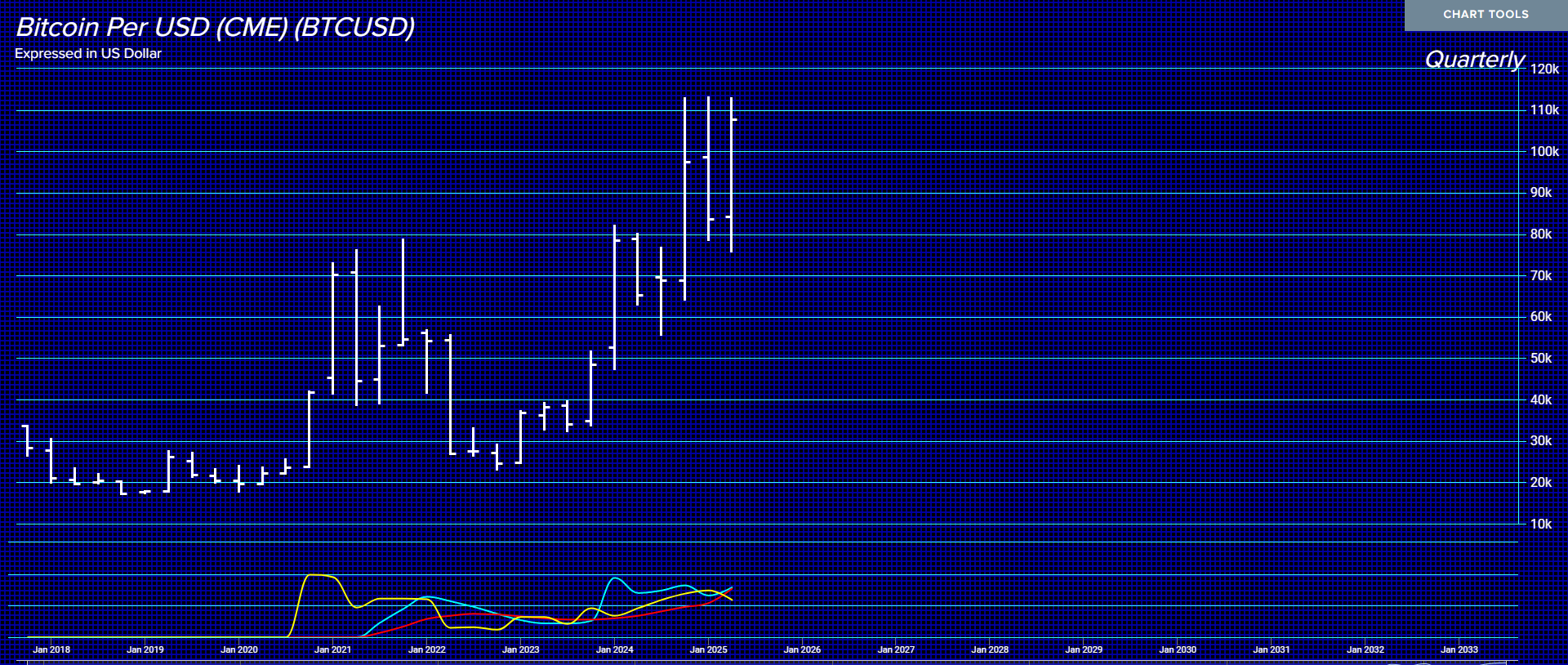
While the FAKE NEWS and the perpetual GOLD-ONLY crowd promote the de-dollarization with BRICS, that means in time of war, you are buying Chinese yuan, Russian rubles, and the country most in debt – Brazil. Their perpetual promotion of BRICS and even the latest absurd forecast for Bitcoin at $21,000 by 2046 suggests that these individuals appear to know little about the world economy, the business cycle, or war. They refuse to consider two critical factors: (1) the sovereign debt crisis, and (2) the war.
Interest Expenditures as % of GDP (Top 30 Economies):
United States: 1.9%
China: 1.2%
Japan: 2.0% (despite high debt, low rates keep payments manageable)
Germany: 0.8%
India: 3.3%
United Kingdom: 3.5%
France: 1.7%
Italy: 3.9%
Brazil: 8.5% (highest among major economies)
Canada: 1.4%
The sovereign debt crisis is brewing, but outside the USA FIRST!!!! Canada’s interest expenditures are on track to exceed healthcare expenditures. While people continue to discuss the US debt as a reason for de-dollarization, consider the BRICS; they are paying more in interest as a percentage of GDP than the US, and Brazil is the worst. Britain is in a precarious state, comparable to Italy, and Starmer’s policies are pushing the UK over the edge. Germany has just abandoned austerity and is now going to inflate to prepare for war. The Sovereign Debt Crisis is UNSUSTAINABLE, but it will break FIRST outside the USA. The United States will be the last standing.
NATO to Accelerate Sovereign Debt Crisis
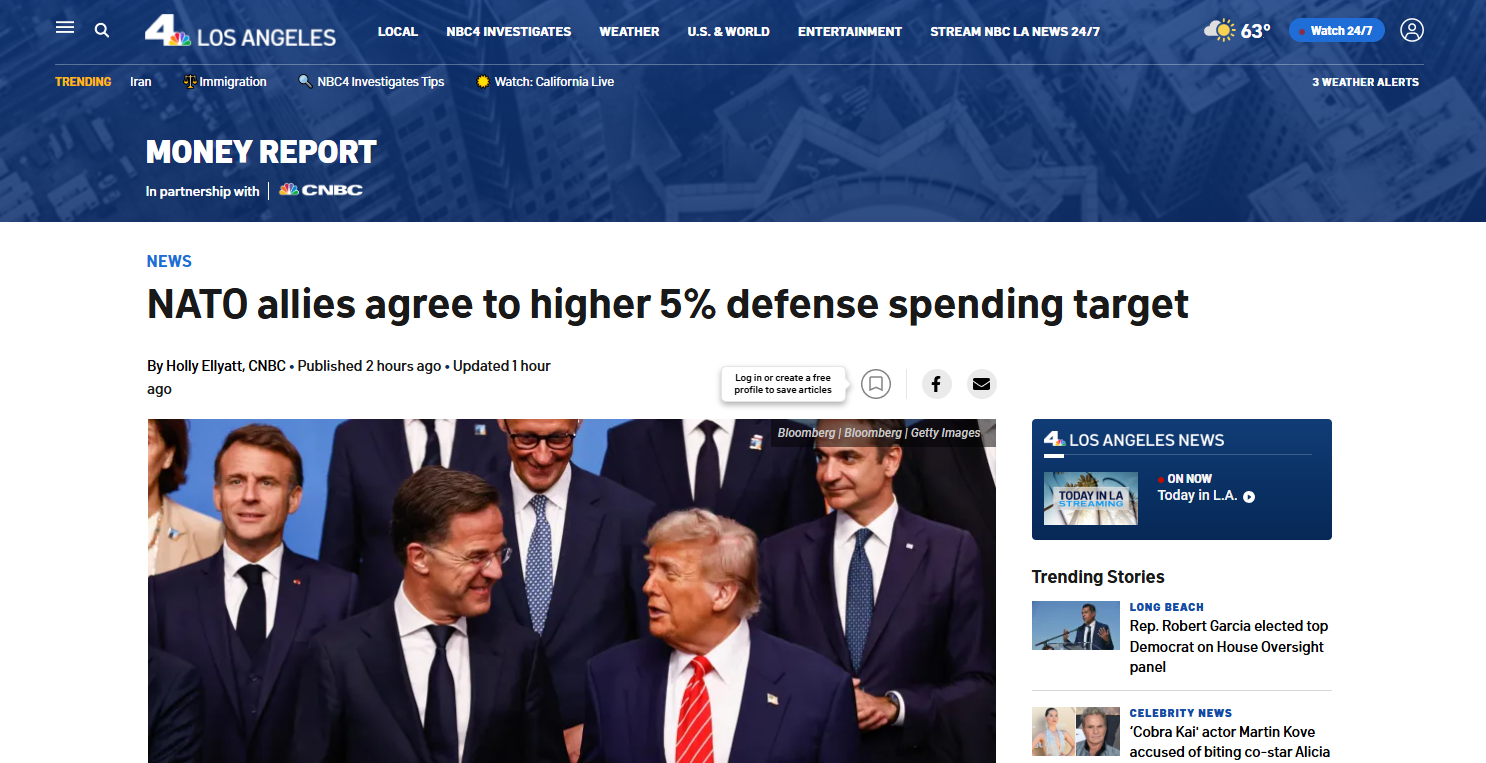
As the pressure on funding the war, NATO wants 5% of GDP for its Neocon War objectives. They are handing Ukraine another $40 billion that goes into the pockets of untold politicians and no doubt kickbacks even into NATO. This 5% is greater than the interest expenditures. NATO will not only take us into World War III, but they are also accelerating the Sovereign Debt Crisis.
This is NOT positive for the de-dollarization BS. Europe is highly socialistic, and this shift from social spending to war will lead to more civil unrest. NATO is a warmongering NEOCON retirement home. They have no interest in peace, for that would make them redundant. The only way they can keep their salaries and pensions is to insist on endless wars.
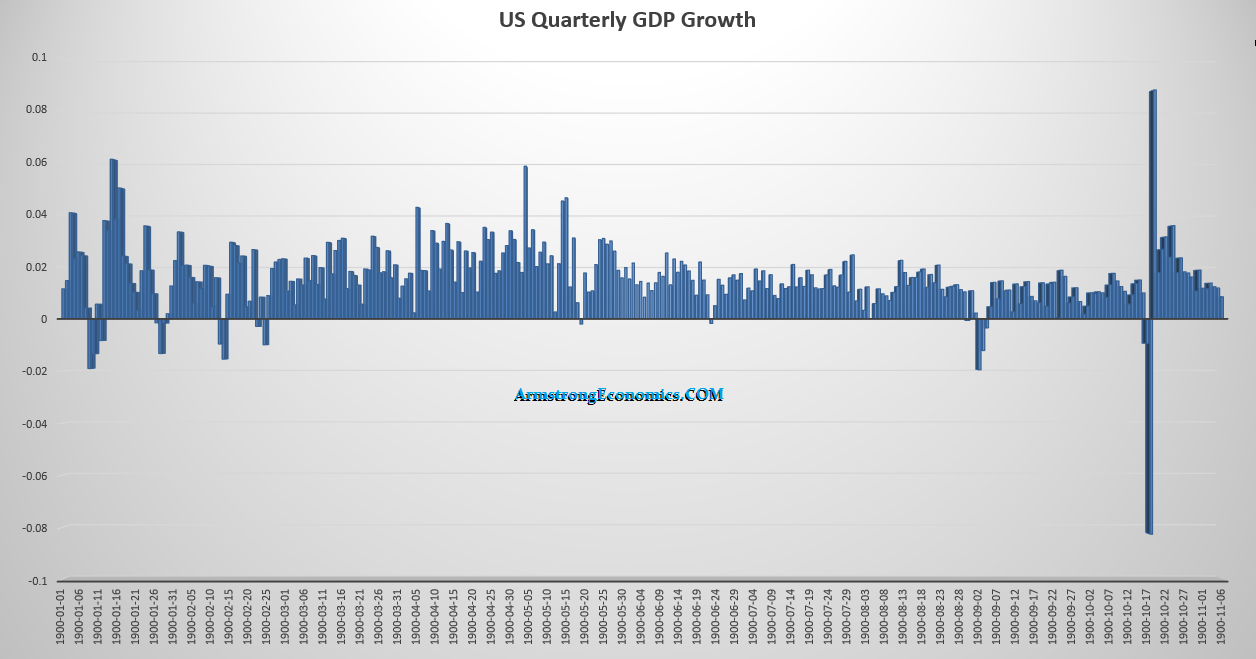
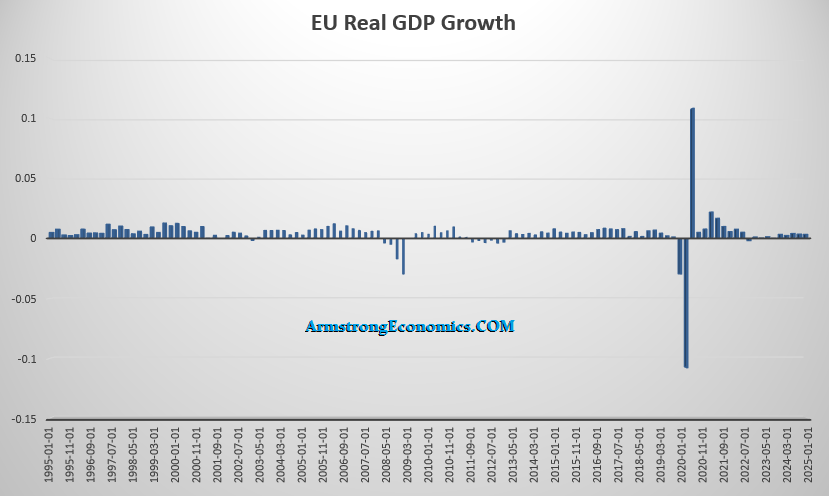
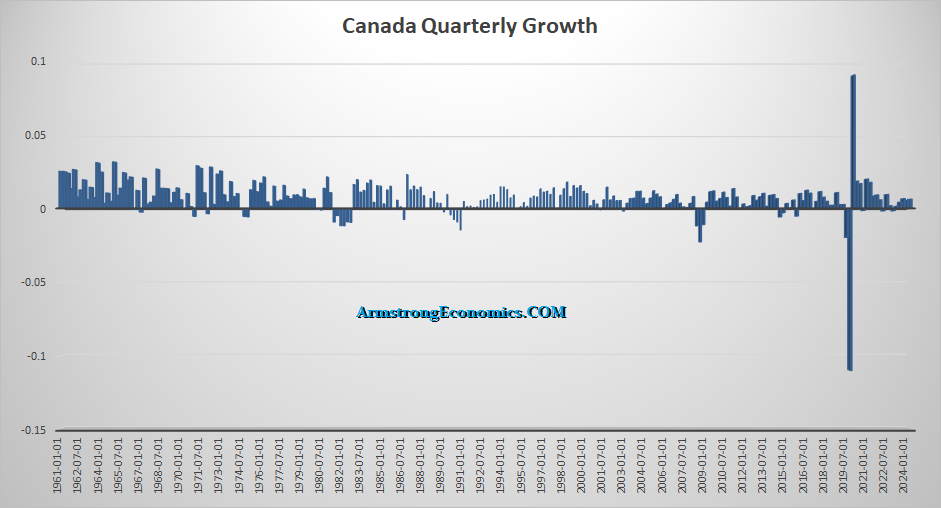
Just compare the economic growth rate of the United States to the exceptionally socialistic policies of Europe. There is no comparison. But the dollar is trash against everything else? When the bullets start to fly, capital controls will be imposed in the EU, and capital will be trapped. Compare even the GDP of Canada to that of the EU. Carney wants to join Europe.
We are looking at the pressure to raise taxes beyond income. In Australia, some leftists actually proposed that it is unjust for one person to inherit a fortune and another not to. They argued that upon death, everything should be given to the government in the name of “Fairness” and “Equality,” which is their favorite word. In Canada, discussions have been held about proposing a tax on unrealized capital gains on property. The argument is that this was like gambling. They earned this money by mere chance. Such proposals would absolutely destroy society and the economy. They are not likely. However, these extreme examples demonstrate how the LEFT cannot live in peace and always want to take what others have because they have more than they do.
As for the absurd forecast that Bitcoin will reach $21,000 by 2046, that is the same emotional analysis used in discussions about climate change. Sorry, 2025 may be a significant high point. With war on the horizon, Bitcoin has been a great vehicle for transferring money from one country to another. It is not being bought as a fantastic store of wealth. In war, take out the power grid and watch what happens. I can attest to being in Florida, when a hurricane takes down the power, not even a credit card will work – CASH ONLY!
Posted originally on Jun 8, 2025 by Martin Armstrong
QUESTION: Mr. Armstrong, this feud between Trump and Musk has caused me to wonder about Musk. Then, all of these forecasts are using tools you warned do not work because they rely solely on linear analysis. The Tax Foundation said Trump’s bill would result in a $2.6 trillion increase in the deficit. The University of Pennsylvania’s Penn Wharton Budget Model claimed that the bill would raise deficits by $2.8 trillion. Then Yale’s Budget Lab claimed that over a 30-year window, the bill would add $10.8 trillion to the national debt. None of these organizations even understands that there is a business cycle. I find all of this chatter is no different from the climate change projects, as you said, one degree up this year means that will continue forever, and we will all die in 50 years.
Does Socrates have any view that is more reliable than these fake academic prognostications that are never right even once?
Rich
ANSWER: These forecasts are totally worthless. The CBO’s projections for the federal budget deficit were about $900 billion in 2019, and it was expected to exceed $1 trillion each year beginning in 2022. The deficits for 2020, 2021, and 2022 were $3.1 trillion, $2.7 trillion, and $1.3 trillion, respectively. They are incapable of forecasting. How many millions do these fake forecasts cost? We will do it for 10% of their budget. They are all based not just on linear analysis, but on the classic assumption that all things remain equal. They NEVER understand that there is a natural inherent business cycle.
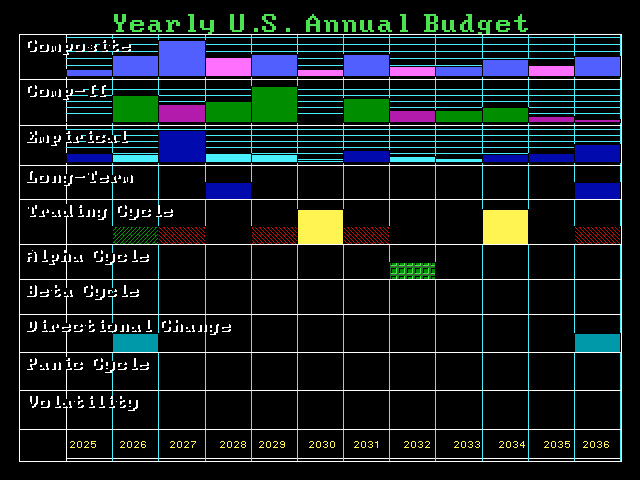
Socrates examines everything, and nothing ever remains the same. We have a Directional Change in the annual budget in 2026, and then you see the big target is 2027. Just looking at the French government, which is in its 5th Republic. France changes government like the Biden Administration changed the definitions of a woman from women’s rights for abortion to his appointment of Jackson to the Supreme Court, who said she could not define what a woman is. The French government is expected to fall in 2027, potentially taking the EU with it.
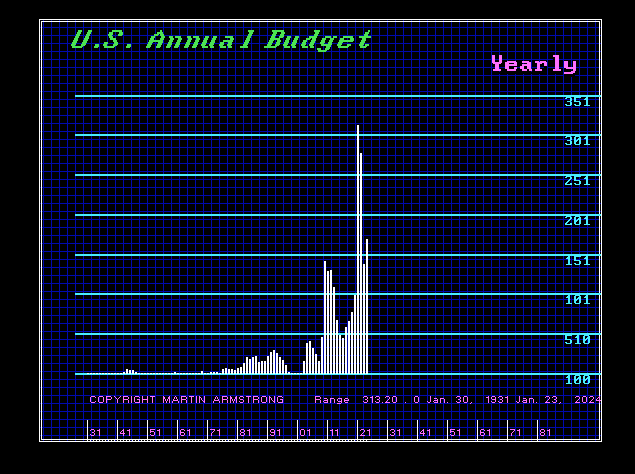
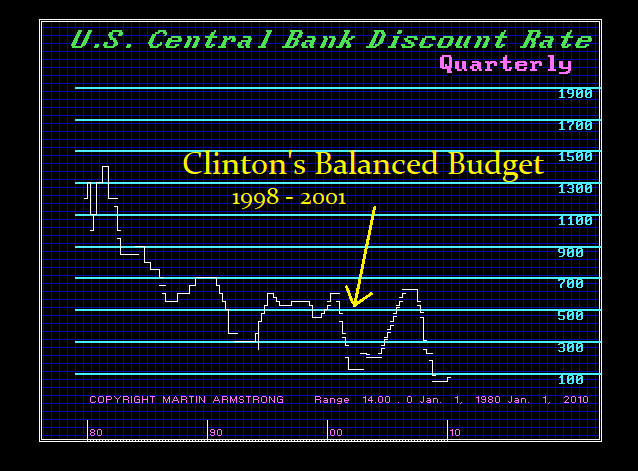
When you look at the chart for the annual budget deficit, we peaked with the COVID-19 pandemic in 2020. Look at the 1998-2002 period. We had a balanced budget. I was asked by the Wall Street Journal to write about how this was accomplished. In sum, the manner in which President Clinton (1993-2001) was able to balance the budge was (1) the economy recovered in 1994 with capital pouring into the United States as it fled South East Asia resulting in the Asian Currency Crisis in 1997, (2) US Interest rates rose sharply in 1994 attracting huge capital inflows including those from Japan, and (3) Clinton shortened the maturity of the debt funding it short-term to cut interest expenditure.
The National Debt rose from $4,064.6 billion in 1992 to $5,807.5 billion by 2001. The shift in funding slowed the rate of growth. Interest rates at the Fed dropped by 6.5% in 2000 to 1.75% in 2001. When Clinton took office, the Fed Discount Rate stood at 3.5%. The rise began in 1994, which helped to attract foreign capital, especially from Japan, and it peaked in 2000 with the Dot Com Bubble on the heels of the 1998 Long Term Capital Management debacle that followed the collapse of Russian debt.
However, because Clinton shifted from long-term to short-term, which reduced the interest expenditures, now look at how the debt exploded when the rates went back up to 6.5%. This is what I mean by the Fed can no longer control inflation, for the biggest borrower is the government.
Posted originally on May 19, 2025 by Martin Armstrong
Senator Ted Cruz of Texas believes that the federal government should provide each child $1,000 at birth to be invested in the stock market. “Every child in America will have private investment accounts that will compound over their lives, enhancing the prosperity and economic participation of the vast majority of Americans,” Cruz said. Around 3.6 million children were born in the US last year, meaning that the federal government would need to set aside $3.6 billion a year to fund this program.
Cruz’s program would permit family and friends to add $5,000 annually to these private investment accounts, with the hope that the compounding interest will give these kids a head start in life. “What I’m interested in is giving these kids the ability to climb the economic ladder much, much faster to accumulate wealth,” Cruz told CNBC. “I think there’s a real power to making them investors and stakeholders in the economy.”
This is not a completely new concept. Senator Cory Booker of New Jersey proposed providing newborns with funds for investing that would be worth up to $2,000, but rather than investing in the private sector, they would hold treasuries or “baby bonds.” Hillary Clinton also proposed a “baby bond” worth up to $5,000 during her first presidential campaign, costing the public $18 billion annually.
Future generations pay for social programs and the surmounting national debt. Cruz, Clinton, and Booker fail to realize that these programs require funding which comes from these future taxpayers. In a December 2024 interview, Federal Reserve Chairman Jerome Powell stated, “We’re borrowing from future generations. And every generation really should pay for the things that it needs.” Massive spending packages are detrimental in the long run and cause more harm than good.
There’s a strong chance that many parents would simply pocket the funds or not know how to properly invest it in the market. Around 62% of Americans currently hold equities, but the majority own through retirement accounts. Only 21% of American families directly own stocks. The public education system should begin teaching future generations about investment and personal finance, as one in four Americans are financially illiterate.
Suppose lawmakers actually want to improve the lives of future generations. In that case, they need to stop adopting policies that saddle the American public with debt that they then forcibly collect through increased taxation.
Posted originally on May 19, 2025 by Martin Armstrong
Nordic nations have been leading the cashless society revolution. Masked as a manner of efficiency, digital transactions are not demanded by governments globally as they seek to rake in all money off the grid for taxation purposes.
Sweden is nearly a cashless society, with less than 2% of transactions occurring in physical currency as of 2020. Some estimates believe cash transactions have risen to 10% as of 2025, but it is becoming less commonplace. Swish transfer, launched in 2012, is a mobile payment system that enables users to transfer money in real-time. Accounts are linked to bank accounts, and transactions are authorized by Mobile BankID. As of February 2025, Swish had over 9 million users with 8.9 million private accounts and 318,000 business accounts. Only 10.5 million people currently live in Sweden.
The governor of Risbank declared in 2017 that “half of Swedish traders believe they will stop accepting cash by 2025” and Swish would be used for “Transaction that used to be mostly cash based.” In 2010, around 40% of transactions occurred in cash compared to 2-10% today.
Norway is also close to becoming cashless. Similar to Swish, Norway uses a program called Vipps that is owned by DNB Bank. Around 90% of Norwegian bank customers are using this program. Vipps began accepting crypto last year as well.
The National Bank of Denmark reported that cash was used in only 11% of transactions in 2024. Finland has seen a drastic drop in cash transactions, accounting for under 20% of payments.
Customers across Nordic nations report having a high level of trust in their banking institutions and government. Polls and reports vary, but the aforementioned nations typically have a higher level of confidence in their national government compared to other OECD nations. The 2024 OECD poll found 48% of Norwegians had high or moderately high trust in their national government, exceeding the OECD average of 39%. Yet, that figure has declined 16% since 2021. Around 77% of Finns reported having a high level of trust in their government, and 43% of Swedes felt similarly.
Using a credit card or mobile pay option has become the new normal everywhere. Cash transactions are becoming increasingly rare. Cash is still legal tender, and governments have not banished physical currencies—yet. It will be easier for governments to mandate CBDC as the majority of citizens have already gone digital.
I have created this site to help people have fun in the kitchen. I write about enjoying life both in and out of my kitchen. Life is short! Make the most of it and enjoy!
This is a library of News Events not reported by the Main Stream Media documenting & connecting the dots on How the Obama Marxist Liberal agenda is destroying America











 Centinel2012