Why Did Trump Really Take Venezuela? It Wasn’t Just Oil!


Posted originally on Jan 4, 2026 by Martin Armstrong |  

COMMENT: You said these podcasts that Venezuela had the oil but the big question is China. Would like to expand on that now? Socrates showed the dollar taking off in October 2024 and the fourth quarter was a turning point. But it now shows volatility rising from February on. It looks like this is not over as you say until the fat lady sings.

FDS
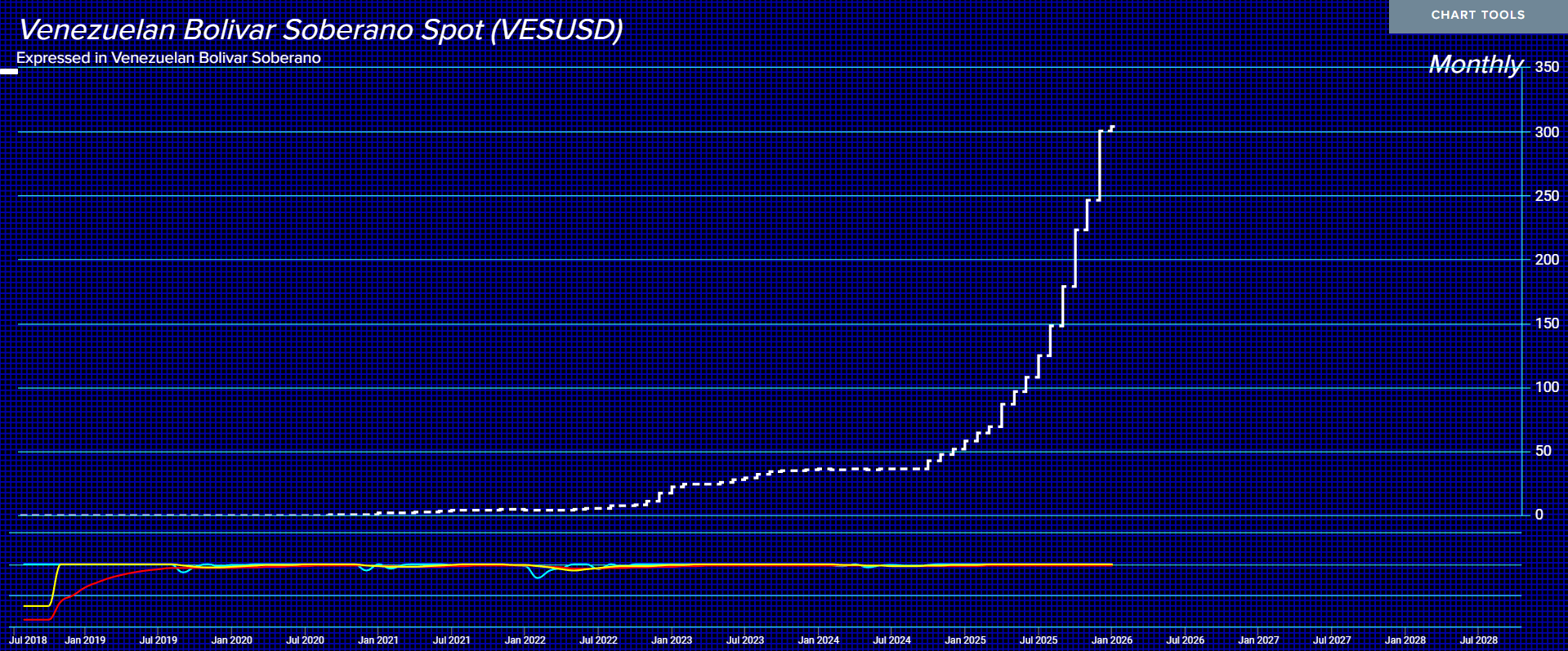
Venezuela Bolivar Y 1 3 26

ANSWER: OK. I suppose I can now give the bigger picture that headlines miss. Trump’s comment throws in energy secondly. He does not mention drugs. Most of the drugs come in through Mexico. As I have said, China is the #1 client of Venezuela. This all depends on the takover of those oil assets by the American oil companies and do they cut off China. That may not be in the cards just yet because Venezuela owes a lot of monet to China. However, overlooked here is the connection to Russia. That is the real issue nobody is taking about and this has been a goal of Rubio for a very long time.

Russian lawmaker Alexei Zhuravlyov told Gazeta.ru on November 1st, 2025 that Russia MAY supply Venezuela with its new Oreshnik and Kalibr missiles, stating “I see no obstacles to providing our friendly nation with new systems such as the Oreshnik or the well-proven Kalibr missiles.” This wasn’t merely hypothetical posturing but a direct response to U.S. military buildup in the Caribbean. This threat was taken seriously. The Oreshnik, with a reported maximum range of about 3,400 miles, could theoretically threaten much of the continental United States as well as Puerto Rico. The Kalibr is thought to have a range of between 930 and 1,550 miles, which could possibly threaten the southern continental U.S., as well as facilities throughout the Caribbean.

From Venezuelan territory, the missile could target most of South America, the Caribbean, Mexico, and large portions of the United States—with Washington likely among its primary targets, given the tense relations between the US and Maduro’s regime. Even parts of Canada could fall within its range.

The relationship between Venezuela and Russia and China represented one of the most significant geopolitical realignments of the 21st century, built on anti-American sentiment, oil-for-loans arrangements, and mutual opposition to U.S. hegemony. This trilateral dynamic evolved from modest beginnings under Hugo Chávez into a comprehensive strategic partnership that has sustained the Maduro regime through economic collapse and international isolation.

The relationship between China and Venezuela took formal shape in 2006, under President Hugo Chávez, with Caracas signing several trade agreements with Beijing and describing China as a “Great Wall” against US influence. Chávez, seeking to diversify Venezuela’s oil exports away from the United States and counter American regional dominance, found in China an eager partner with rapidly growing energy needs and no political conditions attached to its financing.

The financial dimensions proved staggering. China began extending large loans to Venezuela, backed by future oil supplies of oil. In 2006, Beijing provided $2 billion in loans, which rose to $7 billion in 2007. Of the $150 billion the Chinese Development Bank loaned to Latin America in the past 12 years, a third went to Venezuela. These weren’t traditional loans but rather oil-collateralized arrangements where Venezuela repaid through petroleum shipments to Chinese state companies.

In 2007, China and Venezuela set up a joint fund worth $6 billion–$4 billion loan from the China Development Bank (CDB) and $2 billion from El Fondo De Desarrollo Nacional S.A. (FONDEN) set up by Caracas. This fund doubled to $12 billion by 2009. The mechanism was straightforward: China provided upfront capital, and Venezuela committed to shipping specified quantities of oil at predetermined prices. When oil prices collapsed in 2014 and Venezuela’s economy imploded, China extended additional lifelines including a $10 billion loan to support the country’s balance of payments.

The relationship peaked between 2010 and 2013, when Venezuela received approximately 64% of China’s new credit lines to Latin America. However, as Maduro’s mismanagement destroyed the oil industry and production plummeted, Chinese enthusiasm collapsed as a result. By 2016, Venezuela received only 10% of Chinese regional lending, and new financing essentially ceased. China focused instead on restructuring existing debt and protecting already-committed investments.

China is owed by Venezuela at least $20 billion in loans established before 2017. Some estimate that is even higher. The relationship shifted from expansion to damage control. Maduro’s rampant corruption and mismanagement has led to the region’s worst economic depression, creating unfavorable investment conditions, affecting oil production and exports, and limiting return on Chinese investment and Venezuela’s ability to repay Chinese loans.

Now, that said, we must look at the Russian comment and look at this video. Who is standing there with Trump? Marco Rubio. If you remember, Rubio was also running for president against Trump in 2016. Who was funding his campaign? Goldman Sachs. Rubio has pushed for regime change in Venezuela because of Russia for years. Marco Rubio has held many titles during Donald Trump’s presidency, and he now adds another: Viceroy of Venezuela.

Russia’s engagement with Venezuela followed different patterns than China’s, emphasizing military cooperation alongside energy sector involvement since Russia did not need their oil. Where China provided infrastructure loans, Russia sold weapons systems. From 2005, Venezuela purchased more than $4 billion worth of arms from Russia. These sales included fighter aircraft, helicopters, armored vehicles, and air defense systems, transforming Venezuela’s military from American-equipped forces to Russian-supplied ones.

Russia and Venezuela forged a comprehensive strategic partnership centered on anti-hegemonic solidarity and pragmatic cooperation. This wasn’t merely commercial but explicitly geopolitical. Chávez and later Maduro positioned Venezuela as Russia’s foothold in the Western Hemisphere, allowing military exercises and bomber flights that signaled Moscow’s reach into America’s traditional sphere of influence.

The energy relationship proved more complex than China’s. Russia’s state oil company Rosneft provided billions in loans and took equity stakes in Venezuelan projects, though on smaller scale than Chinese financing. Russia’s state-backed oil company Rosneft loaned $2.3 billion, excluding interest. Critically, Russia helped Venezuela circumvent U.S. sanctions by facilitating oil exports through complex shipping arrangements and providing technical expertise to maintain declining production.

The trade balance between Moscow and Caracas increased by 64% in 2024, demonstrating sustained engagement despite Venezuela’s economic deterioration. Russia viewed Venezuela through multiple lenses simultaneously both as an economic opportunity, as well as a strategic geopolitical asset.

The Geopolitical Chess Move
Checkmate 2

I hope this explains behind the curtain for this is NOT simply a grab for oil NOR is it simply about drugs. We will see if Trump/Rubio cuts off the energy flow to China. But I believe that is a card to be played later in the game. I believe that #1 reason is to prevent Russia using Venezuela as a foothold like Cuba in 1962. But this is again only one reason in a complex strategic geopolitical move that is beyond the headlines right now.

EU Central Banker Christine Lagarde Outlines the “Trillions at Stake” Within President Trump’s Geopolitical Reset


Posted originally on CTH on October 19, 2025 | Sundance 

Underpinning the contracting EU economy are two major forces.  First, the instability of their financial markets, thanks in majority to their catastrophic Build Back Better energy agenda.  Secondly, China exploiting the economic vulnerability and dumping massive amounts of cheap goods onto their consumer market.  Both forces are working against the EU economy.

To backstop the collapse, the EU is counting on expanded militaristic spending to get them out of their dead-end path.  Again, in majority, the economics of the thing is why they want expanded war with Russia – regardless of the detrimental outcome.  Without war they have to give up their Build Back Better green energy program.

In this interview, EU Central Bank President Christine Lagarde obfuscates both issues and points a finger at President Trump’s geopolitical economic and trade reset.  The only thing she accurately presents is the scale of the issue, the “trillions at stake” part.  WATCH (Transcript Below):

[Transcript] – MARGARET BRENNAN: We’re joined now by the President of the European Central Bank, Christine Lagarde. The ECB sets interest rates for many countries in the European Union, which is America’s largest trading partner. Good to have you here.

CHRISTINE LAGARDE: Lovely to be back, Margaret.

MARGARET BRENNAN: From where you sit, how would you describe the state of the global economy?

CHRISTINE LAGARDE: In transformation.

MARGARET BRENNAN: Transformation.

CHRISTINE LAGARDE: Transformation, I think caused by a couple of things. One is the tariffs, which have changed the map of trade around the world and reconstituted new alliances and reformed the way in which we trade with each other. I think the second major transformation is the impact of artificial intelligence on everything we do from data management to dating and everything in between.

MARGARET BRENNAN: Absolutely, and it’s changing how we even receive the data itself —

CHRISTINE LAGARDE: — Yep. —

MARGARET BRENNAN: — to indicate what’s happening, but the stock market has been up and down. I want to talk to you on the other side of this commercial break about some of the specifics with these trade wars and what else you’re seeing in Europe, but we’re going to take a quick break here. And we have more questions, but we have to come back in just one moment.

MARGARET BRENNAN: Welcome back to Face The Nation. We return to our conversation with European Central Bank President Christine Lagarde. You said the economy is in transformation. S&P Global forecasts Trump’s tariffs are going to cost global businesses upwards of $1.2 trillion this year, with a lot of those costs passed along to consumers themselves. You’ve said that many economists overestimated the impact of Trump’s tariffs. Does that mean you think we’ve moved past the point of risk or are we yet to feel the pain?

CHRISTINE LAGARDE: I think we’re yet to feel the pain. What we observe, I’ll give you some numbers. From Europe to the United States, our goods to the U.S. consumers had a tariff of 1.5. With the tariff that was decided by the U.S. administration, it’s gone up to 13%. So the question is, where does this additional 11-ish percentage point go? At the moment, it’s one-third on the exporter, so the European company, one-third of the U.S. importer and one-third of the consumer. What will happen, though, is that these two-thirds borne by two corporates, essentially, the exporter and the importer, is based on a squeeze of their margins. How long are they going to put up with a squeeze of the margin, to be seen. And when they don’t, because it’s becoming too tight, then it will be on the consumer. So it’s a question of time.

MARGARET BRENNAN: How much they can stomach the hit —

CHRISTINE LAGARDE: — Yep. —

MARGARET BRENNAN: — to their own profits before passing that along. Well, there are talks happening, we understand, between the world’s two largest economies. The Treasury Secretary Scott Bessent said on social media he’s going to meet with China’s Vice Premier in the coming days. This was after he called the negotiator unhinged recently, and President Trump said that starting November 1st there will be new tariffs as retaliation for Chinese restrictions on rare earth exports. These are the largest economies in the world. Where does this go? How damaging does this get?

CHRISTINE LAGARDE: First of all, I would discount a little bit of the positioning at the moment because this is typical of negotiating tactics on both sides. Typical. You show your muscles and you say that you’re ready to kill. I’m exaggerating, of course. But people will have to come to the table because it’s the interest of both economies, despite the hostility that there is between the two. But China is using an advantage that it has built over the course of time by accumulating rare earth and the ways to refine rare earth and then to sell it to the rest of the world. They have a very, very strong trading position on that front and they’re going to use it, which is why I think that on the other side the consumers, that is the United States, Europe and a few other countries around the world, we should, you know, join forces and be a purchasing force on the other side of the table of a selling force.

MARGARET BRENNAN: Well, exactly to that point, there has been frustration on the American side of it that Europe hasn’t been standing lock step with the United States when it comes to China. That China has leverage over Europe here.

CHRISTINE LAGARDE: Well, China currently has leverage against most countries that consume rare earth. And I think on the front of rare earth, the Europeans and the Americans are in the same boat and they are rowing in the same direction.

MARGARET BRENNAN: But it’s other items that you see —

CHRISTINE LAGARDE: — Well, I think, you know, it’s not for me to say I’m just a central banker, but the European authorities and the U.S. administration see it slightly differently. I think it’s the U.S. would see a blanket force. I think the Europeans are more interested in targeting specific industries or specific sectors where they think that it will make a difference. So it’s a question of tactics that they will be discussing, I’m sure.

MARGARET BRENNAN: So you have also said recently that you think investors have begun to question whether the dollar would still warrant its status as the ultimate safe haven currency. I mean, the American dollar is one of the strongest weapons, frankly, that the administration has to use. Do you think that it is the rise of cryptocurrency that is most threatening to that or why are you worried?

CHRISTINE LAGARDE: I see signs that the attraction of the dollar is slightly eroded, and future will tell whether there is more erosion of that. But when you look at the rise of cryptos, number one, when you look at the price of gold. Gold is typically, in any situation, the ultimate destination for safe haven. Price of gold has increased by more than 50% since the beginning of the year. —

MARGARET BRENNAN: — So people are worried. —

CHRISTINE LAGARDE: — That’s a clear sign that the trust in the reserve currency that the dollar has been, is and will continue to be, is eroding a bit. In addition to that, we’ve seen capital flows outside of the U.S. towards other destinations, including Europe. So, you know, for a currency to be really trusted you need a few things. You need geopolitical credibility. You need the rule of law and strong institutions. And you need, I would call it, a military force that is strong enough. I think on at least one and possibly two accounts, the U.S. is still in a very dominant position, but it needs to be very careful because those positions erode over the course of time. We’ve seen it with the Sterling Pound, you know, way back after, after the war. But it happens gently, gently, you don’t notice it and then it happens suddenly. And we are seeing intriguing signs of it, which is why I think that having a strong institution with the Fed, for instance, is important. Having a credible environment within which to trade is important. So volatility, uncertainty, to the extent it is fueled by the administration, is not helpful to the dollar.

MARGARET BRENNAN: Quickly on Ukraine, President Zelenskyy said he spoke to you recently about using frozen Russian assets. What is fair use in your view?

CHRISTINE LAGARDE: I think fair use would consist of an operational loan that would be using cash balances as collaterals. And I think that the strength of the system should be based on everyone holding Russian assets to do the same thing. So if all those countries holding assets, that have cash balances available as collaterals, go in the same direction of lending the money to Ukraine to be repaid by Russian financing of the reconstruction of Ukraine because Russia is the aggressor, then I think that that would go a long way in convincing Russia that it has to come to the table to negotiate.

MARGARET BRENNAN: Christine Lagarde, always great to hear your insights. We’ll be right back.

[END TRANSCRIPT]