President Trump Delivers a Good Friday Easter Message – Video and Transcript…


Earlier today President Trump participated in an Easter message with Bishop Harry Jackson from the Oval Office. [Video and Transcript Below]

.

[Transcript] – THE PRESIDENT: Well, thank you very much. On this Good Friday, Christians from all around the world remember the suffering and death upon the cross of our Lord and Savior, Jesus Christ. At Easter Sunday, we will celebrate his glorious resurrection.

At this holy time, our nation is engaged in a battle like never before — the invisible enemy. Our brave doctors, nurses, and responders — first responders, responders of all — are fighting to save lives. Our workers are racing to deliver critical medical supplies. Our best scientists are working around the clock to develop lifesaving therapeutics, and I think they’re doing really well in doing so. Our people are making tremendous sacrifices to end this pandemic.

Though we will not be able to gather together with one another as we normally would on Easter, we can use this sacred time to focus on prayer, reflection, and growing in our personal relationship with God. So important.

I ask all Americans to pray that God will heal our nation; to bring comfort to those who are grieving; to give strength to the doctors, nurses, and healthcare workers; to restore health to the sick; and to renew the hope in every person who is suffering. Our nation will come through like never before.

I thank the many families who have prayed for me and for my family. And your prayers are felt, and I am forever grateful.

I’d like to thank our great Vice President and his wonderful wife, who we all know very well, Karen, for the incredible job they do and for their service not only to the country but for their service to God.

Almost 3,000 years ago, the Prophet Isaiah wrote these words: “Darkness covers the Earth…but the Lord rises upon you, and His glory appears over you…For the Lord will be your everlasting light.”

As our nation battles the invisible enemy, we reaffirm that Americans believe in the power of prayer. We give thanks for the majesty of creation and for the gift of eternal life. And we place our trust in the hands of Almighty God.

I’d like to just wish everybody a very Happy Easter. We’re going to be celebrating that very, very special day, and it’s going to be, hopefully, a very good weekend and a very productive weekend.

And I want to thank everybody in our country and beyond for all they’ve had to put up with. One hundred and eighty-four countries, as of this morning, are fighting this enemy and we pray for them all.

With that, I’d like to introduce Bishop Harry Jackson from Maryland, a highly respected gentleman who is a member of our faith and a person that we have tremendous respect for.

Bishop, please. Thank you.

BISHOP JACKSON: Thank you, Mr. President. First of all, let me say thank you for the job you’re doing — you and the Vice President — to protect our nation. And you’ve included the churches in the relief efforts. Many churches would’ve had to close down —

THE PRESIDENT: Yes.

BISHOP JACKSON: — had it not been for your insightful leadership. So thank you both very much.

THE PRESIDENT: Thank you, Bishop.

BISHOP JACKSON: Good Friday, as we prepare to pray, is one of the darkest days in the Christian faith in that Christ stood in substitution for our sin. But the resurrection is our victory. But it parallels with the Passover.

I’m going to read two verses and pray out of them about what we want to have happen. We want this plague to pass over. We want everyone in America to be safe.

Psalm 105 says: He brought them out without — with gold — silver and gold, and there was none feeble among His tribes.

Verse 39 goes on to say: He spread a cloud for covering, and fire to give light in the night.

Let us pray:

Lord, let the death angel pass over. Let there be a mitigation of this plague, this disease. Let medical science come forth.

Lord, let us come out with a thriving economy. That silver and gold spoken of in that passage, let it be our portion.

And then, God, as we face other challenges in the future, Lord covers with a cloud by day and a fire by night.

But in this great land that was set up to glorify your name, we want to break, we come against the spirit of division.

Lord, let e pluribus unum be a reality in us. Let there be a uniting of America. Heal the divide between race, class, and gender.

Once again, give this great man, our President, and give the Vice President wisdom beyond their natural limitations. Give them insights so they can cover us, lead us, and bless us.
We bless them and America in Jesus’s name.

Be encouraged. Hope is on the way. Amen.

THE PRESIDENT: Thank you, Bishop. That’s beautiful.

BISHOP JACKSON: Thank you, my friend.

THE PRESIDENT: Thank you very much. That was a great honor, and thank you.

And thank you all. And have a great Good Friday, and we’re going to see you in a little while. And also, if I don’t see you, have a great Easter. Thank you very much. Thank you.

Q Mr. President, what’s your message to churches? Should pastors have Easter services?

THE PRESIDENT: Thank you very much.

Q Can we ask you that at the briefing perhaps?

THE PRESIDENT: Yeah.

Q Okay. Thank you. Happy Easter.

THE PRESIDENT: You too. Happy Easter, everybody.

END 12:15 P.M. EDT

It Is Finished. Good Friday.


Today we observe Good Friday, the day of the death of Jesus. Many Christian Churches have different ways of observation, to prepare us for the coming resurrection of the Lord on Easter Sunday. Today, the sacrifices we have made during Lent culminate in our internalization of the great offering of Christ’s life. If we have been diligent in our Lenten preparations, Good Friday hits us with a power and force that brings us, literally and figuratively, to our knees with the grasp of what Jesus poured out for us. It becomes personal, a tiny sliver of the cross is buried in our heart. And so each year, we find that we give ourselves over to Christ just a little more through this time of penance and reflection. 

This year, in particular,  I suspect that many of us will experience Good Friday as we never have before, with a comprehension of our own mortality and perhaps even an understanding that there are so many things in this world we do not, we cannot, control. We can control our choice in relationship to those things, and to the most important choice of all, the life and death of Jesus Christ, who chose to hang on a cross and die for us. He had all control, and he made his choice for us.

For many years the practice of my faith was on auto pilot. Although I have an intellectual bent, I did not delve as deeply into the Bible, the Catechism, the history, and the teachings of my faith. When I finally did do more, pray more, read more, learn more, question more, and give more of myself, very haltingly at first, I was met with a tsunami of love and guidance from God, from Jesus, and of course, by the Spirit.

I timidly knocked on the door, and Jesus flung it open instantly, pulled me in, hugged me, sat me at his banquet table and introduced me to the feast I had shunned for years.

Of course, it isn’t always that way. Your spiritual life takes surprising turns, slows down, stops even at times, according to your senses. But your own senses are not a good guide. Sometimes when you struggle the most, feel things the least, you have a moment of self examination of your last months and you see the long path you traveled without really knowing where you were going.

Don’t do faith by feel. Don’t wait for sensation, answers, joy, hope, knowledge. All those things and so many more, they will come, but never on demand. Get on your knees and pray. Daily. Read the Bible, find a church if you haven’t already. Give alms. Do a good deed.

Feel good religion has pretty shallow moorings. Row out into the deep. When the storms come, try to remember that He who calms the storm is always in the boat with you.

The Easter Triduum, the marking of the days of Jesus’ passion and resurrection, the  most important time of the church year, begins with the evening Mass of Holy Thursday, reaches its high point in the Easter Vigil, and closes on Easter Sunday evening. After preparing during the days of Lent, we celebrate these holiest of days in the Church year.

From John, Chapter 19:

Then Pilate tried to release him, but the Jewish leaders told him, “If you release this man, you are no friend of Caesar’s. Anyone who declares himself a king is a rebel against Caesar.

At these words Pilate brought Jesus out to them again and sat down at the judgement bench on the stone paved platform. It was now about noon of the day before Passover.

And Pilate said to the Jews, “Here is your King!”

“What? Crucify your king?” Pilate asked. “We have no King but Caesar,” the chief priests shouted back.

So they had him at last, and he was taken out of the city, carrying his cross to the place known as “The Skull,” in Hebrew, “Golgotha.” There they crucified him and two others with him, one on either side, with Jesus between them. And Pilate posted a sign over him reading “Jesus of Nazareth, the King of the Jews.” The place where Jesus was crucified was near the city; and the signboard was written in Hebrew, Latin, and Greek, so that many people read it.

Then the chief priests said to Pilate, “Change it from ‘The King of the Jews’ to ‘He said, I am King of the Jews.’ ”

Pilate replied, “What I have written, I have written. It stays exactly as it is.”

When the soldiers had crucified Jesus, they put his garments into four piles, one for each of them. But they said, “Let’s not tear up his robe,” for it was seamless. “Lets throw dice to see who gets it.” This fulfilled the scripture that says, “They divided my clothes among them, and cast lots for my robe.” So that is what they did.

Standing near the cross were Jesus’ mother, Mary, his aunt, the wife of Cleopas, and Mary Magdalene. When Jesus saw his mother standing there beside me, his close friend, he said to her, “He is your son.”

And to me he said, “She is your mother.” And from then on, I took her into my home.

Jesus knew that everything was now finished, and to fulfill the scriptures said, “I’m thirsty.” A jar of sour wine was sitting there, so a sponge was soaked in it and put on a hyssop branch and help up to his lips.

When Jesus had tasted it, he said, “It is finished,” and bowed his head and dismissed his spirit.

Today we would like to invite you to share with us your reflections, your thoughts, your favorite readings on Good Friday. We sincerely hope that you will join in this conversation as a sharing of our common faith, an active searching, united in asking in this small way for God’s blessing upon His world this Easter Triduum. So many of us see change as something that is all or nothing. We postpone the changes we need to make in our lives to improve our relationship with God because we aren’t mentally “ready” to make that leap. In reality, our path to God is made in tiny steps, small differences, the little things that take us one step closer in faith.

We ask you to join us, help us, take that step. Together and seperately, may we aid each other through our words and prayers, to make this Good Friday an opening for the light that is Christ to penetrate our darkness.

I would also like to share a paragraph from The Catechism of the Catholic Church.

In Her Magisterial teaching of the faith and in the witness of her saints, the Church has never forgotten that “sinners were the authors and the ministers of all the sufferings the Divine Redeemer endured.” Taking into account the fact that our sins affect Christ himself, the Church does not hesitate to impute to Christians the gravest responsibility for the torment inflicted upon Jesus, a responsiblity with which they have all too often burdened the Jews alone.

]

Please respect the solemnity and purpose of this post and keep the comments on the Passion of our Lord.

The Fabric of Our Faith


If the fabric of our faith is strong, we do not need the Shroud—we believe without seeing.

William Kevin Stoos image

Re-Posted from the Canada Free Press By  —— Bio and ArchivesApril 7, 2020

Christ, Cross, Holy Week, EasterEaster, 2020

“Except I shall see in his hands the print of the nails and put my finger into the print of the nails and thrust my hand into his side, I will not believe.” John 20:25

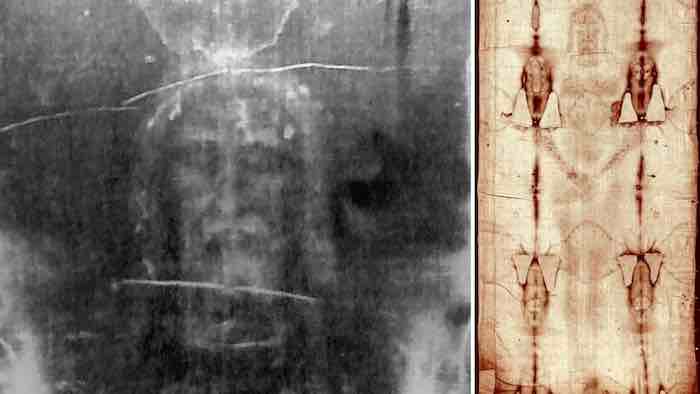
His face looks incredibly lonesome, as if every one of His friends abandoned him in the moment of his greatest need.  And sad—sad for all time. As if the weight of the whole world were upon His shoulders. There is an eternal pensiveness in His death pose.  The stabbing thorns that cut so unkindly into His scalp and the blood that flowed from His head are visible, indelible.

They are vivid, tangible signs of the once painful wounds that hurt no more.  The gash in His side flows with blood now etched in to the cloth, running no more but visible still. A record of one final insult visited upon Him by a soldier’s side arm. His thumbs turn inward tightly, from the pressure of the crude nails against the radial nerves as they pierced the bones of His wrist, causing unimaginable pain. The gaping wound in the feet is visible, caused by the large nail driven into muscle and bone as if driven through a piece of wood. Preserved for all time in the fabric.  Scores of blood-filled pockmarks riveted into His back by a sweating Centurion wielding a flagellum touch the fabric and testify to a brutal scourging. Leather thongs tipped with metal beads raked His flesh with incredible velocity. The fabric speaks of the indignity, suffering and humiliation inflicted on the Man, who certainly experienced every type of torture, brutality and humiliation possible, in His final hours of life on earth.

He is not painted or drawn. His face appears to be scorched onto the cloth—the product of a divine, cosmic energy—loosed at the moment of His transformation. When the Man on the cloth was resurrected. Skeptics doubt the fabric, scientists work to disprove it, atheists scoff at it, yet none can fully explain the image. The truth is that no one knows how the Man was created, how He came to be on the fabric.  Therein lies the mystery that may elude mankind for all time.  Perhaps it is not meant to be understood, but rather to inspire thought, awareness, or understanding of what such a Man endured at the time of His death.  To me, the Man in the cloth is Jesus, the Son of God, whose transformation scorched His face into the cloth creating an imprint that was meant to linger, inspire, and remind forever. It is a visible record of His human form, His injuries, a testament to and reminder of His divine suffering and how much this Man loved His people.  Or, “he” is a divine forgery, an imprint of an all too-human human created by an artist or a charlatan, whose work baffles twenty-first century science. Perhaps the Spirit worked even in a forger, to create an earthly reminder of His time on earth.

Like most people, I believed before I ever heard of or saw the fabric. It reinforces my faith, but I do not need it to believe. Whether real or not, it does not matter. I would have believed and did believe without it. I believed regardless of the Shroud, in spite of the Shroud, and, in part, because of the Shroud. In my heart I think that most people believe this way. I do not know one person who believes in Jesus only because of the

Shroud. Yet, if there are such persons, how is that bad? The Spirit moves people in various ways to understand and to come to a deeper faith in Christ. Perhaps they believe because of a homily, a picture, a song, a nun or priest. Perhaps they see the stars at night and are led to believe in something greater than themselves. If they believe because of those things, then why not because of the fabric?  Does it ultimately matter how people are led to Christ? Could not the fabric divinely inspire even if it did not touch His divine person?

There are those who believe without the Shroud and those who may believe because of it. Is it so wrong to seek or want proof? Even Jesus did not condemn Thomas, who wanted to feel the nail holes in His hands. He did not say, “Thomas, you believe because you see, but blessed only are those who have not seen and yet believe.”  He clearly opened His arms and His church to those who believe without seeing and those who believe because they see.

Personally, I believe that this fabric is the death shroud of Jesus. I want to believe and I do believe. Believing in it deepens my faith, but did not cause my faith. I will never know if I am right or wrong. And it does not matter. I believe that Jesus is the Son of God and died for our sins in the most painful, humiliating, and violent way imaginable. I think He chose this way so He could show people how much He loved them and how much He was willing to endure for them—how human He could be. I believed this before the Shroud, without the Shroud, and despite the


Shroud. It reinforces my belief and reminds me of the suffering recounted in the Bible. It causes me to ponder the central truth of our faith.

If it is an exquisite, divine, phony that reminds us of His suffering, death and resurrection, then it is nevertheless a good thing. If it is the real thing and touched the Divine Body, then it is an indescribably awesome and inspiring thing. Whether a divine forgery or divine death wrap, it is wonderful anyway. I do not care what scientists say or do not say about it. None has yet to explain it and I take great comfort in that. No one can explain the Man, whose face is scorched into the fabric.  But faith is an unscientific process. In fact, it may be the antithesis of science. We believe what we cannot see all the time. That is faith. Yet, there are those who believe only in what they can see and what they can prove. If the fabric actually touched Him, then it is to be revered and honored. It should create awe and inspiration. But if it is entirely the work of a man, whether an art object or forgery it is still a beautiful, poignant illustration of the ultimate sacrifice He made for us all. If it is real, I say: “Thank God.”  But if it is a forgery that serves to remind us of His last hours on earth, I say “Thank God for the forger.” He was moved somehow, some way, by The Holy Spirit to create a poignant, stark reminder of how much He gave, how much we owe, and how many ways He suffered for the sins of us all. It is a perfect forgery or a perfect relic and either way it is good.

If the fabric of our faith is strong, we do not need the Shroud—we believe without seeing. Yet, if it causes someone to believe, leads them to the Church, or causes them to ponder for one brief moment the incredible suffering, sacrifice and gift that the Son of God gave us, it is innately good, and a proper part of the fabric of our faith.

Shroud of Turin

Palm Sunday, Holy Week Begins


palm-sundayMT 21:1-11

When Jesus and the disciples drew near Jerusalem
and came to Bethphage on the Mount of Olives,
Jesus sent two disciples, saying to them,
“Go into the village opposite you,
and immediately you will find an ass tethered,
and a colt with her.
Untie them and bring them here to me.
And if anyone should say anything to you, reply,
‘The master has need of them.’
Then he will send them at once.”
This happened so that what had been spoken through the prophet
might be fulfilled:
Say to daughter Zion,
“Behold, your king comes to you,
meek and riding on an ass,
and on a colt, the foal of a beast of burden.”

The disciples went and did as Jesus had ordered them.
They brought the ass and the colt and laid their cloaks over them,
and he sat upon them.
The very large crowd spread their cloaks on the road,
while others cut branches from the trees
and strewed them on the road.
The crowds preceding him and those following
kept crying out and saying:
“Hosanna to the Son of David;
blessed is he who comes in the name of the Lord;
hosanna in the highest.”
And when he entered Jerusalem
the whole city was shaken and asked, “Who is this?”
And the crowds replied,
“This is Jesus the prophet, from Nazareth in Galilee.”

set my face like flintIS 50:4-7

The Lord GOD has given me
a well-trained tongue,
that I might know how to speak to the weary
a word that will rouse them.
Morning after morning
he opens my ear that I may hear;
and I have not rebelled,
have not turned back.
I gave my back to those who beat me,
my cheeks to those who plucked my beard;
my face I did not shield
from buffets and spitting.

The Lord GOD is my help,
therefore I am not disgraced;
I have set my face like flint,
knowing that I shall not be put to shame.

What was Jesus doing at the Triumphal Entry?

Pope Emeritus Benedict XVI explains:

Jesus claims the right of kings, known throughout antiquity, to requisition modes of transport.

The use of an animal on which no one had yet sat is a further pointer to the right of kings. Most striking, though, are the Old Testament allusions that give a deeper meaning to the whole episode. . . .

For now let us note this: Jesus is indeed making a royal claim. He wants his path and his action to be understood in terms of Old Testament promises that are fulfilled in his person. . . .

At the same time, through this anchoring of the text in Zechariah 9:9, a “Zealot” exegesis of the kingdom is excluded: Jesus is not building on violence; he is not instigating a military revolt against Rome. His power is of another kind: it is in God’s poverty, God’s peace, that he identifies the only power that can redeem [Jesus of Nazareth, vol. 2].


Read more: http://www.ncregister.com/blog/jimmy-akin/9-things-you-need-to-know-about-palm-passion-sunday/#ixzz3VjXWfUi3

I saw a meme a day or two. It said “This is the Lentiest Lent I have ever Lented.” Isn’t that true? This time of the Corona virus, the sheltering in place, loss of jobs, fear for lives and how we live those lives, it is forming this Holy Week into something we have never seen before as our hearts yearn toward Easter.

Will we wait impatiently, longingly even, looking forward with anticipation to the dawning of Easter Sunday and the risen Savior that day belongs to? Will we be changed as we never really have before, or will this time of being locked out of our churches remove the unseen tie that bound us, and allow us to keep on sleeping late on Sundays, and savoring those lazy family mornings?

Most of us will not be attending our churches today. We will worship in the privacy of our homes, perhaps joining our church families online. May our hearts be full of longing for Easter Sunday, and for rejoining each other when we can.

We are a people of hope. From the triumphant Palm Sunday through the agony of Good Friday, we cast our eyes with faith, hope, and love toward Easter Sunday, for we know what lies behind that stone rolled to the side is the empty tomb.