Japan, China, and South Korea Strengthen Ties Amid US Tariffs


Posted originally on Apr 3, 2025 by Martin Armstrong 

RCEP

Tariff concerns have heightened to such an extreme level that China and Japan are discussing deepening ties. Donald Trump may be awarded a Nobel Peace Prize for that one. Japan and China, along with South Korea, held their first trade discussions in half a decade where they agreed to navigate US tariffs.

One of the aspects that made the US economy great was consumerism. Other nations lined up for the opportunity to sell goods to US citizens. But now that tariffs will heavily impact the price of goods, nations are looking for new buyers.

The Regional Comprehensive Economic Partnership (RCEP) went into effect in 2022 to lower trade barriers between 15 Asian nations. However, ongoing tensions have caused the partnership to reach a stalemate of sorts. The alliance includes 10 ASEAN members (Brunei, Cambodia, Indonesia, Laos, Malaysia, Myanmar, the Philippines, Singapore, Thailand, Vietnam) and five regional partners (Australia, China, Japan, New Zealand, South Korea). India withdrew from the alliance but the option to rejoin is on the table. This bloc covers 30% of GLOBAL GDP and includes 30% of the world’s population or 2.2 billion people.

“It is necessary to strengthen the implementation of RCEP, in which all three countries have participated, and to create a framework for expanding trade cooperation among the three countries through Korea-China-Japan FTA negotiations,” said South Korean Trade Minister Ahn Duk-geun, referring to the Regional Comprehensive Economic Partnership.

“The three countries exchanged views on the global trade environment, and as you can see in the joint statement, they shared their understanding of the need to continue economic and trade cooperation,” the South Korean trade ministry spokesperson said.

China US Trade War

Breaking down America’s trade with these three nations alone:

China exported $143.5 billion in goods to the US in 2024, down 2.9% from the year prior. The US imported $438.9 billion to China, up 2.8% form the year prior. The nations have a $295.4 billion trade deficit, a 5.8% YoY increase. The top US imports were electrical equipment ($127.1 billion), machinery ($85.1 billion), and toys/games ($32 billion).

Japan exported $79.7 billion in goods to the US in 2024, up 5.4% from 2023. The US imported $148 billion to Japan last year, up 0.7% YoY. The trade deficit between the two nations fell by 4.3% on an annual basis to $68 billion. The top US imports were vehicles ($45.4 billion), machinery ($26.5 billion), and electronics ($20.7 billion).

South Korea imported %127.8 billion to the US in 2024, up 10.5% from 2023. US imports to South Korea totaled $135.5 billion. The two nations have an estimated $7.7 trade deficit. The top US imports were vehicles ($45.4 billion), machinery ($26.5 billion), and electronics ($20.7 billion).

Note that autos/vehicles account for a substantial portion of US trade with South Korea and Japan. China’s auto sector has been rapidly expanding. The government has been providing mass subsidies to manufacturers and China already has the materials needed to create vehicles without any reliance on the US or West.

Technology was reportedly in the spotlight during discussions. China is willing to import semiconductor raw materials to Japan and South Korea. Japan and South Korea are willing to sell chip products to China.

Now the RCEP was expected to add $186 billion to the global economy before the US announced tariffs. Again, this alliance accounts for 30% of the global population. China’s middle class continues to grow and nations are now realizing that there are buyers outside the US. America will lose its spot as the financial capital of the world to China, as the computer has been predicting, once the world begins lining up to sell goods to China instead.

Uptick in US Manufacturing


Posted originally on Apr 3, 2025 by Martin Armstrong 

manufacturing man 1

Companies are beginning to move production to the United States to avoid tariffs. “President Trump’s economic polices are simple: if you invest in and create jobs in America, you’ll be rewarded. We’ll lower regulations and reduce taxes,” Vice President J.D. Vance posted online. “But if you build outside of the United States, you’re on your own.”

Hyundai announced a massive $20 billion investment in the United States with plans to open plants in Georgia and Alabama. Around $5.8 million will go towards an updated steel plant that is expected to employ over 1,400 people. Hyundai believes it will soon produce over 1 million cars in America per year.

Eli Lilly is sending $27 million to the US economy as it enhances domestic pharmaceutical production, equating to a total of $50 billion in US manufacturing since 2020. Johnson & Johnson also plans to invest $55 billion in domestic drug manufacturing over the next four years and will build a new biologics facility in North Carolina.

GE Aerospace plans to invest $1 billion to “strengthen manufacturing and increase the use of innovative new parts and materials needed for the future of flight.” The company will increase operations across 16 states, with plans to hire 5,000 new employees.

Apple announced one of the largest investment plans to the tune of $500 billion over the next five years. The company plans to build advanced AI server manufacturing factory in Texas and will double the size of its Advanced Manufacturing Fund from $5 to $10 billion. Apple will need to fill over 20,000 new positions.

Taiwan Semiconductor Manufacturing Company (TSMC) is set to invest $165 billion into creating new plants and R&D centers. Nvidia also plans to begin manufacturing highly desired semiconductor chips in the US over the next four years.

Tariffs are not helpful overall, but US manufacturing was at a standstill. The Inflation Reduction Act promised to fund the Infrastructure Investment and Jobs Act that was intended to expand American manufacturing, but regulation and an emphasis on clean energy initiatives drove business away. The Biden Administration had promised to add 1 million manufacturing jobs to the US but failed miserably. So far, there is a bit of success behind the push for US manufacturing and job creation, but the overall burden of tariffs will have a wider impact on the global economy. The latest ADP report shows a 21,000 increase in manufacturing jobs, but it is too early to know if the trend will continue.

Trump Tariffs & Liberation Day


Posted originally on Apr 2, 2025 by Martin Armstrong 

ECM 2020 2028 R

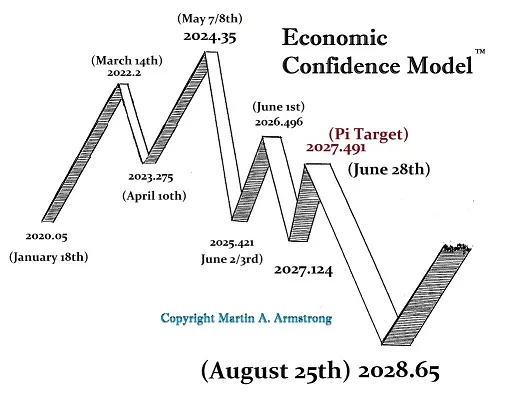
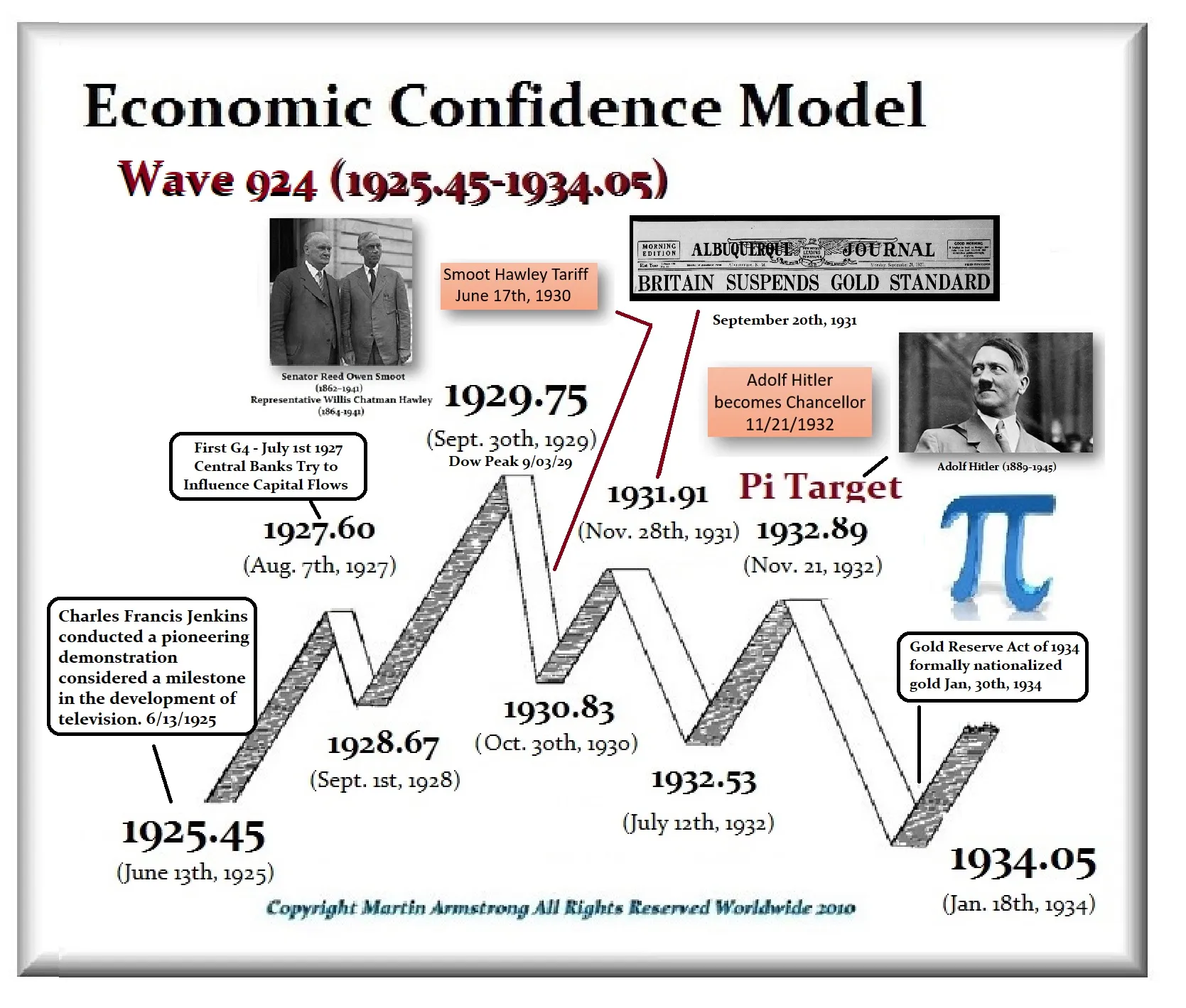
President Trump announced a baseline 10% tariff on U.S. imports, with steeper reciprocal levies on goods from Europe, Japan, China, and more than 50 other nations. The problem is that he will be blamed for the recession/depression the world is headed into, which will not bottom until August 25th, 2028. Economists widely criticized tariffs for deepening the global trade collapse during the Great Depression. The Smoot-Hawley tariffs were targeting agriculture because they did not understand currency. I disagree with what Trump is doing with tariffs. Some are justified where the EU is very abusive, for they are still living in the days of Marxism. You keep high tariffs to protect local jobs at the expense of your living standards. Citizens must pay 20% more for goods made domestically because they are subsidized by blocking imports from other provinces, as inside Canada, or nations such as the EU.

924 ECM 11925.45 1934.05 Hitler

I believe Trump will have a PR problem because the economy is turning down because of global debt and warmongering, but the LEFT and economists, who are biased leftists in general, will blame Trump and his tariffs. I stated at the November WEC in 2024 that it did not matter who won economically, the world is in trouble, and we were headed into a recession by 2028.

MA War Cycle 2011 WEC

I was pro-Trump because of the war, and I knew he was anti-war. My computer warns that we are headed into World War III, and I stated that clearly at the 2011 WEC conference in Philadelphia. I understand that many hate my guts because they do not like the forecasts. These are NOT my personal opinions. My job is to present the forecasts that Socrates has put out. I have also said at our WEC events that I have tried my best to defeat my own model. I have consistently failed.

Trump announced that universal 10% tariffs on all imports into the US will go into effect on April 5th, in a key moment for global trade. Certain countries will be hit with steeper tariffs based on US trade deficits, as high as 50% – these begin April 9th. Insofar as the UK is concerned, Trump says the UK will have a 10% tariff on goods, but the EU’s rate will be 20% Theis will benefit the UK for what you will see is redeployment of goods being shipped from the AAEU to the UK and then sent to USA to skirt the tariffs.

The Smoot-Hawley Tariff Act, formally known as the Tariff Act of 1930, was signed into law by President Herbert Hoover on June 17, 1930. This protectionist legislation significantly raised U.S. tariffs on over 20,000 imported goods, aiming to shield American industries during the Great Depression. However, it exacerbated global economic tensions by prompting retaliatory tariffs from other nations, further reducing international trade. The act is often cited as contributing to the severity of the worldwide economic downturn in the 1930s.

Galbraith Great Crash

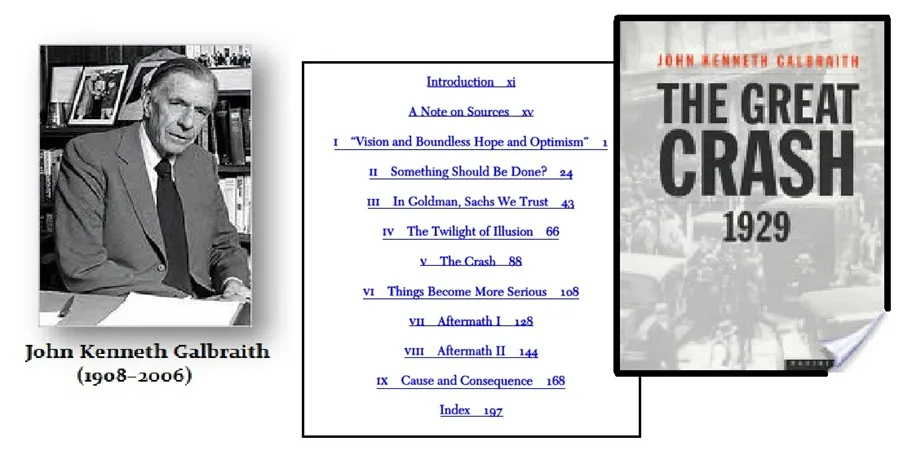
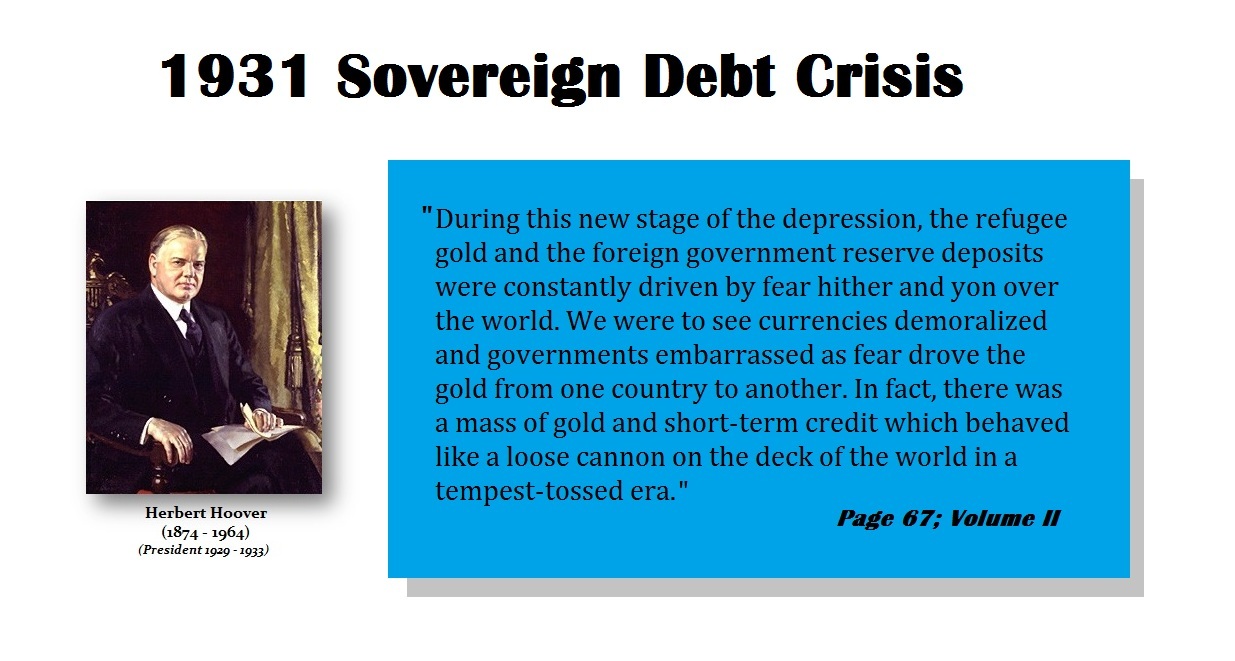
That is because the economists were all LEFTIST Marxists. I had to read in high school The Great Crash by Galbraith and I came to understand everything I was being taught is school was a lie – just LEFTIST propaganda. Galbraith never mentioned that all of Europe defaulted on its debt. Even Canada defaulted. That is what pushed the dollar to historic highs and that is what led to the protectionism. It was all currency.

Hoover Quote

If Galbraith told the truth, then FDR’s New Deal was wrong – the problem was not greedy capitalists, but greedy politicians. Nevertheless, just as they still lie every day in economics classes around the globe, selling covertly Marxism/Keynesianism, nobody mentions the Sovereign Defaults of 1931 that led to the collapse of 9000 banks.

1931_GB Abandons Gold 1

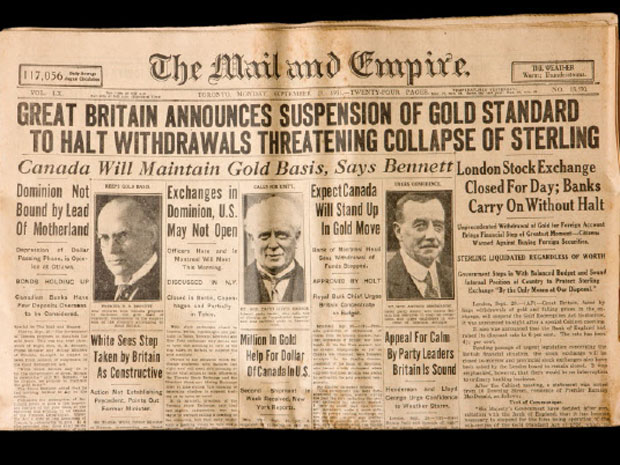
Canada suspended the gold standard in 1931, following the United Kingdom’s decision to abandon it in September of that year. The move was part of a broader response to the economic pressures of the Great Depression, which led many countries to exit the gold standard to gain more flexibility in monetary policy. Canada’s suspension occurred shortly after Britain’s, aligning with its economic ties to the British Commonwealth. The exact timing is often cited as October 1931, marking a critical step in Canada’s efforts to mitigate financial instability during the crisis. This decision differentiated Canada from the United States, which retained the gold standard until 1933.

1931 Dow 1927 37 Dollar

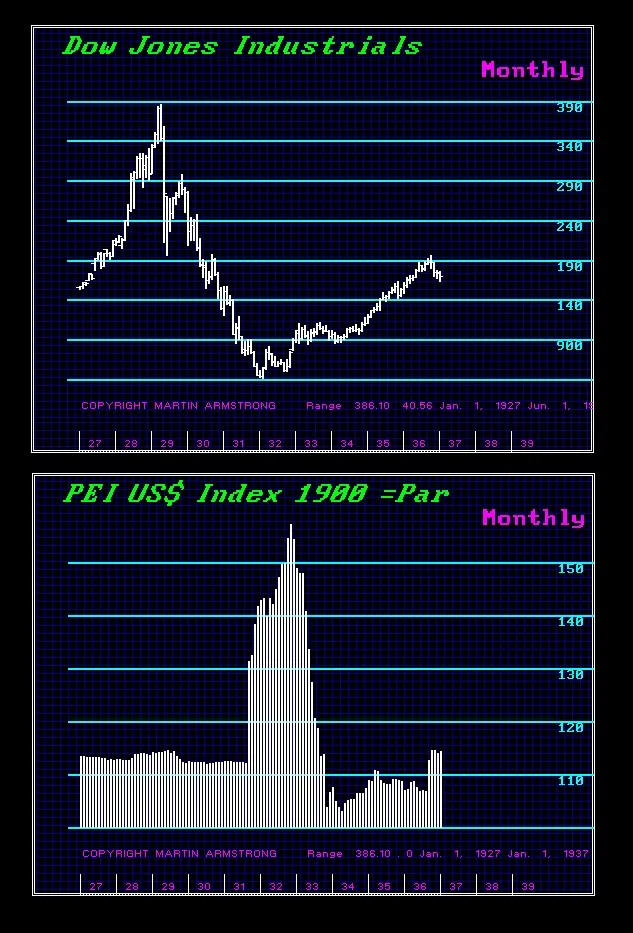
The US share market, based on the Dow Jones Industrials, fell 89%. However, the dollar rose 41%. That means in real terms of international value, the Dow Jones declined by only about 47% – not 89%. Nobody understood the capital flows, and nobody understood currency.

Trump will be blamed for the Tariffs

Just as they blamed the Capitalists rather than Governments in the 1930s

President Trump announced sweeping global tariffs on Liberation Day — a risky move that he vowed would lure manufacturing back to the United States. Sorry – it’s the taxes, not tariffs!

This will upend the global economy mainly because Europe is HIGHLY Marxist. We are talking about culture shifts, not just economic

Sorry. I cannot be Partisan. I have to call the Shots as they are fired

Treasury Secretary Scott Bessent Outlines Details of President Trump Tariff Plan


Posted originally on CTH on April 3, 2025 | Sundance

US Treasury Secretary Scott Bessent discusses President Trump’s tariff plans, federal deficit negotiations and the efforts to extend the 2017 tax cuts with Annmarie Hordern on “Balance of Power.”

Bessent walks through a strong, focused and deliberate outline while warning other nations not to assemble any retaliatory effort, or else the tariff ceiling currently outlined is likely to go much higher.  WATCH:

SEGMENTS:
00:00- Bessent says of tariffs, “this is the number barring retaliation”
01:20- China tariff rate, potential rate
03:13- Bessent on markets: “A mag seven problem, not a MAGA problem
05:07- Potential timing of reconciliation bill
07:00 – US on Debt ‘Warning Track’ for May or June
07:45 – Bessent on raising revenues through tariffs
09:18 -Bessent discusses US soft data, sentiment
10:25 – Government agenda for the remainder of 2025, Ukraine progress, and Iran

USTR Jamison Greer Discusses Tariffs and Trade Policy with Senior White House Team


Posted originally on CTH on April 3, 2025 | Sundance 

Senior White House Officials Taylor Budowich, Stephen Miller, and Karoline Leavitt have a discussion on Tariffs with U.S. Trade Representative Jamieson Greer.

President Trump’s trade and tariff policy is a complete restructuring and reset of the U.S. economy and manufacturing base.  The former presidential administrations (both parties) from Jimmy Carter to Ronald Reagan, to George HW Bush, to Bill Clinton, to George W Bush, to Barack Obama and forward to Joe Biden, all of them purposefully and with specific intent taking apart the U.S. manufacturing base through trade and economic policy.

The discussion below is familiar to those who have watched the MAGAnomic policy unfold.  However, for those who are only beginning to understand just how impactful these policies will have on the life of your family, this conversation begins the journey.  WATCH:

.

President Trump Remarks at Make America Wealthy Again White House Event


Posted originally on CTH on April 3, 2025 | Sundance

President Trump delivers a speech at the White House outlining a global trade reset established on the principle of trade and tariff reciprocity.  [Primary Executive Order Here]  – [Executive Order Here]

The post-war international economic system was based upon three incorrect assumptions: first, that if the United States led the world in liberalizing tariff and non-tariff barriers the rest of the world would follow; second, that such liberalization would ultimately result in more economic convergence and increased domestic consumption among U.S. trading partners converging towards the share in the United States; and third, that as a result, the United States would not accrue large and persistent goods trade deficits.”

“Put simply, while World Trade Organization (WTO) Members agreed to bind their tariff rates on a most-favored-nation (MFN) basis and thereby provide their best tariff rates to all WTO Members, they did not agree to bind their tariff rates at similarly low levels or to apply tariff rates on a reciprocal basis.  Consequently, according to the WTO, the United States has among the lowest simple average MFN tariff rates in the world at 3.3 percent, while many of our key trading partners like Brazil (11.2 percent), China (7.5 percent), the European Union (EU) (5 percent), India (17 percent), and Vietnam (9.4 percent) have simple average MFN tariff rates that are significantly higher.”

.

Country-specific ad valorem rates of duty as specified in Annex I to the main Executive Order.

The tariffs generally target completed goods, not the imported chemical or component materials needed to by industry to manufacture the products domestically.  Annex II are the exemptions to the Executive Order.

I have been going through the details and will have much more soon.

White House Message: “Happy Liberation Day, America!”


Posted originally on CTH on April 2, 2025 | Sundance 

President Trump and the White House posted the following message to begin “Liberation Day.”

President Donald Trump is scheduled to end the U.S Marshal Plan for Europe, eliminating one-way tariffs eighty years after the Marshal Plan began.  President Trump is now planning to institute global reciprocal tariffs, by matching all tariff and non-tariff trade barriers and restrictions.  WATCH:

[SOURCE]

NEGOTIATE WINS: Richard Stern On How Reciprocal Tariffs Will Be Used For Securing America


Posted originally on Rumble By Bannon’s War Room on: Apr 1 2025, at 7:00 pm EST

Winters: “If You’ve Engaged In Human Trafficking You Shouldn’t Be In This Country To Begin With”


Posted originally on Rumble By Bannon’s War Room on: Apr 1 2025, at 7:00 pm EST

WINTERS: Harvard Center Teaching Violent MAGA Resistance Caught Receiving Funds From USAID, CCP


Posted originally on Rumble By Bannon’s War Room on: Apr 1 2025, at 7:00 pm EST

Posted originally on Rumble By Bannon’s War Room on: Apr 1 2025, at 7:00 pm EST