Green Energy is just not viable


Sun, wind and drain

Wind and solar power are even more expensive than is commonly thought

SUBSIDIES for renewable energy are one of the most contested areas of public policy. Billions are spent nursing the infant solar- and wind-power industries in the hope that they will one day undercut fossil fuels and drastically reduce the amount of carbon dioxide being put into the atmosphere. The idea seems to be working. Photovoltaic panels have halved in price since 2008 and the capital cost of a solar-power plant—of which panels account for slightly under half—fell by 22% in 2010-13. In a few sunny places, solar power is providing electricity to the grid as cheaply as conventional coal- or gas-fired power plants.

But whereas the cost of a solar panel is easy to calculate, the cost of electricity is harder to assess. It depends not only on the fuel used, but also on the cost of capital (power plants take years to build and last for decades), how much of the time a plant operates, and whether it generates power at times of peak demand. To take account of all this, economists use “levelised costs”—the net present value of all costs (capital and operating) of a generating unit over its life cycle, divided by the number of megawatt-hours of electricity it is expected to supply.

To get around that problem Charles Frank of the Brookings Institution, a think-tank, uses a cost-benefit analysis to rank various forms of energy. The costs include those of building and running power plants, and those associated with particular technologies, such as balancing the electricity system when wind or solar plants go offline or disposing of spent nuclear-fuel rods. The benefits of renewable energy include the value of the fuel that would have been used if coal- or gas-fired plants had produced the same amount of electricity and the amount of carbon-dioxide emissions that they avoid. The table summarises these costs and benefits. It makes wind and solar power look far more expensive than they appear on the basis of levelised costs.

Mr Frank took four sorts of zero-carbon energy (solar, wind, hydroelectric and nuclear), plus a low-carbon sort (an especially efficient type of gas-burning plant), and compared them with various sorts of conventional power. Obviously, low- and no-carbon power plants do not avoid emissions when they are not working, though they do incur some costs. So nuclear-power plants, which run at about 90% of capacity, avoid almost four times as much CO{-2} per unit of capacity as do wind turbines, which run at about 25%; they avoid six times as much as solar arrays do. If you assume a carbon price of $50 a tonne—way over most actual prices—nuclear energy avoids over $400,000-worth of carbon emissions per megawatt (MW) of capacity, compared with only $69,500 for solar and $107,000 for wind.

Nuclear power plants, however, are vastly expensive. A new plant at Hinkley Point, in south-west England, for example, is likely to cost at least $27 billion. They are also uninsurable commercially. Yet the fact that they run around the clock makes them only 75% more expensive to build and run per MW of capacity than a solar-power plant, Mr Frank reckons.

To determine the overall cost or benefit, though, the cost of the fossil-fuel plants that have to be kept hanging around for the times when solar and wind plants stand idle must also be factored in. Mr Frank calls these “avoided capacity costs”—costs that would not have been incurred had the green-energy plants not been built. Thus a 1MW wind farm running at about 25% of capacity can replace only about 0.23MW of a coal plant running at 90% of capacity. Solar farms run at only about 15% of capacity, so they can replace even less. Seven solar plants or four wind farms would thus be needed to produce the same amount of electricity over time as a similar-sized coal-fired plant. And all that extra solar and wind capacity is expensive.

A levelised playing field

If all the costs and benefits are totted up using Mr Frank’s calculation, solar power is by far the most expensive way of reducing carbon emissions. It costs $189,000 to replace 1MW per year of power from coal. Wind is the next most expensive. Hydropower provides a modest net benefit. But the most cost-effective zero-emission technology is nuclear power. The pattern is similar if 1MW of gas-fired capacity is displaced instead of coal. And all this assumes a carbon price of $50 a tonne. Using actual carbon prices (below $10 in Europe) makes solar and wind look even worse. The carbon price would have to rise to $185 a tonne before solar power shows a net benefit.

There are, of course, all sorts of reasons to choose one form of energy over another, including emissions of pollutants other than CO2 and fear of nuclear accidents. Mr Frank does not look at these. Still, his findings have profound policy implications. At the moment, most rich countries and China subsidise solar and wind power to help stem climate change. Yet this is the most expensive way of reducing greenhouse-gas emissions. Meanwhile Germany and Japan, among others, are mothballing nuclear plants, which (in terms of carbon abatement) are cheaper. The implication of Mr Frank’s research is clear: governments should target emissions reductions from any source rather than focus on boosting certain kinds of renewable energy.

* “The Net Benefits of Low and No-carbon Electricity Technologies“, by Charles Frank, Brookings Institution, May 2014

† “Comparing the Costs of Intermittent and Dispatchable Electricity-Generating Technologies“, by Paul Joskow,  Massachusetts Institute of Technology, September 2011

Sea ice news Volume 5, # 5 NSIDC: ‘the expansion in Antarctic sea ice is confirmed’


Its not really ice its a new breed of dense white algae from how hot it is down there from climate change!

Recent paper finds 1950-2009 Solar Grand Maximum was a ‘rare or even unique event’ in 3,000 years


Looks very promising so we know the IPCC and Al Gore will ignore it!

Warmers now say its aerosols? Or oceans? Or the dog ate my really good model?


Money does talk and some will do anything to get it!

john1282's avatarJunkScience.com

Here’s another lecture by a warmer.

View original post 16 more words

Five Years After The Last Multi-Year Ice Disappeared …


So much for the Northwest passage …

Tony Heller's avatarReal Climate Science

It has been five years since Canada’s leading ice expert announced that multi-year ice is a thing of the past.

The multiyear ice covering the Arctic Ocean has effectively vanished, a startling development that will make it easier to open up polar shipping routes, an Arctic expert said on Thursday.

Vast sheets of impenetrable multiyear ice, which can reach up to 80 meters (260 feet) thick, have for centuries blocked the path of ships seeking a quick short cut through the fabled Northwest Passage from the Atlantic to the Pacific. They also ruled out the idea of sailing across the top of the world.

But David Barber, Canada’s Research Chair in Arctic System Science at the University of Manitoba, said the ice was melting at an extraordinarily fast rate.

Multiyear Arctic ice is effectively gone: expert | Reuters

Five years since the last of it disappeared, half of the Arctic Basin…

View original post 5 more words

BOMBSHELL: Study shows greenhouse gas induced warming dropped for the past 14 years


Just more information that the statists’ will not like and will suppress as it would not work well with their propaganda campaign to tax carbon to save the earth!

CO2 data might fit the IPCC hypothesis, but it doesn’t fit reality


CO2 is not the enemy the progressives are!

Mark’s Nature Trick


NSIDC Turning tricks?

Tony Heller's avatarReal Climate Science

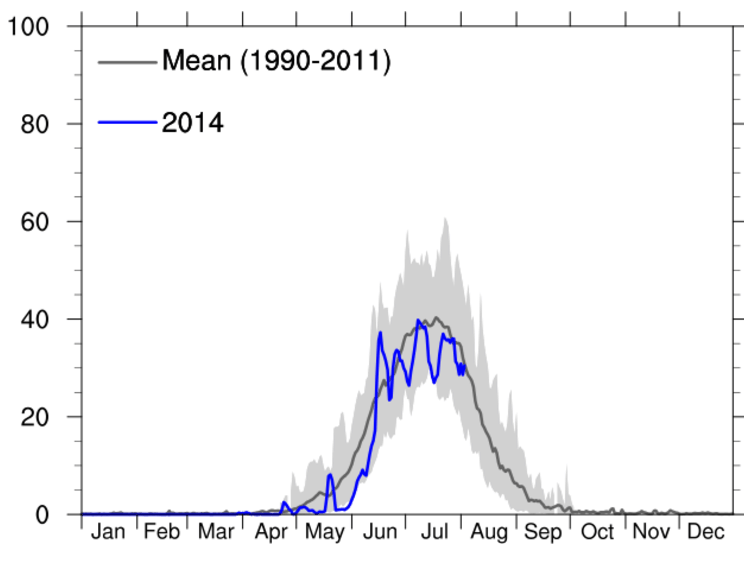
NSIDC shows Greenland melting out of control, far above average this summer.

ScreenHunter_1674 Aug. 04 23.45Greenland Ice Sheet Today | Surface Melt Data presented by NSIDC

This makes no sense, because NCEP maps have showed Greenland temperatures well below normal this summer.

Now lets look at the DMI graph of the same thing. DMI shows Greenland melting well below normal this summer.

ScreenHunter_1675 Aug. 04 23.46

Greenland Ice Sheet Surface Mass Budget: DMI

How did Mark Serreze’s NSIDC team pull off their Greenland nature trick?  They included the cold 1980’s in their average, which was the coldest decade on record in that region.

ScreenHunter_1676 Aug. 04 23.52

There was essentially no melting that decade, which dragged the mean line way down. More evidence of why DMI is a better reference than NSIDC. DMI doesn’t have a global warming agenda. The NSIDC graph is extremely misleading, no doubt by design.

h/t to Chris Beal

View original post

Mark’s Nature Trick (Part 2)


What else can they do they don’t have science or logic on their side!

Tony Heller's avatarReal Climate Science

Mark Serreze calls me “breathtakingly ignorant.”

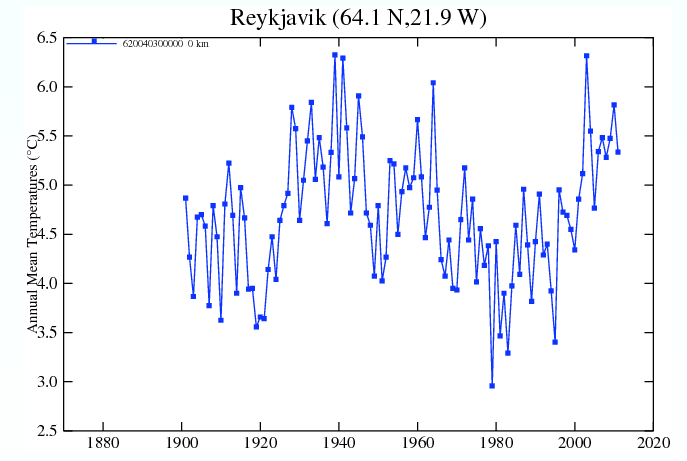
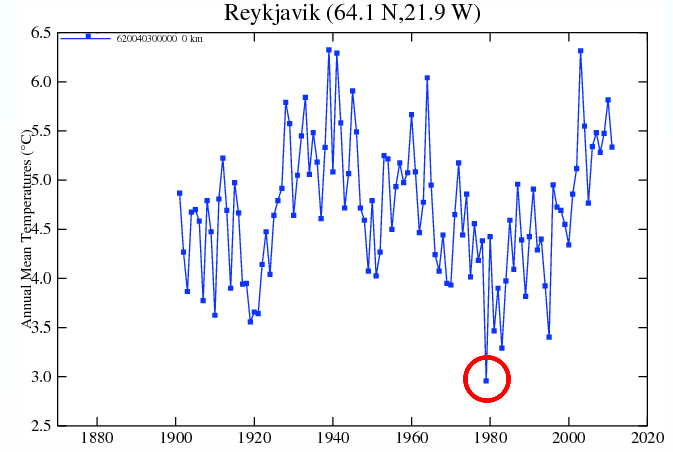
The red circle shows the year when NSIDC starts their Arctic sea ice graphs. The mother of all cherry picks.

ScreenHunter_1693 Aug. 05 08.54

View original post

A Trivial Proof That Mann-Made Global Warming Has Had No Impact On Sea Level


Hey this is way better than a couple of old tree ring samples!

Tony Heller's avatarReal Climate Science

This proof is so simple, that even a climate scientist couldn’t understand it.

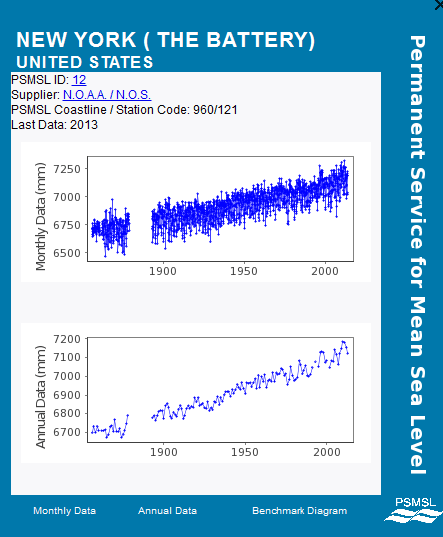
Sea level at Manhattan has been rising at a steady rate since the start of records in the 1850’s. The rate of rise has not accelerated or decelerated over the past 160 years.

ScreenHunter_1667 Aug. 04 20.50

http://www.psmsl.org/data/obtaining/stations/12.php

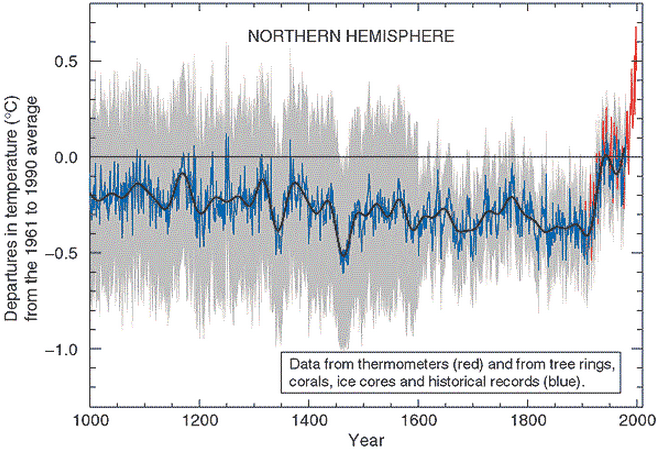
The hockey stick doesn’t start until 1910, yet the sea level rise rate was essentially identical before and after the hockey stick. This tells us that there is no correlation between GISS temperatures and sea level. One station is adequate for this analysis, because melting glaciers would raise sea level more or less equally at all locations.

ScreenHunter_1668 Aug. 04 20.52

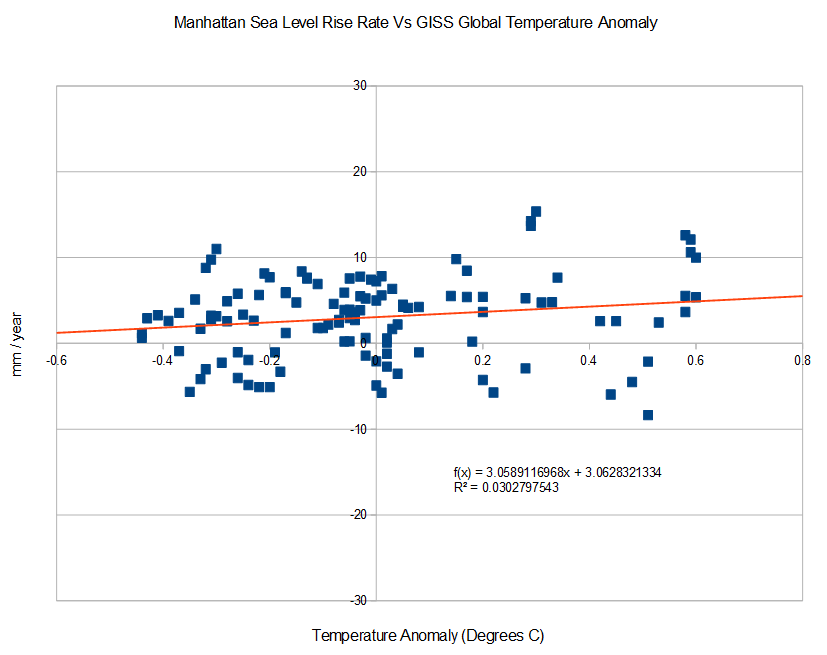
The graph below plots Manhattan sea level rise rates (9 year slope) vs. GISS  5 year mean global temperature anomaly. Again, there is no correlation between sea level rise rates and GISS temperatures. The fastest decline in sea level occurred near the highest temperature anomaly.

ScreenHunter_1669 Aug. 04 21.16

You may ask…

View original post 73 more words

A Jeanne in the Kitchen

I have created this site to help people have fun in the kitchen. I write about enjoying life both in and out of my kitchen. Life is short! Make the most of it and enjoy!

True the Vote

A group of Americans united by our commitment to Freedom, Constitutional Governance, and Civic Duty.

Zeee Media

Share the truth at whatever cost.

thefoghornexpress

De Oppresso Liber

De Oppresso Liber

The Most Revolutionary Act

Uncensored updates on world events, economics, the environment and medicine

America-Wake-Up

This is a library of News Events not reported by the Main Stream Media documenting & connecting the dots on How the Obama Marxist Liberal agenda is destroying America

TOTT News

Australia's Front Line | Since 2011

CherriesWriter - Vietnam War website

See what War is like and how it affects our Warriors

Murray Report

Nwo News, End Time, Deep State, World News, No Fake News

Scott Adams Says

De Oppresso Liber

Stella's Place

Politics | Talk | Opinion - Contact Info: stellasplace@wowway.com

livingbyathread

Exposition and Encouragement

Disrupted Physician

The Physician Wellness Movement and Illegitimate Authority: The Need for Revolt and Reconstruction

Easy Money Martin

Real Estate Lending