Posted originally on Apr 7, 2025 by Martin Armstrong
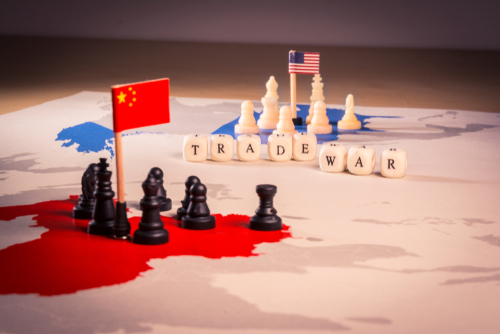
China imposed a 34% retaliatory tariff on all US goods that will go into effect on April 10. Nations everywhere are beginning to impose their own penalties on US goods. April 2, “Liberation Day,” may well be remembered as the beginning of the end for Trump’s legacy.
Trump hit China with a 34% tariff in addition to the 20% levy implemented earlier in the year, marking up all Chinese exports by 54%. China is not taking matter lightly, and in addition to tariffs, has added 16 US entities to its export control list. Dual-use items from these companies will be prohibited from entering China. Another 11 US agencies were added to the “unreliable entities” list, which the commerce ministry believe “undermined” China’s national security and sovereignty.
The Ukraine mineral deal will become more important now that China as placed controls on exporting an array of rare earth minerals that are crucial for manufacturing. Autos, batteries, smartphones, military defense, and countless other industries will take a blow from these new restrictions.
China has also issued a formal complaint with the World Trade Organization, declaring that the US has violated global trade rules and unfairly punished China. The WTO has 60 days to resolve the matter, and if no progress occurs, China may request adjudication by the Dispute Settlement Body. China has called these “retaliatory” tariffs “unilateral bullying” and pleaded for Washington to drop the levies.
“The US practice is inconsistent with international trade rules, seriously undermines China’s legitimate rights and interests, and is a typical unilateral bullying practice that not only undermines the interests of the United States itself, but also endangers global economic development and the stability of the production and supply chain,” the state council tariff commission stated.
The US exported $143.5 billion in goods to China in 2024, a 2.9% decrease from the year prior. Imports from China in 2024 totaled $438.9 billion, a 2.8% increase from 2023. American companies heavily rely on Chinese imports. The effects of these tariffs will prove utterly disastrous in the coming months when we will feel the full impact of the so-called “liberation.”
Posted originally on CTH on April 7, 2025 | Sundance
President Trump smartly remained quiet after delivering the economic thunder-shock with his national security tariffs and new global trade expectations. Now President Trump takes questions from the media about the initial reactions to the seismic event he created.
“China needs to solve the problem of the trade deficit with have with them,” is codespeak for China needs to open their markets to U.S. companies that have already established a footprint, AND China needs to purchase U.S. goods. Despite the size of China, President Trump knows Beijing will never comply in earnest, so he gives the Panda a few words, but doesn’t give it too much time until the Dragon comes out from behind the mask.
President Trump notes he has “spoken to a lot of leaders from Europe and Asia” this weekend. However, now is that powerful moment in any negotiation when the principal has clearly outlined his position, then remain silent as the opposition responds. The “tariffs are instituted, they are not going away,” Trump said.
When questioned about having a “threshold” of “pain he is willing to tolerate,” President Trump notes the “question is stupid.” We are responding to opposition who are playing a zero-sum game, there is no level of pain too intolerable when ultimately your survival as a nation is at stake. Either we do, and win – or, we do not and die, that is our current status.
When questioned about having a zero-tariff agreement with Europe, President Trump references the scale of the imbalance. “There’s no talk possible” with the EU unless they acquiesce. Every country wants to make a deal, but “this is not sustainable” President Trump repeats.
When questioned about Tik Tok, President Trump notes there was a likely deal with China, but then Beijing responded to the tariffs and said the deal around the social media platform ownership was no longer possible. Trump doesn’t care, he wants a TikTok deal; but ultimately, the tariffs are more important.
President Trump then weaves through the Russia conflict, bombs are still bad, and the Middle east conflict, Gaza is still full of terrorists, and moves directly into domestic national security.
President Trump then reaffirms he has not agreed to reduce, soften or smooth any tariffs against any nation. The tariffs are in place, they will remain in place, and the global trade reset will continue until America wins. Period.
The remarks were ‘Full force Big Ugly‘ and the winnamins were flying off the shelves for 15 straight minutes. I could not be more proud of our president.
Posted originally on CTH on April 7, 2025 | Sundance
U.S. Attorney General Pam Bondi appears for her 73rd performance on Fox News this year.
As the DOJ embeds continue working diligently against the interest of the Trump administration, the top of the DOJ leadership structure appears for another performance to discuss the outcome of the embed diligence. Yes, that’s the non-pretending reality currently being faced.
Not all, but many in key positions, are career DOJ lawyers working passively (weak arguments) and with willful blindness (purposeful mistakes) to undermine the agenda of President Trump. The whac-o-mole General Bondi outlines is both external in the courts and internal in the Main Justice ranks. Lawfare operatives are like cells within the larger body awaiting their turn to self-detonate. WATCH:
Posted originally on CTH on April 6, 2025 | Sundance
White House Senior Advisor for Trade and Manufacturing Peter Navarro discusses the trade reset and tariff impact as it works through the process.
As visible and stated by the Trump team, the broad-based tariff approach was designed to save time and create the environment where foreign countries, including those with bilateral Free Trade Agreements (FTAs) would come to President Trump in an effort to retain their interests. From there, new trade agreements would be structured.
Navarro rightly notes that both tariff and non-tariff barriers are designed to create a structural trade imbalance in their favor. The trade reset strategy is designed to confront these issues. Navarro also notes how Vietnam operates as case-study in the use of non-tariff barriers and simultaneously operates as a transnational shipping point for Chinese products. WATCH:
Posted originally on CTH on April 6, 2025 | Sundance
Treasury Secretary Scott Bessent appears on NBC to discuss the current MAGAnomic tariff program and global trade reset. Bessent outlines how the history of President Trump’s tariff approach toward China (’17-’19) did not result in higher consumer prices for goods from China.
Secretary Bessent, like the rest of the MAGAnomic team, cuts through the talking points with direct evidence and analysis that destroys the preferred media narrative. Video and Transcript Below:
[Transcript] – KRISTEN WELKER: And joining me now is Treasury Secretary Scott Bessent. Secretary Bessent, welcome back to Meet the Press.
SEC. SCOTT BESSENT: Kristen, good to see you.
KRISTEN WELKER: It’s great to have you back after a very big week. Let’s start with the market reaction to President Trump’s announcement of his tariffs. As I just laid out at the top of the program, the markets lost more than $6 trillion in value. Was this disruption always part of the plan, Mr. Secretary?
SEC. SCOTT BESSENT: Look, the – Kristen, markets are organic. They’re animals. I mean, you never know what the reaction is going to be. One thing that I can tell you, as the Treasury secretary, what I’ve been very impressed with is the market infrastructure, that we had record volume on Friday and everything is working very smoothly. So, the American people – they can be very – take great comfort in that. And in terms of the market reaction, look, we get these short-term market reactions from time to time. The market consistently, the – underestimates Donald Trump. I remember that in 2016 the night President Trump won, the market crashed. The market crashed, and it turned out he was going to be the most pro-business president – the – in over a century, maybe in the history of the country, and we went on to very high after inflation returns for the next four years.
KRISTEN WELKER: Well, but this was the biggest two-day crash since the pandemic. And the president on Saturday urging people, quote, “to hang tough,” saying, “It won’t be easy.” And I guess the big question on people’s minds, Mr. Secretary, how difficult is it going to be? And how long are Americans going to have to “hang tough?”
SEC. SCOTT BESSENT: Well, again, I – I reject that – the assumption – there doesn’t have to be a recession, the – who knows how the market is going to react in a day, in a week. What we are looking at is building the long-term economic fundamentals for prosperity that I think the previous administration had put us on the course toward financial calamity.
KRISTEN WELKER: But just in terms of the uncertainty, I think, that people are feeling and seeing, and President Trump saying he wants people to hang tough acknowledging there’s going to be what he has described as a short period of pain. Can you help provide some clarity for folks? How long will this period of uncertainty be here? Are we talking about weeks? Are we talking about months? Are we talking about years?
SEC. SCOTT BESSENT: Again. This is an adjustment process. What we saw with President Reagan, when he brought down the – the great inflation and we got past the Carter malaise that there – there was some choppiness at – at that time, but he held the course, and, you know, we’re going to hold the course. And this has been years in the building, years in the making, you know, this unsustainable system – our trading partners have taken advantage of us. We can see that through the large surpluses. We can see this through the large budget deficits. And also, Kristen, this is a national security problem, which we saw during Covid. We saw during Covid that optimal supply chains are not resilient. And what I could say is the only good outcome from Covid is it was a beta test for what would happen if our supply chains got broken, and President Trump has given – has decided that we cannot be at risk like that, for our crucial medicines, for semiconductors — the — for shipping, and we are going to move forward so the American people can know that they are going to have a more secure future.
KRISTEN WELKER: And yet, President Trump promised that he was going to improve the economy starting on day one. He said prices are going to come down. More than 160 million Americans, Mr. Secretary, as you know, are invested in the market. Many of them have spent their lives saving for their retirement. What is your message to Americans who want to retire right now and who’ve just seen their lifetime savings drop significantly?
SEC. SCOTT BESSENT: Kristen, I think that’s a false narrative. Americans who want to retire right now, Americans who have put away for years in their savings accounts, I – I think they don’t look at the day-to-day fluctuations of what’s happening. And you know, in fact, most Americans don’t have everything in the market. Most Americans in a 401K have what’s called a 60/40 account. 60/40 accounts are down 5 or 6% on the year. People have a long-term view. They have a program that the reason the stock market is considered a good investment is because it’s a long-term investment. If you look day-to-day, week-to-week, it’s very risky. Over the long term, it’s a good investment.
KRISTEN WELKER: President Trump’s tariffs are being described as the biggest tax hike on Americans in decades. They could cost the average household thousands of dollars. Republican Senator Ted Cruz had this to say. I’m going to play it, get your reaction on the other side.
[START TAPE]
SEN. TED CRUZ: Tariffs are attacks on consumers. And I’m not a fan of jacking up taxes on American consumers.
[END TAPE]
KRISTEN WELKER: Do you acknowledge that President Trump’s tariffs will cause prices to go up on a range of goods?
SEC. SCOTT BESSENT: Well, Kristen, what I like is data. And if we look at the data from President Trump’s first term, and there’s a big study that just came out from a group of economists, mostly at MIT, that showed that a 20% – 20% tariff on China led to a .7% tax or price level increase over four years. I think that’s pretty good if we can take in 20% in tariffs and it’s a .7% increase. And Kristen, the – the little publicized story this week, everyone wants to look at the stock market going down. You know what else went down? Oil prices went down almost 15% in two days which impacts working Americans much more than the stock market does. Interest rates hit their low for the year. So I’m expecting the mortgage applications to pick up.
KRISTEN WELKER: Well, just to be very clear though, I mean, during President Trump’s first term, the cost to Americans was nearly $80 billion in new taxes due to his tariffs. Prices did go up on everything from washing machines to tires.
SEC. SCOTT BESSENT: Well, no, no, no. But let’s go back. The aggregate number was. 7. So we can discern the individual things. Also households saw real net wages go up. So if wages go up faster than prices, which is not what happened over the past four years, that’s why the bottom 50% got eviscerated.
KRISTEN WELKER: Let – let me ask you about your view. Because last January you wrote that, quote, “Tariffs are inflationary.” The Fed chair said the same thing on Friday that tariffs announced this week caused higher inflation. Have you expressed any concerns to President Trump directly that his tariff policy could be inflationary?
SEC. SCOTT BESSENT: No. What – what I’ve said is, “Tariffs are a one-time price adjustment.” So there- there’s a big difference between insipid, endemic inflation within the system and consistent price level increases and a one-time adjustment. But the other thing that we’re doing is we are raising wages for working Americans. We’re bringing down regulation. So, you know, there are estimates that regulations have caused the average household about $8,000. That when we get this tax bill through, then we will make the tax levels permanent. And – and again, the drop in the energy prices, the drop in interest costs, now, I – I think real after-tax wages are going to go up for Americans. And that’s what’s important.
KRISTEN WELKER: One of the big questions and points of confusion I think is are these tariffs permanent? Or are they a negotiating tactic? Some administration officials have said they’re permanent. President Trump himself has said he’s open to negotiating. So let me just ask you. Is President Trump willing to negotiate? Or are these tariffs permanent?
SEC. SCOTT BESSENT: Well, I think that’s gonna be a decision for President Trump, but I can tell you that, as only he can do at this moment, he’s created maximum leverage for himself, and more than 50 countries have approached – they have approached the administration about lowering their non-territory barriers, lowering their tariffs, stopping currency manipulation, and Kristen, you know, they’ve been bad actors for a long time, and it’s – it’s not the kind of thing you can negotiate away in days or weeks.
KRISTEN WELKER: You yourself have said that he’s using these for negotiating. He has told me directly he’s open to negotiating. So just very clearly for the American people: Can you say definitively, is he planning to negotiate? Has he already started negotiations with countries?
SEC. SCOTT BESSENT: Well, I – I – I think we’re going to have to see what the – what the countries offer, and whether it’s believable, because again –
KRISTEN WELKER: So, he’s open to it, is what I hear you say.
SEC. SCOTT BESSENT: The – no, no, no, it is – I think that we are going to have to see the path forward, because after 20, 30, 40, 50, years of bad behavior, you can’t just wipe the slate clean.
KRISTEN WELKER: All right. Let me ask you about one of the big questions. Recession, as you know, analysts say the chances of a recession are rising in the wake of the tariffs announced this week. Do you believe that President Trump’s tariffs are risking the chances of a recession?
SEC. SCOTT BESSENT: I – I don’t. And I think we could see from the jobs number on Friday that it was well above expectations that, you know, we are moving forward. So I – I see no reason that we have to price in a recession.
KRISTEN WELKER: Okay. Before I let you go, I know you’ve been one of the officials spearheading the efforts to get President Trump’s budget bill passed on Capitol Hill. It includes the president’s plans for tax cuts, extending the 2017 tax cuts, for example. Are you confident that the president’s budget bill will pass before the August recess?
SEC. SCOTT BESSENT: We are shooting for even a much earlier date. And Kristen, I – I can tell you the under-reported story in D.C. is, you know, it’s fun from our side of the aisle to watch the Democratic chaos. But the under-reported story is the Republican unity. And Speaker Johnson has done an incredible job with a small minority. He got reconciliation instructions out on the first try. He got a clean continuing resolution. Speaker Thune, the – the Senate issued the reconciliation instructions. So things are moving very quickly.
KRISTEN WELKER: Very quickly, President Trump called on the Fed chair to lower interest rates. Do you think that Fed chair Jerome Powell should lower interest rates?
SEC. SCOTT BESSENT: I – I – I think that when we see inflation dropping, that the Fed will do what it always does and lower rates. But in the meantime, what we can control is the longer-term rate, the ten-year rate which hit – hit a new low on Friday. That’s where mortgages are priced. That’s where long-term capital formation is priced. And, you know, back to the tax deal, when we can pass that, we will have economic certainty.
KRISTEN WELKER: Okay, we’ll be watching for that timeline you just laid out very closely. Secretary Scott Bessent, thank you so much for being here. We appreciate it.
Posted originally on CTH on April 6, 2025 | Sundance
Margaret Brennan is very worried about the penguins of the Heard and McDonald Island being able fill their orders for EU heavy industrial equipment, against the backdrop of President Trump’s 10% tariffs. Secretary Lutnick points out the issue of transnational shipping, as Brennan sits flummoxed.
That’s just one of the talking points from the ever-insufferable Margaret Brennan in this left-wing narrative engineering under the pretense of an interview. WATCH:
[TRANSCRIPT] – MARGARET BRENNAN: Mr. Secretary, welcome to “Face the Nation.”
COMMERCE SECRETARY HOWARD LUTNICK: Great to be here.
MARGARET BRENNAN: We see about 60% of Americans have money in the stock market, which mean that retirees could be just as concerned as hedge fund managers this morning. Did you expect this level of shock in the financial markets?
SEC. LUTNICK: Well, you’ve got to realize this is a national security issue. I mean, we don’t make medicine in this country anymore. We don’t make ships. We don’t have enough steel and aluminum to fight a battle, right? All our semiconductors are made overseas. So every button we press when we try to start our car or even use our microwave, these are all semiconductors. They’re all made elsewhere. We’ve got to start to protect ourselves, and we’ve got to stop having all the countries of the world ripping us off. We have a $1.2 trillion trade deficit, and the rest of the world has a surplus with us. They’re earning our money. They’re taking our money, and Donald Trump has seen this, and he’s going to stop it. So it is going to be a big change. Of course, it’s going to be a big change, but the rest of the world has been ripping us off for all these many years. Donald Trump has seen it. He’s spoken about it–
MARGARET BRENNAN: –I understand that and–
SEC. LUTNICK: –and he’s just not going to take it anymore. And that’s his model.
MARGARET BRENNAN: And that was abundantly clear during the presidential campaign, how much the president truly believes in tariffs and putting them at the center of his economic policy, but you saw absolute panic in the global markets. Did you expect that or were you surprised?
SEC. LUTNICK: No, I think the point is, you need to reset the power of the United States of America and reset it against all our allies and our enemies alike. The- the idea that all the countries of the world can run trade surpluses with America and buy our things with us– remember, $1.2 trillion. in 1980 we were a net investor- meaning we owned more of the rest of the world than they owned of us–
MARGARET BRENNAN: Yeah, it’s a different world now, it’s a different market.
SEC. LUTNICK: And now- and now they own 18- they own $18 trillion of us, net. So that means the rest of the- every year when we run a $1.2 trillion deficit, the rest of the world buys $1.2 trillion of America, and it goes up and up and up. And eventually we’re not going to own America, and we are going to be owned by the rest of the world.
MARGARET BRENNAN: Are you talking about–
SEC. LUTNICK: Imagine if we had a war and we can’t build a ship, we can’t fly a plane. We can’t build our own planes–
MARGARET BRENNAN: Okay–
SEC. LUTNICK: –we don’t have our own semiconductors. This is what the President is here to fix for America. It’s- he- in his hands, and he wants to fix America. This is his chance–
MARGARET BRENNAN: Understood. So–
SEC. LUTNICK: –to fix America, and we need him to fix it for our children and our grandchildren.
MARGARET BRENNAN: Okay, but for- for businesses to do what you’re doing, because what I hear you laying out there is a plan to re-industrialize the United States and to bring companies back to America. For a CEO to choose to invest–
SEC. LUTNICK: Well said. Well said.
MARGARET BRENNAN: –but for a CEO to make those decisions- you know this- they need certainty. They need to know if it costs them more to stay overseas, or if it costs them more to move here. So can you give them clarity, so that they don’t just cut jobs because they’re dealing with the cost of these tariff- tariffs. Can you tell them how long they’re staying in place?
SEC. LUTNICK: Absolutely. The United States of America is going to protect the people who invest in America. Trillions and trillions of dollars- you heard the President speak about it- are coming to invest in America. This is the economy of the world. We are the consumer of the world, and companies need to build it here, and we will protect them for building it here.
MARGARET BRENNAN: Okay, so–
SEC. LUTNICK: We will help the American workers, yes. American workers are more expensive, but they’re better.
MARGARET BRENNAN: I got it–
SEC. LUTNICK: We’re going to protect all the factories that come to America, and that’s what’s coming here. So, the President is on it–
(CROSSTALK)
MARGARET BRENNAN: Okay, is the 10% tariff permanent?
SEC. LUTNICK: He’s going to protect them- well, remember, this is a national security issue–
MARGARET BRENNAN: –I got it. Is the 10% tariff permanent?
SEC. LUTNICK: –and he needs to address our budget deficit- that- the, you know, the laws of America are the laws of America, he would like it to be that we need to protect the companies that invest here, and we are going to protect the companies that invest here. That is the policy of the United States of America. That’s why trillions of dollars are coming here. The rip off of the- of the United States of America is over. All these companies are going to come and invest here. That’s what they’re doing. That’s why they’ve committed trillions of dollars. They know this is the economy–
MARGARET BRENNAN: – Okay, Mr. Secretary, though–
SEC. LUTNICK: –this is the place to go.
(END CROSSTALK)
MARGARET BRENNAN: Mr. Secretary, the campaign’s over. You won. So I’m asking what the plan is. So the treasury secretary said on another network, “we’re going to hold the course.” “It’s not the kind of thing you can negotiate away in days or weeks.” That makes it sound like the tariffs are staying in place at least for days or weeks. Is that correct? Or is the President considering postponing implementation to negotiate?
SEC. LUTNICK: There is no postponing. They are definitely going to stay in place for days and weeks. That is sort of obvious. The president needs to reset global trade. Everybody has a trade surplus and we have a trade deficit. We are paying away our future and our lives. Come- the countries of the world are ripping us off, and it’s got to end. The President has made it crystal, crystal clear. This is the policy we’re going to protect. The factories that come build in America, we’re going to protect them. They’re going to be successful. That’s why they’re going to build in America, the greatest economy in the earth. All of these companies are going to come and build here.
MARGARET BRENNAN: So when three of the President’s other economic advisers, who are on other networks today, say that 50 different countries have been calling the White House to try to talk about the tariffs, what does that mean? Because that makes it sound like there is a negotiation, which is different from saying the tariffs are permanent.
SEC. LUTNICK: Well, what it shows is that all these countries know that they’ve been ripping us off, and the day has come for that to end. Now the problem is, it’s not just tariffs- like, I’ll give you an example, like Vietnam said they’d like to be zero-zero. Remember, Vietnam sends us $120 billion worth of goods every year–
MARGARET BRENNAN: Yes, cheap manufacturing
SEC. LUTNICK: And we send them about $12 billion- wait, we send them $12 billion. So it’s not the tariffs. It has nothing to do with tariffs. If they went to zero-zero, they would go to 200 billion with us. We need to stop the rip off, and zero-zero is- is the way–
MARGARET BRENNAN: –I know but we don’t have zero-zero, sir.
SEC. LUTNICK: –to make it more of a rip off. We need–
MARGARET BRENNAN: We don’t have zero-zero actually, because when we saw the president stand in the Rose Garden holding up that chart that you helped make, that- that wasn’t actually tariffs. That was actually confusing to investors, because it was some kind of other formula, and the countries themselves seemed kind of random. Like, why are the Heard and McDonald Islands, which don’t export to the United States and are quite literally inhabited by penguins,😂 why do they face a 10% tariff? Did you use AI to generate this?
SEC. LUTNICK: No. No, the idea- look, the idea is that there are no countries left off.
MARGARET BRENNAN: Why are they on the list? 😂🤣😂
SEC. LUTNICK: Because the idea- what happens is, if you leave anything off the list, the countries that try to basically arbitrage America go through those countries to us. Any country- like we had tariffs, the President put tariffs on China, right, in 2018, and then what China started doing is they started going through other countries to America. They just built through other countries, through America. And so, the President knows that, he’s tired of it, and he’s going to fix that. So basically he said, look, I can’t let any part of the world be a place where China or other countries can ship through them–
MARGARET BRENNAN: Through the Heard Islands.
SEC. LUTNICK: –so the end of those loopholes- these ridiculous loopholes. And now what he’s trying to say is, I’m going to fix the trade deficit of the United States of America. It’s a national security issue. We need to make medicine. We need to make semiconductors. We need to make ships. We need to have steel and aluminum. Come on, we need the greatness of America to actually be built in America. And he’s tired of getting ripped off by the rest of the world.
MARGARET BRENNAN: Okay, but just to be clear, April 9, the so-called retaliatory tariffs- the reciprocal tariffs, I should say. Are those coming or are they open to negotiation?
SEC. LUTNICK: The tariffs are coming. He announced it, and he wasn’t kidding. The tariffs are coming. Of course they are.
MARGARET BRENNAN: Okay. Is the administration considering any kind of offset, any kind of subsidy? You mentioned the first administration, there was some bailout to farmers to help them deal with the pain from Chinese retaliation. Are you looking at that now?
SEC. LUTNICK: I’m- not that I’ve- I have not participated in any meetings with respect to that. The country is focused on- you realize, trillions of dollars of factories are going to be built in America. That’s huge GDP. The factories being built in America are huge GDP–
(BEGIN CROSSTALK)
MARGARET BRENNAN: That takes years–
SEC. LUTNICK: And that is going to matter to us.
MARGARET BRENNAN: And you said that robots are going to fill those jobs. So those aren’t union worker jobs.
SEC. LUTNICK: No, it’s really automated jobs. It’s automated factories- automated factories. But the key is, who’s going to build the factories? Who’s going to operate the factories? Who’s going to make them work? Great American workers. You know, we are going to replace–
MARGARET BRENNAN: You said robots on other networks. You said that to FOX.
SEC. LUTNICK: –the armies of millions of people- well, remember, the army of millions and millions of human beings screwing in little- little screws to make iPhones, that kind of thing is going to come to America. It’s going to be automated and great Americans- the tradecraft of America, is going to fix them, is going to work on them. They’re going to be mechanics. There’s going to be HVAC specialists. There’s going to be electricians, the tradecraft of America. Our high school educated Americans- the core to our workforce, is going to have the greatest resurgence of jobs in the history of America to work on these high-tech factories, which are all coming to America. That’s what’s going to build our next generation of America.
(END CROSSTALK)
MARGARET BRENNAN: Are you concerned, in the time it will take for a company to move to America, that it will benefit China in the- in the immediate term, that other markets will look to other suppliers instead of dealing with the United States?
SEC. LUTNICK: That is ridiculous. The problem is, everyone in the world sells to us. Our economy is the consumer of the world. We are the only one with a trade deficit. The rest of the world has a trade surplus. Why does Europe have a trade surplus? Is there something about Europe that’s special? Seriously, are they a different world than we are? Why are they selling 200 billion a year–
MARGARET BRENNAN: Oh, Mr. Secretary.
SEC. LUTNICK: –more to us. It’s because it’s not fair. The rules are made not fair, and President Trump is going to fix them, and he’s doing it for America, and he’s doing it for your children and mine and our grandchildren. This is the moment that the United States of America takes hold of itself, and Donald Trump’s been talking about this his whole life. This is Donald Trump’s agenda, and we’re all here to help him execute it.
MARGARET BRENNAN: And we will take him at his word, quite literally. Thank you, Mr. Secretary, for your time this morning. “Face the Nation” will be back in a minute. Stay with us. [END TRANSCRIPT]
Them friggin' penguins, are trouble I tell ya. Eventually people might why they keep ordering industrial equipment from Europe. Those darn sea pandas wear suits for a reason. 😉 https://t.co/p7k1Tgtmdb
Posted originally on CTH on April 6, 2025 | Sundance
Appearing on This Week with George Stephanopoulos, regime commander for the hard left, White House Director of the National Economic Council, Kevin Hasset, shared that, “more than 50 countries have reached out to the president to begin a negotiation.”
Despite all the media pontification to the contrary, this notation should not come as a surprise, considering how dependent many emerging nations are on access to the U.S consumer market.
The ‘taking a knee’ sequencing should be reviewed through two closely intertwined metrics. (1) The wealth of the nation; and (2) the dependency of the nation. Both metrics are closely aligned, and that will be the commonality of the first to line up to join a zero-tariff trade agreement.
More wealthy, parasitic and ideologically opposed nations will fight hard before they acquiesce. However, they will eventually acquiesce and come to terms. The wealthy nations (like EU etc.) will be the most vocal in opposition to the global trade reset; and they will also be the voices we should see strategically ignored by President Trump.
NEC Director Kevin Hassett cuts through the Stephanopoulos talking points like a ninja quokka. WATCH:
You know Stephanopoulos is outwitted when he relies upon Rand Paul to frame his narrative. lol
Regarding the Russia talking point. How is Trump supposed to calculate a tariff regime against a country we have placed under trade sanctions with a full economic embargo? There’s no current U.S. trade with Russia, deficit or otherwise, so there’s nothing to tariff.
I have created this site to help people have fun in the kitchen. I write about enjoying life both in and out of my kitchen. Life is short! Make the most of it and enjoy!
This is a library of News Events not reported by the Main Stream Media documenting & connecting the dots on How the Obama Marxist Liberal agenda is destroying America






 Centinel2012