Posted originally on CTH on June 1, 2025 | Sundance
Making Poland Great Again. Despite all the media and EU efforts to shape the outcome of the Polish election, it looks like nationalist candidate Karol Nawrocki will secure the presidential victory. As the votes continue to be counted (55% so far) Nawrocki is ahead by 54.67 percent to 45.33 percent.
The European Union, Team Obama and every globalist activist group in Europe was earnestly trying to give Warsaw Mayor Rafał Trzaskowski the win. However, the central areas outside the leftist enclave of Warsaw, boosted by significant support from young voters, have provided enough support to lift Nawrocki to victory. Brussels is going bananas.
President-elect Karol Nawrocki will replace outgoing President Andrzej Duda, and Nawrocki does not support war against Russia, is strong on deporting migrants out of Poland and not supportive of the European Commission making rules for the Polish people. Nawrocki is generally in alignment with President Donald Trump and the MAGA support base. This is a win to counterbalance other leftist states within the EU. Obviously, the media call Karol Nawrocki “far-right.”
WARSAW — Right-wing candidate Karol Nawrocki is leading centrist Rafał Trzaskowski by 51 percent to 49 percent in Poland’s presidential election, according to a final exit poll released early Monday morning.
The country’s electoral commission says final results of the vote count will be announced later on Monday. With 55 percent of the votes counted, Nawrocki was ahead by 54.67 percent to 45.33 percent. […] Nawrocki, backed by the nationalist Law and Justice (PiS) party and also by U.S. President Donald Trump’s administration, aims to pull Poland away from the European mainstream in a more populist direction. (more)
The media tried their oft-deployed trick earlier in the day by saying the exit polls supported leftist Rafal Trzaskowski; however, as the votes continued to be counted Nawrocki gained the lead, and he is extending that lead as more votes are counted. It looks like Poland voted ‘too big to rig.‘
Congratulations Poland.
Polish Prime Minister Donald Tusk has big sad.
A Nawrocki victory would deal a significant blow to the Tusk government, which would face another adversarial president likely to block key legislative proposals. “Nawrocki’s presidency means a high-level conflict between the president and Tusk. But it’s clear that it will be difficult for the government to implement key reforms because the president can veto most of them,” said Sawicka. (link)
Posted originally on CTH on June 1, 2025 | Sundance
The basic outline of what took place are now a bit clearer. In what was called “Operation Spider Web” Ukraine counterintelligence operatives staged a series of semi-trucks near five strategic air bases deep inside Russia. The trucks were loaded with explosive drones, and the drones came out and attacked the bases. Most of the truck drivers and drone operators were captured by Russian military. It was a suicide mission.
According to Ukraine government officials the mission was a big success; however, the claim of 40 strategic long-range Russian bombers being destroyed seems more like a PR narrative than likely actual outcome.
Factually, it was a counterintelligence success to pull off such a well-coordinated significant operation deep inside the Russian Federation. However, on the other hand this operation outlines how Russia is more like the USA than people think as it relates to the locations of their military bases and the vulnerable proximity around them.
Most Americans think of Russia as some form of locked-down totalitarian state where every square inch is under strict surveillance. My recent travels throughout Russia highlight exactly the opposite. Russia is far more open and unmonitored; yes, even around military bases, than our own country. There is not a big matrix of surveillance around the Russian Federation at all.
Some of the five known attacks took place 2,000km deep into Russia. According to Axios, “Ukrainian intelligence agents launched 117 attack drones from trucks that have been covertly placed near Russian air bases — some of them in Siberia — thousands of kilometers from Ukraine. Around 40 Russian military planes — most of them strategic bombers — were reportedly hit in the attack. Zelensky said 34% of Russias strategic bombers were hit.”
I doubt the accuracy of that “40” hit target number with 117 drones; yet even if true, not all the targeted aircraft would be completely disabled.
According to CBS, “The drones hit airfields including the Belaya air base in Russia’s Irkutsk region, more than 2,500 miles from Ukraine. It is the first time that a Ukrainian drone has been seen in the region, local Gov. Igor Kobzev told AP, stressing that it did not present a threat to civilians. While White House spokespeople declined to comment on the attack, administration sources told CBS News on Sunday that the White House was not aware it was coming.”
Russian news outlets are reporting that the truck drivers and drone operators have been captured. Obviously, the Russian Federation considers this an act of terrorism, and the captured suspects will not be treated as combatants at war. The operators who carried out the mission will be tortured (for quite a while), questioned and then ultimately disappeared or sent back to their Ukrainian homeland in several pieces.
There’s also an important detail to remember. People are laughing at the long-range Russian bombers being left out in the open, vulnerable to attack. However, their visibility is required as part of several nuclear agreements between the USA and Russia. Our long range nuclear capable bombers, covered under the agreements, are also visible. Zelenskyy is playing with fire by targeting them, which also explains why Zelenskyy never told President Trump in advance.
Ukrainian saboteurs also carried out two successful attacks on small regional bridges near the Russia/Ukraine border. Again, CBS,”The first bridge, in the Bryansk region on the border with Ukraine, collapsed on top of a passenger train on Saturday, causing casualties. The train’s driver was among those killed, state-run Russian Railways said. Hours later, officials said a second train derailed when the bridge beneath it collapsed in the nearby Kursk region, which also borders Ukraine.”
As the notices first started appearing online via Telegram, my first impression was that this was more akin to a one-time value terrorist attack by Ukraine counterintel operatives in Russia, with little/no western support. The attacks themselves, while well-coordinated and seemingly quite effective, are of a very rudimentary level. However, that said, the CIA or western intelligence agencies may well have supported or assisted.
The attacks come as Russian officials are in Turkey for further ceasefire negotiations with their Ukrainian counterparts scheduled to begin tomorrow. Obviously, President Zelenskyy would know this operation would create an environment in Turkey the opposite of peace talks. Highlighting once again that Zelenskyy is not interested in peace discussions as long as he has USA and NATO cover (and support) for his continued attacks upon Russia.
Russian President Vladimir Putin considers Ukraine President Zelenskyy as a terrorist. This method of attack by Zelenskyy certainly underlines and affirms that perspective by Putin. The counterstrike by Vladimir Putin will likely be very serious and devastating, and we can anticipate Zelenskyy running behind the NATO apron for cover now that he has punched Putin deep inside the Russian Federation.
According to the New York Post, Axios and CBS News, President Trump was unaware the attack was going to take place. It will be interesting to see what position President Trump takes with a rather significant predictable response now pending from Vladimir Putin.
The carpet-bombing of Ukraine is more likely today than it was yesterday.
‼️Unique footage and details of the preparation of the operation to destroy Russian air bases published by the SBU! Drones were hidden in the roofs of camouflaged cargo containers.
— Special Kherson Cat 🐈🇺🇦 (@bayraktar_1love) June 1, 2025
‼️BREAKING: Right now the SBU is striking the Russian military airfield Belaya in the Irkutsk region by controlling drones in real time, receiving a video signal from the drones! (Video is from the Irkutsk region)
Ukraine did not warn or notify President Trump, because they were carrying out a terrorist attack and they knew Trump would not support it.https://t.co/qjsX08Nktc
Posted originally on CTH on June 1, 2025 | Sundance
If we cut through all the polite pretending, Commerce Secretary Howard Lutnick appears on Fox News to tell the bobble head the nation specific tariffs are going to hit regardless of what approaches need to be taken. President Trump is going to remain focused on structural changes to the global economic system of trade, manufacturing and USA commerce despite all of the grandiose efforts of the multinationals and their Lawfare foot soldiers.
As Lutnick again repeats, there are a variety of legal mechanisms that can be used to enforce the tariff program triggered by President Trump. Adhering to them is not optional for trade partners who wish to have access to the USA market. If the exporting nation wants to play games, try and delay or delay tactics, the end result will be even more against their interests. There is no alternative other than to acquiesce. WATCH:
German Chancellor Friedrich Merz is going to find this out on Thursday when he shows up in full Blackrock mode and only creates a worse scenario for himself and the EU Commission he represents. If Merz wants ‘ugly’, no problem – President Trump has an endless supply of big ugly tools.
Posted originally on CTH on June 1, 2025 | Sundance
This interview is really easy to boil down. 86% of American parents do not want to give their child a COVID-19 vaccination. 88% of pregnant American Women do not want to get a COVID-19 vaccination. However, the majority of CBS News advertising funding comes from Big Pharma.
In essence, Margaret Brennan is protecting her next contract negotiation, and the transparency of it is off the charts.
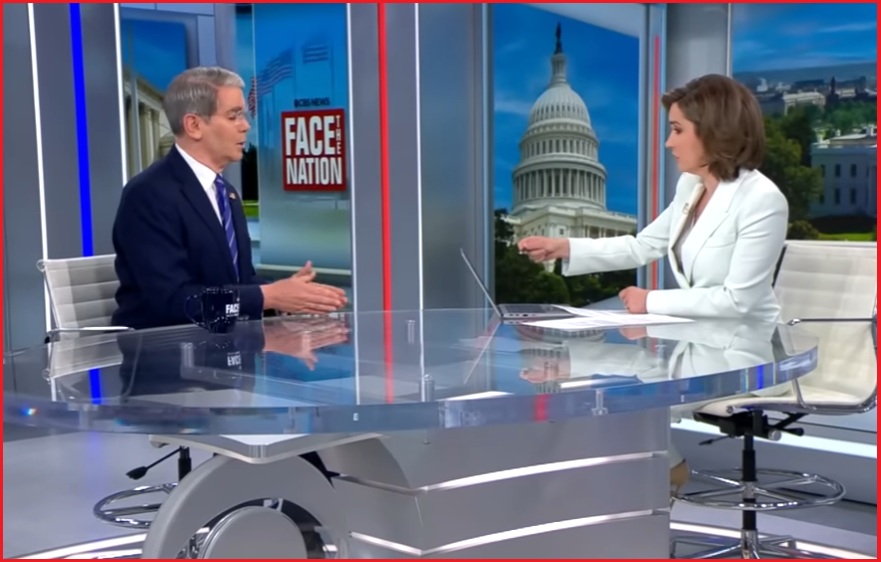
That’s the context you will hear play out in this interview between FDA commissioner Marty Makary and CBS News Margaret Brennan. Video and Transcript below:
.
[Transcript] – MARGARET BRENNAN: Welcome back to Face the Nation. We’re joined now by FDA Commissioner Dr. Marty Makary. Good morning.
FDA COMMISSIONER DR. MARTY MAKARY: Good morning.
MARGARET BRENNAN: Good to have you here in person.
DR. MAKARY: Good to be here.
MARGARET BRENNAN: So I want to get through a lot here, but one of the things we’ve noticed is this new COVID variant that seems to be circulating in Asia. I believe it’s NB.1.8.1. It’s a variant under monitoring. What do we need to know?
DR. MAKARY: Yeah so this appears to be a subvariant of JN.1, which has been the dominant strain so it’s believed that there is cross-immunity protection. The COVID- COVID virus is going to continue to mutate, and it’s behaving like a common cold virus. It’s now going to become the fifth coronavirus that’s seasonal, that causes about 25% of the cases of the common cold.
MARGARET BRENNAN: So you’re thinking of it as like a flu-type variant, just a normal fluctuation.
DR. MAKARY: The flu mutates about 34 times more frequently than COVID. The COVID variant mutation rate appears to be a little more stable, but the international bodies that have provided some guidance on which strain to target, have suggested that either JN.1 or any of these subvariants would be reasonable strains to target.
MARGARET BRENNAN: So you don’t seem overly concerned about that. I want to get now into some of the recommendations that have been very specific this week from the CDC and you with the HHS Secretary in this video announcement on Tuesday where Secretary Kennedy said the CDC was removing the COVID vaccine for healthy children and healthy pregnant women from its recommended immunization schedule. He then had a memo to the CDC rescinding recommendations for kids’ vaccines, saying the known risks do not outweigh the benefits. Then late Thursday, the CDC said quote “shared clinical decision-making,” which I think is just talking to your doctor should determine whether kids get vaccinated. Can you clearly state what the policy is? Because this is confusing.
DR. MAKARY: Yeah, we believe the recommendation should be with a patient and their doctor. So we’re going to get away from these blanket recommendations in healthy, young Americans because we don’t want to see–
MARGARET BRENNAN: For all vaccines?
DR. MAKARY: We don’t- well on the COVID vaccine schedule, we don’t want to see kids kicked out of school because a 12-year-old girl is not getting her fifth COVID booster shot. We don’t see the data there to support a young, healthy child getting a repeat, infinite, annual COVID vaccine. There’s a theory that we should sort of blindly approve the new COVID boosters in young, healthy kids every year in perpetuity, and a young girl born today should get 80 COVID mRNA shots, or other COVID shots in her average lifespan. We’re saying that’s a theory, and we’d like to check in and get some randomized, controlled data. It’s been about four years since the original randomized trials, so we’d like an evidence based approach. Dr. Prasad and I published this in the New England Journal of Medicine last week, and we’re basically saying we’d like to bring some confidence back to the public around this repeat booster strategy theory, because–
MARGARET BRENNAN: Your statement was not about repeat boosters. It says the vaccine is not recommended for pregnant women, the vaccine is not recommended for healthy children. That’s different than annual boosters.
DR. MAKARY: Yeah at this point we’re dealing, you know, it is a booster strategy- people would be getting the updated shot. So whether or not a young, healthy–
(CROSSTALK)
MARGARET BRENNAN: But what about kids who haven’t gotten a shot?
DR. MAKARY: So we’d like to see the data. We’d love to see that- that data. It doesn’t exist.
MARGARET BRENNAN: No, no, no, but on a practical level, for a parent at home, hearing you, trying to make sense here.
DR. MAKARY: Yeah. We’re saying, take it back to your doctor.
MARGARET BRENNAN: Their child has not been vaccinated. Are you recommending that their first encounter with COVID be an actual infection?
(END CROSSTALK)
DR. MAKARY: We’re not going to push the COVID shot in young, healthy kids without any clinical trial data supporting it. That is a decision between a parent and their doctor. And just so, I don’t know if you know the statistics, but 80 for 88% of American kids, their parents, have said no to the COVID shot last season. So America, the vast majority Americans, are saying no. Maybe they want to see some clinical data as well. Maybe they have concerns about the safety–
(CROSSTALK)
MARGARET BRENNAN: I don’t want to crowdsource my health guidance. I want a clear thing–
DR. MAKARY: The worst thing you–
MARGARET BRENNAN: –I wouldn’t go with popularity–
DR. MAKARY: The worst thing–
MARGARET BRENNAN: –I’m going with, as you’re saying, data–
DR. MAKARY: –Yeah so let’s see the data.
(END CROSSTALK)
MARGARET BRENNAN: Okay. So the CDC data said 41% of children aged six months to 17 years hospitalized with COVID between 2022 and 2024 did not have a known underlying condition. In other words, they looked healthy–
DR. MAKARY: So–
MARGARET BRENNAN: –and COVID was serious for them.
DR. MAKARY: So first of all, we know the CDC data is contaminated with a lot of false positives from incidental positive COVID tests with routine testing of every kid that walks in the hospital–
MARGARET BRENNAN: You don’t trust the CDC data?
DR. MAKARY: –When I go to the ICU, when I walk to the P- the we know, We know that data, historically under the Biden administration, did not distinguish being sick from COVID or an incidental positive COVID test. When you go to an ICU in America and you ask, how many people are in the ICU that are healthy, that are sick with COVID, the answer I get again and again is, we haven’t seen that in a year or years. And so the worst thing you can do in public health is to put out an absolute universal recommendation in young, healthy kids. And the vast majority of Americans are saying, no, we want to see some data. And you say, Forget about the data. Just get it anyway.
MARGARET BRENNAN: Okay, so on data and transparency for decades, since 1964 it was the Advisory Committee on Immunization Practices, ACIP that went through this panel recommendation. People watched these things during COVID. The report was then handed up. It offered debate, it offered transparency, and it offered data points that people could refer back to. Why did you bypass all of this and just come down with a decision before the panel could meet and meet that data?
DR. MAKARY: That panel has been a kangaroo court where they just rubber stamp every single vaccine put in front of them. If you look at the minutes of the report from, they even say we were- generally want to move towards a risk stratified approach.
MARGARET BRENNAN: So why not let them do that in June?
DR. MAKARY: So in the meantime, we don’t want an absolute recommendation for healthy kids to get it. They can do it, and that committee-committee will meet and make recommendations. But you look at the minutes of the last couple of years, they say we want a simple message for everybody, just so they can understand it. It was not a data based conversation. It was a conversation based on marketing and ease and and I’ve written an article titled “Why the people don’t trust the CDC,” and it’s in part from that blanket strategy–
MARGARET BRENNAN: You’re telling them not to right now. You just said don’t trust the CDC.
DR. MAKARY: We’re saying it’s going to be between a doctor and a patient until that committee meets or more experts weigh in, or we get some clinical data. If there’s zero clinical data, you’re opining. I mean, you’re just, it’s a theory, and so we don’t want to put out an absolute recommendation for kids with no clinical data at this point.
MARGARET BRENNAN: So you made this pronouncement as well on pregnant women. There is data. Researchers in the UK analyzed a series of 67 studies, which included 1.8 million women, and the journal BMJ Global Health published it. People can Google it at home, and it says the COVID vaccine in pregnant women is highly effective in reducing the odds of maternal SARS-CoV-2 infection, hospital admission and improves pregnancy outcomes with no serious safety concerns. This is data that shows that it is recommended or could be advised, for pregnant women to take this vaccine. Why do you find otherwise?
DR. MAKARY: There’s no randomized control trial. That’s the gold standard. Those 67 studies are mixed. The data in pregnant women is different for healthy versus women with a comorbid condition. So it’s a very mixed bag. So we’re saying your obstetrician, your primary care doctor, and the pregnant woman should together decide whether or not to get it. 12% of pregnant women last year got the COVID shot. So people have serious concerns, and it’s probably because they want to see a randomized trial data, the randomized trial of pregnant women–
MARGARET BRENNAN: But in the meantime, the world moves on, and you published in the New England Journal of Medicine on May 20. In that report, you referenced, you listed pregnancy as an underlying medical condition that increases a person’s risk for severe COVID. You said that. So then seven days later, you joined in this video announcement saying you should drop the recommendation for the COVID vaccine in healthy pregnant women. So what changed in the seven days?
DR. MAKARY: In the New England Journal medicine, we simply list what the f- what the CDC has traditionally defined as high risk, and we’re just saying, decide with your doctor. We’re not saying the other–
MARGARET BRENNAN: But doctors want data and information as well from you–
DR. MAKARY: and the randomized trial– so here’s the data on pregnant women. A randomized control trial was set up, and it was closed without any explanation. We wanted to see that trial complete so women can have information that in a randomized control trial, which is the gold standard, this is what the data shows. We don’t have those data.
MARGARET BRENNAN: All right. It is still unclear what pregnant women now should do until they get the data that you say–
DR. MAKARY: I’d say talk to their doctor.
MARGARET BRENNAN: When do they get the data you’re promising? All these controlled studies.
DR. MAKARY: In the absence of data, they should talk to their doctor–
MARGARET BRENNAN: So no date?
DR. MAKARY: –and their doctor will use their best wisdom and judgment.
MARGARET BRENNAN: FDA Commissioner, thank you for trying to help clear this up.
Posted originally on CTH on June 1, 2025 | Sundance
Treasury Secretary Scott Bessent appears on CBS News to counter the false information being spread by Margaret Brennan on behalf of Wall Street corporations. The topics of interest surround China and tariffs.
Let me clarify for the audience that does not follow closely. Tariffs are paid by the importer based on the wholesale price of the product as delivered by the exporting country depending on the exporters’ tariff rate. Tariffs are NOT LEVIED/PAID based on the retail price of the product as sold to the consumer.
Example: A pair of Denim Jeans made in China for Guess Brand. The Chinese manufacturer sells the jeans to Guess Brand for $10 a pair manufactured. Guess sells the jeans at retail in the USA for $100 (a $90 gross profit).
A 50% tariff on China means the jeans cost Guess Brand $15 instead of $10 (an $85 gross profit). A 50% tariff on Guess brand jeans, that retail for $100, changes the cost to the retail brand by $5.
Multinational corporations who have off shored their production and manufacturing to China are the ones screaming about tariffs. Ultimately in the final analysis, President Trump is exposing corporatism, multinational corporate vultures; he is not necessarily just exposing China.
In the example above the company makes $85 gross profit as opposed to $90 gross profit on the pair of jeans if they do not raise the retail price. They don’t raise the price because their profit margins are already ridiculous, and that’s why consumer prices do not go up. A 50% direct tariff on Chinese goods only marginally hits the multinational corporation. American consumers need to understand this dynamic better. WATCH:
[TRANSCRIPT] – MARGARET BRENNAN: Good morning and welcome to ‘Face the Nation.’ We begin today with Treasury Secretary Scott Bessent. Good morning and thank you for being here.
SECRETARY SCOTT BESSENT: Morning, Margaret.
MARGARET BRENNAN: There’s so much to get to. I want to start with China, because the Defense Secretary just said there’s an imminent military threat from China to Taiwan. Days earlier, Secretary Rubio said he’d aggressively revoked Chinese student visas. On top of that, you have curbing exports to China. Trade talks you said with Beijing are stalled, and President Trump just accused China of violating an agreement, and now says no more, ‘Mr. Nice Guy.’ Are you intentionally escalating this standoff with Beijing?
SEC. BESSENT: Well, I don’t think it’s intentional. I- I think that what Secretary Hegseth did was remind everyone that during COVID, China was an unreliable partner, and what we are trying to do is to de-risk. We do not want to decouple Margaret, but we do need to de-risk, as we saw during COVID, whether it was with semiconductors, medicines, the other products we are in the process of de-risking.
MARGARET BRENNAN: Making the United States less reliant on China, but at the same–
SEC. BESSENT: –Well, and the whole world. The whole world, because what China is doing is they are holding back products that are essential for the industrial supply chains of India, of Europe, and that is not what a reliable partner does.
MARGARET BRENNAN: So is that like- what specifically is President Trump saying when he says they are violating an agreement? Because it was the one you negotiated in Geneva earlier this month. And what’s the consequence for that?
SEC. BESSENT: Well, we will see what the consequences are. I am confident that when President Trump and party Chairman Xi have a call, that this will be ironed out. So- but the fact that they are withholding some of the products that they agreed to release during our agreement- maybe it’s a glitch in the Chinese system, maybe it’s intentional. We’ll see after the President speaks with party chairman.
MARGARET BRENNAN: That’s critical minerals, rare earths. Is that what you’re talking about?
SEC. BESSENT: Yes.
MARGARET BRENNAN: So, the President has said a few times that he was going to speak to President Xi, but he hasn’t since before the inauguration. Beijing keeps denying that there was any contact. Do you have anything scheduled?
SEC. BESSENT: I believe we’ll see something very soon, Margaret.
MARGARET BRENNAN: Do you have a conversation with your counterpart or Lutnick with his counterpart at the commerce level?
SEC. BESSENT: Well, I think we’re going to let the two principles have a conversation, and then everything will stem from that.
MARGARET BRENNAN: JP Morgan CEO, Jamie Dimon, spoke this week at an economic forum, and he gave this read on Beijing.
[SOT]
JAMIE DIMON: I just got back from China last week. They’re not scared, folks. This notion they’re gonna come bow to America. I wouldn’t count on that. And when they have a problem, they put 100,000 engineers on it, and they’ve been preparing for this for years.
[END SOT]
MARGARET BRENNAN: Have you underestimated the Chinese state’s backbone here?
SEC. BESSENT: Again, Margaret, I hope it doesn’t come to that. And Jamie is a great banker. I know him well, but I would vociferously disagree with that assessment, that the laws of economics and gravity apply to the Chinese economy and the Chinese system, just like everyone else.
MARGARET BRENNAN: But when you were last here in March, we were trying to gauge what the impact of the standoff with China and with the tariffs on the rest of the world would do for American consumers here at home. At that time, you told us you were going to appoint an affordability czar and council to figure out five, you said, or eight areas where there will be some pain for working class Americans. Where are you anticipating price increases?
SEC. BESSENT: Well, thus far- we wanted to make sure that there aren’t price increases, Margaret. And thus far there have been no price increases. Everything has been alarmist, that the inflation numbers are actually dropping. We saw the first drop of inflation in four years. The inflation numbers last week, they were very- the- pro-consumer. We’ve–
MARGARET BRENNAN: Right, but you listen to earnings calls just like we do. You know what Walmart’s saying, what Best Buy’s saying and what Target are saying of what’s coming–
SEC. BESSENT: But Margaret, I also know what Home Depot and Amazon are saying. I know what the South China Morning Post wrote within the past 24 hours that 65%- 65%- the- of the tariffs will likely be eaten by the Chinese producers.
MARGARET BRENNAN: So are there five or eight areas that you have identified, as you said back in March, where American consumers will be able to have lower prices, or should be warned of higher prices?
SEC. BESSENT: Well, a lot of it’s already working its way through the system. So we’ve seen a substantial decrease in gasoline and energy prices. So that’s down 20% year over year. We’ve seen the food prices go down, these notorious egg prices. Through the good work of President Trump and Secretary Rollins, egg prices have collapsed. So we’re seeing more and more. And what we want to do- the- is even that out across the all sections of the economy. So inflation has been very tame. Consumer earnings were up 0.8% last month, which is a gigantic increase for one month. So real earnings minus low inflation is great for the American people, and that’s what we’re seeing.
MARGARET BRENNAN: But you know, because when you met with the Chinese earlier this month and you went down from the 145% tariff down to about- it’s like 30%. 30%’s not nothing, that tax on goods coming in here. Retailers are warning of price hikes–
SEC. BESSENT: Well, so–
MARGARET BRENNAN: When you go back to school shopping, things are going to cost more.
SEC. BESSENT: But Margaret, some are and some aren’t. Home Depot and Amazon said they’re not.
MARGARET BRENNAN: Home Depot and Amazon aren’t where you go for your back school shopping, when you buy your jeans, when you buy your crayons, and you buy all those things that parents–
SEC. BESSENT: I don’t know about you, but I do it online at Amazon. This isn’t an advertisement for Amazon. And guess where most of the Halloween costumes in America get bought? At Home Depot. So that’s just not right. There’s a wide aperture here. Different companies are doing different things. They are making decisions based on their customers, what they think they’re able to pass along to their customers, what they want to do to keep their customers. And I was in the investment business for 35 years, Margaret, and I will tell you earnings calls- they have to give the worst case scenario, because if it- if they haven’t and something bad happens, then they’ll be sued.
MARGARET BRENNAN: It’s not always the worst case. It’s the most probable case–
SEC. BESSENT: –No, no, no–
MARGARET BRENNAN: as well–
SEC. BESSENT: –No, no, no. No, they have to give the worst case.
MARGARET BRENNAN: So Walmart- there was just a piece published with the conservative strategist Karl Rove. I’m not asking about politics, because he is a political strategist, but he went in on the math here. And he points out that Walmart has a profit margin of less than 3%. He says, ‘If it does what Mr. Trump says, eat the tariffs, it can’t break even. It can’t absorb the cost of an imported pair of kids jeans with a 46% tariff on Vietnam, a 37% tariff for Bangladesh, or 32% tariff on sneakers from Indonesia. Other companies are in the same pickle.’ So should companies cut back on the amount of goods they have on their shelves or just on their profitability?
SEC. BESSENT: That- that’s a decision company by- by company, Margaret. And I had a long discussion with Doug McMillon, the CEO of Walmart, and they’re going to do what’s right for them.
MARGARET BRENNAN: But for consumers, the reality is there will either be less inventory or things at higher prices, or both.
SEC. BESSENT: Margaret, when we were here in March, you said there was going to be big inflation. There hasn’t been any inflation. Actually, the inflation numbers are the best in four years. So why don’t we stop trying to say this could happen, and wait and see what does happen.
MARGARET BRENNAN: Just trying to gauge for people planning ahead here, one of the things the President said on Friday is that he’s going to double the tariffs on steel and aluminum up to 50%, effective June 4. How much will that impact the construction industry?
SEC. BESSENT: Well, I think- I was with the president at the U.S. Steel Plant in Pittsburgh on Friday, and I will tell you that the President has the- reignited the steel industry here in America. And back to the earlier statements on national security. There are national security priorities here for having a strong steel industry.
MARGARET BRENNAN: But do you have a prediction on how much it’s going to impact the construction industry, for example?
SEC. BESSENT: Well, I have a prediction on how much it’s going to impact the steel industry, and you know, again, we- we’ll see there are a lot of elasticities that- you know this is a very complicated ecosystem. So is it going to impact the construction industry, maybe. But it’s going to impact the steel industry, the- in a great way. The steel workers, again, were left on the side of the road after the China shock, and now they’re back that the- they are Trump supporters. And when I tell you that it was magic in the arena, or it was actually at the steel plant that night, that these hard working Americans know their jobs are secure, there’s going to be capital investment, and the number of jobs is going to be grown around the country, whether it’s in Pittsburgh, whether it’s in Arkansas, whether it’s in Alabama.
MARGARET BRENNAN: I want to ask you about this big tax bill that worked through the House, is going to the Senate next. In it is increase or suspension to the debt limit that you need delivered on by mid-July. How close of a brush with default could this be, given how massive some of the Senate changes are expected to be to the other parts of the bill?
SEC. BESSENT: Well, first of all, Margaret, I will say the United States of America is never going to default. That is never going to happen. That- we are on the warning track and we will never hit the wall.
MARGARET BRENNAN: You have more wiggle room if they don’t deliver this by mid-July? I mean, how hard of a date is this?
SEC. BESSENT: That- we don’t give out the X date because we use that to move the bill forward.
MARGARET BRENNAN: Sometimes deadlines help force action, as you know, particularly in this town, sir, that’s why I’m asking. The President did say he- he expects pretty significant changes to this bill, though, so that affects the timing of it moving. What would you like Republican lawmakers to keep? What would you like them to alter?
SEC. BESSENT: Again, that’s going to be the Senate’s decision. Leader Thune, who I’ve worked closely with during this process, has been doing a fantastic job. And Margaret, I’ll point out, everyone said that Speaker Johnson would not be able to get this bill out of the house with his slim majority. He got it out Leader Thune has a bigger majority, and this is with President Trump’s leadership. So–
MARGARET BRENNAN: –There’s no red lines for you in there of just don’t touch this you can, you know, tinker with that.
SEC. BESSENT: Well, I- I think that they’re not necessarily my red lines. The President has the- his campaign promises that he wants to fulfill for working Americans. So no tax on tips, no tax on overtime, no tax on Social Security, deductibility of auto loans for American made automobiles.
MARGARET BRENNAN: So those have to stay in.
SEC. BESSENT: Those have to stay in.
MARGARET BRENNAN: JP Morgan’s Dimon also predicted a debt market crisis. ‘Cracks in the bond market’ was what he said. You are considering easing some regulations, you’ve said, for the big banks. How do you avoid that bond market crisis he’s predicting, spreading and really causing concern, particularly with all of the worries about American debt right now?
SEC. BESSENT: So again, I’ve known Jamie a long time and for his entire career he’s made predictions like this. Fortunately, none of them have come true. That’s why he’s a banker- a great banker. He tries to look around the corner. One of the reasons I’m sitting here talking to you today and not at home watching your show is that I was concerned about the level of debt. So the deficit this year is going to be lower than the deficit last year, and in two years it will be lower again. We are going to bring the deficit down slowly. We didn’t get here in one year. We didn’t get here in one year, and this has been a long process. So the goal is to bring it down over the next four years, leave the country in great shape in 2028.
MARGARET BRENNAN: You know that the Speaker of the House estimates this is going to add four to five trillion dollars over the next 10 years, and there’s that debt limit increase.
SEC. BESSENT: Well again, Margaret, that’s CBO scoring.
MARGARET BRENNAN: That’s the Speaker of the House.
SEC. BESSENT: No, no, no.
MARGARET BRENNAN: He said it last Sunday on this program.
SEC. BESSENT: The- he said that’s the CBO scoring. Let me–
MARGARET BRENNAN: –No, he said that sounds right.
SEC. BESSENT: Let me tell you what’s not included in there, what can’t be scored. So we’re taking in substantial tariff income right now, so that there are estimates that that could be another 2 trillion that we are the- pushing through savings. So you know my estimate is that could be up to another 100 billion a year. So over the 10 year window, that could be a trillion. President has a prescription drug plan with the pharmaceutical companies that could substantially push down costs for prescription drugs, and that could be another trillion. So there’s the four.
MARGARET BRENNAN: Treasury Secretary Bessent, we’ll be watching closely what happens next. ‘Face the Nation’ will be back in a minute, so stay with us.
I have created this site to help people have fun in the kitchen. I write about enjoying life both in and out of my kitchen. Life is short! Make the most of it and enjoy!
This is a library of News Events not reported by the Main Stream Media documenting & connecting the dots on How the Obama Marxist Liberal agenda is destroying America







 Centinel2012