Lebanon Announces War Will Escalate


Posted originally on Aug 11, 2025 by Martin Armstrong |  

Hezbollah

Lebanese Prime Minister Nawaf Salam left a six-hour cabinet meeting, whereby it was determined that the Iran-backed militant group Hezbollah must be eliminated by the end of the year. Salam said it is the “state’s duty to monopolise the possession of weapons”, and disarm Hezbollah. Western influence has successfully penetrated Lebanon, and war is guaranteed to escalate.

Lebanese President Joseph Aoun called on Hezbollah to abandon its weapons to prevent war—a request that he knew would go unanswered. Such a request would have been unfathomable one year ago when Hezbollah was at the peak of its power. Israel recently accused Hezbollah of expanding its forces, with the US World Factbook estimating that the group had 50,000 active combatants. Yet, Hezbollah leader Hassan Nasrallah warned that he has 100,000 men who are prepared to fight.

“The government of Prime Minister Nawaf Salam committed a grave sin by taking a decision to strip Lebanon of its weapons to resist the Israeli enemy… This decision fully serves Israel’s interest,” the militant group said. “This decision undermines Lebanon’s sovereignty and gives Israel a free hand to tamper with its security, geography, politics and future existence. Therefore, we will treat this decision as if it does not exist.”

Lebanon is indebted to the West and must expel Hezbollah to secure funding. Lebanese Finance Minister Yassin Jaber announced earlier in the year that the World Bank prepared a “preliminary plan” worth $1 billion to assist in rebuilding efforts. Lebanon is attempting to form a new government, and the West is encroaching on the Middle Eastern nation to ensure it can insert political influence, if not dominance.

IMF chief Kristalina Georgieva said that any funding would be “linked to specific steps and procedures with a specific time frame and objective.” The European Union has taken an interest as well, offering to disburse €500 million in aid as part of a deal signed last year that was contingent on reducing the number of migrants. US Special Envoy to the Middle East Steve Witkoff also stated he believes the US may wish to broker a deal.

LandofPlentyLebanon1

I reported that the US military is building a $1.2 billion mega compound in Awkwar, Lebanon. The location is a mere 10 miles from the center of Beirut and 60 miles away from the Israeli border.  Hezbollah and Israel agreed to a ceasefire on November 27, 2024, but the group is still strong and continues to support Hamas. Lebanon is vulnerable to becoming part of a larger regional crisis, which could involve escalation around its southern border and deeper Turkish influence. Syria was a key supporter of Hezbollah but has been gutted with a new interim puppet government. Iran remains Hezbollah’s top supporter and has said it will not support any efforts to disarm the militant group, blaming the West for interfering in the Middle East once more. Notably, Russia and Iran signed a 20-year treaty back in January to bypass US sanctions. Could Lebanon become the new battlefield for the proxy war?

60% of Germans Refuse to Play War Games


Posted originally on Aug 8, 2025 by Martin Armstrong |  

GermanyUkraineWarPropogandaRecruitment

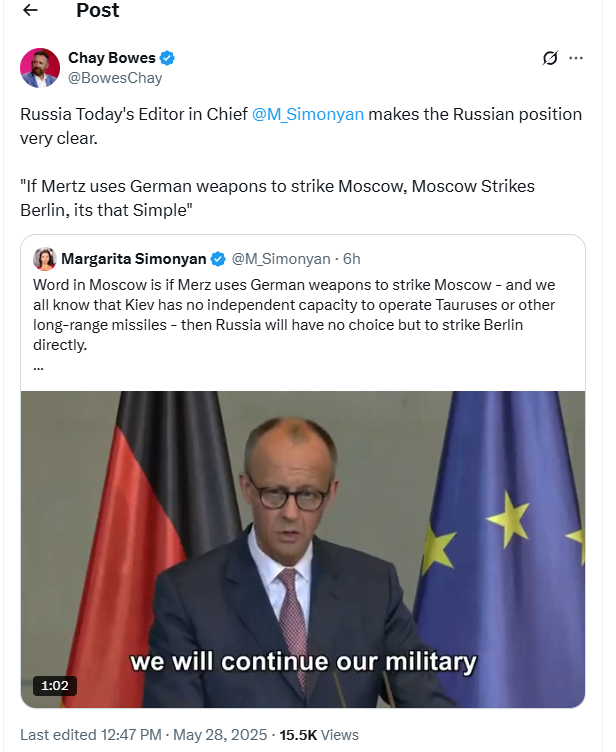
The people do not wish to play the neocons’ war games. Germany has been discussing reintroducing mandatory military service since the war began—a war that was never Germany’s battle but always the obligation and responsibility of the German people. I reported in May that over half of Brits would not fight for their country in the event of an attack. A new survey by German broadcaster RND revealed that nearly 60% of Germans would refuse to go into battle.

Only 16% of respondents said they would “definitely fight,” and another 22% reported they “probably” would. This is precisely why Germany has been considering a mandatory conscription for all adults over the age of 18. German Defense Minister Boris Pistorius said he is “convinced” that Germany “needs a form of military conscription.” Since the West has effectively eliminated genders or the need for a family structure, they plan to draft both men and women. Anyone fit to fight will be sent off to die.

Russia Threaten Germany

Pistorius has been urging Germany to amass 260,000 active-duty troops, whom he believes should begin training immediately. Germany has a goal of gathering an army of 203,000 troops at a minimum, but the current force is a bit over 180,000. The military also plans to increase its reserve forces from 60,000 to 200,000, citing the need for immediate mobilization if the conflict escalates. Mandatory conscription may be introduced in 2026, which would align with our models precisely.

German politicians speaking out against the war are being silenced. The government has been preparing the European public for the inevitable. Everyone currently living in Europe knows how intensely the media has been discussing Europe’s alleged duty to prevent Russian aggression. “Will you fight for Germany? None of us wants war, but we already have to prepare for it. How ready are we really?” German magazine Stern states on its March 2025 cover.

The people always lose in times of war. Those on the ground firing missiles at one another are on the same side—the people—while the neocons sit in their safe high towers, unaffected by the destruction they unleashed.

Japan to Build Australia’s New Warships


Posted originally on Aug 7, 2025 by Martin Armstrong | 

Australia has tapped Japan to begin building its next fleet of warships as the nation retires the ANZAC-class fleet. Japanese shipbuilder Mitsubishi Heavy Industries beat German manufacturer Thyssen­Krupp Marine Systems as Japan’s Mogami frigate was more desirable than the German MEKO A-200. This is a landmark win for Japan as it marks the first time Japan has exported warships to a foreign nation.

The first 11 frigates alone are worth at least 10 billion Australian dollars ($6.5 billion USD). Japan will produce the first three ships domestically before building a facility in Australia to create the rest. Australia has exclusive access to the first Mogami warships. The 4,800-tonne Mogami carriers are faster than their German rival’s at a speed of 30 knots and has a range of 10,000 nautical miles. The ANZAC-class ship required a crew of 170 compared to the frigate’s need for only 90 personnel, maximizing operational efficiency.

“The upgraded Mogami is built in a way that makes it easy to customise depending on the owner’s order — the power setting and the space design are different from the original one, so the ship is ready to cater to any requests coming from the Australian government,” ATLA official Koji Nishimura stated. “From the very first phase of the project, I thought about the benefit for Australia and for the Japanese Maritime Self-Defence Force, because of that we formed an all-Japan team — with Ministry of Defence working as a team to make this project happen,” he added.

“This is clearly the biggest defence industry agreement that will ever have been struck between Japan and Australia. In fact, it’s really one of the biggest defence exports that Japan has ever engaged in,” Defence Minister Richard Marles said

This is a huge win for Japan as they have not previously had a heavy role in defense exports. The deal will show the world if Japanese manufacturers can reliably enter the sector and begin exerting its geopolitical power. Domestic defense is a matter of survival for Japan but now it has the ability to share its elite manufacturing capacities with the world.

The US supported Japan’s bid because it plans to use American-made components and comes equipped to carry American-made missiles specifically. The European Union has been back and forth on whether it wants to continue purchasing military equipment from America. Germany’s loss is a big hit to its already contracting manufacturing sector, as the nation was once the go-to for industrial exports. Japan is not beholden to unelected officials who could sway policy and, therefore, trade.

Secretary of State Marco Rubio Discusses Potential for President Trump and President Putin Meeting


Posted originally on CTH on August 6, 2025 | Sundance

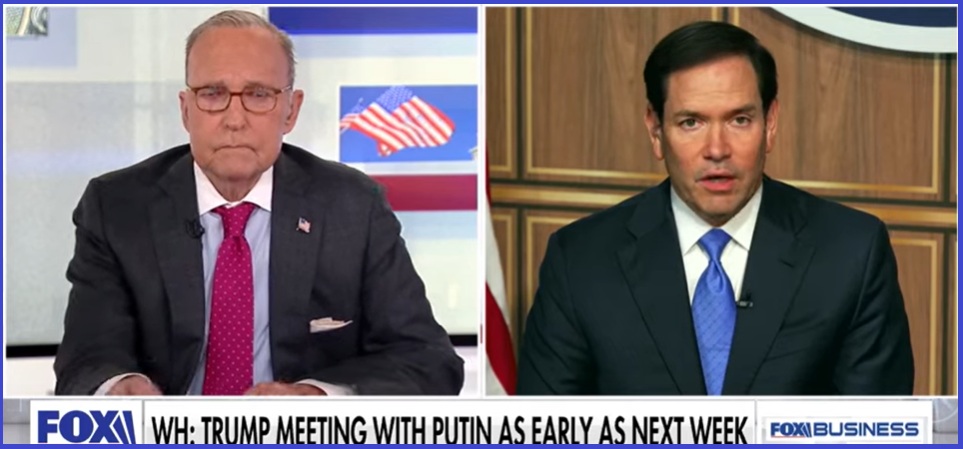
Secretary of State Marco Rubio appears for an interview with Larry Kudlow to discuss the recent reporting around a potential meeting between President Trump and President Putin.

As Rubio notes, following the recent Moscow visit by Steve Witkoff, there is now great clarity on the terms and conditions for Russia to enter a ceasefire period.  President Trump has reportedly told EU officials he will likely pick-up the ceasefire negotiations soon via a face-to-face meeting with Putin.  WATCH:

At the White House event with Apple CEO Tim Cook, President Trump said that “there’s a really good prospect that” there will be a meeting with Zelenskyy and Putin. But he disagreed with the suggestion it amounted to a “breakthrough.”

Secretary of State Marco Rubio notes in the interview here, “an opportunity will present itself very soon for the president to meet both with Vladimir Putin and with President Zelenskyy at some point here, hopefully in the near future.” Rubio added “a lot has to happen before that can occur.”

The Rare Earth Elements Crisis – Why isn’t America Digging in Ukraine?


Posted originally on Aug 6, 2025 by Martin Armstrong |  

MINERALS.Ukraine Mineral Resources_Site_Elements

America is desperate for rare earth minerals. China was supplying the US with around 70% of all such minerals, but they’re not going to supply them to an enemy nation to create weapons. As I mentioned yesterday, this is precisely why America is desperate to access Ukraine. I received a few comments asking why the US has not begun digging, and unfortunately, they are unable to reach those crucial minerals due to the ongoing war.

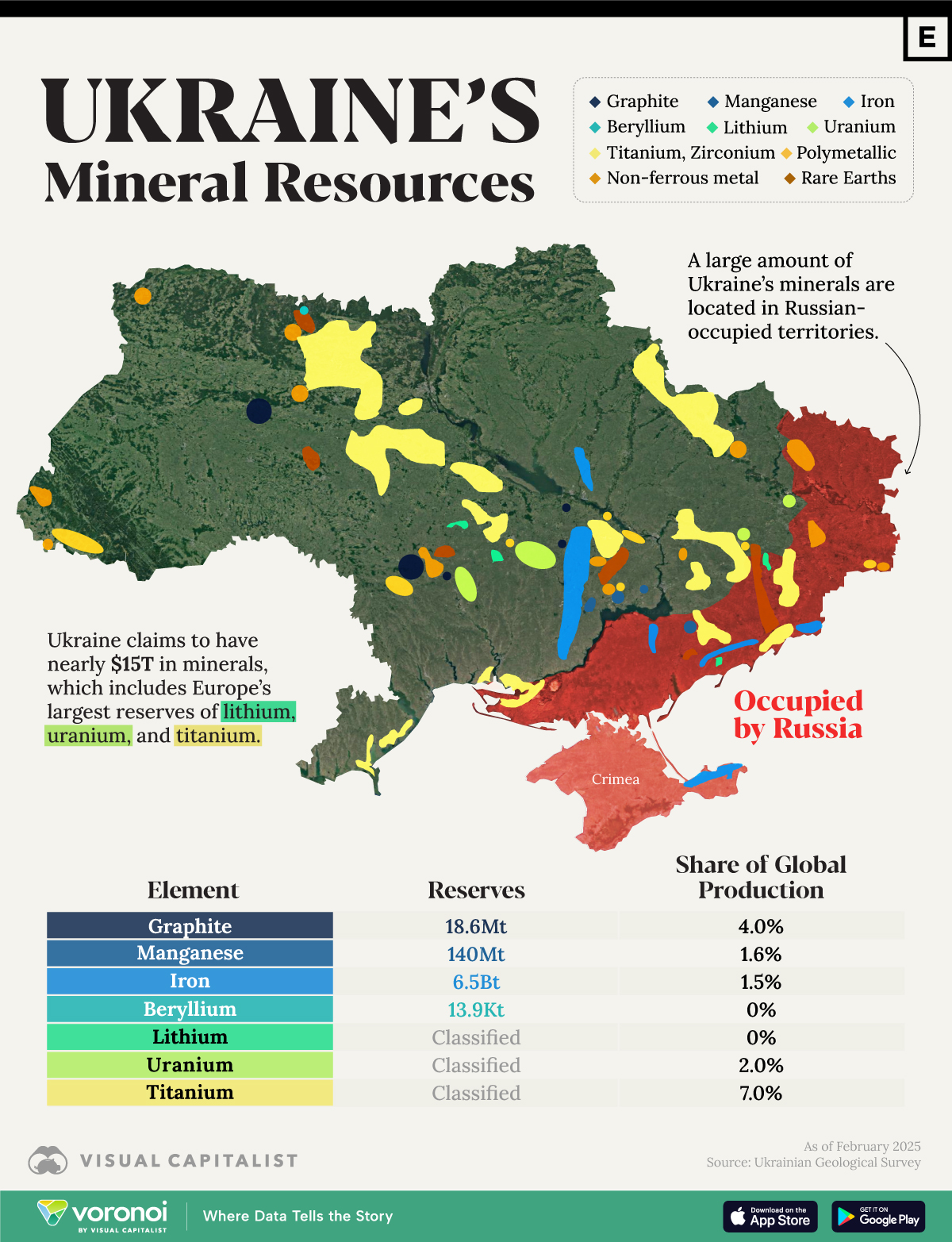
It is estimated that Ukraine holds 5% of the world’s critical raw materials. Ukrainian officials believe they have 19 million tonnes of graphite reserves and significant deposits of titanium, rare earth metals, and lithium. The current plan would require harvesting up to HALF of Ukraine’s minerals and rare earth materials.

On April 30, 2025, Ukraine and the US finalized a minerals deal and established a United States–Ukraine Reconstruction Investment Fund. Congress approved a $50 million defense package to Ukraine through direct commercial sales (DCS). Trump is a businessman first and foremost—the mineral deal had to be approved before he would approve of any aid package. The United States now has preferential rights to extract minerals from Ukraine.

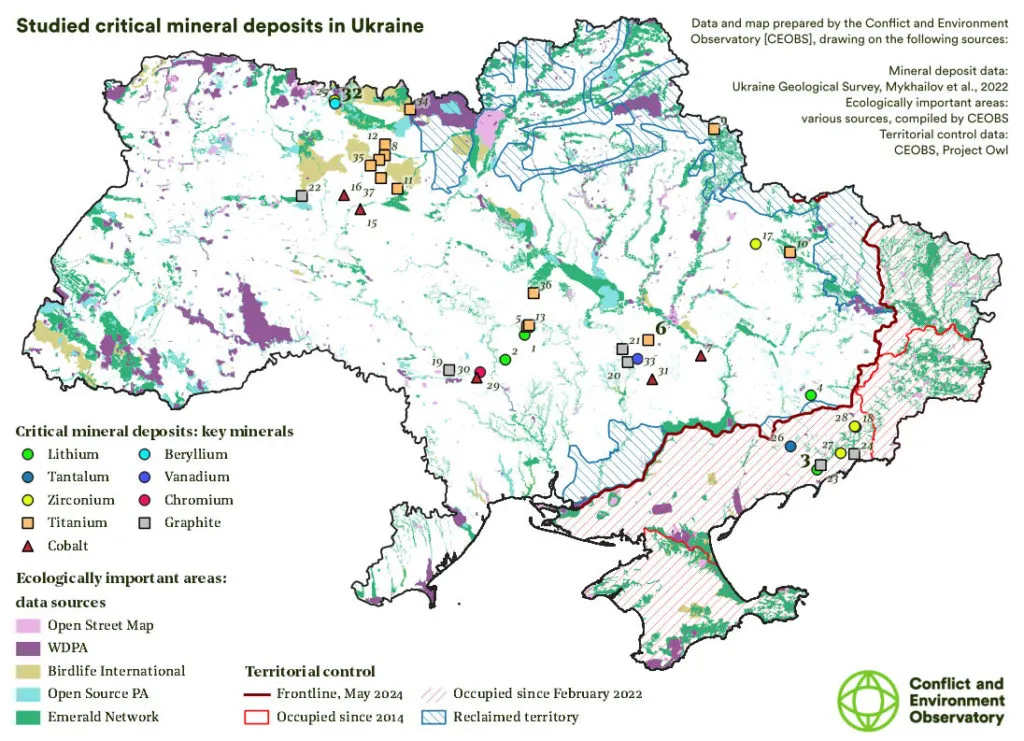
Why hasn’t the US begun digging? An estimated 50% of Ukrainian minerals are in areas under Russian control. The Donbas region, the Donetsk and Luhansk are rich in critical minerals, rare earth minerals, coal, and gas. They host the Shevchenko lithium field. Russia currently controls 40% of Ukraine’s metal resources and 56% of its coal reserves. Other essential sites are within a 10-mile radius of occupied enemy territory. Dnipropetrovsk & Kharkiv have uranium, but they are unstable due to frontline advances. Zaporizhzhia has the rare earth elements that America is seeking but it is partially occupied by Russian troops and extremely dangerous. Central and Western Ukraine could be safe for extractions, but they are far less rich in minerals.

MineralsUkraine

Where else can the West turn? Europe faces the same crisis. Estonia has rare minerals, but not enough to meet demand, with the nation currently providing the US with 5% of its needs. Malaysia imports about 13% of US rare earth imports, with Japan providing another 6%. Japan has minerals, but still imports from China. They plan to begin extracting rare earth minerals from the Minami-Torishima Island in 2026, marking the world’s first large-scale mining operation 6,000 meters beneath the ocean. Scientists believe that the area could contain around 16 million tonnes of rare earth elements, but that is a mere estimate. Malaysia has a low mineral reserve in comparison to other nations and cannot be an alternative supplier. Malaysia hosts the Lynas Corporation, the biggest rare earths processor outside China, but the nation has modest reserves.

So while Ukraine may hold nearly $15 trillion worth of crucial minerals and 15% of the world’s reserves, they cannot be accessed due to the ongoing war. China and Russia are abundant in minerals and have no restrictions when it comes to weapon production. China has pioneered molten salt reactors to produce uranium and convert it into nuclear energy. America’s enemies have a notable advantage right now and there are no reliable alternatives.