
Posted originally on Jun 14, 2026 by Martin Armstrong |
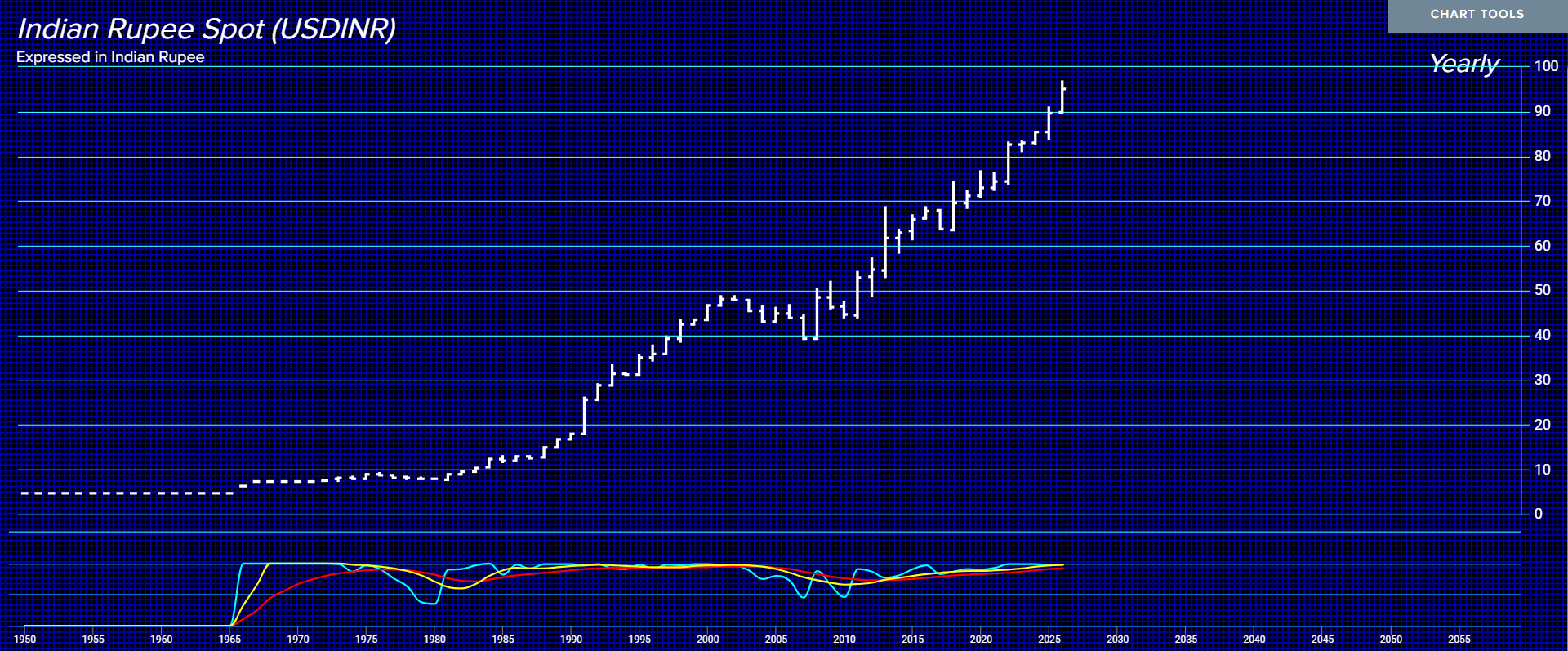
The primary driver of the rupee’s recent movement has been the conflict between the US-Israel alliance and Iran. India has stated that the conflict has had a “debilitating impact on the global economy and energy supplies.” As a major importer of oil, India is vulnerable to price shocks and supply chain disruptions. The rupee hit an all-time low primarily due to the war. The currency appears poised to strengthened sharply on the back of falling crude oil prices, if President Donald Trump can at least extract the US from this conflict.
The Reserve Bank of India has actively managed the situation. It has been intervening in the forex market to prevent excessive volatility and has announced specific measures to attract dollar inflows, which has helped stabilize the currency.
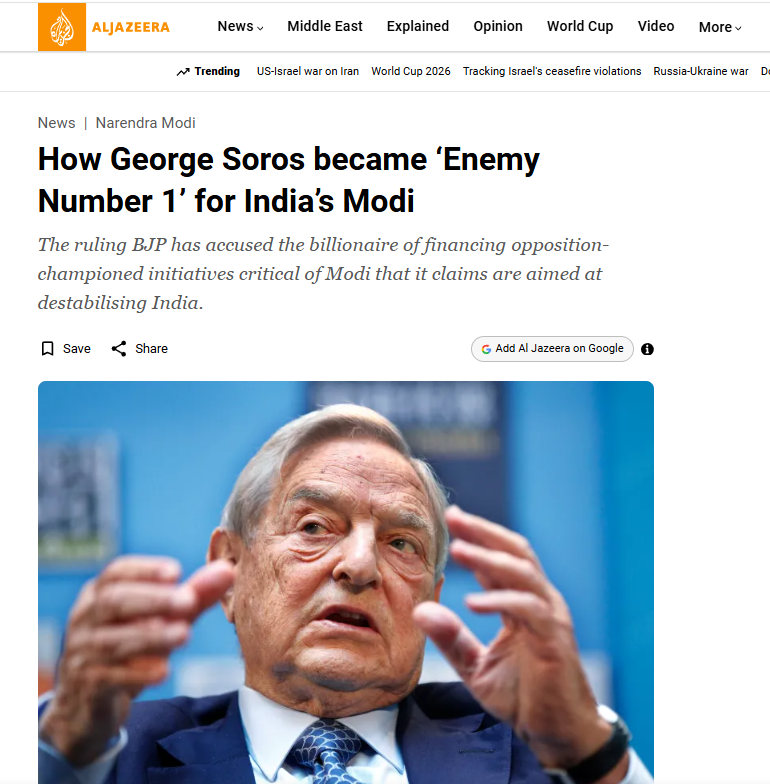
The conflict between George Soros and Indian Prime Minister Narendra Modi is a clash of ideologies and interests. Soros, a supporter of his “open societies,” and is an outspoken critic of Modi’s Hindu nationalist politics. This has led the BJP to label him a foreign threat attempting to destabilize India by funding opposition parties and critical media.
Soros has openly criticized the Modi government for its policies, which he views as creating a “Hindu nationalist state” and threatening India’s secular fabric. At the World Economic Forum in 2020, he specifically expressed concern over policies in Kashmir and the Citizenship Amendment Act (CAA). His “open society” ideals fundamentally clash with the BJP’s “Hindu nationalist” agenda.
Nevertheless, George Soros has been funding opposition to Modi and many see this as his political meddling to force his political views upon the world. This has had the realization that people like George Soros and Bill Gates share a specific worldview where they try to alter societies based on personal beliefs.
This dynamic duo seem to believe that solving big global problems (pandemics, climate change, extreme poverty, political instability) is good for everyone, including themselves and their descendants. A world with fewer refugees, more stable democracies, and less disease is a safer, more predictable, and more prosperous world for their businesses and families. This is their egotistic Enlightened Self-Interest.
Both have signed the Giving Pledge (started by Gates and Warren Buffett), committing to give away the majority of their wealth. They argue that if you have been extraordinarily lucky—born in the right country, with the right talents, at the right time—you have a moral obligation to use that wealth to help others, not just pass it to your children.
Unlike traditional charity (feeding the hungry today), Gates and Soros practice strategic philanthropy. They identify a root cause (e.g., malaria is caused by a parasite, weak rule of law enables corruption) and fund targeted interventions. They are not imposing a random opinion; they are imposing what they believe to be the most effective, evidence-based solution. In finance, we call this a crime as market intervention.
Because they “IMPOSE” their personal views upon the world using money instead of military interventions, this is why people get uncomfortable. They don’t have armies or governments, but they have two powerful tools. With tens of billions of dollars, they can fund think tanks, university departments, legal advocacy groups, and media outlets buying the press to boost their images, which Gates is famous for. They can launch global health campaigns (Gates) or pro-democracy civil society organizations (Soros) in dozens of countries simultaneously. This scale can drown out local voices or less-funded alternative views.
They have mastered the Conditional Grants. This is the key. When they give a grant, it almost always comes with strict conditions. For example, the Gates Foundation admits:
“We will give your country $10 billion for vaccines, but you must adopt these specific electronic health records, meet these quarterly reporting metrics, and co-fund the delivery system.”
Soros’ Open Society Foundations states:
“We will fund your anti-corruption NGO, but your advocacy must focus on judicial independence and freedom of information laws, not on economic nationalism or religious identity.”
This is imposing a view. They are using money to buy leverage, requiring recipients to adopt their preferred methodology and priorities. Buying politicians is very anti-democratic and funds the very corruption they claim to oppose.
These tactics are highly controversial, while we don’t criticize a local billionaire for building a hospital, but far too often the strings are hidden. There is just no Democratic Accountability. A government is voted in. A corporate board answers to shareholders. Soros and Gates answer to nobody. They have immense power to shape policy on education (Gates’ early school reform push was widely criticized as a failure that imposed a top-down model) or criminal justice (Soros’ funding for progressive prosecutors has outraged conservatives who see it as importing American ideology into their local elections).
The assumption that a computer programmer (Gates) and a hedge fund manager (Soros) know the best way to run agricultural policy in Tanzania or public health in India can seem deeply condescending. Critics call it a new age of imperial “colonialism”—extracting local problems and forcing solutions designed in Seattle or New York. They may not be kings seated on a throne, but they have self-anointed themselves to oversee the world.
Critics note that Gates made his fortune with monopolistic business practices that crushed competitors, and Soros made his by speculating on currency devaluations (e.g., “breaking the Bank of England” in 1992). They argue it’s galling for these men to now pose as the world’s moral architects.
Why Do They Do It?
From their perspective, they have unique resources, a clear view of the most urgent global problems, and a moral duty to act on their evidence-based beliefs. Not acting, they’d argue, would be irresponsible.
From a neutral perspective, they trying to shape the world according to their values. They simply have an almost unimaginable amount of money to do it with. The debate is whether their specific values (liberal democracy, scientific rationalism, globalism) and methods (top-down, conditional funding) are beneficial or harmful.
From a critical perspective, they are unelected oligarchs using tax-free foundations to override local democracies and impose a narrow, technocratic worldview that serves the interests of global capital under the guise of altruism. Merely having the resources to act, and the pretense of modern philanthropy allows them to impose conditions on their gifts. This is not a heroic problem-solving venture, but a problematic power-grabbing agenda that all depends on their character.
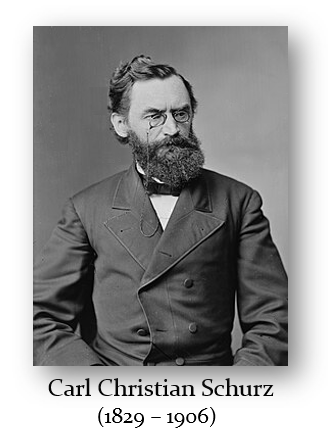
An example of someone imposing their views on another country is none other that Carl Christian Schurz (1829-1906) who was a refugee from Germany fleeing to the USA after their failed 1848 European Revolution. It was Schurz who deliberately sought political power in the USA to impose what he failed to achieve in Germany. They became known as the Forty-Eighters. Schurz became an adviser to Abraham Lincoln and recommended Lincoln enter the American Civil War.
Schurz was a crucial asset to Lincoln, primarily for his ability to mobilize the German-American vote, a key constituency for the Republican Party, which at the time was counting on the refugees from the 1848 European Revolution. In recognition of Schurz’s efforts during the 1860 campaign, Lincoln appointed him as Minister to Spain in 1861.
Once the war began, Schurz was eager to serve directly, initially requesting to raise a cavalry regiment. The correspondence between them shows Lincoln actively managing Schurz’s career, hoping to make him a brigadier general over German regiments.
In this sense, you have a non-American, seeking to gain political access, to instigate the civil war after failing and having to flee from Germany as was the case for Karl Marx. This immigration is what infected the United States with Marxist theories that fermented during the second half of the 19th century. Many in Europe today see the vast influx of immigrants, especially into Britain, which has altered its very culture and character.

