MORRISON: “The Only Way To Get Out Safely Is To Do What President Trump Has Done”


Posted originally on Rumble By Bannon’s War Room on: Apr 2, 2025, at 5:00 pm EST

Morrison: “If You Look At Industrial Output Between America And China, China Is Producing 3x More”


Posted originally on Rumble By Bannon’s War Room on: Apr 2 2025, at 5:00 pm EST

“Trump Brought The Realignment” Mike Davis On President Trump’s Populist Fusion Of Right And Left


Posted originally on Rumble By Bannon’s War Room on: Apr 2 2025, at 5:00 pm EST

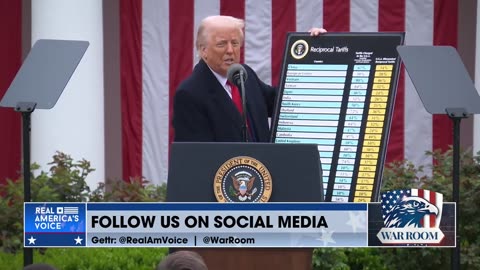
Trump Announces Reciprocal Tariffs on All Countries: “This Is Liberation Day”


Posted originally on Rumble on Bright Bart News Network on: Apr 2, at 7:00 pm EST

Brian Glenn: “He Simply Put America First In Terms Of Trade”


Posted originally on Rumble By Bannon’s War Room on: Apr 2 2025, at 5:00 pm EST

“Congress Has To Get In Line” Rep. MTG On Supporting President Trump’s Liberation Day Agenda


Posted originally on Rumble By Bannon’s War Room on: Apr 2 2025, at 5:00 pm EST

President Trump Reminiscences About Losing Shinzo Abe, Making a Trade Deal with Him


Posted originally on Rumble on Bright Bart News Network on: Apr 2, at 7:00 pm EST

President Trump Announces 25% Tariffs on All Foreign-Made Automobiles Starting at Midnight


Posted originally on Rumble on Bright Bart News Network on: Apr 2, at 7:00 pm EST

Japan, China, and South Korea Strengthen Ties Amid US Tariffs


Posted originally on Apr 3, 2025 by Martin Armstrong 

RCEP

Tariff concerns have heightened to such an extreme level that China and Japan are discussing deepening ties. Donald Trump may be awarded a Nobel Peace Prize for that one. Japan and China, along with South Korea, held their first trade discussions in half a decade where they agreed to navigate US tariffs.

One of the aspects that made the US economy great was consumerism. Other nations lined up for the opportunity to sell goods to US citizens. But now that tariffs will heavily impact the price of goods, nations are looking for new buyers.

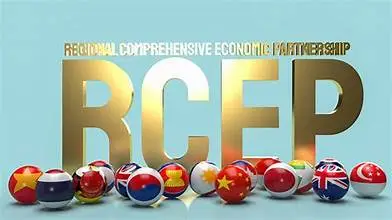
The Regional Comprehensive Economic Partnership (RCEP) went into effect in 2022 to lower trade barriers between 15 Asian nations. However, ongoing tensions have caused the partnership to reach a stalemate of sorts. The alliance includes 10 ASEAN members (Brunei, Cambodia, Indonesia, Laos, Malaysia, Myanmar, the Philippines, Singapore, Thailand, Vietnam) and five regional partners (Australia, China, Japan, New Zealand, South Korea). India withdrew from the alliance but the option to rejoin is on the table. This bloc covers 30% of GLOBAL GDP and includes 30% of the world’s population or 2.2 billion people.

“It is necessary to strengthen the implementation of RCEP, in which all three countries have participated, and to create a framework for expanding trade cooperation among the three countries through Korea-China-Japan FTA negotiations,” said South Korean Trade Minister Ahn Duk-geun, referring to the Regional Comprehensive Economic Partnership.

“The three countries exchanged views on the global trade environment, and as you can see in the joint statement, they shared their understanding of the need to continue economic and trade cooperation,” the South Korean trade ministry spokesperson said.

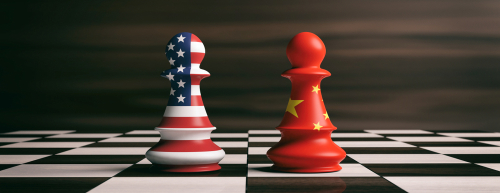
China US Trade War

Breaking down America’s trade with these three nations alone:

China exported $143.5 billion in goods to the US in 2024, down 2.9% from the year prior. The US imported $438.9 billion to China, up 2.8% form the year prior. The nations have a $295.4 billion trade deficit, a 5.8% YoY increase. The top US imports were electrical equipment ($127.1 billion), machinery ($85.1 billion), and toys/games ($32 billion).

Japan exported $79.7 billion in goods to the US in 2024, up 5.4% from 2023. The US imported $148 billion to Japan last year, up 0.7% YoY. The trade deficit between the two nations fell by 4.3% on an annual basis to $68 billion. The top US imports were vehicles ($45.4 billion), machinery ($26.5 billion), and electronics ($20.7 billion).

South Korea imported %127.8 billion to the US in 2024, up 10.5% from 2023. US imports to South Korea totaled $135.5 billion. The two nations have an estimated $7.7 trade deficit. The top US imports were vehicles ($45.4 billion), machinery ($26.5 billion), and electronics ($20.7 billion).

Note that autos/vehicles account for a substantial portion of US trade with South Korea and Japan. China’s auto sector has been rapidly expanding. The government has been providing mass subsidies to manufacturers and China already has the materials needed to create vehicles without any reliance on the US or West.

Technology was reportedly in the spotlight during discussions. China is willing to import semiconductor raw materials to Japan and South Korea. Japan and South Korea are willing to sell chip products to China.

Now the RCEP was expected to add $186 billion to the global economy before the US announced tariffs. Again, this alliance accounts for 30% of the global population. China’s middle class continues to grow and nations are now realizing that there are buyers outside the US. America will lose its spot as the financial capital of the world to China, as the computer has been predicting, once the world begins lining up to sell goods to China instead.


Uptick in US Manufacturing


Posted originally on Apr 3, 2025 by Martin Armstrong 

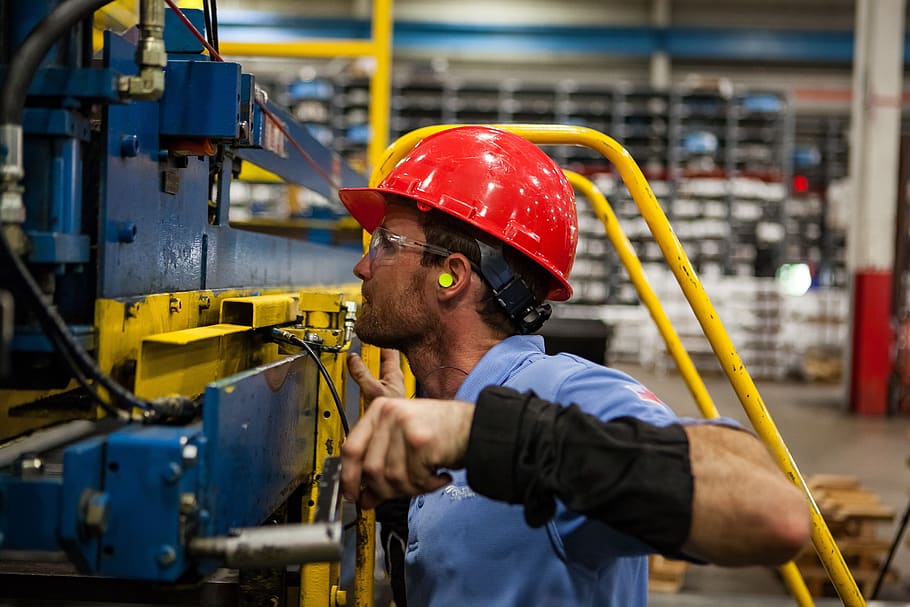
manufacturing man 1

Companies are beginning to move production to the United States to avoid tariffs. “President Trump’s economic polices are simple: if you invest in and create jobs in America, you’ll be rewarded. We’ll lower regulations and reduce taxes,” Vice President J.D. Vance posted online. “But if you build outside of the United States, you’re on your own.”

Hyundai announced a massive $20 billion investment in the United States with plans to open plants in Georgia and Alabama. Around $5.8 million will go towards an updated steel plant that is expected to employ over 1,400 people. Hyundai believes it will soon produce over 1 million cars in America per year.

Eli Lilly is sending $27 million to the US economy as it enhances domestic pharmaceutical production, equating to a total of $50 billion in US manufacturing since 2020. Johnson & Johnson also plans to invest $55 billion in domestic drug manufacturing over the next four years and will build a new biologics facility in North Carolina.

GE Aerospace plans to invest $1 billion to “strengthen manufacturing and increase the use of innovative new parts and materials needed for the future of flight.” The company will increase operations across 16 states, with plans to hire 5,000 new employees.

Apple announced one of the largest investment plans to the tune of $500 billion over the next five years. The company plans to build advanced AI server manufacturing factory in Texas and will double the size of its Advanced Manufacturing Fund from $5 to $10 billion. Apple will need to fill over 20,000 new positions.

Taiwan Semiconductor Manufacturing Company (TSMC) is set to invest $165 billion into creating new plants and R&D centers. Nvidia also plans to begin manufacturing highly desired semiconductor chips in the US over the next four years.

Tariffs are not helpful overall, but US manufacturing was at a standstill. The Inflation Reduction Act promised to fund the Infrastructure Investment and Jobs Act that was intended to expand American manufacturing, but regulation and an emphasis on clean energy initiatives drove business away. The Biden Administration had promised to add 1 million manufacturing jobs to the US but failed miserably. So far, there is a bit of success behind the push for US manufacturing and job creation, but the overall burden of tariffs will have a wider impact on the global economy. The latest ADP report shows a 21,000 increase in manufacturing jobs, but it is too early to know if the trend will continue.