Posted originally on CTH onApril 5, 2025 | Sundance
On March 27th, CTH shared the following: “Wealthy nations will attempt to maintain exports against President Trump tariffs by subsidizing their industries. Corporations have deeper pockets, and the politicians are used to the bribes, we call it “lobbying.” Therefore, the government responds by subsidizing the corporations [ie. the WEF business model].
How does the politics of opposition surface? …”Canada will subsidize their export industries, Germany will subsidize their auto industry, the EU will provide subsidies to their manufacturing powerhouses, and China will once again start subsidizing their manufacturing industry. Each of these nations will in turn, eventually, devalue their currency.
However, poorer nations will be faster to lower import tariffs on USA goods because they have lower lobbying (bribe) income from corporations to govt. That’s what we should expect to see.” [LINK]
With the tariffs now triggered, it begins exactly as anticipated:
The economics of the thing is now colliding with the politics and the ideology, of the thing. Globalists are being confronted. The proverbial West will cleave according to their financial self-interest.
The World Economic Forum (Build Back Better) model no longer views the USA as an ally. The MAGAnomic “Big Ugly” is underway. Countries will thrash and gnash their teeth; then surge in opposition, fail, then attempt to refoot and realign, then surge again and fail again.
And so it will go…
In 2019 Asia (ASEAN) was aligned as China was being confronted. The EU was the intended target for President Trump’s trade reset in term two as scheduled (2021-2025). However, COVID-19 pandemic and the resulting 2020 election threw a wrench in the plan.
In 2025 the EU focus is now a priority. ASEAN nations quickly reassemble on the original terms of Trump T-1. For Trump T-2, China is quickly moved back into adversarial position and focus returns to the previously scheduled look at Europe.
Yes, the EU understand the agenda; they know what was planned then and put aside. In Trump T-2 there is no avoidance mechanism that can be deployed. The only play the EU has is defense.
Europe is currently trying to arrange and coordinate a group of ideological allies to assist them. Those allies include Canada and to a lesser extent, Mexico. President Trump has shown a keen awareness of their best defense.
The Association of Southeast Asian Nations (ASEAN) will not battle Donald J Trump. Factually, they all aligned their economic investment policy to gain from Trump confronting China. ASEAN countries will not battle President Trump; they will comply.
Africa will try to walk a fine line between China and the USA. However, Africa will not confront President Trump directly and, if push comes to shove, they will likely not support China using their belt-and-road leverage to attempt transnational shipping as a tool for U.S tariff avoidance. [Insert a Trump-favorable Russia into this regional dynamic.]
It is the EU and the workaround relationships they created within Mexico and Canada who will fight the global trade reset with ferocity. Everything in the geopolitical world of economic opposition to President Trump will center around Europe.
PARIS, April 3 (Reuters) – French President Emmanuel Macron called on Thursday for European companies to suspend planned investment in the United States after U.S. President Donald Trump announced sweeping global tariffs on American imports.
“Investments to come or investments announced in recent weeks should be suspended until things are clarified with the United States,” Macron said during a meeting with French industry representatives.
The comments come weeks after French shipping firm CMA CGM announced plans to invest $20 billion in the U.S. to build shipping logistics and terminals, a plan that was hailed by President Trump at the time and mentioned again in his Wednesday speech unveiling the tariffs.
French electrical equipment supplier Schneider Electric (SCHN.PA) said late last month it would invest $700 million in the country to support U.S. energy infrastructure to power AI growth. (more)
The EU judicial and intelligence services hit Marine Le Pen for a reason.
Canada – Mark Carney, France – Macron, Ukraine – Zelenskyy, the EU Commission and Ursula Von der Leyen, all the way through NATO and into the German/Romanian elections and beyond, it’s all connected to the geopolitical dynamics of money, power and globalist economics.
Stay elevated. Keep watching. President Donald Trump is a master at the big picture stuff.
[ps. President Trump assigned every single one of those country specific tariff rates personally. Few understand why.]
Posted originally on CTH on April 5, 2025 | Sundance
Tucker Carlson interviews the fulcrum between Wall Street and Main Street in the MAGAnomic policy world, Treasury Secretary Scott Bessent.
Secretary Bessent notes the goal of the tariff plan, and the accompanying economic policy is to give the working middle-class a boost in wealth and simultaneous relief from bad policy that has exclusively benefited the investment class. WATCH:
Chapters:
0:00 Trump’s Tariff Plan 5:42 The Current State of the Stock Market 8:22 Will Americans See Substantial Tax Cuts Because of Tariffs? 13:16 How Much Money Will America Make Through Tariffs? 14:33 Bringing Manufacturing Back to the US 20:14 Tariff Pushback From Foreign Countries
22:16 Will China Retaliate? 25:42 How Will Europe Be Impacted? 33:12 Is the Upper Class Out of Touch With the Lower and Middle Class? 35:47 Bessent’s Biggest Worries 42:35 The Long Term Benefits of DOGE 46:17 The Corruption of the Federal Reserve 49:22 Why Gold Is So Critical Right Now 52:13 Zelensky’s Self-Sabotaging Negotiation Tactics 1:00:19 The Trump Administration’s Messaging About the Economy
Posted originally on CTH on April 4, 2025 | Sundance
During one of the 2016 Republican debates, the Wall Street Journal’s Kimberly Stassel challenged Donald Trump on the projected revenue from his proposed tax plan. In essence Stassel claimed some economists doubted the growth factor Mr. Trump projects in his tax proposal.
What was highlighted within the question was one of the larger hurdles Trump faced as he needs to re-educate an entire generation on a fundamentally new vision of the U.S. economy. A return to a goods-based manufacturing and industry driven economic model.
President Trump’s MAGAnomic trade and foreign policy agenda is jaw-dropping in scale, scope and consequence. There are multiple simultaneous aspects to each policy objective; they have been outlined for a long time.
Interestingly, many people have forgotten a 1991 (35 years old) video of Donald Trump testifying before congress – as evidence of him being tuned in to the economic consequences of political activity.
The entire video is well worth watching, because it gives us insight into a very specific moment in time as they discuss the ‘Reagan era’ 1986 tax reform act.
However, for the sake of this discussion post, I would like to draw your attention to a very specific exchange between Donald Trump and Representative Helen Delich Bently (R-MD).
Representative Bently takes the discussion a little off subject from real-estate and engages Mr. Trump on U.S. manufacturing. Remember, this is 1991. (The video is prompted to @39:24) Watch – it’s only about two minutes:
[Related Note – During Donald Trump’s testimony before congress in this video, Marco Rubio and Ted Cruz were approximately 20 years old. This understanding sets the backdrop for a generation who were disconnected from the previous economic model being discussed within the congressional committee itself.]
In this 1991 hearing, Representative Helen Bently is pointing out an ongoing erosion of U.S. manufacturing. Notice how she references current trade deals and “fair trade” versus “free trade”, sound familiar? It should.
What you will find in all of Donald Trump’s positions, is a paradigm shift he necessarily understands must take place in order to accomplish the long-term goals for the U.S. citizen/worker as it relates to “entitlements” or “structural benefits”.
All other politicians, and even Presidents, begin their policy proposals with a fundamentally divergent perception of the U.S. economy. They are working with, and retaining the outlook of, a U.S. economy based on “services”; a service-based economic model. Consequently, their forecasted economic growth projections are based on ever-increasing foreign manufacturing dependency, and a self-fulfilling prophecy of service-based economics.
While this economic path has been created by decades old U.S. policy and is ultimately the only historical economic path now taught in school, Trump intends to change the course entirely.
Because so many shifts -policy nudges- have taken place in the past several decades, few academics and even fewer MSM observers, are able to understand how to get off this path and chart a better course.
President Trump continually proposed less dependence on foreign companies for cheap goods (the cornerstone of a service economy) and a return to a more balanced U.S. larger economic model, where the manufacturing and production base can be re-established and competitive based on American entrepreneurship and innovation.
No other economy in the world innovates like the U.S.A. President Trump sees this as a key advantage across all industry – including manufacturing.
The benefit of cheap overseas labor, which is considered a global market disadvantage for the U.S, is offset by utilizing innovation and energy independence.
The third highest variable cost of goods beyond raw materials first, labor second, is energy. If the U.S. energy sector is unleashed -and fully developed- the manufacturing price of any given product will allow for global trade competition even with higher U.S. wage prices.
In addition, the U.S. has a key strategic advantage with raw manufacturing materials such as: iron ore, coal, steel, precious metals and vast mineral assets which are needed in most new modern era manufacturing. Trump proposes we stop selling these valuable national assets to countries we compete against – they belong to the American people; they should be used for the benefit of American citizens. Period.
EXAMPLE: China was buying and recycling our heavy (steel) and light (aluminum) metal products (for pennies on the original manufacturing dollar) and then using those metals to reproduce manufactured goods for sale back to the U.S. – Donald Trump proposed we do the manufacturing ourselves with the utilization of our own resources; and we use the leverage from any sales of these raw materials in our international trade agreements.
When you combine FULL resource development (in a modern era) with the removal of over-burdensome regulatory and compliance systems, necessarily filled with enormous bureaucratic costs, President Donald Trump feels we can lower the cost of production and be globally competitive.
In essence, Trump changes the economic paradigm, and we no longer become a dependent nation relying on a service driven economy.
In addition, an unquantifiable benefit comes from investment, where the smart money play -to get increased return on investment- becomes putting capital INTO the U.S. economy, instead of purchasing foreign stocks.
With all of the above opportunities in mind, this is how we get on the pathway to rebuilding our national infrastructure. The demand for labor increases, and as a consequence so too does the U.S. wage rate which has been stagnant (or non-existent) for the past three decades.
As the wage rate increases, and as the economy expands, the governmental dependency model is reshaped and simultaneously receipts to the U.S. treasury improve. More money into the U.S Treasury and less dependence on welfare programs have a combined exponential impact. You gain a dollar and have no need to spend a dollar. That is how the SSI and safety net programs are saved under President Trump.
When you elevate your economic thinking, you begin to see that all of the “entitlements” or expenditures become more affordable with an economy that is fully functional.
As the GDP of the U.S. expands, so too does our ability to meet the growing need of the retiring U.S. worker. We stop thinking about how to best divide a limited economic pie and begin thinking about how many more economic pies we can create.
Simply put, we begin to….
…..Make America Great Again !
If you understand the basic elements behind the new dimension in American economics, you already understand how three decades of DC legislative and regulatory policy was structured to benefit Wall Street and not Main Street. The intentional shift in fiscal policy is what created the distance between two entirely divergent economic engines.
REMEMBER […] there had to be a point where the value of the second economy (Wall Street) surpassed the value of the first economy (Main Street).
Investments, and the bets therein, needed to expand outside of the USA. hence, globalist investing.
However, a second more consequential aspect happened simultaneously. The politicians became more valuable to the Wall Street team than the Main Street team; and Wall Street had deeper pockets because their economy was now larger.
As a consequence Wall Street started funding political candidates and asking for legislation that benefited their interests.
When Main Street was purchasing the legislative influence the outcomes were -generally speaking- beneficial to Main Street, and by direct attachment those outcomes also benefited the average American inside the real economy.
When Wall Street began purchasing the legislative influence, the outcomes therein became beneficial to Wall Street. Those benefits are detached from improving the livelihoods of main street Americans because the benefits are “global”. Global financial interests, multinational investment interests -and corporations therein- became the primary filter through which the DC legislative outcomes were considered.
As an outcome of national financial policy blending commercial banking with institutional investment banking something happened on Wall Street that few understand.
♦ When U.S. banks were allowed to merge their investment divisions with their commercial banking operations (the removal of Glass Stegal) something changed on Wall Street.
Companies who are evaluated based on their financial results, profits and losses, remained in their traditional role as traded stocks on the U.S. Stock Market and were evaluated accordingly. However, over time investment instruments -which are secondary to actual company results- created a sub-set within Wall Street that detached from actual bottom line company results.
The resulting secondary financial market system was essentially ‘investment markets’. Both ordinary company stocks and the investment market stocks operate on the same stock exchanges. But the underlying valuation is tied to entirely different metrics.
Financial products were developed (as investment instruments) that are essentially wagers or bets on the outcomes of actual companies traded on Wall Street. Those bets/wagers form the hedge markets and are [essentially] people trading on expectations of performance. The “derivatives market” is the ‘betting system’.
♦Ford Motor Company (only chosen as a commonly known entity) has a stock valuation based on their actual company performance in the market of manufacturing and consumer purchasing of their product. However, there can be thousands of financial instruments wagering on the actual outcome of their performance.
There are two initial bets on these outcomes that form the basis for Hedge-fund activity. Bet ‘A’ that Ford hits a profit number, or bet ‘B’ that they don’t. There are financial instruments created to place each wager. [The wagers form the derivatives.] But it doesn’t stop there.
Additionally, more financial products are created that bet on the outcomes of the A/B bets. A secondary financial product might find two sides betting on both A outcome and B outcome.
Party C bets the “A” bet is accurate, and party D bets against the A bet. Party E bets the “B” bet is accurate, and party F bets against the B. If it stopped there, we would only have six total participants. But it doesn’t stop there, it goes on and on and on…
The outcome of the bets forms the basis for the tenuous investment markets. The important part to understand is that the investment funds are not necessarily attached to the original company stock, they are now attached to the outcome of bet(s). Hence an inherent disconnect is created.
Subsequently, if the actual stock doesn’t meet it’s expected P-n-L outcome (if the company actually doesn’t do well), and if the financial investment was betting against the outcome, the value of the investment actually goes up. The company performance and the investment bets on the outcome of that performance are two entirely different aspects of the stock market. [Hence two metrics.]
♦Understanding the disconnect between an actual company on the stock market, and the bets for and against that company stock, helps to understand what can happen when fiscal policy is geared toward the underlying company (Main Street MAGAnomics), and not toward the bets therein (Investment Class).
The U.S. stock markets’ overall value can increase with Main Street policy, and yet the investment class can simultaneously decrease in value even though the company(ies) in the stock market is/are doing better.
This detachment is critical to understand because the ‘real economy’ is based on the company, the ‘paper economy’ is based on the financial investment instruments betting on the company.
Trillions can be lost in investment instruments, and yet the overall profit valuation – as measured by company operations/profits – can increase.
Conversely, there are now classes of companies on the U.S. stock exchange that never make a dime in profit, yet the value of the company increases. This dynamic is possible because the financial investment bets are not connected to the bottom-line profit. (Prior examples included tech stocks, social media companies, Amazon and a host of internet stocks.) It is this investment group of companies that stands to lose the most if/when the underlying system of betting on them stops or slows.
Specifically due to most recent U.S. monetary policy, modern multinational banks, including all of the investment products therein, are more closely attached to this investment system on Wall Street. It stands to reason they are at greater risk of financial losses overall with a shift in economic and monetary policy.
That financial and economic risk was the basic reason behind President Trump and then Treasury Secretary Mnuchin putting a protective, secondary and parallel, banking system in place for Main Street. They deregulated smaller banks and credit unions with under $10 billion in assets.
Big multinational banks can suffer big losses from their investment instruments, yet the Main Street economy can continue growing and have access to capital, uninterrupted.
Bottom Line: U.S. companies who have actual connection to a growing U.S. economy can succeed; based on the advantages of the new economic environment and MAGA policy, specifically in the areas of manufacturing and domestic production (and the ancillary supply benefactors).
Meanwhile U.S. investment assets (multinational investment portfolios) that are disconnected from the actual results of those benefiting U.S. companies, and as a consequence also disconnected from the U.S. economic expansion, can simultaneously drop in value even though the U.S. economy is thriving.
Trump’s Policy and Economic Solutions in Three Easy To Understand Parts:
Posted originally on CTH on April 4, 2025 | Sundance
Secretary of State Marco Rubio is attending a meeting of NATO foreign ministers in Brussels. The timing puts Secretary Rubio in Europe just as NATO allies and European countries are reviewing the impact of the reciprocal tariffs levied against them by President Trump.
The press pool reacts to the concerns of several European and NATO member states through their questions. Secretary Rubio eloquently cuts through the nonsense, through the narrative engineering, and deliberately – with clarity – outlines the position of the Trump administration. Secretary Rubio is well within his element in these responses.
Rubio has really showcased a remarkable talent in support of President Trump and the diplomatic agenda of the Trump administration; remarkably so. The era of pretending diplomacy is coming rapidly to a close and Rubio is doing very well in his position. WATCH:
Posted originally on Apr 4, 2025 by Martin Armstrong
QUESTION: I take it you agree with Putin that Zelensky is not legitimate and that Trump is wrong. Would you care to explain your position?
WG
ANSWER: I believe that Trump is being fed bad info regarding Ukraine, NATO, and Europe. Putin is absolutely correct, and Trump is dead wrong. No peace deal will ever be achieved as long as Zelensky’s dictatorship remains in place.
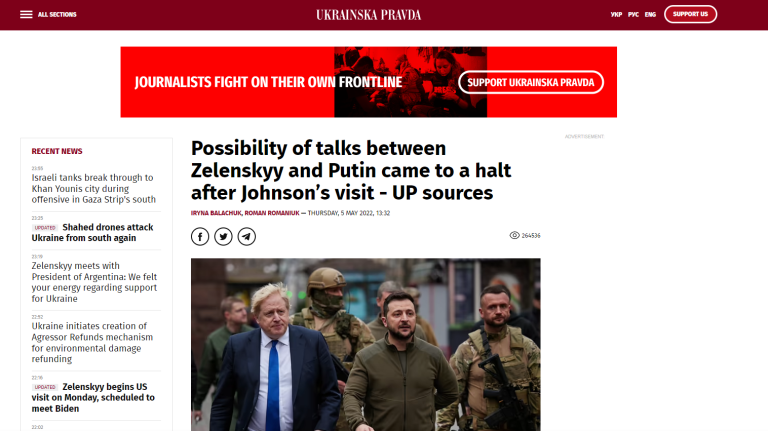
Boris Johnson ran to Kiev 3 days before the rare earth deal that was supposed to be signed in Kiev. Borris instructed Zelensky to insist on going to the White House, and the plan was to embarrass Trump on national TV to force him to fund the war. I passed on that info from my Ukrainian sources. That is why it appeared that Trump was prepared for the scheme. They always send Borris in to dictate to Zelensky. There was a peace deal, and it was Borris who flew to Kiev to inform Zelensky he was not allowed to sign any peace deal.
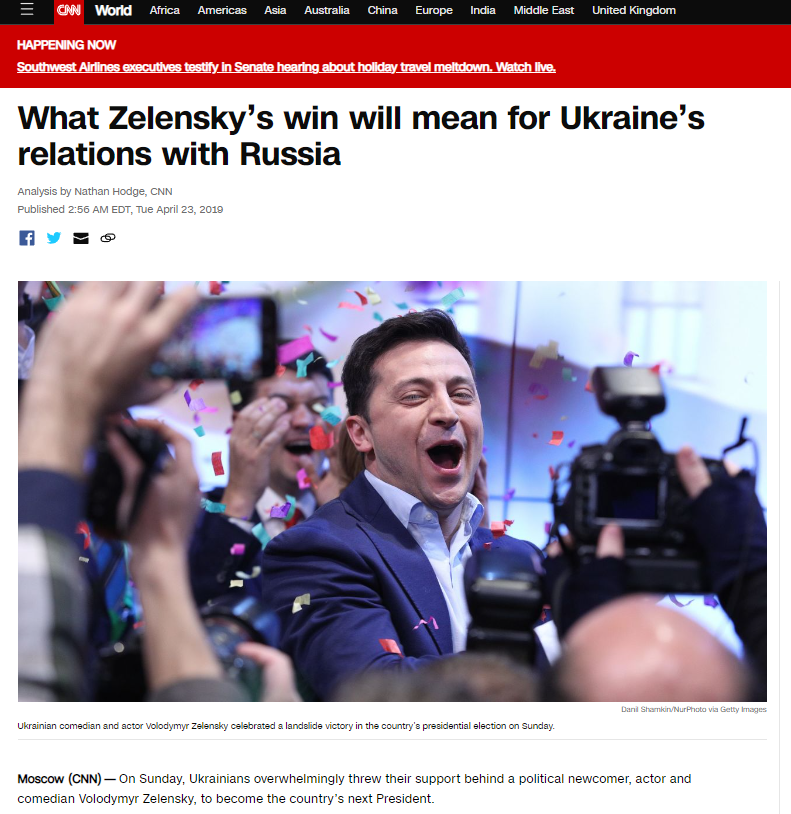
Zelensky is a piece of shit and that degrades shit because it is worse than that. He is a total fraud, and Putin is absolutely right: Zelensky is not the legitimate leader of Ukraine. Nobody in WWI or WWII used martial law to prevent elections. He is doing so because he is a fraud, and he would lose. The Ukrainian people voted for him because he promised peace when the previous government invaded the Donbas on the orders of Victoria Nuland et el and began this civil war to lure in Putin. The death toll when Zelensky took office was 13,000. It is now 1.1 million Ukrainians, and more than 8 million have fled to Europe because of him.
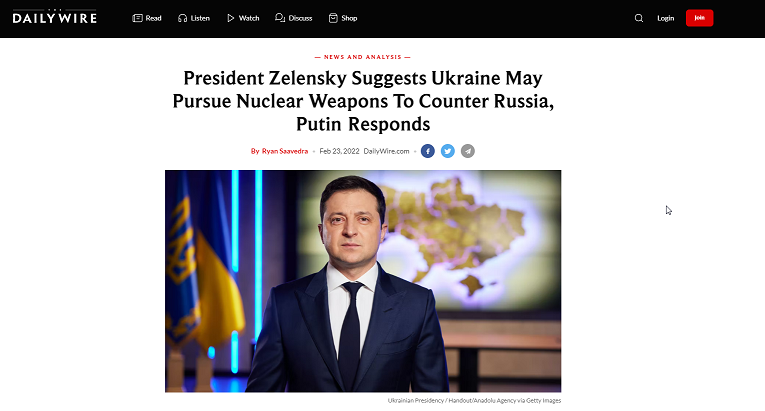
The day before Russia crossed the border, Zelensky declared he would rearm with nuclear weapons pointed at Russia. That was to make sure he would cross the border.
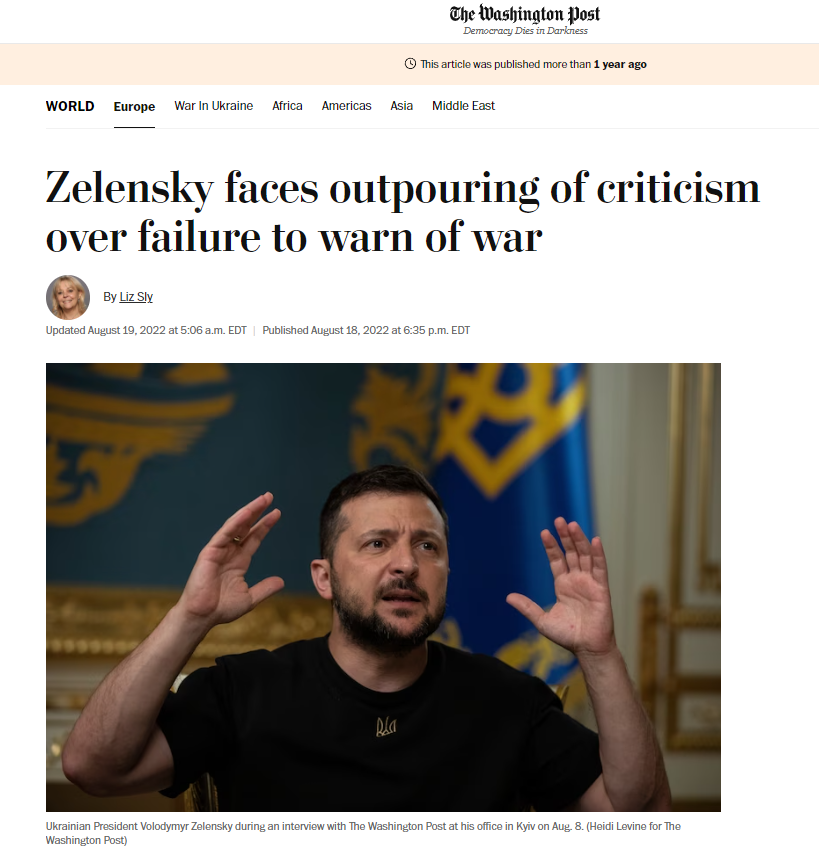
The Washington Post discovered that Zelensky KNEW when Russia would cross the border. They asked him WHY he did not warn his people, and he said it would have cost him $7 billion.
This latest attempt to renegotiate the deal to include NATO is to wage World War III and to invade Russia. He is taking his orders from the Neocons. Putin is absolutely correct. There will be no peace as long as this war criminal is in power.
Trump, wake the hell up!!!!
There is only one way out of this mess. Putin should give the Ukrainian people 30 days to vacate Kiev and inform them that he intends to nuke the city and end Kiev once and for all. Europe will then threaten to nuke Moscow, and Putin will target every European city. Maybe then, the Western Press will stop the propaganda and demand peace. This is going to take Europe backing down and for the people to rise up and get rid of these insane leaders like Kaja Kallas and Merz, along with Stamer and Macron. These are the people behind the curtain telling Zelensky to resist Trump because they want to invade Russia. Perhaps then the military in Ukraine will turn on Zelensky and allow a real election by the people.
Zelensky has done nothing but try to drag the entire world into his war against Russia. And for what? A territorial grab where Ukrainians have never lived? Any politician who supports Ukraine and this deliberate attempt to create World War III should be barred from ever holding any public office, including a dog catcher or a sanitation worker cleaning toilets.
–
Zelensky has called for a preemptive nuclear strike against Russia.
He is being coached all of the time. Let’s get real!!!!!!!!!!!!!!!!!!
This guy is not interested in peace. Putin is right. My Ukrainian sources have said that if he were on fire, they would not urinate on him until he was dead. Trump is pissing in the wind. Wake the hell up. The enemy is both within and in Europe.
Posted orignally on Apr 4, 2025 by Martin Armstrong
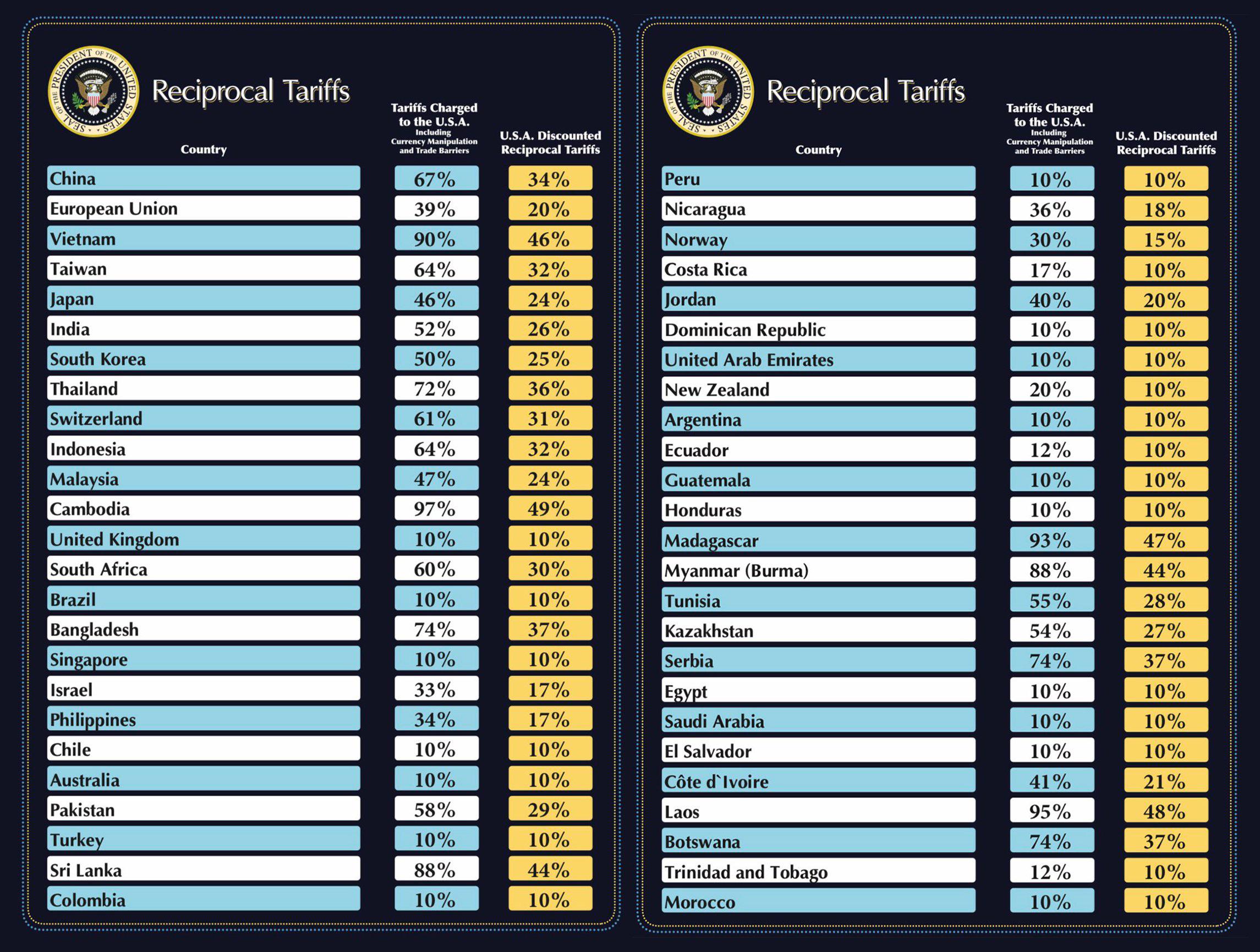
How did the Trump Administration come up with these tariff rates? Why would a nation like Madagascar, for example, with a small economy, be hit with a 47% tariff? Reciprocal tariffs were determined based on America’s trade deficit with other nations. They took each nation’s trade surplus with the US by total exports and divided that number by two, proclaiming we are asking them for half of what they have been charging the United States.
The assumption behind this method is that a trade surplus means one country is “taking advantage” of the other. However, trade imbalances do not function in such a cut-and-dry manner. The US runs trade deficits with some countries while running surpluses with others. The global economy is interconnected, and imposing arbitrary tariffs based on a deficit does not reflect the broader picture.
For example, China may have a surplus with the US, but it also imports raw materials from other nations to manufacture goods. If the US places a retaliatory tariff, it does not necessarily mean that China has been unfairly charging the US. China’s advantages of natural resources and lower production costs is part of the trade deal. There is a reason the US and China were one the largest trading partners, as China relied on American consumers the same way that America relied on cheaper Chinese goods. China was then investing in US debt, which it once viewed as a safe trade, but that is no longer the case, and America will suffer as a result. All of these measures are causing America’s trading partners to flee.
Look at Canada, where the population is far smaller than America’s, which is one of many variables. There is less demand overall and while Canada relied on the US for numerous imports, America was not subsidizing Canada. A trade deficit is not a subsidy! The US pays for Canadian goods and services with USD, which Canada then reinvests in the US economy. This is how global trade works; it is not a one-way street where Canada simply takes advantage of the US.
We cannot expect a complete balance in trading. Look at poorer nations—they simply could never purchase the same volume from America. Wages in these nations are far less than the US minimum wage, and thus, production is cheaper from a labor standpoint alone. For example, no one from Cambodia will be seeking an American-made car. A Cambodian factory will not move operations to the US to avoid the 49% tariff. They will look for alternative buyers outside of the US. Imbalances are a natural part of trade. Treasury Secretary Bessent said, “Let them eat flat screens,” but that is not the core of the issue. Americans did enjoy cheaper goods, but the bigger issue is that these tariffs make American investments LESS attractive as major companies cannot operate from a purely domestic standpoint.
The calculations do not factor in currency exchanges. Capital flows and currency values often influence trade deficits. If foreign capital flows into the US to buy Treasury bonds, real estate, or equities, it strengthens the USD, making US exports more expensive and imports cheaper. This is not a function of unfair trade practices but of the global demand for US assets.
By imposing tariffs arbitrarily, the cost of imported goods rises, which can negatively impact domestic industries who rely on those goods. Most American manufacturers rely on foreign goods to operate or finalize their “Made in America” products. Hiking up tariffs will cause the cost of production to soar. The workforce will shrink as profits decrease. Consumers bear the brunt of these policies through higher prices.
The assumption that tariffs should be determined by “half of the surplus” rule ignores the reality that trade wars are not linear. These tariffs are NOT “reciprocal” as the Trump Administration insists. They are not looking at the actual tariffs set by other nations. Those advising Trump believe that other countries will want to negotiate “tariffs” to permit free trade, but instead they are simply hoping to close trade deficits, and that simply cannot occur. Thursday’s sell-off is indicative of capital flowing out of the US. The Trump Administration basically told the world that America is closed for international business, and capital is responding to the threat. The real impact of these tariffs will soon come as we move deeper into a period of stagflation.
Posted originally on Apr 4, 2025 by Martin Armstrong
New York City Mayor Eric Adams, the man who fought tooth and nail to maintain sanctuary city status for migrants, has abandoned the Democratic Party. The Democrats have become so deeply unpopular that even Adams does not want to run for mayor under the DNC umbrella of madness.
“People often say, ‘You don’t sound like a Democrat, and you seem to have left the party.’ No, the party left me, and it left working-class people,” Adams touted. “We stopped talking to everyday New Yorkers and Americans. When I’m in the street talking to them, they’re not asking me, ‘Eric, tell me about fascism.’ They’re talking about finance. They’re not talking about Hitler, they’re talking about housing.”
Precisely. The people care about the ECONOMY first and foremost. Adams saw how quickly the law could turn against him when he faced his own inditement charges for bribery, wire fraud, and conspiracy. A right-wing Trump-appointed judge fought to drop his case, arguing it would interfere with his election campaign. Then a left-wing installed judge, Judge Dale Ho, insisted the charges remain in place as they felt the dismissal was “politically motivated” and would lead Adams to support Trump. The judge later dismissed the case with prejudice. Adams maintains his innocence and says he “trusted the wrong people” in his own party. As soon as he felt the injustice of New York’s legal system, Adams changed his stance on the Democratic Party dramatically.
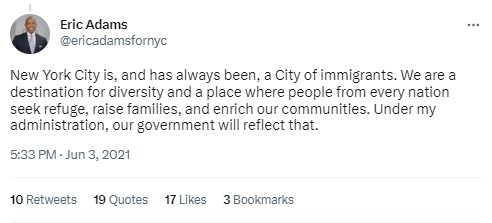
This is the same man who once said, “New York is a city that shares Democratic values.” That was before Eric Adams saw the repercussions of progressive policies firsthand when his city became overrun with migrants and crime. Retailers were losing over $12 million daily in NYC due to looters not being arrested under light-on-crime blue policies. Housing is entirely unaffordable. Businesses are fleeing New York due to excessive taxation. Even Wall Street has begun to migrate to Miami since conducting business in New York is nearly impossible.
Adams expressed his concerns regarding the migrant crisis, unable to decipher why simple policies like deporting criminals were controversial. “The mere fact that we cannot share with ICE that this person has committed three robberies and this person is part of an organized gang crew; there mere fact we can’t say that and communicate, that is a problem for me,” Adams said, adding, “I don’t believe people who are violent in our city and commit repeated crimes should have the privilege of being in our city.” How is this controversial?”
Adams repeatedly told the media that his Democratic friends in Washington refused to take his calls. “I was told to ‘be a good Democrat’ when I criticized Biden’s handling of the crisis. We were getting Venezuelan gang leaders that were coming to the city, creating crimes,” Adams later admitted.
Environmental madness began spreading to New York as well. Restaurants and businesses were told to prepare to reduce emissions by 75%. This meant restaurants in business for over 100 years would be forced to change their coal and wooden oven methods, eliminating the city’s culinary destination tourism. New York state approved a ban on gas stoves under a $229 BILLION budget plan to combat nature. Building codes have been changed to bend to these climate initiatives. None of these progressive policies has helped the people of New York and has done far more harm than good.
“I firmly believe that this city is better served by truly independent leadership, not leaders pulled at by the extremists on the far left or the far right, but instead those rooted in the common middle, the place where the vast majority of New Yorkers are firmly planted,” Adams said. The media is now demonizing Adams, stating that he is attempting to align himself with Trump. That is the only issue the Democrats can align on—demonizing Trump as Hitler and writing off anyone who does not view him as an enemy. The Democratic Party is dying a slow death by its own hands and will eventually cease to exist.
I have created this site to help people have fun in the kitchen. I write about enjoying life both in and out of my kitchen. Life is short! Make the most of it and enjoy!
This is a library of News Events not reported by the Main Stream Media documenting & connecting the dots on How the Obama Marxist Liberal agenda is destroying America








 Centinel2012