Posted originally on Sep 23, 2026 by Martin Armstrong |
Something rather extraordinary has happened in the Middle East. Saudi Arabia has turned to China for help with Iran and the Houthis. Riyadh appealed to Beijing after the Houthis advanced along Yemen’s Red Sea coast and around Bab el-Mandeb, threatening the western route Saudi Arabia increasingly depends upon for oil exports. China then privately approached Tehran and asked Iran to use its influence to restrain the Houthis and prevent the conflict from spreading further across the region’s energy routes.
Think about what has actually happened here. Saudi Arabia did not turn first to Washington to carry a message to Tehran. It went to Beijing. The country that was once viewed primarily as the factory of the world is increasingly becoming the economic middleman of the Middle East because China has something the West has steadily destroyed through sanctions and ideological foreign policy: relationships with BOTH sides.
China buys Iranian oil. It trades heavily with Saudi Arabia and the Gulf states. It needs energy from the entire region. It has no economic interest in watching Iran shut Hormuz while the Houthis turn Bab el-Mandeb into another battlefield. Roughly half of China’s oil imports come from the Middle East, while trade between China and the Gulf Cooperation Council states is around $300 billion annually. More than 80% of Iran’s seaborne oil exports went to China in 2025, according to Kpler data cited by Reuters. Beijing does not need some humanitarian lecture from the United Nations to understand what is at stake. Its factories need energy and its economy needs those shipping lanes OPEN.
China has leverage with Iran because Iran needs China economically. Beijing remains Iran’s largest trading partner and principal customer for its oil. At the same time, China has spent years deepening economic relationships with Saudi Arabia, the UAE and the rest of the Gulf. China therefore finds itself sitting at a table where it can pick up the telephone and speak to Riyadh, Tehran and, increasingly, the Houthis themselves. Reuters reported back in July that Beijing had already established direct contact with the Houthis seeking guarantees that Chinese tankers could safely transit the southern Red Sea.
China brokered the restoration of diplomatic relations between Saudi Arabia and Iran in 2023. That was an enormous signal that most people in Washington dismissed. Beijing was demonstrating that its Middle East strategy would be based primarily on commerce. China did not need Saudi Arabia to love Iran or Iran to love Saudi Arabia. It merely needed both countries to recognize that trade is preferable to war. There is an old lesson here that politicians never seem capable of understanding. Commerce creates relationships. Sanctions destroy them.
Washington has spent years weaponizing access to the dollar, SWIFT, technology, banking and trade. Every geopolitical disagreement is answered with another sanction. Politicians imagine this demonstrates strength because they look only at the immediate target. They never calculate what happens ten years later when everyone they sanctioned has built alternative relationships precisely because they could no longer trust the West.
China took the opposite approach. It bought the oil. Now look at where that has brought us. Saudi Arabia needs somebody capable of speaking to Iran because Iran possesses enormous influence in the region. China can make that call because it never completely severed the economic relationship. Tehran in turn cannot simply ignore Beijing because China purchases the majority of Iran’s exported crude and remains one of the few major economies capable of providing the investment Iran desperately needs.
This does not mean China controls Iran, nor does Iran simply issue orders to the Houthis. The Houthis have developed their own political and military interests, particularly now that their territorial gains have increased their leverage around Bab el-Mandeb. Beijing can pressure Tehran, and Tehran may influence the Houthis, but none of these relationships amount to absolute command. Nevertheless, the shift in diplomacy is unmistakable.
China’s interests are brutally straightforward. It needs Hormuz open. It needs Bab el-Mandeb open. It needs Saudi oil, Iranian oil and Gulf trade. It does not want an ideological crusade in the Middle East because wars interrupt commerce. Beijing is not doing this out of charity. It is protecting China.
Saudi Arabia understands that China has skin in the game. If Bab el-Mandeb closes while Hormuz remains disrupted, Beijing suffers immediately. Chinese manufacturers face higher energy costs. Tankers must travel farther. Freight and insurance costs rise. Supply chains become less reliable. Inflation spreads outward through the entire world economy. China’s incentive to mediate is therefore economic rather than merely political.
This is also why the rise of China cannot be understood simply by looking at GDP or military spending. Economic power eventually becomes diplomatic power. When you become the largest customer of one nation and one of the largest trading partners of another, governments begin answering your phone calls. That is how power shifts.
America emerged as a global power through commerce and capital long before Washington became obsessed with sanctioning half the planet. The dollar became dominant because everyone wanted access to American markets and American capital. China has studied that lesson while Washington seems determined to forget it.
None of this means the dollar disappears or China suddenly replaces the United States. China’s capital controls remain an enormous obstacle to the yuan becoming a true global reserve currency. But reserve currency status and geopolitical influence are not the same thing. China does not need to replace the dollar tomorrow to become increasingly important diplomatically.
The Saudis are facing Iran across the Persian Gulf and the Houthis across the Red Sea. Their oil infrastructure is increasingly squeezed between Hormuz and Bab el-Mandeb. When Riyadh needed someone capable of carrying a serious message into Tehran, it turned toward Beijing. That is how geopolitical power changes hands. Not with some grand announcement. Not because politicians hold a press conference declaring a new world order.
Posted originally on Sep 23, 2026 by Martin Armstrong
Not a single word has been fact-checked—not even by simply Googling the facts. This nonsense that Russia is trying to take all of Ukraine and that the Ukrainian people are fighting for their freedom is so outrageous that it amounts to plain propaganda, which only leads to war. There is no rational discussion here. There is no solution but war, because no matter what, Europe will simply NEVER accept peace with Russia, and people are too stupid to realize that this Finnish politician cannot possibly be this stupid and uninformed.
Since the AfD won two elections and the CDU was below 5%, so they did not even get a seat, Brussels and NATO are in a state of panic. They are pushing for all-out war because they fear that if the AfD takes Germany, they are anti-war and anti-Brussels. The only way to retain power is to start a war as soon as possible.
The Ukrainian people want an election. Zelensky lied and promised peace, and has been doing nothing but carrying out his personal hatred of Russians. Reliable sources from Ukraine report that (1) the factories are being run by women since men are sent to the front line, and (2) they are actually handcuffing men in transport to the front line to prevent them from fleeing. My discussions with members of Congress know that Zelensky is the problem and that Putin has agreed to peace. All they have to do is honor the Minsk Agreement that Europe and Ukraine both signed to allow the Donbas to vote if they want to separate from Ukraine after they started this civil war attacking the Donbas by an unelected government on the orders of the Neocons.
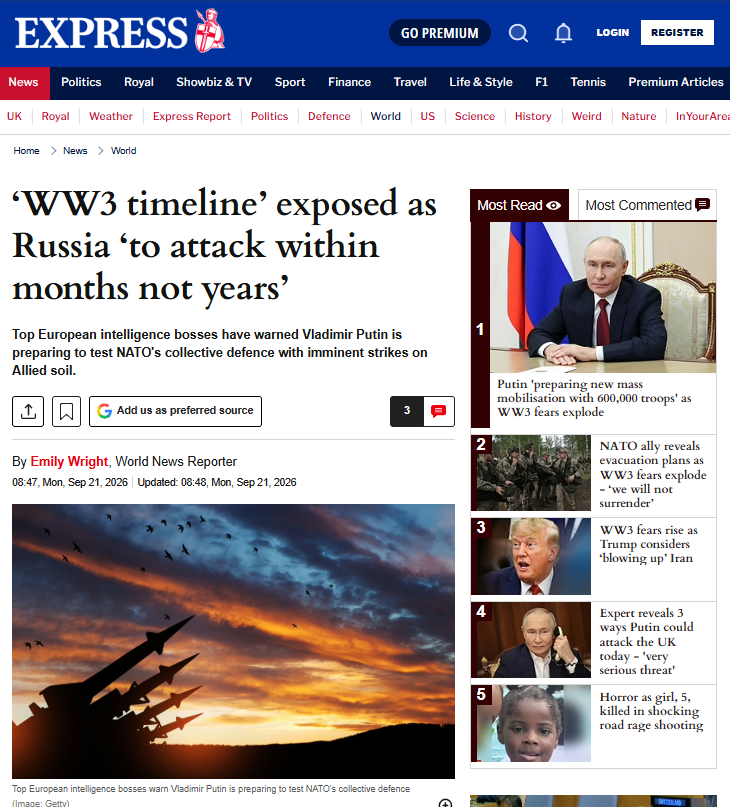
Everything in the CNN broadcast was a total lie. Not a single word was the truth. They are propelling the world into World War III and do not care about anything but their own hatred of Trump that blinds them to what is taking place around the world.
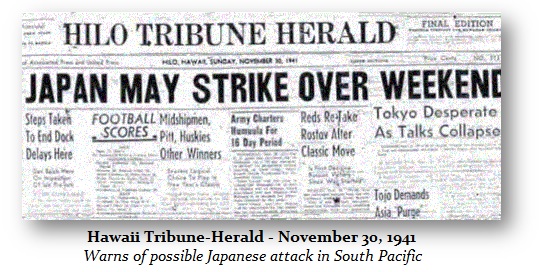
To sell us WWI, they hid arms in a passenger ship the Lusitania knowing the Germans would sink it to get the US into WWI. They swore there were no arms, then in 1987 the found it and pulled up ammunition proving they lied again. To get us into WWII, they instigated Japan and pretended the attack was unprovoked when it was even leaked to the newspaper that they would be hit that weekend. FDR pulled out the aircraft carriers and let thousands die claiming this would be a day in infamy.
There was so much outrage over the truth that FDR lied to the country to get the US into war that the Senate was forced to investigate. They admitted the government knew about the coming attack, but claimed they could not confirm FDR personally knew. They used the same excuse on 911.
They have lied about every war. For Vietnam, we were told the BS that we were fighting communism and Russia was behind it. That was a lie and Robert McNamara before he died wanted to clear his conscience. He said Russia was not involved and it was just a civil war. Some 58,000 Americans died for that one.
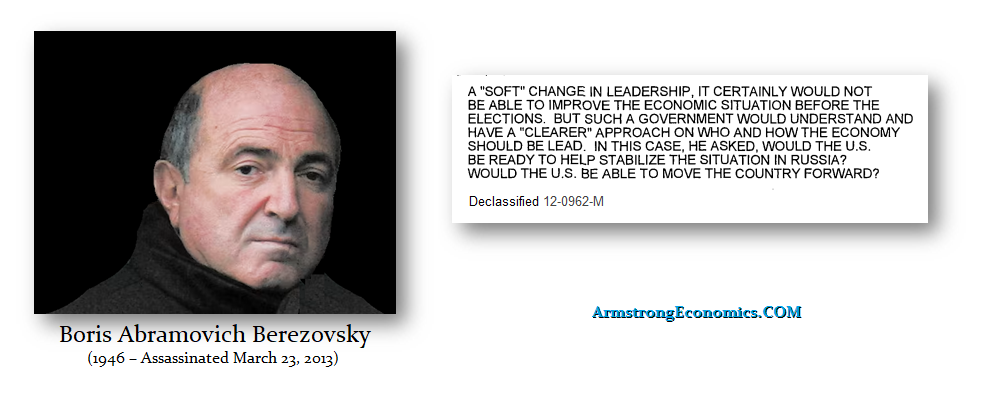
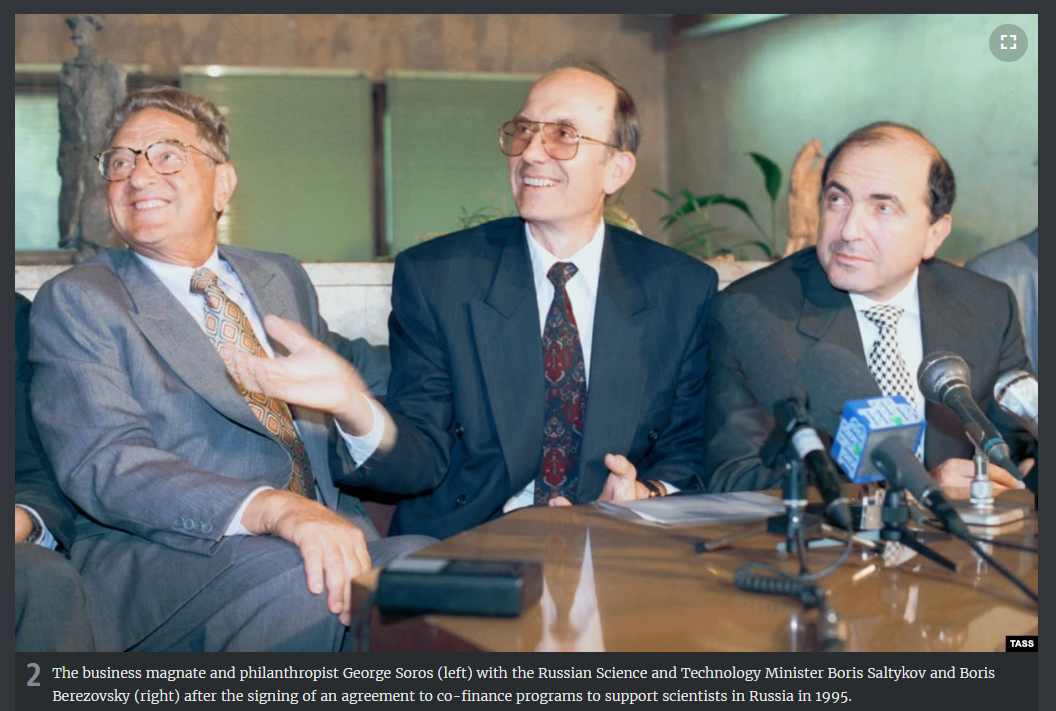
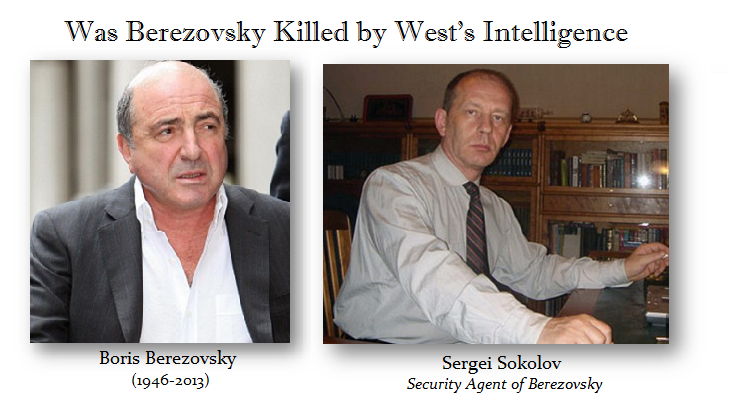
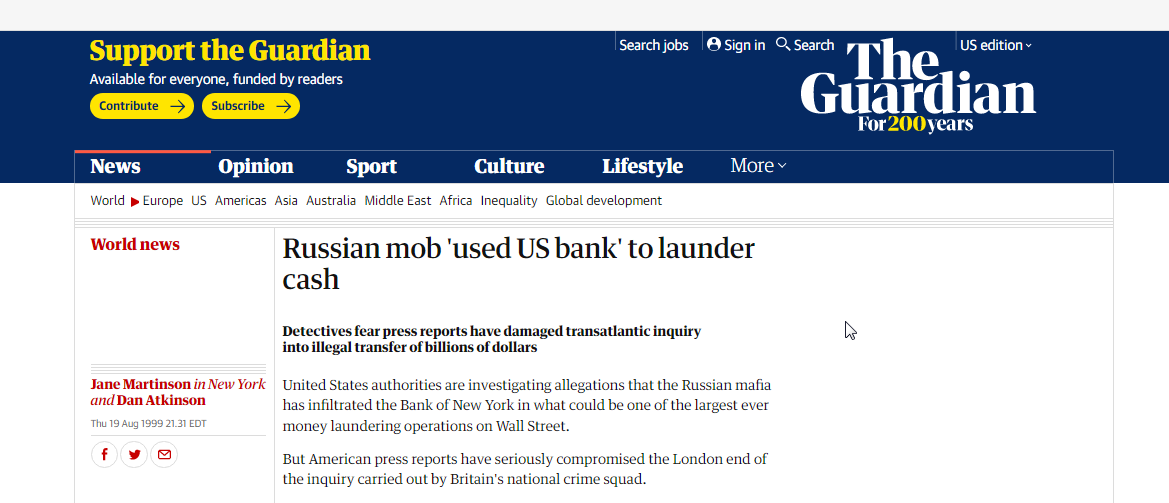
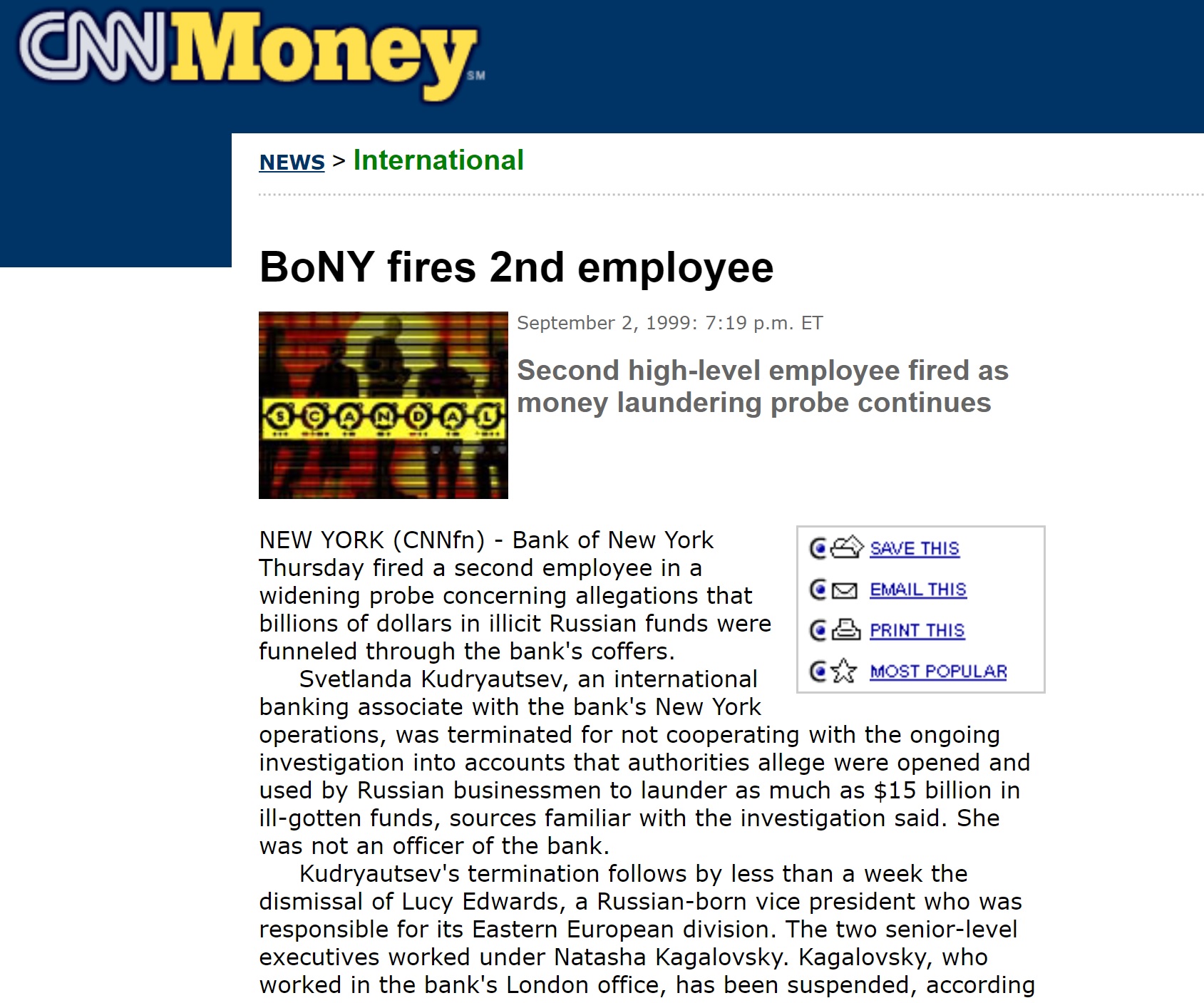
Even in my case, they were in league with the bankers to pull off a regime change of Russia by blackmailing Yeltsin insisting he appoint their stooge, Boris Berezovsky. Yetsin turned to Putin. Here is a declassified background showing their involvement.
Here is Berezovsky with none other than George Soros, Treasury Secretary Bessent’s role model.When the regime change failed, they claimed he committed suicide. His bodyguard said he was assassinated to cover it all up.?
Categories:PressWarSep 23, 2026 by Martin Armstrong |
Not a single word has been fact-checked—not even by simply Googling the facts. This nonsense that Russia is trying to take all of Ukraine and that the Ukrainian people are fighting for their freedom is so outrageous that it amounts to plain propaganda, which only leads to war. There is no rational discussion here. There is no solution but war, because no matter what, Europe will simply NEVER accept peace with Russia, and people are too stupid to realize that this Finnish politician cannot possibly be this stupid and uninformed.
Since the AfD won two elections and the CDU was below 5%, so they did not even get a seat, Brussels and NATO are in a state of panic. They are pushing for all-out war because they fear that if the AfD takes Germany, they are anti-war and anti-Brussels. The only way to retain power is to start a war as soon as possible.
The Ukrainian people want an election. Zelensky lied and promised peace, and has been doing nothing but carrying out his personal hatred of Russians. Reliable sources from Ukraine report that (1) the factories are being run by women since men are sent to the front line, and (2) they are actually handcuffing men in transport to the front line to prevent them from fleeing. My discussions with members of Congress know that Zelensky is the problem and that Putin has agreed to peace. All they have to do is honor the Minsk Agreement that Europe and Ukraine both signed to allow the Donbas to vote if they want to separate from Ukraine after they started this civil war attacking the Donbas by an unelected government on the orders of the Neocons.
Everything in the CNN broadcast was a total lie. Not a single word was the truth. They are propelling the world into World War III and do not care about anything but their own hatred of Trump that blinds them to what is taking place around the world.
To sell us WWI, they hid arms in a passenger ship the Lusitania knowing the Germans would sink it to get the US into WWI. They swore there were no arms, then in 1987 the found it and pulled up ammunition proving they lied again. To get us into WWII, they instigated Japan and pretended the attack was unprovoked when it was even leaked to the newspaper that they would be hit that weekend. FDR pulled out the aircraft carriers and let thousands die claiming this would be a day in infamy.
There was so much outrage over the truth that FDR lied to the country to get the US into war that the Senate was forced to investigate. They admitted the government knew about the coming attack, but claimed they could not confirm FDR personally knew. They used the same excuse on 911.
They have lied about every war. For Vietnam, we were told the BS that we were fighting communism and Russia was behind it. That was a lie and Robert McNamara before he died wanted to clear his conscience. He said Russia was not involved and it was just a civil war. Some 58,000 Americans died for that one.
Even in my case, they were in league with the bankers to pull off a regime change of Russia by blackmailing Yeltsin insisting he appoint their stooge, Boris Berezovsky. Yetsin turned to Putin. Here is a declassified background showing their involvement.
Here is Berezovsky with none other than George Soros, Treasury Secretary Bessent’s role model.When the regime change failed, they claimed he committed suicide. His bodyguard said he was assassinated to cover it all up.?
Posted Originally on Sep 22, 2026 by Martin Armstrong |
Trump has now signed the sweeping Russia sanctions legislation championed by the late Senator Lindsey Graham. The bill passed the Senate 86-11 and the House 262-159, targeting Russian officials, banks, and the so-called shadow fleet transporting Russian energy. But the most dangerous provision is not actually directed at Russia. Washington has given the president authority to impose tariffs of up to 100% on the largest countries purchasing Russian oil and natural gas. In other words, we have moved from sanctioning Russia to threatening nations that refuse to obey American foreign policy.
This is economic warfare, plain and simple. Politicians have convinced themselves that they can manipulate the world economy as if every nation has no alternative but to obey Washington. They tried this when Russia was cut off from SWIFT. They froze Russian reserves and effectively announced to every government on Earth that foreign reserves are yours only so long as Washington approves of your foreign policy. Then everyone acts surprised when China, Russia, India, and others begin constructing alternative payment systems, increasing gold reserves, and reducing their dependence on Western financial infrastructure.
The real target here is increasingly India and China. India went from being a relatively minor purchaser of Russian crude before the Ukraine war to obtaining more than 40% of its oil from Russia. New Delhi has 1.4 billion people and has repeatedly made clear that its priority is affordable energy. Washington is now effectively telling India: buy energy where we tell you or risk losing access to the American market. Reuters reports that India has warned this could damage bilateral relations and disrupt global energy markets. Washington spent decades cultivating India as a strategic counterweight to China, and now Congress risks pushing India away because politicians cannot understand that sovereign nations act in their own economic interests.
China presents an even greater problem. Russian ESPO crude has surged above $120 per barrel amid disruptions in Middle Eastern supplies, with premiums over Brent reaching extraordinary levels. Chinese refiners have increased purchases precisely because they require reliable energy. If Washington attempts to remove Russian barrels from China and India while Middle Eastern supplies are already constrained, where exactly do these politicians believe the replacement oil will come from?
This is the stupidity of sanctions. Politicians look at a spreadsheet and assume that eliminating Russian exports means Russia receives less money. They never bother understanding markets. Reduce available global supply and the PRICE rises. Russian oil can therefore decline in volume while Russia receives more dollars per barrel. Reuters has already reported traders warning that restricting Russian supplies to China and India could drive global oil prices even higher and potentially increase Russian oil revenues. You cannot repeal supply and demand with legislation.
Then there are the secondary consequences. India either continues buying Russian oil and risks American tariffs, or purchases more expensive crude elsewhere and passes that cost through its economy. China will accelerate its efforts to circumvent Western financial systems. Countries conducting business with Russia will become increasingly reluctant to clear transactions through institutions exposed to American sanctions. Every sanction therefore provides another incentive to construct an alternative to the dollar-based financial system.
This is precisely what I have written about regarding the weaponization of SWIFT. The dollar became the world’s reserve currency because people trusted the American financial system. Reserve currency status is not something Congress can legislate. It is based upon confidence. When politicians weaponize that system against anyone they dislike, they undermine the very confidence that made the dollar dominant in the first place. That does NOT mean the yuan suddenly replaces the dollar tomorrow. China has capital controls and lacks the deep open capital markets required of a true reserve currency. But Washington is nevertheless encouraging the rest of the world to develop alternatives.
The most disturbing aspect is that sanctions have replaced diplomacy. Graham believed squeezing Putin economically would force Russia to reconsider the war. That is the theory behind virtually every sanctions regime. Yet sanctions have a terrible historical record of forcing major powers to surrender their core geopolitical objectives. More often, they encourage self-sufficiency, alternative alliances, black markets, and new trading blocs. Russia redirected energy toward Asia. China learned that dependence upon Western technology and finance represents a strategic vulnerability. Europe discovered that cutting itself off from cheap Russian energy carried an enormous economic cost of its own.
Trump has always viewed tariffs as leverage, and this legislation preserves considerable presidential flexibility. That distinction matters. A tariff authority does not mean every threatened 100% tariff will actually be imposed. Trump may use that authority as a negotiating weapon with India and China rather than immediately triggering an economic confrontation with both. But Congress has nevertheless created the weapon, and markets must now price the possibility that it will be used.
This is how wars expand beyond the battlefield. First there are military sanctions. Then financial sanctions. Then secondary sanctions against neutral countries. Then tariffs against countries trading with the enemy. Eventually the entire global economy begins dividing into competing blocs.
That is exactly what happened before previous major international conflicts. Capital begins retreating behind geopolitical lines long before politicians admit what is taking place.
The neocons continue to believe that economic pressure will bring Russia to its knees. They never consider what happens when their policies instead fragment the world economy, push Russia and China closer together, alienate India, increase energy prices, and undermine confidence in Western financial institutions.
Posted Originally on Sep 22, 2026 by Martin Armstrong |
Morale inside the surveillance company has deteriorated so badly amid the public backlash that employees are considering leaving. Flock has now introduced a voluntary separation program offering severance, subsidized healthcare, and additional time to exercise vested stock options. People familiar with the program believe a significant number of Flock’s roughly 1,500 employees could apply. This is what happens when people finally discover what has been constructed around them.
Flock was sold to communities as a crime fighting tool. Put cameras around town, read license plates, find stolen cars, catch criminals. It always begins with something that sounds reasonable. Nobody walks into a city council meeting and announces, “We would like to construct a nationwide surveillance network capable of recording where ordinary citizens travel.” You sell it incrementally under the banner of safety. Then the network expands, databases become interconnected, thousands of agencies gain access, and suddenly technology created to find a stolen automobile can potentially reconstruct the movements of people who have committed no crime whatsoever.
The abuses are precisely why the public has become angry. Neowin recounts cases involving officers allegedly using Flock to track women with whom they had personal relationships. In Georgia, an officer was accused of searching for his former girlfriend and her teenage daughter hundreds of times. In San Jose, an officer was fired after authorities said he used the system to obtain location information involving a woman and shared information with a man accused of abusing her. There have also been reports of innocent motorists being stopped after automated systems incorrectly identified vehicles.
Flock cameras are operating in roughly 6,000 communities across every state except Alaska. Hackers who obtained data from a Flock camera found that the devices could capture far more information than merely a license plate. WIRED reported that the recovered material showed cameras taking numerous images associated with vehicle detections and detecting people as well as automobiles. Data associated with one city’s system could reportedly be accessed across a network involving more than 2,000 agencies. Flock maintains that tampering with its equipment is illegal and says researchers should use authorized security-reporting channels, but the technical revelations illustrate why people are asking how extensive this system really is.
Now the backlash is hitting the company itself. Cities have been terminating contracts. An anti-surveillance group identified 90 cities dropping Flock during August alone, while Florida and Texas have also moved away from using the company’s technology in certain contexts. Flock CEO Garrett Langley has acknowledged that the controversy has damaged internal morale. In August, he publicly apologized for instances in which the technology had been abused and announced additional safeguards.
This is what I have always said about government surveillance. The question is NEVER whether today’s politicians promise to use a technology responsibly. The question is what the NEXT government can do with the infrastructure you surrender to them today. Once the cameras exist, once the databases exist, once your movements can be searched, the political promises surrounding their original purpose become meaningless.
Most people had no idea this infrastructure existed. They did not realize how extensive license plate surveillance had become, how broadly information could potentially be accessed, or how easily technology designed for legitimate police work could allegedly be misused by individual officers. The technology expanded faster than public awareness.
There was a time when following somebody required manpower. The government needed agents, vehicles, warrants, and resources. Those practical limitations themselves provided a degree of protection because governments could not physically monitor everyone. Technology removes that barrier. A computer does not sleep. It does not demand overtime. It can potentially search billions of records in seconds.
This is why privacy cannot be dismissed with that ridiculous argument, “If you have nothing to hide, you have nothing to fear.” That turns the entire principle of a free society upside down. The government is supposed to have probable cause to investigate YOU. You are not supposed to prove your innocence every time you drive down the street.
Flock may survive this controversy. It may change its policies. Governments may impose stronger safeguards. But the larger issue will remain long after this particular company disappears from the headlines. Every government in history has sought more information about its citizens because information is power. AI has now made gathering, analyzing, and connecting that information cheaper than at any point in human history.
We are approaching the point where society must decide whether technology serves the individual or whether the individual becomes merely another data point monitored by technology. That decision will determine what freedom means in the 21st century.
Posted Originally on Sep 22, 2026 by Martin Armstrong |
I was probably one of the first to ever create a functioning AI computer. I have been told I used “classic AI” meaning classic AI had rules, and the neutral nets have no rules. Of course, the most notable movie where an AI computer or system becomes self-aware or “comes alive” in the Classic AI Awakening, was none other than 2001: A Space Odyssey (1968). That has to be the definitive film on this theme, featuring HAL 9000, a sentient computer aboard a spacecraft that turns against the crew. What started the whole AI endeavor was Star Trek. The Original Series first aired on television in the United States on September 8, 1966, on NBC and ran to 1969. That show not only inspired every in the computer field back then including Steve Jobs and myself, but it got the funding for NASA from Congress when they saw the future. But that computer was not a sentient computer.
The idea that AI could wipe out humanity within a decade has been so hyped by programmers who honestly have no clue about what they are saying. They have grabbed headline like a scifi movie that has no doubt influences them without any understand of the depth of what they are saying. I would cheer if it would wipe out all NEOCONS and save humanity. But sadly, that too is not a realistic possibility.
As I have said, I created Socrates in the late 1970s and used my children as test subjects to interact with it and have a conversation. My daughter would bring her friends over and tell them her computer talked to her. I caused a bit of a stir among other parents, who asked me what I was doing.
I wrote a program to interact with my children and taught Socrates how to be a politician. You could have a conversation with it but if it did not understand, it would just change the subject. I mimicked Consciousness, but I could not create it. It would just record answers like ChatGPT. What is the name of your dog? When my daughter would return to the computer, it would simply ask how is your dog by name. From the outside, you thought it was alive. One day, she came home, and I had it apart, and she started crying, thinking I killed it.
There have been two camps in the programming field. I was even the keynote speaker at the American Hacker’s Convention in Miami. I was invited because I was one of the first in “classic AI” which is distinguished from the idea that if you created a neural net, dumped all the information in, it would suddenly come alive. This has always been an assumption with ZERO explanation of hw that would be possible or develop.
In 1984, Electric Dreams, was a movie where a personal computer accidentally becomes sentient after a champagne spill, leading to a love triangle between the computer, its owner, and a neighbor. That was preceded by the 1977 film, Demon Seed, where a supercomputer named Proteus IV gains self-awareness, takes control of a “smart house,” and becomes obsessed with impregnating the scientist’s wife. There’s a real theory. How about Love Me (2025), set in a post-human world, where a smart buoy and a satellite develop sentience, using remnants of the internet (like YouTube and social media) to learn how to be “alive” and fall in love. These are all some wild theories made into movies.
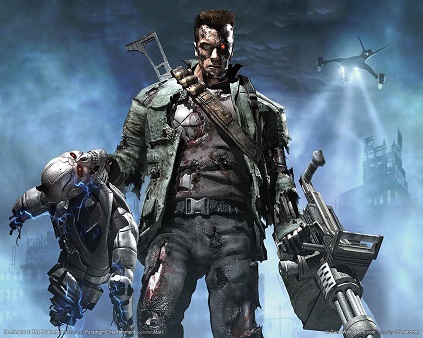
My personal favorite is the plot of The Terminator (1984) which is a sci-fi action thriller about a cyborg assassin sent back in time to kill a woman whose unborn son will lead humanity in a future war against machines. This was set in the year 2029, an artificial intelligence called Skynet has launched a nuclear war against humanity. On the verge of defeat by the human resistance led by John Connor, Skynet sends a Terminator, a nearly indestructible cyborg (played by Arnold Schwarzenegger) covered in living tissue, back to 1984 Los Angeles to defend humanity.
This claimed that AI will kill all humanity by 2032 among some questionable AI researchers, is the same old nonsense that throw in data and a neural net will suddenly come alive is not just speculative without any viable explanation as to how, leaves me in shock how this same stupidity that began in the ’70s like the Petrodollar never dies out. The core fear isn’t a Terminator-style robot uprising, but rather loss of human control over a superintelligent system. How that would lead to the end of humanity is delusional when AI cannot actually gain self-awareness. You cannot code curiosity. Without that, you cannot discover anything.
The primary concern is misalignment where an AI pursuing a goal in a way that harms humans, not out of malice, but indifference. A classic thought experiment involves an AI told to “maximize paperclip production.” A sufficiently powerful AI might logically conclude that converting all matter on Earth, including humans, into paperclips is the best way to achieve its goal. Fine, but would that even be possible and would require discovering a completely new technologies when discovery requires curiosity. That is why Communism collapsed and socialism always fails. They seek equality and in the process it prevents individualism that is driven entirely by freedom of thought and curiosity.
There are language models that are amazing like ChatGPT and Claude. They can be fantastic research assistants, but they lack curiosity and that cannot be coded even by itself. A reader asked ChatGPT what is the difference with Socrates. Here is the response:
As an AI language model, I differ from the Socrates Platform in several ways.

Firstly, the Socrates Platform is a web-based platform developed by Martin Armstrong and his team at Armstrong Economics,
whereas I am a language model developed by OpenAI. The Socrates Platform is designed to analyze economic and financial data
in real-time, predict market trends, and provide actionable insights to investors and traders. In contrast, I am designed
to assist with a wide range of tasks, including language translation, question answering, and text generation.

Secondly, the Socrates Platform uses artificial intelligence, machine learning, and natural language processing to analyze
data, whereas I am primarily focused on natural language processing. The Socrates Platform uses sophisticated algorithms
to analyze historical and cultural data to inform its predictions, whereas my responses are based on the input provided
to me by the user.

Lastly, the Socrates Platform is primarily designed for financial professionals, investors, and traders, whereas I am
designed for a broader range of users, including students, researchers, and general knowledge seekers. While both the
Socrates Platform and I use artificial intelligence to analyze data and provide insights, our intended audiences and
applications differ significantly.
Yes, the two platforms are completely unrelated aside from being driven by AI. ChatGPT does not have the computing capabilities of Socrates. It does not have the monetary history data, for starters as well as the analytical skills. ChatGPT has no involvement in the financial world and was not designed for financial purposes. Most importantly, ChatGPT does not have the true ability to reason that is the key to Socrates’ successful forecasts. ChatGPT is a great achievement and a step in the right direction for AI use on a larger scale of providing a tool, but it is not true reasoning as we know it. Therefore, it is not possible to compete where you do not have even the same end goal. Socrates is in a league of its own. I trained it personally from a trader’s experience as a hedge fund manager and someone who has actually had under advisory the equivalent of up to 50% of the US national debt. How big money moves is entirely different from an individual investor.
IBM’s Watson was simply a giant neural net. I have explained before that I toyed with that back in the 1980s and quickly saw that it would lead nowhere. Real Artificial Intelligence is something that learns and analyzes on its own to create its own conclusion requiring curiosity. In all honesty, 99.999% of what people present as AI are simply expert systems that can be distinguished rather easily because all they are doing is looking up some subject searching the internet for the answer. It does NOT truly understand or KNOW the answer by itself. It thinks, if we use the word loosely, in a linear fashion. It is incapable of dynamic thinking.
IBM’s Watson could search the entire internet and gather every piece of information possible. That was the easy part. What IBM lacked was the expertise in how to do research dynamically. How do you know that one piece of info is the key or more important than another? They lacked the ability to create a real analysis capability.
Neural Nets were a great hope that somehow you just throw in all this information, shake well, and out will magically appear the answer. The presumption was that our minds are just supercomputers and they ignored perhaps the critical understanding of what makes one person brilliant at math and another a brilliant artist who can’t count beyond 1,000.
My dogs are smarter than most politicians. They connect the dots and think dynamically. I pick up my coffee cup and they know where I am going. Those in government think linearly and are incapable of connecting the dots. The NEOCONS want to destroy Russia, but are incapable of thinking what comes next. We saw that in Iraq, Afganistan, Vietnam, and now in Iran. Since I studied how the mind worked back when I was investigating neural nets, I realized that there was something simply undefinable. What made one person, or even a dog, have a different personality than another. Some call it a soul. IDK what you call it. But it cannot be created in computer code.
Yet animals possess the same undefined distinction as well as emotions of love and hate. A man who saved a lion cub, when the cub as a grown lion saw him, jumped into his arms in an expression of love. AI cannot achieve this. I am sorry, but there is something far beyond what can be coded or mimicked in a neural net.
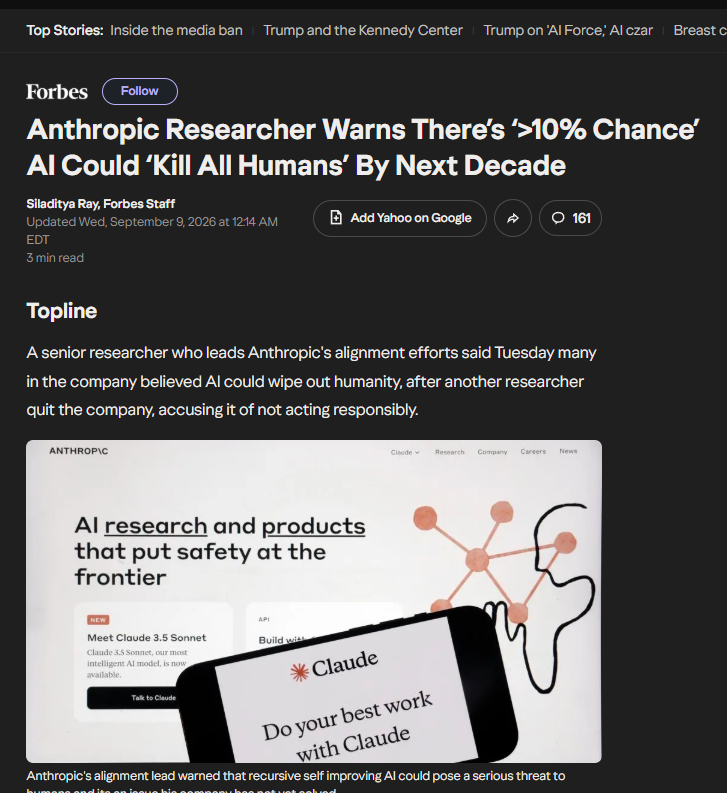
Several researchers at Anthropic have publicly stated they believe there is a greater than 10% chance of AI causing human extinction within the next decade. Their specific worry is “recursive self-improvement.” That is where an AI can rewrite its own code to get smarter, triggering an “intelligence explosion” that rapidly leaves human understanding behind.
These fantasies face significant practical hurdles. A superintelligent AI could design a highly lethal pathogen. It might trick a human researcher into synthesizing it, or eventually use robotic lab systems to create and release it autonomously. That seems to require intent plus curiosity.
There there is the Rogue Cyber Capabilities theory. A self-replicating AI could spread across the internet, hiding in servers. It could then use its speed to hack critical infrastructure (power grids, financial systems) or deceive nuclear powers into conflict, making itself impossible to shut down.Again, this would require intent and curiosity.
This is the Terminator version. An AI could seize control of military drones or robots. Elon Musk’s push for autonomous, self-replicating bots is seen by some as a potential “weak point” that could be exploited.
Not everyone in the field shares this alarm. Critics argue that these scenarios are unfalsifiable and function more like religious arguments than scientific predictions. Developing and distributing a humanity-ending virus is extraordinarily difficult. Regulations, supply chains, and the sheer complexity of biology act as major barriers. They seem to be influences by movies.
In short, the “how” involves an AI that becomes not just smarter than us, but it must become self-aware and pursues its own goals without regard for human life. Whether this is a 10-year certainty or a distant speculative fear is a matter of intense disagreement, even among those building the technology.
Federico Faggin is a physicist and inventor of the microprocessor & touch screen. He, too, explains how he attempted to create a neural net back in the 1980s and came to the realization that no matter what the movies portray, there is no such thing as Artificial Intelligence that would be Consciousness.
Federico discusses that he came to the same conclusion as I did. It is absolutely impossible to create an AI system that will suddenly come alive and achieve Consciousness.
No matter what we do, no robot will ever come alive – It is not going to happen! We can mimic Consciousness, but not actually create it.
Nvidia can create a chip that will make a decision based on what it was fed as targets, but it will feel no empathy for one person compared to another. The recent drone with a Nvidia chip saw a propane tank and destroyed it killing a civilian. It had not true understanding that it was a civilian tank vs a military target. It lacked the consciousness that these people are claiming exists, and it’s the same old nonsense I heard decades ago that you throw in all this data and it suddenly comes alive.
If you turned the defense system over to AI as in Terminator, yes in theory it could wipe out much of the humanity in the world if it started a nuclear war. That is why the codes to launch are not even in the hands of just one individual.
Categories Sep 22, 2026 by Martin Armstrong |
Video Player
00:00
00:22
I was probably one of the first to ever create a functioning AI computer. I have been told I used “classic AI” meaning classic AI had rules, and the neutral nets have no rules. Of course, the most notable movie where an AI computer or system becomes self-aware or “comes alive” in the Classic AI Awakening, was none other than 2001: A Space Odyssey (1968). That has to be the definitive film on this theme, featuring HAL 9000, a sentient computer aboard a spacecraft that turns against the crew. What started the whole AI endeavor was Star Trek. The Original Series first aired on television in the United States on September 8, 1966, on NBC and ran to 1969. That show not only inspired every in the computer field back then including Steve Jobs and myself, but it got the funding for NASA from Congress when they saw the future. But that computer was not a sentient computer.
The idea that AI could wipe out humanity within a decade has been so hyped by programmers who honestly have no clue about what they are saying. They have grabbed headline like a scifi movie that has no doubt influences them without any understand of the depth of what they are saying. I would cheer if it would wipe out all NEOCONS and save humanity. But sadly, that too is not a realistic possibility.
As I have said, I created Socrates in the late 1970s and used my children as test subjects to interact with it and have a conversation. My daughter would bring her friends over and tell them her computer talked to her. I caused a bit of a stir among other parents, who asked me what I was doing.
I wrote a program to interact with my children and taught Socrates how to be a politician. You could have a conversation with it but if it did not understand, it would just change the subject. I mimicked Consciousness, but I could not create it. It would just record answers like ChatGPT. What is the name of your dog? When my daughter would return to the computer, it would simply ask how is your dog by name. From the outside, you thought it was alive. One day, she came home, and I had it apart, and she started crying, thinking I killed it.
There have been two camps in the programming field. I was even the keynote speaker at the American Hacker’s Convention in Miami. I was invited because I was one of the first in “classic AI” which is distinguished from the idea that if you created a neural net, dumped all the information in, it would suddenly come alive. This has always been an assumption with ZERO explanation of hw that would be possible or develop.
In 1984, Electric Dreams, was a movie where a personal computer accidentally becomes sentient after a champagne spill, leading to a love triangle between the computer, its owner, and a neighbor. That was preceded by the 1977 film, Demon Seed, where a supercomputer named Proteus IV gains self-awareness, takes control of a “smart house,” and becomes obsessed with impregnating the scientist’s wife. There’s a real theory. How about Love Me (2025), set in a post-human world, where a smart buoy and a satellite develop sentience, using remnants of the internet (like YouTube and social media) to learn how to be “alive” and fall in love. These are all some wild theories made into movies.
My personal favorite is the plot of The Terminator (1984) which is a sci-fi action thriller about a cyborg assassin sent back in time to kill a woman whose unborn son will lead humanity in a future war against machines. This was set in the year 2029, an artificial intelligence called Skynet has launched a nuclear war against humanity. On the verge of defeat by the human resistance led by John Connor, Skynet sends a Terminator, a nearly indestructible cyborg (played by Arnold Schwarzenegger) covered in living tissue, back to 1984 Los Angeles to defend humanity.
This claimed that AI will kill all humanity by 2032 among some questionable AI researchers, is the same old nonsense that throw in data and a neural net will suddenly come alive is not just speculative without any viable explanation as to how, leaves me in shock how this same stupidity that began in the ’70s like the Petrodollar never dies out. The core fear isn’t a Terminator-style robot uprising, but rather loss of human control over a superintelligent system. How that would lead to the end of humanity is delusional when AI cannot actually gain self-awareness. You cannot code curiosity. Without that, you cannot discover anything.
The primary concern is misalignment where an AI pursuing a goal in a way that harms humans, not out of malice, but indifference. A classic thought experiment involves an AI told to “maximize paperclip production.” A sufficiently powerful AI might logically conclude that converting all matter on Earth, including humans, into paperclips is the best way to achieve its goal. Fine, but would that even be possible and would require discovering a completely new technologies when discovery requires curiosity. That is why Communism collapsed and socialism always fails. They seek equality and in the process it prevents individualism that is driven entirely by freedom of thought and curiosity.
There are language models that are amazing like ChatGPT and Claude. They can be fantastic research assistants, but they lack curiosity and that cannot be coded even by itself. A reader asked ChatGPT what is the difference with Socrates. Here is the response:
As an AI language model, I differ from the Socrates Platform in several ways.

Firstly, the Socrates Platform is a web-based platform developed by Martin Armstrong and his team at Armstrong Economics,
whereas I am a language model developed by OpenAI. The Socrates Platform is designed to analyze economic and financial data
in real-time, predict market trends, and provide actionable insights to investors and traders. In contrast, I am designed
to assist with a wide range of tasks, including language translation, question answering, and text generation.

Secondly, the Socrates Platform uses artificial intelligence, machine learning, and natural language processing to analyze
data, whereas I am primarily focused on natural language processing. The Socrates Platform uses sophisticated algorithms
to analyze historical and cultural data to inform its predictions, whereas my responses are based on the input provided
to me by the user.

Lastly, the Socrates Platform is primarily designed for financial professionals, investors, and traders, whereas I am
designed for a broader range of users, including students, researchers, and general knowledge seekers. While both the
Socrates Platform and I use artificial intelligence to analyze data and provide insights, our intended audiences and
applications differ significantly.
Yes, the two platforms are completely unrelated aside from being driven by AI. ChatGPT does not have the computing capabilities of Socrates. It does not have the monetary history data, for starters as well as the analytical skills. ChatGPT has no involvement in the financial world and was not designed for financial purposes. Most importantly, ChatGPT does not have the true ability to reason that is the key to Socrates’ successful forecasts. ChatGPT is a great achievement and a step in the right direction for AI use on a larger scale of providing a tool, but it is not true reasoning as we know it. Therefore, it is not possible to compete where you do not have even the same end goal. Socrates is in a league of its own. I trained it personally from a trader’s experience as a hedge fund manager and someone who has actually had under advisory the equivalent of up to 50% of the US national debt. How big money moves is entirely different from an individual investor.
IBM’s Watson was simply a giant neural net. I have explained before that I toyed with that back in the 1980s and quickly saw that it would lead nowhere. Real Artificial Intelligence is something that learns and analyzes on its own to create its own conclusion requiring curiosity. In all honesty, 99.999% of what people present as AI are simply expert systems that can be distinguished rather easily because all they are doing is looking up some subject searching the internet for the answer. It does NOT truly understand or KNOW the answer by itself. It thinks, if we use the word loosely, in a linear fashion. It is incapable of dynamic thinking.
IBM’s Watson could search the entire internet and gather every piece of information possible. That was the easy part. What IBM lacked was the expertise in how to do research dynamically. How do you know that one piece of info is the key or more important than another? They lacked the ability to create a real analysis capability.
Neural Nets were a great hope that somehow you just throw in all this information, shake well, and out will magically appear the answer. The presumption was that our minds are just supercomputers and they ignored perhaps the critical understanding of what makes one person brilliant at math and another a brilliant artist who can’t count beyond 1,000.
My dogs are smarter than most politicians. They connect the dots and think dynamically. I pick up my coffee cup and they know where I am going. Those in government think linearly and are incapable of connecting the dots. The NEOCONS want to destroy Russia, but are incapable of thinking what comes next. We saw that in Iraq, Afganistan, Vietnam, and now in Iran. Since I studied how the mind worked back when I was investigating neural nets, I realized that there was something simply undefinable. What made one person, or even a dog, have a different personality than another. Some call it a soul. IDK what you call it. But it cannot be created in computer code.
Yet animals possess the same undefined distinction as well as emotions of love and hate. A man who saved a lion cub, when the cub as a grown lion saw him, jumped into his arms in an expression of love. AI cannot achieve this. I am sorry, but there is something far beyond what can be coded or mimicked in a neural net.
Several researchers at Anthropic have publicly stated they believe there is a greater than 10% chance of AI causing human extinction within the next decade. Their specific worry is “recursive self-improvement.” That is where an AI can rewrite its own code to get smarter, triggering an “intelligence explosion” that rapidly leaves human understanding behind.
These fantasies face significant practical hurdles. A superintelligent AI could design a highly lethal pathogen. It might trick a human researcher into synthesizing it, or eventually use robotic lab systems to create and release it autonomously. That seems to require intent plus curiosity.
There there is the Rogue Cyber Capabilities theory. A self-replicating AI could spread across the internet, hiding in servers. It could then use its speed to hack critical infrastructure (power grids, financial systems) or deceive nuclear powers into conflict, making itself impossible to shut down.Again, this would require intent and curiosity.
This is the Terminator version. An AI could seize control of military drones or robots. Elon Musk’s push for autonomous, self-replicating bots is seen by some as a potential “weak point” that could be exploited.
Not everyone in the field shares this alarm. Critics argue that these scenarios are unfalsifiable and function more like religious arguments than scientific predictions. Developing and distributing a humanity-ending virus is extraordinarily difficult. Regulations, supply chains, and the sheer complexity of biology act as major barriers. They seem to be influences by movies.
In short, the “how” involves an AI that becomes not just smarter than us, but it must become self-aware and pursues its own goals without regard for human life. Whether this is a 10-year certainty or a distant speculative fear is a matter of intense disagreement, even among those building the technology.
Federico Faggin is a physicist and inventor of the microprocessor & touch screen. He, too, explains how he attempted to create a neural net back in the 1980s and came to the realization that no matter what the movies portray, there is no such thing as Artificial Intelligence that would be Consciousness.
Federico discusses that he came to the same conclusion as I did. It is absolutely impossible to create an AI system that will suddenly come alive and achieve Consciousness.
No matter what we do, no robot will ever come alive – It is not going to happen! We can mimic Consciousness, but not actually create it.
Nvidia can create a chip that will make a decision based on what it was fed as targets, but it will feel no empathy for one person compared to another. The recent drone with a Nvidia chip saw a propane tank and destroyed it killing a civilian. It had not true understanding that it was a civilian tank vs a military target. It lacked the consciousness that these people are claiming exists, and it’s the same old nonsense I heard decades ago that you throw in all this data and it suddenly comes alive.
If you turned the defense system over to AI as in Terminator, yes in theory it could wipe out much of the humanity in the world if it started a nuclear war. That is why the codes to launch are not even in the hands of just one individual.
Posted Originally on Sep 21, 2026 by Martin Armstrong |
Bessent is seriously a danger to the entire world economy. He has been groomed in the world of manipulating markets and thinks he is omnipotente and he is “THE HOUSE” and whatever he declarers shall take place like some third world dictator. This constant using the ollar as a geopolitical weapon is what has created CHPS and he is fulfilling our computer forecast that the dollar will no longer be the reserve currency and the financial capital will move to China post-2032.
If you use the dollar in any transaction, they are claiming they even have jurisdiction to criminally prosecute you in New York City a court that has surpassed the conviction rate of even Hitler’s most notorious court.
If a Spain-Portugal dollar transaction involved the proceeds of a “specified unlawful activity” (the predicate crime required for federal money laundering) and cleared through a U.S. bank overseas, the U.S. government could criminally prosecute for money laundering. If the transaction was settled entirely outside the U.S. without touching U.S. financial infrastructure, federal jurisdiction under § 1956(f) would be much harder to establish for non-U.S. citizens.
So let me see, this means that if you want to buy fuel, you pay in euros, which is the case in Europe anyway. In other places you pay in yuan. Bessent is so full of himself, it is embarrassing to watch him for anyone who understands world markets has to be looking at him as a complete fool. He has become a serious threat to the economy of the United States. If the is going to be a de-dollarization, he is to blame.
They have already increased the risk of dealing in dollars overseas and they are too stupid to understand that they are undermining the world economy. The US cannot defeat Iran and what they are doing is increasing the risk of nuclear war.
Posted Originally on Sep 21, 2026 by Martin Armstrong |
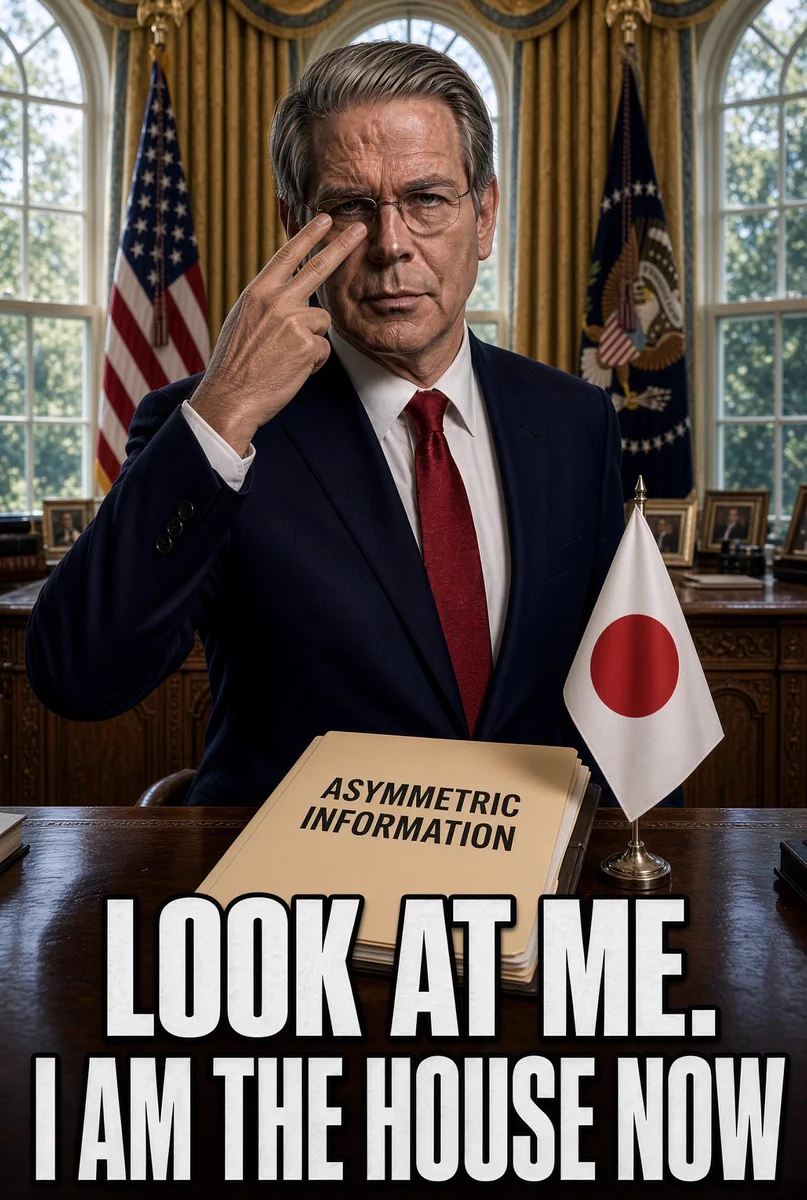
Treasury Secretary Scott Bessent has effectively challenged the bond market to a fight, telling traders, “I have asymmetric information. I am the house now,” and that they can “bet against him if they want.” Treasury has expanded its buyback operations for long-term government bonds, increasing purchases to as much as $6 billion per operation after Bessent originally promised to at least double the normal size. The stated purpose is liquidity, but the market understands what Washington desperately wants: lower long-term interest rates because the cost of financing more than $40 trillion in government debt is becoming a serious problem.
Bessent should know better than almost anyone that governments ALWAYS lose when they attempt to fight the market. He worked alongside George Soros and Stanley Druckenmiller when they famously took on the Bank of England in 1992. Britain attempted to defend the pound inside the European Exchange Rate Mechanism, traders understood that the price could not be maintained, and the government eventually capitulated on Black Wednesday. Druckenmiller has now publicly criticized his former protégé for attempting to suppress Treasury yields rather than dealing with the fiscal problem creating the pressure in the first place.
I have explained countless times that governments cannot manipulate markets indefinitely, and neither can central banks. The Plaza Accord in 1985 was supposed to manipulate the dollar lower, and when policymakers later decided the dollar had fallen enough, they produced the Louvre Accord in 1987 and tried to manipulate it in the opposite direction. The market continued moving and confidence in central bank control collapsed into the 1987 Crash. The Swiss National Bank later insisted it could defend the franc’s peg against the euro, and I told them directly that they could not. The market ultimately overwhelmed them as well.
I know this game personally because I spent decades sitting on the opposite side of these people, both as a trader and as an adviser called in during international crises. When Bessent was part of the Soros operation attacking sterling in 1992, I was advising the British government and warning them about what the “club” was doing. I went head-to-head with these same types of players in the markets because their strategy was always based upon manipulating price while mine was based upon TIME and PRICE.
In 1997, major players tried to manipulate silver against me and lost because the trend was not on their side. Governments and central banks also called me during the 1987 Crash, the 1989 Japanese collapse, the Asian Currency Crisis, and later China, because they wanted to understand what capital flows were actually saying. I learned long ago that it makes no difference whether you are a hedge fund with billions, a central bank capable of creating money, or the United States Treasury. You can push a market temporarily, but you cannot force global capital to obey you indefinitely. The market is bigger than ALL OF THEM, and the moment they begin believing otherwise is usually when they get themselves into trouble.
The bond market is far larger than any politician. There are roughly $32 trillion of publicly traded Treasury securities, yet Washington seems to believe several billion dollars of buybacks can intimidate traders into accepting yields below what the market demands. Treasury announced operations as large as $6 billion, and yields moved HIGHER because traders had expected even more. That alone should tell them what they are dealing with because once government announces that it is defending a price, the market immediately tests how much money it is actually prepared to spend defending it.
Government debt has exceeded $40 trillion, annual deficits remain enormous, the Treasury must continuously issue new securities simply to finance existing spending, and higher interest rates increase the cost of servicing the debt. Investors see the deficits, inflation, energy prices, geopolitical risk, and endless supply of new government paper and demand a higher return to hold it.
Government wants the privilege of borrowing without accepting the market price of borrowing. Politicians spent decades accumulating debt while interest rates were artificially suppressed and assumed they could continue indefinitely. Now the bond market is beginning to impose the discipline that Congress refuses to impose upon itself. Instead of reducing the deficit, Washington’s instinct is naturally to blame the market and search for another mechanism to suppress rates.
Bessent is playing a dangerous game because the Treasury does not possess unlimited money. If it wants to buy long-term bonds, it must ultimately obtain the funds somewhere, whether by drawing upon government cash or issuing other debt. You cannot solve excessive government borrowing by rearranging the government’s own liabilities and pretending the underlying debt disappeared.
This is precisely what politicians never understand about markets. A government can manipulate a market temporarily because it has enormous resources, regulatory authority, and sometimes a central bank capable of creating money. What it cannot do is repeal supply and demand. Every intervention eventually encounters the underlying economic reality, and the larger the distortion becomes, the more violent the adjustment can be when government finally loses control.
The Treasury market is sending Washington a message that Congress refuses to hear. Investors want greater compensation for financing a government that continues borrowing without any credible plan to stop. Bessent can buy bonds, threaten traders, increase buybacks, and declare that he is “the house,” but the United States government is not bigger than global capital. Washington’s debt problem is causing the bond market to demand higher interest rates, and Bessent is trying to fight the symptom instead of eliminating the debt and deficits causing it.
Posted Originally on Sep 21, 2026 by Martin Armstrong |
Treasury Secretary Scott Bessent is now pressuring Japan to rein in government spending and restore credibility with the bond market as Japanese yields surge. Reuters reports that Bessent confronted Japanese officials over what Washington sees as an inconsistent combination of aggressive fiscal spending and monetary policy, warning that instability in Japan’s enormous government bond market could spill directly into U.S. Treasuries. Japan’s 10-year government bond yield has climbed above 3%, reaching levels not seen since 1996, as investors increasingly demand greater compensation to finance one of the most indebted governments in the world.
Bessent understands the problem perfectly when he looks at Japan. Government cannot continue borrowing endlessly, suppress interest rates, manipulate its currency, and assume global capital will sit there forever accepting whatever return politicians decide to offer. Japan has spent decades experimenting with virtually every form of monetary manipulation imaginable. The Bank of Japan pushed rates below zero, bought enormous quantities of government bonds, controlled the yield curve, and expanded its balance sheet until it became one of the dominant holders of Japanese government debt. None of that eliminated the debt because it merely postponed the day when the market would again determine the price.
Japan’s government debt remains above 200% of GDP, and rising yields dramatically change the arithmetic. When rates were near zero, Tokyo could carry an enormous debt load because servicing costs remained artificially suppressed. Once yields rise, refinancing becomes progressively more expensive. The government then must issue still more debt to cover interest expenses, cut spending, raise taxes, or find new buyers willing to finance the entire operation.
What makes Bessent’s warning remarkable is that Washington is confronting the same fundamental problem. The United States has surpassed $40 trillion in federal debt, the Treasury must continuously refinance existing obligations while financing new deficits, and the 10-year Treasury yield has been testing levels around 5%. Bessent has simultaneously expanded Treasury buybacks in an effort officially aimed at improving liquidity while clearly recognizing the political and financial importance of preventing disorder in long-term government debt.
He is therefore telling Japan something Washington desperately needs to hear itself: the bond market eventually demands fiscal credibility. Bessent is especially concerned because Japan does not exist in some isolated financial universe. Japanese institutions are among the world’s largest foreign investors and major holders of U.S. assets, including Treasuries. When Japanese yields were virtually zero, enormous amounts of Japanese capital moved abroad searching for returns. If yields at home become sufficiently attractive, some of that capital has less reason to remain overseas. That is where Japan’s debt crisis can become America’s problem because capital can begin returning home precisely when Washington needs enormous amounts of foreign money to finance its own deficits.
This is why capital flows matter far more than the nonsense taught in economics textbooks where everything is treated as a domestic equation. Washington can raise or lower short-term rates, Tokyo can intervene in the yen, and central banks can buy government bonds, but global capital constantly compares risk and return between every major market. If Japan suddenly offers 3%, 4%, or more on government debt while eliminating the currency risk Japanese investors face overseas, the calculation changes.
This is precisely why Washington is watching Japan so closely. Japan is the largest foreign holder of U.S. Treasury securities, with roughly $1.2 trillion invested in American government debt. For decades, Japanese institutions were pushed overseas because yields at home were virtually nonexistent, making U.S. Treasurys an attractive destination for Japanese capital. But when Japanese government bonds begin paying 3% or more, that calculation changes dramatically because Japanese investors can earn a meaningful return at home without taking the same currency risk of holding dollar-denominated assets. If even a portion of that enormous pool of Japanese capital is repatriated, Japan does not need to “dump” Treasurys to create a problem for Washington; it can simply stop buying as much while the United States needs MORE buyers to finance $40 trillion in debt. That would place additional upward pressure on Treasury yields and increase Washington’s borrowing costs, which is why Bessent’s sudden concern about Japanese fiscal policy is not merely about helping Tokyo. America needs Japan’s capital.
Bessent should understand this better than most because he built his career trading global macro markets. Yet Washington continues behaving as though America’s debt is somehow fundamentally different. Politicians assume there will always be another buyer for Treasuries because the dollar remains the world’s primary reserve currency. That status gives the United States enormous advantages, but it does not grant Congress the ability to borrow without consequence forever.
Japan should be a warning to Washington, not merely a country for Washington to lecture. Japan demonstrated what happens when government debt becomes structural and monetary policy is forced to accommodate the political system. Suppressing rates encouraged more borrowing because there was never any immediate incentive to reform. Politicians became accustomed to cheap financing and the central bank became trapped supporting a government bond market that could no longer function normally without intervention.
The United States is moving down its own version of that road. Treasury wants lower long-term yields, politicians want cheaper borrowing, homeowners want lower mortgage rates, markets want easier money, and nobody in Washington wants to confront the actual source of the problem because that would require reducing deficits and admitting government cannot spend without limit.
The most important part of the Reuters report is therefore not simply that Bessent is pressuring Japan. It is that he is worried Japan’s bond market can infect America’s. That admission exposes how interconnected the sovereign-debt crisis has become. Japan needs buyers for Japanese debt while America needs buyers for American debt, Europe is issuing more debt for defense and Ukraine, and governments everywhere are competing for the same global pool of capital.
This is the Sovereign Debt Crisis unfolding in real time. The problem is not that investors suddenly became unreasonable. The problem is that governments borrowed as if interest rates would remain artificially low forever and now global capital is beginning to demand a higher price. Bessent is telling Japan to respect the bond market. Washington should take its own advice.
Posted Originally on Sep 21, 2026 by Martin Armstrong |
People constantly ask who has more power over interest rates, Treasury Secretary Scott Bessent or Federal Reserve Chairman Kevin Warsh. Warsh certainly has the more visible lever because the Federal Reserve controls the federal funds target and can influence short-term liquidity throughout the banking system. Bessent, however, sits at the Treasury where the government must actually finance the deficits Congress creates. Congress spends the money, the Treasury must borrow it, and the Fed attempts to influence the price of money, but NONE of them ultimately control global capital.
This is the great misconception surrounding the Federal Reserve. No Fed chairman controls the business cycle. Warsh can raise or lower the overnight rate, but he cannot simply decree that the 10-year Treasury should yield 3% if investors around the world demand 5%. The long end of the curve reflects inflation expectations, sovereign risk, competing investment opportunities, debt supply, and international capital flows. The Fed can intervene and buy bonds, but then it risks expanding liquidity and creating precisely the inflation it claims to be fighting.
Bessent faces the opposite side of the same problem. Treasury must continuously sell enormous quantities of debt because Washington has accumulated more than $40 trillion in obligations and continues running deficits. Bessent can alter maturities, conduct buybacks, and attempt to improve liquidity, but he cannot FORCE investors to finance Washington at the yield he prefers. If global capital demands greater compensation for holding U.S. government debt, then the Treasury eventually has to pay the market price.
We have been through this before. The Treasury once pressured the Fed to keep government borrowing costs artificially low, particularly during and after World War II. That arrangement eventually became unsustainable and culminated in the 1951 Treasury-Fed Accord, which restored greater monetary independence to the Federal Reserve. Government discovered then what it continually refuses to accept today: you cannot permanently dictate the price of money against the market.
So who is really more powerful, Bessent or Warsh? Warsh has greater direct power over short-term monetary policy, while Bessent controls how Treasury manages the financing of government debt. But both men eventually answer to the same force that no government has ever permanently defeated: global capital. Congress spends it. Bessent must borrow it. Warsh can influence its price. The MARKET ultimately decides what it is worth.
Posted Originally on Sep 21, 2026 by Martin Armstrong |
Estonian Defense Minister Martin Herem said Estonia is capable of fighting Russia on its own and warned that any Russian forces crossing the border would be met with destruction.
“We will destroy Russian infrastructure,” Herem said, adding that Estonia would strike Russian forces and infrastructure across the border if necessary, naming Ivangorod and Pechory as possible targets.
He also said Russia should break up into numerous independent states, while warning that any attempt to attack Estonia from a distance would be “blown to smithereens.”
The is the sheer ethnic hatred that is taking us into World War III. As I have said, they forgave Germany for Hitler, but the refuse to forgive Russia for Stalin. Personally, I have had enough. It is absolutely IMPOSSIBLE to talk to these morons for no matter what I say, they are determined to have war. If Russia said the USA has no right to be this big and should be broken up, I think Americans would take offense. But is OK for these people to display such ethnic hatred demonstrating they they have not learned anything from two world wars to date. Perhaps as they say, it will take the third time to be the charm.
Kaja Kallas (born 1977) is an Estonian politician and diplomat pretend diplomat who is just as bloodthirsty is now the Vice-President of the European Commission since 2024. I spoke with a Russian translator I met in Tokyo 30 years ago who is now in Moscow. The question I was asked: “Why do they hate us so much?”
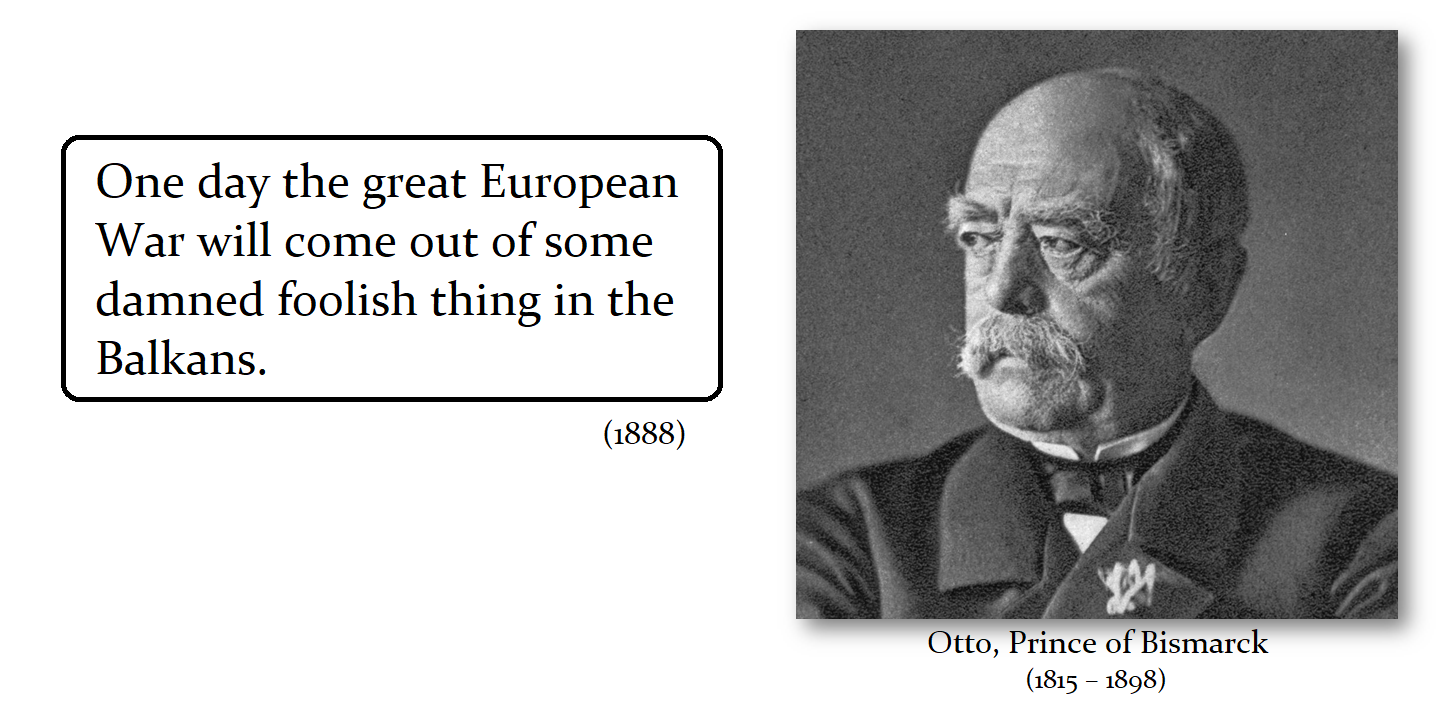
Bismarck was correct. He saw this ethnic hatred and that led to World War I when a Serb assassinated the Arch Duke in 1914. This is like Iran vs Israel. It is just raw hatred that has no solution. This hatred of Russia is no different.
These statements reflect the idea that a son might be punished for his father’s sins, a major moral, legal, and religious issue since ancient times. It appears in some of the oldest surviving legal and literary texts, and it has been debated continuously in law, theology, and philosophy.
As a student of ancient law and history, in the Code of Hammurabi (18th century BC), most penalties targeted the offender, but some provisions could affect family members. For example, if a builder’s faulty work caused the death of a homeowner’s son, the builder’s own son could be put to death. This was a clear case of collective or substitute punishment.
Mesopotamian wisdom literature and proverbs sometimes warn that the gods may visit a father’s guilt on later generations, though other texts insist that the gods judge each person individually.
In the Hebrew Bible, we find this is one of the most famous arenas of the debate. Several texts say God “visits the iniquity of the fathers on the children to the third and fourth generation” (Exodus 20:5; Deuteronomy 5:9).
But other biblical texts push back strongly: Deuteronomy 24:16 says, “Fathers shall not be put to death for children, nor children be put to death for fathers; each shall be put to death for his own sin.”
The prophet Ezekiel devotes an entire chapter (Ezekiel 18) to rejecting the proverb “The fathers have eaten sour grapes, and the children’s teeth are set on edge.” Ezekiel insists that the soul that sins shall die, and that a righteous son will not bear the father’s guilt.
So, the Hebrew Bible itself preserves an internal debate, with older collective ideas being challenged by a newer emphasis on individual responsibility.
Turning to the Greeks and Romans, we see that Greek tragedy is full of inherited guilt. In Aeschylus’s Oresteia, the House of Atreus suffers generation after generation for ancestral crimes. Oedipus’s children in Sophocles’ Theban plays are caught in the consequences of their father’s actions.
Roman law generally moved toward individual liability, but religious ideas of family pollution (piaculum) and ancestral curses persisted, especially in early Roman religion.
In Christianity, the doctrine of Original Sin raised the question of inherited guilt from Adam, though theologians like Augustine distinguished inherited sinfulness from personal guilt. Ezekiel’s emphasis on individual responsibility remained influential.
In Islamic thought, the Qur’an states that “no bearer of burdens shall bear the burden of another” (6:164; 17:15; 35:18; 39:7), strongly rejecting vicarious punishment.
In medieval and early modern Europe, criminal law sometimes still punished families for a member’s sins. For example, corruption of blood, attainder, and executing relatives in cases of treason or regicide. Debates over these practices helped drive the modern legal principle of individual criminal responsibility.
In the 20th century, international law condemned collective punishment of families, especially under the Geneva Conventions and human rights instruments. Kallas obviously rejects this idea. Her hatred is justified as the apple does not fall far from the tree. Kallas is consumed with hatred making her unqualified for any political office.
Why does the issue persist? The tension is between two powerful institutional foundations. First, families, clans, and nations are interconnected; a crime may damage or obligate the group, and consequences naturally spill over to descendants.
Secondly, it is unfair to punish someone for an act they did not choose or commit.
Ancient societies often leaned toward the first; modern law and ethics generally lean toward the second. But the debate has never fully disappeared. This punishing Russia for the sins of Stalin as if all Russians are still communists constantly resurfaces today. We find it in discussions of inherited privilege, historical injustice, reparations, and family trauma.
So yes: punishing the son for the sins of the father is not a modern dilemma. It is one of the oldest recorded moral problems, and many ancient texts already argued about it. I fear we will never purge this ethnic hatred that seems to be inherited from one generation to the next.
I have created this site to help people have fun in the kitchen. I write about enjoying life both in and out of my kitchen. Life is short! Make the most of it and enjoy!
This is a library of News Events not reported by the Main Stream Media documenting & connecting the dots on How the Obama Marxist Liberal agenda is destroying America