South Africa: The Lights Came Back On — The Economy Did Not


Posted  originally on Jun 16, 2026 by Martin Armstrong |  

Disastrous power cuts threaten South African economy and rulers -  CSMonitor.com

For years, South Africa’s rolling blackouts became a symbol of national decline. Businesses bought generators. Families planned their lives around power schedules. Factories lost production. Politicians blamed everyone but themselves. Now, after years of crisis, South Africa has achieved something many thought impossible. The country recently passed 300 consecutive days without load-shedding, and Eskom’s energy availability factor has climbed to nearly 66%. Diesel spending has fallen dramatically, and for the first time in years the power grid is no longer the country’s biggest economic problem.

The IMF projects South African GDP growth of just 1.0% in 2026. Even more troubling, real GDP per person has fallen from roughly $5,954 in 2010 to about $5,715 in 2024. After fourteen years, South Africans are approximately 4% poorer on a per-capita basis despite commodity booms, government plans, infrastructure spending, and now an improving electricity system.

This is where governments consistently misunderstand economics. They identify a visible problem and assume solving it will automatically create prosperity. It rarely works that way. South Africa’s blackouts were certainly damaging, but they were never the sole cause of economic stagnation. Weak investment, deteriorating infrastructure, high unemployment, declining productivity, capital flight, and government inefficiency were already undermining growth long before the power crisis reached its peak. The blackouts simply made the deeper problems impossible to ignore.

The labor market tells the real story. Official unemployment has climbed to 32.7%, while youth unemployment has reached an astonishing 45.8%. In the first quarter of 2026 alone, employment reportedly fell by 345,000 jobs. An economy growing at 1% simply cannot absorb a rapidly expanding labor force. Young people entering the workforce find themselves competing for opportunities that often do not exist.

The investment numbers are equally concerning. Gross fixed capital formation stands at just 14.5% of GDP, well below the levels typically seen in emerging economies that experience sustained growth. No country becomes prosperous without investment. Factories, railways, ports, power plants, technology infrastructure, and housing all require capital. When investment remains weak, growth inevitably follows.

Even South Africa’s freight network reveals the problem. Rail volumes have recovered from recent lows, but remain nearly 30% below the levels recorded less than a decade ago. The country may have restored electricity, but moving goods efficiently across the economy remains a challenge. Growth is not merely about producing power. It is about transmitting economic activity throughout an entire system.

What makes South Africa particularly important is that it serves as a warning for many countries facing similar pressures. Around the world, governments are confronting aging infrastructure, rising debt, slowing productivity, demographic challenges, and declining living standards. Politicians continue searching for single solutions to what are fundamentally systemic problems. There is no magic switch that restores prosperity once confidence has been damaged.

The lesson is simple. Electricity matters. Infrastructure matters. But confidence matters more. Capital flows where it feels secure. Investment follows confidence. Jobs follow investment. Living standards follow productivity. South Africa solved the crisis everyone could see. The challenge now is solving the problems that remain hidden beneath the surface.

The lights came back on. The harder task is reigniting economic confidence.

Pokémon Go Data Used for Drone Warfare


Posted originally on Jun 15, 2026 by Martin Armstrong |  

PokemonGO2

Back in 2016, when Pokémon Go exploded across the world, I wrote that people should be asking a simple question: why would investors spend billions creating a game that encouraged hundreds of millions of people to walk around with GPS-enabled devices, cameras, and location tracking operating continuously? At the time, most people laughed. They saw a harmless game. What they failed to understand is that in the digital age, data has become more valuable than oil.

Now we are discovering that nearly 30 billion images collected from Pokémon Go users over the past decade helped create one of the most sophisticated three-dimensional mapping systems ever assembled. According to recent reports, Niantic Spatial used those scans to build a visual positioning system capable of allowing robots and drones to navigate even when GPS signals are unavailable. Researchers claim that this technology is now finding applications not only in commercial robotics but potentially in military systems as well.

Think about what has actually happened. Millions of people, children included, believed they were simply catching virtual creatures. In reality, they were helping build an extraordinarily detailed digital reconstruction of the physical world. Every building scanned, every landmark photographed, every street corner mapped became part of a massive geospatial database. Niantic Spatial itself has acknowledged that its system has been trained using more than 30 billion images gathered through years of player participation.

Drone.Kid_

The most remarkable aspect of this story is that the public largely financed and built the database themselves. They supplied the images. They supplied the location data. They supplied the training material and carried the cameras. They volunteered years of labor without realizing they were helping create a valuable artificial intelligence asset. Convince people they are playing a game while simultaneously constructing one of the most comprehensive mapping projects in human history.

What is particularly troubling is that the reports suggest the technology developed from Pokémon Go data may help drones navigate even when GPS signals are jammed or unavailable. Modern battlefields increasingly rely on electronic warfare, with both sides attempting to disrupt satellite navigation systems. By training artificial intelligence on billions of images collected by players around the world, Niantic’s mapping technology allows machines to recognize buildings, roads, landmarks, and terrain visually rather than relying solely on GPS coordinates.

In practical terms, that means a drone could potentially continue operating, identifying its location, and reaching its target even after traditional navigation systems have been disabled. Few participants, if any, could have imagined that hunting for Pokémon would assist government kill machines.

Every smartphone user is contributing to systems far larger than they imagine. Every search query, every location ping, every photograph, every online interaction becomes part of a data ecosystem that can be analyzed, monetized, and repurposed in ways never envisioned when the information was originally collected.

The world is rapidly moving toward a digital infrastructure where everything is mapped, tracked, modeled, and analyzed. The race is no longer merely about information. It is about creating a real-time digital replica of the physical world itself. Pokémon Go may ultimately be remembered as one of the most successful data collection operations in history. Millions thought they were hunting Pikachu. What they were really helping to build was the foundation for a new generation of artificial intelligence, robotics, and autonomous navigation systems. The question is not whether this technology will be used. The question is who will control it once it becomes indispensable.

Russia’s New Warning Shot From Space


Posted originally on Jun 15, 2026 by Martin Armstrong |  

Baltic Sea Airspace Flooded With GPS Interference, Authorities Point to  Russia — UNITED24 Media

For years, politicians have been obsessed with tanks, artillery, missiles, and troop counts while the real battlefield has quietly moved into space. The latest reports suggesting that Russian satellites may be capable of disrupting GPS signals on a continental scale should be sending shockwaves through military circles. If these findings prove accurate, then we are looking at a capability that extends far beyond simply making a driver’s navigation system malfunction. GPS is embedded in aviation, shipping, banking, telecommunications, emergency services, power grids, financial transactions, military operations, and virtually every aspect of modern infrastructure.

According to researchers, dozens of GPS interference events detected across Europe since 2019 may have originated from Russia’s EKS satellite constellation. These satellites were originally designed as part of Russia’s missile early-warning system, but testing suggests they may also possess the ability to transmit powerful signals capable of disrupting GPS reception across vast regions. The significance is not whether a disruption lasts a few seconds or a few minutes. The significance is proving the concept works. Once a nation demonstrates it can interfere with navigation systems from orbit, the entire strategic equation changes.

What many fail to appreciate is how dependent modern warfare has become on satellite navigation. Precision-guided weapons rely on GPS. Drones rely on GPS. Aircraft, ships, logistics networks, battlefield communications, and intelligence systems all depend on accurate positioning data. Remove that capability and armies suddenly find themselves operating under conditions that resemble an entirely different century. During the Ukraine conflict, both sides have aggressively pursued electronic warfare, jamming systems, and signal disruption technologies. What appears to be emerging now is the possibility of extending those capabilities far beyond localized battlefields and into continental-scale operations.

Researchers from the University of Texas and Stanford University have  linked mysterious GPS interference across Europe to a group of Russian  satellites. The research was carried out by Todd Humphreys and Zach

Financial markets depend on precise timing synchronization. Cellular networks require timing signals to coordinate traffic. Shipping companies use satellite navigation to move trillions of dollars worth of goods annually. Airlines depend on navigation systems to safely manage thousands of flights every day. Even modern agriculture relies heavily on GPS-guided equipment. The public views GPS as a convenience. Governments and corporations know it has become a critical piece of economic infrastructure.

This development also highlights something I have warned about repeatedly. The next major conflict will not resemble the wars of the twentieth century. Future wars will target infrastructure before populations even realize an attack has occurred. A cyberattack can disable communications. A satellite disruption can interfere with transportation networks. Financial systems can be disrupted electronically. Power grids can be targeted remotely. The battlefield increasingly consists of networks, satellites, data centers, and communications systems rather than simply soldiers crossing borders.

Researchers from the University of Texas and Stanford University have  linked a series of mysterious GPS interference events across Europe to  Russia's EKS early-warning satellite constellation. By analyzing years of  data, the

The timing is noteworthy. We are entering the most dangerous phase of the geopolitical cycle. The 2026 Panic Cycle year has already begun exposing vulnerabilities across the global system. Relations between Russia and NATO remain strained. The United States and China are engaged in a rapidly escalating technological competition. Military spending is rising globally. Governments everywhere are preparing for contingencies that most citizens never consider. Space is no longer a peaceful frontier. It has become a strategic domain where the major powers are competing for dominance.

What should concern policymakers is not merely that Russia may possess this capability. The real question is how many nations are developing similar systems. The United States, China, Russia, and other powers have invested heavily in electronic warfare, anti-satellite technology, cyberwarfare, and space-based military assets. Every major power understands that controlling information, communications, and navigation systems may prove more decisive than controlling territory itself.

Soros vs India – Trying to Change Foreign Countries


Posted originally on Jun 14, 2026 by Martin Armstrong |  

Indian_Rupee Y 6 13 26

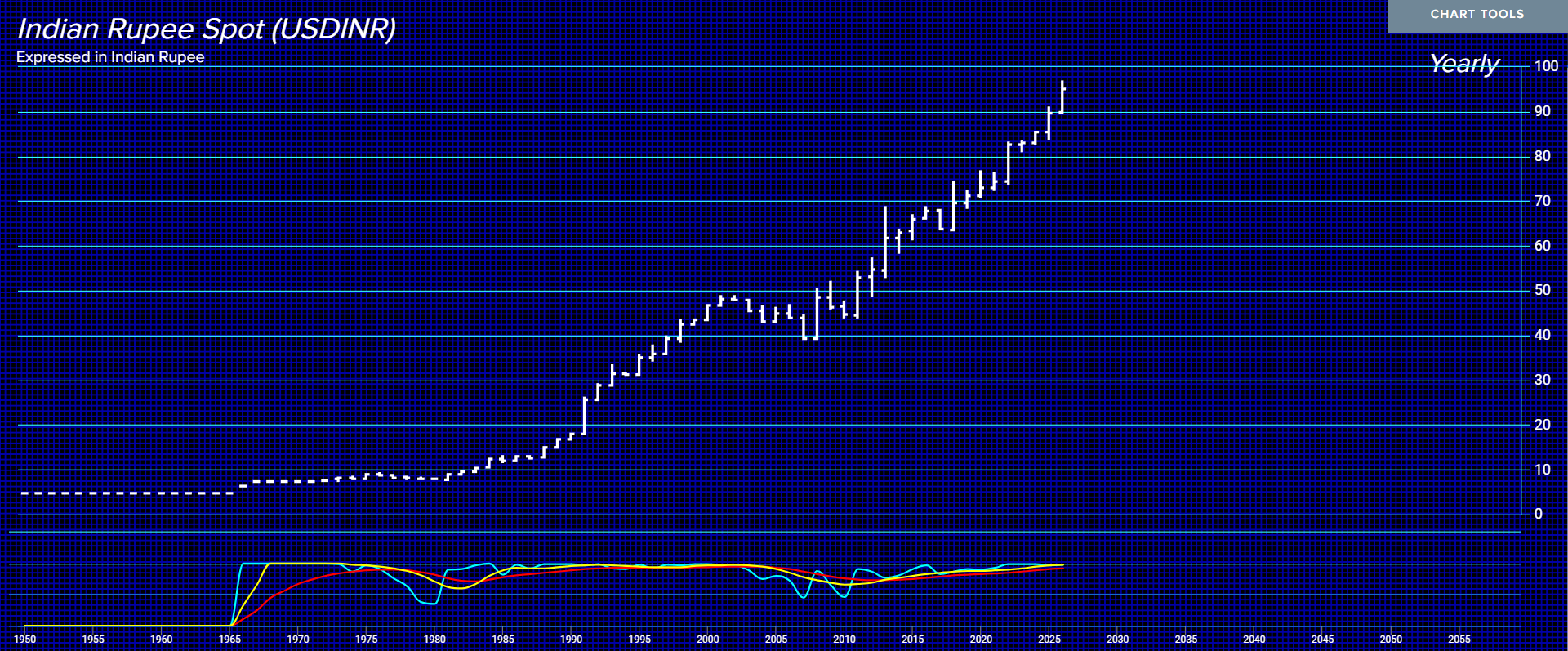
The primary driver of the rupee’s recent movement has been the conflict between the US-Israel alliance and Iran. India has stated that the conflict has had a “debilitating impact on the global economy and energy supplies.”  As a major importer of oil, India is vulnerable to price shocks and supply chain disruptions. The rupee hit an all-time low primarily due to the war. The currency appears poised to strengthened sharply on the back of falling crude oil prices, if President Donald Trump can at least extract the US from this conflict.

The Reserve Bank of India has actively managed the situation. It has been intervening in the forex market to prevent excessive volatility and has announced specific measures to attract dollar inflows, which has helped stabilize the currency.

2026_06_13_17_06_32_How_George_Soros_became_Enemy_Number_1_for_India_s_Modi_Narendra_Modi_News_

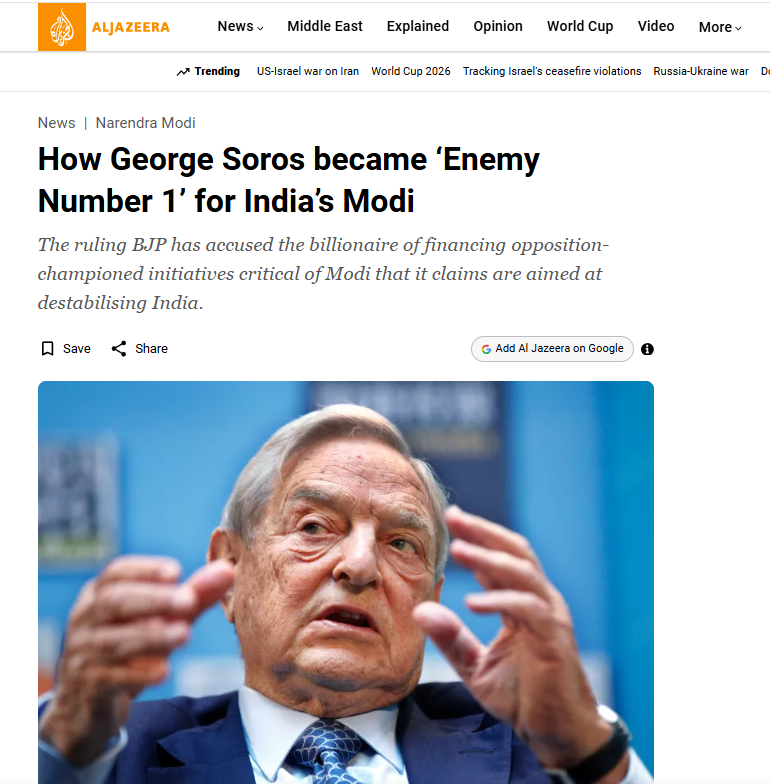
The conflict between George Soros and Indian Prime Minister Narendra Modi is a clash of ideologies and interests. Soros, a supporter of his “open societies,” and is an outspoken critic of Modi’s Hindu nationalist politics. This has led the BJP to label him a foreign threat attempting to destabilize India by funding opposition parties and critical media.

Soros has openly criticized the Modi government for its policies, which he views as creating a “Hindu nationalist state” and threatening India’s secular fabric. At the World Economic Forum in 2020, he specifically expressed concern over policies in Kashmir and the Citizenship Amendment Act (CAA). His “open society” ideals fundamentally clash with the BJP’s “Hindu nationalist” agenda.

Nevertheless, George Soros has been funding opposition to Modi and many see this as his political meddling to force his political views upon the world. This has had the realization that people like George Soros and Bill Gates share a specific worldview where they try to alter societies based on personal beliefs.

This dynamic duo seem to believe that solving big global problems (pandemics, climate change, extreme poverty, political instability) is good for everyone, including themselves and their descendants. A world with fewer refugees, more stable democracies, and less disease is a safer, more predictable, and more prosperous world for their businesses and families. This is their egotistic Enlightened Self-Interest.

Both have signed the Giving Pledge (started by Gates and Warren Buffett), committing to give away the majority of their wealth. They argue that if you have been extraordinarily lucky—born in the right country, with the right talents, at the right time—you have a moral obligation to use that wealth to help others, not just pass it to your children.

Unlike traditional charity (feeding the hungry today), Gates and Soros practice strategic philanthropy. They identify a root cause (e.g., malaria is caused by a parasite, weak rule of law enables corruption) and fund targeted interventions. They are not imposing a random opinion; they are imposing what they believe to be the most effective, evidence-based solution. In finance, we call this a crime as market intervention.

Because they “IMPOSE” their personal views upon the world using money instead of military interventions, this is why people get uncomfortable. They don’t have armies or governments, but they have two powerful tools. With tens of billions of dollars, they can fund think tanks, university departments, legal advocacy groups, and media outlets buying the press to boost their images, which Gates is famous for. They can launch global health campaigns (Gates) or pro-democracy civil society organizations (Soros) in dozens of countries simultaneously. This scale can drown out local voices or less-funded alternative views.

They have mastered the Conditional Grants. This is the key. When they give a grant, it almost always comes with strict conditions. For example, the Gates Foundation admits:

“We will give your country $10 billion for vaccines, but you must adopt these specific electronic health records, meet these quarterly reporting metrics, and co-fund the delivery system.”

Soros’ Open Society Foundations states:

“We will fund your anti-corruption NGO, but your advocacy must focus on judicial independence and freedom of information laws, not on economic nationalism or religious identity.”

This is imposing a view. They are using money to buy leverage, requiring recipients to adopt their preferred methodology and priorities. Buying politicians is very anti-democratic and funds the very corruption they claim to oppose.

These tactics are highly controversial, while we don’t criticize a local billionaire for building a hospital, but far too often the strings are hidden. There is just no Democratic Accountability. A government is voted in. A corporate board answers to shareholders. Soros and Gates answer to nobody. They have immense power to shape policy on education (Gates’ early school reform push was widely criticized as a failure that imposed a top-down model) or criminal justice (Soros’ funding for progressive prosecutors has outraged conservatives who see it as importing American ideology into their local elections).

The assumption that a computer programmer (Gates) and a hedge fund manager (Soros) know the best way to run agricultural policy in Tanzania or public health in India can seem deeply condescending. Critics call it a new age of imperial “colonialism”—extracting local problems and forcing solutions designed in Seattle or New York. They may not be kings seated on a throne, but they have self-anointed themselves to oversee the world.

Critics note that Gates made his fortune with monopolistic business practices that crushed competitors, and Soros made his by speculating on currency devaluations (e.g., “breaking the Bank of England” in 1992). They argue it’s galling for these men to now pose as the world’s moral architects.

Why Do They Do It?
From their perspective, they have unique resources, a clear view of the most urgent global problems, and a moral duty to act on their evidence-based beliefs. Not acting, they’d argue, would be irresponsible.

From a neutral perspective, they trying to shape the world according to their values. They simply have an almost unimaginable amount of money to do it with. The debate is whether their specific values (liberal democracy, scientific rationalism, globalism) and methods (top-down, conditional funding) are beneficial or harmful.

From a critical perspective, they are unelected oligarchs using tax-free foundations to override local democracies and impose a narrow, technocratic worldview that serves the interests of global capital under the guise of altruism. Merely having the resources to act, and the pretense of modern philanthropy allows them to impose conditions on their gifts. This is not a heroic problem-solving venture, but a problematic power-grabbing agenda that all depends on their character.

Schurz Carl Christian

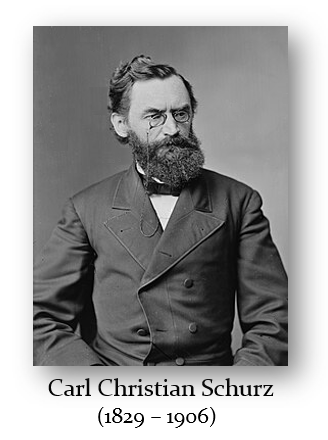
An example of someone imposing their views on another country is none other that Carl Christian Schurz (1829-1906) who was a refugee from Germany fleeing to the USA after their failed 1848 European Revolution. It was Schurz who deliberately sought political power in the USA to impose what he failed to achieve in Germany. They became known as the Forty-Eighters. Schurz became an adviser to Abraham Lincoln and  recommended Lincoln enter the American Civil War.

Schurz was a crucial asset to Lincoln, primarily for his ability to mobilize the German-American vote, a key constituency for the Republican Party, which at the time was counting on the refugees from the 1848 European Revolution. In recognition of Schurz’s efforts during the 1860 campaign, Lincoln appointed him as Minister to Spain in 1861.

Once the war began, Schurz was eager to serve directly, initially requesting to raise a cavalry regiment. The correspondence between them shows Lincoln actively managing Schurz’s career, hoping to make him a brigadier general over German regiments.

In this sense, you have a non-American, seeking to gain political access, to instigate the civil war after failing and having to flee from Germany as was the case for Karl Marx. This immigration is what infected the United States with Marxist theories that fermented during the second half of the 19th century. Many in Europe today see the vast influx of immigrants, especially into Britain, which has altered its very culture and character.


New Movie on Financial Crisis


Posted originally on Jun 14, 2026 by Martin Armstrong |  

Interview: The Sovereign Debt Crisis Has Already Begun – and Iran Just Lit the Fuse


Posted originally on Jun 13, 2026 by Martin Armstrong |  

Wholesale Inflation Confirms Energy Crisis


Posted originally on Jun 12, 2026 by Martin Armstrong |  

inflation

The Producer Price Index for May came in far hotter than expected, rising 1.1% for the month and 6.5% year-over-year, the largest annual increase since late 2022. What is important here is that nearly 80% of that increase came from goods, and energy was the driving force behind the move. Gasoline prices at the wholesale level surged more than 23% in a single month. Diesel fuel, jet fuel, natural gas, industrial chemicals, plastics, and transportation costs all moved sharply higher. This is exactly why I have repeatedly stated that energy is the lifeblood of the economy. Everything must be manufactured, transported, and delivered. When energy prices rise, they eventually work their way through the entire system.

The press continues to focus on consumer inflation, but wholesale inflation is often the more important indicator because it reveals what businesses are paying before those costs are passed on to the public. Companies absorbed much of the inflation shock over the past several years because consumers had reached their breaking point. That cushion is disappearing. Businesses cannot continue absorbing rising fuel, transportation, and raw material costs indefinitely. The result is that the inflation consumers are experiencing today is likely only the first stage of a broader wave working its way through the economy.

Energy Crisis Cover

The politicians will blame corporations, speculators, or anyone else they can find, but the source of this inflation is staring everyone in the face. The conflict in the Middle East has disrupted shipping routes, threatened the Strait of Hormuz, and created uncertainty throughout global energy markets. Oil remains the foundation of modern civilization whether governments wish to admit it or not. The dream that governments could simply regulate away fossil fuels while simultaneously fighting wars was always detached from reality. Energy shortages and rising costs are now exposing the consequences of those policies.

What concerns me is that we are entering a period where inflation, war, and sovereign debt problems are converging at the same time. The Federal Reserve cannot solve an energy shortage with interest rates. Raising rates will not create more oil, open shipping lanes, or end geopolitical conflict. Meanwhile, governments continue spending as though debt no longer matters. The May PPI report is not simply another inflation statistic. It is a warning that the energy crisis is spreading through the economic system and that the inflation battle is far from over. As we move deeper into this Panic Cycle year, volatility in commodities, interest rates, and global capital flows should surprise no one.

BRITAIN CANNOT AFFORD ITS EMPIRE


Posted originally on Jun 12, 2026 by Martin Armstrong |  

The Decline of the UK Over the Last 100 Years | by Adam Kuro | Medium

UK Defence Secretary John Healey suddenly resigned because the government cannot find the money to fund military commitments. In his resignation letter, he openly accused Prime Minister Keir Starmer and the Treasury of refusing to commit the resources needed to defend the country at a time of rising geopolitical tensions. When a defence minister quits claiming the government cannot adequately fund national security, that is a warning sign far beyond politics. It is a signal that the financial reality has finally collided with political promises.

Britain’s economic condition is far worse than many appreciate. Government debt has climbed above £3 trillion, exceeding 100% of GDP. Interest payments on that debt have become one of the largest items in the national budget. The tax burden is at its highest level in decades, yet the government still cannot balance the books. Economic growth has been stagnant for years. Productivity growth has virtually disappeared. Manufacturing continues to shrink as a percentage of the economy while energy costs remain among the highest in the industrialized world. Britain now spends more servicing debt than it does on many essential public services. The government talks about expanding defence spending, expanding social programs, funding green initiatives, supporting Ukraine, and maintaining the welfare state, yet the numbers simply do not add up.

UK Defence Secretary John Healey has unexpectedly resigned over Prime  Minister Starmer's defence spending plan. In his letter to the PM, Healey  said the “Treasury has been unwilling to commit the resources

The dispute centers around Britain’s Defence Investment Plan. Healey reportedly wanted at least £18 billion in additional military funding through 2030, while military officials have warned of a £28 billion shortfall over the next four years. Instead, the proposed spending plan would only raise defence spending to roughly 2.68% of GDP by 2030, well below what military planners believe is necessary given the commitments Britain has made around the world. The government delayed the plan for months because the Treasury could not find the money.

Britain is trying to maintain global military commitments on an economy that has been steadily weakening for years. Governments always expand obligations during periods of prosperity and then discover during economic decline that they cannot afford the promises they have made. Britain wants to project military power from Eastern Europe to the Middle East, lead NATO initiatives in the Arctic, support Ukraine indefinitely, and modernize its armed forces, all while carrying massive debt burdens and facing weak economic growth.

The resignation of Healey exposes a much deeper problem. Britain is no longer debating how much it wants to spend. Britain is confronting the reality of how much it can afford. As we move deeper into the sovereign debt crisis unfolding across the Western world, more governments will face this same dilemma. They will discover that geopolitical ambitions are ultimately constrained by economic reality, and economic reality is becoming increasingly difficult to ignore.

Bill Gates Invests in Lab-Grown Baby Formula


Posted originally on Jun 12, 2026 by Martin Armstrong |  

People have become so conditioned to thinking in partisan terms that they miss the larger issue entirely. The question is not whether Bill Gates is a good person or a bad person. The question is why one individual continually appears at the center of industries that later become critical during periods of crisis.

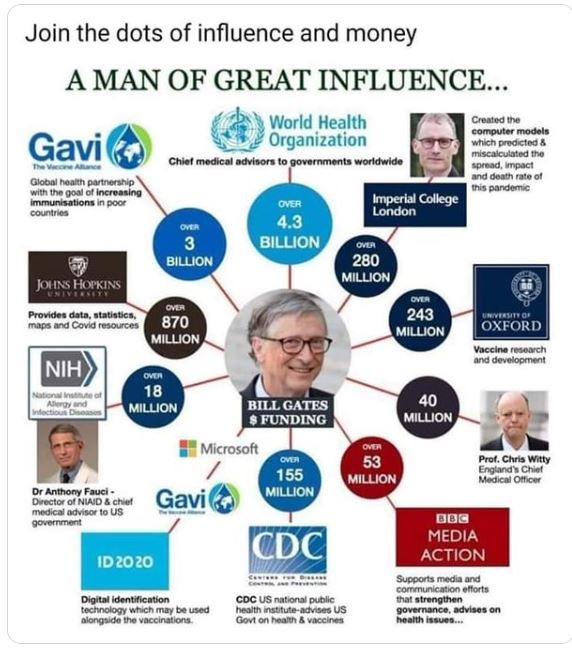
Bill Gates became one of the most influential private figures in global vaccination programs long before COVID. Through the Gates Foundation, billions of dollars have been directed into vaccine development, distribution, and organizations such as Gavi. The foundation has committed more than $4 billion to Gavi alone over the years and remains one of the most influential private actors in global vaccine policy. During COVID, the Gates Foundation committed hundreds of millions more toward vaccine development, manufacturing, and distribution worldwide. Nobody can seriously dispute that Gates became one of the most powerful private forces in the vaccine industry. Yet when a global pandemic arrived, suddenly vaccines became one of the most profitable and politically protected industries on earth.

Then there is agriculture. Bill Gates spent years quietly acquiring farmland across the United States until he became America’s largest private farmland owner, accumulating roughly 250,000 to 275,000 acres spread across numerous states. While many dismissed concerns by arguing that farmland is simply another investment, the timing remains extraordinary. Food inflation exploded. Supply chains broke down. Fertilizer shortages emerged. Farmers found themselves squeezed from every direction. Food security suddenly became a national discussion. Once again, one individual sat at the center of a strategic industry during a period of crisis.

Now consider infant nutrition. Gates-backed investment funds supported BIOMILQ, a startup attempting to produce human breast milk in laboratories using cultured cells. This was not science fiction. It was a real venture designed to create lab-produced breast milk as a commercial product. Around the same period, America experienced one of the worst baby formula shortages in modern history. The shortage stemmed from manufacturing disruptions and supply chain failures coincidentally tied to COVID.

Vaccinate Baby

Gates infamously speaks on controlling the population. “If we do a really great job on new vaccines, health care, reproductive health services, we could lower that [population growth] by perhaps 10 or 15 percent,” he stated. When an influential billionaire who funds vaccine programs and bankrolls the World Health Organization buys vast amounts of farmland, finances alternative food technologies, and speaks about managing population growth all at the same time, people are going to ask questions. You cannot expect the public to ignore those connections.

Gates Health Monopoly

The establishment immediately labels anyone who notices these patterns a conspiracy theorist. That is how debate is shut down before it begins. Yet concentration of power has always been a legitimate concern. When banking became concentrated, governments eventually regulated it. When railroads became concentrated, governments intervened. When media became concentrated, concerns emerged over influence and control. Why should food, medicine, agriculture, and biotechnology be treated differently?

The same people who finance vaccines finance health policy. The same people buying farmland finance agricultural innovation. The same investors funding synthetic food products dictate the future of nutrition. All distinction between private influence and public policy has disappeared.

What concerns me is where this trend leads. We are moving toward a world where food production, healthcare, biotechnology, artificial intelligence, digital identity systems, and financial systems are increasingly controlled by a shrinking circle of institutions and individuals. That concentration creates systemic risk. If they are wrong, everyone suffers. If their interests diverge from the public’s interests, society has few alternatives.

History warns that whenever too much influence accumulates in too few hands, the public eventually pays the price. The issue is the system that allows any private individual to become influential across so many strategic sectors at the same time. That is the lesson people should be paying attention to, because concentration of power has never ended well, regardless of who holds it.

Posted originally on Jun 11, 2026 by Martin Armstrong |  


Fiat

FIAT The Truth About Money – 2nd Edition (unedited)

$59.95

At last, the real truth about money.

This book on FIAT is perhaps the most definitive work on this subject, tracing the origin of this theory of FIAT and why it has become so distorted. The lack of understanding of what even constitutes FIAT, that all paper currency is just FIAT because it is not backed by some commodity, prevents us from comprehending not merely what money is, but its role within the global economy. Coins over the century could be struck in gold, silver, bronze, or some copper-alloy, and if their value was decreed to be worth far more than their metal content. FIAT is by no means just paper money. There were people who proposed issuing a platinum coin with a value of $1 trillion to pay off the debt? That too would be FIAT.

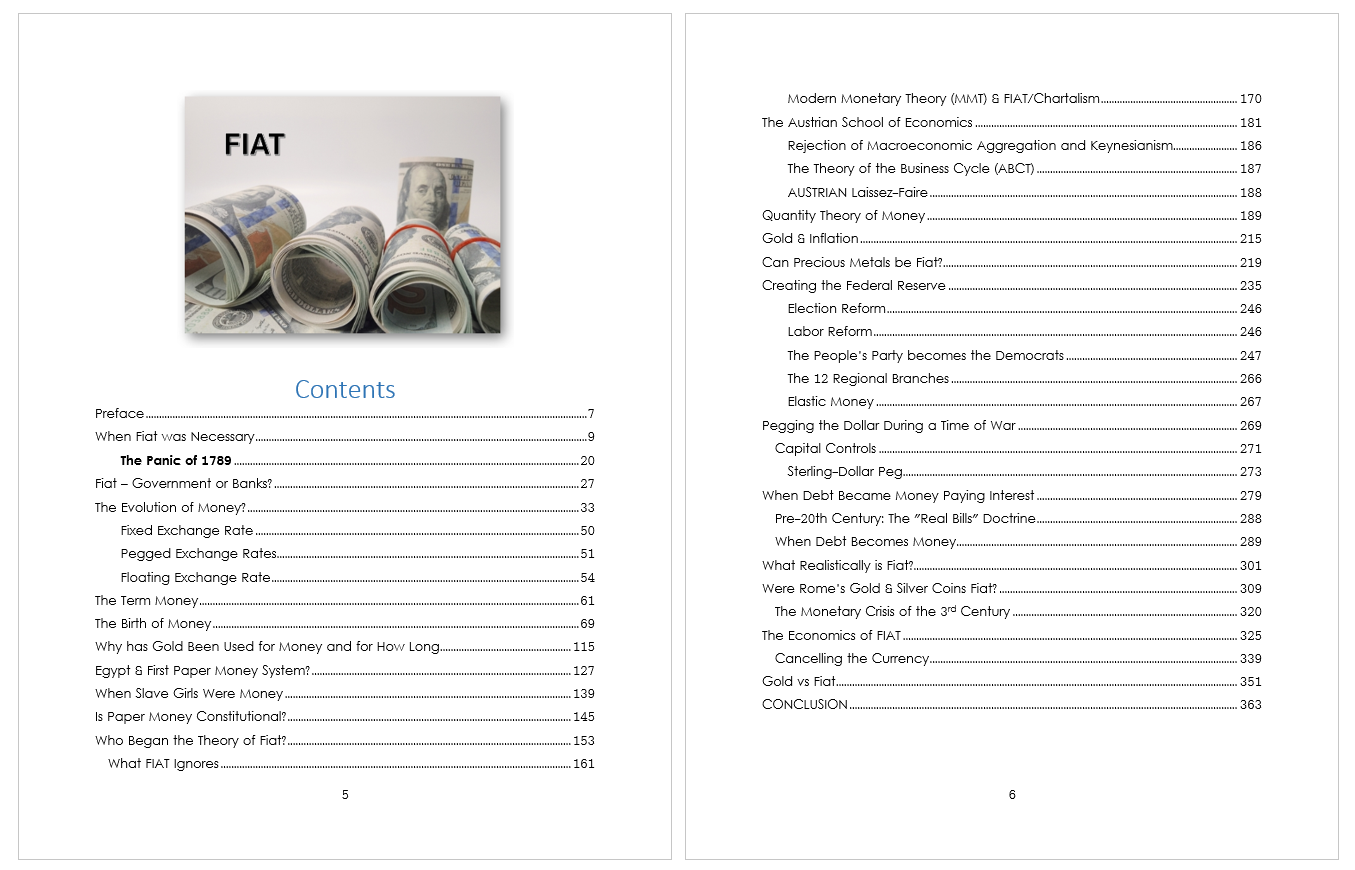
Then there is the questionable Elastic Money used by central banks creating inflation combined with discredited Keynesian Economics assuming society can be manipulated with interest rates. But is money exclusively the product of a central bank? Has debt become money that just pays interest? Are we blaming the gun for a murder rather than the person who pulls the trigger? Is debt a part of the monetary system? Does bank lending create money privately? Where does BITCOIN fit into this quagmire of trying to define what is actually money?

Fiat_Currency 2nd Ed Index