The European Parliament has now thrown its support behind the creation of a digital euro, marking a significant political step toward introducing a central bank digital currency across the eurozone. While the project has been under development for several years at the European Central Bank, this vote signals that lawmakers are increasingly prepared to move the concept from theory toward reality.
Members of Parliament approved amendments endorsing a digital euro that would function both online and offline, effectively aligning with the European Central Bank’s vision for a publicly issued digital form of money. The vote passed with a strong majority, signaling broad political backing for the idea that Europe should create a digital currency controlled by its own monetary institutions rather than relying entirely on private payment networks.
The move reflects growing concern within Europe about the structure of global payment systems. A large portion of digital transactions within the European Union currently run through networks such as Visa and Mastercard, companies headquartered outside the EU. European policymakers have become increasingly uncomfortable with this dependency, arguing that payment infrastructure is no longer just a technical system but a strategic asset tied to economic sovereignty.
Officials have openly framed the digital euro as a way to regain control over the “rails” of Europe’s payment system. If payments are moving steadily away from cash and toward electronic platforms, central banks want to ensure that sovereign currency continues to play a role in that environment rather than being displaced by private payment systems or foreign financial networks.
Under current proposals, the digital euro would complement cash rather than replace it immediately. Citizens would access the currency through digital wallets provided by banks or financial institutions, allowing them to send and receive payments electronically using money issued directly by the central bank. Supporters argue this would preserve public access to central bank money in an economy where physical cash is used less frequently.
Yet the broader implications extend beyond convenience. A digital currency issued by a central bank changes the architecture of the financial system itself. For the first time, individuals could potentially hold digital money backed directly by the central bank rather than commercial bank deposits. That raises complex questions about the relationship between central banks, commercial banks, and the public.
The project remains in its legislative and technical stages. EU governments agreed on a negotiating framework in late 2025, and the European Parliament’s vote now signals that lawmakers are prepared to move forward with the next phase of legislation. If the regulatory framework is finalized in the coming years, the European Central Bank hopes to begin pilot testing around 2027, with a potential public rollout later in the decade.
Posted originally on Mar 6, 2026 by Martin Armstrong |
The conflict now unfolding with Iran is beginning to expose a series of geopolitical lines that had been quietly building for years. What is striking about the current situation is not simply the military confrontation itself, but the reaction of various nations. The world is no longer responding as it did in earlier conflicts where alliances moved almost automatically behind Washington. Instead, governments are drawing their own lines in the sand.
The United States and Israel are presently the two nations directly engaged in military operations against Iran. While Washington has access to bases throughout the Middle East, most of those countries are not actively participating in combat. Gulf states such as Qatar, Bahrain, Kuwait, Saudi Arabia, and the United Arab Emirates host American military infrastructure, but their involvement largely reflects long-standing defense agreements rather than enthusiastic participation in a new regional war. These nations find themselves caught between two competing pressures: their security arrangements with the United States and the geographic reality of living within missile range of Iran.
What has been particularly revealing is the response in Europe. Spain openly refused to allow the United States to use its bases at Rota and Morón for operations against Iran, sparking a diplomatic confrontation with Washington. That decision has highlighted the growing divide inside NATO. During the Cold War and even in the early post-Cold War era, European governments generally aligned themselves with U.S. military policy. Today that unity is no longer automatic. European leaders increasingly calculate their own political and economic risks before committing themselves to American military campaigns.
The reluctance to join the conflict reflects deeper concerns about escalation. Many European governments are already facing fragile economies, political fragmentation, and rising social tensions. Opening another military front in the Middle East while the war in Ukraine continues would add another layer of uncertainty to an already unstable geopolitical environment. As a result, several governments are publicly urging diplomacy rather than military expansion.
Iran does not stand entirely alone. Its support network is less conventional than traditional state alliances but still significant. Groups such as Hezbollah in Lebanon, the Houthis in Yemen, and various militias operating in Iraq form part of a regional structure that Tehran has cultivated over decades. These organizations are not merely political sympathizers; they possess their own military capabilities and can operate across multiple fronts simultaneously. This creates a form of distributed conflict that complicates any direct confrontation with Iran itself.
What we are witnessing is the emergence of a fragmented geopolitical landscape where alliances are no longer rigid. Countries are evaluating their interests in a far more transactional way. Some governments provide logistical support while avoiding direct involvement. Others refuse cooperation altogether. Meanwhile, regional actors pursue their own strategic agendas independent of traditional Western alliances.
When crises arise, the difference between formal alliances and genuine strategic alignment becomes visible. The current situation with Iran is exposing those differences in real time. Nations are making calculations not only about military risk but also about energy markets, economic stability, and domestic political pressures.
The phrase “lines in the sand” has long been associated with the Middle East, yet today it applies equally to the diplomatic landscape surrounding the conflict. Countries are defining the limits of their involvement, sometimes publicly and sometimes quietly behind the scenes. These decisions reveal a world where geopolitical loyalties are becoming far more fluid than they once appeared.
Posted originally on Mar 6, 2026 by Martin Armstrong |
Existing home sales just delivered one of the clearest signals yet about the true state of the housing market in 2026, and it is not the rebound narrative the mainstream keeps promoting. The latest data shows that existing-home sales fell 8.4% in January to a seasonally adjusted annual rate of just 3.91 million units, the steepest monthly decline in nearly four years and the slowest pace in over two years. Sales were also down 4.4% compared to the same month last year, and declines occurred across every region of the United States.
The median existing-home price rose to $396,800, marking the 31st consecutive month of year-over-year price increases, indicating that prices remain historically elevated even as transaction volume collapses. Inventory stood at roughly 1.22 million units, representing just a 3.7-month supply. Yet, this is still well below historical norms needed for a healthy market turnover.
What makes this particularly significant is that the drop took place even as mortgage rates eased to their lowest levels since 2022. In a normal liquidity-driven market, lower borrowing costs should stimulate demand. Instead, the opposite occurred. Even though affordability has technically improved for several consecutive months, buyers are not returning in force. That disconnect is critical. When affordability improves, but sales still fall, it means the restraint is psychological and economic, not purely financial.
Regional data reinforces the structural weakness. The West experienced the sharpest decline, down over 10%, while the South and Midwest also fell notably, showing that this is not a localized slowdown but a nationwide contraction in transaction activity. First-time buyers accounted for only about 31% of purchases, far below the historical norm of nearly 40%, indicating that entry-level demand remains severely constrained.
Real estate does not turn on interest rates alone. Real estate factors in confidence, taxation, job stability, and the long-term economic outlook. Existing-home sales have now been stuck near a roughly 4 million annual pace since 2023, well below the historical norm of about 5.2 million, confirming that the housing market has been in a prolonged structural slump rather than a cyclical boom-bust phase.
What we are witnessing is a frozen market, not a crashing one. Homeowners remain locked into ultra-low legacy mortgages and are unwilling to sell, while buyers face high prices, economic uncertainty, and long-term affordability concerns despite slightly lower rates. The result is reduced turnover rather than forced liquidation. The real estate market remains cautious and tied to the broader economic confidence cycle.
Posted originally on CTH on March 5, 2026 | Sundance
I’m working on a deep explainer for the behavior of China as it relates to ongoing U.S. strategic military operations. More to come soon. In the interim, Carl Higbie from Newsmax outlines how China is spending domestically inside the USA in order to try and stimulate opposition to the Iran confrontation. WATCH:
Posted originally on CTH on March 5, 2026 | Sundance
Sometimes you have to sip coffee slowly, while taking in the landscape.
About a month ago President Donald J Trump bombed Caracas, engaged the U.S. military with a direct firefight against Venezuela military & security forces, then snatched regime dictator Nicholas Maduro out of the country to face criminal charges in the United States.
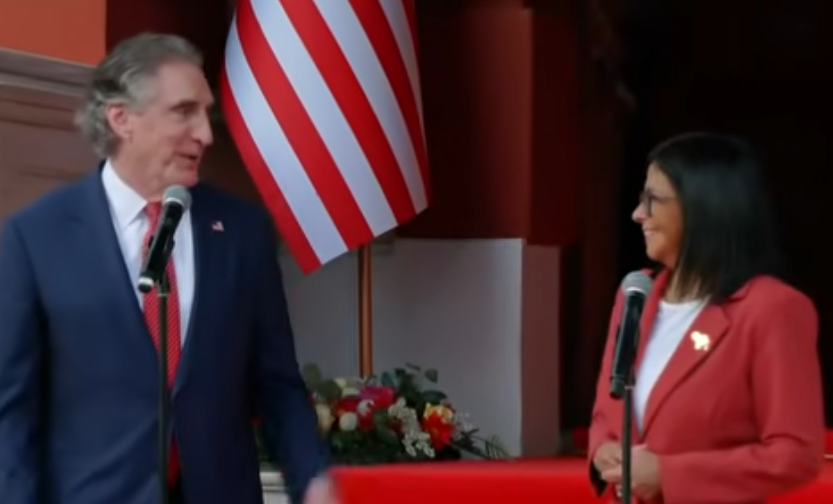
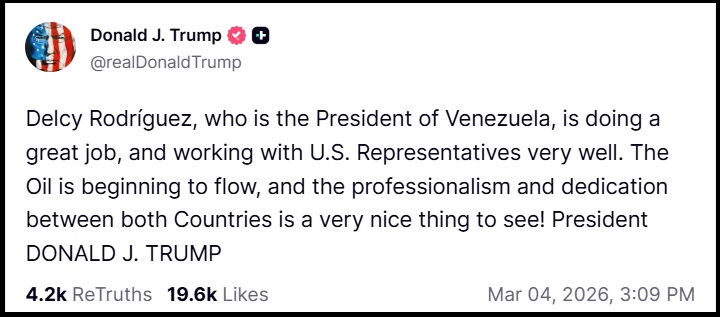
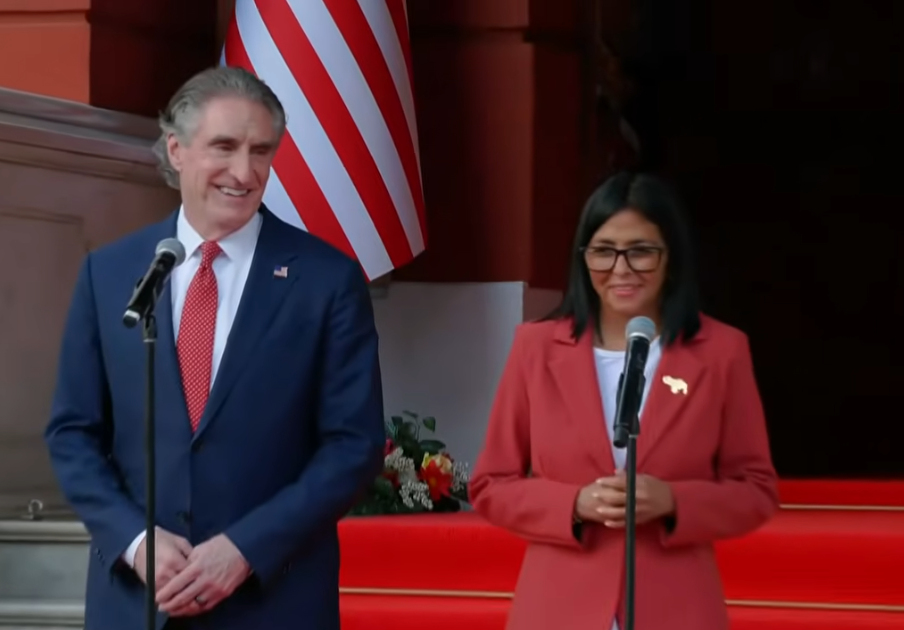
Yesterday, Maduro’s replacement, President Delcy Rodriquez, stood on the steps to the Venezuela presidential office and publicly thanked Interior Secretary Doug Bergum for the kindness and support of President Donald Trump.
That reality represents a level of hemispheric ‘ultimate boss’ that boggles the mind. But wait, it gets better. There’s video (prompted):
Before going further to current events, let us remind ourselves of a few details.
Sandwiched between the Venezuela Maduro operation and the recent Operation Epic Fury in Iran, approximately three weeks ago, Gen. Dan Caine, chairman of the Joint Chiefs of Staff, and Defense Secretary Pete Hegseth convened a gathering in Washington of all the defense chiefs and senior military officials from 34 Western Hemisphere countries.
As most of you will remember, securing the national security of the entire Western Hemisphere, was outlined in the national defense strategy document [SEE HERE] released by President Trump. In addition to setting the priorities for the United States focus, the report details the Trump administration perspective on the world as broken down into specific regions. The report is a brutally honest review of the current state of geopolitical benefits, risks and threats as they pertain to vital U.S. interests. The report outlines a critically renewed focus on the Western Hemisphere.
Now, back to Secretary Bergum’s visit.
At the same time as Interior Secretary Bergum is meeting with key government and private sector partners to discuss strategic mineral development (ie. deconflict dependency on China via independent development), oil production for U.S. hemispheric security (Iran output offsets), Venezuela announced the transfer of 1,000 kilos (more than a ton) of gold reserves for sale on the U.S. market {SOURCE}.
Venezuela needs stability. Hemispheric Boss President Trump wants Venezuela to have stability. Venezuela needs dollars and both the coordinated sale of Venezuela oil and Venezuela gold (47 tonnes in strategic reserve) will provide those dollars to retain stability and seed economic growth projects.
This coordinated approach secures the economic future of Venezuela and simultaneously secures the energy security of the Western Hemisphere while geopolitical operations continue in other regions, like the confrontation with Iran.
In essence, President Trump is isolating the Western Hemisphere from collateral economic damage that is likely to happen as the U.S. begins to take down the leading sponsors of global conflict. As things are in flux, the close and controlled partnership with Venezuela can offset/mitigate a lot of chaos.
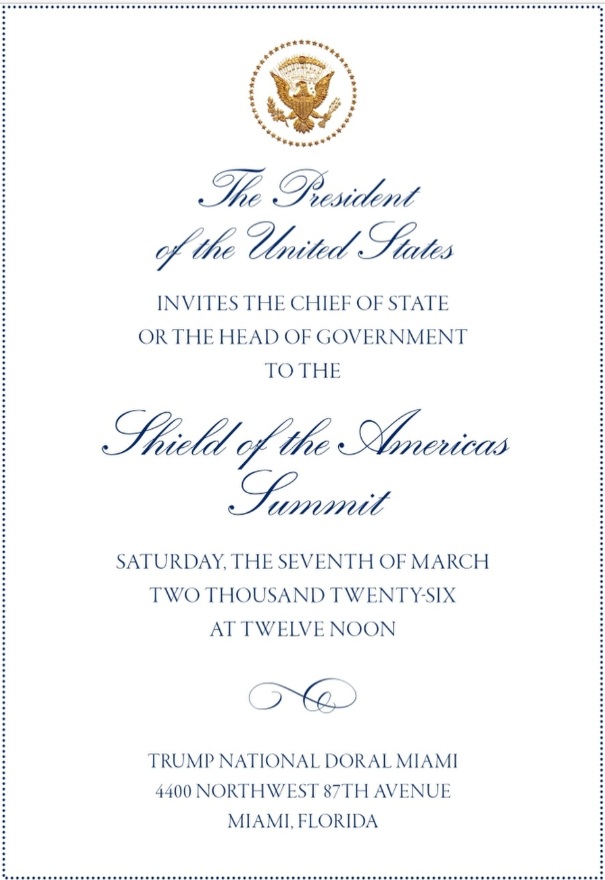
While the ongoing Iran confrontation happens in the middle east, and in combination with the priority of the National Security Strategy, President Trump then convenes a meeting of hemispheric leaders in Florida this weekend.
The Latin-America meeting in Doral is being called the “Shield of the Americas Summit.” The Trump administration has made it a priority to assert dominance over the Western Hemisphere, where China previously built influence through massive loans and expansive trade.
Yesterday, White House Press Secretary Karoline Leavitt announced President Trump will host heads of state from “Argentina, Bolivia, Chile, Costa Rica, the Dominican Republic, Ecuador, El Salvador, Honduras, Panama, Paraguay, Trinidad and Tobago, and maybe some others as well.”
So, let’s put it all together.
President Trump proactively secured the border, targeted narcotraffickers, confronted narcoterrorists, targeted Mexican drug cartel leadership, leveraged the DOJ to indict regional actors, pushed China out of control in the Panama Canal, took out Nicholas Maduro, took control of Venezuela oil production – both for the security of the U.S. and benefit of the Venezuelan people, removed the discounted oil benefit for China and reasserted stability in the Western hemisphere.
Then, with all that in place, he turned toward Iran…. but, proactively planned for a ‘Shield of the Americas Summit’ before the Iran operation began and scheduled it while Operation Epic Fury continues.
Jumpin’ ju-ju bones. That outline and timeline is not supposition; it is what took place.
And, yeah, we just watched “interim” Venezuela President Delcy Rodriquez react to what she is witnessing happening all around her.
Accepting all of this, I would not be in the least surprised to see President Rodriquez in Doral this weekend.
This my friends, is a level of strategic boss maneuvering beyond anything we have ever witnessed before.
[…] – “Interior Secretary Doug Burgum landed in Venezuela on Wednesday to begin talks about a potential rare earth minerals partnership, just weeks after the U.S. arrested former Venezuelan President Nicolás Maduro.
FOX Business exclusively joined Burgum on the trip. President Donald Trump‘s administration views Venezuela’s untapped resources as a potential alternative to relying on China for critical minerals, FOX Business has learned.
While in Venezuela, Burgum will also help expand the relationship between U.S. oil companies and the Venezuelan government. The secretary will meet with the current Venezuelan President Delcy Rodríguez to continue the growing relationship between the two countries.
Burgum is the first member of Trump’s Cabinet to leave the country since the U.S. launched Operation Epic Fury against Iran on Saturday.” (read more)
Posted originally on CTH on March 5, 2026 | Sundance
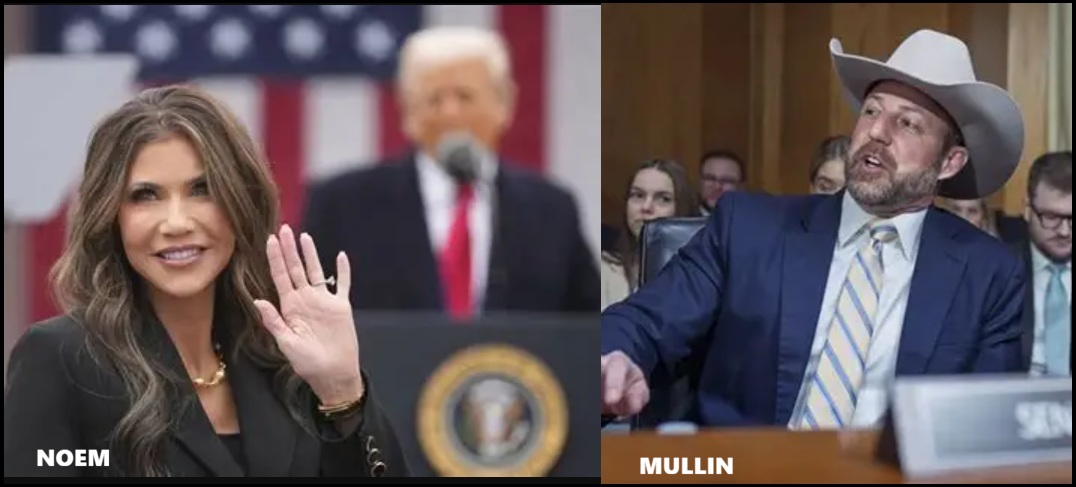
Making the announcement on his Truth Social Account, President Trump announces that Dept of Homeland Security Secretary Kristi Noem will be replaced with Oklahoma Senator Markwayne Mullin.
[Truth Social] – I am pleased to announce that the Highly Respected United States Senator from the Great State of Oklahoma, Markwayne Mullin, will become the United States Secretary of Homeland Security (DHS), effective March 31, 2026. The current Secretary, Kristi Noem, who has served us well, and has had numerous and spectacular results (especially on the Border!), will be moving to be Special Envoy for The Shield of the Americas, our new Security Initiative in the Western Hemisphere we are announcing on Saturday in Doral, Florida. I thank Kristi for her service at “Homeland.”
Serving 10 years in the United States House of Representatives, and 3 in the Senate, Markwayne has done a tremendous job representing the wonderful People of Oklahoma, where I won all 77 out of 77 Counties — in 2016, 2020, and 2024! A MAGA Warrior, and former undefeated professional MMA fighter, Markwayne truly gets along well with people, and knows the Wisdom and Courage required to Advance our America First Agenda.
As the only Native American in the Senate, Markwayne is a fantastic advocate for our incredible Tribal Communities. Markwayne will work tirelessly to Keep our Border Secure, Stop Migrant Crime, Murderers, and other Criminals from illegally entering our Country, End the Scourge of Illegal Drugs and, MAKE AMERICA SAFE AGAIN. Markwayne will make a spectacular Secretary of Homeland Security. Thank you for your attention to this matter!
I have created this site to help people have fun in the kitchen. I write about enjoying life both in and out of my kitchen. Life is short! Make the most of it and enjoy!
This is a library of News Events not reported by the Main Stream Media documenting & connecting the dots on How the Obama Marxist Liberal agenda is destroying America




 Centinel2012