Posted originally on Jul 14, 2025 by Martin Armstrong
The world’s largest pension fund, the Government Pension Investment Fund (GPIF) of Japan, reported a $61.1 billion loss for the first quarter of the year. Half of the fund’s $1.5 trillion assets under management (AUM) are within overseas markets, and although susceptible to currency fluctuations, the true problem lies in the fund’s other 50% of its portfolio—government bonds split 25% domestically and 25% foreign.
Any pension fund that holds government debt in size and thinks it will return to normal is delusional, as I mentioned back in 2021. They have faith that yields will recover when that is simply not the case. The entire idea of pensions has been set around the average 8 % return in interest rates, but it has been pension funds that are primarily the cause of lower interest rates, not the central banks. The number of pension funds out there created a bid for long‑term bonds.
Japan has the highest debt-to-GDP ratio among advanced economies. The Bank of Japan owns over 50% of JGBs, making it the largest single holder, which has created a rigged market. Yields have been artificially lowered, and capital allocation has been distorted for years. Pension funds, banks, and insurance companies have been locked into JGBs, not because they want yield, but because regulation and policy have given them no choice.
As for Japanese pensions, the large aging population and shrinking workforce have led to fewer taxpayers capable of supporting this growing demographic. GPIF began moving into foreign assets to escape the BOJ’s doomed policy of negative interest rate,s but it is trapped overall. Japan looks to GPIF as a sign of economic confidence, and these losses are a warning.
Socrates has issued bearish long-term outlooks on the Japanese bond market and warns of sovereign debt crises that will directly impact pension systems. Japanese Government Bonds (JGBs) pay absolutely nothing, and yet GPIF is required to hold a portion. When there is no buyer left, the burden will fall on the Bank of Japan, and that is simply unsustainable. As the computer has warned, the sovereign debt crisis will begin in Japan before spreading like a contagion.
Posted originally on Jul 9, 2025 by Martin Armstrong
The Federal Reserve’s Survey of Consumer Expectations foresees inflation returning to “pre-tariff” levels. As I have mentioned, the rising costs were a mere price correction and not a permanent rise in inflation. Tariffs were NEVER the root cause of inflation.
The central bank predicts that inflation will read 3% in 13 months, which would be the same level of inflation—at least by the Fed’s calculations—since Trump entered the White House. The Fed was stating that prices would rise 3.6% back in March and April when the tariffs were announced. They blamed the Smoot-Hawley Tariff for the Great Depression, just like they’re now blaming Trump’s tariffs for inflation. It’s a political narrative.
Central bank members see inflation remaining unchanged over the next three to five years at 3% and 2.6% respectively. However, members see prices increasing in food (5.5%), medical (9.3%), gas (4.2%), rent (9.1%), and college tuition (9.1%). There is a plethora of factors leading to inflation in the aforementioned categories, none of which have any relation to tariffs.
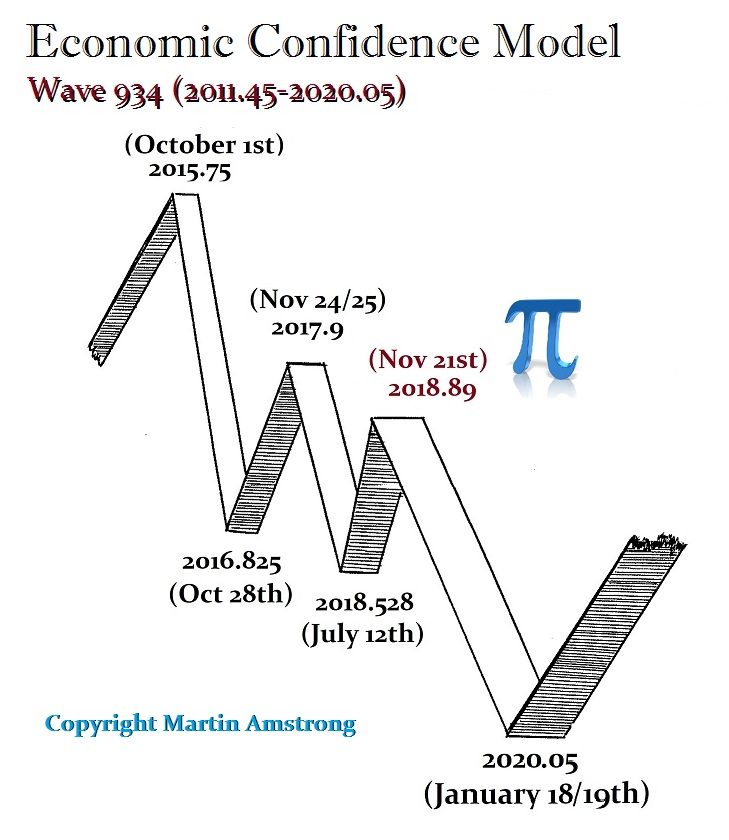
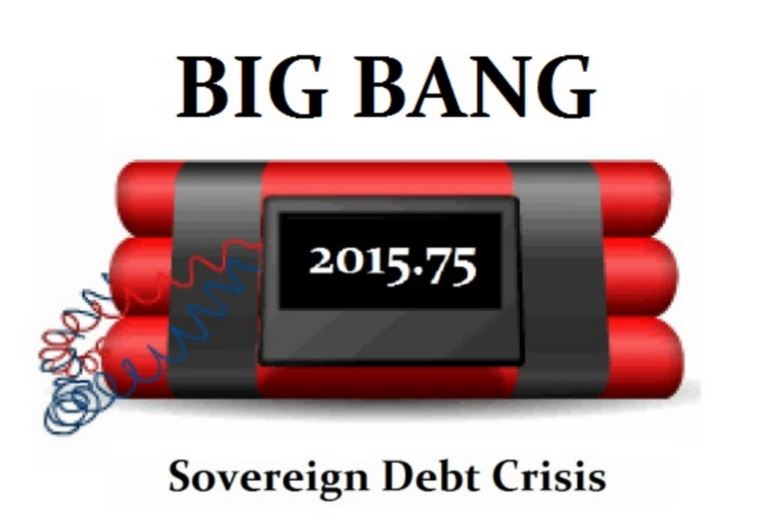
Prices have simply not returned to what they once were before the global economy came to a standstill during COVID. Every nation has been affected. The lockdowns and supply chain cracks were exacerbated by a massive increase of government spending. Then the government doubled down on green policies, causing energy prices to rise, and lit the situation ablaze amid the Ukraine war and Russian sanctions. The world was already amid a sovereign debt crisis before COVID, and in fact, the Economic Confidence Model clearly stated that the landscape would permanently change after the Big Bang target of October 1, 2015 (2015.75)—the peak in government confidence.
2015.75 was the beginning of the decline we are witnessing in sovereign bonds globally. The migrant crisis began in 2015 when former German Chancellor Angela Merkel invited Syrian refugees to Europe, leading other Build Back Better nations to follow suit in the years since. Anti-establishment sentiment was already on the rise when Trump first secured the presidency the following year in 2016.
Trump was not the cause, he was the symptom. The people lost faith in the establishment starting in 2015.75 and this is part of the global shift predicted precisely by the system. The Fed thinks inflation is a monetary issue. We are in a sovereign debt crisis, a confidence crisis, and a geopolitical storm and not a normal business cycle.
Posted originally on Jul 8, 2025 by Martin Armstrong
I have written about how Rome fell, and just by mapping the population of Rome, you can see the fate of many current nations and states operating under poor fiscal policies – people sell and just leave. It is different this time because, under socialism, the government has become abusive. When it came to integration, they sought to implement it by sheer force.
You can’t legislate the poor into prosperity by legislating the wealthy out of prosperity. Jobs are created by the wealthy who become wealthy because of their innovative vision – i.e., Henry Ford, Bill Gates, Steve Jobs, and so on. Henry Ford’s vision created the auto industry. Bill Gates, in bringing DOS to life, created the personal computer industry, as did Steve Jobs. How much employment did just those three men create? Far more than government.
Government creates nothing to advance society or to increase GDP in any positive manner. It is a natural human response not to pay taxes and this is why taxes have been the number one reason for civil war and revolution. It is always resentful to pay taxes, whereas giving money to help someone is rewarding. Taxes tend to support politicians and their pensions. If they must sell some assets to take a government job, it is tax-free. Few leave government without growing their net worth far beyond what one could typically earn through income or investments.
The great welfare state has produced a large segment of fraud and kept many people down since they would rather be taken care of than work to take care of themselves. Even in prison, many people are sentenced to 10 or 20 years, and the first thing they do is commit a crime to get back in, where they do not have to pay taxes, and they are taken care of. You destroy people’s lives for such a long period for non-violent crimes, and then expect them to have a fulfilling life thereafter?
In the United States, we have witnessed a significant shift in the population since the COVID-19 pandemic. People are continuing to flee authoritarian states with high taxes like California, New Jersey, and New York in favor of financially friendly states like Arizona, Texas, and Florida.
New Zealand once had a program where if a woman was pregnant and she had no idea who the father was, the government provided everything right down to a free home. They ended up with the highest percentage of women who had no idea who the father of their child was. Naturally, they did know the identity of the biological father, and he would jump out the back window when the social worker visited. They got everything for free then.
Any of these types of programs employ a divide-and-conquer strategy. The government cannot give to anybody anything that the government doesn’t first take from somebody else. When you reach a state where 50% of the people depend upon the other 50% to pay their bills, you end up with class warfare and bitterness. This is the cycle where civilization rises, peaks, and then crashes when government becomes the enemy of the people.
Posted originally on Jul 8, 2025 by Martin Armstrong
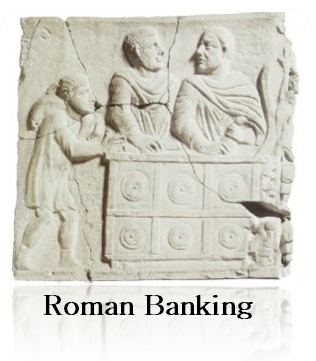
Banking has existed from the earliest of times and has taken many forms, from safe deposit storage, money changers, merchants with the ability to move money internationally, to money lenders. Some people wrongly assume that they can eliminate the business cycle by eliminating fractional banking. They assume that it will be possible to match lenders and borrowers to maturity contracts. They do not comprehend that this is the line of thinking that always leads to authoritarianism, all the way to communism.
The problem that will emerge from matching lenders and borrowers to a maturity contract is that the boom-bust cycle will still exist. There will always be the perpetual rise and fall in asset values caused by other factors (including human nature), not least of which will be changes in technology, civil unrest, and war that can alter capital flows. History offers a catalogue of solutions. All we need to test such an idea is to open the books.
People assume the cause of the business cycle is the fractional banking issue, as if that were eliminated, then you would flat-line the business cycle, creating utopia. Be very careful. This was the goal of Karl Marx as well. So the starting point is a basic question. Has fractional banking always existed? NO! Since the answer is no, then did the boom and bust cycle in banking exist even without fractional banking? The stark answer – YES.
In ancient times, financial panics also occurred without fractional banking. In Athens during 354BC, people borrowed money from the Temple unbeknownst to everyone else. They were speculating in real estate. The real estate market collapsed without fractional banking, and then it was exposed that the money was borrowed behind the curtain, so to speak, from the temple. Corrupt priests had all this money donated to Athena. She obviously was very frugal since she never seemed to go on a spending spree to buy shoes, owls, or spears. She wore a helmet so she didn’t need a hairdresser. So the priests could keep their hands out of the treasury. Oops – they were caught lending it out to their buddies for spare change. There was no fractional banking involved. They had the money and lent it to their buddies. The assets collapse because, as always, the mood of people changes with the seasons.
Fast forward to the 17th century, and we find the very same scheme played out by politicians. There was the collapse of Wisselbank in Amsterdam, where people had deposited their money and assumed the bank was strictly a safekeeping facility. They offered no loans and paid no interest. Little did they know, the government was using their deposits to fund its own trading.
The Wisselbank was founded in 1609. Upon first opening an account, a depositor paid a fee of ten guilders, three guilders, and three stuivers for each additional account. Two stuivers were paid for each transaction, except those of less than three hundred guilders, for which six stuivers were paid, in order to discourage the multiplicity of small transactions. A person who neglected to balance his account twice in the year forfeited 25 guilders. A person who ordered a transfer for more than what was upon his account, was obliged to pay three per cent for the sum overdrawn. The bank made further profit by selling foreign coin and bullion, which fell to it by the expiration of receipts, and by selling bank money at five percent and buying it at four percent. These sources of revenue were more than enough to pay for the wages of bank officers and defray the expense of management. (Adam Smith)
In 1602, the United East India Company (VOC) was formed from six trading companies in the Netherlands and granted a trade monopoly over the Indies. The bank was administered by a committee of city government officials concerned to keep its affairs secret. It initially operated on a deposit-only basis, but by 1657, it was allowing depositors to overdraw their accounts, and lending large sums to the Municipality of Amsterdam and the United East Indies Company (Dutch East India Company). Initially, this was kept confidential, but it had become public knowledge by 1790. The City of Amsterdam took over direct control in 1791 as a bailout, before finally closing it in 1819.
There is plenty of history of banking BEFORE fractional banking. Sorry, but that did not stop banking panics nor did it stop the business cycle with the boom and bust events. The Tulip Bubble was not leveraged with fractional banking. No matter what, the boom and bust cycle is driven by human nature. We do have a tendency to change our minds about everything from fashion to money.
The idea of matching lenders and borrowers sounds appealing. However, that will not eliminate the cycle. I can find no instance of such a flat line except during a Dark Age where there was no banking, private ownership, or any real economy. Coinage during the period is rare and is typically confined to the region where it was struck, demonstrating the lack of an economy or circulation due to trade.
Posted originally on Jul 5, 2025 by Martin Armstrong
QUESTION: You said that the German Nazi Party was raising money selling bonds in the United States before they invaded Poland in 1939. When I asked AI, if the Nazis sold bonds in the US it said “No, the Nazi regime did not sell sovereign bonds in the United States after coming to power in 1933 and before the outbreak of WWII in 1939.” So, who is correct? You or AI?
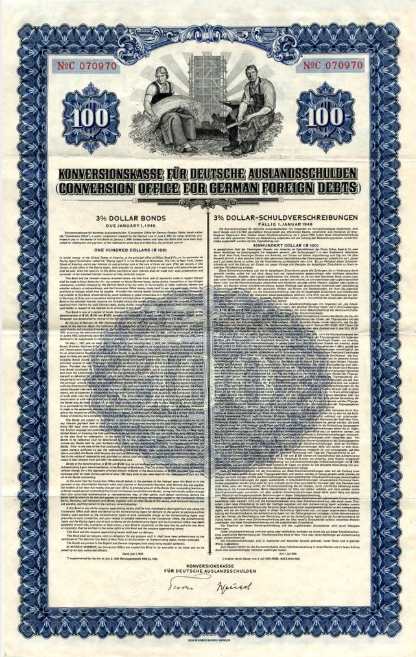
ANSWER: From what I am being told, a problem is surfacing with ChatGPT-generated content, which often contains factual inaccuracies. The development of language models to engage in AI is presenting a problem. They are learning from the WEB, correct. However, they are not necessarily capable of verifying what is true or false. Here is a Conversion Office for German Foreign Debts $100 Bond (Nazi Government sold in the United States) into the New York 1936. I have the physical evidence that suggests that the answer you received was incorrect.
British Journal of Educational Technology (BJET) recently explained that “no research has yet examined how epistemic beliefs and metacognitive accuracy affect students’ actual use of ChatGPT-generated content, which often contains factual inaccuracies. ” For those unfamiliar with this arcane term of philosophy, linguistics, and rhetoric, epistemic, it traces back to the knowledge of the Greeks. That Greek word is from the verb epistanai, meaning “to know or understand.”
I try to be accurate, and if I state something as fact, I have generally verified it versus making a statement of just an “opinion,” perhaps derived from a belief. Nobody is perfect – not even ChatGPT.
I have created this site to help people have fun in the kitchen. I write about enjoying life both in and out of my kitchen. Life is short! Make the most of it and enjoy!
This is a library of News Events not reported by the Main Stream Media documenting & connecting the dots on How the Obama Marxist Liberal agenda is destroying America








 Centinel2012