Breaking Down the Significance of the CapEx Comeback and How It Will Make Everyday Americans Richer


Posted originally on Rumble By Charlie Kirk show on: July 24, 2025

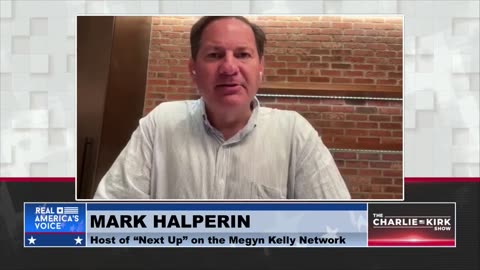
Mark Halperin Analyzes the Latest Trump Approval Numbers


Posted originally on Rumble By Charlie Kirk show on: July 24, 2025

War Bankrupts Empires, Nations & City-States – Here We Go Again


Posted originally on Jul 27, 2025 by Martin Armstrong 

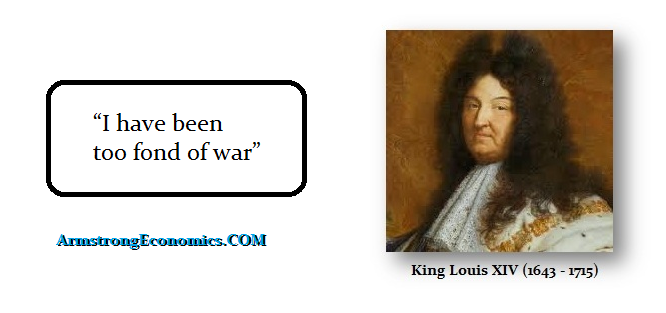
Louis XIV War

France was on the brink of its Fifth bankruptcy in 1720. France defaulted in 1558 under Henry II, following the costly Habsburg-Valois Wars (also known as the Italian Wars), the outright repudiation of debt, and currency devaluation. Then in 1648, a Debt Crisis occurred under Louis XIV (Early Reign) with the Thirty Years’ War (1618–1648) and the Franco-Spanish War (1635–1659). Louis XIV suspended payments and manipulated currency. Then, in 1661, there was another financial collapse under Louis XIV, when Finance Minister Nicolas Fouquet was arrested for corruption. Jean-Baptiste Colbert later reformed finances, but debt remained high.

Then, in 1715, France fell into bankruptcy following the death of Louis XIV. The War of the Spanish Succession (1701–1714) left France deeply indebted. The regency of Philippe d’Orléans implemented the Visa of 1715, a partial debt repudiation. This brings us to 1720 and the collapse of the Mississippi Bubble (John Law’s system), for which history blamed him without examining France’s chronic debt problems. John Law’s speculative financial scheme collapsed, resulting in hyperinflation of paper money and a banking crisis. The French government defaulted on its obligations.

This was followed by the 1770  Bankruptcy under Louis XV. The Seven Years’ War (1756–1763) and financial mismanagement led to another debt crisis. The Finance Minister Étienne de Silhouette and later René de Maupeou imposed austerity and partial defaults.

Then, just 19 years later, this brings us to the debt crisis that sparked the 1789 French Revolution. The Pre-Revolution Financial Crisis was when France was effectively bankrupt under Louis XVI, leading to the Estates-General and the French Revolution (1789). The revolutionary government later repudiated royal debt.

Then, 23 years later, we come to the 1812–1813 Financial Crisis under Napoleon. The Napoleonic Wars drained French finances. The government resorted to forced loans and currency debasement. Just 5 years later, we come to the 1818 Post-Napoleonic Debt Restructuring. After Waterloo (1815), France struggled with reparations and debt. The Duc de Richelieu negotiated loans to stabilize finances. It is a wonder why anyone lends to governments that always want war.

We arrive at the next Revolution in 1848 and the 1848  Financial Crisis during the Second Republic. The February Revolution led to a credit crunch. The government imposed emergency financial measures, as it was unable to meet its debts, given that this was a socialist revolution against the wealthy.

Never learning from the past, which they always seem to assume is gone, we again arrive at the 1871 Post-Franco-Prussian War Bankruptcy Threat. Here, France had to pay 5 billion francs in reparations to Germany after losing the war. The government took massive loans (e.g., Morgan Loans) to avoid default. This was also why France demanded reparations from Germany after World War I, which resulted in bringing Hitler to power in 1933.

Then there was the Great Depression. Here, France was forced to restructure again in 1936, with the Franc Devaluation and Debt Restructuring. The Great Depression weakened France’s economy. The Popular Front government devalued the franc and restructured debt.

Then there was the 2010 EU Debt Crisis, which most people look at in relation to Greece and stop there. The 2010s European Debt Crisis (Near-Default Risk) contagion affected France, which faced high deficits but avoided sovereign default. Debt-to-GDP rose sharply, but the country barely maintained its creditworthiness and is once again incurring deficits, all to wage war on Russia.

Here we go again. We will see massive sovereign defaults in Europe as they wage war on Russia at the behest of NATO and the Neocons.

Trump EU Trade Deal


Posted originally on Jul 27, 2025 by Martin Armstrong 

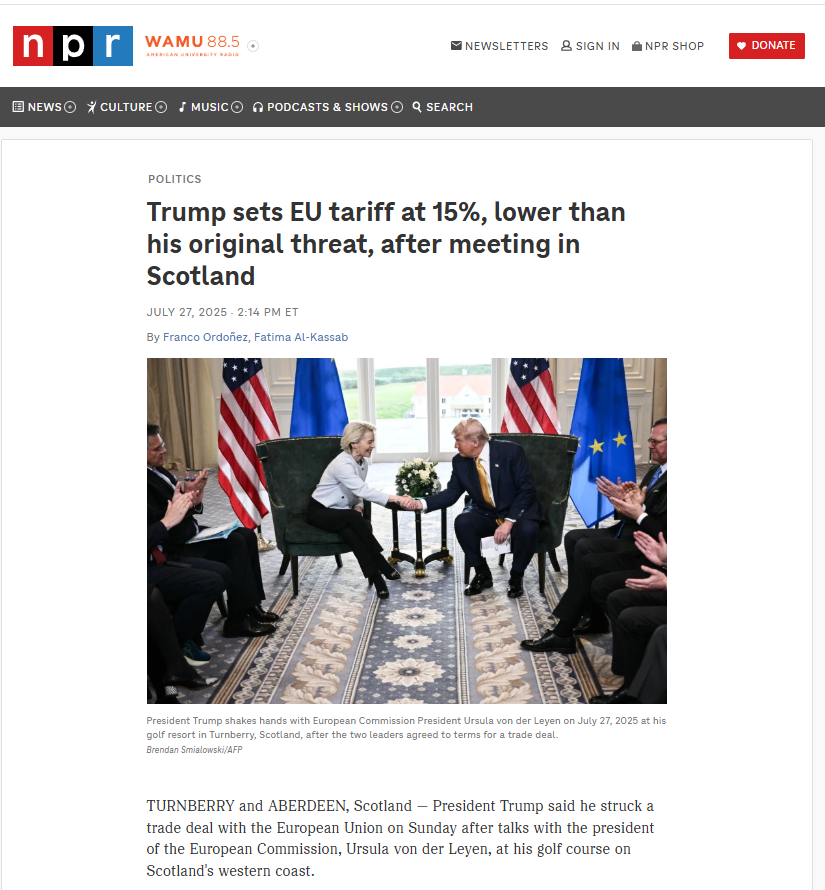
2025_07_27_16_48_06_Trump_clinches_trade_agreement_with_EU_with_15_tariff_NPR

Trump strikes a deal in Scotland with the EU where most EU exports to the United States will face a 15% tariff, down from the 30% tariff. The EU has agreed to accept U.S. imports without tariffs, according to Trump. This will fulfill our model forecast that the EU economy is in recession and will not bottom until 2028.

The Marshall Plan is Over – EU Commission President Ursula von der Leyen Announces Details of U.S-EU Trade Agreement


Posted originally on CTH on July 27, 2025 | Sundance 

The Marshall Plan is OVER!

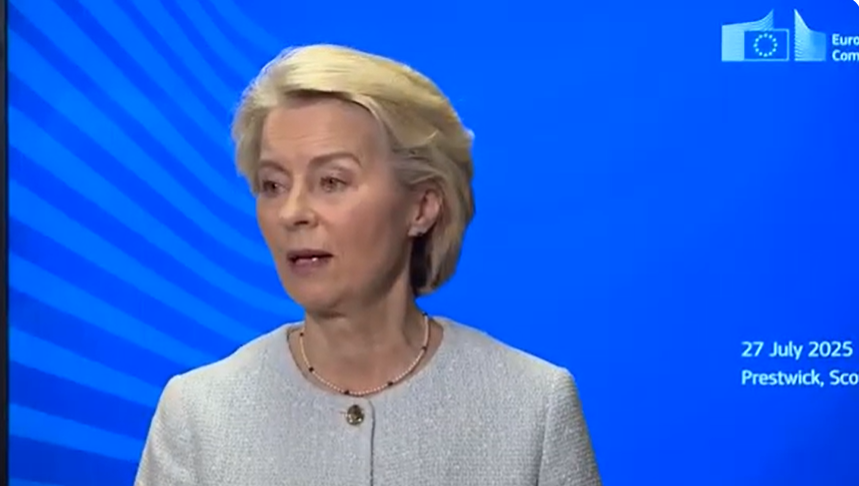
Okay, this is a very big win.  EU Commission President Ursula von der Leyen outlines some more details of the U.S-EU trade agreement.  The parameters fall similar to the Japanese deal, without the banking aspect.

The EU will face (and accept) a 15% tariff rate for most exports to the USA including autos, that’s huge, even with some zero-for-zero tariff sectors outlined.  The primary motivating factor was to avoid the 35% tariff rate scheduled for August 1st and provide the EU corporations with certainty in their tariff rate as applied by the USA (15%).  WATCH:

.

This is almost full acquiescence to President Trump.  WATCH THE VIDEO

Ursula has the sads.

.

President Trump Gives Broad Outline of U.S-EU Trade Agreement


Posted originally on CTH on July 27, 2025 | Sundance

President Trump and EU Commissioner Ursula von der Leyen have apparently come to terms around the broad outlines of a U.S-EU trade agreement.

The EU will commit to purchasing $750 billion in energy products.  The EU will commit to investing $600+ billion in direct U.S. industries.  The EU will commit to purchasing their NATO military hardware from the USA ($500+ billion likely).  The EU will open up all markets to USA products without tariffs.  The EU and U.S. will both carry a 15% auto tariff for imports.  WATCH:

.

I’m all about the broad outline described in the video above, but I also want to see the details.  If what President Trump said about all EU markets being open is accurate, it sounds like the Marshall Plan is over

Canada will not be happy; Europe gets a deal – Canada gets a cold shoulder.

Also, with U.K, Japan, ASEAN and EU trade agreements complete, President Trump is likely to begin focusing on the USMCA (Canada and Mexico) sooner than later.  Two bilateral trade agreements will likely replace the USMCA.

President Trump Meets with EU Commission President Ursula von der Leyen – 11:15am ET Livestream


Posted originally on CTH on July 27, 2025 | Sundance

While President Trump visits his golf courses in Scotland, he will also be conducting business on behalf of the USA by meeting with trade partners from both Great Britain and Europe.

This morning USA time, President Trump is scheduled to meet with EU Commission President Ursula von der Leyen, at approximately 11:30am ET.  Livestream Links Below:

.

The EU is in a very precarious position.  Currently scheduled to receive 35% reciprocal tariffs on August 1st, President Trump is in no hurry to negotiate any multilateral trade agreement.   The 35% tariff essentially ends the Marshall Plan, and that is the key issue that has currently made the EU go bananas.

Without the one-way benefit of tariffs against the USA, the EU cannot continue to afford its very lucrative social subsidies.  Get rid of the Marshall Plan and everything related to the economy in Europe changes. President Trump knows this as does the entire EU collective.

President Trump is not in a hurry to negotiate any trade agreement, and the baseline 10% tariff rate on all nations is a done deal.  The EU, specifically under the influence of a very tenuous German economy, are now trying to negotiate avoidance of the 35% reciprocal tariffs.

.

Secretary of State Marco Rubio Discusses Execution of Foreign Policy Under President Trump


Posted originally on CTH on July 27, 2025 | Sundance

Secretary of State and National Security Advisor Marco Rubio discusses foreign policy engagements with President Trump’s doctrine at the forefront.  As noted by Secretary Rubio, President Trump is the ultimate closer who genuinely enjoys the art of negotiating deals on behalf of the United States.

Secretary Rubio walks through some of the global confliction points where President Trump has tasked his team to engage with foreign governments. Rubio also talks about the restructuring within the U.S. Dept of State.

.

The Secretary of State and National Security Advisor roles are perfect for the skillset of Marco Rubio.  If there are some big positive surprises within the second term, the executive excellence of Marco Rubio is certainly at the top of the list.


Hearing on The One, Big, Beautiful Bill Delivering for American Workers…


Posted originally on Rumble on Bright Bart News Network on: July 26 2025

Trump’s “Big, Beautiful Bill” Forces 5 Planned Parenthood Clinics to Close in NorCal


Posted originally on Rumble on Bright Bart News Network on: July 26 2025