Third Member of Ansar Al Sharia Captured and Indicted for Participating in Benghazi Attack


Posted originally on CTH on February 6, 2026 | Sundance

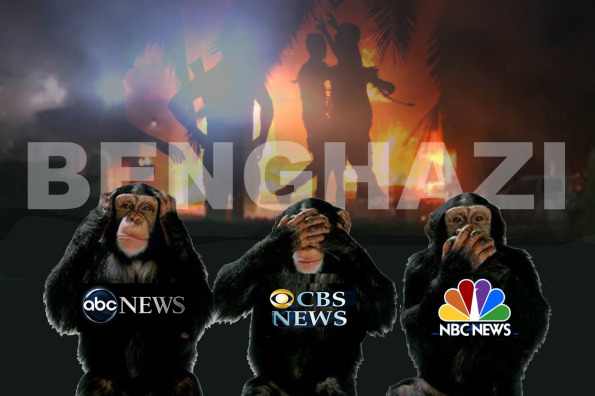
A lesser-known member of Ansar al Sharia, the Islamic group who conducted the attack on the U.S. consulate in Benghazi Libya, Zubayar Al-Bakoush, was captured and indicted by federal law enforcement. Attorney General Pam Bondi made the announcement earlier today.

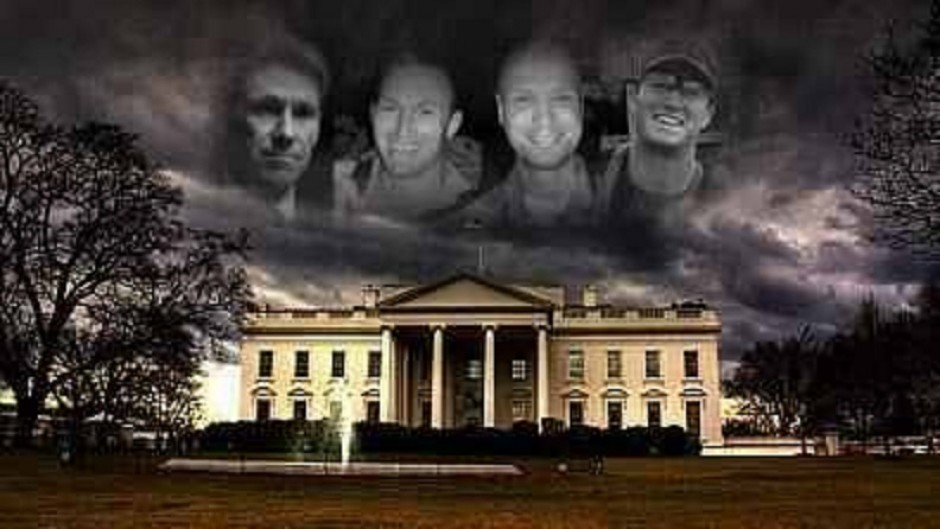
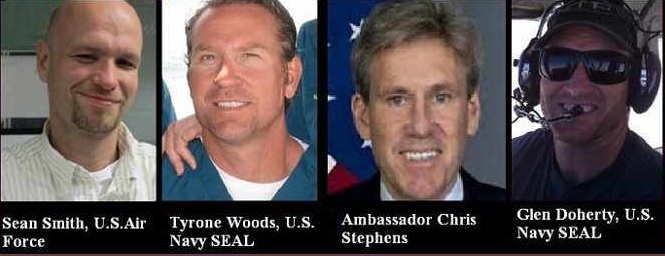
Bakoush is labeled as a leading ‘facilitator’, essentially a ground planner of Ansar al Sharia during the attack that killed U.S. Ambassador Christopher Stevens, Sean Smith, Tyrone Woods and Glenn Doherty. He was charged in an eight-count indictment unsealed today in U.S. District Court on multiple terrorism and murder counts. AG Pam Bondi made the announcement.

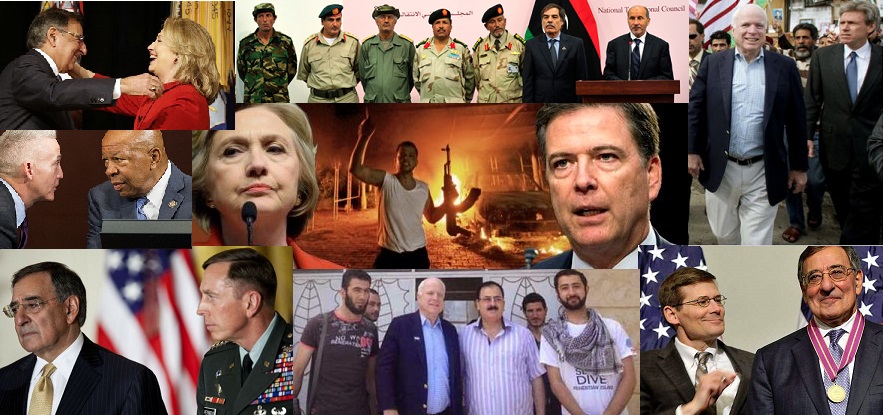
CTH followed the events closely, conducted a two-year research effort and then subsequently published the full story Benghazi Brief [SEE HERE]. Domestically, Barack Obama, Leon Panetta, Hillary Clinton, Mike Morrell and James Comey participated in the coverup.

DOJ PRESS RELEASE – The indictment charges Zubayar Al-Bakoush with:

•Conspiracy to Provide Material Support and Resources to Terrorists Resulting in Death
•Providing Material Support and Resources to Terrorists Resulting in Death
•Murder of an Internationally Protected Person
•Murder of a United States National Outside of the United States (Two Counts)
•Attempted Murder of a United States National Outside of the United States
•Arson and Placing Lives in Jeopardy Within the Special Maritime and Territorial Jurisdiction of the United States and Attempting to Do the Same
•Maliciously Destroying and Injuring Property and Placing Lives in Jeopardy within the Special Maritime and Territorial Jurisdiction of the United States and Attempting to Do the Same

The charges stem from the Sept. 11, 2012, terrorist attack on the U.S. Special Mission and nearby CIA Annex that killed Ambassador Stevens and U.S. government personnel Sean Smith, Tyrone Woods, and Glen Doherty.
According to the indictment, Bakoush was a member of Ansar Al Sharia (AAS), an Islamist extremist militia in Benghazi, which had the goal of establishing Sharia law in Libya.

On the evening of Sept. 11, 2012, a group of more than 20 heavily armed men – including Bakoush assembled outside the main gate of the U.S Special Mission in Benghazi. They were armed with assault rifles, other firearms, and explosive devices. At about 9:45 p.m., the group of armed men violently breached the main gate of the Mission. Upon entry, the men fanned out across the Mission complex, setting fires to building within the Mission compound.
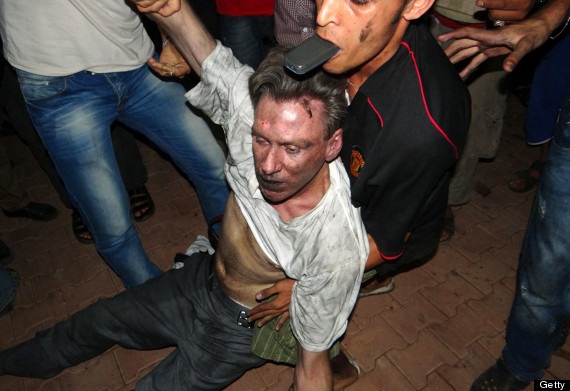
When the attackers could not gain entry to the secure area of Villa C, the Ambassador’s residence, they set fire to it. Ambassador Stevens and Mr. Smith suffocated from the thick, black smoke that enveloped the residence. Diplomatic Security Services (DSS) Special Agent Scott Wickland, who had tried to guide Ambassador Stevens and Mr. Smith to safety, was injured and repeatedly took small arms fire while trying to rescue the two Americans.

The extremist group also attacked the Quick Reaction Force building, which was occupied by local Libyans serving as guards for the Mission.

About 10 p.m., Bakoush entered the Mission compound with other conspirators, and conducted surveillance of the Tactical Operation Center and the Villa. After Bakoush attempted to gain entry to vehicles belonging to Mission staff, he and his co-conspirators temporarily retreated to an area just outside the Mission.

About 11:15 p.m., conspirators assembled outside the southern gate and launched a second violent attack on the Mission using AK-type assault rifles, grenades, and rocket-propelled grenades. After 30 minutes, the group entered the compound and plundered the Mission’s office of documents, maps, and computers containing sensitive information about the location of the CIA Annex.

At 12:30 a.m., conspirators attacked the Annex with small arms, assault rifles, and rocket-propelled grenades.

Following the attack at the Mission, in the early hours of September 12, 2012, the violence continued at the CIA Annex, first with gunfire and then with a precision mortar attack. While defending the Annex, Mr. Woods, Mr. Doherty, DSS Special Agent David Ubben, and CIA security specialist Mark Tiegen were hit by a precision mortar attack, leading to the deaths of Mr. Woods and Mr. Doherty. Special Agent Ubben and Mr. Tiegen were seriously wounded but survived.

The Department of Justice previously charged and convicted two leaders in the Benghazi attack on federal terrorism charges and other offenses. Ahmed Abu Khatallah, aka Ahmed Mukatallah was sentenced in June 2018 to 22 years in prison and resentenced in September 2024 to 28 years in prison. Mustafa al-Imam was sentenced in January 2020 to nearly 20 years. (SOURCE)

[The Benghazi Brief]

After I published the Benghazi Brief, our CTH website was blocked in Qatar.
President Trump and Egypt’s President Abdel Fattah al-Sisi Hold a Bilateral Discussion


Posted originally on CTH on January 21, 2026 | Sundance 

Going back to 2016, Egyptian President Fattah al-Sisi formed a strong relationship based on mutual interests.  When the Hamas/Gaza war with Israel broke out, it was al-Sisi who was the key regional leader who -with full credibility from prior action against Islamic extremists- became the voice of stability that both sides of the crisis could respect.

Army General al-Sisi had the respect of the Egyptian people and during the Arab Spring it was al-Sisi who took control, dispatched the Muslim Brotherhood and restored lawful order to the country.  Following the ouster of Mohammed Morsi, al-Sisi won the election with 80% support, then destroyed the Hamas tunnels that were used by extremists to smuggle weapons into Gaza.  The Muslim Brotherhood and al-Qaeda elements then targeted al-Sisi and conducted numerous terrorist attacks in the Sinai.  Despite their efforts to destabilize Egypt, al-Sisi kept things under control.

President Sisi strongly influenced the other regional leaders to support President Trump as the one political leader who could bring forceful peace back to the situation in Gaza. During this bilateral session at the WEF, President Sisi thanks President Trump for his leadership and pledges full support to participate in the Gaza Board of Peace. WATCH:

.

Joint Statement from U.S Negotiators, Arab Partners, Turkey and Gaza Officials on Next Steps in Peace Plan


Posted originally on CTH on December 21, 2025 | Sundance

President Trump Special Emissary Steve Witkoff relays this official statement following meetings with U.S. Negotiators, Arab state partners, Turkey and Gaza officials about the next phase in the Israel-Gaza peace plan.

STEVE WITKOFF – “We, the representatives of the United States of America, the Arab Republic of Egypt, the State of Qatar, and the Republic of Türkiye, met yesterday in Miami to review the implementation of the first phase of the Gaza ceasefire and to advance preparations for the second phase.

The first phase has yielded progress, including expanded humanitarian assistance, the return of hostage bodies, partial force withdrawals, and a reduction in hostilities.

In our discussions regarding phase two, we emphasized enabling a governing body in Gaza under a unified Gazan authority to protect civilians and maintain public order.

We also discussed regional integration measures, including trade facilitation, infrastructure development, and cooperation on energy, water, and other shared resources, as essential to Gaza’s recovery, regional stability, and long-term prosperity.

In this context, we expressed our support for the near-term establishment and operationalization of the Board of Peace as a transitional administration for the civilian, security, and reconstruction tracks of the reconstruction. We reviewed next steps in the phased implementation of the Comprehensive Peace Plan for Gaza, underscoring the importance of sequencing, coordination, and effective monitoring in partnership with local Gazan institutions and international partners.

We reaffirm our full commitment to the entirety of the President’s 20-point peace plan and call on all parties to uphold their obligations, exercise restraint, and cooperate with monitoring arrangements. Further consultations will continue in the coming weeks to advance the implementation of phase two. (source)

It always seems odd to write Turkey, Egypt and Qatar working collaboratively when you consider the history of their rather oppositional relationship regarding the Muslim Brotherhood.  However, this collaboration highlights the nature of a very historic assembly for peace that President Trump was able to put together.

Secretary Rubio recently spoke about the current Gaza status:

QUESTION: Thank you. Returning to Gaza, what is the U.S. understanding of what Hamas is willing to concede on disarmament? Reports suggest that Hamas might hand over its heavy weapons but retain its smaller arms. Is the U.S. prepared to accept partial disarmament as sufficient in phase two?

SECRETARY RUBIO: Yeah, I’m not going to get into the details of those types of negotiations. Let me just couch it to you this way: Everyone wants peace. No one wants a return to a war. If Hamas is every in a position in the future that they can threaten or attack Israel, you’re not going to have peace, okay? You’re not going to convince anyone to invest money in Gaza if they believe another war is going to happen in two to three years. So, I would just ask everyone to focus on what are the kind of weaponries and capabilities that Hamas would need in order to threaten or attack Israel as a baseline for what disarmament needs to look like. Because you’re not going to have peace. If two years from now Hamas is launching rockets or killing Israelis or carrying out, God forbid, another 7th of October type terrorist attack and so forth, you’re not going to have peace. So, who is going to invest in a peace, who is going to invest in rebuilding a place, that’s going to get destroyed again in a future war? So that’s why disarmament is so critical.

Now, what that entails, we’re going to leave that to the technical teams to work on. It would have to be something obviously that they’re willing to agree to that our partners can push them and pressure them to agree to. It also has to be something that Israel agrees to. In order for that to work, both sides have to agree on it, and we need the space to do it. But that’s the way to think about it, okay? You cannot have a Hamas that can threaten Israel in the future. If they can, you won’t have peace. So that’s the goal.

QUESTION: Thank you, Mr. Secretary. You said a few moments ago that everyone wants peace for Gaza, and yet by any metric the Israelis are flouting the ceasefire that President Trump negotiated by killing an average of two children a day, not allowing the agreed-upon humanitarian aid into Gaza. How long can this continue? How long can the Israelis be allowed to show such disrespect to President Trump?

SECRETARY RUBIO: Well, look, that’s your characterization of it about the term “disrespect.” What I would say is this. This – we – this was – first of all, it was a miracle that it happened in the first place. We all understand how difficult it was for that to come to the conclusion that it did, where the actual – the bombing and everything else, the scale and scope of what we saw ended, all the hostages were released, and we have relative peace right now for the most part, despite the things you’re pointing to. That was very difficult.

But this is not easy. Peace is a verb. It’s not – it’s an action. It’s not a sentiment. Every single day will bring challenges. Every single day. We also have had instances, for example, over the last couple weeks where Hamas elements emerged from a tunnel, attached an explosive device to the side of a vehicle, and injured and almost killed Israeli soldiers. We still have this threat. We still have and see every single day Hamas openly taking steps to strengthen themselves with – inside of those places in Gaza that they still control. We saw early on the atrocities they were committing in the streets against people as they were trying to show people how strong they were.

So, I don’t think I’m standing here to tell you this is going to be easy. This is an hour-by-hour, day-by-day challenge. It’s one of the reasons why we have stood up this center there in – operating in Israel in partnership as well with another cell that exists in a regional country. It’s why every single day there are leading – there are meetings among both intelligence, diplomatic, and military officials of multiple countries that helped bring about this deal to manage this. And that’s why it is so critical, it is so critical and so key, that we move to complete this first phase, that we move to put in place the Board of Peace, get everybody to agree to be a part of it, move to put in place this Palestinian technocratic organization so that they can begin to provide some governance structure, and move to put in place the stabilization force.

That’s the goal here. But it’s not going to be easy. Every day will bring new challenges to that, and we recognize those challenges are coming from all sides.

QUESTION: Very quick follow-up. Who’s going to be – want to be a part of a stabilization force if Israel is effectively using Gaza as a free fire zone?

SECRETARY RUBIO: Well, these are the things we – that’s – these are the things that we’re working through right now. Again, that’s why it didn’t happen yesterday. That’s why we didn’t – I don’t mean yesterday literally. That means why we’re not there yet. This is the hard work of diplomacy and peacemaking. Peacemaking isn’t just signing a piece of paper. It’s actually complying with it. And compliance oftentimes requires – in many cases, in most cases requires – daily, constant follow-up and nurturing.

So that is why we are in such a hurry – and I say as a priority – to get to this point where we have the stabilization force in place overseen by the Board of Peace and ultimately a Palestinian technocratic entity that can increase in its capability to provide governance. The stronger they are, the weaker Hamas will be in terms of threatening Israel, and I think the more security Israel should feel and less need for some of these things to happen.

But no one is claiming this is going to be easy. We have to work on this every single day. We have people in this building and deployed abroad – this is all they do 24 hours a day, day after day, elements of the State Department, the Department of War, and all other agencies, and including Jared and Steve and even myself who talk or do something about – there isn’t a day in the last since we – this was signed two months ago – that haven’t had to do something with regards to making progress on the phases of the ceasefire.

[SOURCE]