Posted originally on CTH on March 28, 2026 | Sundance
According to Politico, Texas Attorney General Ken Paxton was spotted in Mar-a-Lago last Friday talking face-to-face with President Trump.
With the base and President Trump still leveraging everything possible for the SAVE America Act, President Trump seems unlikely to endorse John Cornyn or Ken Paxton until the dust on that issue settles.
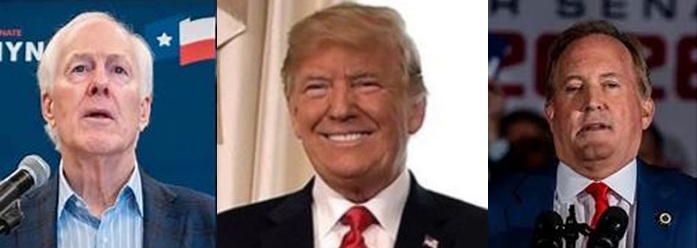
The only way Senator John Cornyn can survive the primary challenge from Paxton is if President Trump endorses the incumbent. If President Trump stays out of the race, Ken Paxton looks likely to achieve victory. Surprisingly, the National Republican Senatorial Committee (NRSCC) has not spent more money on Cornyn, another good sign.
(VIA POLITICO) – […] Paxton, though, hasn’t rested his case. He traveled to Mar-a-Lago last Friday for a Palm Beach County GOP dinner, and was spotted speaking to Trump himself, according to three sources familiar.
Trump and Paxton were on the patio, one source added, with another saying the two discussed the runoff. “It was a positive meeting,” said yet another person. A Paxton spokesperson declined to comment on the meeting.
It’s the latest sign of a fierce and feverish effort to keep Trump from endorsing Cornyn.
Even when all signs pointed to a Cornyn endorsement following the longtime senator’s showing in the primary, MAGA faithful kept pressing for Paxton. Now they’re optimistic their guy can come out on top — and they’re still taking shots at Cornyn every chance they get.
“The Cornyn endorsement looks dead, but it’s Trump, so it’s never certain,” a person close to the White House said. (read more)
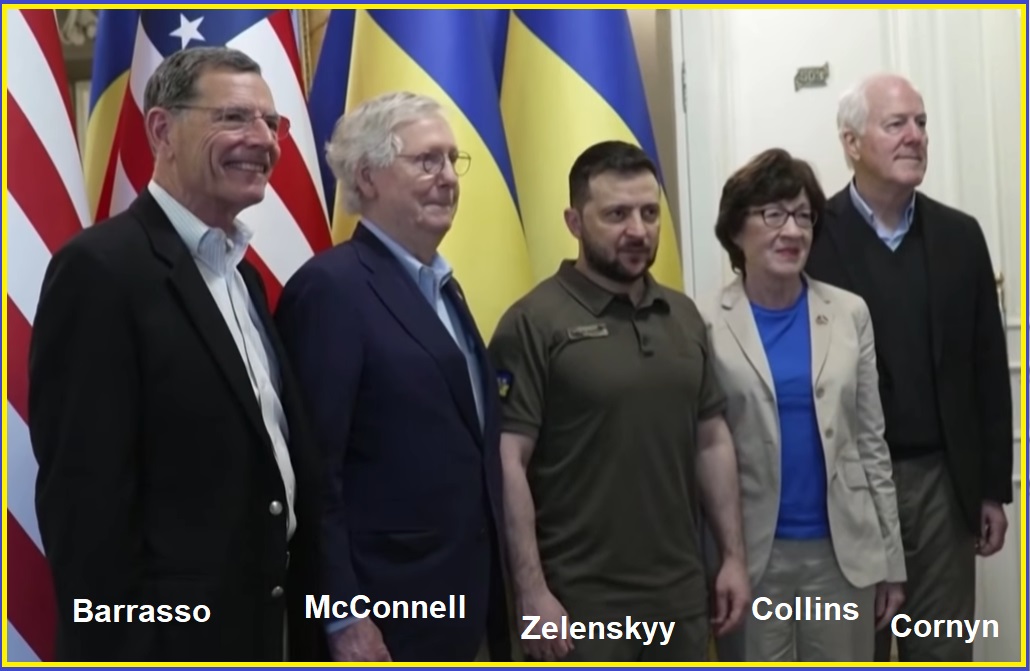
U.S. senators (mostly) write foreign aid policy, rules and regulations thereby creating the financing mechanisms to transmit U.S. funds. They are guided by K-Street lawyers who represent various interests.
Those same senators then receive a portion of the laundered funds back through their various “institutes” and business connections to the foreign government offices. Everyone in DC knows the gig.
Example: Ukraine laundry to Biden, Haiti laundry to Clinton, Iran laundry to Obama.
The U.S. State Dept. served as a distribution network for the authorization of the money laundering by granting DC conflict waivers, approvals for financing (McCain Institute, Clinton Global Initiative etc), and permission slips for the payment of foreign money.
The officials within the State Dept. take a cut of the overall payments through a system of “indulgence fees”, commissions, junkets, gifts and expense account payments to those with political oversight.
If anyone gets too close to revealing the process they become a target of the apparatus.
President Trump was considered a threat to this process.
In reality all of the U.S. Senators (both parties) on the Foreign Relations Committee understand what is going on and/or are participating in a process for receiving taxpayer money and contributions from foreign governments. [See Bob Menendez]
A “Codel” is a congressional delegation that takes trips to work out the payments terms/conditions of any changes in graft financing.
On the right the McCain Institute was/is one of the obvious examples of the financing network. [That is the primary reason why Cindy McCain was such an outspoken critic of President Trump.] On the left you see the Clinton Global Initiative, same/same.
This is why Senators spend $20 million on a campaign to earn a job paying $350k/year.
The “institutes” is where the real foreign money comes in; billions paid by governments like China, Qatar, Saudi Arabia, Kuwait, Ukraine, etc. etc. There are trillions at stake.
The current nation of focus is the Ukraine laundry operation. The U.S. intelligence services, including CIA operations in USAID, have historically been the bagmen. That’s also why they consider Gabbard a threat.
Posted originally on CTH on March 19, 2026 | Sundance
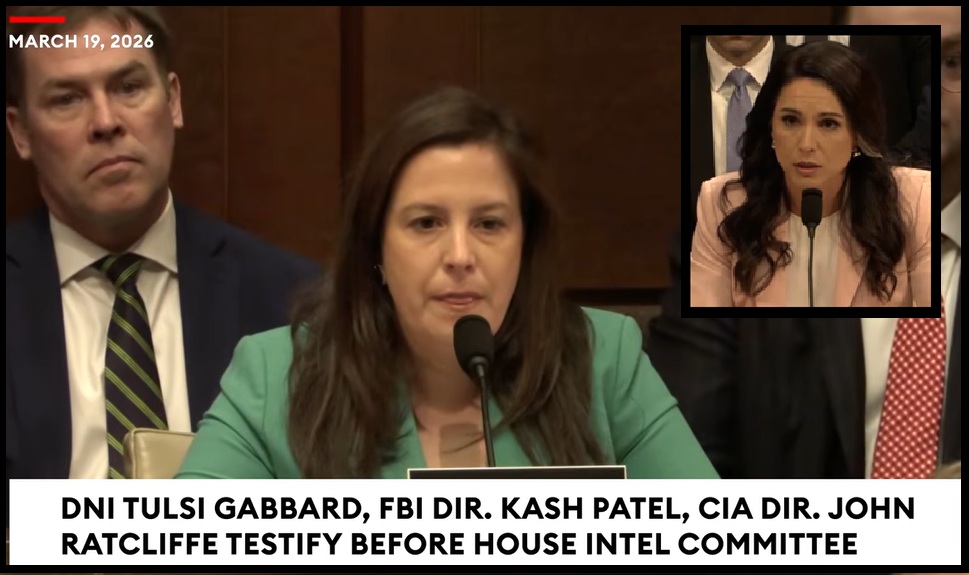
Representative Elise Stefanik is a strong supporter of Israel and has concerns about current narratives swirling around the politicization of Intelligence Community information to shape anti-Israel sentiments. Part of that collective effort is a not-so-subtle effort to remove DNI Gabbard from her position by questioning her loyalties. A considerable segment of Washington DC wants to return to a more Dan Coats style DNI.
As a tenured member of the House Permanent Select Committee on Intelligence (HPSCI), Mrs. Stefanik used her time during the congressional testimony of Gabbard, Ratcliffe and Patel to confirm the Trump administration policy toward the IC to remove all political interests. WATCH:
.
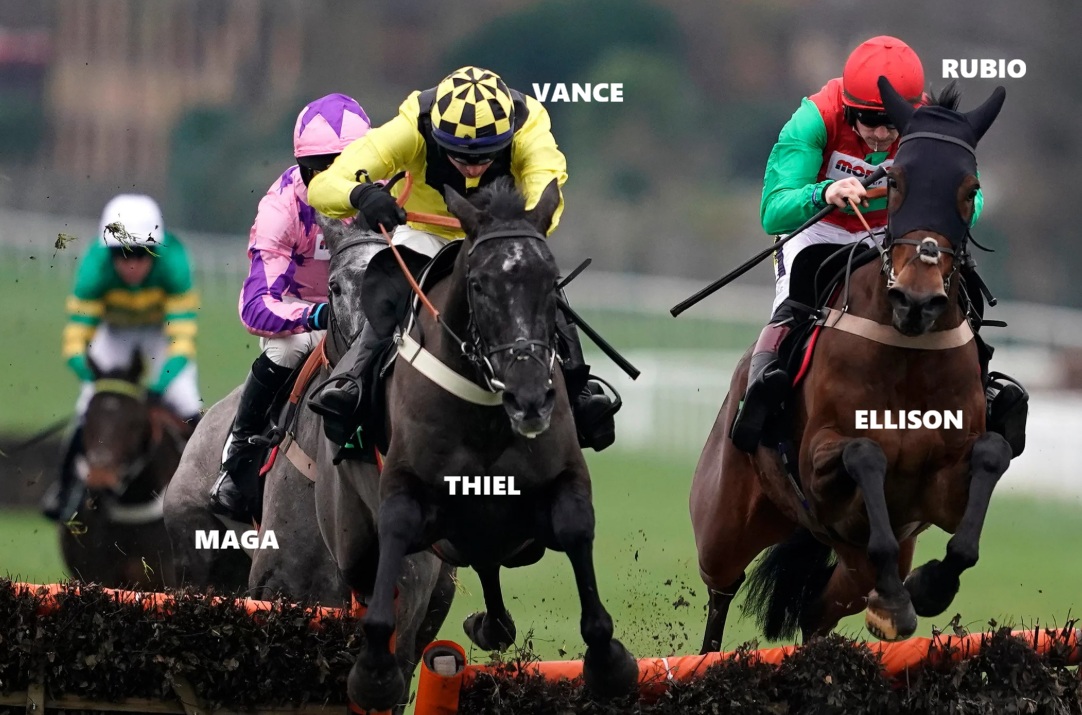
In the political horse racing analogy, the stable of Peter Thiel has taken major hits recently as the stable of Larry Ellison is gaining considerable influence. However, it’s a steeplechase and anything can happen.
Posted originally on CTH on arch 13, 2026 | Sundance
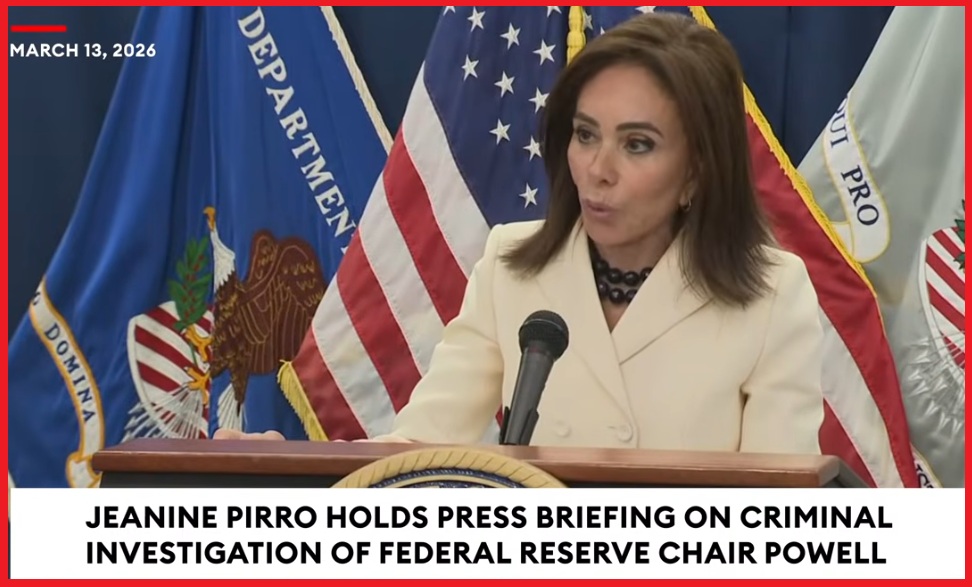
Well known activist Judge James Boasberg [SEE HERE], the same judge who granted illegal searches and seizures of congressional phone data, the same judge who has a long history of corrupt rulings to defend the interests of the DC power structures, ruled today [pdf Ruling Here] that USAO Jeanine Pirro is blocked from grand jury testimony surrounding fraud perpetrated by the Federal Reserve Board.
Boasberg ruled today that taxpayer funds used by the Federal Reserve to indulge themselves are exempt from investigative review. The ruling elite must never be challenged, and Judge Boasberg proudly stands in place to preserve and protect the interests of Washington DC. USAO Jeanine Pirro is very angry. WATCH:
Posted originally on CTH on March 8, 2026 | Sundance
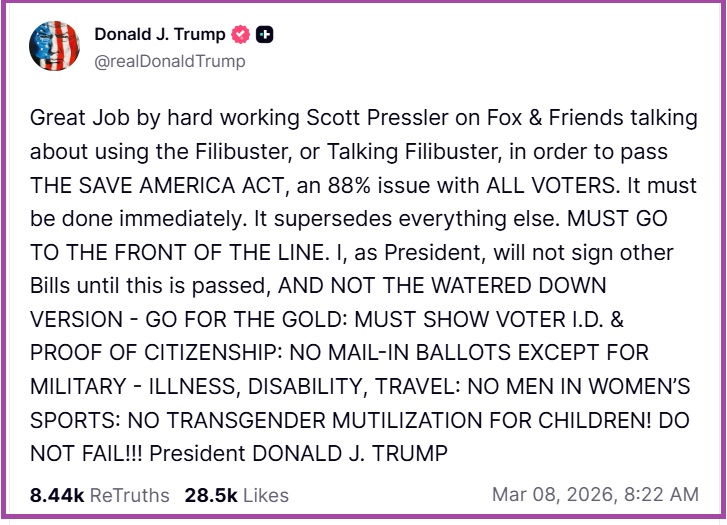
President Trump is again urging the Senate to pass the Save America voting act that is a core element of restoring voter integrity in U.S. elections. In his Truth Social post, President Trump notes he will not sign other legislation until the Save America Act reaches his desk.
Posted originally on CTH on March 5, 2026 | Sundance
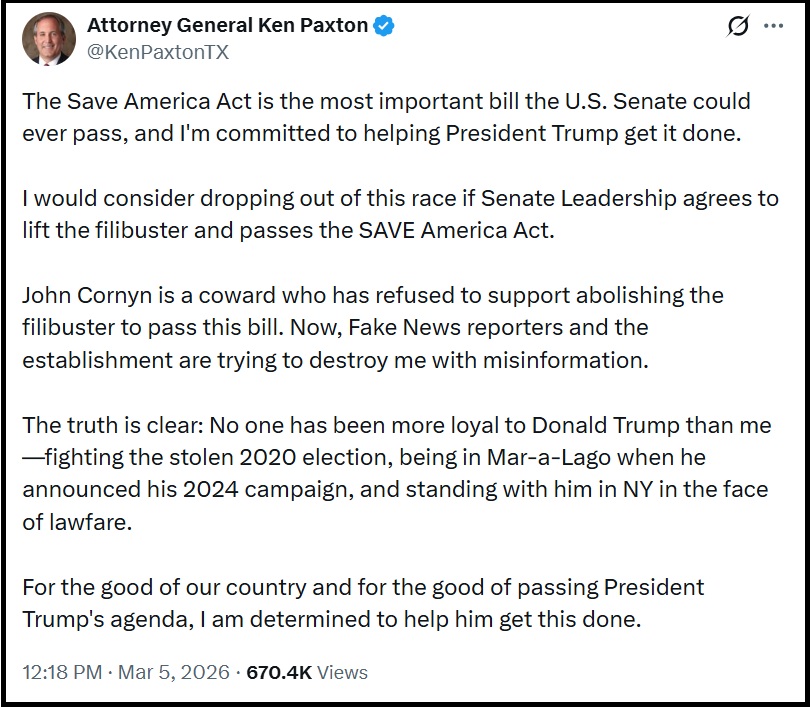
This is a pretty solid position by Texas Attorney General Ken Paxton who is offering to drop out of the Texas senate race if John Thune and John Cornyn will stop blocking President Trump, eliminate the filibuster and pass the SAVE Act.
Paxton gets a pass at calling Cornyn a “coward,” as the slight is negligible considering the selflessness within the offer. Paxton is a patriot and this is a solid alternative that boosts President Trump.
Posted originally on CTH on March 4, 2026 | Sundance |
This is a rather unusual approach for President Trump to take. President Trump draws attention to the Texas Republican senate race between John Cornyn and Ken Paxton, which will now turn to a run-off election.
As noted in his Truth Social post, President Trump will be endorsing one of the two candidates and subsequently asks the non-endorsed candidate to exit the race.
[Via Truth Social] – “The Republican Primary Race for the United States Senate in the Great State of Texas, a State I LOVE and won 3 times in Record Numbers (the HIGHEST vote ever recorded, by far!!!), cannot, for the good of the Party, and our Country, itself, be allowed to go on any longer. IT MUST STOP NOW! We have an easy to beat, Radical Left Opponent, and we have to TOTALLY FOCUS on putting him away, quickly and decisively! Both John and Ken ran great races, but not good enough. Now, this one, must be PERFECT!
My Endorsements within the Republican Party have been virtually insurmountable! It is such an honor to realize and say that almost everyone I Endorse WINS, and wins by a lot, especially in Texas! I will be making my Endorsement soon, and will be asking the candidate that I don’t Endorse to immediately DROP OUT OF THE RACE! Is that fair? We must win in November!!! Thank you for your attention to this matter.”
Good News: Dan Crenshaw loses Primary – Cornyn and Paxton Advance to Runoff
Posted originally on CTH on March 4, 2026 | Sundance
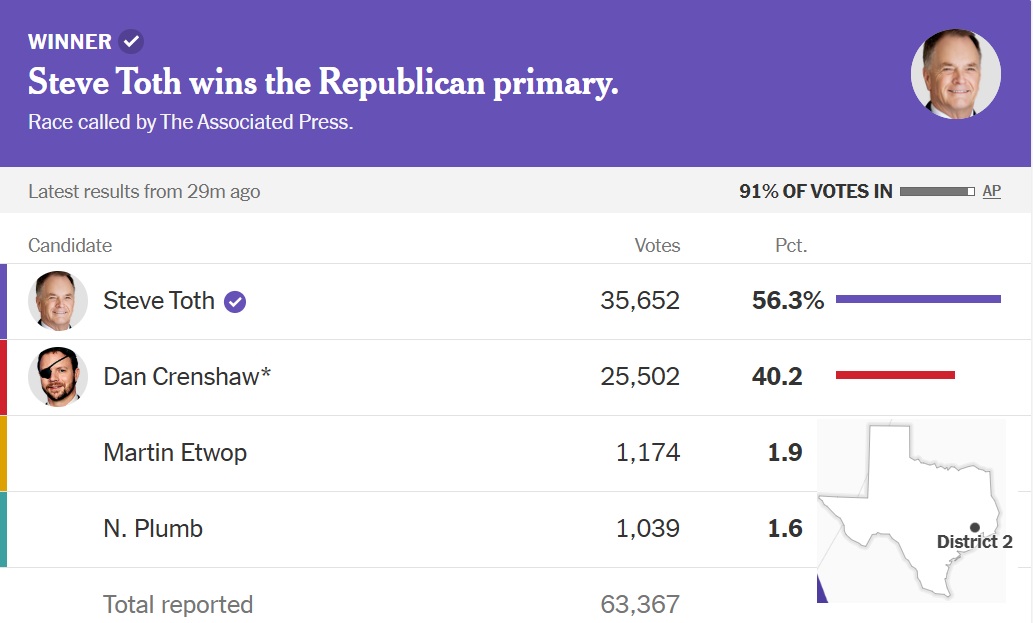
Texas DeceptiCON Dan Crenshaw, aka “one-eyed McCain”, a man of notoriously arrogant and intemperate disposition, has lost the Texas CD02 primary race to Steve Toth. Mr Toth won 56% of the primary vote, so there will not be a runoff.
At the conclusion of this year, the perpetually horrible Dan Crenshaw will no longer be a congressman.
Apparently, Crenshaw was blindsided and didn’t see it coming. [SOURCE]
.
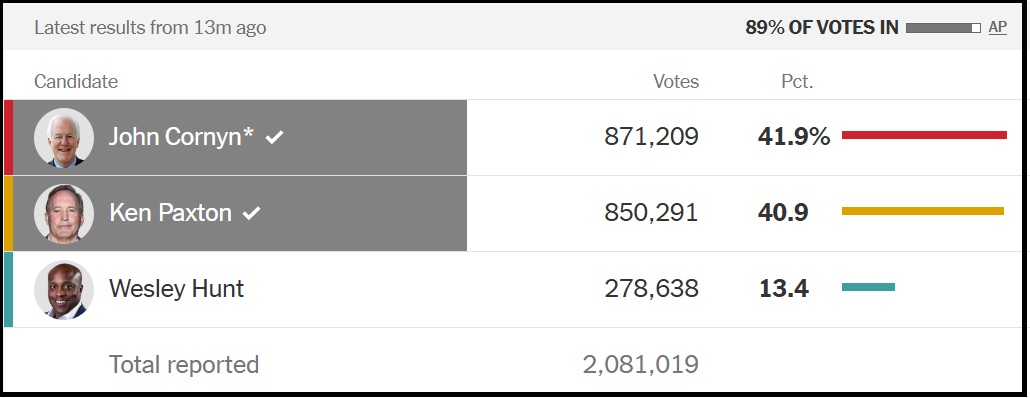
In the statewide republican senate primary, incumbent Senator John Cornyn and Texas Attorney General Ken Paxton will advance to a runoff. Cornyn received 42%, Paxton received 41%, Wesley Hunt received 13.5%. Because no candidate won more than 50% of the vote, Paxton and Cornyn will now advance to a runoff on May 26th. [SOURCE]
The greater share of Wesley Hunt’s vote is expected to go toward Ken Paxton, setting up the opportunity for the people of Texas to finally remove another DeceptiCON from the Senate. However, the Bush/McConnell clans are expected to rally on Cornyn’s behalf, in order to stop Paxton.
.
We can expect to see all the professionally republican pundits and politicians appealing to the Texas voters to give John Cornyn another term in office. Obviously, the decision is in the hands of the Texas base – but we can hope Cornyn is dispatched.
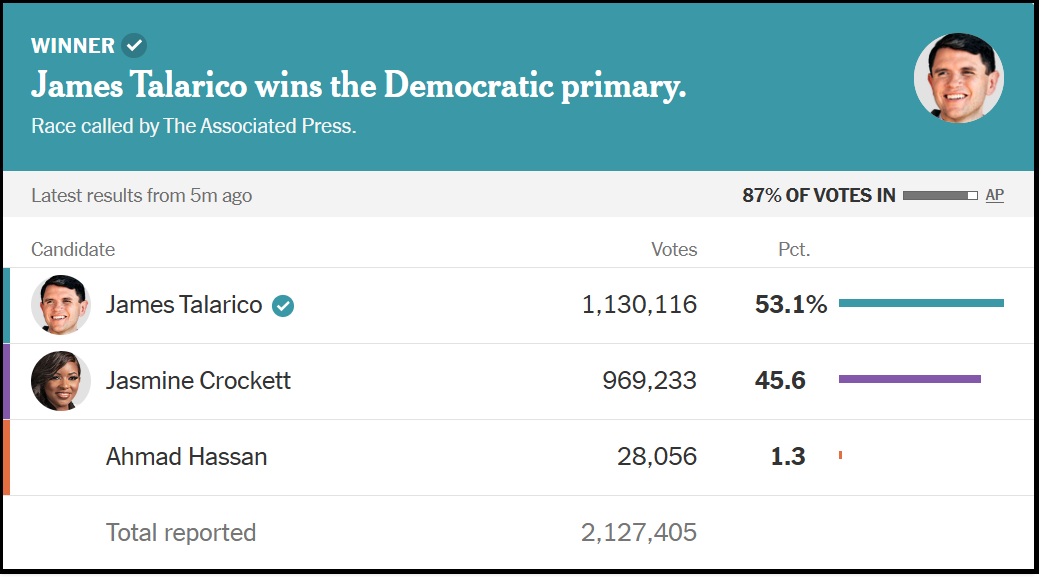
In other good news the insufferable Jasmine Crockett has lost her Democrat senate race. [SOURCE]
Posted originally on CTH on February 16, 2026 | Sundance
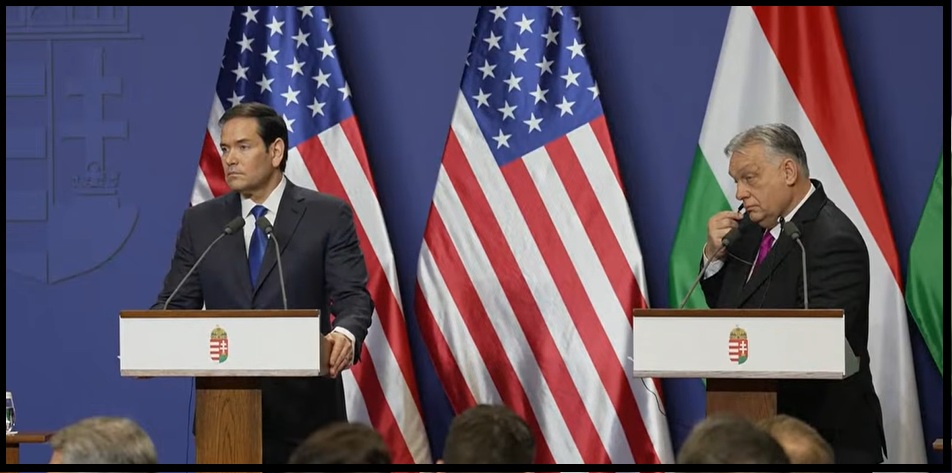
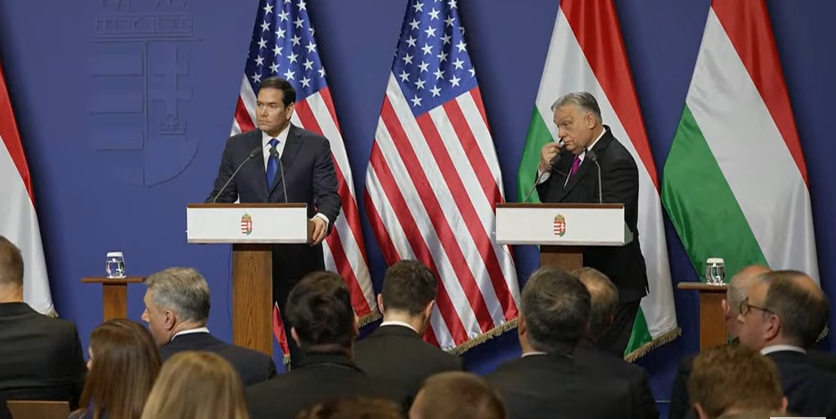
Secretary Marco Rubio went out of his way in this joint presser to emphasize the personal relationship between Hungarian Prime Minister Viktor Orban and U.S. President Donald Trump. Orban is facing a serious election challenge this April and all of the EU/NATO systems are actively trying to create pressure points to remove him.
Secretary Marco Rubio is in Budapest today for meetings with Prime Minister Viktor Orbán and his government to include the signing of a civilian-nuclear cooperation agreement heralded by the Trump administration. Hungary is one of the few voices within the European Union who is pushing back against Brussels efforts to go to war against Russia.
Prime Minister Orban has been very critical of Ukraine, openly stating his opposition to EU membership for the embattled country. In response President Zelenskyy has weaponized Ukraine’s geographical stewardship of oil and gas pipelines to shut down Hungarian energy and drive-up prices. VIDEO:
[Transcript] – MODERATOR: (Via interpreter) Good morning, ladies and gentlemen. May I extend my most cordial welcome to all of you, and may I extend my most special welcome to His Excellency Mr. Marco Rubio, Secretary of State of the United States of America, at the press conference and signing ceremony organized on the occasion of his visit to Hungary. Let me also extend my warm welcome to Mr. Viktor Orban, Prime Minister of Hungary, members of the U.S. and Hungarian delegations, and all our esteemed guests.
At today’s event, the agreement between the Government of the United States of America and the Government of Hungary to facilitate cooperation on the civilian nuclear program in Hungary will be signed. The signatories to the agreement on behalf of the United States of America, Secretary of State Marco Rubio, and on behalf of Hungary, Minister for Foreign Affairs and Trade Mr. Peter Szijjarto.
MODERATOR: (Via interpreter) Thank you very much, gentlemen. And now, may I invite Prime Minister of Hungary Viktor Orban to deliver his statement.
PRIME MINISTER ORBAN: (Via interpreter) Good morning, distinguished ladies and gentlemen, distinguished Mr. Secretary of State. This week starts well. It’s only Monday, and we are already over friendly and very serious discussion with the Secretary of State arriving from the United States of America. We agreed upon this visit with the President of the United States on our visit to the U.S. last November, and I’d like to deliver my heartfelt thanks to Secretary of State to – for visiting Hungary and therefore doing a privilege to Hungary.
We reviewed and overviewed our bilateral relationships. There is a new U.S. President, so I am also adapting to the new expressions. A new golden age has set upon us concerning the relationship between the United States and Hungary. We operate with understatements in the Hungarian language and Hungarian politics, but the situation is that I cannot remember – although for 30-odd years I have been present in politics – when the last time it was that the relationships between the two nations were at such a high level, so balanced and so friendly. So, my heartfelt thanks goes to President Trump.
Perhaps the last time we were near this, when President Bush visited us prior to the change of the political regime, which visit greatly contributed to us doing away with the communists and the Warsaw Pact. Since then, we had better and worse periods in the U.S.-Hungarian relationships, but we’ve never been to this high a level.
Since last year’s January, 17 U.S. investments have been decided upon here in Hungary. This is a decade-long record. And Hungarians can once again travel to the U.S. without a visa – thank you very much, Mr. Secretary of State. Hungary was invited to the Peace Council. The first inauguration meeting will take place in Washington, D.C., this Thursday, perhaps where I shall represent Hungary. And we entered into agreements of key importance in the fields of energy, including oil, gas, and nuclear energy. And these agreements, with the exception provided by the President of United States of America which allows for the use of Russian gas and oil here in Hungary, jointly contribute to the fact that Hungary can continue to remain secure on the aspect of energy supply and that we shall be able to supply households and the industry with cheap energy in an international comparison. And we also discussed the refinery in Serbia, how that can be purchased – NIS – how NIS can be purchased by MOL, the Hungarian oil company.
As for me, I assured Secretary of State Mr. Rubio that Hungary continues to support, regardless of European conflicts (inaudible), Hungary shall continue to support the efforts of peace of the U.S. in Ukraine. The current President of the United States did the most in international politics in order to ensure peace in the Russia-Ukrainian war. And I must reiterate, although everybody knows, that if Donald Trump had been the president of the United States, this war would never have broken out. And if he were not the President now, then we would not even stand a chance to put an end to the war with peace. So, thanks goes to the United States President for his efforts in favor of peace.
Hungary remains ready that if there is a peace summit, that we provide a venue for that here in Budapest, and I assured Mr. Rubio that Mr. Trump has a live invitation to Hungary. Thank you very much, Mr. State Secretary, for the opportunity to enter into discussions today.
MODERATOR: (Via interpreter) Thank you very much, Mr. Prime Minister. Now, may I invite Secretary of the United States of America Marco Rubio to make a statement?
SECRETARY RUBIO: Well, thank you, Mr. Prime Minister, for welcoming us here today. It’s an honor to be with you in this incredibly gorgeous city. It’s my first time being here, and it’s phenomenal, even to be in this hall where – and the history behind it and everything that’s going on here.
The second is the relationship – you talked about the golden age, which is not an exaggeration. The relationship between the United States and Hungary today is as close as I can possibly imagine it being. And it’s not just close rhetorically; it’s close in action and things that are actually happening. And I think some evidence of that is here today in the agreement that we’ve just signed that builds on a historic meeting that we had in November at the White House, that you had with the President and that I happened to be – have the honor to be present and be a part of.
The signed agreement we’ve had today is one that we hope will be many in the years to come in areas of collaboration. You spoke about the 17 investments. To those who think that Hungary is being isolated, that’s an example of the fact that that’s not the case – that under the prime minister’s leadership, in fact, there is a growing number of American companies, as evidenced by the 17 that have already arrived, who want to invest in your economy and want to be a part of what’s happening here and are excited about it – because you have strong leadership, because you have leadership that we know are going to protect investments and allow it to continue to be a place that’s friendly for business, and be competitive with rules that are competitive that allow businesses to grow and prosper in comparison to other places. And there are so many other areas that we can work together on, especially on energy, but just so many areas of common interest.
But I have to say this because it’s important to understand. We are entering this golden era of relations between our countries, and not simply because the alignment of our people, but because of the relationship that you have with the President of the United States. I don’t think it is any mystery – and should not be a mystery to anyone here – how the President feels about you, how he interacted with you in his first term as President, and now in his second term as President that relationship’s grown even closer. And it’s important to understand how important the relations between leaders are to the relations between countries. There is – we are – at the end of the day, we are still human, we are still people, and that person-to-person connection that you’ve established with the President has made all the difference in the world in building this relationship and in hopefully growing this relationship even more.
It is the kind of thing that I think, for example, I can say to you with confidence that President Trump is deeply committed to your success because your success is our success, because this relationship we have here in Central Europe through you is so essential and vital for our national interests in the years to come – that if you face financial struggles, if you face things that are impediments to growth, if you face things that threaten the stability of your country, I know that President Trump will be very interested because of your relationship with him and because of this importance of this country to us, to finding ways to provide assistance if that moment ever were to arise, and obviously with regards to finances and the like.
I also think it’s the reason why, in your visit in November, you saw an extension of – and a suspension of the imposition of sanctions and allowed to move forward on energy. It was because of that personal relationship. It’s because we want you to continue, because we want this economy to prosper, we want this country to do well. It’s in our national interest. Especially as long as you’re the prime minister and the leader of this country, it’s in our national interest that Hungary be successful. It helps America, and obviously it helps you.
So, it’s an honor to be with you here today. We have a lot that we can continue to work on. We also want to thank you, and I want to thank you, on behalf of the President of the United States, for the indispensable role you’ve played on the Board of Peace. Not everyone’s on the Board of Peace, and not everyone – for different reasons they can be participants or not be participants, but you are, and you’ve been there from the very first day. And again, a testament to the personal relationship between President Trump and Prime Minister Orban that I think speaks volumes. The role you play geopolitically, the role you play even outside of this region in affairs involving the Middle East, is invaluable and indispensable, and we are very appreciative of it.
And that’s why after traveling to Munich for the Security Conference, I wanted to make sure we paid a visit here to continue to build on this relationship and to signal very clearly that not only are we in a golden age, but we haven’t even scratched the surface of what we can achieve together as a people – as peoples, as nations, and as leaders. And so I thank you for the opportunity to be with all of you here today, and thank you for the very warm invitation and the very important conversations that we had where we touched on a bunch of subjects and a bunch of topics that I think will be of great interest back in Washington when I return. Thank you.
MODERATOR: (Via interpreter) Mr. Secretary of State, thank you very much. We have some time for questions. Hungarian Television gets the floor.
QUESTION: (Via interpreter) Good morning. I am Laszlo Meszaros. Volodymyr Zelenskyy, president of Ukraine, is constantly attacking Prime Minister Viktor Orban for not supporting the accession of Ukraine. What is your take on this political action, this political attack against a NATO and EU member-state?
PRIME MINISTER ORBAN: (Via interpreter) And who is the question addressed to?
QUESTION: (Via interpreter) Both of you. Both of you, naturally.
PRIME MINISTER ORBAN: (Via interpreter) I don’t wish to drag Secretary of State into Hungarian internal political issues.
(In English) So if you allow me, I start to answer first to this question.
(Via interpreter) The Ukrainians and their president obviously have entered into the Hungarian election campaign. For a while, I was thinking whether we should take that on the wrong note or not. I mean, with such brutal openness entering into the election campaign of another country is not very frequent. You don’t see that often. But then again, I realized it was understandable, because the Hungarian elections is the most important to Hungarian people but it has an impact beyond Hungary as well. And the Ukrainians quite justly believe that what government Hungary shall have is significant to them. And there are only two options.
One is what you knew well – that is the option of the Hungarian people who, at a vote – vote 2025, clearly stated that they would not undertake the Ukraine acceding to the European Union because that would drag us into a war and ruin our economy. And you can also know that we shall not provide money for Brussels in order for them to send that to Ukraine.
The other option, which is a real option, and the Ukrainians would favor that – and with common sense you can realize that if a government arrived which would want or which will accept Ukraine becoming a member of the European Union, they obviously want a government which will take a part in the financial burden of Ukraine – in other words, send money to Ukraine. And for the Ukrainians it does matter what the outcome of the elections will be, therefore they decided to participate in the campaign. And since we stand on the ground of common sense, we must not be surprised at that. We must adapt to it, and we must acknowledge that the Ukrainian president and Ukraine will be an active participant of this election, and we have to prevail against them too. That is our reality. Anything else attached to that – the future of the war, the funding of the war – are beyond the framework of this press conference. I will not go into detail.
I would only return to a single aspect, that this is an election. As an election, people decide. And for Ukraine, it does matter what the outcome of the decision is, and therefore, they put their full weight and weaponry in participating in the Hungarian campaign. We know full well that they fund – finance our opponents. We know how that happens. This is a well-known, written fact.
But once again, we must not be outraged, but we must acknowledge that this campaign in Hungary also has an international dimension – in other directions, too, but in the Ukrainian direction. That is why it’s an important international event, not only for Hungarians, but as the example of the Ukrainians shows, it’s important for other greater nations. That’s how you have to win elections. We have won elections in many ways. Now, we shall win this way.
SECRETARY RUBIO: My only comment is the United States interest is to see the war end, and we want to do what we can to make it end. We’re the only nation on Earth that apparently can get both sides to the table to talk. I’m not here to insult anybody, but the United Nations hasn’t been able to do it. There’s no other country in Europe that’s been able to do it. The United States has been successful at being able to get both sides to talk. I mean, for the first time in a number of years, you have – truly have, at a technical level, military officials from both sides sat down last week in the Middle East. And we’ll restart those talks again in Geneva later this week. I think that’s a very positive thing.
That said, all we are trying to do is play a role, if it’s possible, in reaching a deal. We’re not seeking to impose a deal on anybody. We’re not trying to force anyone to take a deal they don’t want to take. We just want to help them, because we think it’s a war that’s incredibly damaging. We think it’s a war that’s incredibly destructive. We think it’s a war that never should have happened and should end as soon as possible. That’s how the President feels, and the President’s invested a tremendous amount of time and political capital in trying to serve a useful purpose. Usually, in my time observing geopolitics, when a president tries to engage himself in peacemaking and in ending wars, that’s usually applauded.
So, this is one of the few times, for a lot of different reasons – I don’t know what they may be, but maybe I can speculate what they are – where people actually criticize a President trying to end a war. Usually when you’re trying to end wars, the international community applauds you. This is one of the few wars I’ve ever seen where some people in the international community condemn you for trying to help end a war. But that’s what we’re trying to do. That’s what we’re going to continue to do as long as our role is, and our engagement is, a positive one.
And, hopefully, the war will end – the sooner, the better. It should have ended a long time ago. It should have never actually happened. This war should have never happened. This war would have never happened if Donald Trump had been president of the United States at the time it began. But that’s what happened, and so now here we are. So, we’re going to continue to do everything we can to try to bring it to an end. And if we can be successful at it, I think the world will be a better place. And if we can’t, then unfortunately the suffering and the dying and the killing will continue, and that’s not good for anybody, but that’s where we find ourselves. So hopefully we can stop it, but let’s see.
MODERATOR: Next is CBS News. Please, Olivia.
QUESTION: Thank you very much. Budapest is, in fact, beautiful. Mr. Secretary, on the notion of a golden age, why isn’t the United States conditioning deeper cooperation with Budapest on Hungary reducing its extensive and ongoing, deepening cooperation with China, which is a strategic rival for the United States?
Secondly, if, despite President Trump’s endorsement and your visit here, Prime Minister Orban does not succeed and loses the April election, does the U.S. commit to working with his challenger constructively? Prime Minister Orban, do you commit to accepting electoral defeat if it happens?
And to both of you, president – I mean, sorry, Prime Minister Orban has said that the exemption that Hungary has been granted for Russian energy purchases is indefinite. The U.S. has said it was for one year. Which one is it? Thank you.
SECRETARY RUBIO: All right, well, let me start by answering that question. First of all, let me – so everybody can be very clear, I’ve made this point repeatedly. I’ll make it again. Under President Trump, it is our expectation that every nation on Earth is going to act in their national interest. That’s what nations are supposed to do. If the prime minister of Hungary does not act in the national interest of Hungary, he won’t be prime minister for long; but who’s going to act in the national interest of Hungary if their prime minister doesn’t do it? If your government is not acting in your national interest, then who will? By the way, we feel the same way about America.
So, in those instances in which our national interest and some other country’s national interests are aligned, that is an opportunity for extraordinary partnership. And we have many, many areas where our national interests are aligned. Where they’re not aligned or where we have some differences, that’s where that – alignment and the other issues, that’s where this relationship, that’s where these deep ties to one another are so important, because that’s where you can find accommodation. That’s where you can hear each other out. That’s where maybe you can work together on.
But we’re not asking any country in the world to isolate themselves from anybody. We understand that every country in the world has to deal with the reality of their geography, of their economy, of their history, and of the challenges of their future. We will obviously share with partners and friends concerns we may have about certain things. But as an example, the United States – you mentioned China as an example. Okay. We have trade and relations with China. The President of the United States is going to travel in April to China. Why? Because China is a big country. It’s got a billion-something people, second largest economy in the world. They have nuclear weapons. It would be crazy – okay, it’s insane for the United States and China not to have relations and interact with one another.
Now, two big countries like this, do we have differences? We absolutely do, and we’ll have to manage those differences. And some of those differences are things – we’ve spoken very frankly and clearly and repeatedly about the fact that it is not good for the world – it’s not good for anybody – to rely on one country or one economy for 90 percent of anything, especially things like critical supply chains. This is a reality. We want to diversify supply chains around the world. We’ve spoken clearly about it. That’s not an anti-China thing. That’s just the reality that over-dependence on one source is not good, and especially when there’s been a willingness in the past to use it as leverage against each other.
But we expect – we pursue these things within the context of the U.S. national interest. And that’s why we met with the Chinese in South Korea earlier in the year and were able to reach an understanding on some trade matters. That was a mutual interest between us and them. So, geopolitics is difficult because it requires a little bit of maturity and seriousness, okay? It requires a little bit of seriousness about these things have real implications, and the balancing of relations between nation-states requires maturity and seriousness.
So, our relationship here, you asked the last question about it. Look, I’m just telling you guys what it is, okay? The President has an extraordinarily close relationship to the prime minister. He does. And it has had tangible benefits in our relationship. I’m not going to speculate about the future. What happens in this country is up to the voters of this country to determine and decide, and we love the people of Hungary. But I’m not – but there’s no reason to sugarcoat it. I’m going to be very blunt with you. The prime minister and the President have a very, very close personal relationship and working relationship, and I think it has been incredibly beneficial to the relationship between our two countries.
QUESTION: The sanctions waiver, sir? Is it a year?
SECRETARY RUBIO: What’s that? I’m sorry.
QUESTION: The sanctions waiver on Russian energy purchases?
SECRETARY RUBIO: Yeah, but here’s the way I would couch that. Those sanctions waivers happened, as much as anything else, because of the relationship between the prime minister and the President. And so I think all I can tell you is that’s the – that relationship and the importance of that relationship, and the importance of that relationship to our bilateral relationship, underpins the decision the President made and, I think, will continue to underpin it as long as that relationship is a factor in our bilateral relations.
PRIME MINISTER ORBAN: Thank you very much, Your Excellency. So, to answer to your question, for those who are relatively young, it’s difficult to know the Hungarian modern political history. But if you look at it carefully, you see that I’m not just registered as the longest-serving prime minister in Europe, which means 20 years, but I’m the longest-serving leader of the opposition with 16 years. So, I spent 16 years as leader of opposition. What does it mean? It means that sometimes I lose, sometimes I win. So don’t afraid what will be if we are not winning, because it’s regularly happened here at least four times already. So, there is no need to be afraid what will happen in Hungary.
The Hungarian democracy is very strong, and the government of this country is very strongly believe on democracy and competitiveness and competition in politics as well, as we have done in the last 35 – 35 years. So, our record is very strong on the governmental side and on opposition side as well. So, a government will be created after the election in Hungary based on the intention of the Hungarian people, and Hungary as a country will remain strong anyway.
MODERATOR: (Via interpreter) Thank you very much. Now Index is up next.
QUESTION: Good morning. I’m Balazs Karóczkai from Index. I will ask my question in English because I think it’s easier for you. So —
SECRETARY RUBIO: (Inaudible) in English than in Hungarian, absolutely. You can ask it in Spanish, and that’s – maybe Italian I might be able to pick it up too, but —
QUESTION: Unfortunately, my Spanish is not so good.
SECRETARY RUBIO: (Laughter.) Okay.
QUESTION: So, Mr. Prime Minister, you mentioned the invitation of President Trump. I have a question for both of you. Is there – have been any discussion regarding a potential visit by President Trump? And if so, when might it take place, and will it be a peace summit? And a brief question is: Have there been any progress toward new Hungarian-U.S. tax treaty? Because the last one is terminated on two years ago. Thank you.
SECRETARY RUBIO: Yeah. On the visit, I don’t have any news for you on it today other than I know the President would love to come and I know the President would love to be here. Obviously, like any world leader, there’s a lot of balancing going on, but we’ll see what happens. I mean, the President has made very clear his feelings about the prime minister, both on a personal and on a political level in terms of the relationship and the impact it’s had on us. And so, I’m certainly here today because I wanted to make sure that, having been in Munich for the Security Conference, being so close by, we saw an opportunity to be here today and build on that historic gathering that we had. I don’t have any updates for you on the tax treaty per se today, but we may soon. It’s something we’ll look at.
PRIME MINISTER ORBAN: (Via interpreter) And if you’ll allow it, I’ll answer in Hungarian. So, in Hungarian, all I’d like to say is that it’s not worth planning in the distant future in current politics. I mean, the fact that this Thursday we will meet in Washington, D.C., with the President of the United States was not in our calendar two weeks ago. What I’m trying to say is that events take place and the current of international politics is that significant changes can take place in three or four days. For instance, when the first meeting was called for the establishment of the Board of Peace in Sharm El-Sheikh, you could only know that three or four days in advance.
So, in international politics, it is not long-term planning, but short-term response is what is a real virtue. And the Americans are very good at that. So, the fact that we don’t know anything for certain now does not mean that it will not happen. In fact, it might mean the exact opposite. The less we know anything certain about something, the more possible it might happen. Thank you.
MODERATOR: (Via interpreter) Thank you. And the last question is for Reuters.
QUESTION: Thank you, Mr. Secretary. Good to see you. Mr. Prime Minister. Just two questions, Mr. Secretary. Iran is pursuing a nuclear agreement with the U.S. that it says would deliver economic benefits for both sides. Is that acceptable for the U.S., even if it doesn’t cover Tehran’s ballistic missile program?
Recently a U.S. immigration judge has ruled that there were no grounds to deport Tufts University student who wrote an op-ed on Gaza. A second judge said using deportation as a threat violated the First Amendment rights of people like her because those rights apply to foreigners. What is your response to that?
And, Mr. Prime Minister, I just wanted to follow up on the China angle. Secretary just spoke about balancing relationships. You’ve been pushing a lot for more Chinese investments in Hungary. How will you make sure that that does not create a problem in your relationship with Washington? Thank you.
SECRETARY RUBIO: Yeah, on the two questions you asked, first of all, on the particular case of the student, look, my job at the State Department is if I identify someone who I believe is present – someone who’s not – who’s a visitor, a guest to the United States, and we identify that their presence in our country poses a threat to our foreign policy, to our national security, we’re going to take that person’s visa away. We’re going to take their visa away. That’s what we’re going to do. We’ve done that – in a lot of cases over the last year, we’ve done it.
Fact is that visas are not a right. I’ve said this repeatedly. I don’t know why it’s so hard for some to comprehend it, so let me repeat it again. A visa – no one’s entitled to a visa. There is no constitutional right to a visa. Okay, a visa is a permission to enter our country as a visitor. If you enter our country as a visitor, and as a visitor in our country – be it a student, a tourist, a journalist, whatever you want to be – and you undertake activities that are against the national interest and national security of the United States, we will take away your visa. In fact, if we knew you were going to do it, we probably wouldn’t have given you your visa.
That’s what we do. The decision to remove someone from our country after we take away our visa, that belongs to other agencies of our government. As far as judges are concerned, judges – that’s a different branch of government. They’re not going to tell us how to conduct the foreign policy of the United States. If they have an issue with the process by which someone was removed, then obviously that’s an issue for other agencies in our government that are involved in enforcing that. All I can opine to you on is the – is taking away someone’s visas. And no judge is going to tell the Executive Branch how to conduct foreign policy because that’s not up to judges. That’s up to the Executive Branch.
On your first question about Iran, look, doing a deal with Iran is not easy. I said it yesterday; I’ll repeat it again today. I mean, we have to understand that Iran ultimately is governed and its decisions are governed by Shia clerics – radical Shia clerics, okay? These people make policy decisions on the basis of pure theology. That’s how they make their decisions. So, it’s hard to do a deal with Iran. We’ve always said it’s hard, but we’re going to try. That’s what the President is trying. I’m not going to prejudge those talks. I’m certainly not going to negotiate with Iran here in front of the press and on the stage. Our negotiators are on their way there now. They’ll have meetings. We’ll see what happens.
We’re hopeful there’s a deal. The President always prefers peaceful outcomes and negotiated outcomes to things. He’s a President that’s shown his willingness to talk to anyone and meet with anyone. And I think if there’s an opportunity here to diplomatically reach an agreement that addresses the things we’re concerned about, we would be very open and welcoming to that. But I don’t want to overstate it either. It’s going to be hard. I mean, we’re dealing – it’s been very difficult for anyone to do real deals with Iran because we’re dealing with radical Shia clerics who are making theological decisions, not geopolitical ones. But, let’s see what happens. I hope it works out; we all hope it works out.
PRIME MINISTER ORBAN: (Via interpreter) I can answer in Hungarian, right? There is a fact that we must take into consideration in every international relationship of ours as an (inaudible), and that is that we are members of NATO. This means that in the field of security issues, that determines the boundaries of cooperating with others. In fact, in security issues, Hungary only cooperates with NATO member-states. Anything beyond that, including commerce, trade, we are in favor of cooperating with as many entities as possible. And if our cooperation does not – is not liked by any of our partners, disliked by them, they will indicate that to us. And if they do so, we shall discuss the matter.
I have been working together with Americans for over 30 years now. President Bush, Sr., was the first president I met. I don’t know how many I’ve met since, and I do have an experience pertaining to Americans. It is best if you share with them everything openly and clearly. We play with open cards – open, visible cards. Our partnership is built upon clear speech, and if we do not like anything, we tell our partner. And if the Americans don’t like anything, they will share that with us.
And I can report to you that since there is a new President, there is not one single point of conflict. I have never come across any of those in the field of our cooperation with the United States. That was not the case, previously. When we had a Democrat administration, we had multiple conflicts. We still openly represented our position, but we could not cooperate with that administration. We can with the current one.
But one thing has unchanged: Hungarians always say what they want, for what reason, what they object against, what they can support, and what they ask. We are a reliable partner because we are open. We are in favor of open, clear speech. And as I observe the current President of the United States, he represents the same school. He is very straightforward. He says what is the interest of the United States of America. There are no taboo issues. We can discuss any issue, including the issue of China and any other issue. And I think that is to the best.
MODERATOR: (Via interpreter) Mr. Secretary of State, Mr. Prime Minister, thank you very much. This concludes our press conference. Thank you very much for being with us today. I wish you a pleasant remaining part of the day. Goodbye.
Posted originally on CTH on February 13, 2026 | Sundance
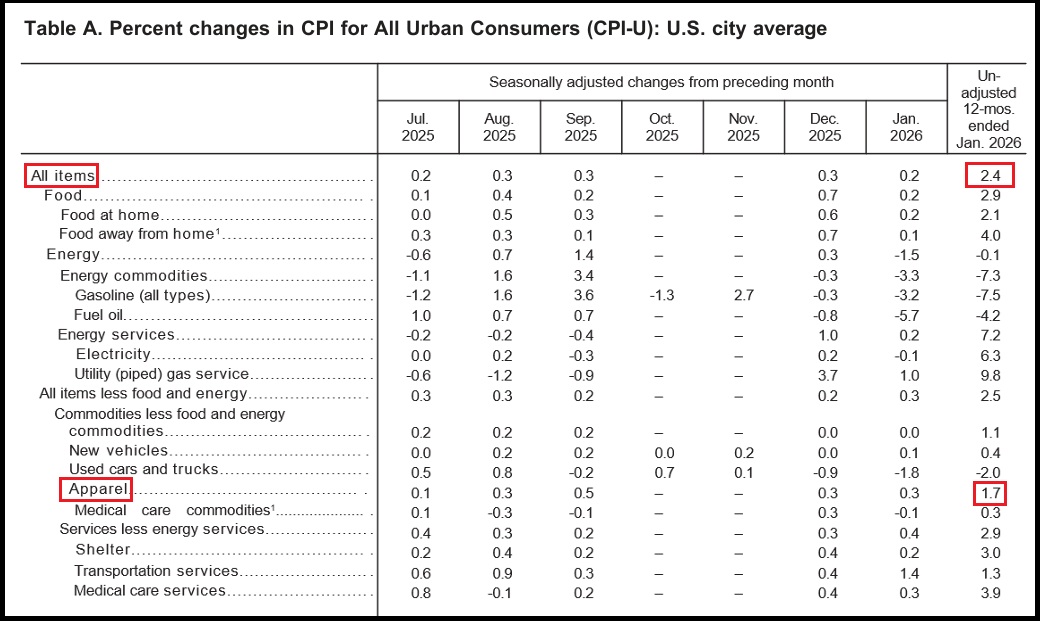
The pundits, economists and financial media are shocked, perplexed, befuddled and flummoxed. The Bureau of Labor and Statistics has released the January inflation data [SEE HERE] and the results are much better than they expected.
Overall inflation is 2.4% year-over-year, and there are zero indications that tariffs are having any impact on consumer prices [See Apparel].
CORE inflation, which removes food and energy, comes in at 2.5% year-over-year, the lowest number since March 2021. This is like reliving 2018 all over again, when the pundits proclaimed with absolute certainty that Trump’s tariff approach was going to cause inflation; it never happened.
VIA ABC – Inflation cooled in January, dropping price increases to their lowest level in nine months, new data from the Bureau of Labor Statistics showed. The lower-than-expected reading defied fears of a tariff-induced hike in overall costs.
Prices rose 2.4% in January compared to a year earlier, according to the Consumer Price Index.
The data arrived days after fresh hiring figures showed stronger-than-expected job growth in January, even though an updated estimate released at the same time indicated a near-paralysis of the labor market last year. (read more)
While it is likely prices will never reset to the 2021 levels, at least right now we have wages growing faster than inflation, which essentially nulls the inflationary impact within the economy.
🚨 HOLY SMOKES. CNN was just forced to report that President Trump successfully lowered annual inflation to the LOWEST in YEARS
"That's the lowest annual inflation rate for core since March of 2021 — before the inflation crisis!"
Posted originally on CTH on February 13, 2026 | Sundance
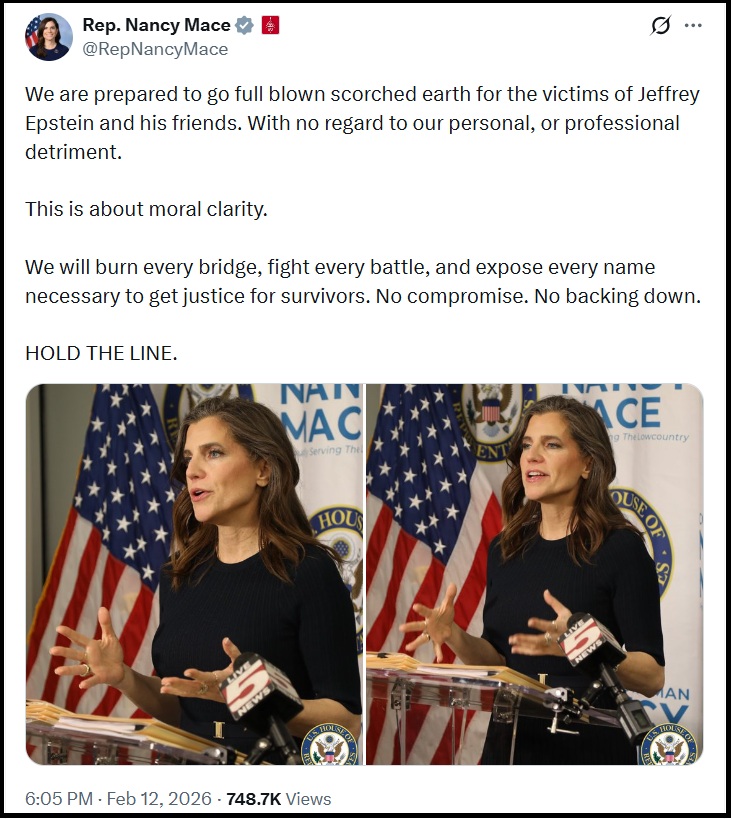
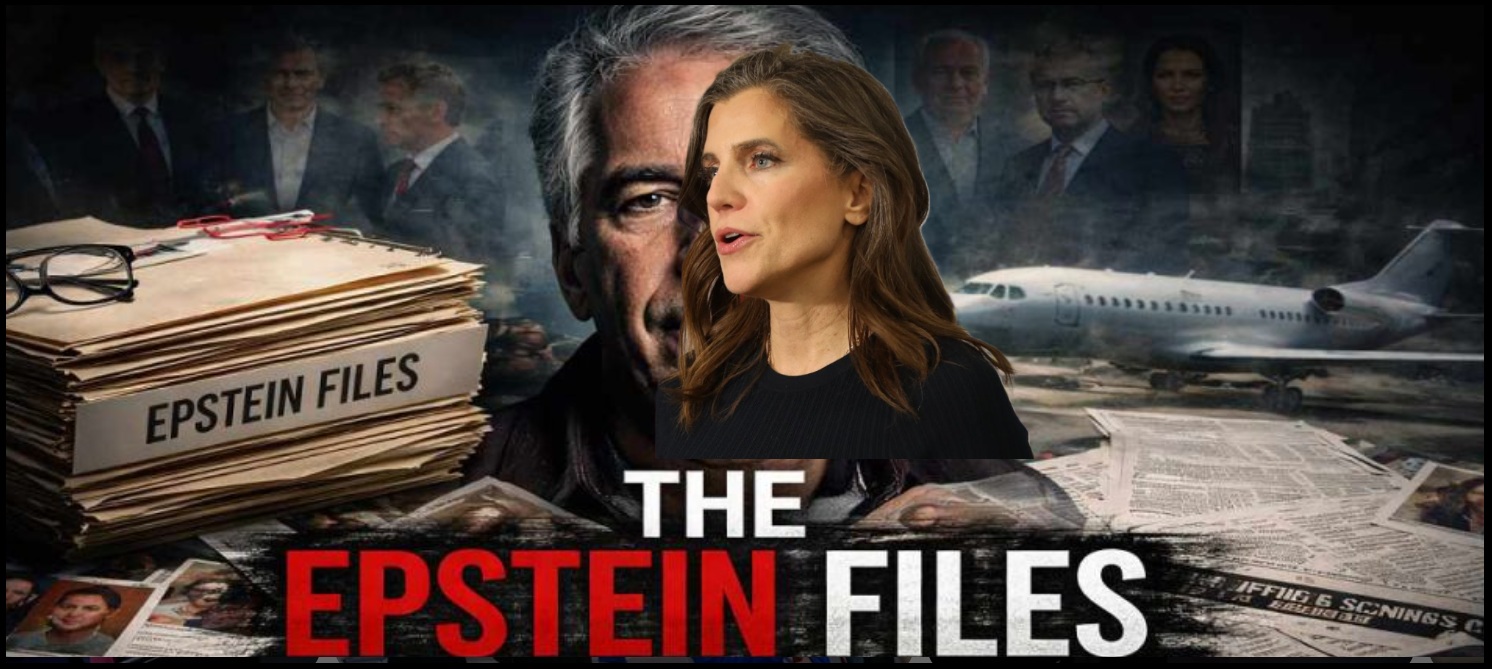
Highlighting how the various anti-Trump factions of the Republican apparatus are using the Epstein drama to support their specific needs, Representative Nancy Mace announces yesterday she will use Epstein drama to, “go full blown scorched earth for the victims of Jeffrey Epstein and his friends. With no regard to our personal, or professional detriment.”
The background and political timeline hold the key to understanding the mooonbat crazy of it all.
Thursday morning South Carolina Governor Henry McMaster endorsed Lt. Gov. Pamela Evette to succeed him when he leaves office at the end of the year. {LINK} This triggered the generally unstable Nancy Mace into an explosive fit of rage, because it’s likely President Trump will also follow McMaster’s endorsement. {LINK}
By the end of the day Thursday, Nancy Mace had her strategy in place. The LAUNCH:
See how it works? Don’t get what you want in MAGA-era politics; simply throw out the Epstein name and become a virtue signaling member of the righteous tribe, vowing to take down the corrupt Trump system that allows Epsteinism to exist.
Approximately 80% of every narrative surrounding the Jeffrey Epstein saga is manufactured nonsense. The politicians like Thomas Massey and Nancy Mace are working diligently inside that 80% to manufacture false stories based on innuendo, rumor, gossip and strawman arguments that collapse when scrutinized. In short, it’s a grift!
I have created this site to help people have fun in the kitchen. I write about enjoying life both in and out of my kitchen. Life is short! Make the most of it and enjoy!
This is a library of News Events not reported by the Main Stream Media documenting & connecting the dots on How the Obama Marxist Liberal agenda is destroying America



 Centinel2012