Posted originally on Jan 27, 2025 by Martin Armstrong
Federal Reserve Chairman Jerome Powell and Donald Trump face off once again. The two have notoriously butted heads over interest rates, as Trump has accused the Fed of stifling economic growth by raising the cost of borrowing. Speaking at Davos, the president said he would “demand that interest rates drop immediately.”
We all know the Federal Reserve is independent and the White House cannot dictate interest rates. Lowering interest rates does not stimulate the economy, contradictory to the common belief that reducing rates will boost economic growth. The outdated understanding based on Keynesian Economics states that an increase in the supply of money MUST be inflationary. The Fed raises rates to reduce consumption and lowers rates to stimulate consumption.
It’s a very nice theory, but when actually tested, it utterly fails. Lower rates will NEVER cause people to invest until they believe that there is an opportunity to invest. We are watching the big players withdraw from equities, let alone government debt. We are in a private wave where money is running off the grid at a rapid pace.
Once upon a time, you could not borrow against government debt. Thus, it was deemed non-inflationary as long as it could not be used as money. Today, you post bills as collateral to trade futures. The old theories no longer exist in this new, strange world we live in. Hence, all the QE was merely swapping the debt for cash.
Every fiscal policy in recent years has exacerbated inflation and the Fed cannot keep up with government spending. QE FAILED. The artificially low interest rates of the recent past were completely unsustainable and relied on outdated theories.
The most significant issues facing our economy are simply out of the Fed’s hands: war, taxation, and government spending. Chairman Jerome Powell surprised everyone when he called spending under the Biden-Harris administration “unsustainable” and warned that it would hurt generations to come. While not a direct criticism, Powell issued a stark warning that aligned with our Revolution Cycle of 72 years. In 1951, the central bank defied the US government by refusing to purchase debt to prevent rate hikes amid the Korean War. The minutes reports always mention that the central bank is keenly monitoring geopolitical events as it must look at all variables from a global standpoint.
The issue of increasing sanctions on Russia, and the rest of the world for that matter, may raise inflationary fears and push long-term rates higher. Then we are looking at the risk of Japan, who holds the bulk of US debt, experiencing a sovereign default in a contagion that will spread to Europe.
We may see the Fed pull back rates this year. Powell understands that Keynesian policies no longer work and raising rates have no effect on inflation. Interest rates are really the price of money in anticipation of future inflation.
Posted originally on Jan 18, 2025 by Martin Armstrong
QUESTION: On Friday, the UK FTSE and DAX closed at new all-time highs, so clearly money is flowing into these indices yet euros and Pounds seem to be flying out the door as they prepare for lower lows and thus this seem confusing. Added to the confusion is that Europe is where the sovereign debt crisis SDC) is likely to begin, so why is capital flowing into these markets? I suppose better to hold UK or German equities vs. their sovereign debt and thus will those equity markets continue to rally during the SDC?
SR
ANSWER: A number of questions have been coming in about the European markets. Keep in mind that we are in the throes of geopolitical and political upheavals, not to mention the entry of Trump and his old-school nonsense about lowering the dollar to sell more stuff overseas and imposing tariffs. Those ideas I have dealt with constantly over the course of the past few decades. It is confusing without question. The press does not understand currency, not even those in government. Absolutely everything has an international value, and this has led to the overwhelming majority getting things wrong. Many ask why mainstream media will not interview me on such important topics as this. The reason is simply – it is too confusing for them as well.
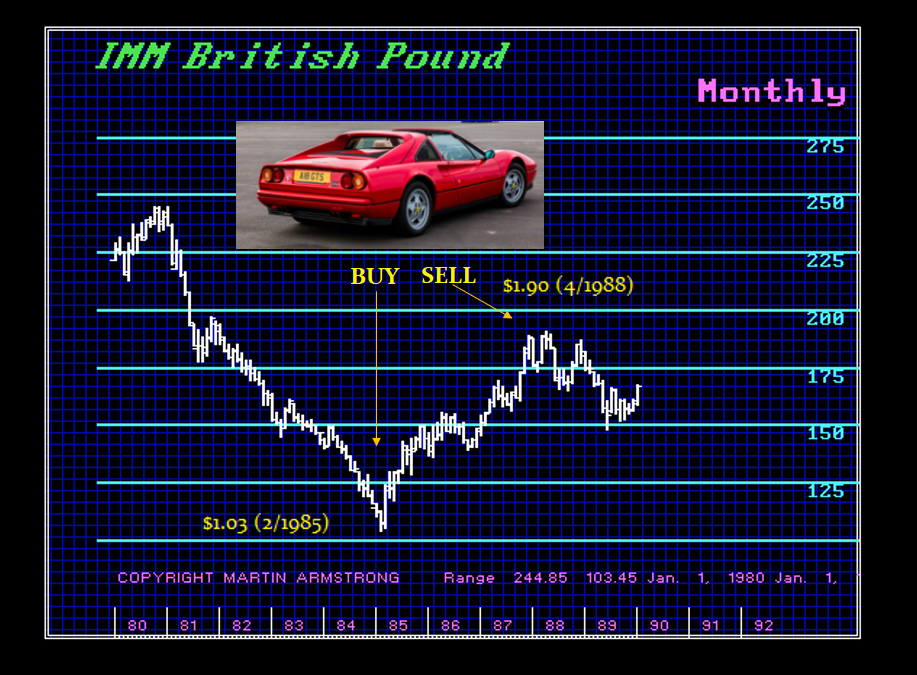
I have told the story at conferences about my Ferarri Trade and how I bought a 308 Ferrari when I lived in London in 1985 when the British pound fell to $1.03. The Italians were getting $60,000 for the car in the States back then. It was still priced in pounds when the pound used to be $2.40. I bought the car for about $35,000 when converted. The Italians could no longer sell these Ferarris for such a price in London. Hence, they doubled the price in British pounds based on $1.03.
Over the course of the next couple of years, the pound rallied and went to $1.90 again by 1988. I drove the car for 2 years, sold it used for £40,000, and virtually doubled my money. Then, people were buying Ferraris as an investment, thinking it was the car that appreciated when, in fact, it was just a currency play. If you did not look at the currency, you missed the whole point.
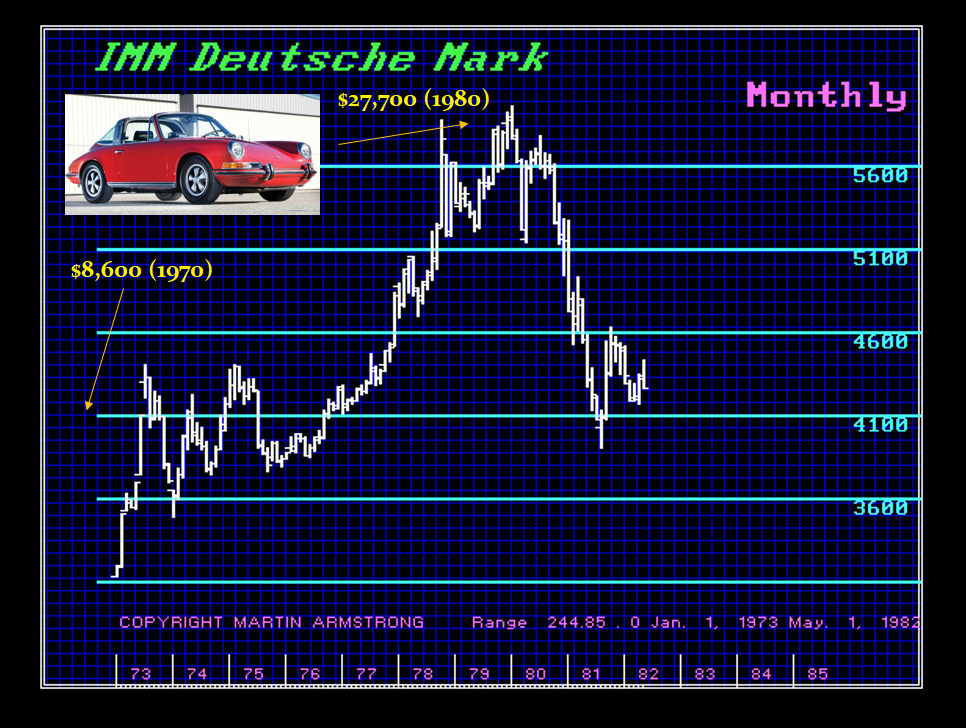
In fact, I was buying German cars throughout the 1970s as the dollar was declining. A Porsche was $8,600 in 1970, and by 1980, it was $27,700. I would drive the cars for 2 years and then trade them in and get my money back, so cars never cost me a dime throughout the 1970s. I understood it was all just currency – not the cars themselves. My father took the family to Europe for the summer of 1964, which taught me about currency as we traveled from Sweden to Italy and all around. We had to change currency every time we crossed a border. I learned that CURRENCY was actually a mental language. I would listen to the price in Italian lira and convert that back to dollars in my mind to asses if the value was a fair price.
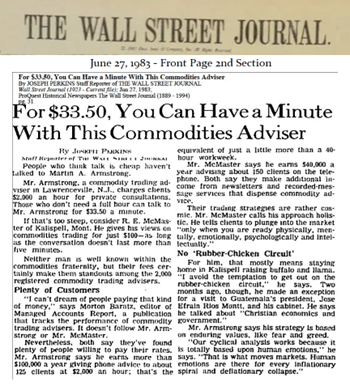
I was really the only true foreign exchange analyst. I was dealing in billions in the early 1980s. Clients would even put me on a speak in the middle of an OPEC meeting. I was being called in around the world all on currency crises. That’s how I became friends with Margaret Thatcher. I was being touted as the highest-paid analyst in the world, all for currency. When I was opening an office in Geneva in 1985, I was going to use some European names to blend in. I went to lunch with the head of one of the top main banks in Switzerland, who was a client and asked his opinion of what European name to use. He asked me to name one European FOREX analyst. I was embarrassed for I could not. He then explained why everyone was using my firm. He said there were no European analysts because they each would tout their own currency because it was a political issue. He explained everyone was using my firm because I did not care if the dollar went down or up. I said it was just a trade.
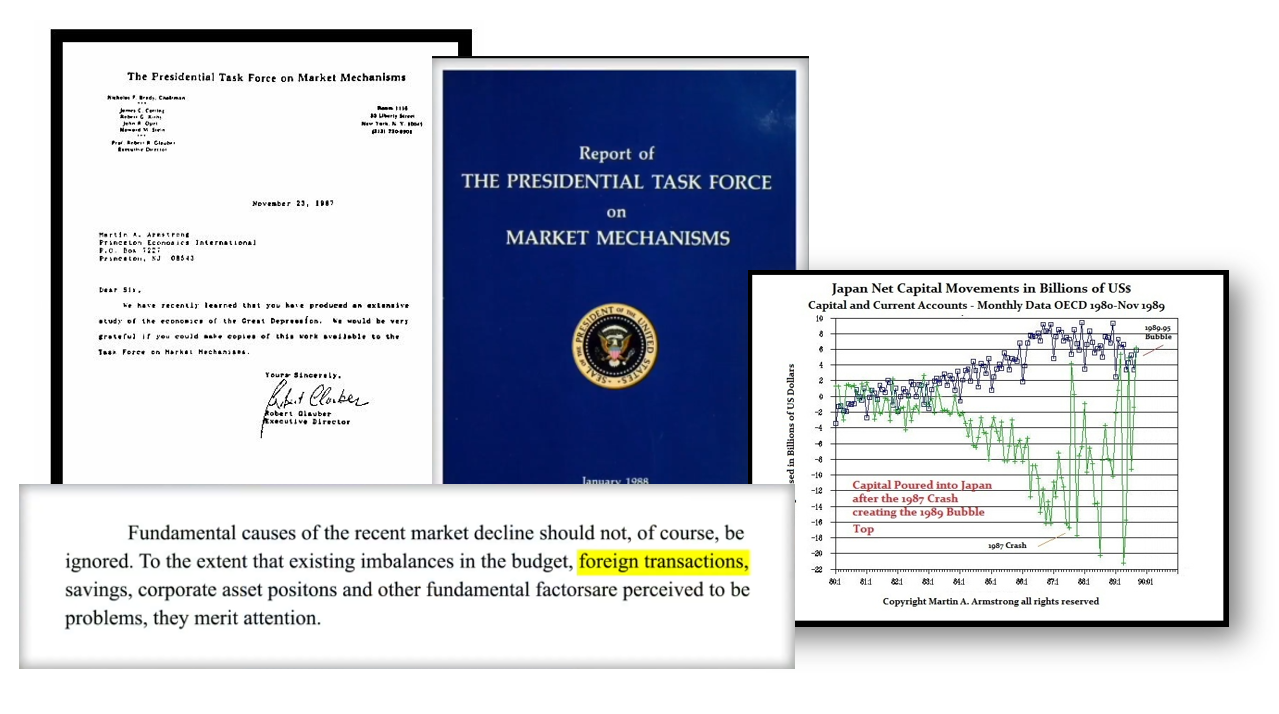
By 1985, I was summoned to the US. They were arguing to force the dollar down by 40% to reduce the trade deficit as that theory today is espoused by Trump. That was the Plaza Accord, and I wrote to President Reagan and warned that they would cause a crash within two years, and that became the 1987 Crash. The Presidential Commission then called me in for that one. They just do not teach this stuff in school and that seems to be the problem.
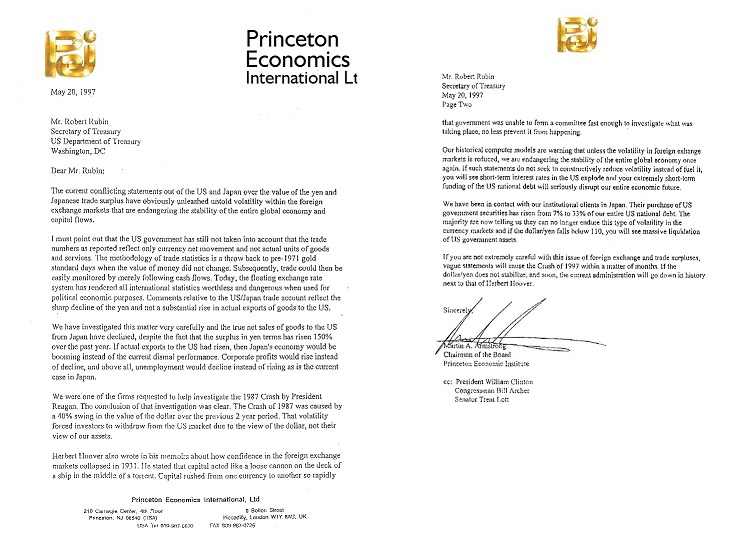
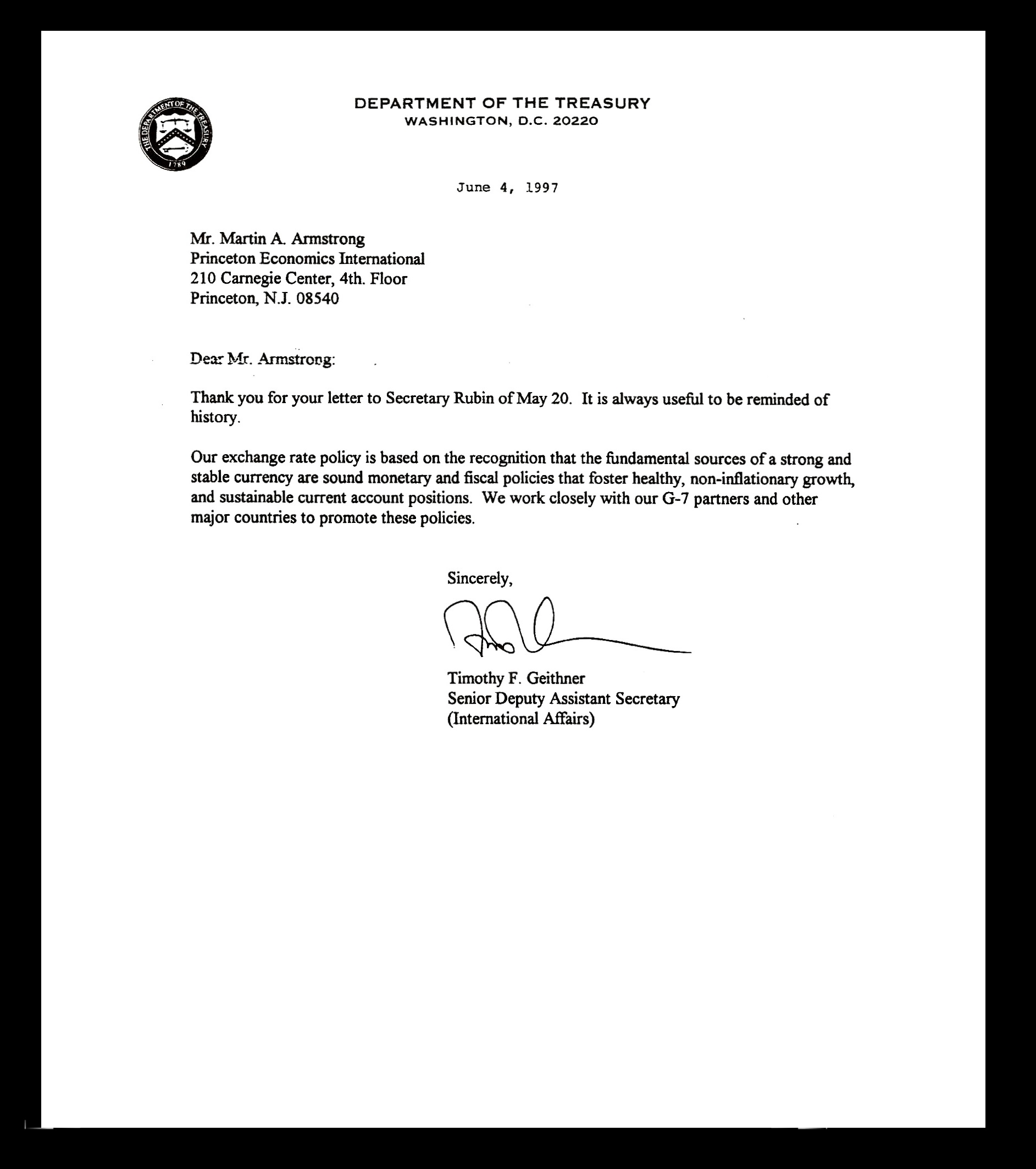
In 1997, Robert Rubin, former head of Goldman Sachs, was also trying to talk the dollar down for trade. Again, he did not really understand currency and its impact on markets. The Asian currency Crisis unfolded weeks later. He may have been at Goldman, but that was more related to debt. To one person, a stock rally can look like a bull market, and to another, a bear market. When you get into currency swings of 10%-40%, it alters the perception of value because they still do not teach this stuff in school. We are clinging to old theories like Keynesian economics from the period of fixed exchange rates. Politicians are making the wrong decisions and investors are confused because these concepts are never taught.
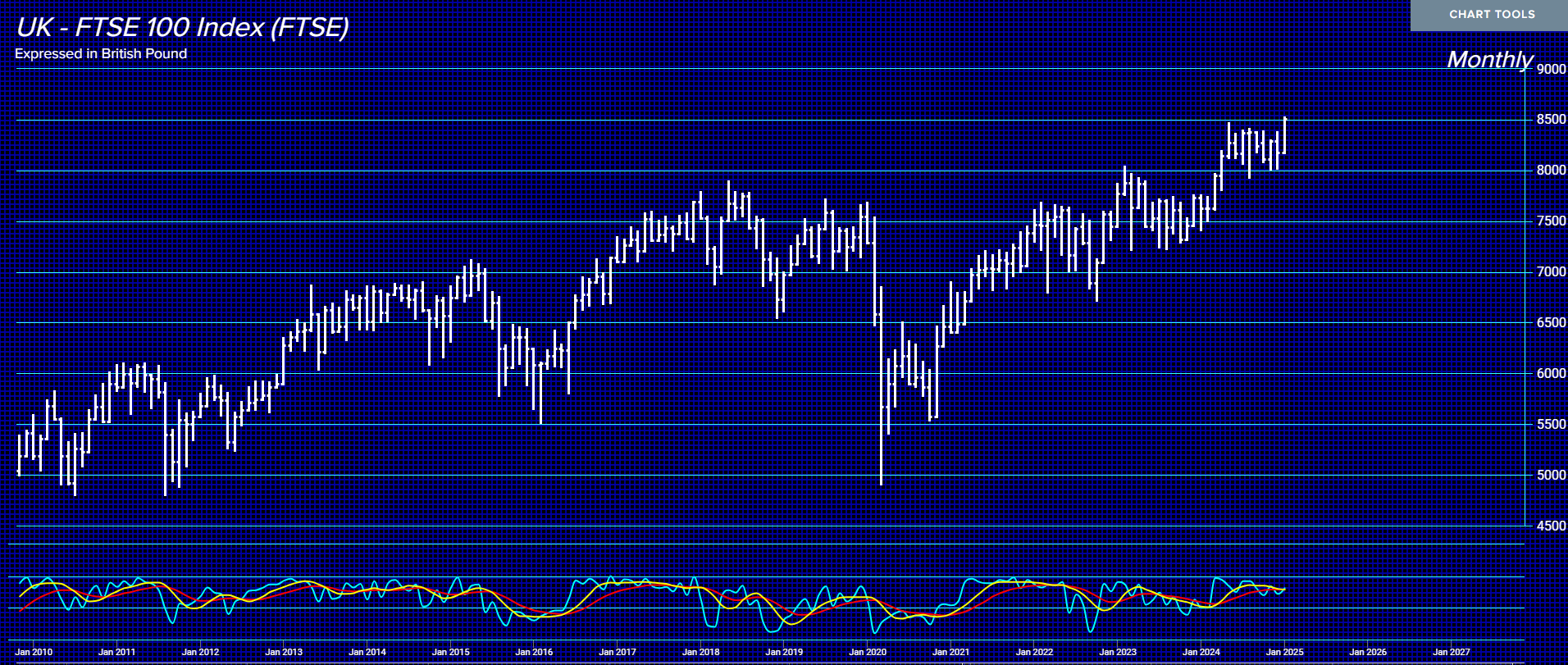
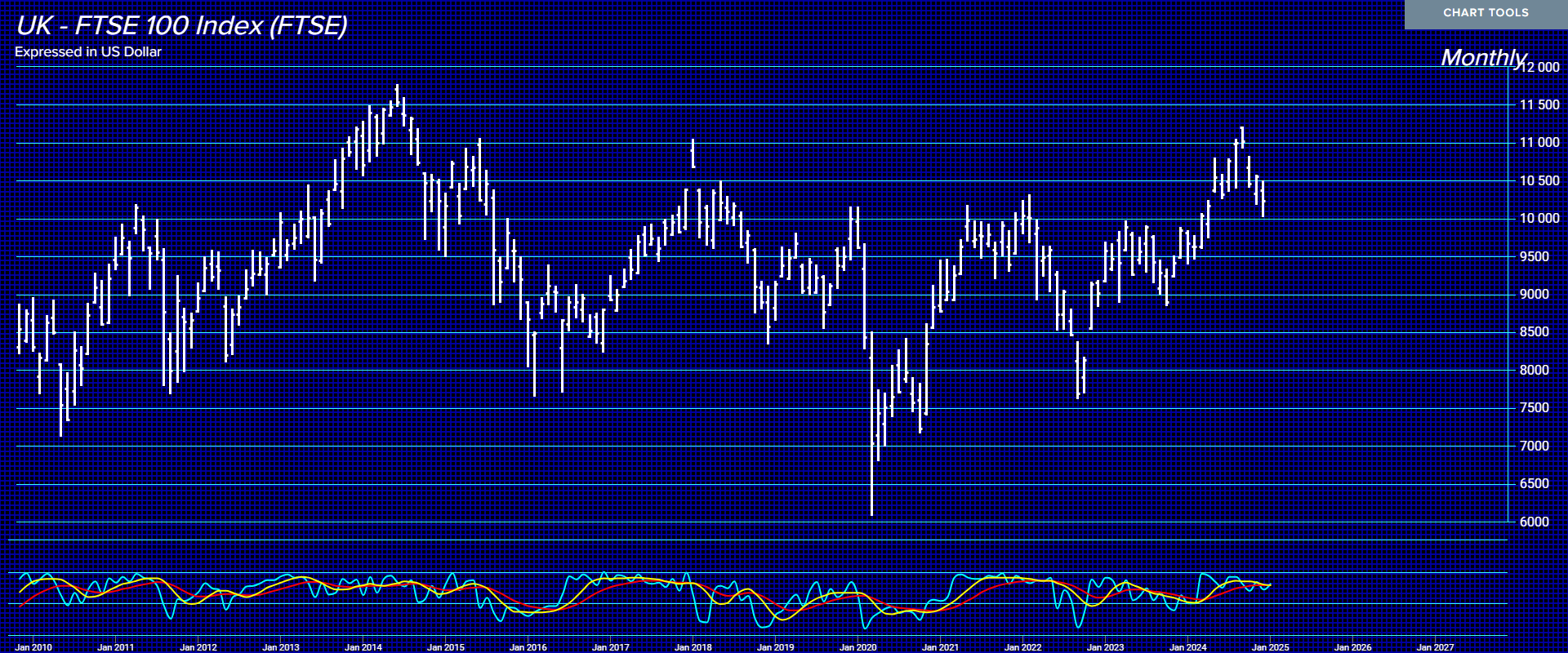
As the greenback rallies, then the European share prices will appear cheap, just as Ferarri did in 1985 when the pound fell to $1.03. You will have domestic movement away from public assets as we have seen corporate rates move below that of government rates in France. Here is the FTSE in pounds and then in dollars. While you see new highs in pounds, the FTSE has not made new highs in dollars and has backed off, showing that the rally in the FTSE is not keeping pace with the decline in the pound.
01:56This is why, in Socrates, you can plot any instrument in a host of various currencies. The definition of a bull market is something that rallies in terms of all the key currencies. When it is rising only in terms of the local currency, it is simply a domestic shift and not international.
We do NOT see a major Crash on the horizon in shares, commodities, gold, silver, etc.
The greatest risk of a crash will be in government debt.
Posted originally on the CTH on December 30, 2024 | Sundance
Treasury Secretary Janet Yellen has announced the U.S. debt ceiling is likely to be reached mid-January, while Joe Biden is still in office. President Trump tells congress to deal with the issue now.
First, here’s Secretary Yellen:
WASHINGTON, Dec 27 (Reuters) – The U.S. Treasury Department may need to take “extraordinary measures” by as early as Jan. 14 to prevent the United States from defaulting on its debt, Treasury Secretary Janet Yellen told lawmakers in a letter on Friday.
Yellen urged lawmakers in the U.S. Congress to act “to protect the full faith and credit of the United States.”
U.S. debt is expected to decrease by about $54 billion on Jan. 2 “due to a scheduled redemption of nonmarketable securities held by a federal trust fund associated with Medicare payments,” she added.
She said: “Treasury currently expects to reach the new limit between January 14 and January 23, at which time it will be necessary for Treasury to start taking extraordinary measures.”
Under a 2023 budget deal, Congress suspended the debt ceiling until Jan. 1, 2025. The U.S. Treasury will be able to pay its bills for several more months, but Congress will have to address the issue at some point next year. (more)
The Biden spending is already baked into the proverbial cake. Congress will have to raise the debt ceiling limit and President Trump is urging them to do it now, before he takes office.
Specifically, because 38 republicans voted against the 2nd continuing resolution earlier this month, President Trump will face this debt ceiling mess on day one if it is not addressed before. They republicans knew this reality when they voted no.
Now President Trump is trying to avoid a potential mess early in his administration. No amount of spending cuts are going to stop the previously authorized spending. We are still going to hit the debt ceiling regardless of action from within the House to downsize government. Congress can freeze all spending, and we will still hit the debt ceiling.
It certainly looks like a crew of House republicans knew this would hamstring President Trump, and measures to avoid default are going to be needed.
Posted originally on Dec 26, 2024 by Martin Armstrong
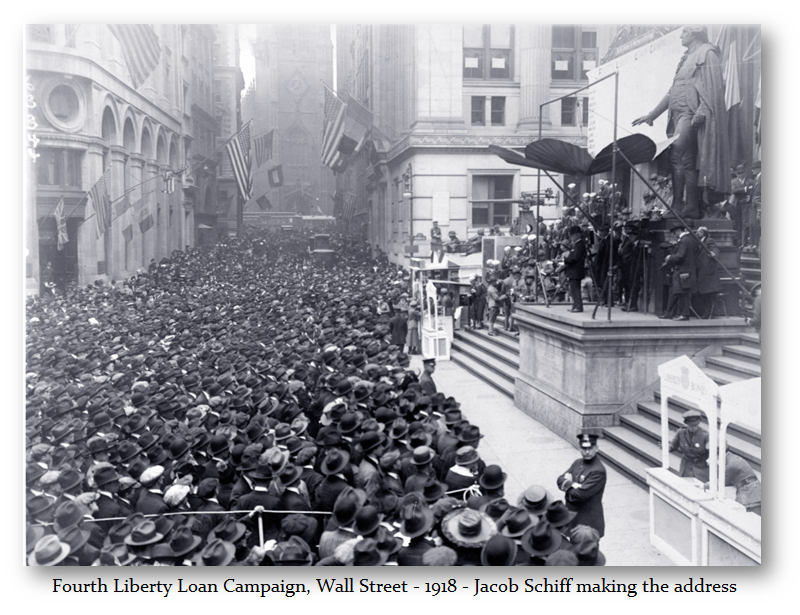
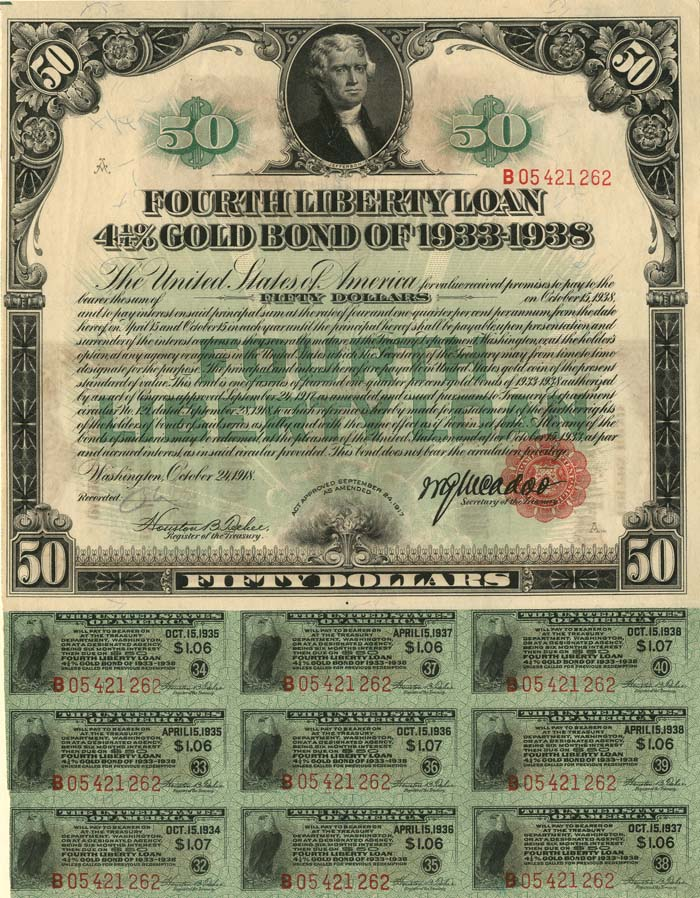
The first three Liberty bonds and the Victory Loan, sold to fund World War I, were indeed retired during the 1920s. However, because the terms of the bonds included a Ponzi Scheme that allowed the bondholder to swap them for the newer bonds, with superior terms, most of the debt from the first, second, and third Liberty bonds had been rolled over into this fourth issue. The terms of this 4th issue were as follows:
Date of Bond: October 24, 1918 Coupon Rate: 4.25% Callable Starting: October 15, 1933 Maturity Date: October 15, 1938 Amount Originally Tendered: $6 billion Amount Sold: $7 billion
The terms of this Fourth Liberty Bond specified: “The principal and interest hereof are payable in United States gold coin of the present standard of value.” This was the typical “gold clause” that was found in most sovereign bonds, both domestic and international. In addition, private contracts and bonds also included this gold clause before Roosevelt. Generally, it was intended to guarantee that bondholders would not suffer from a currency devaluation – not inflation since even a gold standard does not prevent inflation.
The US defaulted on these bonds thanks to Roosevelt. The US Treasury called in this Fourth Liberty Bond on April 15, 1934, for redemption. However, the US defaulted on this term by refusing to redeem the bond in gold. They also ignored the dollar devaluation imposed by Roosevelt, which changed the dollar’s gold value from $20.67 to $35. The entire purpose of the gold clauses prior to Roosevelt was to protect against a currency devaluation. The 21 million bondholders lost 139 million troy ounces of gold, which caused the loss in international value terms to be approximately 70% of the bond’s principal.
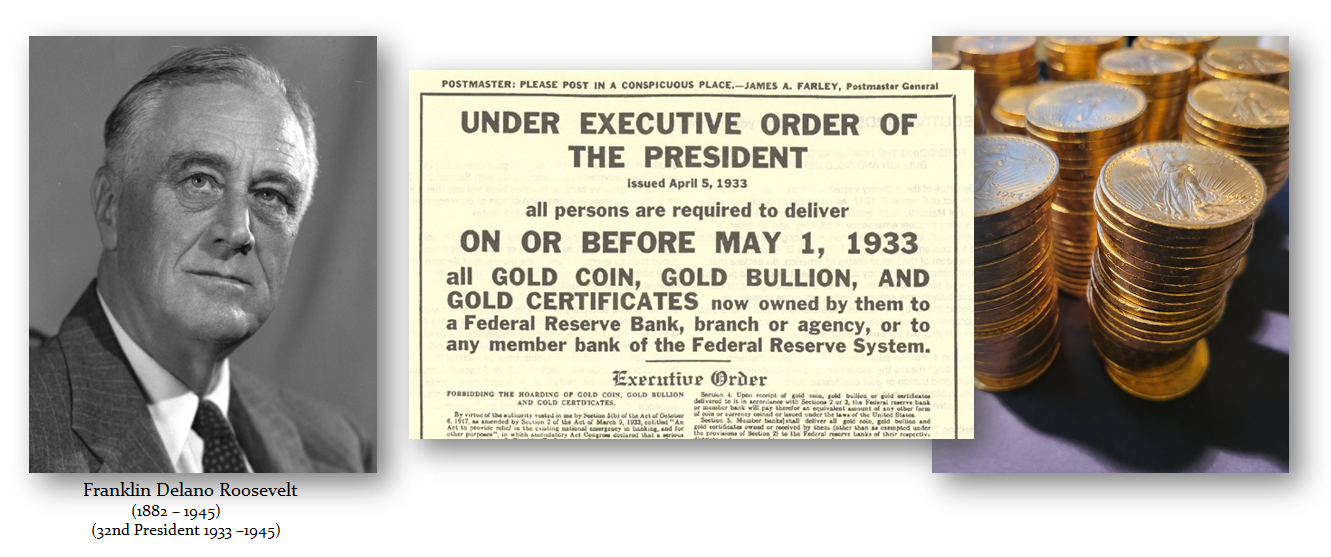
The legal basis for the refusal of the US Treasury to redeem in gold was the gold clause resolution was Roosevelt’s effort to seize gold, devalue the dollar, and attempt to ensure that all profits would accrue to the government (Pub. Res. 73–10), dated June 5, 1933. The Supreme Court was petitioned to decide this issue, and what we will see is that Roosevelt just ignored the Supreme Court once again, showing that the Constitution means nothing when it constructs the government from its goal.
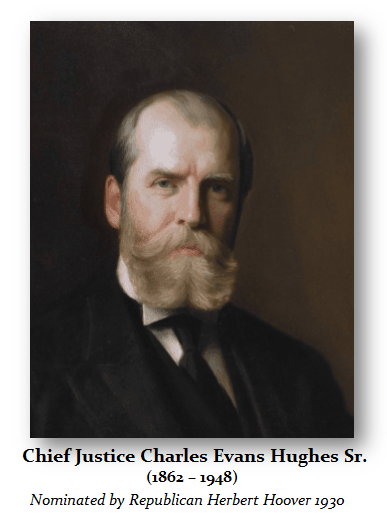
Chief Justice Charles Evans Hughes wrote the decision in Perry v. United States, 294 U.S. 330, 354 (1935). He made it very clear that the Joint Resolution of June 5, 1933, nullified the gold clause obligations of the United States and that they would only honor dollar for dollar, which was unconstitutional id /349. Furthermore, the Court held that Congress cannot use its power to regulate the value of money to invalidate the Government’s obligations.
President Franklin D. Roosevelt’s closure of the open gold market and the removal of the domestic backing of the dollar with gold took place with the signing of Executive Order 6102 on April 5, 1933. The Supreme Court ruled that the bondholders’ loss was unquantifiable and, therefore, repaying them in dollars according to the 1918 standard of value would be an “unjustified enrichment.” FDR essentially defaulted on the US national debt, repaying it with depreciated dollars, reducing the debt by nearly 70%.
Default is Always a Sovereign Prerogative when Things get Tight.
I have created this site to help people have fun in the kitchen. I write about enjoying life both in and out of my kitchen. Life is short! Make the most of it and enjoy!
This is a library of News Events not reported by the Main Stream Media documenting & connecting the dots on How the Obama Marxist Liberal agenda is destroying America





 Centinel2012