Will NATO & Europe Be Down for the Count with WWIII?


Posted Dec 9, 2025 by Martin Armstrong |  
EU Cancelled

COMMENT: Marty, Thank you for the WEC. I agree with many, it was your best ever. I have re-watched it twice and pick up new things every the time. The contrast of arrays on Europe vs USA confirms sadly that Socrates will be correct and your effort to prevent WWIII will fail. But it does appear that you may succeed in keeping the US out of war here in Europe. I am taking my family out of here. They are introducing a conscription bill here in Germany. Thank you for that. You can smell war is in the air. The press will not tell the truth and there is nothing Putin can do or say that they do not criticize and subconsciously are telling Europeans Russia is weak and can be easily defeated.

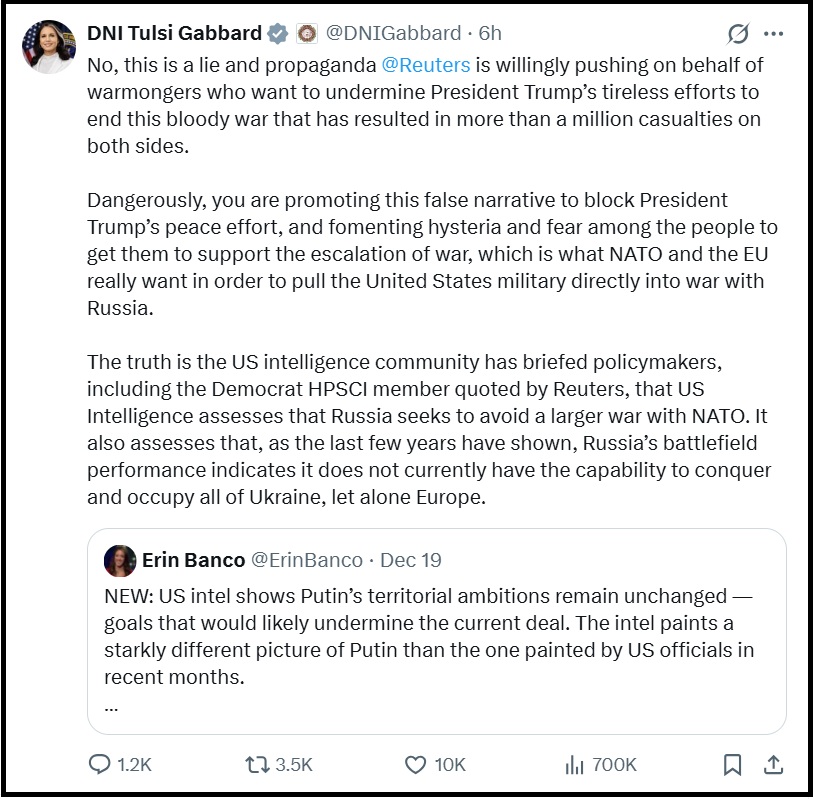
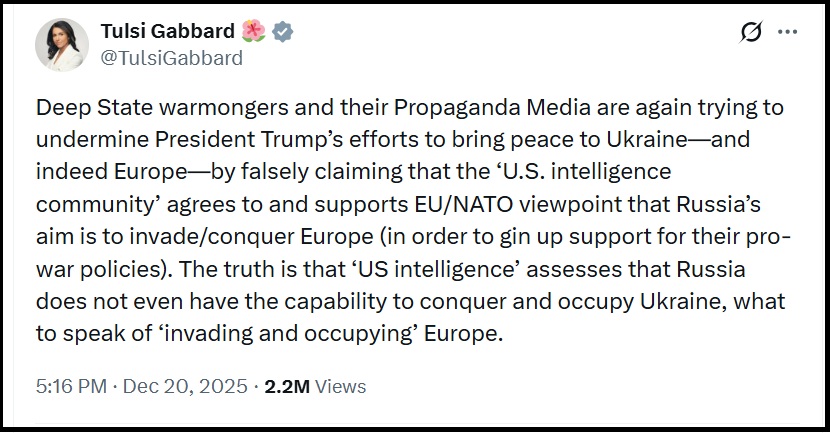
Our European powers have again rallied behind Ukraine on Monday after President Trump blasted Zelensky a day prior, accusing him of not bothering to read the U.S.-proposed peace plan to end the Russia-Ukraine war. British Prime Minister Keir Starmer said: “We stand with Ukraine.” German Chancellor Merz and French President Macron concurred.

2025_12_08_20_25_54_Confidential_Conference_on_Ukraine_Peace_We_Must_Not_Leave_Ukraine_and_Volodym

Here in Germany, DER SPIEGEL, German Chancellor Friedrich Merz and French President Emmanuel Macron in a secret call said that the U.S. could betray Ukraine and Europe. I think this is in line with your peace plan and they reject. They did not want to hear Trump say that Europe is erasing its culture with migration and has become irrelevant.

Nobody seems to ask how many Europeans are they willing to sacrifice this time for war? I would have thought Europe would have learned. That clip you had of Merkel and Hollande saying the purpose of creating the EU was to eliminate war seems to only refer to internally. So now they want all of Europe to invade Russia. It never ends. I really do not understand why humanity always loves war.

PVB

ECM Euro Waves 1 2

REPLY: We are about to enter the 3rd Wave 2026.03137 (January 11-12, 2026). It is highly questionable if the EU will survive beyond 2030.330137. Europe will never accept peace because these leaders are broke and they are robbing Russians in front of the entire world.

2025_12_08_21_33_13_Europe_nears_deal_on_Russian_assets_after_talks_in_London

Up to 80% of the “Russian Assets” that have been seized, belong to Russian individuals – not the state. On the private-side: reporting in 2023 estimated that private Russian property subject to freeze in the EU (yachts, villas, private accounts, corporate holdings, etc.) amounted to about US $58 billion. But the foreign reserves that were seized are not purely state assets. The central bank was holding foreign accounts of all various Russian companies and individuals doing business with the West. This is a violation of International Law and the EU does not give a shit because the European Press is so anti-Russia that they will never report the truth.

As of early 2025, Swiss authorities reported that around 7.4 billion Swiss francs (≈ US $8.4 billion) in Russian-owned assets had been frozen. That includes assets linked to individuals / companies subject to sanctions (real estate, luxury goods, etc.) as well as holdings tied to the Russian Central Bank.  Under Swiss law, outright confiscation of legally acquired private assets of Russians — simply because they are Russian — was deemed unconstitutional (as of 2023) by the Swiss Federal Council (not a “court”) on February 15th, 2023 accepted the conclusion of a working group from the Federal Office of Justice (FOJ) that confiscation of frozen private Russian assets would be unconstitutional under Swiss law and violate the legal order.

The lies that the EU are using is lets say you have money on deposite in a bank, that bank then places reserves at the central bank, the EU seizes all the assets of the Russian central bank and pretend they are the assets of the state. They are clearly showing that the EU cannot be trusted and any non-European client with funds in the EU shoi;d get the funds out of there before you will never see them again. One prominent case involved Mikhail Fridman, a Russian oligarch. In April 2024, a court within the EU system (the General Court of the European Union) ruled there was insufficient evidence to keep him on the sanctions list. That effectively challenged the freeze on his assets under EU sanctions — at least insofar as the justification for listing him was concerned. Following that, Fridman initiated further legal action: he sued a national government (of Luxembourg) over damages arising from his asset freeze, and has also launched arbitration under international investment-treaty rules.

2014 April 23 Anti Terrorist Operation

The EU has violated international law and has ignored the fact that the Ukrainian Civil War was instigated by Ukrainians in Kiev and classified everyone in the Donbas as a Terrorist. Putin even requested that they rescind that terrorist classification to justify attacking the ethic Russians in Crimea and the Donbas.

May 2 2014 Odessa Trade Unions House

Only after the Ukrainians were openly killing Russians on the streets of Odessa and burned them alive did the Donbas declare its independence for which Kiev then declared them to be terrorists. The West wanted this war with Russia and the press refuses to report the truth cheering on World War III with every story they write. Our computer warns this will be the end of European civilization.

Billions are vanishing and these politicians speak nothing about the corruption in Ukraine which makes one wonder what they are making on the sidelines? Public reporting on exactly which European companies have active contracts to supply weapons to Ukraine is often partial, aggregated, or confidential to protect politicians. Many supply-contracts are mediated via governments, export licences, or procurement coalitions. The fact that these politicians NEVER criticize  Zelensky for the corruption is telling implying they have their hand in this cookie jar.

Even when companies are known, shareholding data of individual EU politicians (members of parliaments, governments, etc.) is typically very opaque, rarely if ever disclosed in a way that connects them to defense-industry shareholdings — meaning publicly documented cases are very limited. That said, some European companies known to supply Ukraine (or facilitate supplies), there is little or no verifiable public evidence that EU-politicians are significant shareholders in them.

Czechoslovak Group (CSG) defense conglomerate has explicitly supplied Ukraine. According to publicly available data, in 2022 roughly 41% of its revenue came from deliveries to Ukraine; in 2023 it was around 23%. Its exports include 155 mm and 152 mm artillery rounds, T-72 “Avenger” tanks, BMP-1/2 infantry fighting vehicles, multiple-launch rocket systems (e.g. RM-70 Vampire, BM-21 MT STRIGA), self-propelled howitzers (DANA M2, DITA), among others.

Then there is Rheinmetall (Germany). Again, I found no public breakdown showing “Rheinmetall → Ukraine” under a named contract. Yet, Rheinmetall is widely regarded as one of the major European defense manufacturers benefiting from the surge in European military spending tied to the war. Its business boom is strongly correlated with increased demand for ammunition, armored vehicles, and other military equipment in response to the war.

Smaller or mid-sized European firms are also on the take. The number of smaller or midsize European ammunition / defense-component firms are in supply chains that now support Ukraine or NATO rearmament. For instance, a 2025 academic study on European ammunition & grenade manufacturing outlines structural shifts in supply-chains, partly driven by demand related to Ukraine as reported in the Scandinavian Journal of Military Studies.

In addition, institutional decisions within the European Union have reinforced these flows of money for arming Ukraine. As of early 2025, Defense News analysis estimates that about 60% of total aid is used in the U.S., about 25% is spent in Ukraine, and the remaining ≈15% elsewhere. In November 2025, EU lawmakers voted to deepen integration between the EU defense industry and Ukraine — under a programme allocating €1.5 billion, including €300 million for a “Ukraine Support Instrument.” That suggests EU-based defense contractors (like CSG, Rheinmetall, and others) are likely beneficiaries without and disclosure if any politicians are personally benefiting like Pelosi in the United States.

Despite substantial arms business, I found virtually no credible, publicly verifiable cases where an EU politician is documented as a shareholder — or major shareholder — in a company supplying Ukraine. This is simply being covered up. Shareholding disclosures for many European politicians do not always require them to declare holdings in privately held or non-public companies (especially defense firms). They made sure the laws they write always exonerate themselves.

Even when holdings are declared, they rarely specify the scale, affiliated subsidiaries, or whether the company has defense contracts — so linking a politician to “arms supply to Ukraine” becomes nearly impossible. I have found NOBODY in the press who has even bothered to produce any well-documented examples of a sitting EU politician with material shareholding in a firm known to supply Ukraine. WHY? Curiously, a 2025 Scandinavian Journal of Military Studies on ammunition supply-chains mentions “companies and inter-institutional relationships,” but does not document any politician ownership.

Many defense firms are privately held or structured via holding companies / trusts, which makes public shareholding disclosures harder to trace. There are no political transparency rules worth anything and they vary significantly across EU member states. Some require only limited disclosure; in others politicians may hold stakes indirectly (via holdings, blind trusts, family businesses, pension funds), complicating public traceability.

What we do know is certain, is that contract arms pipelines typically involve governments, intermediaries, export licences, not direct commercial sales — meaning “company X supplies Ukraine” may not appear in public procurement lists even if equipment ends up on the battlefield.

EU vs Russia

The combination of opacity (in shareholding) and indirect contract pipelines means that even well-informed public investigations may miss such connections because this is kept very behind the curtain. When these politicians constantly advocate war, if they are making a fortune on supplying Ukraine and sending people to their deaths, it seems nobody is willing to even open the door and ask a question when European War is now becoming inevitable.

UK Debt 1692 2012

The United States became the financial capital of the world after Britain entered World War I with no direct threat against the British people. Britain’s official declaration of war on August 4th, 1914, was primarily in response to Germany’s violation of Belgian neutrality. However, the reasons were more deeply rooted. Britain was not threatened. It claimed that the Belgian Neutrality Treaty (1839) was violated because Germany’s Schlieffen Plan required invading France through neutral Belgium. Britain was a guarantor (along with other powers) of Belgian neutrality under the 1839 Treaty of London. Ignoring this violation, Britain claimed it would call into question their credibility as a treaty guarantor and great power. That decision ended London as the financial capital of the world and it moved to New York.

Russian Roulette with Nuclear Weapons

I have been fighting hard behind the curtain to keep the US out of this next European War to conquer Russia. They will lose. They are playing Russian Roulette with Nuclear Weapons. NATO claims Russia will never push the button because they know what that would mean. But since the EU is NOT trying to force Russia out of Ukraine, this is about the conquest of Russia. If I was Putin and I know the objective is to totally destroy Russia, I would push the button.

2025_12_08_19_55_53_Nato_considers_being_more_aggressive_against_Russia_s_hybrid_warfare

Admiral Giuseppe Cavo Dragone, chair of NATO’s Military Committee, has recently suggested that a “pre-emptive strike” against Russia could, under certain circumstances, be justified as a form of defensive action. He argued that NATO needs to shift from being purely reactive (responding after attacks) to possibly “being more aggressive or proactive instead of reactive.” He acknowledged that considering “pre-emptive strikes” would depart from NATO’s traditional posture — but that under the pressure of ongoing “hybrid warfare” (cyber-attacks, sabotage, airspace violations, etc.), such options are being studied. He specifically said that in certain contexts a pre-emptive strike “could be considered a defensive action.

This is what I have warned about. There are NO RATIONAL people in NATO. What he is justifying is I walk into a bar and punch you in the face calling it self-defense because if KNOW you really wanted to hit me first. If we strip away the Ukrainian BS and propaganda, reliable sources in Ukraine confirm that Russia has used hypersonic missiles and Ukraine claim that they have been able to intercept them 25% of the time is nonsense. They must launch all 32 missiles of a Patriot Missile System to even have a possible chance at interception. As with everything Ukraine puts out, there is hardly anything that can be verifiable. They are more concerned about pretending that they are successful to keep the money flowing in for their Lamborghinis and Ferraris in Monaco. Europe is not going to hold up very well in a conflict with Russia – it is suicide.

NATO ECM A

I cannot take credit for turning Trump. Perhaps I have contributed, but I have no confirmation. His new strategy warns Europe faces “the real and more stark prospect of civilizational erasure.”  It also asserts that if present-day trends continue with immigration, demographic shifts, low birth rates, cultural/political changes, and suppression of free speech or democratic norms, “the continent will be unrecognizable in 20 years or less.” Yes, this is what our model is forecasting. The EU may not exist post 2030. Trump’s strategy also says some NATO members “will become majority non-European,” and that raises “open questions” about whether they will see their alliance with the U.S. the same way as original members. We are completing the 3rd wave by September 2nd, 2026. Here too, NATO and the Neocon began to implement this war with Russia in 2021 which was 72 years from its founding in 1949. NATO is in its death throes between 2026 and 2030.

Neocon Darkness

Humanity’s gravitation toward war is a deeply complex phenomenon with roots in multiple overlapping domains—psychological, social, economic, political, and evolutionary. Rather than a single cause, it’s better understood as a tragic interplay of many factors. People who are drawn to positions of power involving conflict are deeply entrenched in tribalism. Humans evolved in groups that competed for resources. This fostered strong in-group/out-group dynamics, where loyalty to one’s group and suspicion or hostility toward outsiders could enhance survival. War emerges from such people because of their flawed character. It is amplified group identity—nationalism, ethnicity, religion, or ideology.

Reagan in quest of peace

The Neocons told President Reagan he should not meet with Gorbachev even though they could not call him a communist, so they reverted to tribalism telling Reagan “you can never trust a Russian.” There is no discussion with these people. I have tried and they have only proven that I was an idealistic fool who though I could make then seek the light instead the darkness they carry with them. They always reject peace and live consumed by their hatred.

Thrasymachus Quote

States and rulers have often used war to consolidate power, divert attention from domestic problems, or achieve geopolitical goals. The realist is forced to argue that in a world (no matter what its form Republic, Democracy, Dictatorship, or Monarchy), the thirst for power is the same just as justice is the same regardless of the form of government. Corruption, authoritarianism, lack of democratic checks, and poor governance can make war more likely. Leaders will far too often prioritize personal or regime survival over peace as we are witnessing in Europe rigt now. Historically, empires expanded through warfare, driven by economic exploitation and ideological beliefs in supremacy. The legacy of arbitrary borders and exploited grievances continues to fuel conflicts. Right now, European leaders are being driven by economic necessity to retain power, but simultaneously, they are blinded by ideological beliefs in supremacy that they can displace the United States and rise from the ashes this time from war.

Euro Over the Edge

The computer disagrees

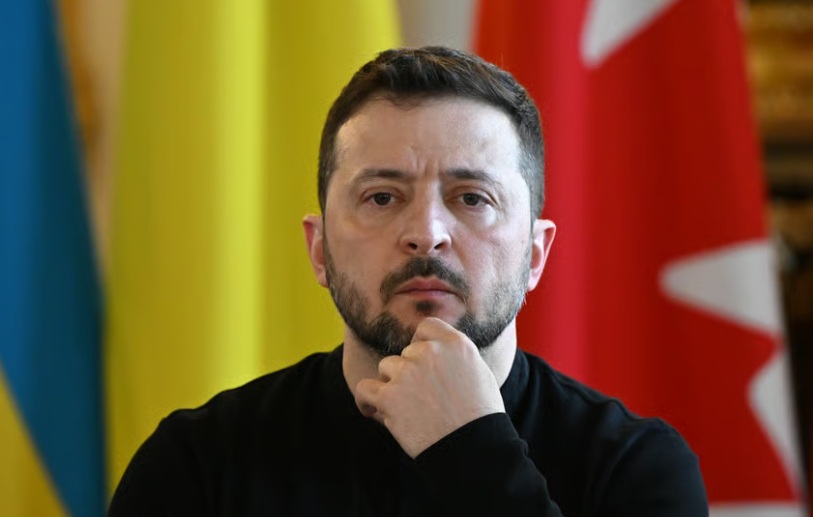
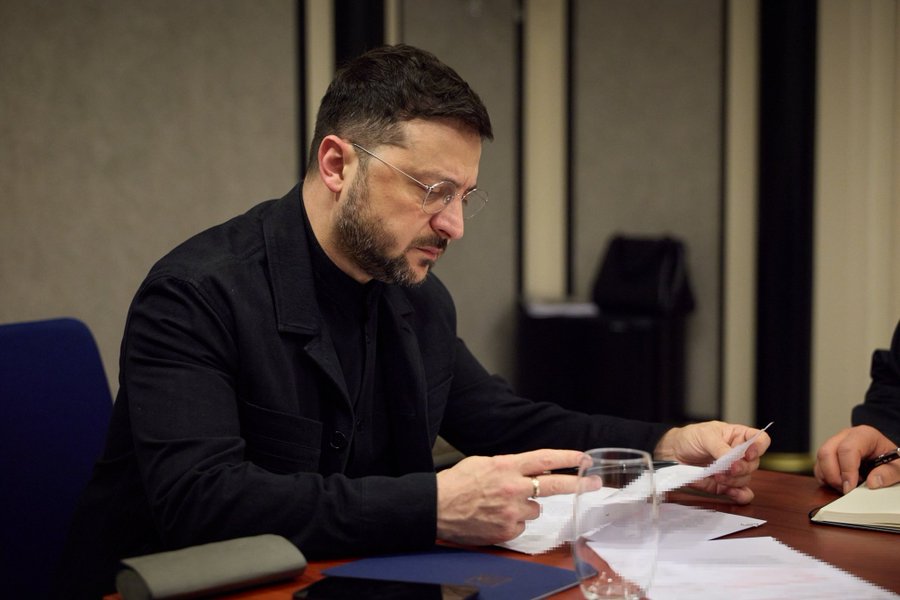
Volodymyr Zelensky


Zelenskyy Met with Starmer, Merz and Macron – Now Heading to Brussels

Posted originally on CTH on December 9, 2025 | Sundance | 19 Comments

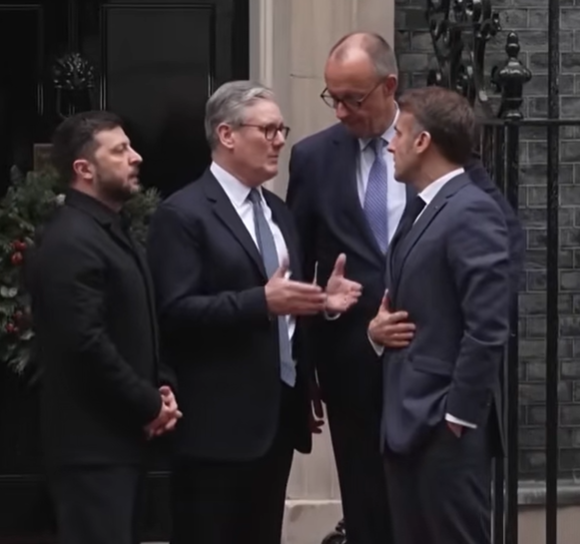
Yesterday, Ukraine President Volodymr Zelenskyy traveled to London to meet with British PM Keir Starmer, German Chancellor Friedrich Merz and French President Emmanuel Macron.

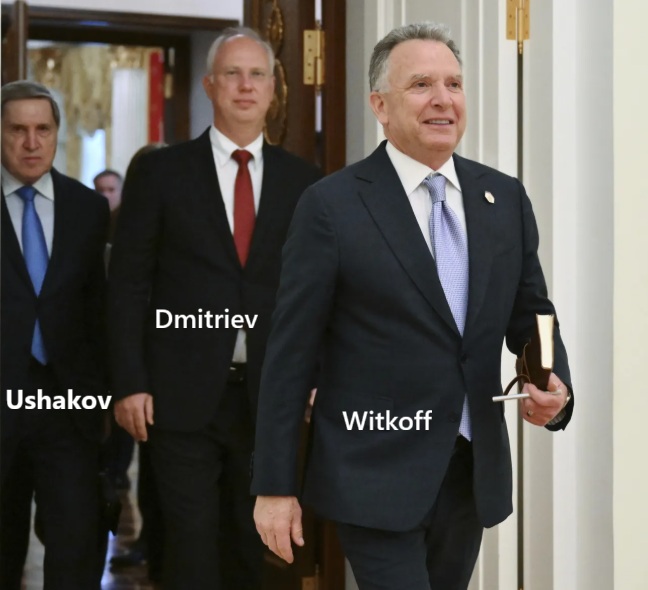
As expected, part of the Zelenskyy meeting with the “coalition of the willing” included a briefing by Ukraine negotiator Rustem Umerov, the secretary of Ukraine’s National Security and Defense Council, who held detailed consultations for three days last week in Miami with Trump’s envoys Steve Witkoff and Jared Kushner.

President Zelenskyy then departed London traveling with his media entourage to Brussels for the next round of discussions with the European Union stakeholders, financiers and politicians. During the trip Zelenskyy told his media stenographers, “Under our laws, under international law — and under moral law — we have no right to give anything away. That is what we are fighting for.

The U.K, France and Germany support Zelenskyy’s position that he is not going to concede any territory to the Russian Federation, specifically the 30% of the Donbas area in Eastern Ukraine currently at the heart of the physical conflict.

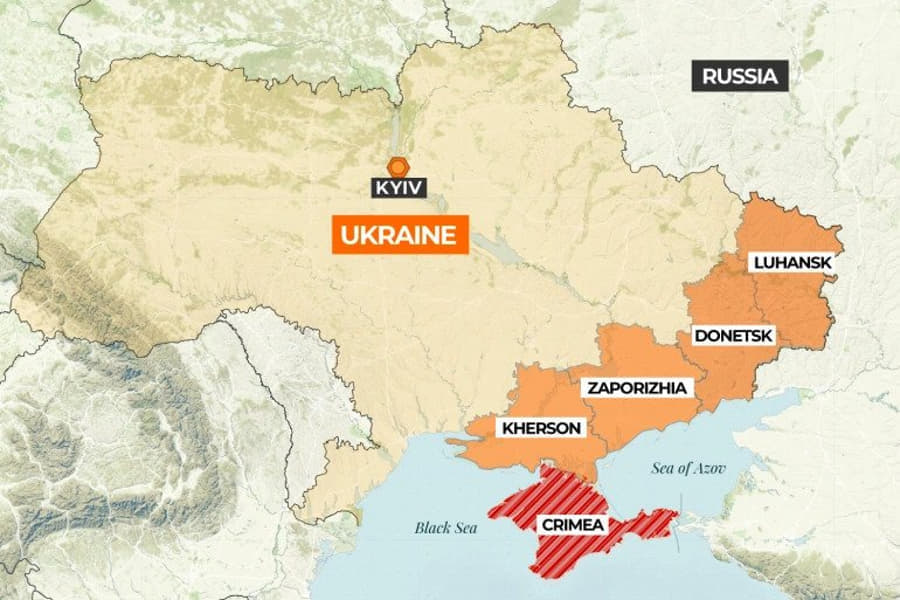
The 30% issue surrounds the Donetsk region in Ukraine, which includes the cities of Kramatorsk and Sloviansk. Russia is currently pushing deep into fortified Ukraine resistance in this region with a population of around 100,000. Zelenskyy claims losing this area would allow Putin to invade the Dnipropetrovsk, Zaporizhzhia and Kharkiv regions.

Historically, this Donbas area was part of a brutal long-term Ukraine civil war between the pro-Russia eastern Ukrainian citizens and the pro-EU western aligned Ukrainian army. Russia’s current position is for Ukraine to cede the entire Donbas to Russia as part of the ceasefire agreement, or Russia will continue forward conflict military operations until successful.

Seeing things through the pragmatic prism of inevitability, President Trump’s view appears to be that this Donbas area will be lost to Russia one way or the other. So, the best scenario to stop the killing is for Ukraine to give up this territory as part of the ceasefire terms. Zelenskyy, with support of the EU, France, Germany and U.K says a firm “no.”

Politico reports that Zelenskyy said in August of this year “it would take Russia four-years to fully occupy the Donbas,” subsequently a lot of killing would take place during this process.  President Trump is trying to stop the brutal “killing” part of that dynamic by getting the negotiation to the point of concession, but the EU team view any land area concession as positive affirmation for Russia to continue threatening Europe.

♦ On the ‘Security Guarantee‘ issue, this is where a quagmire is presented by European leaders.

From a pragmatic standpoint a European demilitarized zone, stood up and supported by EU military forces would appear to be the best solution.  However, the “coalition of the willing” say they are willing to put security troops into Ukraine, but only if the USA will defend them if attacked by Russia.  In essence, quasi-NATO forces on a non-NATO country, that if attacked would draw the entirety of NATO into the conflict, including the United States.

The U.K, France, Germany and EU Commission want a security structure similar to NATO for Ukraine that legally binds the United States to defend their interests if the ceasefire does not hold.  President Trump has rejected this construct as yet another way for Europe to pull the U.S into a conflict zone that is not in our vital national security interests.

The ceasefire proposal structured by Trump, Witkoff and Kushner – seemingly supported by Russia, does not permit Ukraine to join NATO; however, EU membership is entirely up to the EU and people of Ukraine to decide.  If Ukraine joins the EU, then EU forces alone should provide the security guarantee, not NATO which includes the U.S. and Canada.

(Washington Post) […] Zelensky said Ukraine will not surrender its territory in the eastern Donbas region — not to hasten peace talks, not to satisfy Washington’s push for compromise and not under pressure from Moscow’s continuing military onslaught.

Ukraine and Europe have insisted that a ceasefire be declared along current battle lines, but Russia has refused. Putin has claimed, illegally, to have annexed four entire regions of Ukraine (in addition to Crimea, which Russia seized in 2014) — far more territory than his military forces have been able to occupy.

Some Ukrainian officials held out hope that the negotiations could still bear fruit.

The proposal “is closer to be doable for Ukraine, but not easy and not finished,” said a senior Ukrainian official familiar with recent discussions, who spoke on the condition of anonymity because they were not authorized to comment publicly. (read more)

President Zelenskyy, whose term in office has long expired, departed London with his EU media entourage heading to Brussels.  The collective group is trying to figure out how to keep America tied to their stakeholder interests in Ukraine.

The European leaders are manufacturing a construct that is not supported by the vast majority of the citizens within the EU, even within Ukraine itself.  Meanwhile back in the USA, congress (House and Senate majorities) supports the position of Ukraine and the EU against the interests of President Trump and the voting majority.

There are trillions at stake.

The ruling class is supporting Zelenskyy, while the killing of the non-ruling class continues on the fields of Ukraine.

Following Three Days of Talks with U.S, Team Zelenskyy Heads to London for Meeting With “Coalition of the Willing”


Posted originally on CTH on December 8, 2025 | Sundance 

Following three days of negotiations in Florida (Thur, Fri, Sat) between President Trump emissaries Steve Witkoff and Jared Kushner, and Ukraine emissaries Rustem Umierov and Andrii Hnatov, the group then held a 2-hour phone call with Ukraine President Volodymyr Zelenskyy.

No substantial progress was reported.  However, military officials Umierov and Hnatov then flew to meet Zelenskyy in London where French President Emmanuel Macron, British Prime Minister Keir Starmer and German Chancellor Friedrich Merz are assembled to discuss alternatives to ending the conflict.

Starmer, Macron and Merz form the core of the “coalition of the willing,” an EU group who have unilaterally proclaimed they were willing to send the military of the U.K, France and Germany into Ukraine so long as President Trump would backstop their troops with promises of U.S. intervention if things went badly.  Trump would not make that commitment.

Zelenskyy Inc, Macron, Starmer and Merz do not want to end the proxy fight against Russia.  Together with the EU leadership of NATO, the coalition of the willing want to retain the conflict.  However, the problem for the four leaders is that without strong USA support, the citizens of their EU countries will rise up against them.

Even with NATO missiles and transferred technological assistance, they ultimately need the American military in order to ensure Putin doesn’t squish them.  President Trump wants the proxy war to end – loggerheads are reached.

Russian President Vladimir Putin does not seem to be paying too much attention to the bureaucratic speeches and instead is continuing forward advancement [SEE HERE] to secure the territory in Ukraine with or without a negotiated settlement.

The Russian Federation has presented its terms; the Russian terms for cessation are known; the rest is up to the EU, NATO, USA and Ukraine to work out.

At this point the problem is over-talking and FUBAR, or, well, a typically European situation.  So, Putin keeps going, more Ukraine troops are killed, while Putin awaits the endless conversations that he predicted would result in more endless conversations.  To be fair, Putin’s cold approach appears to be a mostly accurate interpretation of what he expected.

ZELENSKYY – “In recent days, representatives of Ukraine held substantive discussions with envoys of the US President – and now National Security and Defence Council Secretary Rustem Umierov and Chief of the General Staff Andrii Hnatov are en route to Europe. I expect detailed information from them on everything that was said to the American envoys in Moscow, and on the nuances the Americans are prepared to modify in negotiations with us and with the Russians.” (link)

By my count in the past two weeks, Witkoff and Kushner have spent nine days in direct all-day negotiations with various Ukraine officials from various institutions of Zelenskyy’s government, with a one-day trip to Moscow sandwiched between them.  Yet, western media continually proclaim the U.S. delegation of Kushner and Witkoff are ignoring the Ukrainians.

This is what I call the ‘paralysis of analysis’, or the part of every negotiation where things get so granular in detail that the larger objective is lost.

While the Ukraine team argues about whether a creek or a railroad track should determine the current point of conflict, another 250 Ukrainian soldiers have their limbs torn from their bodies and lie dead in the mud.  Today they will meet in London to argue over telephone pole ownership, while another battalion is fed to the meat grinder.

CNN frames a narrative that President Trump is unsympathetic and frustrated with Zelenskyy:

(VIA CNN) – […] Trump criticized Zelensky on Sunday after talks between US and Ukrainian negotiators over the weekend in Miami ended with unresolved questions over security guarantees, territorial issues and continued concern that the US proposal tilts in Russia’s favor.

“We’ve been speaking to [Russian] President [Vladimir] Putin and we’ve been speaking to Ukrainian leaders, including… President Zelensky, and I have to say that I’m a little bit disappointed that President Zelensky hasn’t yet read the proposal, that was as of a few hours ago,” Trump said. (more)

President Trump is reviewing the issue through the prism of “hours” because he knows that as each hour passes that’s more dead young men…. And FOR WHAT?

Meanwhile, Volodymyr Zelenskyy is traveling around Europe stopping for tea and crumpets with Macron, Starmer and Merz in London today.  Think about the upside-down priorities here.

Bread and Circuses – With Servants Patiently Waiting (Dec 6, 2025)

[SOURCE]

[If you think I’m not being fair to Ukraine, just go scroll Zelenskyy’s Twitter feed]

President Trump’s 2025 National Security Strategy – Europe Is Destroying Itself


Posted originally on CTH on December 6, 2025 | Sundance

President Trump’s 2025 National Security Strategy is outlined in a detailed 33-page report.

In addition to setting the priorities for the United States focus, the report details the Trump administration perspective on the world as broken down into specific regions.  The report is a brutally honest review of the current state of geopolitical benefits, risks and threats as they pertain to vital U.S. interests.

[Full pdf Here]

In addition to outlining a critically renewed focus on the Western Hemisphere, the Trump administration also notes the practical position of Europe, as it pertains to NATO and dependency on the U.S.A.

In a brutally honest review of the situation, the Trump administration notes Europe is increasingly losing their own identity.  The fear the Europeans express about being vulnerable to Russian strength is hypocritical, in the sense that in practical outcomes the EU is purposefully weakening itself and simultaneously demanding assistance against their own weakness.

[PAGE 25] – American officials have become used to thinking about European problems in terms of insufficient military spending and economic stagnation. There is truth to this, but Europe’s real problems are even deeper.

Continental Europe has been losing share of global GDP—down from 25 percent in 1990 to 14 percent today—partly owing to national and transnational regulations that undermine creativity and industriousness. But this economic decline is eclipsed by the real and more stark prospect of civilizational erasure.

The larger issues facing Europe include activities of the European Union and other transnational bodies that undermine political liberty and sovereignty, migration policies that are transforming the continent and creating strife, censorship of free speech and suppression of political opposition, cratering birthrates, and loss of national identities and self-confidence.

Should present trends continue, the continent will be unrecognizable in 20 years or less. As such, it is far from obvious whether certain European countries will have economies and militaries strong enough to remain reliable allies. Many of these nations are currently doubling down on their present path. We want Europe to remain European, to regain its civilizational self-confidence, and to abandon its failed focus on regulatory suffocation.

This lack of self-confidence is most evident in Europe’s relationship with Russia.

European allies enjoy a significant hard power advantage over Russia by almost every measure, save nuclear weapons. As a result of Russia’s war in Ukraine, European relations with Russia are now deeply attenuated, and many Europeans regard Russia as an existential threat.

Managing European relations with Russia will require significant U.S. diplomatic engagement, both to reestablish conditions of strategic stability across the Eurasian landmass, and to mitigate the risk of conflict between Russia and European states.

It is a core interest of the United States to negotiate an expeditious cessation of hostilities in Ukraine, in order to stabilize European economies, prevent unintended escalation or expansion of the war, and reestablish strategic stability with Russia, as well as to enable the post-hostilities reconstruction of Ukraine to enable its survival as a viable state.

The Ukraine War has had the perverse effect of increasing Europe’s, especially Germany’s, external dependencies. Today, German chemical companies are building some of the world’s largest processing plants in China, using Russian gas that they cannot obtain at home.

The Trump Administration finds itself at odds with European officials who hold unrealistic expectations for the war perched in unstable minority governments, many of which trample on basic principles of democracy to suppress opposition. A large European majority wants peace, yet that desire is not translated into policy, in large measure because of those governments’ subversion of democratic processes. This is strategically important to the United States precisely because European states cannot reform themselves if they are trapped in political crisis.

Yet Europe remains strategically and culturally vital to the United States. Transatlantic trade remains one of the pillars of the global economy and of American prosperity. European sectors from manufacturing to technology to
energy remain among the world’s most robust. Europe is home to cutting-edge scientific research and world-leading cultural institutions. Not only can we not afford to write Europe off—doing so would be self-defeating for what this strategy aims to achieve.

American diplomacy should continue to stand up for genuine democracy, freedom of expression, and unapologetic celebrations of European nations’ individual character and history. America encourages its political allies in Europe to promote this revival of spirit, and the growing influence of patriotic European parties indeed gives cause for great optimism.

Our goal should be to help Europe correct its current trajectory. We will need a strong Europe to help us successfully compete, and to work in concert with us to prevent any adversary from dominating Europe.

America is, understandably, sentimentally attached to the European continent — and, of course, to Britain and Ireland. The character of these countries is also strategically important because we count upon creative, capable, confident, democratic allies to establish conditions of stability and security. We want to work with aligned countries that want to restore their former greatness. (continue reading)

Russian Federation President Vladimir Putin does not see a strong Europe; instead, he sees a continent destroying itself and creating vulnerabilities that can easily be exploited.

President Trump is attempting to stop the inevitable conclusion, the outcome created throughout history, when a strong nation state is positioned right next to a vulnerable, fat, lazy and weak-minded coalition of states.

Europe would be wise to listen to President Trump now, because the American people are not willing to put our blood on the line again to protect the EU – ultimately from itself.

A Welcome Perspective Change Within U.S. State Department


Posted originally on CTH on December 6, 2025 | Sundance 

Deputy Secretary of State Chris Landau presents a well-articulated change in perspective from the U.S. State Department.  The response comes following the EU decision to levy a compliance fine against the social media platform X.

[SOURCE]

What Christopher Landau notes as the contrast and conflict in ideological priority from the EU can just as easily be applied to the USA dynamic with Canada.  As noted by Twitter user John Frank“The same observations can easily apply to the relations with Canada, given the divergence between the US role in the military alliance with Canada, while Canada is involved in activities which work against US interests.

At a certain point it does become necessary to distinguish exactly what values, benefits, perspectives and priorities frame the positions that determine who our U.S. allies really are, and who should benefit from that relationship.

It is good to see a structurally different perspective from the U.S. State Department that puts a bold underline under the term “western alliances.”  What values are those alliances based on?

The Money Phase – Emissary Witkoff Updates on Ukraine/Russia Peace Negotiations


Posted originally on CTH on December 6, 2025 | Sundance

If we read between the lines in the latest update from President Trump emissary Steve Witkoff, we can clearly see the negotiations have entered into that critical phase where payments to all of the stakeholders will determine a successful outcome.

Pragmatic people have long predicted the ultimate solution to the bloodshed will only be determined once western interests get to the point where negotiators propose a long-term plan for continued financial benefit.  Too many people, “stakeholders” are making money from the conflict.

From a western perspective, support for the Ukraine conflict is based on money. Therefore, the solution to the conflict requires a system where the western opportunity for financial benefit continues.

Written in polite diplomatic terms, the continued payments are identified as “the prosperity agenda which aims to support Ukraine’s post-war reconstruction, joint U.S.–Ukraine economic initiatives, and long-term recovery projects.” This is codespeak for the U.S. Senate and EU will retain a financial mechanism to exploit for personal benefit.

From the language it appears that Witkoff and Kusher are confident they can construct a financial reward system for western banks, investors, politicians and Ukraine officials that will retain the benefits of war without the ancillary ingredient of bloodshed.

If the U.S. delegation can pull this off, then Russia can gain the territory they want, corrupt Ukraine officials can keep skimming investment money, the EU can retain the power it wants to extract financial payments, American politicians can use the “long-term recovery projects” for money laundering and quasi-public/private investment banks can benefit from the exploitation of Ukraine resources.

Again, from a ‘western geopolitical perspective’, the territorial issues, security guarantees, EU membership status and the position of NATO are downstream details once the larger payment system is organized.  Put another way, they are down to the stuff that really matters, the money.

STEVE WITKOFF – Readout of Meeting Between Special Envoy for Peace Steven Witkoff, Jared Kushner, Ukrainian Secretary of National Security and Defense Council Rustem Umerov, and Chief of General Staff General Andriy Hnatov

Over two days, Special Envoy for Peace Steven Witkoff and Jared Kushner met with Ukrainian Secretary of National Security and Defense Council Rustem Umerov and Chief of General Staff General Andriy Hnatov for constructive discussions on advancing a credible pathway toward a durable and just peace in Ukraine.

Today, the group had their sixth meeting over the past two weeks. Secretary Umerov reaffirmed that Ukraine’s priority is securing a settlement that protects its independence and sovereignty, ensures the safety of Ukrainians, and provides a stable foundation for a prosperous democratic future.

The participants discussed the results of recent meeting of the American side with the Russians and steps that could lead to ending this war. The American and Ukrainians also agreed on the framework of security arrangements and discussed necessary deterrence capabilities to sustain a lasting peace.

Both parties agreed that real progress toward any agreement depends on Russia’s readiness to show serious commitment to long-term peace, including steps toward de-escalation and cessation of killings.

Parties also separately reviewed the future prosperity agenda which aims to support Ukraine’s post-war reconstruction, joint U.S.–Ukraine economic initiatives, and long-term recovery projects.

American and Ukrainian parties underscored that an end to the war and credible steps toward ceasefire and de-escalation are necessary to prevent renewed aggression and to enable Ukraine’s comprehensive redevelopment plan, designed to make the nation stronger and more prosperous than before the war.

Parties will reconvene tomorrow to continue advancing the discussions.” (source)

From the Russian side of the equation the war is about ideology, national security and proactive defeat of western, mostly American, encroachment and influence.  From the western side, the EU support for Ukraine was less ideological and more financially motivated.

Russia and Ukraine have paid a high price in the larger proxy war.  Russia has won the physical fight.  Hopefully soon the financial terms will be accepted by the western stakeholders and combat operations can cease.

Ukraine President Zelenskyy will get a nice villa in Europe and a reasonable mansion in the USA.  The cocktail parties will continue with crustless cucumber sandwiches and white wine spritzers, while the ladies go shopping and the men get manicures while talking about which of their favorites will replace Zelenskyy.

European Union Fines X (Twitter) $140 Million for Violations of Europe’s Digital Services Act


Posted originally on CTH on December 5, 2025 | Sundance 

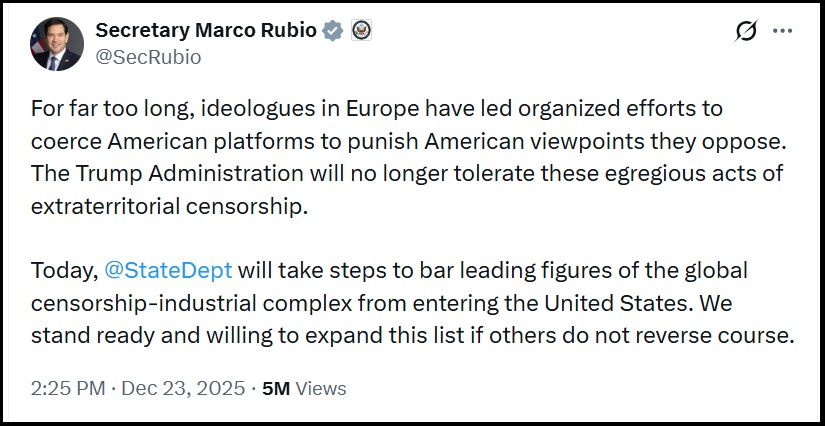
The European Union has fined the X social media platform (formerly Twitter), owned by Elon Musk and his investment group, $140 million (usd) for violations of the EU Digital Services Act.  The decision by the EU is likely to create even more friction between President Trump and the European Union.  However, this problem is not difficult to solve.

The collective government within the EU accuse Elon Musk and X of permitting misinformation, disinformation and malinformation to appear on the platform.

The European DSA is ultimately designed to control information, that reality should not be debated. All efforts to control traditional and social media are efforts to control information.

The specifics of the reasoning for the fine are typically European.  (1) Twitter allows ordinary people to deliver information at the same level as people who should be defined as more important.  (2)  Advertisers of those who pay for promotion of information on X are not easily identifiable – people need to figure it out on their own.  (3)  It is too difficult to figure out who is providing the information.

Basically, all of the EU concerns center around information control.  It’s really an ideology issue.  In the outlook of the EU, bureaucrats and elites feel they are superior and must rule/protect the people under them.  Ordinary people having access to information that may or may not be approved by the EU is the underlying issue.

EUROPE – […] Before Musk acquired X, when it was previously known as Twitter, the checkmarks mirrored verification badges common on social media and were largely reserved for celebrities, politicians and other influential accounts, such as Beyonce, Pope Francis, writer Neil Gaiman and rapper Lil Nas X.

After he bought it in 2022, the site started issuing the badges to anyone who wanted to pay $8 per month.

That means X does not meaningfully verify who’s behind the account, “making it difficult for users to judge the authenticity of accounts and content they engage with,” the Commission said in its announcement.

X also fell short of the transparency requirements for its ad database, regulators said.

Platforms in the EU are required to provide a database of all the digital advertisements they have carried, with details such as who paid for them and the intended audience, to help researches detect scams, fake ads and coordinated influence campaigns. But X’s database, the Commission said, is undermined by design features and access barriers such as “excessive delays in processing.”

Regulators also said X also puts up “unnecessary barriers” for researchers trying to access public data, which stymies research into systemic risks that European users face.

“Deceiving users with blue checkmarks, obscuring information on ads and shutting out researchers have no place online in the EU. The DSA protects users,” Henna Virkkunen, the EU’s executive vice-president for tech sovereignty, security and democracy, said in a prepared statement. (more)

Stopping this nonsense is not complicated.

Attach a $1,000 free speech support fee to every European automobile sold in the USA.

Their pontificating ideology is less important than their need for money.

Secretary of State Marco Rubio Discusses Immigration Vetting, Venezuela Situation and Ukraine-Russia Conflict


Posted originally on CTH on December 3, 2025 | Sundance

Secretary of State and National Security Advisor Marco Rubio appears on Fox News for an extensive interview about current events. Within the interview Secretary Rubio discusses the current status of immigration vetting and the pause therein.

Additionally, Rubio outlines the current state of the U.S. operation in/around Venezuela and the ongoing negotiations with Ukraine and Russia to end the conflict in Eastern Europe. WATCH:

.

Rubio, Witkoff and Kushner Meet Ukraine Officials in Florida for Discussion of Terms Before Witkoff Returns to Moscow Tuesday


Posted originally on CTH on December 1, 2025 | Sundance

On Sunday, Secretary of State Marco Rubio, Trump emissaries Steve Witkoff and Jared Kushner met with the Ukraine negotiating team in Florida to further discuss acceptable terms for a broader ceasefire and end to the war.

Still trying to recover from corruption charges against his senior presidential team, Volodymyr Zelenskyy was not at the talks. Instead, the Ukraine delegation was led by State Security Council Secretary Rustem Umerov, while Zelenskyy went to Paris for an emotional support session with Emmanuel Macron.

Secretary Rubio and Secretary Umerov spoke before and after their 5-hour negotiation session.  Secretary Rubio emphasized the main topic as securing the long-term future of Ukraine both from a security position and from an economic prosperity position.

This state security aspect comes as the Ukraine delegation is facing pressure to accept, they will lose most -if not all- of the Donbas region to Russia. “The end goal is obviously not just the end of the war. Obviously, that’s central and fundamental,” Rubio said. “It’s also about securing an end to the war that leaves Ukraine sovereign and independent and with an opportunity at real prosperity.”

In better-than-expected news, the EU is now saying they will not comply with any removal of sanctions against Russia.  If the U.S-Russia and Ukraine work out a negotiated settlement that permits legal or economic relief for Vladimir Putin, the European Union will not agree and will instead make up their own decision on the issues.

Europe is holding this position as a threat, because President Trump is not fully consulting with them on all the granular details.  However, this is the type of threat that is exactly beneficial to what appears to be the long-term strategy of Trump.

If Europe refuses to remove sanctions or legal threats against Russia, but the U.S. negotiates the removal of U.S treasury and financial sanctions against Russia, then the Europeans have chosen to stay behind the locked door of economic benefit. More than two-thirds of the world does not participate in the sanctions at all.

If Europe and Canada continue blacklisting Russia, the U.S-Russia energy development program gains exclusive benefits to Trump, Putin and other allies like Mohammed bin Salmon (Saudi Arabia), ASEAN nations and even Japan.

In very practical terms, someone like Viktor Orban (Hungary) would like nothing more than to violate ongoing Brussels sanctions against Russia, and as a consequence create a fracture point for European Union exit.

In practical terms, what would this look like?  Well, the entire world would have lower energy prices, lower oil and natural gas prices, and lower gasoline prices by big margins.  Meanwhile, Europe would have a massive disparity in their much higher energy costs – likely double the rest of the world.   Think about the ramifications.  Hungary, Georgia, Montenegro, and Serbia with 50% lower prices on gasoline and electricity than the EU.  lolol  It would be funny.

Unfortunately, with this in mind I find the EU threats hollow.  As soon as the U.S-Russia-Ukraine work out a peace and security agreement, Europe will comply with whatever terms are negotiated for Russia.  Failure to do so only isolates the Europeans and will create a problem amid their collective mindsets.

(Via Axios) Negotiations between the U.S. and Ukraine on Sunday focused on where the de facto border with Russia would be drawn under a peace deal, two Ukrainian officials tell Axios. They described the five-hour meeting as “difficult” and “intense,” but productive.

Why it matters: Russian President Vladimir Putin — who’s expected to meet with President Trump’s envoy on Tuesday — insists Russia won’t stop until it controls the entire Donbas region in eastern Ukraine.

After an hour in a wider format, the meeting narrowed to three officials from each side — with the line of territorial control virtually the only issue discussed, according to the two Ukrainian officials.

On the U.S. side were Witkoff, Secretary of State Marco Rubio and Trump’s adviser and son-in-law Jared Kushner. The Ukrainian side was represented by national security adviser Rustem Umerov, military chief of staff Gen. Andrii Hnatov and deputy head of military intelligence Vadym Skibitskyi.

After the talks with their teams ended, Umerov held another one-on-one meeting with Witkoff. Umerov then called Ukrainian President Volodymyr Zelensky to brief him on the talks.

“It was intense but not negative. We really appreciate serious U.S. engagement. Our position is that we have to make everything to help U.S. succeed without losing our country and preventing another aggression from happening,” one of the Ukrainian officials wrote to Axios after the meeting.

Between the lines: Ukrainian President Volodymyr Zelensky had wanted to discuss territory directly with Trump, but Trump said he’d only meet Zelensky or Putin again once a deal is close.

Umerov is expected to meet Zelensky in Paris on Monday and give him a more detailed report about the negotiations, Ukrainian officials say.

Witkoff plans to depart for Moscow on Monday and meet Putin on Tuesday.

“The main question is where the Russians stand and if their intentions are real. Let’s see what Witkoff brings from Moscow,” a Ukrainian official said. (more)

Sunday Talks: Secretary Scott Bessent -vs- Kirsten Welker


Posted originally on CTH on November 23, 2025 | Sundance 

Treasury Secretary Scott Bessent appears on Meet the Press to debate Kirsten Welker’s formatted corporate media talking points.  The source of most American division is found in the behavior of the media.

Video and Transcript Below:

[TRANSCRIPT] – KRISTEN WELKER: And joining me now is Treasury Secretary Scott Bessent. Secretary Bessent, welcome back to Meet the Press.

Good to see you this morning, Senator.

SEN. MARK WARNER (D-VA), INTELLIGENCE COMMITTEE VICE CHAIR: Good morning, Martha.

RADDATZ: What is your reaction to this peace proposal that is on the table?

WARNER: My reaction is it’s awful. It would make Neville Chamberlain’s giving in to Hitler outside of World War II looks strong in comparison. The fact that this was almost a series of Russian talking points, would require Ukraine to give the — totality of the Donbas, parts they still control, cut back their military forces going forward, never be able to join NATO.

This would be a complete capitulation. And it’s why I think you’re hearing from Congress, both sides, people pushing back. And, obviously, the Europeans feel like they’ve been totally left high and dry.

MARTHA RADDATZ, ABC “THIS WEEK” CO-ANCHOR: You’ve heard the deadline from President Trump, but then him saying that’s not — there’s room for negotiation here, it seems like. So, what do you think happens after today (ph)?

WARNER: I think what happens — it feels like this was a plan that they took almost entirely from the Russians, did no consultation with Congress, no consultation with the Europeans, obviously didn’t read in Zelenskyy and the Ukrainians, and now they’re getting ferocious pushback. So, one more time, Trump is changing his deadline.

Of course, how he picked Thanksgiving to start with, I have no idea. But now it — even with this — some of this back and forth that it’s not really an American plan, or isn’t an American plan, this is the kind of chaos that, unfortunately, represents so much of the Trump foreign policy.

RADDATZ: So, what do you think President Zelenskyy should do? He’s been through this before. It’s kind of back and forth with this White House. They support you. They pull it back. Do you think all of this, this proposal, which seems to heavily favor Russia, is that just a starting point again?

WARNER: Well, I would hope — I would hope so. Again, the Ukrainians have performed magnificently in the field. And they are reinventing the nature of warfare in terms of use — use of drones. To have this proposal forced upon them, I think as Zelenskyy said, Ukrainian dignity versus giving up a partner, I would hope the president would not be so weak as to try to force this plan on the Ukrainian and our other allies. It would, I think, send not only a horrible signal for Europe, but the person who’s watching this probably the most closely is President Xi in China. And if the Americans are willing to throw in their towel so much like this on Ukraine, you can bet that Xi is thinking, this gives him a clearer path in terms of taking Taiwan.

RADDATZ: But what does Zelenskyy do here? If on Thursday the president says, I’m telling you right now, take what we’ve got on the table and — and there will probably be some changes, or we’re done. What — what does Zelenskyy do, just hope that Europe rises and helps him out?

WARNER: Well, let’s — let’s, again, you have overwhelming support still for Ukraine. The last Ukraine aid package had 80 percent of the Congress. I think the president is seeing this one-sided plan kind of blow up in his face with pushback from the Ukrainians, from the Europeans, from members of Congress of his own party. And my hope is, he’ll come back and be a bit more reasonable.

RADDATZ: I want to turn to Venezuela. We’re all watching that this week. What can you tell us about what you think happens now. We’ve got this massive buildup. We’ve got this massive show of force. We have airline who aren’t — that aren’t flying there because of all the activity and the military activity right now.

Do you expect something more to happen?

WARNER: Well, historically, the United States’ intervention in Central America or South America has not always rolled out the way we’d hope. Maduro was a bad guy, frankly, under Biden. When the Venezuelan people voted in overwhelming numbers, Biden should have put more pressure on getting Maduro out then. It was a mistake.

But now, to have this much armed forces, we have not been briefed on any military action that would have been authorized. He keeps putting the word out that maybe he has authorized, maybe he’s not. We are trying to get the answer on that. But there is a real question. You know, to take this big a fleet, bring our largest aircraft carrier, put them there to further blow up boats that they claim have drugs on them, frankly they could have interdicted some of those boats and shown the world that there were drugs.

In terms of Venezuela, the legal opinion about the drug run — drug running doesn’t touch Venezuela at all. So, the president would have to come back and brief us.

RADDATZ: Trump says he’ll be speaking with Venezuelan President Nicolas Maduro. Do you think that is a good idea? And what can you say to him?

WARNER: Because I think the notion that Trump says he’ll talk to anyone, I think that is — I’m not going to critique him on that, if there’s a way to push Maduro out. Remember, our government and fifty other governments, almost all of Western Europe, don’t recognize the Maduro government as legitimate. But it does not feel like there is an organized plan. And coming down again, America only, without any of our other allies in South America or Central America again seems not the right approach to me.

RADDATZ: What could happen short of a show of force? When you have that massive a show of force, it’s almost like, you’re in a position where you have to do something or you might look weak. Short of Maduro saying, OK, I’ll leave, then what does he do?

WARNER: Well, again, that’s the million-dollar question. And as you know, when you’ve got this many forces down there, and you can’t keep the carrier positioned there forever, you also have the chance of an accident happening or a conflict between the Venezuelan air force or some of our planes that might —

RADDATZ: Do you think he wants to go to war with Venezuela? Do you think he wants (INAUDIBLE) —

WARNER: I don’t know. I don’t know. I think he is trying to put outside pressure on Maduro. But by doing it in this kind of America only approach, again without giving any sign to, I think, even his — the Republicans on The Hill what his plans are, I’m not sure is the right way to do foreign policy. You couple this Venezuela misadventure with this desertion of Ukraine and this is not making America safer, and it’s sure not putting America first.

RADDATZ: Thanks very much for joining us, Senator. Always appreciate it.

[End Transcript]