Global Debt Reaches 326% of GDP


Posted originally on Jan 30, 2025 by Martin Armstrong |
Socrates Monetary Crisis Sov Debt

Total global debt has peaked to 326% of global GDP, adding an additional $12 trillion of debt in the last three quarters of 2024, according to the Institute of International Finance. This figure surpasses what we saw amid the pandemic and is expected to continually rise and governments continue to borrow with no intention of repayment.

The Big Bang of the sovereign debt crisis began in 2015.75, as indicated by the computers, around the introduction of negative rates and Quotative Easing, which shifted the risk from the free market to the central banks. The 2015.75 date was also 26 years from the first break in Marxism in 1989. The bottom of the ECM from 2015.75 to 2020.05 was also 31.4 years from the start of the fall of communism that culminated in the final stages of the collapse of socialism. I repeatedly warned that our models indicated the banks would become trapped by these policies and now we have a completely unsustainable situation.

If interest rates rise, their portfolios crash in value (price). Such an outcome would raise the question of will the private sector return to the government bond markets when they see there is a rising risk factor? Our model showed that this would not be the case. In other words, the Sovereign Debt Crisis has taken place and to prevent the PRICE crash, the central banks became the buyer to hold interest rates down and bond prices up. We have seen governments and institutions offload bonds and government debt since the Big Bang.
Emerging Market Debt

Emerging markets have reached 245% of GDP in debt, totaling $105 trillion. Poor nations are now spending more on their debt than infrastructure, health care, or education. These nations cannot afford to simply not repay and multilateral development banks have turned into lenders of last resort.

ALL government debt is in serious trouble because they just never fund a damn thing. The solution is to always borrow and there is no plan to ever pay anything back. The behind the curtain reasoning is they are burning money for fuel because they are always reducing the value of prior debt that is never indexed to inflation.

We have seen larger economies begin the snowball effect of borrowing after World War II and the repercussions are now arising. Now we have a serious crisis that has shifted from the free trading bond markets exclusively to the central banks. This is part of the crisis unfolding in the repo market. There does not appear to be any recovery on the horizon. Politicians are undermining the confidence in government, to begin with, and that will influence bond buyers.

The astounding debt crisis has fanned the flames of war as initiating a global conflict is a way, politicians believe, to continue delaying debt payments. The majority of nations are simply too far gone in debt to ever properly repay. Who would buy if there is no guaranteed return?

Total global government debt is now $98,000,000,000,000 ($98 trillion) and is forecast to reach $130 trillion by 2028, which is also when the computer has predicted that the world will feel the aftershocks of a global recession.

Socrates Monetary Crisis Sov Debt

Total global debt has peaked to 326% of global GDP, adding an additional $12 trillion of debt in the last three quarters of 2024, according to the Institute of International Finance. This figure surpasses what we saw amid the pandemic and is expected to continually rise and governments continue to borrow with no intention of repayment.

The Big Bang of the sovereign debt crisis began in 2015.75, as indicated by the computers, around the introduction of negative rates and Quotative Easing, which shifted the risk from the free market to the central banks. The 2015.75 date was also 26 years from the first break in Marxism in 1989. The bottom of the ECM from 2015.75 to 2020.05 was also 31.4 years from the start of the fall of communism that culminated in the final stages of the collapse of socialism. I repeatedly warned that our models indicated the banks would become trapped by these policies and now we have a completely unsustainable situation.

If interest rates rise, their portfolios crash in value (price). Such an outcome would raise the question of will the private sector return to the government bond markets when they see there is a rising risk factor? Our model showed that this would not be the case. In other words, the Sovereign Debt Crisis has taken place and to prevent the PRICE crash, the central banks became the buyer to hold interest rates down and bond prices up. We have seen governments and institutions offload bonds and government debt since the Big Bang.

Emerging Market Debt

Emerging markets have reached 245% of GDP in debt, totaling $105 trillion. Poor nations are now spending more on their debt than infrastructure, health care, or education. These nations cannot afford to simply not repay and multilateral development banks have turned into lenders of last resort.

ALL government debt is in serious trouble because they just never fund a damn thing. The solution is to always borrow and there is no plan to ever pay anything back. The behind the curtain reasoning is they are burning money for fuel because they are always reducing the value of prior debt that is never indexed to inflation.

We have seen larger economies begin the snowball effect of borrowing after World War II and the repercussions are now arising. Now we have a serious crisis that has shifted from the free trading bond markets exclusively to the central banks. This is part of the crisis unfolding in the repo market. There does not appear to be any recovery on the horizon. Politicians are undermining the confidence in government, to begin with, and that will influence bond buyers.

The astounding debt crisis has fanned the flames of war as initiating a global conflict is a way, politicians believe, to continue delaying debt payments. The majority of nations are simply too far gone in debt to ever properly repay. Who would buy if there is no guaranteed return?

Total global government debt is now $98,000,000,000,000 ($98 trillion) and is forecast to reach $130 trillion by 2028, which is also when the computer has predicted that the world will feel the aftershocks of a global recession.
Trump’s Federal Freeze – Shrinking the Public Sector


Posted originally on Jan 30, 2025 by Martin Armstrong 

Armstrong on Government

President Donald Trump implemented a widespread freeze on federal loans and grants, ordering all agencies this week to “temporarily pause all activities related to obligation or disbursement of all Federal financial assistance.” He was forced to back off after a federal judge halted some of the freeze. The public sector has been multiplying in recent years to the point that there are thousands of agencies whose true purpose are unknown. While many view the act as extreme, public sector growth has become detrimental to our economy and one must determine what exactly the government is funding.

As Adam Smith wrote in “Wealth of Nations”:

“Like an improvident spendthrift, whose pressing occasions will not allow him to wait for the regular payment of his revenue, the state is in the constant practice of borrowing of its own factors and agents, and of paying interest for the use of its own money.”

The wealth of a nation is composed of more than money or gold, for the original idea of “money” did not embrace the concept of true wealth. Money is merely our mental measure of wealth. Cultures in different parts of the world all conceive of money but it is merely how they measure this universal concept of wealth.

There is only one constant and that is the greater the size of government, the lower the production of national wealth. Therefore, the higher the percentage of a nation’s work force is employed by the public sector, the lower its real national product. We saw this in Argentina as of late. Of course, government wishes to include itself in the GDP calculation and it counts government workers twice in many countries. It adds total government spending and adds that to total personal income. By doing this they count all government employees twice for they do not back it out of the total government spending. So we have bogus statistics in GDP as well for the economy appears better when government hires rather than the public sector. That is why we will see unemployment rise under Trump but in all actuality that figure will not be indicative of the overall health of our economy.

Now, Trump specifically is asking for more information on 2,600 programs to determine their legitimacy. Biden implemented a slew of DEI iniatives and programs that do nothing but TAKE from our economy. The Office of Management and Budget (OMB) sent the aforementioned companies the following questions:

  • Does this program provide funding that is implicated by the directive to end discriminatory programs, including illegal DEI and “diversity, equity, inclusion, and accessibility” (DEIA) mandates, policies, programs, preferences, and activities, under whatever name they appear, or other directives in the same EO, including those related to “environmental justice” programs or “equity-related” grants?
  • Does this program promote gender ideology?
  • Does this program promote or support in any way abortion or other related activities identified in the Hyde Amendment?

“It means no more funding for the green new scam that has cost American taxpayers tens of billions of dollars,” White House press secretary Karoline Leavitt said Tuesday at her first news briefing. “It means no more funding for transgenderism and wokeness across our federal bureaucracy and agencies.” The new press secretary, who actually responds to questions, said it is “the responsibility of this president and this administration to be good stewards of taxpayer dollars.” Welfare aid programs are not vanishing, rather, the government is reevaluating its spending to best direct dollars.

Organizations promoting woke gender ideology, DEI, and the green new deal will be the first to go but a significant cut is needed to restore some order. The fear mongering about Trump eliminating Medicaid and food assistance programs are unfounded. The new administration must determine what agencies are legitimate and eliminating services that do not add to our society in any meaningful way is the first step.

Argentina is an excellent example of how quickly an economy can recover when we remove socialistic programs. There were 341,477 people in the public sector on government payroll when President Milei took office, and his aim is to eliminate 70,000 needless positions. From December 2023 to October 2024, Argentina reduced the national administration was reduced by 10% and state-run firms decreased by 12.6%. Reducing the national administration alone saved the government $3.82 billion in the short-term, not accounting for future payouts, additional staffing, or pensions. Yet he began by eliminating services that were simply unnecessary.

Milei.PublicSector

Milei first eliminated useless agencies such as the Ministry of Culture, Ministry of Health, Ministry of Labor, and Ministry of Social Development. In his words, Argentina WAS a poor country that could not afford these departments that do absolutely nothing to improve the nation’s economic conditions. No one noticed when he reduced the cabinet by 50%, but the economy certainly took note and posted its first budget surplus in 123 years this December.

“The deficit was the root of all our evils — without it, there’s no debt, no emission, no inflation. Today, we have a sustained fiscal surplus, free of default, for the first time in 123 years. This historic achievement came from the greatest adjustment in history and reducing monetary emission to zero. A year ago, a degenerate printed 13% of GDP to win an election, fueling inflation. Today, monetary emission is a thing of the past,” Milei proudly announced.

Yes, other factors contributed to Argentina’s recent success, but moving away from socialism and ever-growing social programs was paramount. Socialism NEVER works but world leaders refuse to learn from the past.

Under Biden, we saw manufacturing flee the US. The jobs reports often looked promising but they failed to recognize the rising public sector that can never contribute to GDP. We have seen what happens when governments grow to disproportionate figures and it never ends well. The longest reigning empire, the Roman Empire, fell as a direct result of an oversized public sector that bankrupted Rome. The private sector produces economic growth, while government is a public servant consuming the wealth generated by others.

Deep State

The Deep State is more than a swamp; it is an ocean. It is so deeply rooted that I wish Trump all the best, but I am not sure he will be able to root out the core corruption. That will probably take a sovereign default, and history warns that a revolution will often follow. This time, the government is entrenched in bribing the people to retain power, giving them free food and circuses, and they will be the government alone, as they used to say in Rome.

Should the Feds Lower Rates?


Posted originally on Jan 27, 2025 by Martin Armstrong 

FederalReserve 1

Federal Reserve Chairman Jerome Powell and Donald Trump face off once again. The two have notoriously butted heads over interest rates, as Trump has accused the Fed of stifling economic growth by raising the cost of borrowing. Speaking at Davos, the president said he would “demand that interest rates drop immediately.”

We all know the Federal Reserve is independent and the White House cannot dictate interest rates. Lowering interest rates does not stimulate the economy, contradictory to the common belief that reducing rates will boost economic growth. The outdated understanding based on Keynesian Economics states that an increase in the supply of money MUST be inflationary. The Fed raises rates to reduce consumption and lowers rates to stimulate consumption.

It’s a very nice theory, but when actually tested, it utterly fails. Lower rates will NEVER cause people to invest until they believe that there is an opportunity to invest. We are watching the big players withdraw from equities, let alone government debt. We are in a private wave where money is running off the grid at a rapid pace.

Once upon a time, you could not borrow against government debt. Thus, it was deemed non-inflationary as long as it could not be used as money. Today, you post bills as collateral to trade futures. The old theories no longer exist in this new, strange world we live in. Hence, all the QE was merely swapping the debt for cash.

Every fiscal policy in recent years has exacerbated inflation and the Fed cannot keep up with government spending. QE FAILED. The artificially low interest rates of the recent past were completely unsustainable and relied on outdated theories.

The most significant issues facing our economy are simply out of the Fed’s hands: war, taxation, and government spending. Chairman Jerome Powell surprised everyone when he called spending under the Biden-Harris administration “unsustainable” and warned that it would hurt generations to come. While not a direct criticism, Powell issued a stark warning that aligned with our Revolution Cycle of 72 years. In 1951, the central bank defied the US government by refusing to purchase debt to prevent rate hikes amid the Korean War. The minutes reports always mention that the central bank is keenly monitoring geopolitical events as it must look at all variables from a global standpoint.

The issue of increasing sanctions on Russia, and the rest of the world for that matter, may raise inflationary fears and push long-term rates higher. Then we are looking at the risk of Japan, who holds the bulk of US debt, experiencing a sovereign default in a contagion that will spread to Europe.

We may see the Fed pull back rates this year. Powell understands that Keynesian policies no longer work and raising rates have no effect on inflation. Interest rates are really the price of money in anticipation of future inflation.

Office of Management & Budget Dir. Confirmation Hearing


Posted originally on Rumble By Bannons War Room on: Jan 22, 2025 at 10:10 am EST

Ep 3550a – Yellen’s Computer Was Hacked, The Call To Audit The Fed Is Getting Louder


Posted originally on Rumble By X 22 Report on: Jan 18, 2025 at 4:30 pm EST

Interview: Is Democracy Failing? The West’s New Era of Cold War Propaganda (Commodity Culture -Part 1)


Posted originally on Jan 19, 2025 by Martin Armstrong 

It’s Always the Currency vs Investment


Posted originally on Jan 18, 2025 by Martin Armstrong 

Confused Man

QUESTION: On Friday, the UK FTSE and DAX closed at new all-time highs, so clearly money is flowing into these indices yet euros and Pounds seem to be flying out the door as they prepare for lower lows and thus this seem confusing.  Added to the confusion is that Europe is where the sovereign debt crisis SDC) is likely to begin, so why is capital flowing into these markets?  I suppose better to hold UK or German equities vs. their sovereign debt and thus will those equity markets continue to rally during the SDC?

SR

International Value

ANSWER: A number of questions have been coming in about the European markets. Keep in mind that we are in the throes of geopolitical and political upheavals, not to mention the entry of Trump and his old-school nonsense about lowering the dollar to sell more stuff overseas and imposing tariffs. Those ideas I have dealt with constantly over the course of the past few decades. It is confusing without question. The press does not understand currency, not even those in government. Absolutely everything has an international value, and this has led to the overwhelming majority getting things wrong. Many ask why mainstream media will not interview me on such important topics as this. The reason is simply – it is too confusing for them as well.

Ferarri Trade

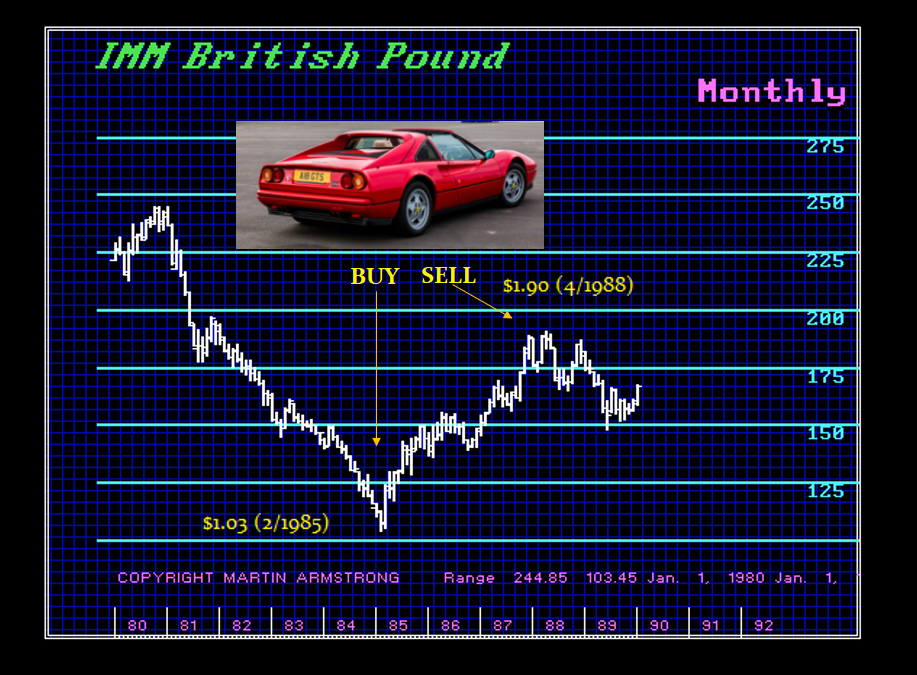
I have told the story at conferences about my Ferarri Trade and how I bought a 308 Ferrari when I lived in London in 1985 when the British pound fell to $1.03. The Italians were getting $60,000 for the car in the States back then. It was still priced in pounds when the pound used to be $2.40. I bought the car for about $35,000 when converted. The Italians could no longer sell these Ferarris for such a price in London. Hence, they doubled the price in British pounds based on $1.03.

Over the course of the next couple of years, the pound rallied and went to $1.90 again by 1988. I drove the car for 2 years, sold it used for £40,000, and virtually doubled my money. Then, people were buying Ferraris as an investment, thinking it was the car that appreciated when, in fact, it was just a currency play. If you did not look at the currency, you missed the whole point.

Porsche Trade 1970s

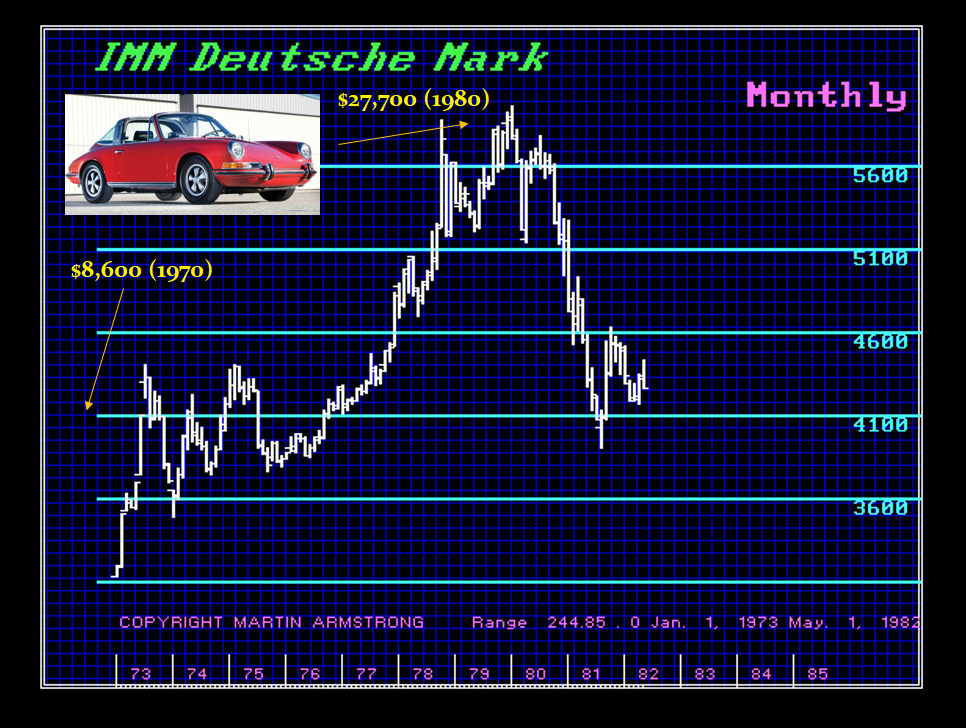
In fact, I was buying German cars throughout the 1970s as the dollar was declining. A Porsche was $8,600 in 1970, and by 1980, it was $27,700. I would drive the cars for 2 years and then trade them in and get my money back, so cars never cost me a dime throughout the 1970s. I understood it was all just currency – not the cars themselves. My father took the family to Europe for the summer of 1964, which taught me about currency as we traveled from Sweden to Italy and all around. We had to change currency every time we crossed a border. I learned that CURRENCY was actually a mental language. I would listen to the price in Italian lira and convert that back to dollars in my mind to asses if the value was a fair price.

WSJ 1983 MAA 1

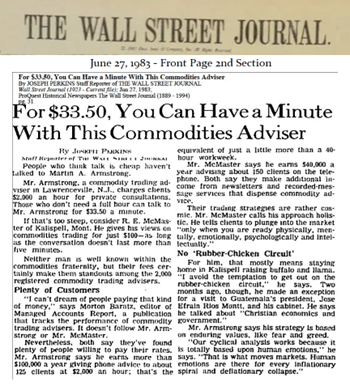
I was really the only true foreign exchange analyst. I was dealing in billions in the early 1980s. Clients would even put me on a speak in the middle of an OPEC meeting. I was being called in around the world all on currency crises. That’s how I became friends with Margaret Thatcher. I was being touted as the highest-paid analyst in the world, all for currency. When I was opening an office in Geneva in 1985, I was going to use some European names to blend in. I went to lunch with the head of one of the top main banks in Switzerland, who was a client and asked his opinion of what European name to use. He asked me to name one European FOREX analyst. I was embarrassed for I could not. He then explained why everyone was using my firm. He said there were no European analysts because they each would tout their own currency because it was a political issue. He explained everyone was using my firm because I did not care if the dollar went down or up. I said it was just a trade.

1987 Crash Brady Commission

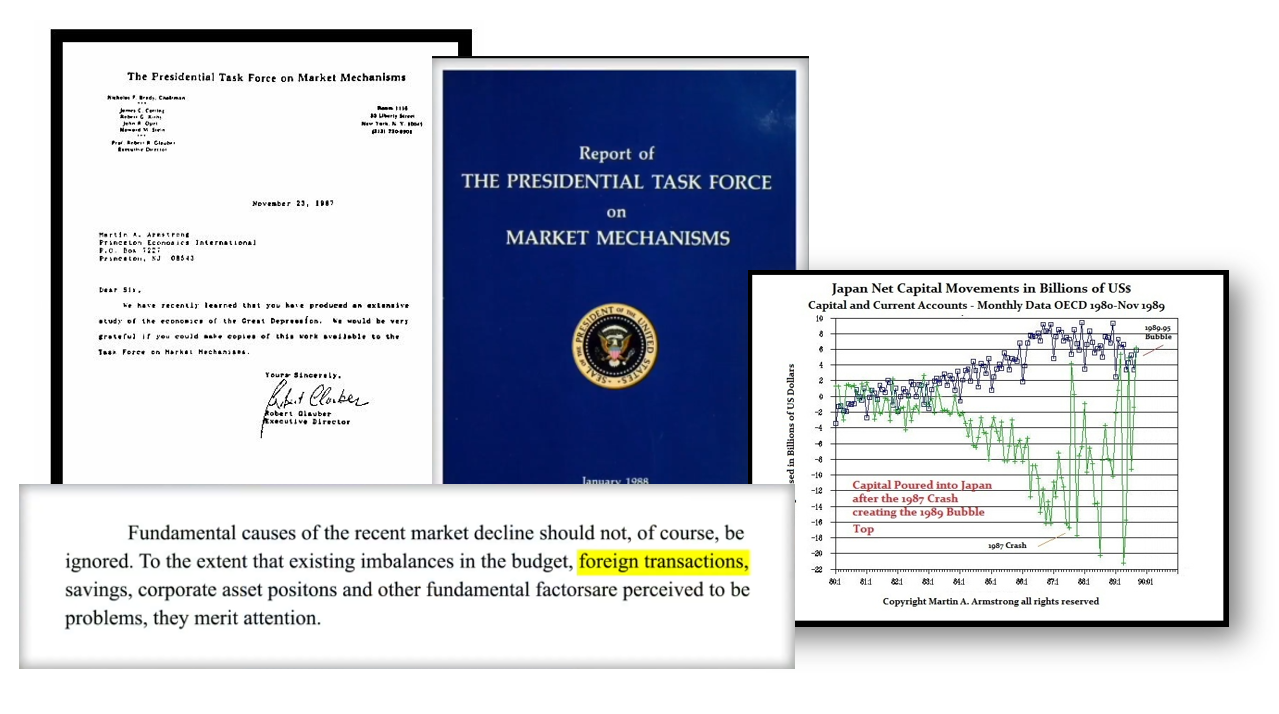
By 1985, I was summoned to the US. They were arguing to force the dollar down by 40% to reduce the trade deficit as that theory today is espoused by Trump. That was the Plaza Accord, and I wrote to President Reagan and warned that they would cause a crash within two years, and that became the 1987 Crash. The Presidential Commission then called me in for that one. They just do not teach this stuff in school and that seems to be the problem.

Rubin Letter
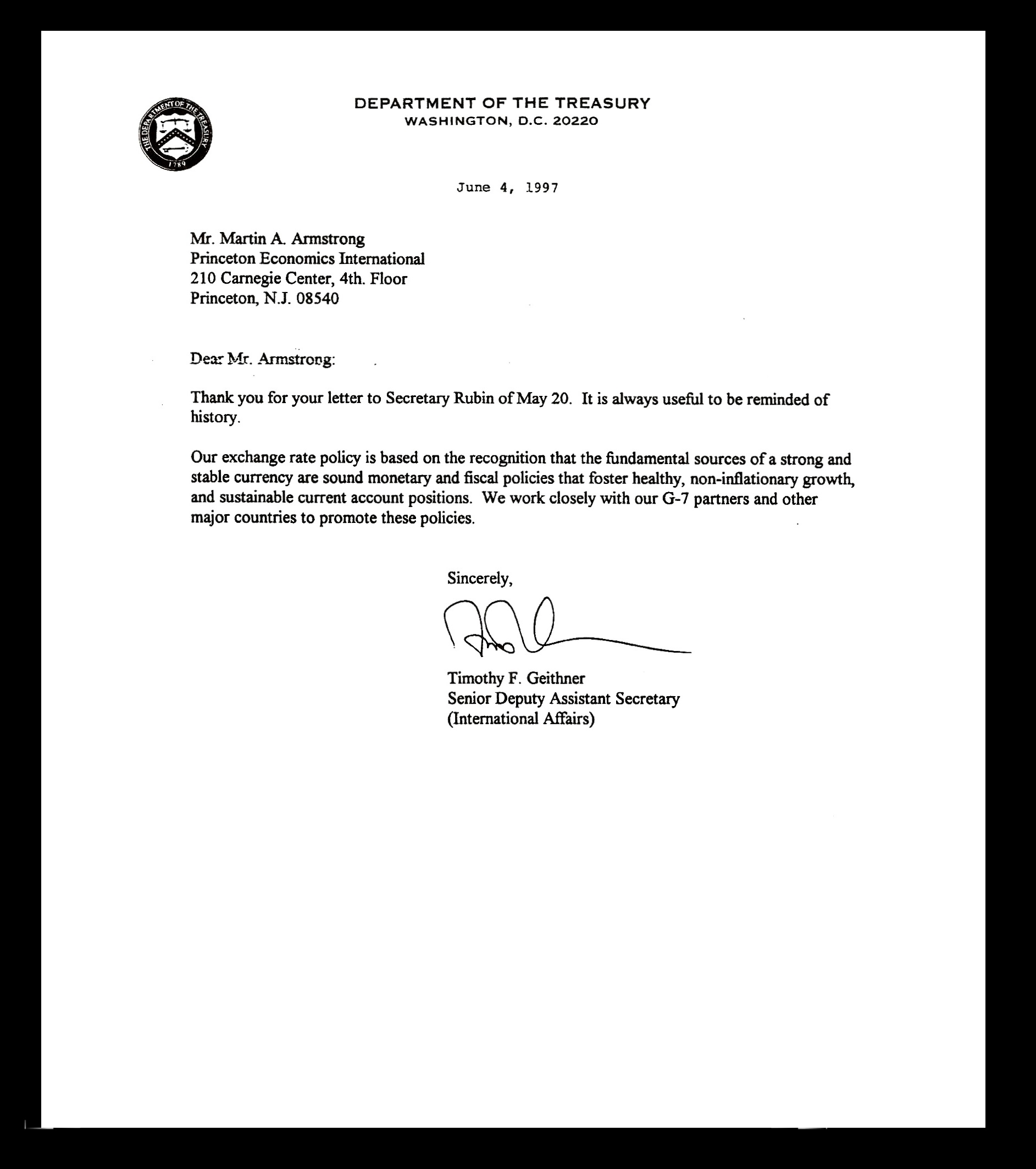
Rubbin response letter Tim Geithneir

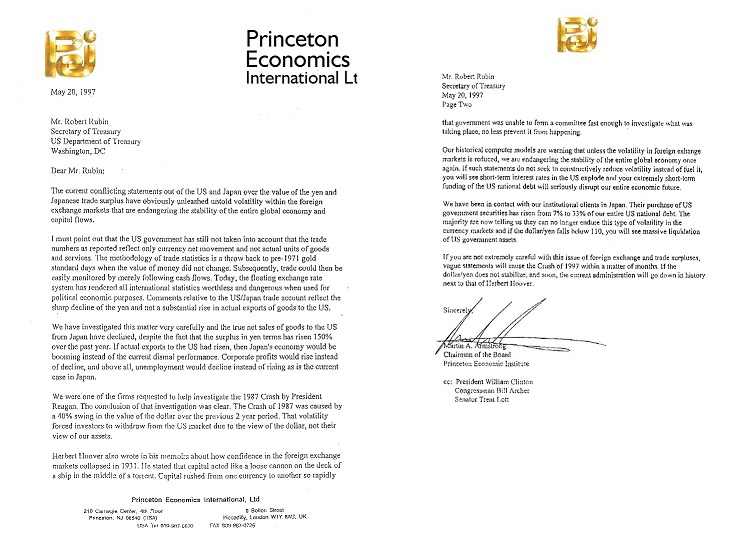
In 1997, Robert Rubin, former head of Goldman Sachs, was also trying to talk the dollar down for trade. Again, he did not really understand currency and its impact on markets. The Asian currency Crisis unfolded weeks later. He may have been at Goldman, but that was more related to debt. To one person, a stock rally can look like a bull market, and to another, a bear market. When you get into currency swings of 10%-40%, it alters the perception of value because they still do not teach this stuff in school. We are clinging to old theories like Keynesian economics from the period of fixed exchange rates. Politicians are making the wrong decisions and investors are confused because these concepts are never taught.

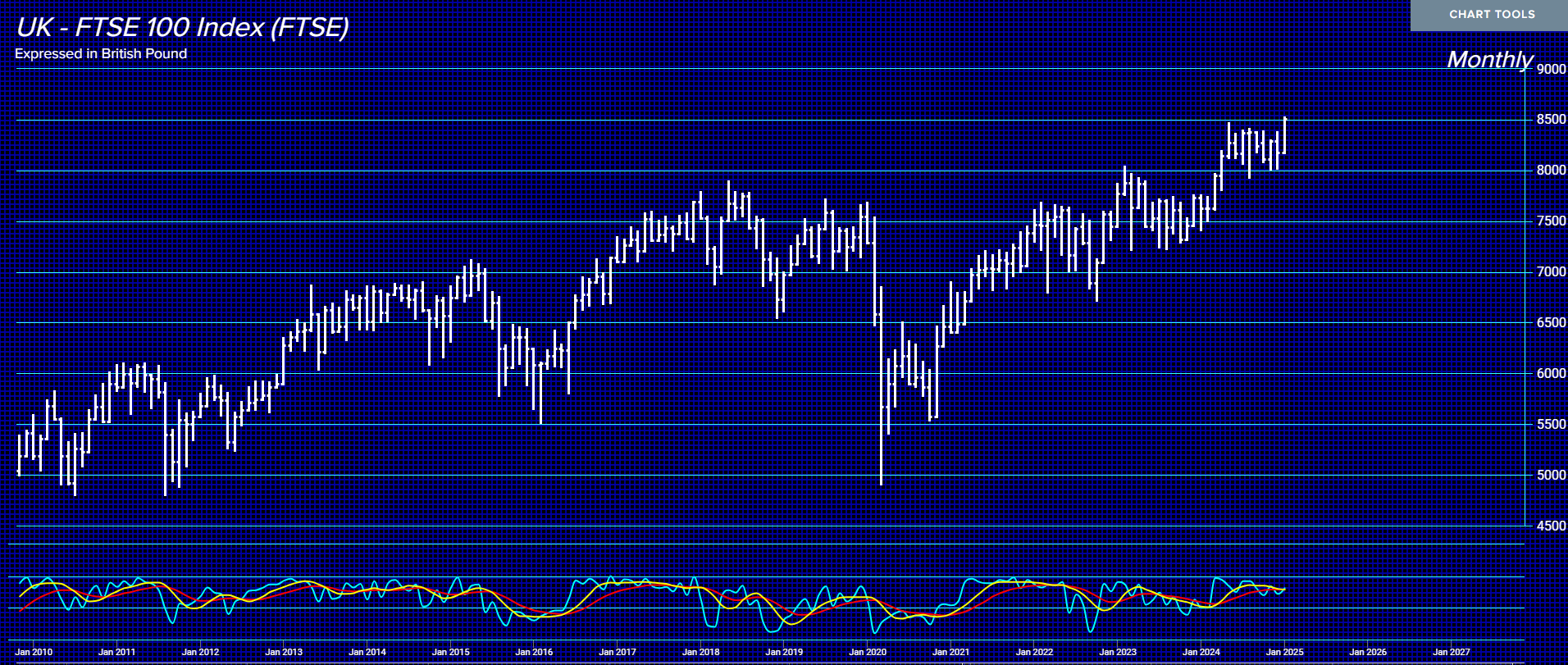
UK_FTSE100 M Tech 1 18 25
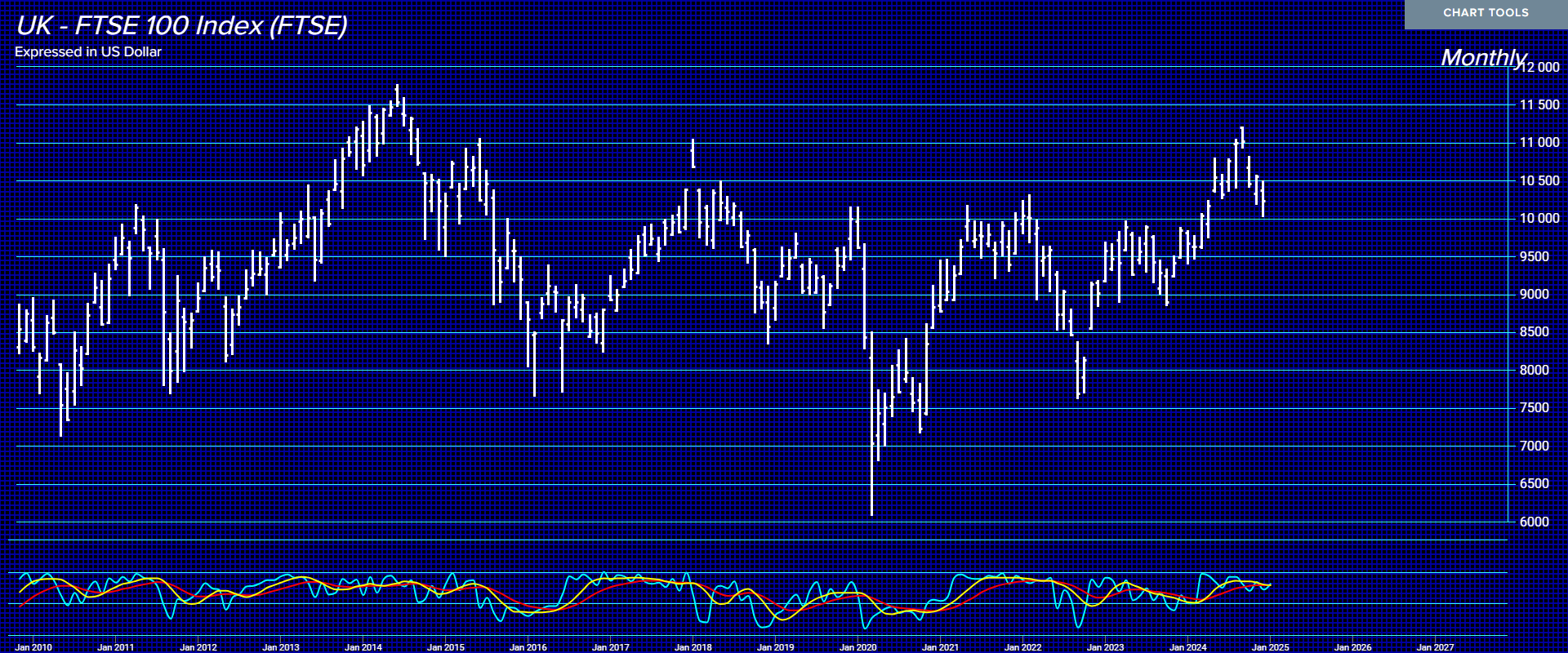
UK_FTSE100 M Tech in US 1 18 25

As the greenback rallies, then the European share prices will appear cheap, just as Ferarri did in 1985 when the pound fell to $1.03. You will have domestic movement away from public assets as we have seen corporate rates move below that of government rates in France. Here is the FTSE in pounds and then in dollars. While you see new highs in pounds, the FTSE has not made new highs in dollars and has backed off, showing that the rally in the FTSE is not keeping pace with the decline in the pound.

01:56This is why, in Socrates, you can plot any instrument in a host of various currencies. The definition of a bull market is something that rallies in terms of all the key currencies. When it is rising only in terms of the local currency, it is simply a domestic shift and not international.

We do NOT see a major Crash on the horizon in shares, commodities, gold, silver, etc.

The greatest risk of a crash will be in government debt.

Interview: Bonds, USD, Gold Trends, and Decline of Global GDP into 2028


Posted originally on Jan 18, 2025 by Martin Armstrong 

Reached During Biden’s Exit – President Trump Tells Congress to Act Now


Posted originally on the CTH on December 30, 2024 | Sundance

Treasury Secretary Janet Yellen has announced the U.S. debt ceiling is likely to be reached mid-January, while Joe Biden is still in office.  President Trump tells congress to deal with the issue now.

First, here’s Secretary Yellen:

WASHINGTON, Dec 27 (Reuters) – The U.S. Treasury Department may need to take “extraordinary measures” by as early as Jan. 14 to prevent the United States from defaulting on its debt, Treasury Secretary Janet Yellen told lawmakers in a letter on Friday.

Yellen urged lawmakers in the U.S. Congress to act “to protect the full faith and credit of the United States.”

U.S. debt is expected to decrease by about $54 billion on Jan. 2 “due to a scheduled redemption of nonmarketable securities held by a federal trust fund associated with Medicare payments,” she added.

She said: “Treasury currently expects to reach the new limit between January 14 and January 23, at which time it will be necessary for Treasury to start taking extraordinary measures.”

Under a 2023 budget deal, Congress suspended the debt ceiling until Jan. 1, 2025. The U.S. Treasury will be able to pay its bills for several more months, but Congress will have to address the issue at some point next year. (more)

The Biden spending is already baked into the proverbial cake. Congress will have to raise the debt ceiling limit and President Trump is urging them to do it now, before he takes office.

[SOURCE]

Specifically, because 38 republicans voted against the 2nd continuing resolution earlier this month, President Trump will face this debt ceiling mess on day one if it is not addressed before. They republicans knew this reality when they voted no.

Now President Trump is trying to avoid a potential mess early in his administration. No amount of spending cuts are going to stop the previously authorized spending. We are still going to hit the debt ceiling regardless of action from within the House to downsize government. Congress can freeze all spending, and we will still hit the debt ceiling.

It certainly looks like a crew of House republicans knew this would hamstring President Trump, and measures to avoid default are going to be needed.

When the US Government Defaulted on its Bonds


Posted originally on Dec 26, 2024 by Martin Armstrong 

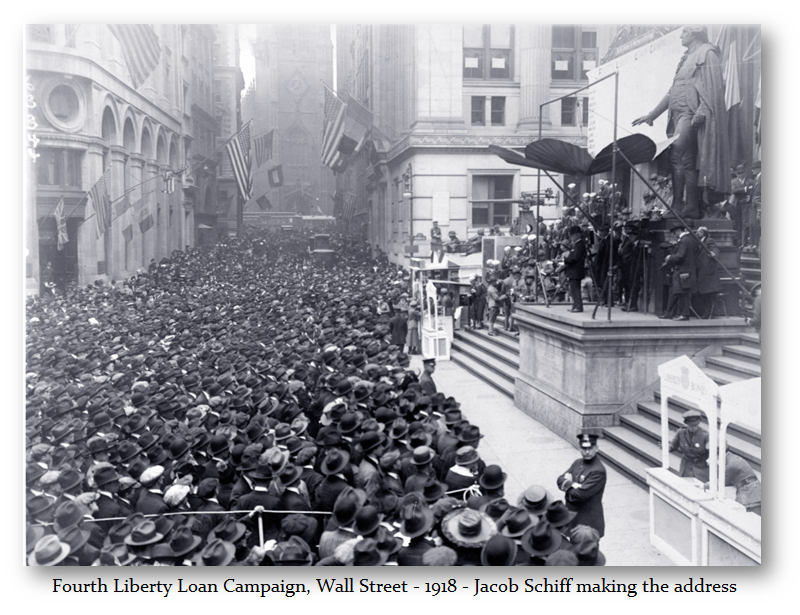
4th Liberty Bond Launch Wall Street 1918

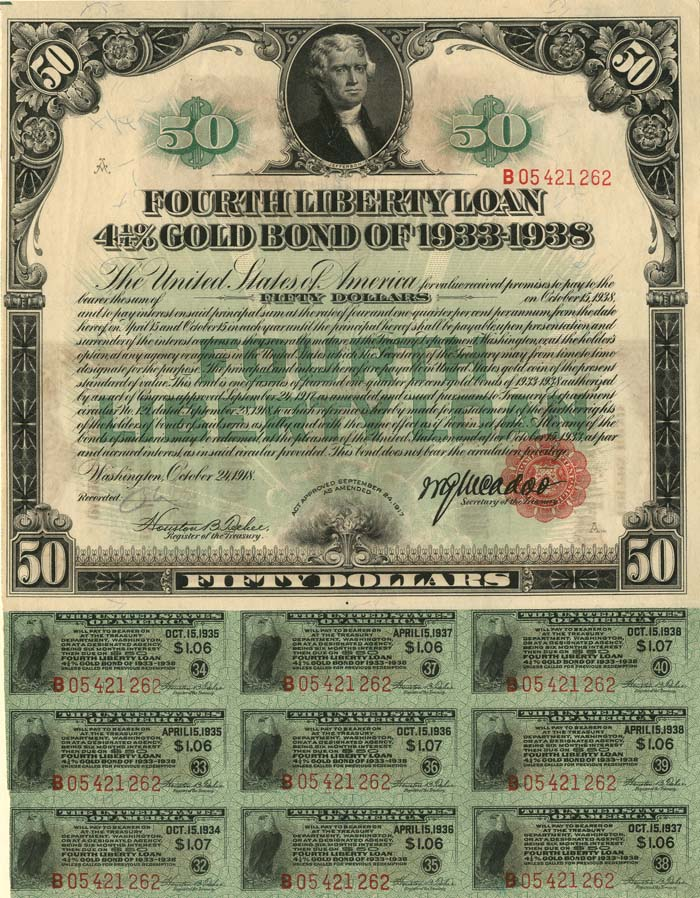
The first three Liberty bonds and the Victory Loan, sold to fund World War I, were indeed retired during the 1920s. However, because the terms of the bonds included a Ponzi Scheme that allowed the bondholder to swap them for the newer bonds, with superior terms, most of the debt from the first, second, and third Liberty bonds had been rolled over into this fourth issue. The terms of this 4th issue were as follows:

Date of Bond: October 24, 1918
Coupon Rate: 4.25%
Callable Starting: October 15, 1933
Maturity Date: October 15, 1938
Amount Originally Tendered: $6 billion
Amount Sold: $7 billion

4th Liberty Bond

The terms of this Fourth Liberty Bond specified: “The principal and interest hereof are payable in United States gold coin of the present standard of value.” This was the typical “gold clause” that was found in most sovereign bonds, both domestic and international. In addition, private contracts and bonds also included this gold clause before Roosevelt. Generally, it was intended to guarantee that bondholders would not suffer from a currency devaluation – not inflation since even a gold standard does not prevent inflation.

The US defaulted on these bonds thanks to Roosevelt. The US Treasury called in this Fourth Liberty Bond on April 15, 1934, for redemption. However, the US defaulted on this term by refusing to redeem the bond in gold. They also ignored the dollar devaluation imposed by Roosevelt, which changed the dollar’s gold value from $20.67 to $35. The entire purpose of the gold clauses prior to Roosevelt was to protect against a currency devaluation. The 21 million bondholders lost 139 million troy ounces of gold, which caused the loss in international value terms to be approximately 70% of the bond’s principal.

The legal basis for the refusal of the US Treasury to redeem in gold was the gold clause resolution was Roosevelt’s effort to seize gold, devalue the dollar, and attempt to ensure that all profits would accrue to the government (Pub. Res. 73–10), dated June 5, 1933. The Supreme Court was petitioned to decide this issue, and what we will see is that Roosevelt just ignored the Supreme Court once again, showing that the Constitution means nothing when it constructs the government from its goal.

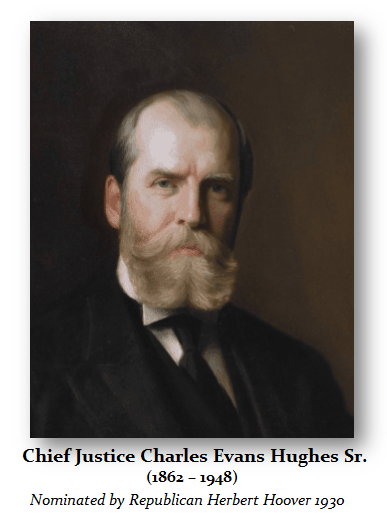
Charles Evans Hughes Sr. April 11 1862 – August 27 1948

Chief Justice Charles Evans Hughes wrote the decision in  Perry v. United States, 294 U.S. 330, 354 (1935). He made it very clear that the Joint Resolution of June 5, 1933, nullified the gold clause obligations of the United States and that they would only honor dollar for dollar, which was unconstitutional id /349. Furthermore, the Court held that Congress cannot use its power to regulate the value of money to invalidate the Government’s obligations.

FDR Gold Confiscation

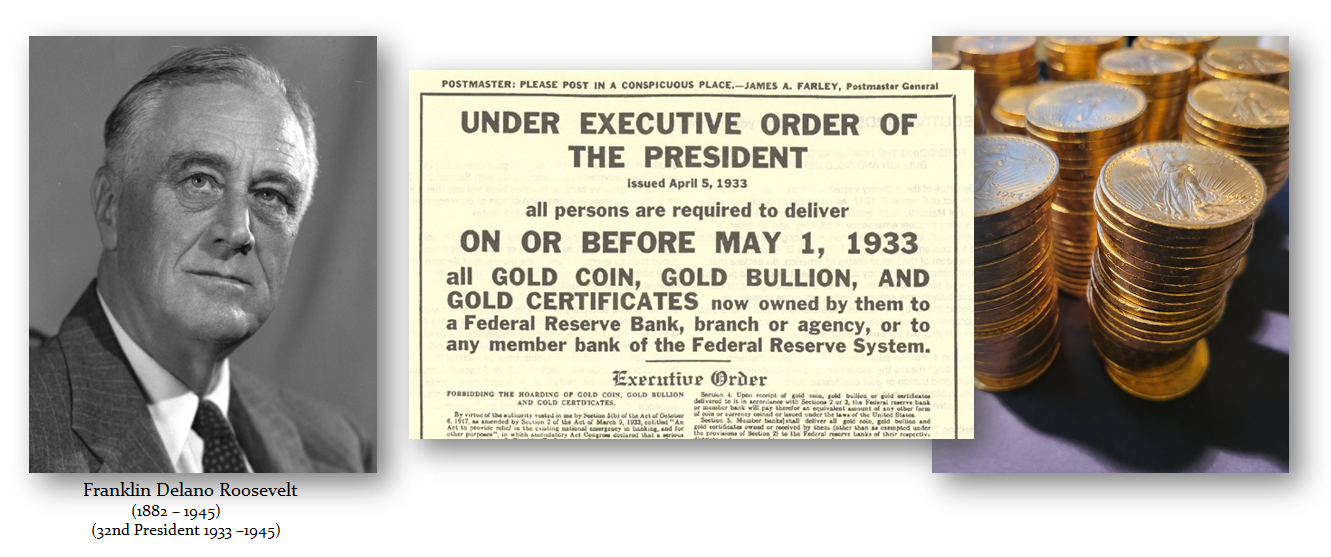
President Franklin D. Roosevelt’s closure of the open gold market and the removal of the domestic backing of the dollar with gold took place with the signing of Executive Order 6102 on April 5, 1933. The Supreme Court ruled that the bondholders’ loss was unquantifiable and, therefore, repaying them in dollars according to the 1918 standard of value would be an “unjustified enrichment.” FDR essentially defaulted on the US national debt, repaying it with depreciated dollars, reducing the debt by nearly 70%.

Default is Always a Sovereign Prerogative when Things get Tight.