President Trump Gives Extensive Comments on State of Ukraine-Russia Conflict


Posted originally on CTH on December 9, 2025 | Sundance 

President Trump sat down for an extensive interview with Dasha Burns of Politico.  Despite the ideological outlook of Politico, the interview itself was remarkably absent of combative antagonism. The result is a good review of the current positions of President Trump as they relate to the rest of the world.

The Ukraine-Russia conflict is the immediate issue that is discussed within the interview.  President Trump answers some direct questions about who is currently most responsible for continuing the conflict and is asked his opinion directly on Ukraine not holding elections.

President Trump notes Russian President Vladimir Putin is in the strongest position within the conflict and carries the strongest leverage into any ceasefire negotiations.  Trump also frames the need for the bloodshed to end with a much greater sense of urgency than any of the EU leaders or Zelenskyy.  Additionally sharing the opinion that Ukraine needs to have an election to showcase the will of the Ukrainian people in the leadership of Volodymyr Zelenskyy.  WATCH:

.

Volodymyr Zelensky


Zelenskyy Met with Starmer, Merz and Macron – Now Heading to Brussels

Posted originally on CTH on December 9, 2025 | Sundance | 19 Comments

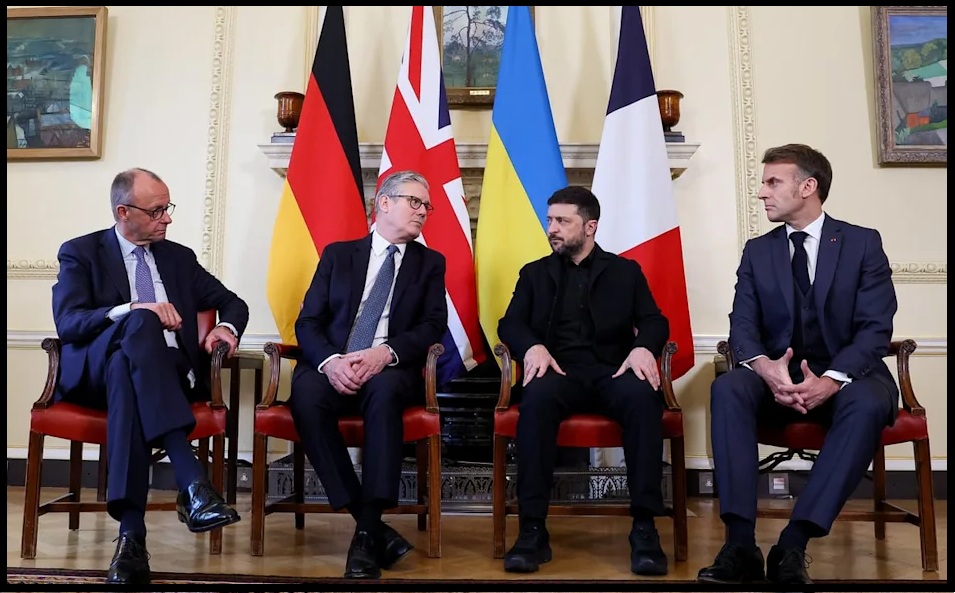
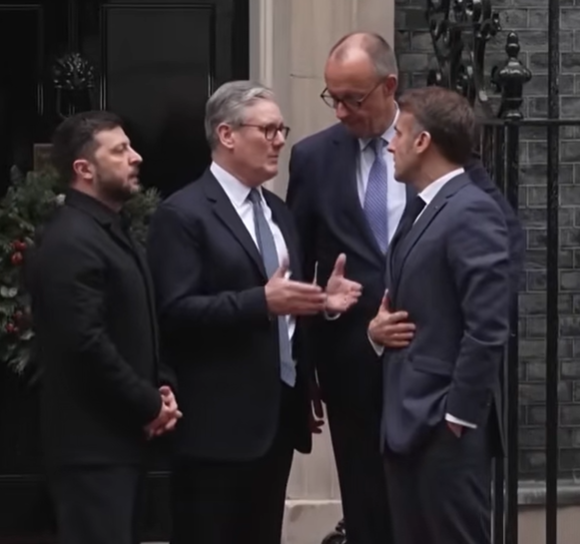
Yesterday, Ukraine President Volodymr Zelenskyy traveled to London to meet with British PM Keir Starmer, German Chancellor Friedrich Merz and French President Emmanuel Macron.

As expected, part of the Zelenskyy meeting with the “coalition of the willing” included a briefing by Ukraine negotiator Rustem Umerov, the secretary of Ukraine’s National Security and Defense Council, who held detailed consultations for three days last week in Miami with Trump’s envoys Steve Witkoff and Jared Kushner.

President Zelenskyy then departed London traveling with his media entourage to Brussels for the next round of discussions with the European Union stakeholders, financiers and politicians. During the trip Zelenskyy told his media stenographers, “Under our laws, under international law — and under moral law — we have no right to give anything away. That is what we are fighting for.

The U.K, France and Germany support Zelenskyy’s position that he is not going to concede any territory to the Russian Federation, specifically the 30% of the Donbas area in Eastern Ukraine currently at the heart of the physical conflict.

The 30% issue surrounds the Donetsk region in Ukraine, which includes the cities of Kramatorsk and Sloviansk. Russia is currently pushing deep into fortified Ukraine resistance in this region with a population of around 100,000. Zelenskyy claims losing this area would allow Putin to invade the Dnipropetrovsk, Zaporizhzhia and Kharkiv regions.

Historically, this Donbas area was part of a brutal long-term Ukraine civil war between the pro-Russia eastern Ukrainian citizens and the pro-EU western aligned Ukrainian army. Russia’s current position is for Ukraine to cede the entire Donbas to Russia as part of the ceasefire agreement, or Russia will continue forward conflict military operations until successful.

Seeing things through the pragmatic prism of inevitability, President Trump’s view appears to be that this Donbas area will be lost to Russia one way or the other. So, the best scenario to stop the killing is for Ukraine to give up this territory as part of the ceasefire terms. Zelenskyy, with support of the EU, France, Germany and U.K says a firm “no.”

Politico reports that Zelenskyy said in August of this year “it would take Russia four-years to fully occupy the Donbas,” subsequently a lot of killing would take place during this process.  President Trump is trying to stop the brutal “killing” part of that dynamic by getting the negotiation to the point of concession, but the EU team view any land area concession as positive affirmation for Russia to continue threatening Europe.

♦ On the ‘Security Guarantee‘ issue, this is where a quagmire is presented by European leaders.

From a pragmatic standpoint a European demilitarized zone, stood up and supported by EU military forces would appear to be the best solution.  However, the “coalition of the willing” say they are willing to put security troops into Ukraine, but only if the USA will defend them if attacked by Russia.  In essence, quasi-NATO forces on a non-NATO country, that if attacked would draw the entirety of NATO into the conflict, including the United States.

The U.K, France, Germany and EU Commission want a security structure similar to NATO for Ukraine that legally binds the United States to defend their interests if the ceasefire does not hold.  President Trump has rejected this construct as yet another way for Europe to pull the U.S into a conflict zone that is not in our vital national security interests.

The ceasefire proposal structured by Trump, Witkoff and Kushner – seemingly supported by Russia, does not permit Ukraine to join NATO; however, EU membership is entirely up to the EU and people of Ukraine to decide.  If Ukraine joins the EU, then EU forces alone should provide the security guarantee, not NATO which includes the U.S. and Canada.

(Washington Post) […] Zelensky said Ukraine will not surrender its territory in the eastern Donbas region — not to hasten peace talks, not to satisfy Washington’s push for compromise and not under pressure from Moscow’s continuing military onslaught.

Ukraine and Europe have insisted that a ceasefire be declared along current battle lines, but Russia has refused. Putin has claimed, illegally, to have annexed four entire regions of Ukraine (in addition to Crimea, which Russia seized in 2014) — far more territory than his military forces have been able to occupy.

Some Ukrainian officials held out hope that the negotiations could still bear fruit.

The proposal “is closer to be doable for Ukraine, but not easy and not finished,” said a senior Ukrainian official familiar with recent discussions, who spoke on the condition of anonymity because they were not authorized to comment publicly. (read more)

President Zelenskyy, whose term in office has long expired, departed London with his EU media entourage heading to Brussels.  The collective group is trying to figure out how to keep America tied to their stakeholder interests in Ukraine.

The European leaders are manufacturing a construct that is not supported by the vast majority of the citizens within the EU, even within Ukraine itself.  Meanwhile back in the USA, congress (House and Senate majorities) supports the position of Ukraine and the EU against the interests of President Trump and the voting majority.

There are trillions at stake.

The ruling class is supporting Zelenskyy, while the killing of the non-ruling class continues on the fields of Ukraine.

Following Three Days of Talks with U.S, Team Zelenskyy Heads to London for Meeting With “Coalition of the Willing”


Posted originally on CTH on December 8, 2025 | Sundance 

Following three days of negotiations in Florida (Thur, Fri, Sat) between President Trump emissaries Steve Witkoff and Jared Kushner, and Ukraine emissaries Rustem Umierov and Andrii Hnatov, the group then held a 2-hour phone call with Ukraine President Volodymyr Zelenskyy.

No substantial progress was reported.  However, military officials Umierov and Hnatov then flew to meet Zelenskyy in London where French President Emmanuel Macron, British Prime Minister Keir Starmer and German Chancellor Friedrich Merz are assembled to discuss alternatives to ending the conflict.

Starmer, Macron and Merz form the core of the “coalition of the willing,” an EU group who have unilaterally proclaimed they were willing to send the military of the U.K, France and Germany into Ukraine so long as President Trump would backstop their troops with promises of U.S. intervention if things went badly.  Trump would not make that commitment.

Zelenskyy Inc, Macron, Starmer and Merz do not want to end the proxy fight against Russia.  Together with the EU leadership of NATO, the coalition of the willing want to retain the conflict.  However, the problem for the four leaders is that without strong USA support, the citizens of their EU countries will rise up against them.

Even with NATO missiles and transferred technological assistance, they ultimately need the American military in order to ensure Putin doesn’t squish them.  President Trump wants the proxy war to end – loggerheads are reached.

Russian President Vladimir Putin does not seem to be paying too much attention to the bureaucratic speeches and instead is continuing forward advancement [SEE HERE] to secure the territory in Ukraine with or without a negotiated settlement.

The Russian Federation has presented its terms; the Russian terms for cessation are known; the rest is up to the EU, NATO, USA and Ukraine to work out.

At this point the problem is over-talking and FUBAR, or, well, a typically European situation.  So, Putin keeps going, more Ukraine troops are killed, while Putin awaits the endless conversations that he predicted would result in more endless conversations.  To be fair, Putin’s cold approach appears to be a mostly accurate interpretation of what he expected.

ZELENSKYY – “In recent days, representatives of Ukraine held substantive discussions with envoys of the US President – and now National Security and Defence Council Secretary Rustem Umierov and Chief of the General Staff Andrii Hnatov are en route to Europe. I expect detailed information from them on everything that was said to the American envoys in Moscow, and on the nuances the Americans are prepared to modify in negotiations with us and with the Russians.” (link)

By my count in the past two weeks, Witkoff and Kushner have spent nine days in direct all-day negotiations with various Ukraine officials from various institutions of Zelenskyy’s government, with a one-day trip to Moscow sandwiched between them.  Yet, western media continually proclaim the U.S. delegation of Kushner and Witkoff are ignoring the Ukrainians.

This is what I call the ‘paralysis of analysis’, or the part of every negotiation where things get so granular in detail that the larger objective is lost.

While the Ukraine team argues about whether a creek or a railroad track should determine the current point of conflict, another 250 Ukrainian soldiers have their limbs torn from their bodies and lie dead in the mud.  Today they will meet in London to argue over telephone pole ownership, while another battalion is fed to the meat grinder.

CNN frames a narrative that President Trump is unsympathetic and frustrated with Zelenskyy:

(VIA CNN) – […] Trump criticized Zelensky on Sunday after talks between US and Ukrainian negotiators over the weekend in Miami ended with unresolved questions over security guarantees, territorial issues and continued concern that the US proposal tilts in Russia’s favor.

“We’ve been speaking to [Russian] President [Vladimir] Putin and we’ve been speaking to Ukrainian leaders, including… President Zelensky, and I have to say that I’m a little bit disappointed that President Zelensky hasn’t yet read the proposal, that was as of a few hours ago,” Trump said. (more)

President Trump is reviewing the issue through the prism of “hours” because he knows that as each hour passes that’s more dead young men…. And FOR WHAT?

Meanwhile, Volodymyr Zelenskyy is traveling around Europe stopping for tea and crumpets with Macron, Starmer and Merz in London today.  Think about the upside-down priorities here.

Bread and Circuses – With Servants Patiently Waiting (Dec 6, 2025)

[SOURCE]

[If you think I’m not being fair to Ukraine, just go scroll Zelenskyy’s Twitter feed]

Rubio, Witkoff and Kushner Meet Ukraine Officials in Florida for Discussion of Terms Before Witkoff Returns to Moscow Tuesday


Posted originally on CTH on December 1, 2025 | Sundance

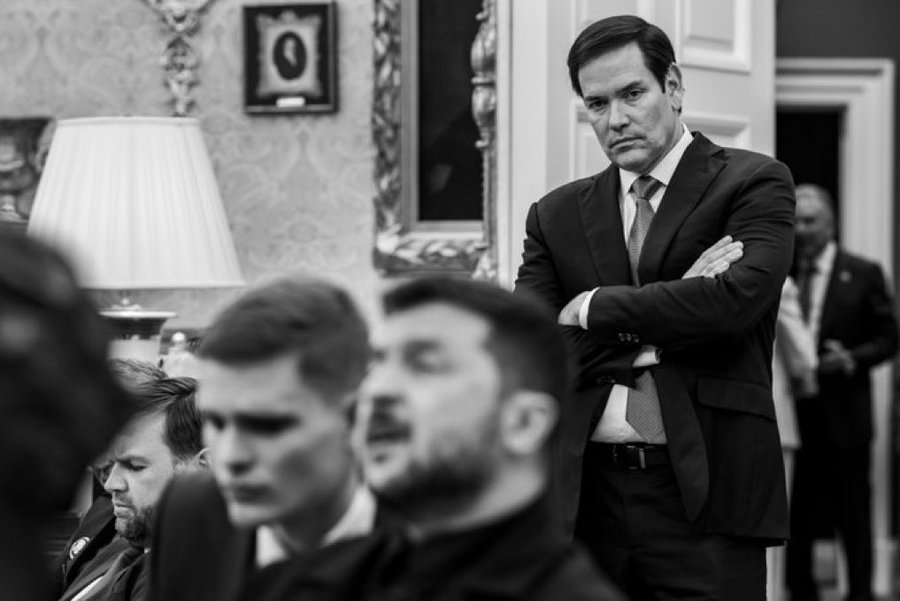
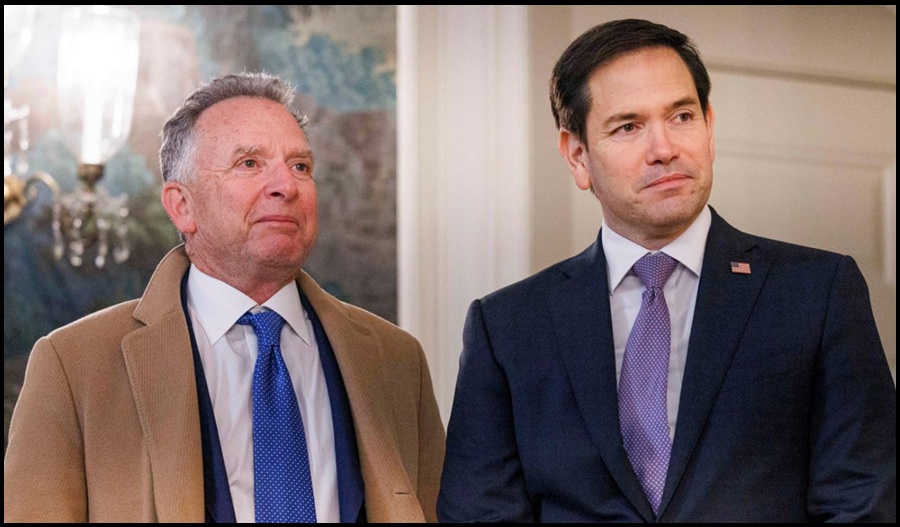
On Sunday, Secretary of State Marco Rubio, Trump emissaries Steve Witkoff and Jared Kushner met with the Ukraine negotiating team in Florida to further discuss acceptable terms for a broader ceasefire and end to the war.

Still trying to recover from corruption charges against his senior presidential team, Volodymyr Zelenskyy was not at the talks. Instead, the Ukraine delegation was led by State Security Council Secretary Rustem Umerov, while Zelenskyy went to Paris for an emotional support session with Emmanuel Macron.

Secretary Rubio and Secretary Umerov spoke before and after their 5-hour negotiation session.  Secretary Rubio emphasized the main topic as securing the long-term future of Ukraine both from a security position and from an economic prosperity position.

This state security aspect comes as the Ukraine delegation is facing pressure to accept, they will lose most -if not all- of the Donbas region to Russia. “The end goal is obviously not just the end of the war. Obviously, that’s central and fundamental,” Rubio said. “It’s also about securing an end to the war that leaves Ukraine sovereign and independent and with an opportunity at real prosperity.”

In better-than-expected news, the EU is now saying they will not comply with any removal of sanctions against Russia.  If the U.S-Russia and Ukraine work out a negotiated settlement that permits legal or economic relief for Vladimir Putin, the European Union will not agree and will instead make up their own decision on the issues.

Europe is holding this position as a threat, because President Trump is not fully consulting with them on all the granular details.  However, this is the type of threat that is exactly beneficial to what appears to be the long-term strategy of Trump.

If Europe refuses to remove sanctions or legal threats against Russia, but the U.S. negotiates the removal of U.S treasury and financial sanctions against Russia, then the Europeans have chosen to stay behind the locked door of economic benefit. More than two-thirds of the world does not participate in the sanctions at all.

If Europe and Canada continue blacklisting Russia, the U.S-Russia energy development program gains exclusive benefits to Trump, Putin and other allies like Mohammed bin Salmon (Saudi Arabia), ASEAN nations and even Japan.

In very practical terms, someone like Viktor Orban (Hungary) would like nothing more than to violate ongoing Brussels sanctions against Russia, and as a consequence create a fracture point for European Union exit.

In practical terms, what would this look like?  Well, the entire world would have lower energy prices, lower oil and natural gas prices, and lower gasoline prices by big margins.  Meanwhile, Europe would have a massive disparity in their much higher energy costs – likely double the rest of the world.   Think about the ramifications.  Hungary, Georgia, Montenegro, and Serbia with 50% lower prices on gasoline and electricity than the EU.  lolol  It would be funny.

Unfortunately, with this in mind I find the EU threats hollow.  As soon as the U.S-Russia-Ukraine work out a peace and security agreement, Europe will comply with whatever terms are negotiated for Russia.  Failure to do so only isolates the Europeans and will create a problem amid their collective mindsets.

(Via Axios) Negotiations between the U.S. and Ukraine on Sunday focused on where the de facto border with Russia would be drawn under a peace deal, two Ukrainian officials tell Axios. They described the five-hour meeting as “difficult” and “intense,” but productive.

Why it matters: Russian President Vladimir Putin — who’s expected to meet with President Trump’s envoy on Tuesday — insists Russia won’t stop until it controls the entire Donbas region in eastern Ukraine.

After an hour in a wider format, the meeting narrowed to three officials from each side — with the line of territorial control virtually the only issue discussed, according to the two Ukrainian officials.

On the U.S. side were Witkoff, Secretary of State Marco Rubio and Trump’s adviser and son-in-law Jared Kushner. The Ukrainian side was represented by national security adviser Rustem Umerov, military chief of staff Gen. Andrii Hnatov and deputy head of military intelligence Vadym Skibitskyi.

After the talks with their teams ended, Umerov held another one-on-one meeting with Witkoff. Umerov then called Ukrainian President Volodymyr Zelensky to brief him on the talks.

“It was intense but not negative. We really appreciate serious U.S. engagement. Our position is that we have to make everything to help U.S. succeed without losing our country and preventing another aggression from happening,” one of the Ukrainian officials wrote to Axios after the meeting.

Between the lines: Ukrainian President Volodymyr Zelensky had wanted to discuss territory directly with Trump, but Trump said he’d only meet Zelensky or Putin again once a deal is close.

Umerov is expected to meet Zelensky in Paris on Monday and give him a more detailed report about the negotiations, Ukrainian officials say.

Witkoff plans to depart for Moscow on Monday and meet Putin on Tuesday.

“The main question is where the Russians stand and if their intentions are real. Let’s see what Witkoff brings from Moscow,” a Ukrainian official said. (more)