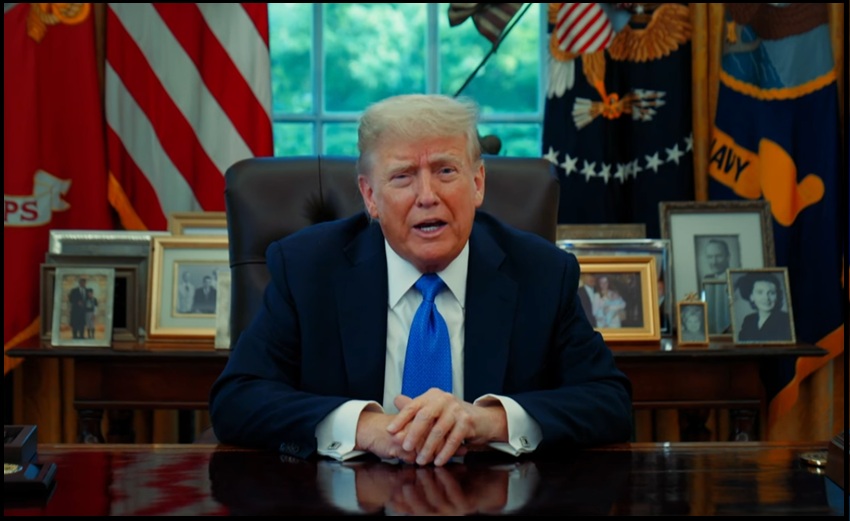
Secretary of State and Nat Sec Advisor Marco Rubio


Posted originally on CTH on June 5, 2025 | Sundance

A point to emphasize.

Current Secretary of State and National Security Advisor, Marco Rubio, was chair of the senate select committee on intelligence (SSCI) and a Gang of Eight member since day one of the Russia-Ukraine conflict. Due to his role in the Gang of Eight Senator Rubio was briefed on all the covert activities being carried out in Ukraine by the CIA and Pentagon.

That is why when Secretary of State Marco Rubio told media months ago that “Ukraine was a proxy war for the United States against Russia,” it was a jaw-dropping statement. If anyone would know the receipts, it’s the former Chair of the SSCI, who became the Secretary of State.  However, to say the truth so openly and publicly was something entirely unexpected, especially from Rubio.

As Secretary of State Rubio represented President Trump’s America-First foreign policy and national security interests very effectively, many people were shocked at the seemingly 180° degree turn Rubio took to represent the MAGA perspectives.  Rubio adroitly navigated the media with exceptional support for President Trump’s positions, and diplomatic action to back it up.

While most of us continue watching Rubio closely, obviously President Trump saw the unique perspectives held by the former Senator on intelligence matters.  President Trump then appointed Rubio to a dual role as National Security Advisor and Secretary of State.

While the Secretary of State represents the public face of President Trump’s diplomatic policy toward the world, the Nat Sec Advisory represents President Trump’s outward view to the global intelligence network. Marco Rubio now carries both extremely important titles and responsibilities.

Keeping in mind the prior statements by Rubio about Ukraine being a proxy state for U.S. operations against Russia, both Marco Rubio and President Trump have been mostly silent and very measured in their comments about Russia after the Ukraine attack on the Russian nuclear-capable bombers.

Obviously, both Secretary Rubio and President Trump know the Senate control of the BBB is unfortunate timing for their solutions to the Ukraine-Russia war. Their solution is likely to be something the Senate will not like.  The Senate will never publicly admit that Ukraine is a U.S. proxy war against Russia.

However, while the Senate needs to retain these ridiculous pretenses, ultimately Russian President Vladimir Putin does not.  Putin is well aware of the USA support level, open and covert, taking place within Ukraine.  This is the context for all of President Trump’s communication with Putin.

You can even pull that context out of President Trump’s statement following his recent conversation with President Putin, “it was a good conversation, but not a conversation that will lead to immediate Peace.” The key word there is “immediate.”  The implication is that Peace can be achieved but some forward factors need to be addressed first.

We are in this weird place where parts of our government (Senate and media) are pretending the Russia-Ukraine conflict is something, while simultaneously part of our government (executive) are clear-eyed and not pretending.

The pretending part of our government now holds a key piece of President Trump’s domestic agenda, the Big Beautiful Bill, in their control.  President Trump and Marco Rubio careful not to apply pressure that could weaken their geopolitical objective with Russia.

Again, the 2025 Marco Rubio is not a familiar person who have followed republican politics.  Rubio has been one of the biggest positive surprises of the administration so far.  In a position of such importance to President Trump, and with this level of responsibility being used effectively, Rubio is well positioned to achieve support in 2028.

…”I don’t think I’d get 99 votes now.” ~Marco Rubio

President Trump Holds Press Availability with German Chancellor Friedrich Merz


Posted originally on CTH on June 5, 2025 | Sundance 

Earlier today President Trump held a press availability in the oval office with German Chancellor Friedrich Merz.  The topics of conversation surrounded trade, NATO funding, Ukraine, Russia, President Trump’s conversation with Chairman Xi Jinping, the tax cut and budget bill and Elon Musk’s criticism.

At 04:42 of the video President Trump discusses his conversation with Chairman Xi Jinping of China.  President Trump and Chairman Xi agreed to organize their teams for another discussion and President Trump noted he would be sending Scott Bessent, Howard Lutnick and Jamieson Greer to another round of talks to hammer out the details.  Additionally, President Trump invited Chairman Xi to the USA, and Chairman Xi invited President Trump to visit China.

At the 10:00 mark, President Trump discusses the autopen controversy around the former Biden administration.  At 13:40 President Trump was asked about Elon Musk and his opposition to the Big Beautiful Bill.  President Trump and Scott Bessent walk through the benefits inside the bill and President Trump notes the EV subsidy was removed from the bill which seemed to be problematic for Musk.  WATCH:

.

…”He hasn’t said anything bad about me personally, but I’m sure that will be next.  But I’m very disappointed in Elon”…

Be Patient, Retain Integrity, The Tide Is Shifting in Our Favor


Posted originally on CTH on June 5, 2025 | Sundance

You Treepers know my top two priorities in the world of politics: Economic Nationalism (MAGAnomics), and capital letter Liberty, the fight against the surveillance state.  In these endeavors the “Tech Bros” are opposed to our positions.

President Trump is focused on #1, economic nationalism. He eats, breathes and thinks about it all the time.  It is also his #1 priority.  However, President Trump has so many other items of great importance on his desk the surveillance state issue does not yet get his focused attention.

But there is good news. Now that Elon Musk has self-detonated, the “Tech Bros” have lost a key source of influence.  The Peter Thiel, David Sacks, Elon Musk, JD Vance and Palantir objective of a comprehensive surveillance state is weakened by President Trump telling Musk to get lost.  This is good, and we finally have reason to be optimistic.  We need to be patient.

As President Trump works through the priorities of the BBB, ongoing trade negotiations, decoupling from China, working toward the dissolution of the USMCA etc., he is also working through the Ukraine-Russia conflict, the Israel-Gaza conflict, the Iran nuclear issues and other geopolitical events.  Once those challenges are majority cleared, hopefully that’s when we will see a confrontation of the surveillance state surface.

If confrontation with the surveillance state is also a priority for you, be patient.

Musk has self-detonated much earlier than I expected. That is awesome, and I carry a big smile today thanking our loving God for His favor, His timing, His unfolding.

Eventually President Trump will see the Palantir constructs that have been laid around the administration by Machiavellian elements.  Trump’s hindsight will then be a weapon as he starts asking the big questions to those who have sat silently as the constructs have unfolded.

Live your very best life, it is the only one you have.

Remember, if you are healthy, you likely have a lot of problems on your mind; however, if you are NOT healthy, you only have one.

Be thankful for our problems and keep them in perspective.

Warmest regards and love to all,

~ Sundance

LIVE: Trump attends White House Summer Soirée


Posted originally on Rumble By Bannon’s War Room on: June 4, 2025, at 8:00 pm EST

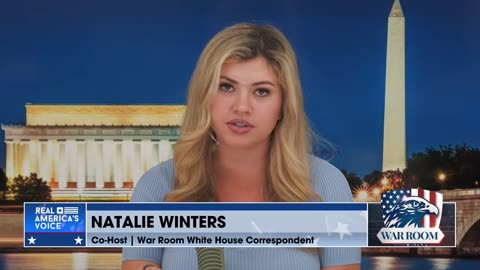
Natalie Winters On The US/CCP Trade War: China Has A Stranglehold Over Critical Minerals


Posted originally on Rumble By Bannon’s War Room on: June 4, 2025, at 7:00 pm EST

NARRATIVE WARFARE: NFSC Reveals The Takedown Of The Nationalist Party In China By CCP


Posted originally on Rumble By Bannon’s War Room on: June 4, 2025, at 1:00 pm EST

“We Don’t Depict China The Way It Is In Reality.” Chris Fenton On CCP Propaganda War


Posted originally on Rumble By Bannon’s War Room on: June 4, 2025, at 1:00 pm EST

Trump Blames Fed for Weak Payrolls – Media Blames Trump Tariffs


Posted originally on Jun 5, 2025 by Martin Armstrong 

Jobs

May’s private payrolls based on ADP estimates are the lowest since March 2023. Private payrolls rose only 37,000 last month, far beneath April’s addition of 60,000 and a far cry from the Dow Jones forecast of 110,000.

The financial sector rose by 20,000, leisure and hospitality saw an increase of 38,000, and construction added 6,000. Still, that was not enough to offset the losses on other sectors. Professional and business services shed 17,000 jobs, education and health services lost 13,000, goods-producing industries shed 2,000, natural resources and mining lost 5,000, and manufacturing was down by 3,000.

Mid-sized corporations gained 49,000 employees, while small businesses with fewer than 50 workers lost 13,000, and large firms with over 500 employees lost 3,000 positions. Raises grew by 4.5% while wages for job changers rose 7%.

Donald Trump is blaming the Fed. “ADP NUMBER OUT!!! ‘Too Late’ Powell must now LOWER THE RATE. He is unbelievable!!! Europe has lowered NINE TIMES!” Trump said on his Truth Social site.

Europe has kept rates artificially low, and it has done absolutely nothing to prevent its economy from contracting. They destroyed pension systems and the banking sector, and still got no economic growth. Rates near zero don’t create investment when there’s no confidence and excessive regulation. It’s the same in reverse: high rates don’t stop inflation when the cause is geopolitical, not consumer-driven or based on demand.

Manipulating interest rates is no longer an efficient tool, as the issue is structural. We are in a phase of stagflation where we see rising costs without real growth. This is not driven by regulation, shortages, and geopolitical tensions. I have warned that history will turn around and blame Donald Trump for implementing tariffs. The tariffs themselves are not the cause of the current state of stagflation, but it is the easiest culprit for politicians and analysts to cite without having a deeper knowledge of the inner workings of the economy.

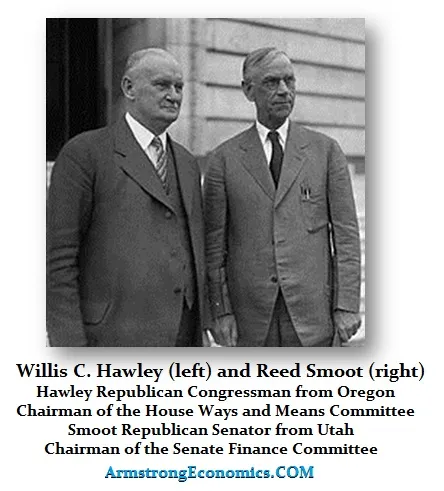
Smoot_Hawley

Only academics believe the Smoot-Hawley tariffs caused the Great Depression. Tariffs were merely the reaction, not the cause, to an overall decline in the global economy. War and reparations have left nations indebted to the point of financial failure.

The entire argument that the Smoot-Hawley Act caused the Great Depression is propaganda. It’s used to denounce free trade and blame Republicans, but the truth is that the collapse was already in motion from 1927, and Smoot-Hawley did not go into effect until June 17, 1930. You had sovereign debt defaults, currency crises, and collapsing capital formation. Tariffs were merely one variable of a much bigger problem. In fact, the US already had tariffs in place for over a century prior to the Smoot-Hawley Act, as that piece of legislation merely updated existing tariffs. Trade was on the decline long before tariffs.

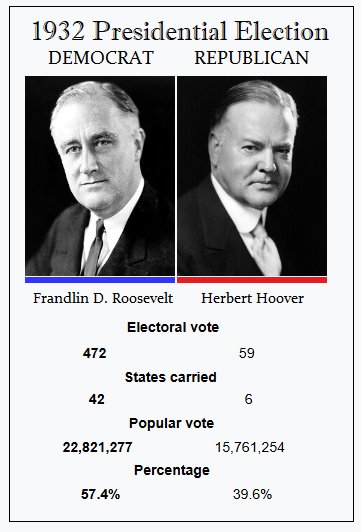
The US was heading into a period of stagflation long before Trump took office. Franklin D. Roosevelt  criticized Smoot-Hawley during his 1932 campaign and blamed Republican leaders for being unable to “stimulate foreign trade.”

1932 Election FDR vs Hoover

As FDR state in a 1934 message to Congress:

“”Other governments are to an ever-increasing extent winning their share of international trade by negotiated reciprocal trade agreements. If American agricultural and industrial interests are to retain their deserved place in this trade, the American government must be in a position to bargain for the place with other governments by rapid and decisive negotiation… If the American government is not in a position to make fair offers for fair opportunities, its trade will be superseded. If it is not in a position at a given moment rapidly to alter the terms on which it is willing to deal with other countries, it cannot adequately protect its trade against discriminations and against bargains injurious to its interests.”

This paved the way for the Reciprocal Trade Agreements Act of 1934, which provided the president with the power to negotiate bilateral tariff-reduction agreements without requiring Congressional approval. Roosevelt then engaged in reciprocity agreements based on mutual agreements where nations agreed to lower tariffs on each other’s goods, as Trump is doing today. Yet, today, consumers are wary of the future and less likely to spend.

Every negative piece of data will be blamed on the Trump Administration. The media will proclaim that jobs are fleeing the US due to Trump’s policies, but the trend was already in motion.

President Trump Announces Executive Order Restricting Entry of Foreign Nationals from Certain Countries


Posted originally on CTH on June 4, 2025 | Sundance

Today, President Trump signed an executive order [SEE HERE] restricting the entry of foreign nationals from a number of countries identified as national security and public safety risks. The goal is to prevent terrorists and other dangerous individuals from entering the United States and to pressure foreign governments to improve cooperation and information-sharing about their citizens.

Full Suspension: Nationals from 12 countries—including Afghanistan, Burma, Chad, Republic of the Congo, Equatorial Guinea, Eritrea, Haiti, Iran, Libya, Somalia, Sudan, and Yemen—are now subject to a full suspension of entry, both for immigrants and most nonimmigrant visas.

Partial Suspension: Nationals from 7 other countries—including Burundi, Cuba, Laos, Sierra Leone, Togo, Turkmenistan, and Venezuela—face a partial suspension, affecting specific visa categories and requiring reduced visa validity.  WATCH:

[Executive Order HERE]

Vietnam is in the Same Tough Trade Spot as Canada – It’s Not an Issue of Unwillingness, it’s Inability


Posted originally on CTH on June 4, 2025 | Sundance

President Trump and the trade team have made specific requests of Vietnam in order to negotiate a trade agreement.  Unfortunately, just like Canada, Vietnam’s problem is not an unwillingness to comply, it’s their inability.

CTH was in the manufacturing base of Vietnam in January; their factories are loaded with component parts from China used to produce finished goods sent to the USA (and globally).  President Trump is telling Vietnam they need to reduce their reliance on Chinese imported component goods, but China has spent billions in advanced positioning and contracts, influencing Vietnam.

Vietnam is a very poor country, and their population cannot afford to purchase the products they manufacture.  They do not have a domestic consumption base. They are reliant on exports to more wealthy nations to keep their manufacturing base afloat.  Practically, it is easy to have sympathy for Vietnam due to their economic dependence on both China (for imported raw materials) and the USA (for exported finished goods).

VIETNAM – The US has sent a “long” list of “tough” requests to Vietnam in its tariff negotiations, including demands that could force the country to cut its reliance on Chinese industrial goods imports, two people briefed about the matter told Reuters.

Washington wants Vietnam-based factories to reduce their use of materials and components from China and is asking the country to control more carefully its production and supply chains, one of the people briefed on the talks said, without elaborating on whether quantitative targets were included.

The list is part of an “annex” to a framework text prepared by US negotiators, according to four people familiar with the matter.

One of them, who had direct access to the document, said the list was sent to Hanoi at the end of May after the conclusion of a second round of talks with Washington aimed at avoiding 46% “reciprocal” tariffs on imports from Vietnam.

The sources declined to be named because those discussions were not public.

Reuters reported on Monday that the Trump administration wants countries to provide their best offers on trade negotiations by Wednesday, citing a draft letter to negotiating partners.

It was unclear which countries would receive the letter, but it was directed at those with active negotiations that included meetings and exchanges of documents. Washington has been engaged in such talks with countries including Vietnam, the European Union, Japan and India.

The sources described the US requests to Vietnam as “tough” and “difficult”. It is unclear how Hanoi will respond to Washington’s requests and whether it will send its own proposal by Wednesday.

The US Trade Representative did not respond to a request for comment outside US business hours.

Vietnam’s trade ministry did not reply to a request for comment.

A source briefed on the matter said if US requests to effectively cut Vietnam’s reliance on China were met, they could pose a serious challenge to the Southeast Asian country’s economy. Its sprawling manufacturing industry, which produces consumer goods including Apple devices and Nike shoes, is closely integrated into its much bigger neighbor’s supply chains.

It might also complicate Vietnam’s long-standing policy of maintaining good relations with China, a major foreign investor but also a source of security concerns due to conflicting claims in the South China Sea.

Vietnam has nearly tripled its exports to the United States since the start of the US-China trade war in 2018, when the first Trump administration imposed wide-ranging tariffs on Beijing, pushing some manufacturers to move production south.

But as exports to the US boomed, Vietnam also vastly expanded imports from China, with their inflow almost exactly matching the value and swings of exports to the United States over the years, each totaling around $140 billion in 2024, data from the US and Vietnam show. (read more)

As an outcome of the 2018 tariffs against China, which coincided with a President Trump visit to southeast Asia, multiple companies shifted manufacturing operations from China to Vietnam.

Beijing saw the move and slowly increased their own strategic footprint.

In the subsequent years as COVID-19 took attention from all other matters, and with Trump removed from the equation in 2020, China increased the scale of their investment and the outcomes in 2025 are very visible.

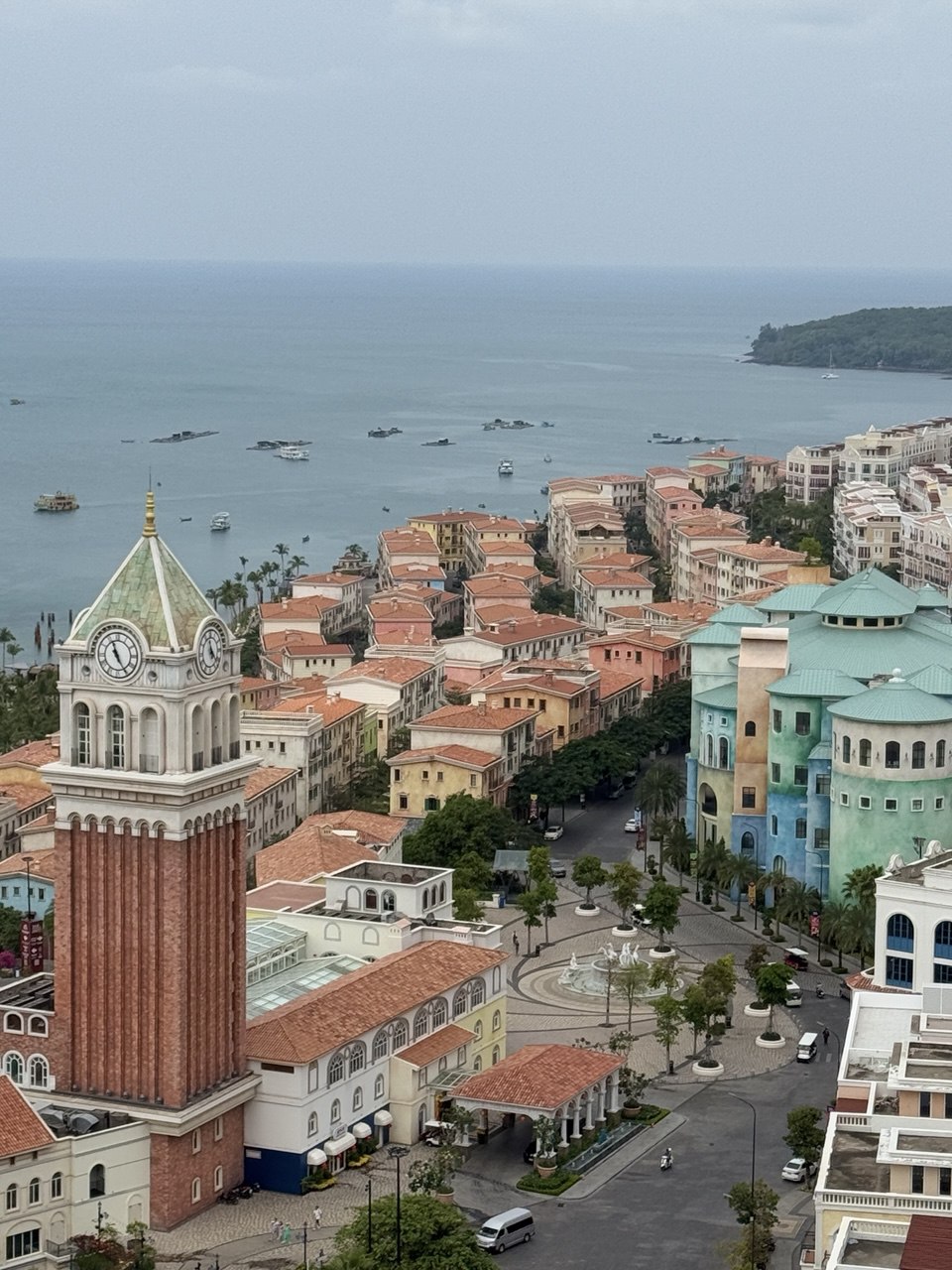
China even built this massive Disney type village in Phu Quõc (it’s nearly empty).

The people who live in Vietnam do not have money; they are a very poor nation.  The baseline poverty level in combination with their communist regime politics essentially eliminates their consumer power to purchase western goods and makes trade agreements between the U.S and Vietnam somewhat moot.

However, as a proxy manufacturing nation Vietnam is a valuable resource for China.

Essentially what can be seen in Vietnam is how Beijing spends money there for influence.  The U.S footprint is negligible in comparison to the visible influence of China.

Following the 2024 presidential election, Prime Minister Justin Trudeau traveled to Mar-a-Lago and said if President Trump was to make the Canadian government face reciprocal tariffs, open the USMCA trade agreements to force reciprocity, and/or balance economic relations on non-tariff issues, then Canada would collapse upon itself economically and cease to exist.  In essence, in addition to the NATO defense shortfall, Canada cannot survive as a free and independent north American nation, without receiving all the one-way benefits from the U.S. economy.

Representing Canada, Justin Trudeau was not expressing an unwillingness to comply with fairness and reciprocity in trade with the USA, what Trudeau was expressing was an inability to comply.  Quite simply, after decades of shifting priorities, Canada no longer has the internal economic capability to comply with a fair-trade agreement (FTA).  Trudeau was not lying, and President Trump understood the argument; hence his 51st state remarks. {Go Deep}

Like Canada, Vietnam has the problem of ability to comply with President Trump demands.  However, unlike Canada, a wealthy nation who did this entirely to themselves as they chased leftist “green” dreams, Vietnam’s inability is an outcome of the financial windfall that came from President Trump’s first term targeting of China.

A free trade agreement with Vietnam is going to be tricky because Vietnam will need to find an alternate source of component material.