The Third Sunday of Lent


Posted originally on the CTH on March 12, 2023 | Menagerie | 15 Comments

Jn 4:5-42

Jesus came to a town of Samaria called Sychar,
near the plot of land that Jacob had given to his son Joseph.
Jacob’s well was there.
Jesus, tired from his journey, sat down there at the well.
It was about noon.

A woman of Samaria came to draw water.
Jesus said to her,
“Give me a drink.”
His disciples had gone into the town to buy food.
The Samaritan woman said to him,
“How can you, a Jew, ask me, a Samaritan woman, for a drink?”
—For Jews use nothing in common with Samaritans.—
Jesus answered and said to her,
“If you knew the gift of God
and who is saying to you, ‘Give me a drink, ‘
you would have asked him
and he would have given you living water.

The woman said to him,
“Sir, you do not even have a bucket and the cistern is deep;
where then can you get this living water?
Are you greater than our father Jacob,
who gave us this cistern and drank from it himself
with his children and his flocks?”
Jesus answered and said to her,
“Everyone who drinks this water will be thirsty again;
but whoever drinks the water I shall give will never thirst;
the water I shall give will become in him
a spring of water welling up to eternal life.”
The woman said to him,
“Sir, give me this water, so that I may not be thirsty
or have to keep coming here to draw water.”

Jesus said to her,
“Go call your husband and come back.”
The woman answered and said to him,
“I do not have a husband.”
Jesus answered her,
“You are right in saying, ‘I do not have a husband.’
For you have had five husbands,
and the one you have now is not your husband.
What you have said is true.”
The woman said to him,
“Sir, I can see that you are a prophet.
Our ancestors worshiped on this mountain;
but you people say that the place to worship is in Jerusalem.”
Jesus said to her,
“Believe me, woman, the hour is coming
when you will worship the Father
neither on this mountain nor in Jerusalem.
You people worship what you do not understand;
we worship what we understand,
because salvation is from the Jews.
But the hour is coming, and is now here,
when true worshipers will worship the Father in Spirit and truth;
and indeed the Father seeks such people to worship him.
God is Spirit, and those who worship him
must worship in Spirit and truth.”
The woman said to him,
“I know that the Messiah is coming, the one called the Christ;
when he comes, he will tell us everything.”
Jesus said to her,
“I am he, the one speaking with you.”

At that moment his disciples returned,
and were amazed that he was talking with a woman,
but still no one said, “What are you looking for?”
or “Why are you talking with her?”
The woman left her water jar
and went into the town and said to the people,
“Come see a man who told me everything I have done.
Could he possibly be the Christ?”
They went out of the town and came to him.
Meanwhile, the disciples urged him, “Rabbi, eat.”
But he said to them,
“I have food to eat of which you do not know.”
So the disciples said to one another,
“Could someone have brought him something to eat?”
Jesus said to them,
“My food is to do the will of the one who sent me
and to finish his work.
Do you not say, ‘In four months the harvest will be here’?
I tell you, look up and see the fields ripe for the harvest.
The reaper is already receiving payment
and gathering crops for eternal life,
so that the sower and reaper can rejoice together.
For here the saying is verified that ‘One sows and another reaps.’
I sent you to reap what you have not worked for;
others have done the work,
and you are sharing the fruits of their work.”

Many of the Samaritans of that town began to believe in him
because of the word of the woman who testified,
“He told me everything I have done.”
When the Samaritans came to him,

they invited him to stay with them;
and he stayed there two days.
Many more began to believe in him because of his word,
and they said to the woman,
“We no longer believe because of your word;
for we have heard for ourselves,
and we know that this is truly the savior of the world.”

Do the Little Things


Posted originally on the CTH on March 11, 2023 | Menagerie 

Impossible

Last week we talked about having a post for people to share their struggles and successes in pursuit of fasting, sacrifices, and healthy living. I had originally intended a weekly post which would be for discussions from both a religious and secular point of view.

After reading comments, as well as reflecting on past feedback from our Treepers, I think that may not be the way to go. We have readers who love to share their religious posts, and mostly do that on the OT, every day. I do think there may be opportunities for those who want to dig deeper into things like fasting and contemplative prayer, or theological discussions, and sacrificial living.

That being said, this is an opportunity for sharing. I am not attempting to guide the Treehouse on a more religious path, or veer away from what it has become. The post will not be a place for arguments or attacks on another denomination. If it goes in that direction I will simply discontinue the posts. There are good sites where one can follow apologetics from many perspectives. Go there for that.

We have also gotten a lot of feedback over the years from people who want a place for discussions other than politics that is not overwhelmingly a faith based discussion. We will try that out also, and I will remind posters to respect the intent of each post, and the audience who may want to contribute.

For now, I tentatively plan to post on alternate weeks, one post, probably on Fridays, for faith discussions, and living it out sacrifically and practically. The next week a post intended for those who’d like to discuss diets, exercise, healthy eating, motivation, share recipes, that sort of thing. I’ll probably post this on Saturday or Sunday with the idea of preparing and being motivated for the week ahead.

This may be confusing, especially at first. Maybe if there is interest we will do it weekly, and that might cut down on confusion. The days might change. Suggestions on my post last week favored every day of the week except Tuesday and Thursday. So, we will attempt something new, and see if it bears fruit.

Now, on to the title I’ve chosen for the first post to share ideas on healthy eating, exercising, health management, maybe even tips on how you manage the aches and pains of aging or injury. For example, my fellow admins had a discussion a month or two ago on B complex vitamins. Their suggestions really helped me with some lingering mild neuropathy from my ankle injury.

Two and a half years ago I fractured my ankle, all three bones, and suffered some ligament damage also. In a few months, hopefully I’ll get an ankle replacement and regain a lot of the mobility I’ve lost, as well as perhaps decrease the pain. For a lot of those two years, I have not handled the new circumstances the injury left me with. I’m sorry (really) to say that I’ve spent a lot of time looking back, a lot of time mourning what I lost, even resenting it, and hating what I cannot do. Of course, that got me exactly nowhere. And was a huge failure in picking up my cross.

Finally, this past December, I decided to forget about how many miles I used to walk daily. The other physical activities I could do. I decided to walk only five minutes, if that was all I could do. To use dumbbells and do one set of low impact exercises, if one set is all I can do. To do chair squats to improve my leg strength. To do the physical therapy exercises again. And to do what I can do throughout the day instead of trying in vain to accomplish things that are no longer in my reach, and will not be, at least for now.

And I’ve gotten stronger. I walked 3/4 of a mile the other day, on some slight hills. I can be on my feet a little longer with less pain. I feel better, and have a better outlook. Because I can see accomplishments physically, I am more motivated to eat healthier foods and stick with my intermediate fasting.

It’s still a hard thing to deal with, that my actions produce incremental progress that might never be what I want it to be. That I have to accept less than what I had, and what I want. But it is better than not trying at all, and I am far from determining what my successes might be.

I recommend the book Atomic Habits by James Clear. It’s a great book on ways to introduce small changes that can lead you to big results.

If you can pass on some tips or experiences to help us eat better, get stronger, stay motivated, and deal with adversity and injury, please share. It might be a keto recipe, a story of how you lost weight and kept it off, or tips on vitamins and supplements like the B complex story above.

Please keep your comments to a moderate length. People stated on the original post, and in emails, that they really don’t want to have to skim past long, long posts, as they simply won’t read them. If you have a big story, share it it segments each week, or sum up what’s most important, or zero in on one important aspect or detail to share.

Second, there are many ways to health and fitness. Many people are eating low carb, or fasting. Some are strictly calorie watchers. Others follow a low fat, no sugar diet. Some are vegetarian. Offer your tips but do not push your thoughts on others. I hope we will get a wide variety of good ideas for people to choose from, no matter what choices they make. Our readers are intelligent enough to make their own choices. Let them.

Stay on topic. I don’t care how much you think political events are relevant to this post, don’t hijack this (or future) posts with political discussions.

I am not sure whether I will start the Fasting Abstinence, and Sacrifices posts during Lent on Fridays, or wait until after Easter. We’ll see how that works out.

The Second Sunday of Lent


Published originally on the CTH on March 5, 2023 | Menagerie | 4 Comments

Gospel

Mt 17:1-9

Jesus took Peter, James, and John his brother,
and led them up a high mountain by themselves.
And he was transfigured before them;
his face shone like the sun
and his clothes became white as light.
And behold, Moses and Elijah appeared to them,
conversing with him.
Then Peter said to Jesus in reply,
“Lord, it is good that we are here.
If you wish, I will make three tents here,
one for you, one for Moses, and one for Elijah.”
While he was still speaking, behold,
a bright cloud cast a shadow over them,
then from the cloud came a voice that said,
“This is my beloved Son, with whom I am well pleased;
listen to him.”
When the disciples heard this, they fell prostrate
and were very much afraid.
But Jesus came and touched them, saying,
“Rise, and do not be afraid.”
And when the disciples raised their eyes,
they saw no one else but Jesus alone.As they were coming down from the mountain,
Jesus charged them,
“Do not tell the vision to anyone
until the Son of Man has been raised from the dead.”

Nero the Antichrist – Deep State & Fake News


Armstrong Economics Blog/Religion Re-Posted Mar 3, 2023 by Martin Armstrong

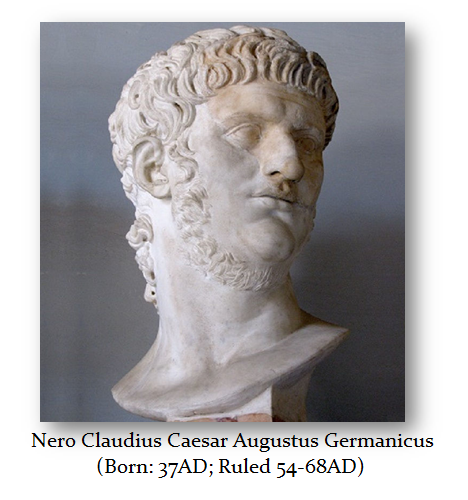
Many in Antiquity were claiming that Nero was the AntiChrist. No doubt, there was even an academic consensus that Nero should be identified with the various Antichrist figures in the bible. I seriously doubt that any of that analysis was correct. Nero was really slandered in antiquity because of the Great Fire of Rome claiming he set the fire and played his fiddle as Rome burned.  First of all, the fiddle didn’t exist in ancient Rome since it only made its appearance during the 11th century. There is no such evidence that Nero played anything during the great fire. The Roman historian Publius Cornelius Tacitus (c. 56–120AD)  wrote that Nero was rumored to have sung about the destruction of Troy while watching the city burn; however, he stated clearly that this was unconfirmed by eyewitness accounts. That was the origin of the saying. When the Great Fire broke out, Nero was at his villa at Antium, some 35 miles from Rome, and was not watching anything burn.

Agrippina-Nero

Nero’s unpopularity developed originally from his mother, Agrippina, Jr., who was a dominant mother and a power-hungry woman with many attributes of Hillary Clinton. Agrippina, Jr. was the first woman whose portrait appeared on Roman gold coins during her lifetime. She was first banished by her brother Caligula for being suspected of a plot against him to take the throne. She was very lucky to escape that one with her life. She then connived to marry her uncle, Claudius. The plot then thickens for Claudius’s heir, his son Britanicus, is then poisoned. Some attributed this to Nero, but it seems more likely the deed of his mother. Upon Claudius’s death, which she also may have aided with poison, she really rules the empire in her son’s name who was still a teenage boy much as Hillary ruled the country while Bill fiddled around. Like Hillary, she wanted power.

Eventually, Nero broke free by having his mother at last killed. He staged a death by drowning to make it look like an accident when her barrage sank. But she swam to shore and he ordered her killed on the spot. Her last words were to stab her in the womb from which he was born. So ended the life of a very vile woman whose quest for power led her to try to kill her brother and then kill her nephew and finally her uncle.

It was Agruppina Jr, who really made Nero very unpopular. Yet, since the people were blaming Nero for the fire, he needed a scapegoat. They became the Christians who he had arrested and executed beginning the Christian persecutions. He did not execute them for their religion at that time. He just needed a scapegoat. Nero was also struggling against the corruption within the Deep State. Sound familiar? Nero took on the fight clashing with the bureaucracy that set in motion his own demise. Tax collectors were accused of being corrupt and too harsh with the poor. Nero championed the little guy and transferred the collection of the tax authority to lower commissioners. Nero banned also any magistrate or procurator from exhibiting public entertainment for fear that the venue was being used as a method to sway the populace to support their corruption behind the scenes – hence giving them circuses and free food. Furthermore, Nero then impeached many officials for corruption and removed them from the government as well as having many arrested for extortion and corruption.

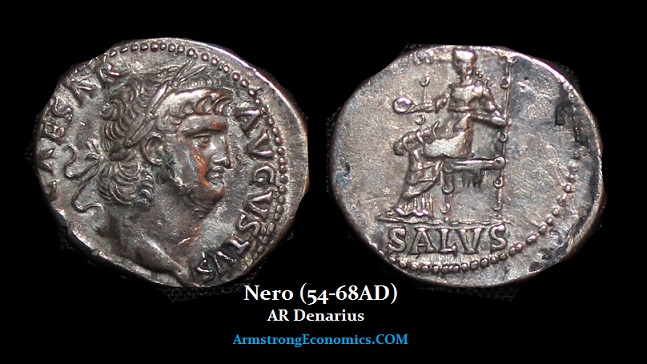
As further complaints arose from the people that the poor were being overly taxed, Nero attempted to repeal all indirect taxes. The Senate convinced him this action would bankrupt the public treasury. As a compromise, taxes were cut from 4.5% to 2.5%. He also began the first debasement of the silver coinage whereas the average fineness pre-64AD was 97.5% as this was reduced to 93.5%. The weight of the silver denarius was also reduced from 3.63 grams to 3.36 grams in 64AD. This was to accommodate the lower taxes on the poor.

Additionally, secret government tax records were now ordered to become public. To lower the cost of food imports, Nero also directed that merchant ships were declared tax-exempt. None of these measures sat well with the Senate, to say the least. They were clearly efforts he took on in his battle against the Deep State trying to weed out corruption. The Deep State, at the time, was getting very angry at reducing its corruption.

Nero not only reduced taxes, but he also gave slaves permission to file civil complaints against unjust masters, which was very shocking to many. Now the elite really got angry. Nero also imposed a tax of 4% on the sale of slaves that was to be remitted by the seller. Nevertheless, purchasers typically found that the tax was merely added as part of the price in a European VAT fashion.

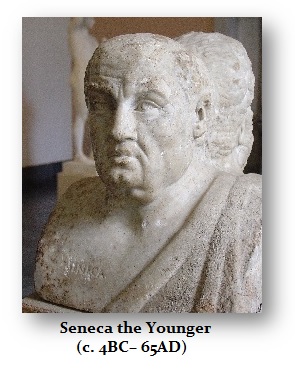
Seneca the Younger (c. 4 BC–AD 65), was a Roman Stoic philosopher and statesman. He was a tutor and later advisor to Emperor Nero. Seneca had a hand in financial reform to improve the financial administration of the Empire. Governors were actually being prosecuted for extortion rather than the modern version of too-big-to-jail. The emperor by an edict (Executive Order today) forbade any magistrate or procurator in the government of a province to exhibit a show of gladiators or of wild beasts, or indeed any other public entertainment. This was typically the method Governors bought favor from the people to cover up the extensive bribery and extortion.

Nero also established retirement colonies for veterans in Italy. There were simply many deeds he enacted prior to 64AD that reveal a decent administrator of the Empire. Nero even attempted to promote free trade by removing all indirect taxes. However, this proved too difficult to administer due to the pervasive corruption.

The Deep State conspired to kill Nero for his reforms. Some sources state that Seneca may have been innocent, but he was also implicated and forced to take his own life for alleged complicity in the Pisonian Conspiracy to assassinate Nero. Human nature most likely implicated Seneca for he was believed to be directing Nero in the reform effort. It makes sense that they would have falsely accused Seneca to get rid of him as well.

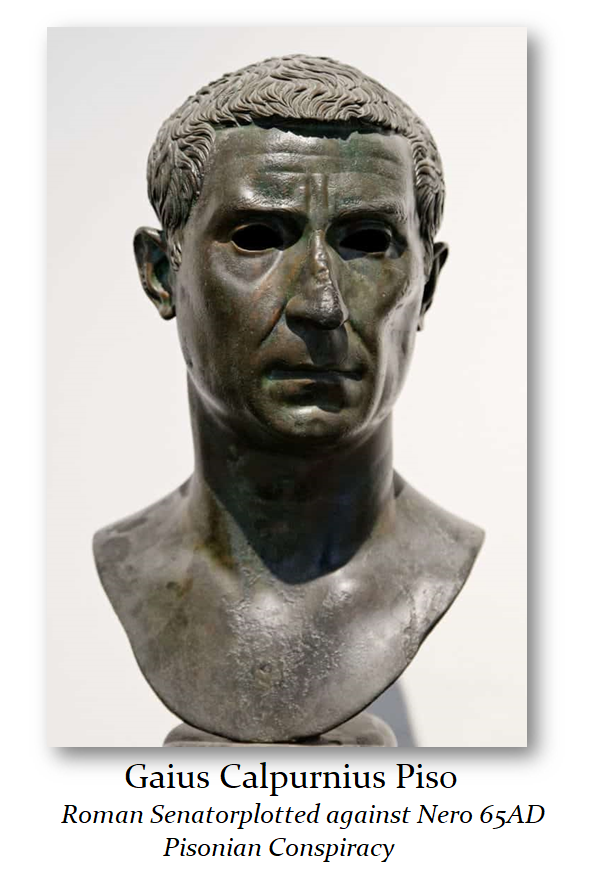
The conspiracy of Gaius Calpurnius Piso in AD 65 was a major turning point for it was clearly the Deep State rising up against Nero. The plot reflected the growing discontent among the ruling class of the Roman state with Nero’s increasing attack upon corruption. Piso was a leading Roman statesman who was said intended to have Nero assassinated and replace him as Emperor through acclamation by the Praetorian Guard. He was joined by many prominent senators, equestrians, and soldiers. The conspirators were said to have varying motives. Some wished to replace Nero with a better emperor who understood the Deep State was off limits, others wished to be free of emperors altogether, and restore a purely Republican form of government and all its free-wheeling corruption.

According to the Roman historian Tacitus, the ringleaders included a Praetorian tribune named Subrius Flavus, and a centurion named Sulpicius Asper, who helped Piso devise the plot, which was discovered when a woman named Epicharis tried to solicit Proculus, a fleet captain in Campania, to join the conspiracy. Instead, Proculus turned her in, but she committed suicide. Another named Milichus discovered the conspiracy and reported it to Nero’s secretary Epaphroditos. When arrested, many conspirators quickly ratted everyone else out to save themselves. Nero ordered Piso, the philosopher Seneca, his nephew Lucan, and the satirist Petronius to commit suicide.

Trump’s battle to drain the swamp was certainly nothing new to history. The Deep State from the NSA, FBI, CIA, the Neocons, along with the media CNN, Washington Post, and the New York Times, all joined forces to remove Trump to also protect the Deep State.

I believe that the early Biblical scholars eat up the fake news of the day as the Deep State sought to slander Nero for their war against him who was also trying to drain the swamp. Lacking a real understanding of the politics of Rome,  they bought into that and declared Nero an AntiChrist. Once again, he was neither a Jew nor was he persecuting Christians for their religion.

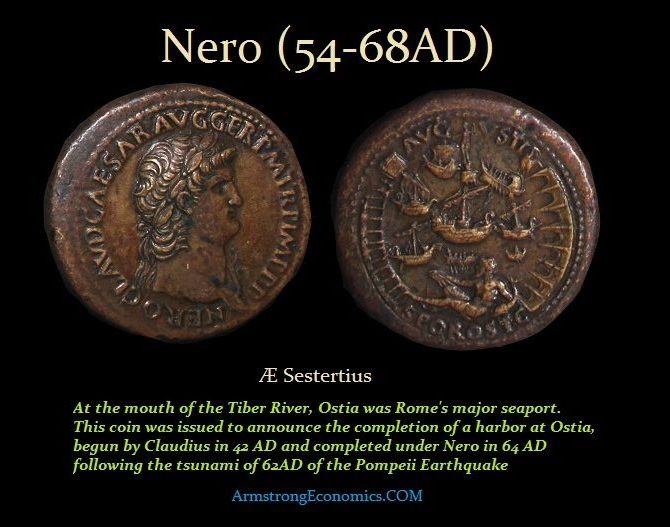
Their attribution of Nero as the AntiChrist was just the outcrop of fake news. It was Nero who liberated Greece from taxation and rose to protect the people who even canceled his trip to Egypt to ensure the grain supply reached Rome safely without the corruption of the Deep State. Nero even issued a sestertius showing the modern port of Ostia to ensure that grain would arrive at Rome from Egypt.

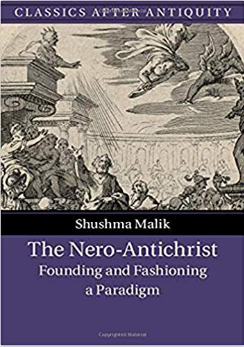
Shushma Malik’s book also refutes that view of Nero as the AntiChrist as she challenged the academic assumption that literary representations of Nero as a tyrant were wrong. The fake news put out by the Deep State merely served to prejudice most Christian populations located at the time who were in Asia – the East. She deconstructs the associations often identified by scholars between Nero and the Antichrist in the New Testament.

Fasting, Abstinence, Sacrifices, and More


Posted originally on the CTH on March 3, 2023 | Menagerie | 34 Comments


Most people of faith have heard much about Catholic practices during Lent. Indeed, we earned the label fish eaters fair and square. Many fast food restaurants add a fish sandwich to their menu in the spring. You start seeing Friday Fish Fry signs beside Catholic churches. By the way, if you haven’t tried out a fish fry, it’s usually a good way to get a pretty good meal cheap.

We’ve had a day of fasting last week on Ash Wednesday, and we will again fast and abstain from eating meat for our one meal on Good Friday. There are also rules about Friday for the rest of the year, but I’m not wanting to talk about our Fridays so much here. Catholics know and practice these things, or they don’t.

What I would like to discuss here, and expand on to a bigger picture, is the custom of Christians who fast, or make personal sacrifices, and not just during Lent. Many Christians have found it very beneficial to choose to give up food, television, sleeping later in order to pray, or some other attachment in order to further their relationship with God. And further yet, personal sacrifices past Lent, every day struggles.

For over a year, I have used the Hallow app. I downloaded it two years ago when I first listened to the Bible in a Year podcast, which I highly recommend to you. The app is full of everything from Sunday sermons, music, daily prayers and Psalms, meditations, and of course, many seasonal aids such as those I’m using now during Lent.

I’ve found it very worthwhile during Advent, and now Lent. As I said, I use it daily now. This app is full of selections and so many celebrities and well known Catholics offer readings. There’s Jim Caviezel, Jonathan Roumie of The Chosen, Bishop Robert Barron, Fr. Mike Schmidt,  and Mark Wahlberg to name a few.

So, I’m wondering, do Protestants have such apps? If so, which ones have you tried, and what would you recommend to others?

The Hallow app has many fine things that Protestant Christians would appreciate and use, and I highly recommend it to all. There must be other resources you use, both during seasons such as Lent, and as an aid daily as well.

What prompted this post is my reflection on how much better I usually do with my resolutions and practices during Advent, and especially during Lent. I recognize that one of the several reasons for this is the use of the app. Another is the fact the the seriousness and purpose of Lent itself is, of course, highly motivating.

But there’s also the fact that I have lots of company in this journey, both at home, and among my fellow Christians, fellow parishioners, and many others who share thoughts and inspiration as we look toward Good Friday.

I’m thinking about perhaps doing a once a week post, not just for Lent, to help each other out in our struggles and sacrifices. Sure, I hope some will share their spiritual goals and struggles. I also hope we could expand that to more mundane struggles and offer encouragement, ideas, success stories, and well, hope.

So, would you find interest in such a post? If so, what day of the week would you prefer? My first thought was Friday, because that’s on my mind right now, but in the larger perspective, perhaps Sunday or Monday would be a more motivational choice?

Any other tips or ideas for the structuring of the post, if we go with it? I have in mind it being pretty wide open, a place where someone might post a book suggestion, a Bible verse, a keto recipe, and a personal celebration of a goal accomplished. And above all, offer encouragement. I would also like it to be a post everyone could participate in, if they choose, either in sharing or just reading the comments. In other words, not just a hangout for Christians who are fasting, etc., but for a wider audience and more comprehensive topics.

Your thoughts?

The First Sunday of Lent


Posted originally on the CTH on February 26, 2023 | Menagerie

Gospel
Mt 4:1-11
At that time Jesus was led by the Spirit into the desert
to be tempted by the devil.
He fasted for forty days and forty nights,
and afterwards he was hungry.
The tempter approached and said to him,
“If you are the Son of God,
command that these stones become loaves of bread.”
He said in reply,
“It is written:
One does not live on bread alone,
but on every word that comes forth
from the mouth of God.”

Then the devil took him to the holy city,
and made him stand on the parapet of the temple,
and said to him, “If you are the Son of God, throw yourself down.
For it is written:
He will command his angels concerning you
and with their hands they will support you,
lest you dash your foot against a stone.”
Jesus answered him,
“Again it is written,
You shall not put the Lord, your God, to the test.”
Then the devil took him up to a very high mountain,
and showed him all the kingdoms of the world in their magnificence,
and he said to him, “All these I shall give to you,
if you will prostrate yourself and worship me.”
At this, Jesus said to him,
“Get away, Satan!
It is written:
The Lord, your God, shall you worship
and him alone shall you serve.”

Then the devil left him and, behold,
angels came and ministered to him.

Remember You Are Dust, and to Dust You Shall Return


Posted originally on CTH on February 22, 2023 | Menagerie

Jl 2:12-18
Even now, says the LORD,
return to me with your whole heart,
with fasting, and weeping, and mourning;
Rend your hearts, not your garments,
and return to the LORD, your God.
For gracious and merciful is he,
slow to anger, rich in kindness,
and relenting in punishment.
Perhaps he will again relent
and leave behind him a blessing,
Offerings and libations
for the LORD, your God.

Blow the trumpet in Zion!
proclaim a fast,
call an assembly;
Gather the people,
notify the congregation;
Assemble the elders,
gather the children
and the infants at the breast;
Let the bridegroom quit his room
and the bride her chamber.
Between the porch and the altar
let the priests, the ministers of the LORD, weep,
And say, “Spare, O LORD, your people,
and make not your heritage a reproach,
with the nations ruling over them!
Why should they say among the peoples,
‘Where is their God?’”

Then the LORD was stirred to concern for his land
and took pity on his people.

Many people associate the season of Lent with Catholicism, but that no longer holds true. Many other churches and people are choosing to observe the forty days (not including Sundays) before Easter. Lent is a time of penance, of choosing to look closely at our lives and invite the Holy Spirit in to help us clean house.

Often we will choose to give up something, a sacrifice we offer to the Lord, but also something we use as a way to remind us to be more holy, more dependent on God. We fast on Ash Wednesday and Good Friday, and we abstain from meat on Fridays as well, although many Catholics do not understand that we still have an obligation to fast on Fridays or substitute another penitential practice year round. We are called to give alms during Lent.

These practices are meant to help us prepare to meet Jesus on Easter Sunday, having walked these six weeks with him toward Calvary, fasting as he fasted in the desert, carrying our cross as he carried his, doing the will of the Father as Jesus taught us so well.

Like Mary, we hope to find ourselves at the foot of the cross on Good Friday, still with our Savior, looking with a more hopeful and receptive heart toward the Resurrection.

If you are not a member of a church, or your particular church does not have any Ash Wednesday service, you are welcome to participate at any Catholic Church. You do not have to be Catholic to attend the service or receive the ashes. I’m sure that is true of other denominations as well.

Catholics, and many other Protestant denominations follow a liturgical calendar, which I find to be of great aid to me daily and yearly in my attempt to follow Jesus. Advent begins our new Church year, and we look forward to the birth of Jesus. We then celebrate Christmas for an Octave, and the season ends with Epiphany. Soon after comes Lent, and we cast our eyes toward Holy Week, and the death, and Resurrection, and we again spend eight days, another Octave, celebrating Easter. After Pentecost comes the long stretch of what the Church call Ordinary Time before we start again with Advent.

I find this yearly journey helps me keep an eye on where I am going. It helps me not just tread water spiritually, but make progress, and to more “live out” the life of Christ.

If your church has special services today or during Lent, please tell us about it, especially if visitors are welcome to participate. And don’t forget the Knights of Columbus fish fry on Fridays! Usually for five or six bucks you’ll get a get supper and help the Knights raise money for their charitable causes.

This post, and all of those you will encounter during Lent and Easter are meant to encourage us in our worship. If you choose not to worship, are not Christian, or have a grudge against specific faiths such as Catholicism , there are many forums online where you can debate or condemn. This is not one of them, and I will without any second chances ban anyone who breaks that rule. I’m sorry that this has become a necessary warning, but it has.

Happy Mardi Gras


Posted on originally on the CTH by Menagerie on February 21, 2023 


Today is Fat Tuesday, the culmination of the famous season of Mardi Gras.

Debauchery. Bacchanalia. Floats, costumes, beads and masks, and lots of drinking and partying. That’s what we think of when we hear the term Mardi Gras, or Fat Tuesday.

There is a lot more behind it. Also called Shrove Tuesday, it marks the last day of the liturgical calendar before Lent begins.

After Catholicism spread throughout Europe, many cultures celebrated the final day before Lent began in ways unique to that individual  culture. Eggs, and milk were finished off in one day, giving rise to the term Fat Tuesday. In Poland, such things as lard, sugar, eggs, and fruit were forbidden during Lent, and the beloved  pączki became a special treat for Fat Tuesday. In Detroit they still sell many thousands of them to long lines of people.

Enjoy your Fat Tuesday, and spare a thought to the next forty days. Why not observe Lent, and use the time to more deeply appreciate Christ’s sacrifice and his love for us?

I am sure you’ve seen people on Ash Wednesday with a cross traced on their foreheads. Many churches have Ash Wednesday services, and all are welcome. It’s a thought provoking way to begin your journey, to center and prepare yourself to make changes, to clean out some baggage and make more room for the truly important things.

This is a repeat post. I hope you will join us the next weeks as we look toward Good Friday and the Cross, with the goal of making ourselves a little more able to celebrate on Easter Sunday.

Former President Jimmy Carter (98) Receiving Hospice Care


Posted originally on the CTH on February 18, 2023 | Sundance 

Former President Jimmy Carter (98) has chosen to spend his final days at home in Plains, Georgia, in hospice care after a series of brief hospital stays, the Carter Center announced today. [Announcement Link]

(Source)

While many of us would not be considered “admirers“, it is a rightful thing to keep a good thought and prayer for his family during this stage of his life.

Psalm 23, a psalm of David:

The LORD is my shepherd, I shall not want. He makes me lie down in green pastures, He leads me beside quiet waters, He restoreth my soul. He guides me along the righteous path for His name’s sake.

Yea, though I walk through the valley in the shadow of death, I will fear no evil, for Thou are with me; Thy rod and Thy staff, they comfort me.

You prepare a table before me in the presence of my enemies. You anoint my head with oil; my cup overflows.

Surely Your goodness and love will follow me all the days of my life, and I will dwell in the house of the LORD forever.

~ Amen

Roman Gods & Religion Was Not as it Might Seem


Armstrong Blog/Ancient History Re-Posted Jan 16, 2023 by Martin Armstrong

QUESTION: You mentioned that Rome actually believed in the freedom of religion. I am correct then that the multitude of gods was the result of that? And you are saying they were not pagans in the sense that the Christians portrayed?

GH

ANSWER: Yes. They allowed all their conquered states to worship whoever they believed. Yet the fascinating thing is that these were more like Christians envisioned saints insofar as each was in charge of something. The Romans believed in an afterlife, but they did not believe that all these “gods” were actually those who created them. For example, you would go to Posiden if you were Greek to plead for a safe voyage and if you were Roman you would go to Neptune. Neptune is the Roman sea and freshwater god, while Poseidon is the Greek god of the sea. So there were subtle differences where Neptune was in charge of even lakes while the Greek Poseidon looked over the sea exclusively.

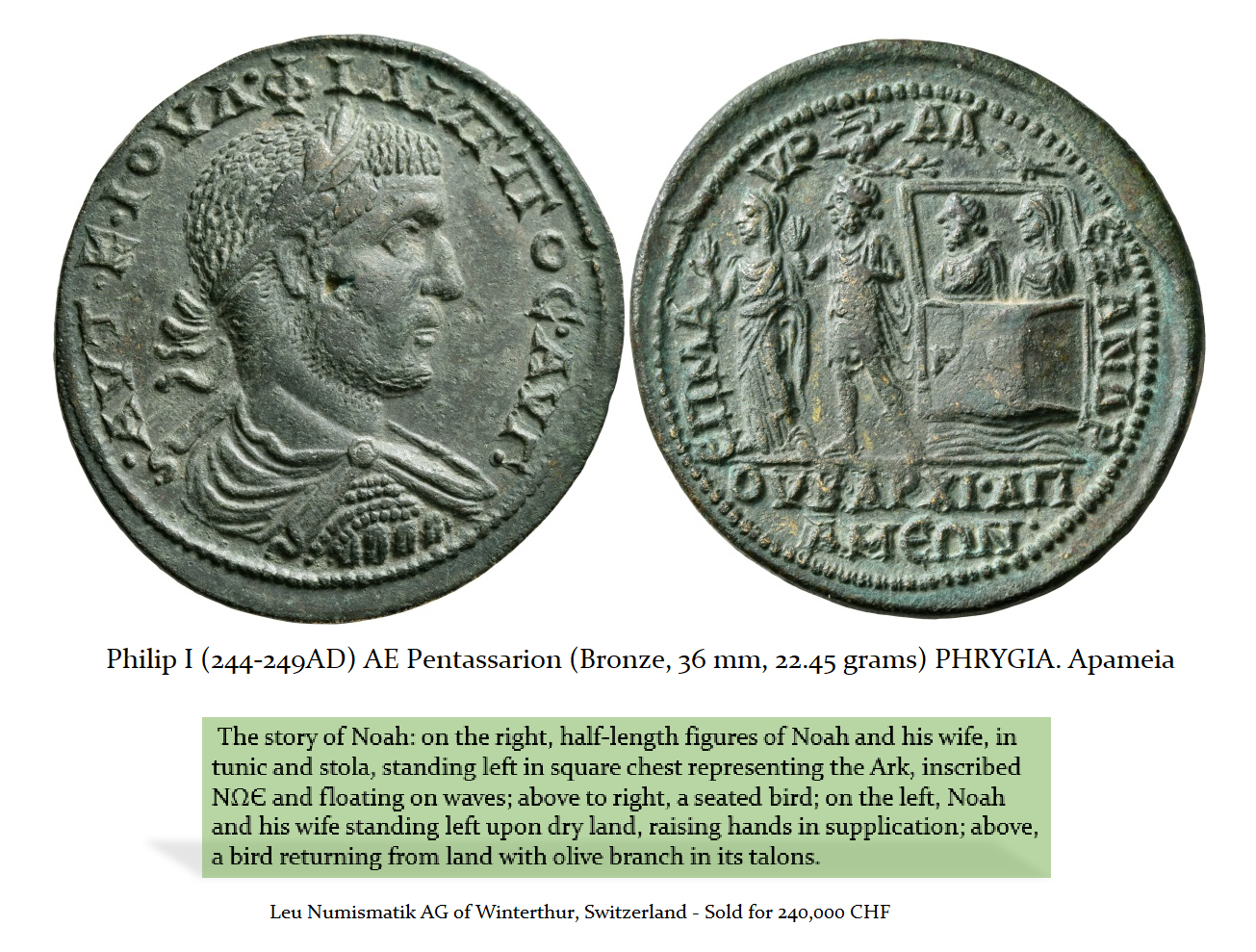
Here is a rare coin of Philip I (244-249AD) struck in Phrygia. The Reverse shows the story of Noah with his wife emerging from the famous Ark. This coin was sold at auction by Leu Numismatik AG in Winterthur, Switzerland for 240,000 Swiss francs. Even the story of Jesus was not so strange for Zeus was said to have sent his son to earth to help mankind. His name was Hercules.

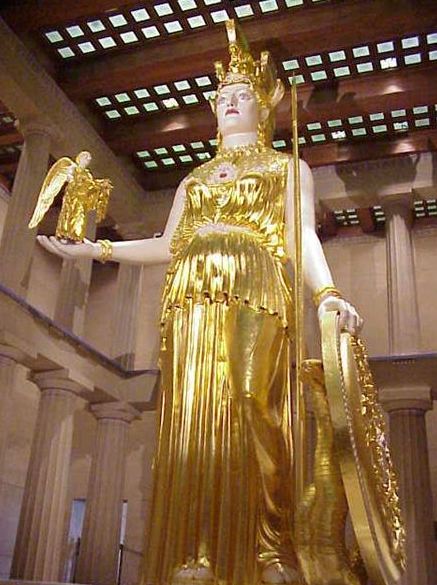
The Christians called everyone else pagans. But these various “gods” were never seen as the person who created the earth and humans.  Athena was merely the “goddess” who was the protector of Athens. She did not create the world or humans. So the definition of what was a “pagan” is not exactly as the early Christians presented. This is also why so many then converted to Christianity for those to whom they prayed were never seen as the “almighty” for created everything.