FBI Director Promises Surge of Investigative Resources Following Minnesota Fraud Revelations


Posted originally on CTH on December 29, 2025 | Sundance

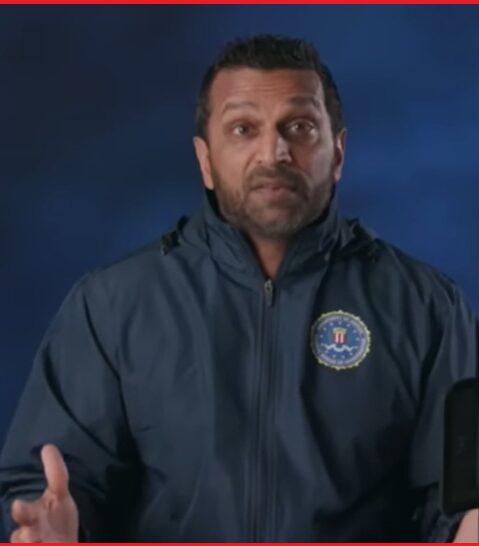
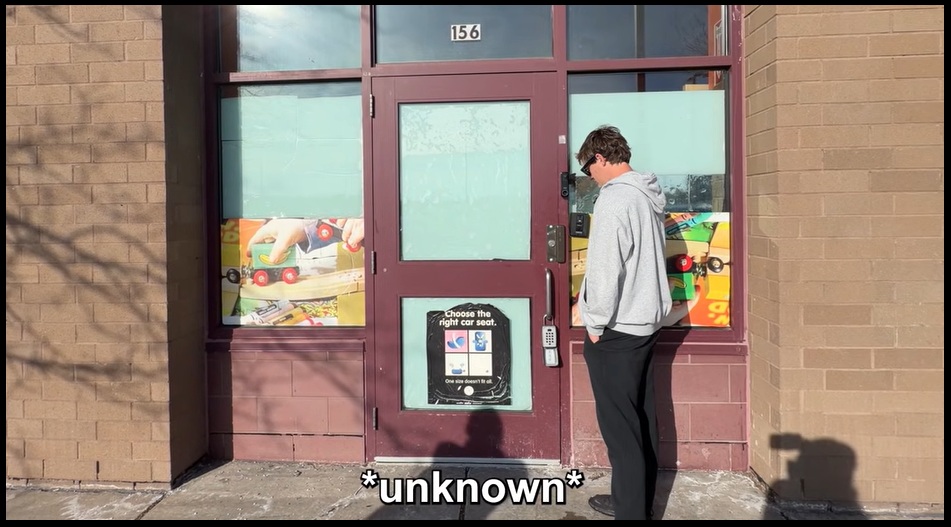
Following a viral investigative report by independent journalist Nick Shirley on the Somali community fraud in Minneapolis, Minnesota, FBI Director Kash Patel announces a surge in FBI resources to the region to follow-up.

VIA Kash Patel – “The FBI is aware of recent social media reports in Minnesota. However, even before the public conversation escalated online, the FBI had surged personnel and investigative resources to Minnesota to dismantle large-scale fraud schemes exploiting federal programs. Fraud that steals from taxpayers and robs vulnerable children will remain a top FBI priority in Minnesota and nationwide.

To date, the FBI dismantled a $250 million fraud scheme that stole federal food aid meant for vulnerable children during COVID. The investigation exposed sham vendors, shell companies, and large-scale money laundering tied to the Feeding Our Future network.

The case led to 78 indictments and 57 convictions. Defendants included Abdiwahab Ahmed Mohamud, Ahmed Ali, Hussein Farah, Abdullahe Nur Jesow, Asha Farhan Hassan, Ousman Camara, and Abdirashid Bixi Dool, each charged for roles ranging from wire fraud to money laundering and conspiracy.

These criminals didn’t just engaged in historic fraud, but tried to subvert justice as well. Abdimajid Mohamed Nur and others were charged for attempting to bribe a juror with $120,000 in cash. Those responsible pleaded guilty and were sentenced, including a 10-year prison term and nearly $48 million in restitution in related cases.

The FBI believes this is just the tip of a very large iceberg. We will continue to follow the money and protect children, and this investigation very much remains ongoing.

Furthermore, many are also being referred to immigrations officials for possible further denaturalization and deportation proceedings where eligible.” (read more)

Generally speaking, the FBI doesn’t usually activate unless the issue at hand begins to become a risk or threat to Washington DC.  The FBI usually acts as a proactive defense mechanism for the interests of federal government.

Citizen Journalist Exposes Scale of Somali Fraud in Minnesota


Posted originally on CTH on December 26, 2025 | Sundance 

The number of mainstream news outlets who are doing investigative journalism on the ground in Minnesota to uncover the scale and scope of the Somali fraud rings are zero.  However, one citizen journalist named Nick Shirley has put some extensive time into actually visiting the childcare centers at the heart of the scandal and his report is stunning.

In this 40-minute video, Shirley takes the time to search govt databases for grants, then goes and visits the actual businesses. Shirley confronts the fraudsters directly and has likely just put a big target on his back. WATCH:

Chapters:

00:00 Minnesota’s billion-dollar fraud scandal
1:24 Minnesota’s fraud explained
4:33 The type of fraud happening
7:00 Confronting the 1st fraudulent Daycare


9:36 Minnesota’s state flag change
11:02 Confronting the 2nd fraudulent business
12:41 Somali Fraudsters confront us outside daycare
16:30 Quality “Learing” Center
18:14 Local reacts to the fraud
20:17 Entering into the daycare and autism fraud centers
24:09 Exposing a double fraud daycare
26:21 Exposing the “Health care” Fraud scandal
30:32 2nd Building with 22 “Health care” companies
34:32 “WHERE ARE THE CHILDREN?”
39:50 Confronting the government

Memos of Conversations Between George W. Bush and President Vladimir Putin Are Released


Posted originally on CTH on December 25, 2025 | Sundance

Following a series of FOIA lawsuits, memos from conversations between Russian Federation President Vladimir Putin and former US President George W. Bush have been released online by the National Security Archive. [Original Source Here]

I know it’s Christmas, but bookmark or review as time allows, because the content is very interesting and very important. As early as 2001 and 2008, President Putin clearly told President Bush of his opposition to Ukraine’s accession to NATO, along with other key positions.

Despite what popular media might say, these are NOT full transcripts. Rather, they are memos containing quotes from both leaders as they discuss geopolitical relations between the U.S. and Russia. [SOURCE HERE]

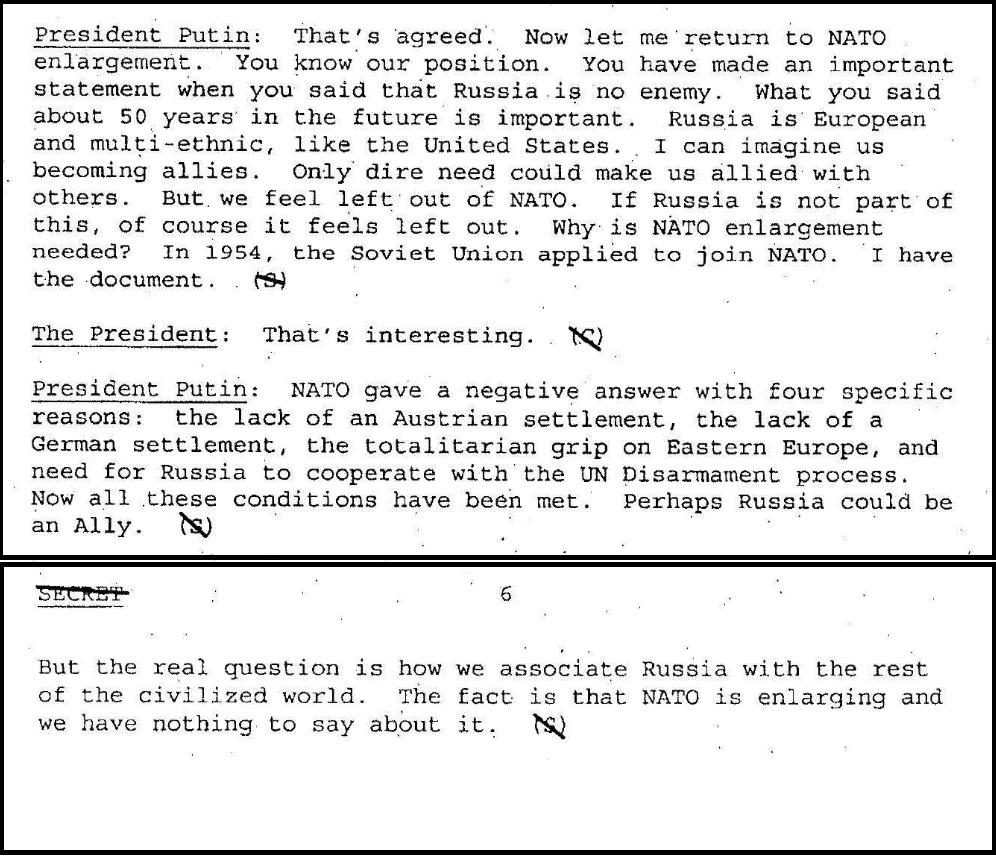
♦ June 16, 2001 – Memorandum of Conversation. Subject: Restricted Meeting with Russian President Vladimir Putin. [LINK HERE] In this first personal meeting at the Brno Castle in Slovenia Vladimir Putin and George W. Bush express respect for each other and desire to establish a close relationship. Putin tells Bush about his religious beliefs and the story of his cross that survived a fire at his dacha. In a short one-on-one meeting they cover all the most important issues of U.S.-Russian relations such as strategic stability, ABM treaty, nonproliferation, Iran, North Korea and NATO expansion. Bush tells his Russian counterpart that he believes Russia is part of the West and not an enemy, but raises a question about Putin’s treatment of a free press and military actions in Chechnya. Putin raises a question of Russian NATO membership and says Russia feels “left out.” [READ MEMO HERE]

♦ September 16, 2005: Document 2 – Memorandum of Conversation. Subject: Vladimir Putin, President of the Russian Federation: [LINK HERE] Putin meets the U.S. President in the Oval Office for a plenary that covers mainly issues of nonproliferation and U.S.-Russian cooperation on Iran and North Korea. The conversation shows impressively close positions on Iran and North Korea, with Putin presenting himself as an eager and supportive partner. Bush tells Putin “we don’t need a lot of religious nuts with nuclear weapons” referring to Iran. Putin said that Ukraine’s accession to NATO would, in the long term, create a field of conflict between Russia and the United States, adding that internal divisions within Ukraine could lead to its fragmentation. [READ MEMO HERE]

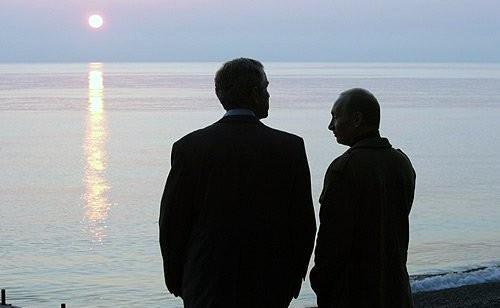
♦ April 6, 2008 – Document 3: Memorandum of Conversation. Subject: Meeting with President of Russia [LINK HERE] This is the last meeting between Putin and Bush, taking place at Putin’s residence in Bocharov Ruchei in Sochi on the Black Sea. The tone is strikingly different from the early conversations, where both presidents pledged cooperation on all issues and expressed commitment to strong personal relationship. This meeting takes place right after the NATO summit in Bucharest where tensions flared about the U.S. campaign for an invitation to Georgia and Ukraine to join NATO. Turning to conversations in Bucharest, Putin states his strong opposition to NATO membership for Ukraine and Georgia and says that Russia would be relying on anti-NATO forces in Ukraine and “creating problems” in Ukraine “all the time,” because it is concerned about “threat of military bases and new military systems being deployed in the proximity of Russia.” Surprisingly, in response, Bush expresses his admiration for the Russian president’s ability to present his case: “One of the things I admire about you is you weren’t afraid to say it to NATO. That’s very admirable. People listened carefully and had no doubt about your position. It was a good performance.” [READ MEMO HERE]

2001 –  Putin raises a question of Russian NATO membership and says Russia feels “left out.”

As noted by The Islander (Via Twitter) –  “The 2001 Memo That Should Have Ended the Cold War 2.0 and Instead Helped Write the Preface to Ukraine. There are documents that don’t merely record history, they expose it. This is one of them.

June 2001. A “restricted meeting” between President George W. Bush and President Vladimir Putin. Not a podium performance, not a television soundbite, not a speech crafted for domestic applause. A private conversation, the place where empires are supposed to speak plainly, where leaders test ideas that could reroute decades.

And what does the memo show?

Putin raises the idea that Russia could eventually join NATO. He says Russia feels “left out” by NATO enlargement. He points to an older fact most Western publics were never meant to internalize: the Soviet Union applied to join NATO in 1954. He argues the reasons for rejection no longer apply. He suggests, almost clinically, that perhaps Russia could be an ally — “European and multi-ethnic,” comparable in character to the United States.

Read that again slowly.

Because the propaganda version you’ve been fed for years requires amnesia: it requires you to believe Russia woke up one morning and decided to be “a threat,” as if geopolitics is a mood swing and security architecture is irrelevant.

But here is the declassified record: Russia was probing for an exit ramp. A pathway into a shared system. A new security architecture. A post–Cold War settlement that could have turned the 1990s from a hollow victory lap into a durable peace.

And it didn’t happen.

Not because it was impossible. Not because Russia “never wanted it.” Not because “the West tried everything.”

It didn’t happen because NATO, as an institution, does not know how to live without a frontier. It does not know how to justify itself without an adversary. It does not know how to maintain internal cohesion without a map that points east and says: there.

The 1954 Ghost: the offer the West never wanted to remember

The most important part of this memo is not the 2001 line, but the 1954 reference.

Because it collapses the morality play.

If the Soviet Union, a state the West defined as the existential enemy, floated the notion of joining NATO in 1954, that means something profound: the idea of Russia being inside the European security architecture is not a “Putin-era trick.” It is a recurring historical proposal, returning whenever Moscow believes there may be a rational way to avoid permanent confrontation.

And what happened then? It was refused.

Which is exactly the point: NATO was never simply a “defensive alliance.” Even in 1954, It was a structure. A protection racket. A way to organize Europe under an American strategic roof and to keep it there. If Russia enters that roof as an equal, the architecture changes. Budgets decrease, with less money for the MIC. Threat perceptions change. The entire postwar hierarchy changes.

So the West did what empires do when presented with a peace that would reduce their leverage:

It smiled, took notes, and kept moving.

“Join NATO” was never a plea, it was a test.

Some people still misunderstand the early Putin posture. They interpret it as naivete, or worse, submission.

Wrong.

This was not Russia begging to be absorbed. The consistent theme in contemporaneous accounts is conditionality, that Russia could consider joining if treated as an equal partner, but not as a defeated province invited into the emperor’s club after proving it can submit.

That distinction matters.

Because it reveals the real incompatibility:
•Russia wanted a security system where it is a partner of European security, not an object to be managed.
•The Atlantic system wanted Russia as a managed periphery, permanently “integrating,” permanently reforming, permanently conceding, never truly sovereign in security decisions.

You can’t fuse those visions. One side must yield.

So the Atlantic system chose the only thing it has ever really chosen, expansion.”

A quarter century has passed since that original outreach by Russian Federation President Vladimir Putin in 2001.  It was rejected by President George W Bush and all presidents thereafter.  In 2025, we are in the phase of consequence.

This public release just happened on December 23, 2025.

Perhaps, just perhaps, this release can change the conversation in the United States.  Perhaps, just perhaps, President Trump, Secretary Rubio and Emissary Witkoff can reverse the course, and change the arc of history toward peace and a strategic alliance.

The timing of the release inspires hope, but the opposition to peace is extreme.

Zelenskyy Announces Eastern Ukraine Citizens Will Not Be Allowed to Vote in Elections


Posted originally on CTH on December 21, 2025 | Sundance 

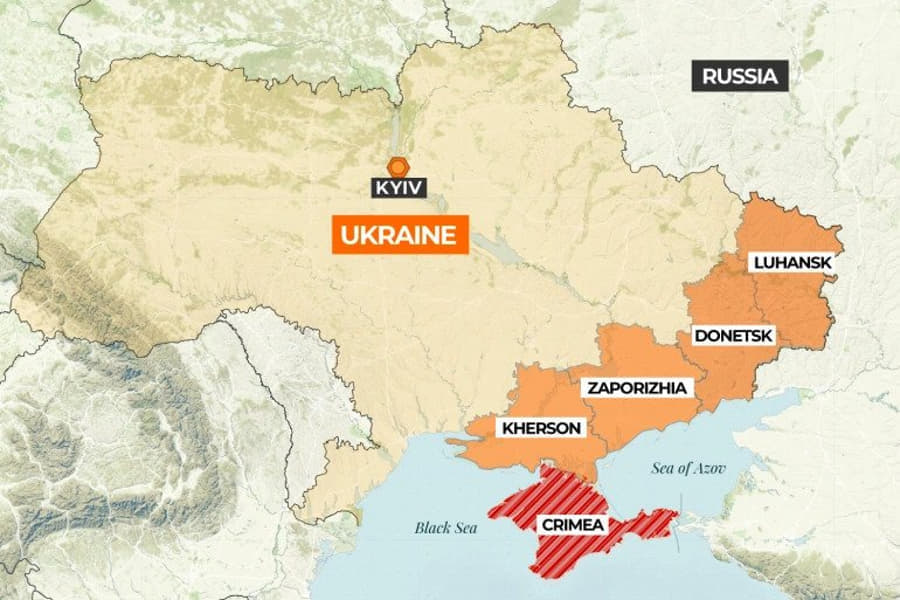
Ukraine President Volodymyr Zelenskyy has agreed to hold elections if there is a ceasefire.  However, Eastern Ukraine citizens, those currently living in the Donbas region, who are supportive of Russia, will not be permitted to vote.

This creates a rather bizarre official hypocrisy within the Zelenskyy regime.  The official position of Zelenskyy is that Eastern Ukraine will never be accepted as a part of the Russian federation.

Zelenskyy has recently noted, with EU leadership support, that his government will never recognize Eastern Ukraine as part of the Russian federation.  However, this same region, approximately 20% of Ukraine, will not be permitted to participate in his controlled election.

Essentially, any Ukraine resident who does not support Zelenskyy will not be permitted to vote in any election, if any election is ever permitted.  Additionally, Zelenskyy notes that “there is the practice of voting abroad,” however, any region not controlled by Zelenskyy cannot submit votes.

Volodymyr Zelenskyy – “It is not up to Putin to decide when or in what format elections in Ukraine will take place, because these elections are exclusively for Ukrainian citizens. Therefore, he will certainly not influence anything, let alone the outcome.

Voting is carried out by citizens of Ukraine who are within the country, on Ukrainian-controlled territory. Here, we can ensure fair and transparent elections. There is also the practice of voting abroad. Elections cannot be held in territories not controlled by Ukraine, because it is obvious how they would be conducted – just as Russia always does.

Overall, elections depend on two factors: security and legislation. Security must be addressed; this is the top priority. It is important that our military personnel, who are defending the country, are able to vote. Every citizen has an absolute right to vote.

We have already discussed this with our U.S. partners; they raised this issue. If they raise it, it means they know how to help us ensure safe elections. This, primarily, could involve a ceasefire, or bringing the war to an end, or a ceasefire, at least for the duration of the elections.” {source}

Also from Zelenskyy:

We are moving at a fairly rapid pace, and our team in Florida has been working with the American side. European representatives were also invited. These negotiations are constructive and this matters. Much depends on whether Russia feels the need to end the war for real – it must not be a rhetorical or political game on Russia’s part. Unfortunately, the real signals coming from Russia remain only negative: assaults along the frontline, Russian war crimes in border areas, and continued strikes against our infrastructure. It is essential that the world does not remain silent about all of this. {source}

[…] Peace is better than war, but not at any cost, because we have already paid a high price. What matters for us is a just, durable peace – one that cannot be violated by another whim of Putin or any other Putin-like figure. It is extremely important to have strong security guarantees in place to prevent even the thought or the physical ability to come back to us with aggression.

I do not see the Budapest Memorandum as an agreement; I see it as nothing more than a piece of paper, because our territories were occupied, and so many people were killed. And this agreement did not protect us. I do not consider it strong or effective.

Therefore, for me, an agreement is not just about signing a document. One must know the details: what will happen if the Russians come with aggression and launch another war. How will the Americans and Europeans respond? How will our partners respond? What deterrence package will Ukraine have? What will be present on Ukrainian territory? How will our army be equipped? How strong will it be, and what reserves will we have? What can we count on? What sanctions package will be imposed simultaneously on the aggressor? {source}

Zelenskyy Announces Eastern Ukraine Citizens Will Not Be Allowed to Vote in Elections


Posted originally on CTH on December 21, 2025 | Sundance

Ukraine President Volodymyr Zelenskyy has agreed to hold elections if there is a ceasefire.  However, Eastern Ukraine citizens, those currently living in the Donbas region, who are supportive of Russia, will not be permitted to vote.

This creates a rather bizarre official hypocrisy within the Zelenskyy regime.  The official position of Zelenskyy is that Eastern Ukraine will never be accepted as a part of the Russian federation.

Zelenskyy has recently noted, with EU leadership support, that his government will never recognize Eastern Ukraine as part of the Russian federation.  However, this same region, approximately 20% of Ukraine, will not be permitted to participate in his controlled election.

Essentially, any Ukraine resident who does not support Zelenskyy will not be permitted to vote in any election, if any election is ever permitted.  Additionally, Zelenskyy notes that “there is the practice of voting abroad,” however, any region not controlled by Zelenskyy cannot submit votes.

Volodymyr Zelenskyy – “It is not up to Putin to decide when or in what format elections in Ukraine will take place, because these elections are exclusively for Ukrainian citizens. Therefore, he will certainly not influence anything, let alone the outcome.

Voting is carried out by citizens of Ukraine who are within the country, on Ukrainian-controlled territory. Here, we can ensure fair and transparent elections. There is also the practice of voting abroad. Elections cannot be held in territories not controlled by Ukraine, because it is obvious how they would be conducted – just as Russia always does.

Overall, elections depend on two factors: security and legislation. Security must be addressed; this is the top priority. It is important that our military personnel, who are defending the country, are able to vote. Every citizen has an absolute right to vote.

We have already discussed this with our U.S. partners; they raised this issue. If they raise it, it means they know how to help us ensure safe elections. This, primarily, could involve a ceasefire, or bringing the war to an end, or a ceasefire, at least for the duration of the elections.” {source}

Also from Zelenskyy:

We are moving at a fairly rapid pace, and our team in Florida has been working with the American side. European representatives were also invited. These negotiations are constructive and this matters. Much depends on whether Russia feels the need to end the war for real – it must not be a rhetorical or political game on Russia’s part. Unfortunately, the real signals coming from Russia remain only negative: assaults along the frontline, Russian war crimes in border areas, and continued strikes against our infrastructure. It is essential that the world does not remain silent about all of this. {source}

[…] Peace is better than war, but not at any cost, because we have already paid a high price. What matters for us is a just, durable peace – one that cannot be violated by another whim of Putin or any other Putin-like figure. It is extremely important to have strong security guarantees in place to prevent even the thought or the physical ability to come back to us with aggression.

I do not see the Budapest Memorandum as an agreement; I see it as nothing more than a piece of paper, because our territories were occupied, and so many people were killed. And this agreement did not protect us. I do not consider it strong or effective.

Therefore, for me, an agreement is not just about signing a document. One must know the details: what will happen if the Russians come with aggression and launch another war. How will the Americans and Europeans respond? How will our partners respond? What deterrence package will Ukraine have? What will be present on Ukrainian territory? How will our army be equipped? How strong will it be, and what reserves will we have? What can we count on? What sanctions package will be imposed simultaneously on the aggressor? {source}

EU Effort to Use Russian Funds to Support Ukraine Collapses – EU Takes Out Loan to Support Zelenskyy


Posted originally on CTH on December 19, 2025 | Sundance

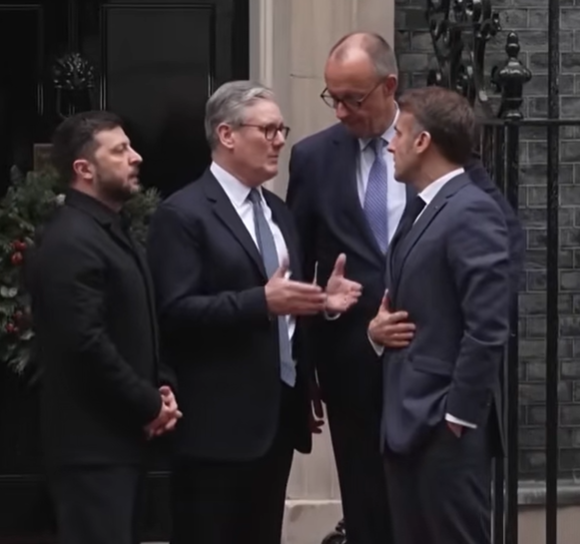
The grand plans of the EU Leadership failed to generate their desired result.  Initially, Ursula von der Leyen, Friedrich Merz, Emmanuel Macron and Keir Starmer intended to permanently confiscate the Russian sovereign wealth fund and use it to fund their interests in Ukraine.  However, the EU coalition didn’t agree.

After 16 hours of failed internal negotiations the EU ended up creating a $90 Billion euro-backed financial loan to Zelenskyy which he will not have to pay back until Russian reparations are paid to Ukraine.

The European elites essentially used EU taxpayers to create an EU loan to Zelenskyy.

EUROPE – BRUSSELS — European governments failed to reach a deal on sending Russian frozen state assets to Ukraine after a 16-hour summit in Brussels, in a major setback for German Chancellor Friedrich Merz and European Commission President Ursula von der Leyen.

Countries were forced instead to agree on an emergency backup plan based on EU joint debt that was pushed for weeks by Belgian Prime Minister Bart De Wever and was deemed a long shot until hours before the deal was done. In a further blow to EU unity, three countries ― Hungary, Slovakia and the Czech Republic ― won’t take part.

“The bottom line, after today, is that our support for Ukraine is guaranteed,” Danish Prime Minister Mette Frederiksen said as the summit wrapped up at 3 a.m.

The agreement provides a crucial lifeline to Ukraine’s war-battered economy as it grapples with the risk of a looming cash crunch as early as next spring with its conflict with Russia grinding on into a fourth year.

Though the accord allows everyone to claim victory, this wasn’t the solution that Germany and the Commission had been pushing for in the lead-up to this summit. (read more)

Providence-area Radio Host Asks Brown University About Their Intentional Disabling of CCTV Systems


Posted originally on CTH on December 18, 2025 | Sundance

During a press conference on Wednesday, a Providence-area radio host, Chas Calenda, directly confronted Brown University officials and law enforcement with information he has received about the school intentionally disabling surveillance systems due to DEI concerns.

The response from university officials and the Providence Mayor indicate Mr. Chas Calenda’s informed accusation and question is directly on target.  WATCH:

In addition to information we previously shared {GO DEEP} reflecting requests from various “civil rights” and “humanitarian” groups who demanded Brown University disable their surveillance system, additional information about the issue comes via the Rhode Island ACLU making the same demand in October of this year [SEE HERE].

Brown University was under pressure from far-left groups as an outcome of concern the CCTV and school security system would be used by federal authorities to (a) identify radical leftists expressing antisemitic sentiments, and (b) identify the immigration status of persons on campus.  It is not just isolated to Brown University.

Multiple municipal governments, private and municipal agencies have received the same demand in an ongoing effort to block Immigration and Customs Enforcement operations.  The mass shooting on Brown University is leading to a larger public awareness of an issue that has been spreading rapidly in the last several months.

The claim by Chas Calenda is that his local sources within law enforcement are confirming the university cowed to the concerns of the civil rights groups, including the removal of cameras.  This is why there is no recorded CCTV footage, and the university is talking gibberish in their efforts to avoid admitting what has taken place.

Brown University and Providence police have $8 billion liability reasons to be less than honest with the alarmed public. The political ramifications of the story are also complicating the issue for Brown University, as well as local and national figures.

Here is the full press conference.  The key question comes at the very end of the video 49:20.

Bannon 2.0 – Another Trump Chief of Staff Creates Another Hot Mess


Posted originally on CTH on December 16, 2025 | Sundance 

Last time it was Steve Bannon who held multiple interviews with Michael Wolff for his book Fire and Fury: Inside the Trump White House.  This time it is White House Chief of Staff Susie Wiles who sat down for a series of recorded ‘on the record’ interviews with Vanity Fair author Chris Whipple. [Article w/ Paywall]

The interviews with Susie Wiles have been taking place all year, with recordings of her statements made to ensure she could not retract the divisive content now deployed by Vanity Fair at a critical moment in the Trump administration.

The intent of the Vanity Fair outline is to paint the most negative light possible, and it appears Susie Wiles gave Chris Whipple all the ammunition to do so.

TIMING: This anti-Trump narrative, supported by the toxic statements by Wiles, is dropped at a key moment when European leadership is purposefully pushing a narrative against President Trump. This series of articles and documented interviews hits at a moment of merging interests against the administration.  The coordination is noted.

SUBSTANCE: The New York Times outlines some of the statements by Susie Wiles that are going to grab attention.

[…] “Over the course of 11 interviews, Ms. Wiles offered pungent assessments of the president and his team: Mr. Trump “has an alcoholic’s personality.” Vice President JD Vance has “been a conspiracy theorist for a decade” and his conversion from Trump critic to ally was based not on principle but was “sort of political” because he was running for Senate. Elon Musk is “an avowed ketamine” user and “an odd, odd duck,” whose actions were not always “rational” and left her “aghast.” Russell T. Vought, the budget director, is “a right-wing absolute zealot.” And Attorney General Pam Bondi “completely whiffed” in handling the Epstein files.”

[…] She said she urged Mr. Trump not to pardon the most violent rioters from Jan. 6, 2021, which he did anyway. She unsuccessfully tried to get him to delay his major tariffs because of a “huge disagreement” among his advisers. And she said the administration needed to “look harder” at deportations to prevent mistakes.

[…] She attributes her ability to work for Mr. Trump to growing up with an alcoholic father, the sportscaster Pat Summerall. “High-functioning alcoholics or alcoholics in general, their personalities are exaggerated when they drink,” she said. “And so I’m a little bit of an expert in big personalities.” While Mr. Trump does not drink, she said he has “an alcoholic’s personality” and operates with “a view that there’s nothing he can’t do. Nothing, zero, nothing.”

[…] Ms. Wiles confided in Mr. Whipple in March that she had told Mr. Trump that his presidency was not supposed to be a retribution tour. “We have a loose agreement that the score settling will end before the first 90 days are over,” she said then. When that did not happen by August, she told Mr. Whipple that “I don’t think he’s on a retribution tour” but said that he was aiming at people who did “bad things” in coming after him. “In some cases, it may look like retribution,” she said. “And there may be an element of that from time to time. Who would blame him? Not me.”

[…] In the interviews published by Vanity Fair, Ms. Wiles faulted Ms. Bondi, one of her closest friends in the administration, for her early handling of the Epstein files, an issue that has been a cause célèbre for Mr. Trump’s right-wing base.

“I think she completely whiffed on appreciating that that was the very targeted group that cared about this,” Ms. Wiles said. “First, she gave them binders full of nothingness. And then she said that the witness list, or the client list, was on her desk. There is no client list, and it sure as hell wasn’t on her desk.” Mr. Vance, by contrast, understood the sensitivity because he himself was “a conspiracy theorist,” she said.

Ms. Wiles said she has read the Epstein documents and acknowledged that Mr. Trump’s name is in them. “We know he’s in the file,” she said. “And he’s not in the file doing anything awful.”

[…] Ms. Wiles described frustration with Mr. Musk, the billionaire who early in the year was empowered to eviscerate federal agencies and fire employees en masse with almost no process. “He’s an odd, odd duck, as I think geniuses are. You know, it’s not helpful, but he is his own person.” When he shared a post saying that Stalin, Mao and Hitler didn’t murder millions, their public sector workers did, Ms. Wiles said, “I think that’s when he’s microdosing.” Asked what she meant, she said, “he’s an avowed ketamine” user.

[…] In the interview with The Times on Monday, Ms. Wiles took issue with the quote attributed to her about his drug use. “That’s ridiculous,” she said. “I wouldn’t have said it and I wouldn’t know.” But Mr. Whipple played a tape for The Times in which she could be heard saying it.

[…] She acknowledged sharp internal divisions over Mr. Trump’s announcement of major tariffs last spring. “There was a huge disagreement over whether” tariffs were “a good idea,” she said. “We told Donald Trump, ‘Hey, let’s not talk about tariffs today. Let’s wait until we have the team in complete unity and then we’ll do it.’” But he announced them anyway and “it’s been more painful than I expected.”

[…] As for the potential successors, Mr. Vance and Mr. Rubio, she distinguished how each of them came around to supporting Mr. Trump after initially opposing him. “Marco was not the sort of person that would violate his principles,” she said. “He just won’t. And so he had to get there.” As for Mr. Vance, “his conversion came when he was running for the Senate. And I think his conversion was a little bit more, sort of political.”

Mr. Rubio told Mr. Whipple what he has said publicly, that “if JD Vance runs for president, he’s going to be our nominee and I’ll be one of the first people to support him.” (read more)

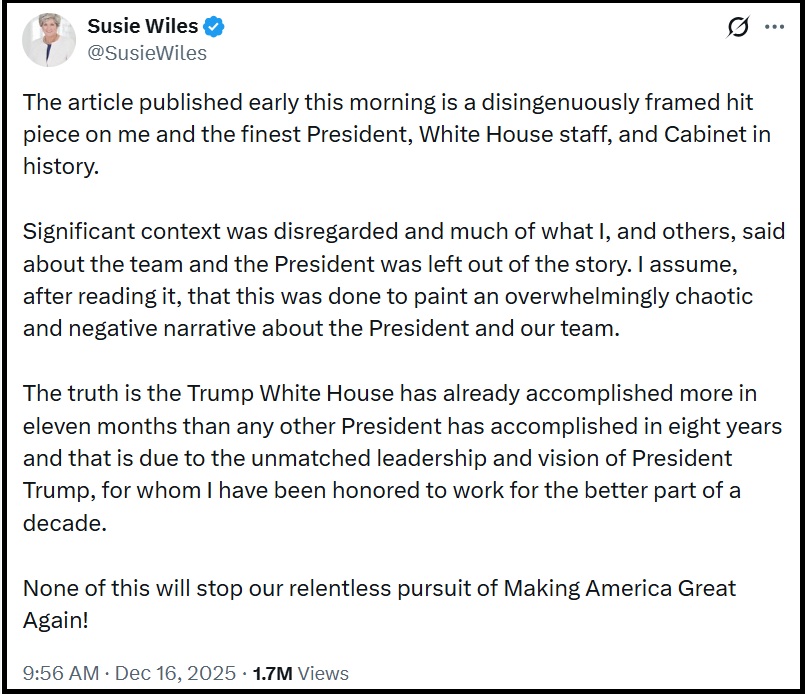
Immediately after publication of the Vanity Fair story, Mrs. Wiles took to Twitter to explain her position:

[SOURCE]

Mrs. Wiles never explains why, for all that is reasonable and holy, she would even sit down with Vanity Fair for eleven interviews over the course of the year.

If you find yourself looking at this narrative engineering and saying, “WTF, why would she be so stupid?”  You are not alone.

Perhaps it’s the old axiom that sooner or later the senior staff always convince themselves that they are the star of the show.  Or perhaps Mrs. Wiles just never heard the Snake Poem:

On her way to work one morning
Down the path ‘longside the lake
A tender-hearted woman saw a poor half-frozen snake
His pretty colored skin had been all frosted with the dew
“Oh well,” she cried, “I’ll take you in and I’ll take care of you”
“Take me in, tender woman
Take me in, for heaven’s sake
Take me in, tender woman,” sighed the snake

She wrapped him up all cozy in a comforter of silk
And laid him by thе fireside with some honеy and some milk
She hurried home from work that night, and soon as she arrived
She found that pretty snake she’d taken in had been revived
“Take me in, tender woman
Take me in, for heaven’s sake
Take me in, tender woman,” sighed the snake

She clutched him to her bosom, “You’re so beautiful,” she cried
“But if I hadn’t brought you in, by now you might have died”
She stroked his pretty skin again and kissed and held him tight
Instead of saying thanks, that snake gave her a vicious bite
“Take me in, tender woman
Take me in, for heaven’s sake
Take me in, tender woman,” sighed the snake

“I saved you,” cried the woman
“And you’ve bitten me, but why?
And you know your bite is poisonous and now I’m gonna die”
“Oh shut up, silly woman,” said the reptile with a grin
“You knew damn well I was a snake before you took me in”

Oscar Brown Jr

Brown University Shooter Still at Large – Open Discussion Thread


Posted originally on CTH on December 16, 2025 | Sundance

Everything about the Brown University shooting doesn’t make sense through the ordinary prism.

However, if political ramifications in the aftermath of Charlie Kirk’s targeted assassination are overlaid against the Brown University murders, then a certain context might reconcile some of the issues. {GO DEEP}  Was Ella Cook targeted in a similarly motivated fashion to the murder of Charlie Kirk?

There are a reported 800 cameras on the Brown University campus, including facial recognition capable cameras, yet school and local police officials claim they do not have any footage of the suspect entering or exiting the building or walking on the campus itself.

Given the nature of the extreme left Brown U ideology, were the cameras turned off or non-recording as part of an ICE resistance effort?

Journalist Mark Halprin received information that College Republican Vice President Ella Cook was the primary target of the shooter.  This is relayed as information to Ms. Cook’s family as stated by FBI investigators. Other victims who were with her in the room were shot as an outcome of their association with the primary target.  WATCH:

There are a lot of odd contradictions and missing information within the statements by the Providence Mayor, school officials and local law enforcement. The suspect has still not been identified, and the local police are trying to avoid specific questions.

Obviously, if Ella Cook, a conservative Christian student and vice-president of the campus Republican group was the specific target, then Brown University would have a motive to try and avoid admitting that Ella Cook a young, female, Christian conservative student was a victim of a targeted political assassination on campus.

Fox News host Jesse Waters has actually put together a strong monologue drawing attention to some of the issues; however, Waters only alludes to the issues raised within the background, he does not draw attention to the specifics. WATCH:

Former J6 House Committee Chairman Says Murder of National Guard in DC Was “An Unfortunate Accident”


Posted originally on CTH on December 12, 2025 | Sundance 

Representative Bennie Thompson was the former Chairman of the corrupt J6 Committee, a highly partisan political endeavor intended to manufacture evidence, create false narratives for political exploitation, and target and destroy any supporter of President Donald Trump.

Yesterday during a House hearing on DHS border enforcement and Immigration Customs Enforcement targeting illegal aliens, Bennie Thompson said the shooting and murder of national guard troops in Washington DC was “an unfortunate accident.”  DHS Secretary Kirsti Noem immediately responded telling Representative Thompson the shooting was an act of terrorism that resulted in the murder of a U.S. service member.   WATCH:

.