James Rosen: Understanding The Supreme Court And The Edge Trump Holds; The Force Of Personality That Is Scalia


Posted originally on Rumble on Bannon War Room on: February 27, 2326

Trump: “Foreign Interests” Have ‘Undue Influence’ Over Supreme Court


Published originally on Rumble By The Gateway Pundit on February, 20, 2026

BREAKING: THE SUPREME COURT HAS STRUCK DOWN PRESIDENT TRUMP’S TARIFFS


Posted originally on Rumble on Bannon War Room on: February 20, 2026

Supreme Court Overrule’s Trump’s Tariffs


Posted originally on Feb 20, 2026 by Martin Armstrong |  

Trump Tariffs 2026_02_20

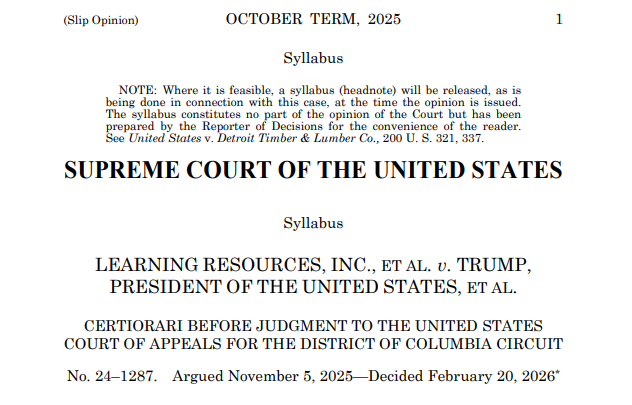
Download the Decision: Trump Tariffs 2-20-26 24-1287_4gcj

The Supreme Court has ruled as I expected. I have said on Podcasts that the power over tariffs lies with Congress, not the president. I also suggested that I did not expect the Supreme Court to overrule the statue as unconstitutional. To me, the plain language was very clear: IEEPA authorizes the President to:

“investigate, block during the pendency of an investigation, regulate, direct and compel,
nullify, void, prevent or prohibit . . . importation or exportation.”
§1702(a)(1)(B).

Nowhere does it authorize the power of tariffs. IEEPA does not authorize the President to impose tariffs plain and simple. I believe those in the Administration knew this would be the outcome. The judgment was vacated, and the case was remanded with instructions to dismiss for lack of jurisdiction; the judgment in No. 25–250 is affirmed.  The Order states:

The judgment of the United States Court of Appeals for the Federal Circuit in case No. 25–250 is affirmed. The
judgment of the United States District Court for the District of Columbia in case No. 24–1287 is vacated, and the
case is remanded with instructions to dismiss for lack of jurisdiction.

We also had a renegade anti-Trump judge in the mix. The Government moved to transfer the Learning Resources case to the Court of International Trade (CIT). It argued that the District Court lacked jurisdiction under 28 U. S. C. §1581(i)(1), which gives the CIT “exclusive jurisdiction of any civil action commenced against” the Government “that arises out of any law of the United States providing for . . . tariffs” or their“administration and enforcement.” The District Court denied that motion illegally seizing jurisdiction since it was anti-Trump and granted the plaintiffs’ motion for a preliminary injunction, concluding that IEEPA did not grant the President the power to impose tariffs. 784 F. Supp. 3d 209 (DC 2025). That judge clearly had NO JURISDICTION whatsoever to make such a ruling. This is a continuing problem in our legal system. This judge should be penalized if not dismissed for an equally unconstitutional ruling our ot personal animosity.

Tariffs have helped the United States collect nearly $99 billion so far this fiscal year, which started on Oct. 1, 2025, according to the Daily Treasury Statement published on Jan. 7.  To me, the law allows presidents to regulate imports during times of emergency, but it was questionable whether that regulation included tariffs, and, in particular, Trump’s large-scale tariffs.

The Trump administration argued that a 1977 law allowing the president to regulate importation during emergencies also allows him to set tariffs. Other presidents have used the law dozens of times, often to impose sanctions, but Trump was the first president to invoke it for import taxes. He classified them as “reciprocal” tariffs on most countries in April 2025 to address trade deficits that he declared a national emergency. Those came after he imposed duties on Canada, China and Mexico, ostensibly to address a drug trafficking emergency.

Multiple federal courts had ruled that Trump’s tariffs exceeded what was allowed under the law. Days after oral argument, Trump indicated in a Nov. 11 post on Truth Social that a negative decision by the Supreme Court could implicate trillions of dollars.

“The ‘unwind’ in the event of a negative decision on Tariffs, would be, including investments made, to be made, and return of funds, in excess of 3 Trillion Dollars.”

He added that the situation “would truly become an insurmountable National Security Event, and devastating to the future of our Country – Possibly non-sustainable!”

I looked at the tariffs and the only grey area was that Trump was imposing a tariff ON TOP OF what Congress authorized, he was not actually altering the Congressional tariff. The tariffs decision doesn’t stop Trump from imposing duties under other laws. While those have more limitations on the speed and severity of Trump’s actions, top administration officials have said they expect to keep the tariff framework in place under other authorities.

Can Trump still impose tariffs? The answer to that question is Yes!.

Supreme Court Rule 6-3 Against President Trump’s IEEPA Tariff Authority – The “Regulate” Opinion


Posted originally on CTH on February 20, 2026 | Sundance

The frustrating issue with the Supreme Court ruling [SEE HERE] is not simply the legal logic applied, which essentially boils down to actionable definitions surrounding the word “regulate,” but also the high court’s seeming blindness to the “emergency” part of the reason IEEPA was used.

Economic security is national security, and the hollowing out of our ability to independently sustain our national economic system posed a real and substantive threat to our nation.  The court never evaluated the ‘urgency’ behind the International Emergency Economic Powers Act (IEEPA) as used by President Donald Trump.

Instead, the court began their legal analysis by seeking to define the word “regulate” as it applies to IEEPA.  Part II–B, concluding: (a) IEEPA authorizes the President to “investigate, block during the pendency of an investigation, regulate, direct and compel, nullify, void, prevent or prohibit . . . importation or exportation.” §1702(a)(1)(B) under the Act.

The majority of the court decided presidential ability to levy countervailing duties is not part of the ability to “regulate” importation.

In the opinion of the court, the President can block importsnullify imports and prohibit imports, but the president cannot “regulate” imports through the use of tariffs.  This is the representative logic of a John Roberts court, the voice of Bush Inc.

It is what it is – and many of us saw this nonsense as a likely outcome, but it is still frustrating to see such a detached parseltongue approach to legal opinions when the national security of our nation is at stake.  These are the judicial minds who will watch the nation burn to the ground, just so they can remain in power ruling over the ashes.

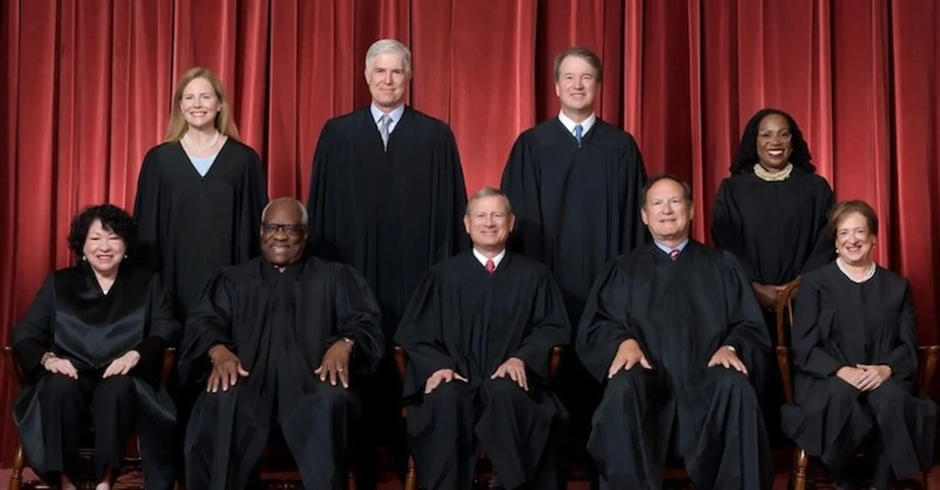
Chief Justice John Roberts and Justices Amy Coney Barrett and Neil Gorsuch joined the court’s three liberals in the majority.  Justices Brett Kavanaugh, Samuel Alito and Clarence Thomas dissented.

(Via Politico) – […] “The President asserts the extraordinary power to unilaterally impose tariffs of unlimited amount, duration, and scope. In light of the breadth, history, and constitutional context of that asserted authority, he must identify clear congressional authorization to exercise it,” Roberts wrote, declaring that the 1977 law Trump cited to justify the import duties “falls short” of the Congressional approval that would be needed.

The ruling wipes out the 10 percent tariff Trump imposed on nearly every country in the world, as well as specific, higher tariffs on some of the top U.S. trading partners, including Canada, Mexico, China, the European Union, Japan and South Korea.

Several of those countries have entered trade agreements with the U.S. — and before the ruling indicated that they would continue to honor those agreements.

That is because the victory for the 12 Democratic-run states and small businesses that challenged Trump’s tariffs is expected to be short lived. The White House has signaled it will attempt to use other authorities to keep similar duties in place.

“We’ve been thinking about this plan for five years or longer,” U.S. Trade Representative Jamieson Greer told POLITICO in December. “You can be sure that when we came to the president the beginning of the term, we had a lot of different options”

“My message is tariffs are going to be a part of the policy landscape going forward,” Greer said. (read more)

Justice Thomas agrees with CTH prior position on the issue.  IEEPA grants the president the authority to regulate imports, and tariffs are a tool for regulation.

Despite this decision the tariffs will remain in place, perhaps using various authorities which have not been challenged as noted in the Kavanaugh dissent:

That said, with respect to tariffs in particular, the Court’s decision might not prevent Presidents from imposing most if not all of these same sorts of tariffs under other statutory authorities. For example, Section 122 of the Trade Act of 1974 permits the President to impose a “temporary import surcharge” to “deal with large and serious United States balance-of-payments deficits.” 19 U. S. C. §2132(a). Section 201 of the Trade Act of 1974 provides that, if the International Trade Commission determines an article is being imported in such quantities that it is “a substantial cause of serious injury, or the threat thereof, to the domestic industry producing an article like or directly competitive with the imported article,” the President may take “appropriate and feasible action,” including imposing a “duty.” §§2251(a), 2253(a)(3)(A). Section 301 of the Trade Act of 1974 authorizes the President through a subordinate officer to “impose duties” if he determines that “an act, policy, or practice of a foreign country” is “unjustifiable and burdens or restricts United States commerce.” §§2411(a)(c). Section 338 of the Tariff Act of 1930 permits the President to impose tariffs when he finds that “any foreign country places any burden or disadvantage upon the commerce of the United States.” §1338(d). And Section 232 of the Trade Expansion Act of 1962 authorizes the President to, after receiving a report from the Secretary of Commerce, “adjust the imports of [an] article and its derivatives so that such imports will not threaten to impair the national security.” §1862(c)(1)(a).

So the Court’s decision is not likely to greatly restrict Presidential tariff authority going forward. (pg, 63 dissent)

Strong Possibility of SCOTUS Ruling on President Trump IEEPA Tariffs – Friday, Tuesday or Wednesday


Posted originally on CTH on February 18, 2026 | Sundance 

The high court has indicated it will be releasing opinions on one or more of the previously argued cases on Friday February 20, Tuesday Feb 24, or Wednesday Feb 25.  The decision over tariffs triggered by President Trump using the International Emergency Economic Powers Act (IEEPA) is one of the decisions now considered highly likely to surface.

If the decision doesn’t come this Friday, a rather interesting situation unfolds.  The following week falls into the Tuesday Feb 24 State of the Union address.

Typically, several Supreme Court justices sit in front row of the House floor during the speech.  The decision could be released on the morning of the speech, or justices could actually sit in the audience – knowing the outcome and the morning after the State of the Union address, the ruling could be released.

Now, there is a possibility the ruling will not come out in this cycle, but that is diminishing possibility considering the length of time the Supreme Court has sat on this opinion.

The court knows the importance of this decision, and they obviously know the State of the Union speech is scheduled to be delivered on Tuesday the 24th.  This will be an interesting dynamic to watch unfold.

James Rosen On Antonin Scalia’s Path To A Historic 98-0 Confirmation Vote To The Supreme Court


Posted originally on Rumble on Bannon War Room on: February 6, 2026

Justice Kentanji Brown Jackson Argues for Supreme Power of DC Bureaucracy


Posted originally on CTH on December 8, 2025 | Sundance 

Highlighting exactly why Barack Obama, Joe Biden and James Clyburn needed to deploy a 2021 Machiavellian strategy to get her moved onto the Supreme Court, Justice Kentanji Brown Jackson (KBJ) argues for the supreme power of the DC bureaucracy that must not be challenged by the President of the United States (Executive Branch).

In the case of Trump v Slaughter, the removal of the FTC Chair, Justice KBJ argues that presidential authority must be kept in check by the unelected “professionals and experts” who make up the bureaucracy underneath him.  The “No Kings” argument is entirely ridiculous given the plenary power of the executive and the constitutional authority of the office.

Ketanji Brown-Jackson was always going to be installed in the supreme court as part of the overall Obama team’s use of Joe Biden.  Merrick Garland was removed from his position specifically to create the path for KBJ to travel.  Everything about this was planned well in advance of Biden’s installation.  KBJ is to the judicial branch what BHO was/is to the executive branch.

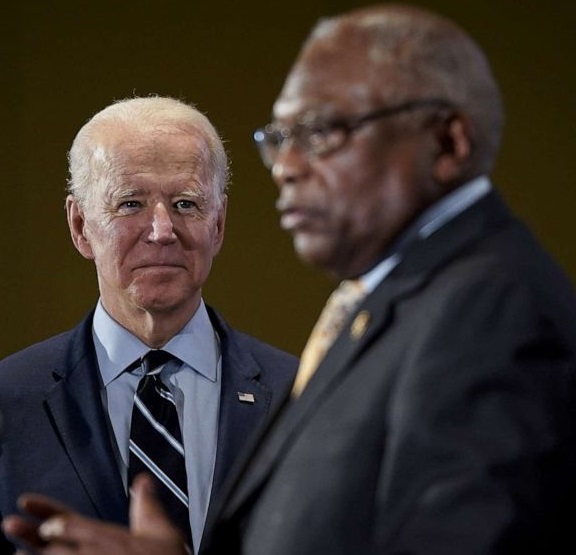
It was February 25th, 2020, to be precise, just four days before the South Carolina Democrat primary.  South Carolina Representative James Clyburn went backstage at the presidential debate and told Biden, “You’ve had a couple of opportunities to mention naming a Black woman to the Supreme Court,” Clyburn lectured his friend of nearly half a century, like a schoolteacher scolding a child. “I’m telling you, don’t you leave the stage tonight without making it known that you will do that.” {link}

Unbeknownst to Biden at the time, just two days earlier Barack Obama and James Clyburn came to an agreement and created the most consequential alliance of the 2020 Democrat campaign.  Barack Obama the figurative and ideological leader of the movement known as “Black Lives Matter”, and James Clyburn the figurative and ideological leader of the political construct within the African Methodist Episcopal (AME) church, had struck a deal.

Obama and Clyburn really had no choice but to come to an agreement and form the alliance.  If they did not act fast, Bernie Sanders was gaining momentum, and they could not have Sanders at the top of the 2020 ticket, because he was too outside the club system which was now almost exclusively focused on racial identity as a tool for political power.

A Bernie Sanders -vs- Donald Trump general election would have been a disaster; and it would be almost impossible for the racial operatives in the key precincts [Atlanta (GA), Philly (PA), Clark County (NV), Wayne County (Mich), Madison (WI)] to feel inspired enough to risk themselves and commit fraud to help Bernie win.

To get rid of Sanders, BLM and AME aligned.  This was the actual moment when Hillary Clinton was cast into the pit of irrelevance in Democrat politics.

Within the agreement, Obama and Clyburn selected Biden as the tool they could easily control to deliver on their larger, progressive, leftist intentions.

A few days later, James Clyburn then endorsed Biden while Barack Obama began making phone calls telling each of the other candidates to drop out in sequence and support Biden or else the club would destroy them.  The only one told not to drop out yet was Elizabeth Warren, as she would be needed as the insurance policy, the splitter against Bernie Sanders.

Each of the candidates was promised the traditional indulgences for toeing the party line, and the rest is history.  Joe Biden wandered around doing what everyone told him to do, which was mostly stay in his basement and let the club work on his behalf, until the club delivered the nomination.

Inside that process, the strategic map was modified to ensure Ketanji Brown-Jackson would advance to the Supreme Court.

With Biden installed, he would select Merrick Garland as his Attorney General.  Judge Garland was an important judge on the important DC Circuit Court.  Garland’s replacement would need to be a Senate confirmed seat for that court.  Brown-Jackson would be put into Garland’s open spot. {Go Deep}

As a standalone Supreme Court nominee, Brown-Jackson would have been a radical pick.  Justice Brown-Jackson is a known activist in the DC District Court; however, with this maneuver she could get through nomination easier and then sit on the highest court for thirty years.

Once Brown-Jackson was Senate confirmed for the DC Circuit Court, the countdown began until she was elevated as a Supreme Court nomination to replace Justice Stephen Bryer, now 83-years-old.  The Senate had no political ammunition to block or not confirm the radical SCOTUS pick, because she was confirmed a few months before with support from Republicans.

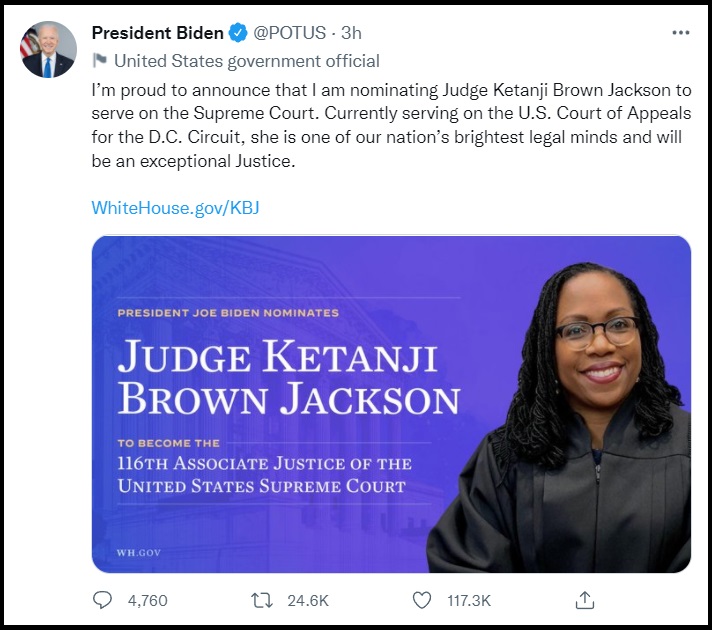
[White House Announcement]

SCOTUS Issues Emergency Order Supporting Trump on SNAP, Justice KBJ Votes Against Her Own Order


Posted originally on CTH on November 11, 2025 | Sundance

The Supreme Court has issued an emergency stay supporting President Trump and the administration’s lawful position that SNAP benefits cannot be paid without congressional funding.

In the most bizarre example of her voting record to date, Justice Ketanji Brown Jackson votes against a short-term extension to the emergency stay she herself created. [SOURCE]

On Tuesday night, the Supreme Court extended the administrative stay, keeping [Rhode Island Judge] McConnell’s ruling on hold until 11:59 p.m. EST on Nov. 13. With the House of Representatives slated to vote on Wednesday on a deal to end the shutdown, the brief unsigned order presumably gives the government time to reopen, and for SNAP benefits to resume. Jackson indicated that she would not have extended the administrative stay, and that she would have turned down the government’s request. (source)

Sunday Talks: Treasury Secretary Scott Bessent vs George Stephanopoulos – Video and Transcript


Posted originally on CTH on November 9, 2025 | Sundance 

Treasury Secretary Scott Bessent appears on ABC This Week to combat the narrative engineering of DNC transcriptionist George Stephanopoulos.

Sometimes it’s worth watching Stephanopoulos, Bill Clinton’s former Chief of Staff, because he frames the political position, current and future, for the Democrat party. Video and Transcript Below:

[Transcript] STEPHANOPOULOS: And we’re joined now by the Treasury secretary, Scott Bessent.

Mr. Bessent, thank you for joining us this morning.

We’ve just heard about all these impacts from the shutdown — government shutdown right now. Are we starting to see — see a permanent impact on the economy?

TREASURY SECRETARY SCOTT BESSENT: Sure, George.

And good to be with you.

And we’ve seen an impact on the economy from day one, but it’s getting worse and worse. We had a fantastic economy under President Trump the past two quarters. And now there are estimates that the economy, economic growth for this quarter, could be cut by as much as half if the shutdown continues.

And what your correspondent didn’t talk about there, George, was there’s, of course, the human cost, and we’re going to have the busiest travel day of the year, the day after Thanksgiving. And, you know, Americans should look to five Democratic senators to come across the aisle to open that. But on the other side, there’s also, cargo is being slowed down. So, you know, we could end up with shortages, whether it’s in our supply chains, whether it’s for the holidays.

So, you know, cargo and people are both being slowed down here. And that’s for safety’s sake, George.

STEPHANOPOULOS: The president continues to post about ending the filibuster. Is that — is that the best way to end the shutdown right now? Is that what the administration’s position is?

BESSENT: No, George, the best — the best way to do it — and look, you were involved in a lot of these in the ’90s. And, you know, you basically called the Republicans terrorists and, you know, you said that it is not the responsible party that keeps the government closed.

And so, what we need is five brave, moderate Democratic senators to cross the aisle because right now it is 52 to three, 52 to three, five Democrats can cross the aisle and reopen the government. That’s the best way to do it, George.

STEPHANOPOULOS: I can disagree with you about the history there, but we don’t do history lesson right now.

BESSENT: No, George —

(CROSSTALK)

STEPHANOPOULOS: Let’s talk — let’s talk about — let’s talk about —

BESSENT: No, no, no. George, George, George —

(CROSSTALK)

STEPHANOPOULOS: Let’s talk — sir, let’s talk about what’s happening right now. I asked you a question —

BESSENT: If you want, I’ve got all your quotes here. I got all your quotes here, George.

STEPHANOPOULOS: I am sure — I am — I’m sure you do. But let’s talk about the situation right now —

(CROSSTALK)

BESSENT: And I went back and read your book. So, you got one — one purchase on Amazon this week. And that’s very much what you said.

STEPHANOPOULOS: That’s — it’s a mis — mischaracterization of history. But I do want to talk about right now, is the best way to end the — to end the shutdown right now to end the filibuster?

BESSENT: The best way is for five Democratic senators to come across the aisle. The — what are we on? Vote 13, 14, 15. Mike Johnson got the reopening out of the House very quickly.

And you know what — what’s changed since the spring, George, is — you know, is Chuck Schumer’s poll numbers. He had a clean continuing resolution in the spring.

And why are Democrats doing this now, George? Again, you’ve been involved with this. The — you know, explain what’s changed.

You know, Senator Chris Murphy gave the game away this week when he said, “Well, you know, now it’s to our advantage to keep the government closed.” They have turned the American people into pawns.

STEPHANOPOULOS: The president has also come forward with a new proposal overnight saying it’s time instead to do away with Obamacare, instead to have the money go directly to the people.

Do you have a formal proposal to do that?

BESSENT: We don’t have a formal proposal, but you know, what I have noticed over time is that the Democrats give all these bills the Orwellian names, the Affordable Care Act, the Inflation Reduction Act, and we end up with just the opposite. You know, the Affordable Care Act has become unaffordable, and the Inflation Reduction Act set off the greatest inflation in 50 years.

STEPHANOPOULOS: Well, I’m a little confused because the president been posting about that overnight and into this morning, but you’re not proposing that to the Senate right now?

BESSENT: We’re not proposing it to the Senate right now. No.

STEPHANOPOULOS: Then why is the president posting about it?

BESSENT: George, you know, the president’s posting about it, but again, we have got to get the government reopen before, you know, we do this. We are not going to negotiate with the Democrats until they reopen the government.

It’s very simple. Reopen the government, then we can have a discussion.

STEPHANOPOULOS: Let’s talk about affordability and inflation. That was one of the key concerns that voters said was on their minds as they were voting this Tuesday. It appeared to be the driving force in the elections. But President Trump is still insisting that prices are way down even though last month’s report showed inflation stuck at about 3 percent.

Are Americans worried about inflation just wrong?

BESSENT: Well, George, I can tell you, the — what we’re not going to do is what happened the — under the Biden administration where, you know, the administration and the media gaslit everyone and said, “Oh, you know, there’s a vibe session. You don’t understand how good you had — had it.”

And what happened then was we had the worst inflation, 40 or 50 years — you know, 22, 23 percent, but the basket of goods and services for working Americans was up more than 30 percent.

And what we’re seeing is we had to stop the increase first. Now we are starting to see prices level off, come down. You know, gasoline is down, interest rates are down, so mortgages are down. And I think we are making substantial progress on that.

And I think over the coming months and the next year, prices are going to come down.

STEPHANOPOULOS: The president says though, he just had posted this morning that there’s almost no inflation. The consumer price index is higher than it was in the beginning of the year. Electricity rates are rising, so are prices for coffee, beef, vegetables, televisions.

And it’s not just me. It’s not just economists are saying that. Your own Republican members of Congress are saying that, including Marjorie Taylor Greene. Let’s look.

(BEGIN VIDEO CLIP)

REP. MARJORIE TAYLOR GREENE (R-GA): I go to the grocery store myself. Grocery prices remain high. Energy prices are high. My electricity bills are higher here in Washington, D.C., at my apartment, and they’re also higher at my house in Rome, Georgia. Higher than they were a year ago. So — so, affordability is a problem.

(END VIDEO CLIP)

STEPHANOPOULOS: How do you respond to Congresswoman Greene?

BESSENT: Well, George, what I — what I would respond to is electricity prices are a state problem. And you know, I was very interested to see in the earlier clip where the governor — the governor-elect of New Jersey said, “Well, I’m going to bring down energy prices.” Well, it was her predecessor, Phil Murphy, who took them up.

So, you know, look, there are things that the federal government can control. Local electricity prices are not one of them. But, you know, energy prices, gasoline prices, are way down. And, you know, we — we are doing what we can every day. I think we’re on a very good path to bringing prices down.

STEPHANOPOULOS: Let’s talk about tariffs and the Supreme Court. The president is also posting about tariffs this morning. He’s saying, “people that are against tariffs are fools. We’re taking in trillions of dollars.” Is that true?

BESSENT: We have taken — over the course of the next few years, we could take in trillions of dollars, George. But the real — the real goal of the tariffs is to re-balance trade and make it more fair.

You know, over time, the president’s goal is to bring back manufacturing to the U.S. You know, for the past two, three, four decades we have seen our manufacturing sector gutted. So, what would happen over time is we would take insubstantial money, as factories come back to the U.S., as we’re seeing now. I was just down in South Carolina at a rare earth magnet plant and a Boeing plant on Friday. And, you know, that’s the, I believe, 1,500 total new jobs. Tariff income will be substantial, but then that will rebalance.

The goal here, George, is to re-balance trade. So, tariff income will be substantial at the beginning. It will come down. And then domestic tax revenues will climb as corporate taxes go up and all of these high-paying jobs are created.

STEPHANOPOULOS: The president’s main argument, though, seems to be that we’re — it’s about taking in the revenue. And he also promised this morning a dividend —

BESSENT: No, no, no, George. Stop right — no.

STEPHANOPOULOS: A dividend of at least $2,000 a person, not including high-income people. How is he going to pay that dividend of $2,000 a person?

BESSENT: Yes, George, it’s not about taking in the revenue, it’s about re-balancing. And the revenue occurs early on. And then as we rebalance and the jobs come home, then it becomes domestic tax revenue.

STEPHANOPOULOS: Are you worried that the president’s focus on revenue, though, which is what he’s been focusing on in his public statements, is going to hurt your argument in the Supreme Court?

BESSENT: Not at all. It’s completely consistent that the revenues come in at the beginning, then, as we rebalance, which is the goal of this, bring back high-paid manufacturing jobs to the U.S., then it will then morph into domestic tax revenues.

You know, President Trump has consistently fought for the American worker, and we are seeing trillions of investments in the U.S. that would not have occurred without the tariffs.

The other thing, too, is, you know, the authority that he uses is called IEEPA. It is an emergency authority. And he used that emergency authority. He got the Chinese to the table to negotiate on stopping the precursors for fentanyl drugs. You know, fentanyl, hundreds of thousands of Americans dying every year is not an emergency, what is? On October 8th, Chinese threatened to put export controls on rare earth materials. He was able to threaten 100 percent tariffs, and we were able to negotiate that away.

And then, finally, in terms of the general tariffs, we are doing these trial deals that would not be possible. We were at a tipping point in terms of the economy, in terms of our trade balance, and we are re-balancing successfully.

STEPHANOPOULOS: Do you have a proposal, a formal proposal, to give a $2,000 dividend to every American?

BESSENT: I haven’t spoken to the president about this yet, but, you know, it could — the $2,000 dividend could come in lots of forms, in lots of ways, George. You know, it could be just the tax decreases that we are seeing on the president’s agenda. You know, no tax on tips, no tax on overtime, no tax on Social Security. Deductibility of auto loans. So, you know, those are substantial deductions that, you know, are being financed in the tax bill.

STEPHANOPOULOS: Secretary, thanks for your time this morning.