Posted originally on the CTH on November 30, 2024 | Menagerie
Advent is a season of preparation that has a twofold purpose. Advent begins with Evening Prayer I of the Sunday falling on or closest to 30 November and ends before evening prayer I of Christmas. We prepare ourselves not only for the coming joy of our celebration of the birth of the Christ child; we also prepare ourselves for the Second Coming of Christ.
For Catholics, Advent is the beginning of the new liturgical year. The seasons of that year have always led me on a journey with Christ each year, and I gain so much in the consistency of the seasons and readings. We begin with Advent, awaiting the birth of Christ, then celebrate the Christmas Octave and season, Epiphany, and then soon begins Lent, in preparation for Easter. Then, after the Easter season ends with Pentecost, we have the bulk of Ordinary Time until the end of the liturgical year, and Advent again.
The readings at Mass reflect these times in the life of Christ. They take us through his birth, baptism, ministry, Passion, Death, and Resurrection. I find Advent and Lent especially to be times that help me prepare to meet Jesus in deeper and more profound ways.
Many Christian denominations celebrate Advent, perhaps in ways a little different from those of us who observe a liturgical calendar and cycle. But the focus, the point, is to prepare for the coming of Jesus.
We will have posts for each Sunday of Advent, beginning this weekend. I ask that you save political comments for the other posts. Please, give people a place to think about and discuss something else. I hope these posts will be an aid to all who stop in here during this busy season, an invitation to take a moment and find the reason we prepare for Christmas.
Native Americans in North America celebrated harvest festivals for centuries before a Thanksgiving federal holiday was formally established in the United States. Colonial services for these festivals date back to the late 16th century. The autumnal feasts celebrated the harvest of crops after a season of bountiful growth.
In the 1600s, settlers in Massachusetts and Virginia held feasts to express gratitude for survival, fertile fields, and their faith. The Pilgrims in Plymouth, Massachusetts, had their Thanksgiving feast in 1621 with the Wampanoag Native Americans.
This 3-day feast is considered the ”first” Thanksgiving celebration in the colonies. However, there were other recorded ceremonies of thanks on these lands. In 1565, Spanish explorers and the local Timucua people of St. Augustine, Florida, celebrated a mass of thanksgiving. In 1619, British settlers proclaimed a day of thanksgiving when they reached a site known as Berkeley Hundred on the banks of Virginia’s James River.
Of course, the idea of “thanksgiving” for the harvest is as old as time, with records from the Egyptians, Greeks, and Romans. Native American cultures, too, have a rich tradition of giving thanks at harvesttime feasts, which began long before Europeans appeared on their soil. And well after the Pilgrims, for more than two centuries, individual colonies and states celebrated days of thanksgiving.
How Did the Pilgrims Come to Settle Here?
When certain men and women of Scrooby, England, were persecuted for separating themselves from the Church of England, they, as Pilgrims, fled to Leiden, Holland. Upon the execution of separatist leader James of Barneveld there on May 13, 1619, they realized that Holland was no freer than England and prepared to go to America.
On July 20, 1620, after putting their plans into effect, they asked for the parting words of their beloved pastor, John Robinson. The next day, they boarded the ship Speedwell, anchored where the canal from Leiden entered the Maas (or Meuse, a river flowing into the North Sea) at Delfshaven, and sailed for Southampton, England.
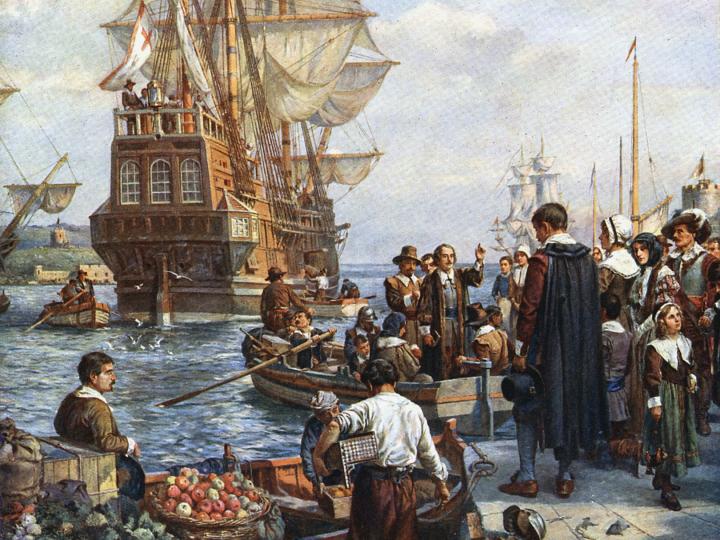
After misadventures and more farewells, these 102 brave souls departed on the Mayflower on September 6, 1620.
Image by Photos.com/Getty Images
The Mayflower arrived at what is now Provincetown, Massachusetts, at the tip of a curved peninsula later named Cape Cod, on November 21 and, on that day, drew up one of the most significant documents of American history, the Mayflower Compact. The Compact was a constitution formed by the people—the beginning of popular government.
They then explored the lands along the bay formed by the peninsula. On December 22, after holding the first town meeting in America to decide where to build their homes, the Pilgrims went onshore at a site now called Plymouth Rock. There, on the shore above the rock, they settled. After 400 years, their descendants and those of the Puritans are still sailing along.
What Ever Happened to the Pilgrims?
So, whatever happened to the Pilgrims? The following highlights reveal what has transpired for the Pilgrims, their Puritan contemporaries, and the descendants of both.
1621: Over dinner with some of their Native American guests, they gave thanks for their welfare
1621: Built a meetinghouse
1634: Forbade wearing gold and silver lace
1639: Started a college (Harvard)
1640: Set up a printing press
1647: Hanged a “witch” (Alse Young—the first person to be executed for witchcraft in the Thirteen Colonies)
1704: Printed the first newspaper in Boston
1721: Were inoculated against smallpox
1776: Again declared themselves to be free and independent
1792: No doubt purchased the 1793 first edition of Robert B. Thomas’s Farmer’s Almanac. Today known as The Old Farmer’s Almanac, this book is North America’s oldest continuously published periodical.
The First National Thanksgiving Proclamation
The first national Thanksgiving celebration was observed in honor of the creation of the new United States Constitution! In 1789, President George Washington issued a proclamation designating November 26 of that year as a “Day of Publick Thanksgivin” to recognize the role of providence in creating the new United States and the new federal Constitution.
Washington was in his first term as president, and a young nation had just emerged successfully from the Revolution. Washington called upon the people of the United States to acknowledge God for affording them “an opportunity peaceably to establish a form of government for their safety and happiness.” This was the first time Thanksgiving was celebrated under the new Constitution.
Thanksgiving’s Path to a Federal Holiday
While Thanksgiving became a yearly tradition in many communities—celebrated on different months and days that suited them—it was not yet a federal government holiday.
John Adams (second U.S. president) and James Madison (fourth U.S. president) issued proclamations recommending such observances as a “National Day of Humiliation, Fasting, and Prayer” or a “Day of Public Thanksgiving for Peace.” Thomas Jefferson (third U.S. president), however, believed in the separation of church and state and that the federal government should not have the power to dictate when the public should observe a religious demonstration of piety, such as a national day of thanksgiving.
In a private letter written to Rev. Samuel Miller in 1808, Jefferson wrote: “I do not believe it is for the interest of religion to invite the civil magistrate to direct its exercises, its discipline or its doctrines: nor of the religious societies that the General government should be invested with the power of effecting any uniformity of time or matter among them. Fasting & prayer are religious exercises. The enjoining them is an act of discipline. Every religious society has a right to determine for itself the times for these exercises & the objects proper for them according to their own particular tenets; and this right can never be safer than in their own hands, where the constitution has deposited it.”
While religious Thanksgiving services continued at a local or state level, after Madison no further presidential proclamations marked Thanksgiving until the Civil War of the 1860s.
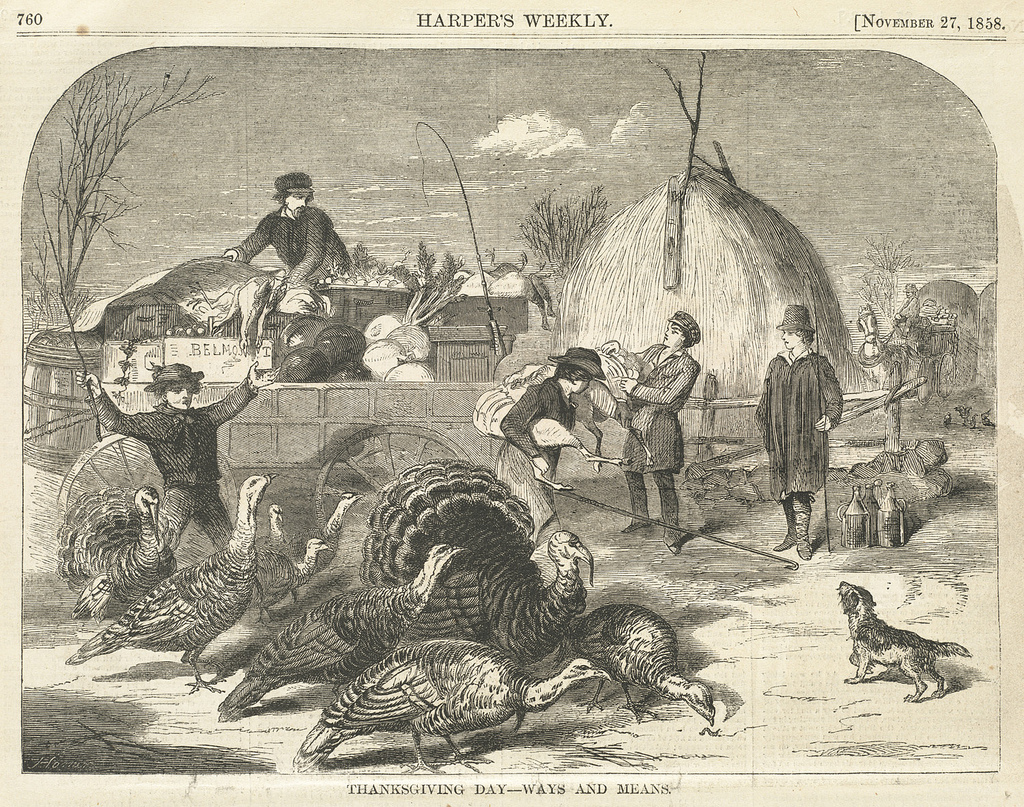
A depiction of Thanksgiving in 1858, by Winslow Homer. Image courtesy of the Boston Public Library.
In addition, President Lincoln proclaimed Thursday, November 26, 1863, as Thanksgiving. Lincoln’s proclamation harkened back to Washington’s, as he also thanked God following a bloody military confrontation.
Lincoln expressed gratitude to God and thanks to the Army for emerging successfully from the Battle of Gettysburg. He enumerated the blessings of the American people and called upon his countrymen to “set apart and observe the last Thursday of November next, as a day of Thanksgiving and Praise.” As of that year, Thanksgiving was celebrated on the last Thursday in November.
Thanksgiving is briefly moved to the third Thursday in November.
In 1939, President Franklin D. Roosevelt changed Thanksgiving from the last Thursday in November to the second to the last Thursday. It was the tail end of the Depression, and Roosevelt’s goal was to create more shopping days before Christmas and boost the economy. However, many people continued to celebrate Thanksgiving on the last Thursday in November, unhappy that the holiday’s date had been meddled with. You could argue, however, that this helped create the shopping craze known as Black Friday.
In 1941, to end any confusion, the president and Congress established Thanksgiving as a United States federal holiday to be celebrated on the fourth Thursday in November, which is how it stands today!
Posted originally on the CTH on August 24, 2024 | Menagerie
If you are a man, I’m sure you’ve reflected on the men who influenced your life. We automatically think of dads, of course, who have such profound and critical importance in not only the development of children, but continue to provide us with wisdom and role models as we age and face the challenges of life.
Las week I witnessed a small, almost unnoticeable incident that illustrated this for me again, and made me think a lot about it this past week.
I am homeschooling my autistic grandson for the third year. My husband is retired now, and often helps out, which has been great for the little guy. Last year when he was studying work, energy, levers, wedges, etc. in his science class, there was a lot of time in the garage using things like a hammer and nail, drill and screws, to illustrate the lessons.
Last week I took him to the track and playground for exercise. He used to love the playground, and was adventurous, but at nine, he’s decided he’s too old. I told him he has to play, or do exercise videos. Very reluctantly, he decided to put minimal effort into the climbing wall, swings, ladders, and other equipment there. My encouragement had no influence.
The next day, my husband was able to come with us. The grandson was a different boy, simply due to the presence of his grandfather. He threw himself into things, and even attempted crossing the hand over hand bars, which he was unable to do, but made a few swings. My husband explained to him that he would easily be able to do this, and other activities, by the end of the year.
I suspect several things happened here. Just the presence of a strong, respected man made Conner feel safe. Perhaps he also felt it important to make an effort to impress his grandfather, or be more like him. And undeniably, as my husband walked beside him and encouraged him to step off the safe platform and swing out into the air, he needed the security of a strong man he trusted, not holding him, but just there.
We fight battles politically, economically, and using our influence to change minds. But this is how we win.
As you go about your day, a simple action like this will change the world more than all the other things. Be there for a kid, whenever you can.
Wikipedia says a logical fallacy is the use of invalid or otherwise faulty reasoning in the construction of an argument. We used to be taught this in school. My first formal exposure to deductive and inductive reasoning was in science class in junior high school. Later I studied mathematical logic in college.
Inductive reasoning is a method of drawing conclusions by going from specific observations to general observations.
Often we tend to think of inductive reasoning as bad, or sloppy reasoning, but that is not the case. Inductive reasoning is the base for the scientific method, for how research is conducted. We use it every day to help us figure the world out, to make sense of things, to make decisions.
That being said, I think it is too often misused.
Before I throw dirt at others, let me come clean with my own worst tendency to use it. Bear with me please, it involves some ideas and conflicts specific to Catholicism, but it’s my best example of where I let my own logic fail me, and emotion take over, and that’s the whole point of this post. If you are Catholic, I’d ask you, no matter which side of the divide you might be on, or perhaps even not relate at all, to look for the point here and not get sidetracked.
The last decades have seen an increasing number of Catholics be just as divided into camps as we are in politics. Catholics who prefer to attend Mass in the Ancient, also called Extraordinary Form, commonly known as the Latin Mass, have become known as Trad Catholics. Some self identify with that term, and some use it, and see it, as an insult.
Most Catholics, including me, choose to attend the Ordinary Form, or Novus Ordo. Little or no Latin is spoken, although there are a number of important differences in the two forms of the Mass.
I have had the unfortunate experience of having a number of bad encounters with Trad Catholics. Indeed, the worst I’ve ever been attacked for one of my posts on this blog was by several Trads, and it was really vicious.
Consequently, I tend to not give Traditional Catholics the benefit of the doubt in my encounters with them. In spite of the fact that theologically my beliefs are almost identical to theirs. My values almost always align with theirs. We have much in common politically and in lifestyle choices.
But because my own specific encounters have been difficult, I often form opinions about their actions and motivations based on a very minute set of facts, and contrary to many other things I know to be true.
So, on to other examples I see, specifically here, that concern me.
Everyone who differs in opinion in some way from commonly held MAGA doctrine, whatever that might be, is not necessarily failing to support President Trump.
Everyone who expresses a dissenting or unpopular opinion here is not necessarily a troll.
Everyone who agrees with the choice of Vance for Vice President or disagrees with the choice is not necessarily a subversive deep state enemy or a brilliant thinker who never fails to connect the dots, or listen to good counsel.
If I have a moral and religious belief or value more closely held than my opposition to abortion, I can’t think what it is. Yet, I will say, not everyone who gets an abortion is evil. There are young, ignorant and uninformed girls and women who are often pressured into this terrible choice. There are sex trafficked victims for whom this is just one more terrible abuse.
There is an awful lot of talk right now, given the British cop who wants to, haha, extradite Americans for exercising freedom of speech. We need to think about what that means, freedom of speech.
If we believe in the right, then we believe in it for everyone. I don’t have to approve of what you say, and I should not therefore decide that you are a bad person, a lazy thinker, or even not just a supporter of President Trump because you said something I don’t believe.
Over the years, some of my most important choices in life have been based on information I obtained by talking to people I thought were wrong, or people I disagreed with. Sometimes those discussions led me to clarify and temper my own thoughts, improving my position and my opinions. Sometimes, they led me to investigate a different path.
My choice to support President Trump in his initial run for president was greatly influenced by Sundance and some of you. I was initially curious, open to learning more and supporting him, as I hated the other choices, but it was not a done deal based on emotion. I had a lot to think about.
I actually never intended to convert to Catholicism, the most important choice of my whole life. I was pursuing knowledge for a different reason entirely. Life is like that, if you set out to learn things.
Do not tell people they don’t belong here because they disagreed with you.
Do not call them a troll because they disagreed with you.
If you only ever go to the library looking for books by one author because you really, really like him, you sure are going to be a stunted, uninformed person throughout your life. And the one who will have lost the most is you.
I have created this site to help people have fun in the kitchen. I write about enjoying life both in and out of my kitchen. Life is short! Make the most of it and enjoy!
This is a library of News Events not reported by the Main Stream Media documenting & connecting the dots on How the Obama Marxist Liberal agenda is destroying America







 Centinel2012