Posted originally on CTH on January 10, 2026 | Sundance
President Trump, President Zelenskyy and the CIA continue to deny any involvement on the drone attack against Russian Federation President Vladimir Putin’s state residence. However, Russia has released evidence from the drones that were shot down including the guidance and targeting systems.
Someone launched the drones from Ukraine and targeted them at Putin’s residence to send a message. There is considerable debate online about it, but if President Trump and Volodymyr Zelenskyy are speaking truthfully, the most likely suspect who launched the drones was British intelligence inside Ukraine. Then again, if the CIA was factually involved, everyone would have to deny it.
In retaliation for the December 29th attack, yesterday Russia fired a hypersonic Oreshnik missile and counterattack drones directly into the heart of Kiev, Ukraine.
The use of the Oreshnik missile comes just hours after Russian President Putin asserted publicly that Ukraine, Europe and NATO have no defenses against the hypersonics.
President Zelenskyy said the Russian attack involved 242 drones, 13 ballistic missiles, one Oreshnik missile and 22 cruise missiles. However, as with all things Zelenskyy, this dramatic claim seems to be slightly exaggerated.
Russia claims they targeted key electricity infrastructure as well as the production facilities for building drones in Kiev which are collocated in residential areas.
The Russian Defense Ministry said, “in response to the terrorist attack by the Kiev regime on the residence of the President of the Russian Federation in Novgorod region, launched on the night of 29 December 2025, the Russian Armed Forces launched a massive strike with high-precision long-range ground- and sea-based weapons including the Oreshnik mobile ground-based medium-range missile system as well as attack unmanned aerial vehicles at critically important facilities on the territory of Ukraine. All the assigned targets have been hit. Production facilities of unmanned aerial vehicles that were used during the terrorist attack as well as power infrastructure enterprises that supported the defense industry of Ukraine have been damaged.”
Moscow appears ambivalent to the demands of the EU/NATO as they pertain to a ceasefire, and it appears the Kremlin has comprehensively rejected the European 20-point peace plan solution based on President Putin’s rejection of the ‘security guarantees’ as outlined by EU leadership.
Statement from Russia: “The document turned out to be extremely far from a peace settlement. The declaration is not aimed at achieving a lasting peace and security but rather at continuing the militarisation, escalation and further conflict aggravation.
Its core element is the deployment of “a multinational force” on Ukrainian territory that the coalition will have to form to contribute to the “rebuilding” of the Ukrainian armed forces and “support deterrence” [against Russia] following the cessation of the hostilities.
The document also includes clauses on further consolidation of Ukraine’s and NATO’s military industrial sectors.
As clarified by British Prime Minister Keir Starmer and French President Emmanuel Macron, who signed the corresponding trilateral statement along with Zelensky, London and Paris plan to establish their own military bases in Ukraine post-ceasefire and build weapon and military equipment storage facilities.
The Russian Foreign Ministry warns that the deployment of military units and the setting-up of military facilities, storages and other Western infrastructure on Ukrainian territory will be qualified as foreign intervention that directly threatens the security of Russia and other European countries.
All such units and facilities will be considered as legitimate military targets for the Russian Armed Forces.
Warnings to this effect have been repeatedly made at the highest level and remain relevant.
We also reaffirm that a peaceful resolution of the conflict is solely possible through the elimination of its root causes, the re-establishment of Ukraine’s neutral non-aligned status, its demilitarisation and denazification, and Kiev’s observance of the language, cultural and religious rights and freedoms, including those of ethnic Russians, Russian-speaking people, and members of ethnic minorities, and through the recognition of the current territorial realities that emerged as a result of the peoples’ exercised right to self-determination.
All these goals will, undoubtedly, be achieved either by political and diplomatic means or in the course of the special military operation, in which the Russian Armed Forces are maintaining full initiative on the battlefield.
The new militarist declarations of the so-called Coalition of the Willing and the Kiev regime are forming a true Axis of war.
Its participants’ plans are becoming increasingly more dangerous and destructive for the future of the European continent and its residents, who are also forced by Western politicians to pay for such ambitions out of their own pockets.” {SOURCE}
President Trump was asked about the current status during his meeting with oil executives on Friday:
On the positive side, it is good to remember the U.S. has now established strong diplomatic ties for deconfliction between the U.S. and Russia. The Europeans and many within the U.S. congress want and demand escalated conflict with Russia, President Trump does not.
The “coalition of the willing” (Brussels, Great Britian, Canada, France, Germany and Australia) cannot reasonably go to war with Russia without the assistance of the United States. President Trump does not want to involve us in the growing quagmire either in Ukraine or any of the various ancillary venues the EU are promoting.
Italian Prime Minister Giorgia Meloni has recently joined with French President Emmanuel Macron to say perhaps it is time for the EU to engage directly with Vladimir Putin. The EU has a position, a 20-point plan, that is not supported by President Trump because it is contingent upon American involvement.
Perhaps it is time for the EU to take responsibility for their own diplomatic efforts and figure out a solution. In the interim, President Putin continues taking apart Ukraine bit by bit.
No, this is not a nuclear explosion. The rest of the world can still sleep and live in peace. This is just another night in Ukraine, the view from the window of an ordinary Kyiv resident.
You watch this through your phone screens, while we watch it from the windows of our own… pic.twitter.com/3jS0r0xsLg
The Russians are exploiting the cold snap – trying to hit as many of our energy facilities as possible. So much for their respect for America and all diplomacy. The main Russian tactic is to try to completely shut cities down.
Posted originally on CTH on January 7, 2026 | Sundance
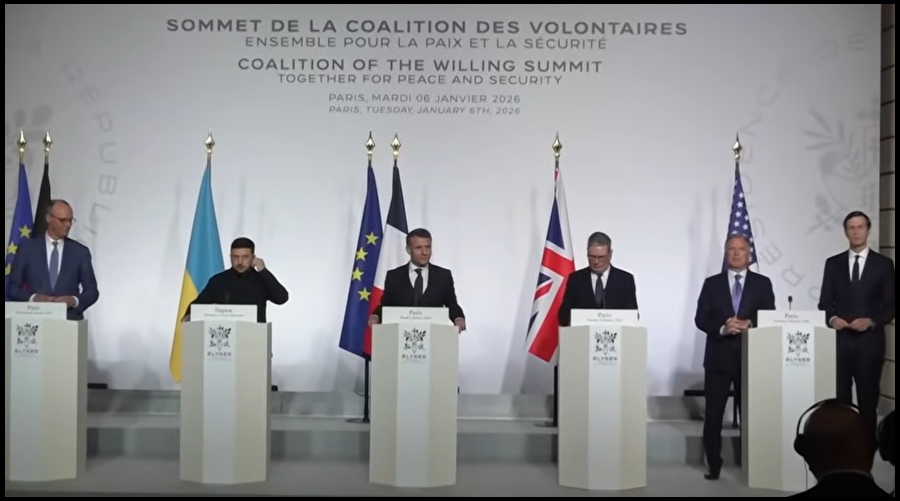
I’ll post the video outcomes of the Paris summit comments below. However, in the interests of time and cutting to the chase, the picture below highlights the reality of things as they present.
The British-based “coalition of the willing” (+1 USA) assembled in Paris as the operation to manipulate the U.S. into forming the cornerstone of the Ukraine “security guarantees” continues. A great deal of this is public relations and psychological operations intended to create something against President Trump’s expressed intention.
However, everything you need to know about the eventual end of this long exposition is evident in the image that everyone pretends not to see.
German Chancellor Merz, Ukraine President Zelenskyy, French President Macron, British Prime Minister Starmer and then you have Mr Witkoff & Mr Kushner. What’s missing? Trump. There’s your answer!
There’s no President Trump because the intent of the principals is against our America-first interest. Hence, the USA did not sign up to the EU created security guarantees, because Trump is demanding they do their own work.
Key word “proposed” [read agreement] …”These elements will be European-led, with the involvement also of non-European members of the Coalition, and the proposed support of the US.”…
President Trump is presenting: The U.S. will provide intelligence *monitoring* assistance, but that’s it.
Not in our strategic interest. Not our war. Not our issue.
Lots of support was mentioned. However, ultimately the responsibility for any agreed security guarantees will be carried by Europe, not by the United States.
As noted by Politico-EU: […] The statement from Kyiv’s European allies says they stand ready to commit to “legally binding” security guarantees to support Ukraine in the event of a peace deal with Russia.
Crucially, the monitoring and verification of a future ceasefire would be led by the U.S., with contributions from countries including the U.K. and Germany.
The plan also sets out security guarantees that would include long-term support for the Ukrainian armed forces, the deployment of a European-led multinational force in Ukraine in case of a peace settlement, and “binding” commitments to support Ukraine should there be a future Russian attack.
French President Macron continues misleading the media, changing the intention of President Trump:
“The coalition of the willing declaration for a solid and lasting peace … for the first time recognizes an operational convergence between the 35 countries, Ukraine and the U.S. to build robust security guarantees,” Macron told reporters. Washington will participate in those guarantees, including with the “backstop” that Europeans wanted, he added.
It’s professional parseltongue from Macron, a man well-versed in the art of linguistic manipulation.
British Prime Minister Keir Starmer said that after a ceasefire, the U.K. and France will set up military hubs across Ukraine and “build protected facilities for weapons and military equipment to support Ukraine’s defense needs.”
France, the U.K. and Ukraine signed a separate declaration on Tuesday laying out these commitments.
The European-led multinational force will cover land, air and sea and will be stationed in Western Ukraine, far from the contact line, Macron said. France and the U.K. have previously said they would be willing to put boots on the ground — but most other coalition members, including Germany, have so far shied away from joining that commitment.
Other nations have suggested deploying aircraft based in neighboring NATO countries to monitor Ukrainian skies, and Turkey has agreed to lead the coalition’s maritime segment to secure the Black Sea.
German Chancellor Friedrich Merz said Berlin was open to deploying its troops in a neighboring NATO country that would act in case of Russian aggression, telling reporters “we are not ruling anything out.” But he stressed that the final decision would be up to Germany’s parliament.
“I will only make proposals to the Bundestag once there is a ceasefire and the coalition of the willing has agreed on the procedure to be followed,” he told reporters. “The prerequisite is a ceasefire.”
Some European countries, however, remain reluctant to deploy military assets in a post-war Ukraine. Greek Prime Minister Kyriakos Mitsotakis repeated that Greece will not participate in a European military force in Ukraine. However, Greek government officials said Mitsotakis has not ruled out other forms of assistance, such as in maritime surveillance. (more)
Witkoff and Kushner continued the Trump approach to heap praise upon the coalition, affirm their best intentions and openly, publicly advocate for the support therein. However, this is a European issue, supported by the U.S, but not operationally engaged with U.S. military despite the EU/Ukraine demands and continued requests.
The U.S. will monitor the Ukraine ceasefire situation and act as a diplomatic peacekeeper, establishing deconfliction channels of open communication between the USA and Russia. However, Europe, this so-called “coalition of the willing,” will be responsible for any military backstop within that approach.
Prime Minister Starmer is all-in to put his British troops on the ground. France less so, with Macron hedging. Germany even less so with Chancellor Merz saying his parliament needs to approve of troop movements.
Everyone is hedging, unsure, seemingly tenuous because they have never operated without the USA acting as the heavy enforcement mechanism. President Trump is coaching them to take responsibility for their own region. The ‘coalition of the willing’ is doing their typically European thing, shouting strong words at Vladimir Putin – but checking to make sure the biggest playground enforcer is standing behind them.
♦ My message to those who worry about President Trump committing us to something protracted that will eventually end in our being pulled into a European theater of conflict, quit worrying. Trump is telling the EU to quit talking and start actively being responsible for their own security. In the background Trump has bigger plans.
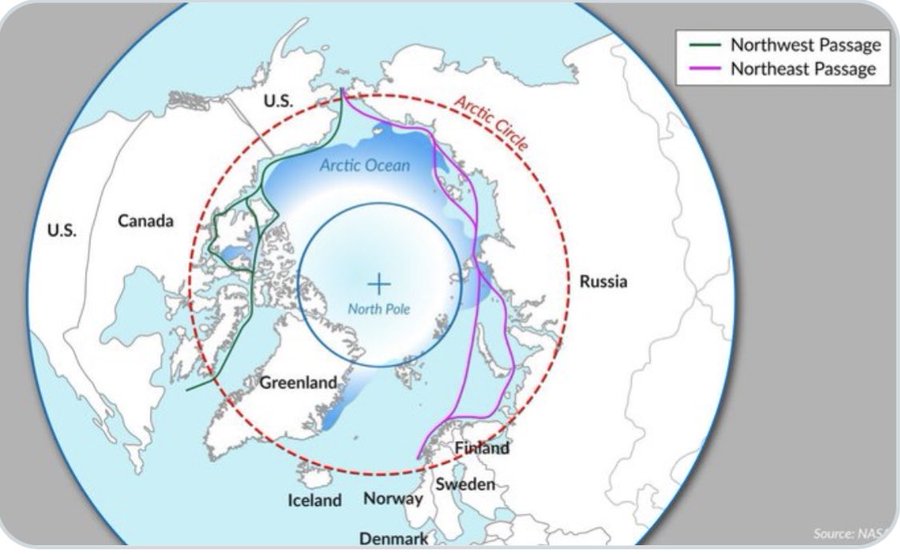
The notion that America wants Greenland for its raw materials is either insanely ignorant or just engagement bait. Extracting anything in the Arctic is prohibitively expensive, and often physically impossible, with extreme cold, thick ice, equipment that won’t function, and no roads, rail or ports to move anything once you have it.
The real reason America needs Greenland is its immense geostrategic military value, which should be obvious to anyone with a functioning brain, especially anyone who has ever looked at a map from above, with the North Pole at the center.
Sure, some tasks could be outsourced to NATO, but that alliance is on its last legs, burdened by too many countries with conflicting priorities, and has mainly served as a way for Europe to freeload on US security guarantees. Relying on it for American national security is reckless. It’s far smarter to cut out the endless middlemen and take direct control. (source)
Mahncke is correct. On one side of the ice, you have North America. On the other side of the ice you have, well, the reason for President Trump to order dozens of icebreakers.
October, 2025:Finland is slightly smaller than Montana and wedged between Sweden and Russia. Finland, a nation of approximately 5 million people, has a security outlook shaped by its geography, a strategic position within the new NATO/Arctic strategy.
President Trump holds a bilateral discussion with Finnish President Alexander Stubb, as the two leaders’ complete terms for eleven icebreaker ships valued at $6.1 billion. Under terms of the deal, three of the ships will be built by Davie in Galveston, Texas, and four by Bollinger Shipyards in Houma, Louisiana.
Finland is the world leader in icebreaker ship building and will help teach U.S. ship building companies the latest advances in the technology. [SOURCE]
Stay Elevated:
December, 2025: Appearing on Fox News to discuss the Ukraine v Russia conflict, Finland President Alexander Stubb is questioned about the conflicting U.S. intelligence reports pushed by Reuters saying Russia will invade Europe, versus DNI Tulsi Gabbard saying Russia has no capability or intent to invade Europe.
President Stubb notes his agencies work closely with U.S. intelligence and in his view, Tulsi Gabbard is correct regarding President Vladimir Putin’s intention. [SOURCE]
President Trump is dancing through a geopolitical minefield, deconstructing numerous long-standing economic and manipulative institutions along the way, while simultaneously keeping 100 domestic agenda plates spinning on sticks.
It is amazing to watch his navigation skills.
Do not join the opposition effort to divide. Instead, smile and enjoy this.
Be thankful that God has allowed you to see what is unfolding. Others that remain asleep are not as lucky as you.
Ask yourself in prayer, why you. Why now? Then, think about this daily in your quiet time.
Affirm your spirit and allow this sense of fortunate knowledge to elevate your faith and confidence in a loving and purposeful God. You have the unique gift of discernment. Ultimately, you have been chosen.
Posted originally on CTH on January 6, 2026 | Sundance
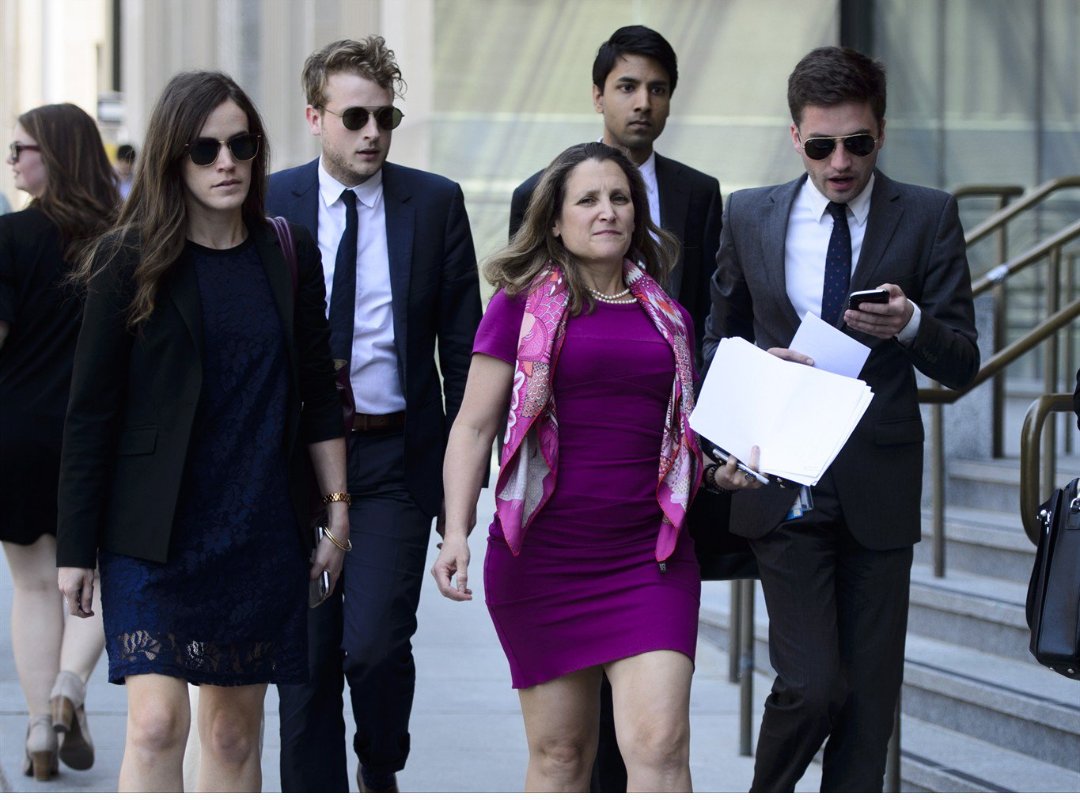
There is some good news within this announcement as Justin Trudeau’s former Deputy Prime Minister to Canada is well known to both President Donald Trump and North American political followers for a decade.
Chrystia Freeland was the former lead of the Canadian trade delegation when Trudeau realized he needed to try and offset the economic damage within the renegotiated NAFTA agreement known as the USMCA. Freeland was also the lead attack agent behind the debanking effort against Canadian truckers who opposed the vaccine mandate.
In addition to holding Ukraine roots, the ideology of Chrystia Freeland as a multinational globalist and promoter for the World Economic Forum’s ‘new world order’ is well documented.
VOLODYMYR ZELENSKYY – “Today, I appointed Chrystia Freeland as an Advisor on Economic Development. Chrystia is highly skilled in these matters and has extensive experience in attracting investment and implementing economic transformations. Right now, Ukraine needs to strengthen its internal resilience – both for the sake of Ukraine’s recovery if diplomacy delivers results as swiftly as possible, and to reinforce our defense if, because of delays by our partners, it takes longer to bring this war to an end. I am grateful to everyone who is ready to support our state and our engagement with partners. Glory to Ukraine!”
Presumably this appointment is intended to assist Zelenskyy in gaining western banking investment in Ukraine, part of the 20-point plan that relates to economic recovery. However, the downside is this announcement undermines any motivation the Trump administration might have toward that same objective.
In reality, given the recent revelations about billions of laundered aid funds being skimmed by corrupt members of the Ukraine government, we can only imagine how much of the recovery funds would be apportioned to maintaining the life of indulgence the political leaders expect.
In response to the lucrative “voluntary” appointment, Chrystia Freeland has announced her resignation from Canadian government in order to avoid any conflict of interest as the skimming is organized.
Approved by British intelligence, MI6, and the greater British Commonwealth in accordance with the needs of the World Economic Forum and banking control managers, it is likely that Freeland will join a growing list of Ukraine Economic “Advisors.”
As Zelenskyy recently said about the opportunity for the EU to confiscate the Russian sovereign wealth fund, “just give me the money.”
Today, around 27 leaders, NATO Secretary-General Mark Rutte as well as the alliance’s top military officer, Gen. Alexus Grynkewich, will gather in Paris amid so-called Coalition of the Willing format. The objective will be to solidify the U.S. elements to provide the “security guarantees,” while Brussels organizes the financial structures that will be possible only because the USA will stand guard over their investment.
…. And, so it goes.
PARIS — U.S. Special Envoy Steve Witkoff and Jared Kushner — U.S. President Donald Trump’s son-in-law — will travel to Paris and attend a meeting of Ukraine’s allies on Tuesday, an Elysée official told reporters on Monday.
U.S. Secretary of State Marco Rubio will not be there “for obvious reasons,” the official added, referring to the situation in Venezuela.
“We have strived to bring the Americans closer to us, never resigning ourselves to the U.S. abandoning Ukraine. We have succeeded in this exercise of reconvergence between Ukraine, Europe, and America,” the official stressed. (read more)
Who knows, maybe we get Greenland in exchange for providing Ukraine security.
Posted originally on CTH on January 6, 2026 | Sundance
President Trump and Secretary of State Marco Rubio have noted that following the ouster of Nicolas Maduro in Venezuela, the remaining government is being pressured to realign their positions and accept a change in direction. It is always tenuous when the leader of a hostile foreign government is removed.
The current approach by the Trump administration is to permit former Vice-President Delcy Rodríguez to continue operating the mechanisms within the country to retain near-term stability.The CIA assessedDelcy Rodriquez was the interim ruler who could keep order.
Prior to the removal of Maduro, Venezuelan opposition leader Maria Corina Machado, the Nobel Peace Prize winner, was asked by the Trump administration to provide a detailed summary of how she could form a functioning government, should she be assisted to power.
Machado’s response did not provide confidence that her strategy was comprehensive enough. Therefore, the Trump administration assessed the best interim approach would be to continue working with the remaining Maduro government officials, led by Delcy Rodriquez, while pressuring them to follow the instructions of the United States.
Various geopolitical powers, including many that attend Mar-a-Lago functions, want Maria Corina Machado installed quickly. President Trump and Secretary Rubio are being more measured in their approach. The powers that want Machado installed are now working on a media strategy. Sean Hannity is enlisted for the assist.
The issue is one of competency and chaos. President Trump and Secretary Rubio do not want to repeat the mistakes of the past (Bush/Powell, Iraq or Obama/Clinton, Libya). The Venezuela issue is entirely different from the Middle East, but the same type of chaos can reemerge if the transition from authoritarianism to representative democracy is not well managed.
The Sea Island attendees support a quick Machado installation. Trump/Rubio prefer to proceed with more caution, especially because someone is going to be on the hook for financial support to Venezuela, because the domestic rewards from any expanded oil revenue are at least 5 to 10 years away.
Changing the regime in Venezuela may break China’s ‘belt and road’ grip, but China’s money is going to need to be replaced with independent domestic economic wealth for the Venezuelan people. That process takes time.
Maria Corina Machado is supported by all the same networks who support Volodymyr Zelenskyy. Despite the twinkles in the eyes of senators within the Foreign Relations Committee, we don’t want Venezuela to become North America’s largest Somali daycare operation.
(WSJ) – […] Latin America analysts have previously cautioned, including during Trump’s first term, that Maduro’s ouster without a capable replacement would likely empower armed military factions, rival politicians and criminal groups within Venezuela as they fought for control, leading to a security crisis in the country.
[…] analysis by the Central Intelligence Agency was briefed to President Trump and shared with a small circle of senior administration officials, according to two of the people. It was a factor in Trump’s decision to back Maduro’s vice president instead of opposition leader and Nobel Peace Prize winner María Corina Machado, some of the people said.
The assessment provides insight into Trump’s decision not to support the opposition’s bid for control of Venezuela following the brazen U.S. military operation to capture Maduro last week and bring him to the U.S. for trial. As in his first term, Trump was convinced that near-term stability in Venezuela could be maintained only if Maduro’s replacement had the support of the country’s armed forces and other elites.
Senior Trump administration officials commissioned the CIA to undertake the analytical assessment and debated it during discussions about day-after plans for Venezuela, the people said. The people familiar with the assessment said they were unsure of the precise date it was produced.
The report was briefed to Trump in recent weeks, according to two of the people.
The assessment didn’t describe how Maduro could lose power, or advocate for removing him, but attempted to gauge the domestic situation in Venezuela in the event that he did, people familiar with it said.
The intelligence report, the people said, cited Rodríguez and two other top Venezuelan regime figures as possible interim rulers who could keep order. The people familiar with the assessment didn’t identify the other two officials, but besides Rodríguez, the two most influential power brokers are Interior Minister Diosdado Cabello and Defense Minister Vladimir Padrino.
The two hard-liners, who command Venezuela’s police and military, could undo any efforts at a transition, according to former U.S. and Venezuelan officials. Both face U.S. criminal charges similar to those filed against Maduro and are unlikely to cooperate with Washington.
The report concluded that Edmundo González, widely seen as the actual winner of the 2024 election against Maduro, and Machado would struggle to gain legitimacy as leaders while facing resistance from pro-regime security services, drug-trafficking networks and political opponents. (more)
My grandpa, and later my father, used to say something at particular moments that generally annoyed me but turned out to be entirely accurate, much to my youthful angst… “Well, hang around a one-legged group long enough, and you’re eventually going to end up limping.”
Yup, I learned to hate that lesson because the truth of it was always annoying.
This is perhaps the first time in memory when I look forward to Donald J Trump getting out of the Mar-a-Lago bubble and back to Washington DC. Good grief, just typing that I can’t believe I’m saying it. Here’s why:
Having followed and written about the optimal solution approach within the Trump Doctrine, a process that assigns responsibility to regional actors, then exits while providing support but not direct involvement [the delegation metric of high-support/low-direction], perhaps that is unfolding again in the background. However, it seems like Trump is accepting the annoying Iran monkey problem on our behalf. [REF: How to Make The Monkey Jump]
To be clear in my personal position, charity begins at home. (1) I don’t want conflict with Iran, nor do I really care about their internal political struggles; most of my day-to-day contacts feel the same. (2) At the same time, yes, I can imagine a scenario where Venezuela represents a threat to our continental objectives and national security, but would prefer to see them isolated from the outside. Embargo them, stuff them inside an economic confinement zone (if needed), tell them why, then let the internal mess work itself out; most of my day-to-day contacts seem to feel the same.
Granting President Trump the long view of support; I mean, we don’t know what he is aware of; I sure hope all of this Iran stuff has a direct connection to American strategic interests.
Simultaneously, I can certainly see where deconflicting the USA, vis-a-vis Ukraine (literally London and the EU) from friction with Russia, has a strategic interest and factual bearing on the dollar-based trade system. Attention on the Ukraine vs Russia stuff does have direct, albeit complicated outcomes attached to the economic standing of the average American. Iran less so.
Pictured Center: a one-legged man.
Pictured Center: a one-legged man.
Looking at it from a geopolitically logical approach…. President Trump and Marco Rubio need Syria to remain stable.
Secretary Rubio has explained this aspect very well when he summarized the reason for President Trump lifting the sanctions against Syria. I get that part. But is this “locked and loaded” simply a brush back pitch against Iran to stop them from disrupting Trump’s Gaza objective. Maybe so, it does make sense; thus, we extend the benefit of doubt.
If Syria destabilizes the tenuous Israel/Gaza stuff gets more complicated. Iran can destabilize Syria. Therefore, putting pressure on the Iranian regime while simultaneously telling Israel to cool it over their Turkish opposition to the Gaza assist again does make sense.
Benjamin Netanyahu dislikes Recep Erdogan immensely and doesn’t trust him an inch. I get that part also, but Turkey is a weird place held together by Erdogan’s very specific brand of Muslim Brotherhood patriotism.
In very direct ways keeping Syria stable helps Turkey and by extension the EU.
If Syria erupts, the refugee exodus heads north, and cunning Erdogan – a tenuous NATO member seemingly never giving up on his Ottoman Empire rebuild – will play his “I can only absorb so much” card, thereby opening the gates for more authentic Islam travel further north into Europe.
[Our solid contacts in Istanbul have confirmed around 5 million Syrians have repatriated since President Ahmed al-Sharaa started his agenda to stabilize the region. The busy former al-Qaeda guy, 43-years-old, is also a bridge between Trump and Putin. So, there’s that.]
Keeping Syria stable also permits Trump’s Arab state coalition to deal with Gaza/Hamas in a constructive way. Trump told Netanyahu this publicly during the recent visit, essentially rebuking Israel’s justification for more IDF military action in Gaza. Again, President Trump is dancing through the minefield here with the long game to get us the f**k out of it, while Netanyahu is hugging Trump to pull the USA deeper into it.
If you understand the Iranian tentacles that still remain in Syria (see recent ISIS attacks), confronting Iran makes Israel very happy; however, it’s not Netanyahu’s happiness that stands behind Trump’s motive for the confrontation. Ultimately, the motive is Syria’s stability, Turkish Gaza support and the Arab money/engagement needed for the Mideast mess.
If our suspicions are correct, we should see Team Trump leaning toward Recep Erdogan, toward the Arab coalition and toward Syria at the same time he is managing Iran, managing Israel and managing a U.S. congress.
If the Ayatollahs are busy tamping down street protests, they are less likely to be poking Syria.
All of that is giving President Trump the maximum benefit of the doubt combined with the application of common sense.
♦ Meanwhile inside Russia, you might not hear about it from western media, but Ukraine and NATO are striking non-military targets, civilian areas, throughout Russia currently focusing heavy drone fire at Kazan, Russia’s third largest city.
STATE DEPT:“There have been drone attacks and explosions near the border with Ukraine, and in Moscow, Kazan, St. Petersburg, and other large cities.
Russian citizens are now very familiar with the sound of air raid sirens as increased drone attacks from Ukraine are extending into Russia. This noticeable increase in activity is happening in combination with U.S/Ukraine strategic discussions on an EU created ceasefire agreement.
The Rubio state department has now updated the Russia advisory summary warning all Americans of the danger in traveling throughout Russia.
The update is also timed with the increased drone attacks into Russia’s main population centers and is likely due to concern that Americans would be street targets for angered Russian nationalists.
If President Trump walks away from the EU/Ukraine peace agreement construct, Russian Federation President Vladimir Putin will likely increase retaliatory attacks against Ukraine by significant levels. One of my good contacts shared, “if Trump walks away, Kiev will now be leveled.”
Apparently, despite the incoming fire increasing, Putin is holding back his response to give Trump room to operate, while still carefully managing the Kremlin politics and striking into Ukraine to appease those in Russian government who want the full weight of the Russian military to come down hard on Zelenskyy.
Posted originally on CTH on January 1, 2026 | Sundance |
The Wall Street Journal is reporting that Ukraine did not target the personal residence of Russian Federation President Vladimir Putin, “according to U.S. officials.” However, Russia captured one of the drones intact and have said they were able to “extract a file containing a flight plan from the navigation unit” which they plan to share with the Trump administration through established channels. {LINK}
WSJ – WASHINGTON—U.S. national-security officials said Wednesday that Ukraine didn’t target Russian President Vladimir Putin or one of his residences in an alleged drone operation, challenging Moscow’s assertion that Kyiv sought to kill the Russian leader.
That conclusion is supported by a Central Intelligence Agency assessment that found no attempted attack against Putin had occurred, according to a U.S. official briefed on the intelligence. The CIA declined to comment.
The U.S. found that Ukraine had been seeking to strike a military target located in the same region as Putin’s country residence but not close by, the official said. (read more)
Who are we going to believe, Russian “special service” operations or anonymous “U.S. Intelligence Officials”?
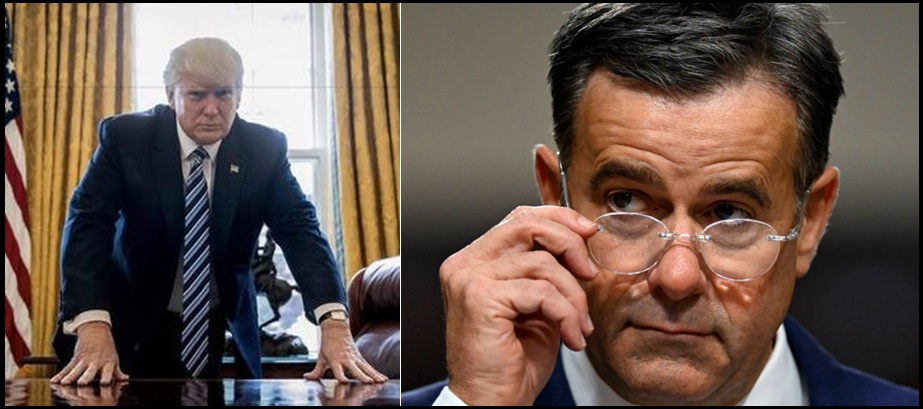
Unfortunately, this question is no longer easy to answer given the history of the U.S. Intelligence Community, and yes, that includes the current embedded IC officials within the National Security Council, DNI and CIA even with Marco Rubio, Tulsi Gabbard and John Ratcliffe in position.
I would be very surprised if the U.S. Intelligence Community would be honest with President Trump on this issue if, and that is a big “if”, they even factually had any specific intelligence about it. [This WSJ narrative could be fake news]
Again, CTH will also assert the likelihood that Volodymyr Zelenskyy likely didn’t carry out the attack; everything about the timing of it during his meeting with President Trump just doesn’t fit. Instead, it is more likely British intelligence, specifically MI6 carried out the attack, timed specifically for the Trump/Zelenskyy meeting.
In context, there have been several attacks against Russia timed with negotiations. CTH has noted that each instance of closer agreement during Russia/Ukraine negotiations (Turkey) or U.S/Ukraine negotiations (Turkey and Paris) there have been attacks into Russia that seemed to carry a motive from an external third party.
U.S. media have said the attack on Putin may be a lie; however, with physical evidence from the defense operation, it is less likely Russia just made up the attack. At this moment in the conflict, Putin doesn’t need domestic propaganda.
CONTEXT: British intelligence previously confirmed their participation in the successful Ukraine drone attack against long-range Russian bombers. That operation, highly controversial at the time, was previously confirmed by President Trump saying the U.S. was not informed in advance.
The “coalition of the willing” has also expanded. Outside the Ukraine regime, the current group making up the “coalition of the willing” includes: the U.K, France, Germany, Canada and Australia. It is worth noting the additions are part of the British commonwealth (Canada, Australia).
Most observers note that Ukraine President Zelenskyy is not an independent actor in the warfare decisions as carried out from within Ukraine itself. In fact, British intelligence has now replaced U.S. intelligence for providing the majority of the satellite guidance systems, targeted systems and missile operations. German and French intelligence have been closely coordinating with the U.K. on behalf of European Union stakeholders.
Europe, specifically the British MI6 intelligence service, have recently espoused their #1 priority is to defeat Russia using the proxy that Ukraine provides.
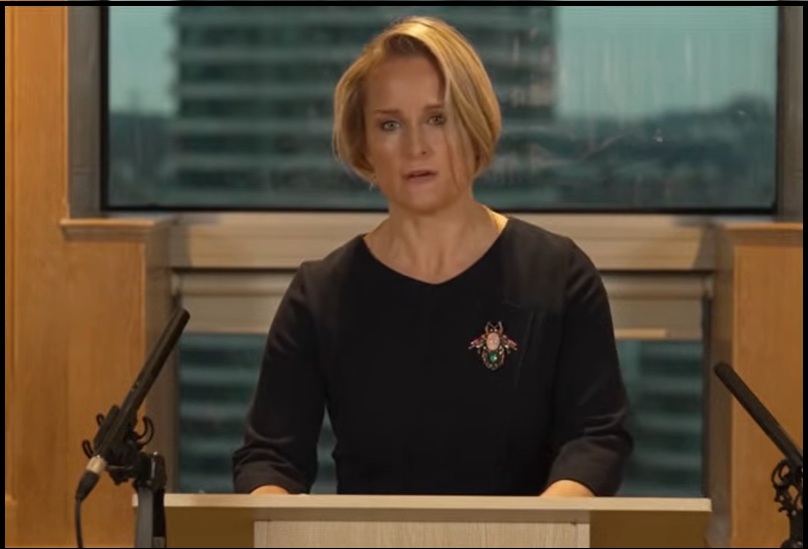
The newly appointed head of MI6, Blaise Metreweli (pictured right), formerly known by her position as “Q”, is literally the granddaughter of factual Ukraine Nazi, Constantine Dobrowolski.
As head of MI6, Metreweli has specifically stated the U.K wants war with Russia. Metreweli’s entire family has Ukraine roots.
So, with full context applied it is entirely likely that both Vladimir Putin and Volodymyr Zelenskyy are not lying. Putin was attacked, but Ukraine -as defined as Zelenskyy- didn’t do it.
The most likely scenario is that U.K intelligence elements inside Ukraine again used the opportunity of the Trump-Zelenskyy negotiation meeting to carry out the attack against Russian President Putin. The motive is obvious.
Beyond the ideological component, the economies of the U.K/EU are now increasingly dependent on their defense spending as was recognized with the severe contraction of the German economy in almost all sectors except those supported by defense spending.
An end to the Russia/Ukraine conflict is against the interests of the “coalition of the willing.” Additionally, an ancillary motive for both the U.K and U.S. group who support the EU effort is to keep President Trump bogged down.
I still strongly suspect the British did it, and the CIA doesn’t factually have any concrete intelligence to prove or dismiss this strongest motivational likelihood.
Posted originally on Dec 31, 2025 by Martin Armstrong |
Sources in Ukraine state that Zelensky is trying to assassinate the top Russian generals in hopes of turning the army against Putin and to bring down Russia. I do not see any possible lasting peace arrangement and the refusal of Zelensky to let the Donbas separate is only supported by the hatred of Russians within the EU further guaranteeing that with the best intentions of Trump, this will never result in a long-standing peace accord. Europe will fall and unless the people purge the Neocons running NATO, their future will never be secure.
Posted originally on CTH on December 30, 2025 | Sundance
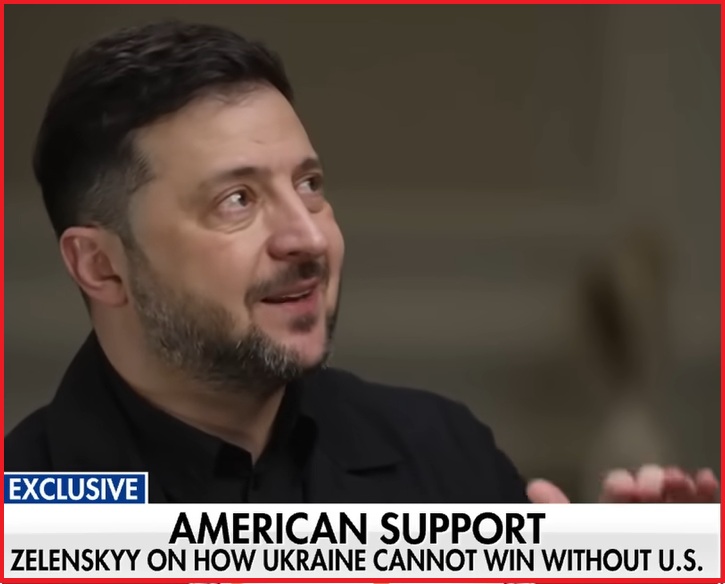
Ukraine President Volodymyr Zelenskyy appears on Fox News for an interview with Bret Baier. Within the interview Zelenskyy gives some context and details to the 20-point plan organized between him and the EU Leaders, currently being reviewed and modified by President Trump, Steve Witkoff, Marco Rubio and Jared Kushner.
The two remaining issues as described by Zelenskyy are the (1) security guarantees and (2) the territorial issue, Donbas control.
(1) Within the security guarantee proposal there are troubling signs. Zelenskyy describes it as a bilateral agreement between the USA and Ukraine, with similar constructs to the NATO alignment. A non-NATO pact between the U.S. and Ukraine that commits us to his defense if Russia would advance another attack. A 15-year guarantee committed in U.S. law through the U.S. House and Senate. This sounds troubling.
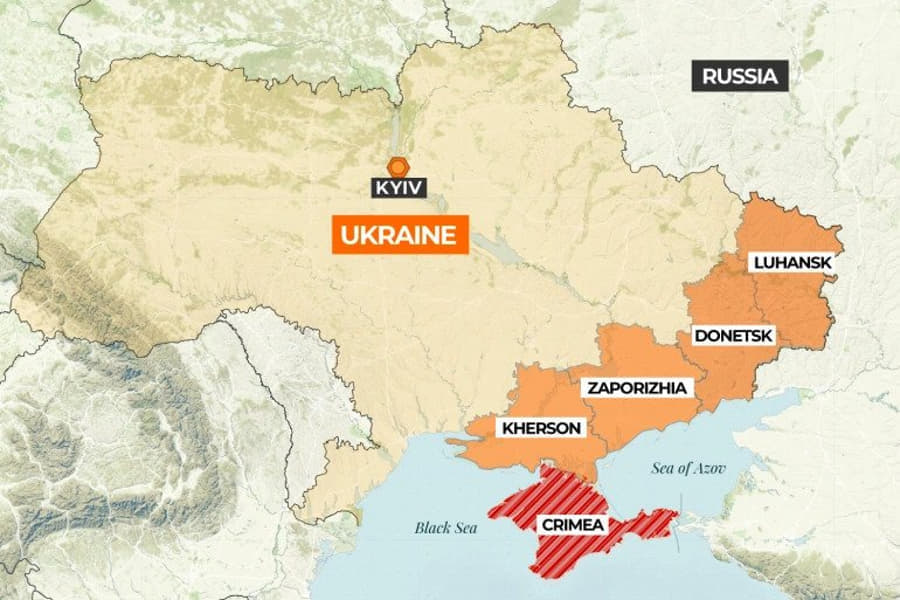
(2) On the territorial issue, regional control of the Donbas, Zelenskyy appears to be willing to cede territory but only under very limited circumstances. Zelenskyy wants a demilitarized zone under the term “a free economic zone” with specific rules.
Zelenskyy admits Ukraine cannot win the conflict against Russia without the United States involvement. Essentially without America, Russia would own the skies and be able to crush the Ukrainian army. WATCH:
Posted originally on CTH on December 30, 2025 | Sundance
During an impromptu press availability beside Israeli Prime Minister Benjamin Netanyahu, President Trump responded to a question about a drone attack against the personal residence of Russian President Vladimir Putin.
President Trump noted that he was informed of the attack by President Putin during an early Monday phone call between the two leaders.
According to Russian media, confirmed by Russian foreign Minister Sergey Lavrov, Putin’s presidential residence in the Novgorod region, more than 400 kilometers (249 miles) northwest of Moscow, was targeted by 91 drones. Russia has vowed retaliation saying, “targets had already been selected.” President Trump’s response is prompted below:
Ukraine President Volodymyr Zelenskyy has denied the accusation that Ukraine carried out this particular attack. The attack took place while Zelenskyy was in Florida meeting with President Trump.
In context, there have been several attacks against Russia timed with negotiations. CTH has noted that each instance of closer agreement during Russia/Ukraine negotiations (Turkey) or U.S/Ukraine negotiations (Turkey and Paris) there have been attacks into Russia that seemed to carry a motive from an external third party.
U.S. media have said the attack on Putin may be a lie; however, with physical evidence from the defense operation, it is less likely Russia just made up the attack. At this moment in the conflict, Putin doesn’t need domestic propaganda.
CONTEXT: British intelligence previously confirmed their participation in the successful Ukraine drone attack against long-range Russian bombers. That operation, highly controversial at the time, was previously confirmed by President Trump saying the U.S. was not informed in advance.
The “coalition of the willing” has also expanded. Outside the Ukraine regime, the current group making up the “coalition of the willing” includes: the U.K, France, Germany, Canada and Australia. It is worth noting the additions are all part of the British commonwealth (U.K, Canada, Australia).
Most observers note that Ukraine President Zelenskyy is not an independent actor in the warfare decisions as carried out from within Ukraine itself. In fact, British intelligence has now replaced U.S. intelligence for providing the majority of the satellite guidance systems, targeted systems and missile operations. German and French intelligence have been closely coordinating with the U.K. on behalf of European Union stakeholders.
Europe, specifically the British MI6 intelligence service, have recently espoused their #1 priority is to defeat Russia using the proxy that Ukraine provides.
So, with full context applied it is entirely likely that both Vladimir Putin and Volodymyr Zelenskyy are not lying.
The most likely scenario is that U.K elements inside Ukraine again used the opportunity of the Trump-Zelenskyy negotiation meeting to carry out the attack against Russian President Putin. The motive is obvious.
Beyond the ideological component, the economies of the U.K/EU are now increasingly dependent on their defense spending as was recognized yesterday with the severe contraction of the German economy in almost all sectors except those supported by defense spending.
An end to the Russia/Ukraine conflict is against the interests of the “coalition of the willing.” Additionally, an ancillary motive for the U.S. group who support the EU effort is to keep President Trump bogged down.
(Bloomberg) — President Donald Trump’s campaign to end the war in Ukraine faced new complications on Monday when Vladimir Putin said he would revise his country’s negotiating position after the Russian leader claimed Ukrainian drones targeted his residence.
Putin told Trump of his decision in a call Monday, according to the Kremlin, even as Kyiv cast the Russian allegations as a fabrication aimed at derailing the peace process.
Trump addressed the dispute while speaking to reporters in Florida, saying that Putin had told him about the purported attack during their discussion. The US president, seeming to side with Putin, said he was “very angry.”
“It’s one thing to be offensive, because they’re offensive,” Trump told reporters in Florida. “It’s another thing to attack his house. It’s not the right time to do any of that.”
Ukrainian President Volodymyr Zelenskiy has dismissed the Russian claims as a “new lie” and warned that Moscow could be using it as an excuse to prepare an attack on government buildings in Kyiv.
Putin said Moscow intends to work closely with the US on peace efforts but would reconsider a number of previously reached agreements, Kremlin aide Yuri Ushakov told Russian newswires. Ushakov added that Putin assured Trump that Moscow would look to continue working with American partners to achieve peace and that the two leaders agreed to maintain their dialogue. (more)
I have created this site to help people have fun in the kitchen. I write about enjoying life both in and out of my kitchen. Life is short! Make the most of it and enjoy!
This is a library of News Events not reported by the Main Stream Media documenting & connecting the dots on How the Obama Marxist Liberal agenda is destroying America










 Centinel2012