Posted originally on CTH on December 14, 2025 | Sundance
As with all information during high-stakes negotiations, particularly ones covered in geopolitics, trillions at stake and power dynamics on this scale, it is prudent to ignore most media reporting and focus on the public statements from the negotiators.
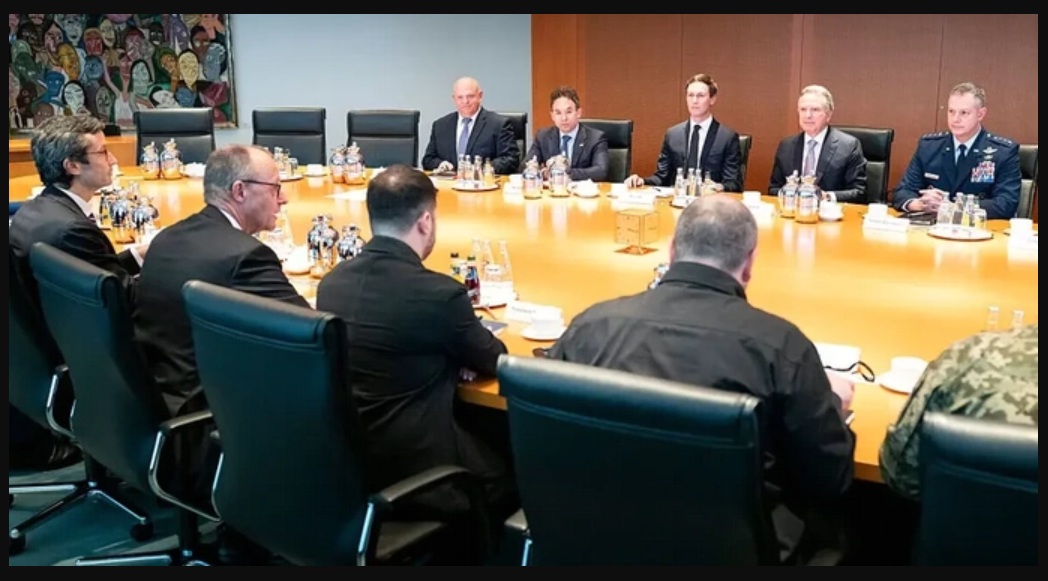
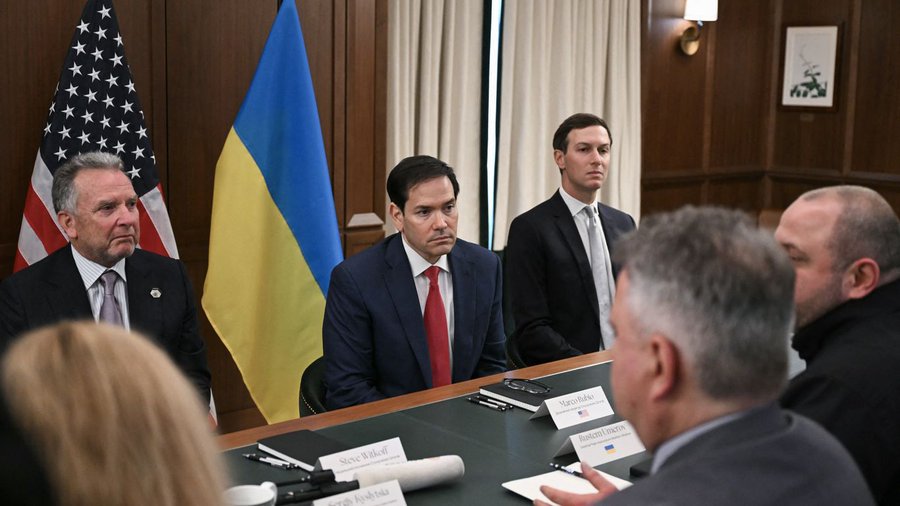
German Chancellor Fredrich Merz seated right next to Zelenskyy, highlighting the oppositional nature of the U.S. vs EU position during negotiations.
STEVE WITKOFF – Official Readout: “The meeting in Berlin between President Zelenskyy, Special Envoy Witkoff, Jared Kushner, and delegations from the United States and Ukraine lasted over five hours. Representatives held in-depth discussions regarding the 20-point plan for peace, economic agendas, and more. A lot of progress was made, and they will meet again tomorrow morning.”
Official Readouts are the statements that all parties agree to. The “readout” is not a shaping statement giving insight into the deal itself, but rather a status statement of the discussions surrounding the deal.
Team Zelenskyy have been waging a public relations campaign to retain support from echo-chambered EU politicians. The focus is continuation of funding, essentially money. Team Trump have been less public and approaching the negotiations with prudent pragmatism; less PR more substance; their focus is an end to the killing. These are two distinctly different priority sets.
DW NEWS – Sunday’s discussions in Berlin between Ukrainianand US officials on ending Russia’s war in Ukraine have concluded for the night, with the talks set to continue on Monday.
In a message sent to reporters over WhatsApp, Ukrainian presidential adviser Dmytro Lytvyn, said the talks “went on for more than five hours and ended for today with an agreement to resume tomorrow morning.”
Lytvyn added Ukrainian President Volodymyr Zelenskyy would comment on the discussions on Monday once they were completed. (source)
Posted originally on CTH on December 14, 2025 | Sundance
Today, Ukrainian President Volodymyr Zelenskyy arrived in Berlin to meet with President Trump emissaries Steve Witkoff and Jared Kushner ahead of the previously scheduled Monday summit with the Coalition of The Willing, U.K, France and Germany.
The wording used by Zelenskyy tells the dynamic: “We are currently preparing for meetings with the U.S. side and our European friends in the coming days. Berlin will host many events.”
The “U.S side” and “European friends”, a notable distinction in the terminology as Zelenskyy notes his friendship with his European stakeholders.
Today, Sunday, Zelenskyy notes, “I am already in Germany. Today’s agenda includes a meeting with the American negotiating team. We are focusing on how to reliably guarantee Ukraine’s security so that the experience of the Budapest Memorandum and Russia’s invasion are never repeated. We are counting on constructive talks.”
For President Zelenskyy and his EU coalition, everything revolves around the security guarantees. As noted by Politico:
“The summit in Berlin is important: we are meeting with both the Americans and the Europeans,” Zelenskyy told journalists in a WhatsApp group chat on Sunday, according to a transcript of his remarks. “It is important for us. And believe me, we have done a lot to ensure that these parties all meet together.”
Zelenskyy emphasized the need for Ukraine to receive firm guarantees from the United States and European allies that would be similar to those offered to NATO members, according to the transcript of the group chat.
“These security guarantees are an opportunity to prevent another wave of Russian aggression,” the Ukrainian leader said. “And this is already a compromise on our part.”
Zelenskyy emphasized that the security guarantees would need to be legally binding and supported by the U.S. Congress. He said he expected an update from his team following a meeting between Ukrainian and U.S. military officials in Stuttgart. (link)
“We are talking about bilateral security guarantees between Ukraine and the United States — namely, Article 5-like guarantees … as well as security guarantees for us from our European partners and from other countries such as Canada, Japan and others,” Zelenskyy told journalists in a group chat, according to a report by the Financial Times.
♦ On the ‘Security Guarantee‘ issue, this is where a quagmire is presented by European leaders.
From a pragmatic standpoint, a European demilitarized zone, stood up and supported by EU military forces, would appear to be the best solution. However, the “coalition of the willing” say they are willing to put security troops into Ukraine, but only if the USA will defend them if attacked by Russia. In essence, quasi-NATO forces on a non-NATO country, that if attacked would draw the entirety of NATO into the conflict, including the United States.
The U.K, France, Germany and EU Commission want a security structure similar to NATO for Ukraine that legally binds the United States to defend their interests if the ceasefire does not hold. President Trump has rejected this construct as yet another way for Europe to pull the U.S into a conflict zone that is not in our vital national security interests.
The ceasefire proposal structured by Trump, Witkoff and Kushner – seemingly supported by Russia, does not permit Ukraine to join NATO; however, EU membership is entirely up to the EU and people of Ukraine to decide. If Ukraine joins the EU, then EU forces alone should provide the security guarantee, not NATO which includes the U.S. and Canada.
It will be interesting to see how the Europeans organize their “security guarantee” proposal. I strongly doubt Steve Witkoff and Jared Kushner are willing to enter into any “article-5 like” agreement to put American troops into the mix, despite the demands of Zelenskyy.
ENOUGH ALREADY! If Zelenskyy’s European “friends” are willing to put their military troops into the mix, then the EU friends should be responsible for the security therein. President Trump needs to exit this hot mess, regardless of what congress wants to see happen.
Posted originally on CTH on December 12, 2025 | Sundance
Generally, the Washington Post is the outlet for interests and concerns of the CIA or international elements of the U.S. intelligence community. Narratives from the Washington Post usually shape storylines against scrutiny of the Intelligence Community.
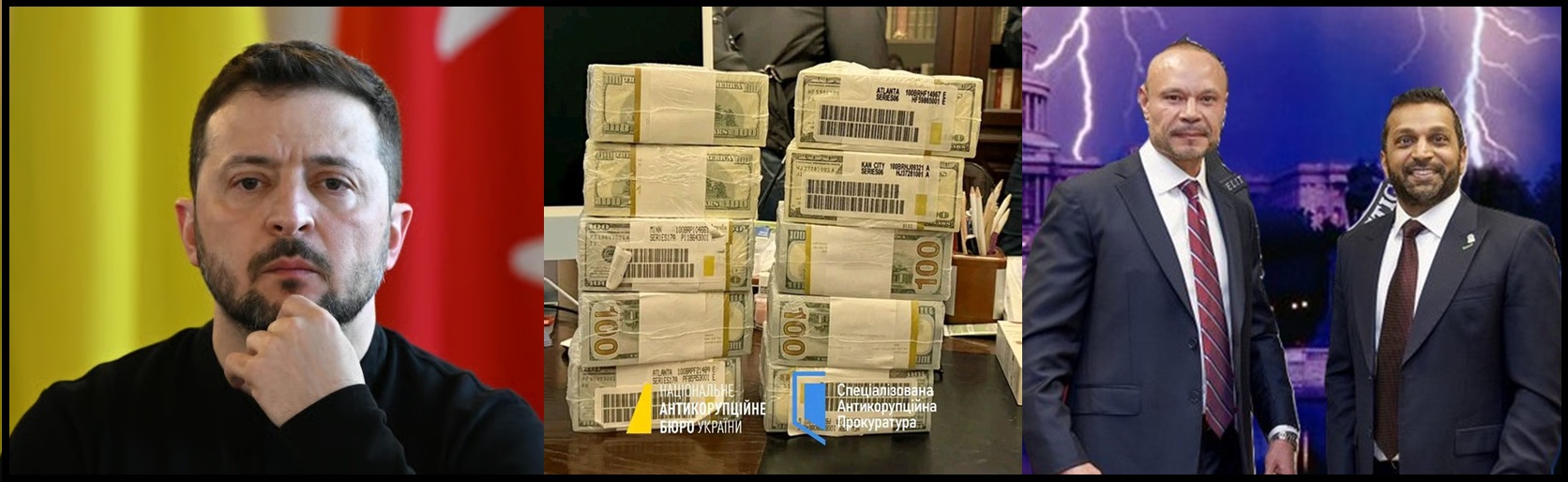
It has been widely reported that the FBI has been working closely with the National Anti-Corruption Bureau of Ukraine (NABU) in detecting and discovering corruption amid Ukraine officials who have skimmed money from various international aid programs. However, the Washington Post is suddenly concerned that FBI Director Kash Patel and Deputy FBI Director Dan Bongino have held “secret meetings” with lead Ukraine peace negotiator Rustem Umerov.
This becomes interesting if you have followed along and noted that during negotiations the reports of Rustem Umerov indicated his concurrence with the peace agreements structured by Marco Rubio, Steve Witkoff and Jared Kushner. Indeed, based on feedback during these meetings President Trump has said the Ukraine delegation appeared “quite happy” with the terms of the Witkoff/Kushner proposals, while Ukraine President Zelenskyy was less accepting.
Between the lines of statements following the consultations, it is easy to get the sense that Rustem Umerov is in alignment with the U.S. proposals, but Volodymyr Zelenskyy is not. Hence, Zelenskyy keeps returning to his U.K, France, Germany and EU support network for counterproposals despite his officials like Umerov working with the U.S. team directly.
[…] “The meetings have caused alarm among Western officials who remain in the dark about their intent and purpose. Some said they believe Umerov and other Ukrainian officials sought out Patel and Bongino in the hopes of obtaining amnesty from any corruption allegations the Ukrainians could face. Others worry the newly established channel could be used to exert pressure on Zelensky’s government to accept a peace deal, proposed by the Trump administration, containing steep concessions for Kyiv.” (more)
The FBI working with NABU to uncover Ukraine corruption. The FBI is meeting with Ukraine lead negotiator, Rustem Umerov. A massive corruption scandal has just taken down Zelenskyy’s main aide, Andriy Yermak.
“The discussions [between the FBI and Umerov] are happening at a critical moment for Ukraine. It is under pressure by the Trump administration to agree to an end-of-war proposal with huge implications for the country’s borders and territorial integrity.
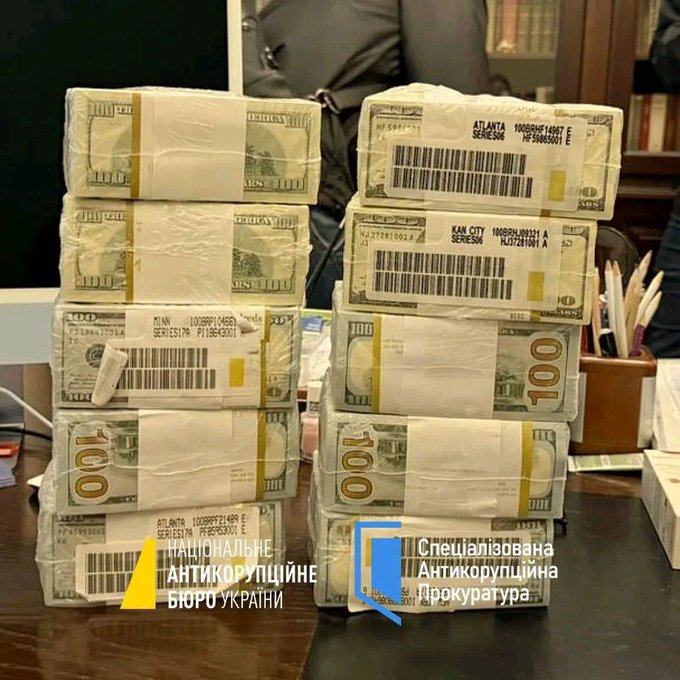
It is also facing its most far-reaching corruption scandal since Zelensky took office in 2019. Ukrainian investigators alleged last month that $100 million had been stolen from the country’s energy sector through graft and kickbacks.
Eight people, including Zelensky’s former business partner, are accused of embezzlement, money laundering and illicit self-dealing. Zelensky’s top aide, Andriy Yermak, the second most powerful person in Ukraine, resigned in late November after his house was raided. Another close former ally of Zelensky, Oleksiy Chernyshov, who served as deputy prime minister, is accused by Ukrainian authorities of receiving $1.3 million in kickbacks.” {link}
Perhaps Zelenskyy’s primary negotiator for the USA team, Rustem Umerov, has specific knowledge of corruption connected to the generous financial support the USA has provided Ukraine. Watching Yermak get taken down within the FBI/NABU investigation, might have triggered Umerov to cooperate on several levels.
Umerov reported as happy with the negotiated U.S. terms. Volodymyr Zelenskyy openly not happy with the negotiated terms.
Posted originally on CTH on December 12, 2025 | Sundance
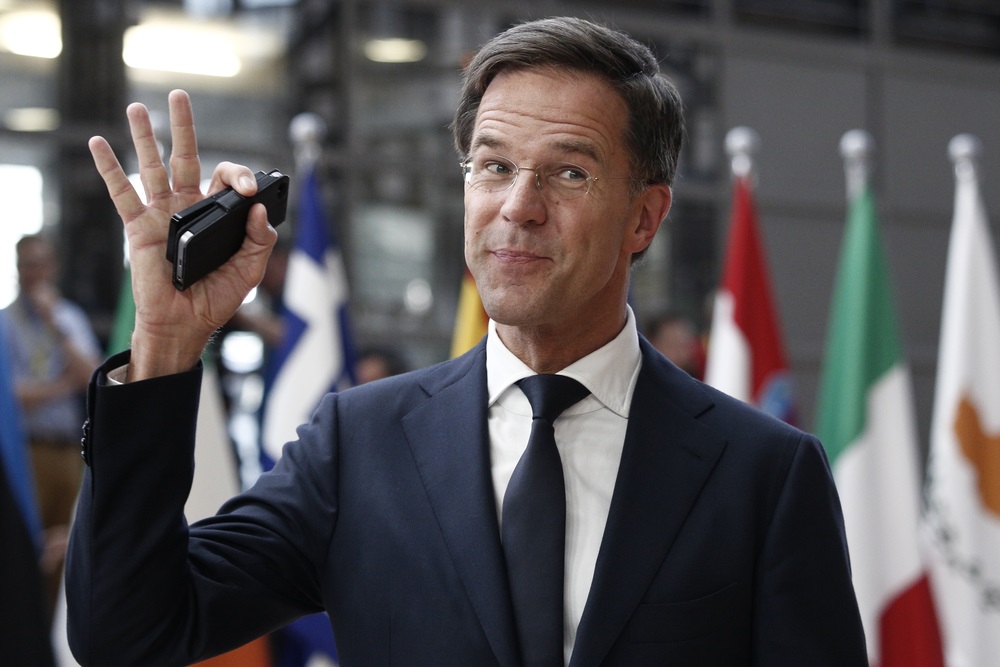
NATO General Secretary Mark Rutte and German Chancellor Frederich Merz hold a press conference as a meeting in Paris this weekend (13th) and Berlin on Monday (15th) are scheduled to finalize EU terms for a negotiated Ukraine-Russia ceasefire.
Within the remarks Merz notes a preliminary document outlining possible land concessions has recently been sent to the Trump administration, and that set of documents likely includes an outline for ‘security guarantees’ assembled by the coalition of the willing (Germany, France and UK). “It mainly concerns the question of what territorial concessions Ukraine is prepared to make,” Mr Merz said. He stressed that any decision on land concessions was up to the Ukrainian government and its people.
Chancellor Merz said, “If we continue as imagined, there will be talks with the US administration over the weekend and there might be a meeting at the beginning of next week in Berlin. Whether the US administration will take part in the meeting depends on the papers we are working on [at present].”
Speaking to an audience together with NATO Secretary Rutte, German Foreign Minister Johann Wadephul, emphasized the 28-point outline originally created by Trump, Rubio, Witkoff and Ukraine/Russia officials was dead. “As the 28-point plan was mentioned, it is no longer existing,” Wadephul said. “We had some influence on it” he remarked, seemingly bragging about how Europe destroyed the U.S plan.
Another report on Thursday said Italian Prime Minister Giorgia Meloni urged Volodymyr Zelensky to accept “painful concessions” for a peace deal. According to the Italian newspaper Corriere della Sera, tensions surfaced between the two leaders as Ms Meloni pressed Mr Zelensky to accede to US demands. “There is sufficient evidence indicating that not everything went smoothly and that some differences were clearly expressed for the first time by both parties,” the newspaper stated.
Meanwhile back in Washington, DC, President Trump delivered remarks on the Ukraine-EU negotiations yesterday, noting his discussions with the European team and the potential for Trump’s emissaries to attend either the Paris or Berlin meeting if something productive can be gained from it.
According to The Telegraph, […] “In Europe, the focus will shift over the weekend to Paris, where the details of the latest peace proposal are expected to be ironed out.
Ukraine is also keen to prevent talks over territorial concessions from happening without parallel discussions on the shape of the security guarantees the US could offer to deter a future Russian invasion.
Officials close to the negotiations have described “incredible pressure” by Steve Witkoff and Jared Kushner to agree to a unilateral withdrawal from the Donbas before any other agreements are struck.
On Thursday, Russia said it had made fresh gains on the front line in Ukraine, where Putin is taking territory slowly and at a heavy cost to his troops.” {source}
Volodymyr Zelenskyy: “Today, we have had a constructive and in-depth discussion with the American team on one of the three documents we are currently working on – the one on security guarantees. The U.S. was represented by Secretary Marco Rubio, Secretary Pete Hegseth, Steve Witkoff, Jared Kushner, Generals Keane and Grynkewich, and Josh Gruenbaum. My thanks also to Sec Gen NATO Mark Rutte of NATO. We greatly value the active engagement of the American side at all levels – not only in working to end the war, but also in ensuring Ukraine’s security and preventing a new Russian invasion. This reflects the seriousness of America’s intentions and its clear focus on achieving outcomes.”
“Security guarantees are among the most critical elements for all subsequent steps. We have already got the negative experience of the Budapest Memorandum. Everyone remembers this, as well as the occasions when Russia repeatedly violated all its other commitments. That is why it is essential that this document on security guarantees provides concrete answers to what concerns Ukrainians the most: what actions partners will take if Russia decides to launch its aggression again. It was agreed that the teams will work actively to ensure that, in the near future, there will be a clear understanding of the security guarantees. I thank everyone who is helping!” {SOURCE}
Volodymyr Zelenskyy – “We held a meeting of the Coalition of the Willing, and this is an important format for supporting Ukraine’s security now and in the future. We are working to ensure that the security guarantees include serious components of European deterrence and are reliable, and it is important that the United States is with us and supports these efforts. No one is interested in a third Russian invasion. And right now, defense support for Ukraine is especially important, because Russia’s attacks are not stopping, and there must be greater protection of life for diplomacy to work toward a just peace. Thank you to everyone who is helping.” {Source}
Ukraine Democracy: 80 diplomat engagements, 30 foreign leader visits, 712 visits by influencers, 5,000 scheduled NATO/EU meetings, briefings and calls, 526 foreign trips, 7,295,000 memos and statements of interest, 280,000 hours of discussion and negotiation, 535 stakeholder briefings, $1,000,000,000 stolen or laundered to international agencies, politicians and Ukraine officials. Four years. Zero elections!
This is my rifle. There are many like it, but this one is mine.
My rifle is my best friend. It is my life. I must master it as I must master my life.
My rifle, without me, is useless. Without my rifle, I am useless.
I must fire my rifle true.
I must shoot straighter than my enemy who is trying to kill me.
I must shoot him before he shoots me.
VIA POLITICO – NATO Chief Mark Rutte urged member countries to do more to prepare for the possibility of large-scale war, warning that Russia may be ready to attack the alliance within five years.
“We are Russia’s next target. And we are already in harm’s way,” Rutte said on Thursday during a speech in Berlin. “Russia has brought war back to Europe, and we must be prepared for the scale of war our grandparents and great grandparents endured.”
Although he welcomed the decision by NATO members to increase overall military spending to 5 percent of gross domestic product annually by 2035, Rutte argued more needed to be done, saying alliance members must shift to a “wartime mindset.”
“This is not the time for self-congratulation,” Rutte said. “I fear that too many are quietly complacent. Too many don’t feel the urgency. And too many believe that time is on our side. It is not. The time for action is now.” {READ MORE}
Posted originally on CTH on December 11, 2025 | Sundance
Lyndon LaRouche (1922-2019) was a rather eclectic fellow in the world of American politics for several generations. Some of his perspectives were sound and nationalistic, and some of his perspectives slipped into the realm of geopolitical conspiracy theory finding British Imperialism under every rock and blaming Queen Elizabeth II for assassination attempts against him.
Susan Kokinda and Barbara Boyd of Promethean Action continue the LaRouche tradition while smoothing out some of the more outlandish elements the originating political movement was known for. Barbara Boyd is the spokesperson and treasurer of the LaRouche Youth Movement. Boyd’s partner, Susan Kokinda, maintains a belief that eliminating British Imperialism is the objective of President Trump’s America-First policy agenda. This is where I disagree.
While the outcome of President Trump’s policy does factually lead to the result LaRouche advocated, I strongly doubt “eliminating British imperialism” is the prism through which Donald Trump’s thought process flows. That said, in the overall picture of American politics, the Kokinda and Boyd analysis of Trump’s opposition is generally accurate.
In their most recent update, Susan Kokinda discusses how President Trump’s recent national security strategy marks a significant departure from over a century of British-influenced American foreign policy. Their review delves into the geopolitical friction between the U.S. and the UK, particularly regarding their strategies toward Russia and Ukraine.
Mrs. Kokinda underscores the broader clash of worldviews between America-First sovereignty and British-led internationalism, highlighting the latest developments including reactions from Russia and European elites. The episode also examines the opposition Trump faces from both within the U.S. political establishment and British geopolitical strategists and emphasizes the importance of maintaining political support to ensure the success of Trump’s transformative policies. WATCH:
The divergence between the worldview of the European Union and President Trump is accurately presented as above. The Ukraine/Russia war serves as a case study in how the two worldviews conflict. The core of U.K policy and national security strategy continues to view Russia as the biggest threat; the national security outlook by President Trump does not.
On the domestic side of the issue, there are several American elements in direct opposition to the geopolitical trade structure of President Trump.
The Koch PAC seems to have abandoned their use of former South Dakota Governor Kristi Noem since she became President Trump’s Secretary of DHS (Dept of Homeland Security). Instead, the Koch network is funding Thomas Massie (House) and Rand Paul (Senate) to represent their interests. MTG is likely to be a beneficiary, and other more traditional GOPe types will also likely benefit from Koch/CoC financing.
Just as the Biden/Obama agenda included the targeting of President Trump for removal (Transition Integrity Project – originating group) in early January 2017, so too did another UniParty stop Trump operation begin in January 2025. We saw the latest iteration surface in the odd (at the time), narrative surrounding Qatar -vs- Israel.
The ideologically similar GOPe elements within the Sea Island network, tech and traditional Republican party, are all aligned due to opposition to Trump policy. They continue their efforts to divide elements from the larger MAGA network.
The use of the Qatar vs Israel wedge is clear within the billionaire tech/political group, and essentially distillates to 2028 positioning, JD Vance -vs- Ron DeSantis.
As noted by Mrs Kokinda, ultimately the issue boils down to “trillions at stake.”
Posted originally on CTH on December 10, 2025 | Sundance |
The entire premise of this interlocutory exchange is bizarre, actually, beyond bizarre when you think about it.
President Trump’s negotiation team worked with Ukraine officials and Russian officials to establish the parameters for a ceasefire proposal. Representatives from the U.S, including Secretary of State Marco Rubio, Steve Witkoff and Jared Kushner working as moderators for a cessation of hostilities held multiple meetings with high level Ukraine and Russian officials, including Russian Federation President Vladimir Putin, and Ukraine President Volodymyr Zelenskyy.
As a consequence, President Trump’s team (Rubio, Witkoff and Kushner) have spent hundreds of hours, including nine entire days, over the last two weeks in detailed face-to-face discussions with Ukraine officials.
Zelenskyy then goes to Paris, London, Brussels and Rome, to consult with European leaders, and then has the audacity to say he will present a counterproposal from the Europeans to President Trump.
PRESIDENT ZELENSKYY – “Today, we already discussed with our negotiating team the results of yesterday’s work in London, which was conducted at the level of the National Security Advisors of our European partners. This was agreed upon yesterday at the leadersʼ level.
We are working very actively on all components of potential steps toward ending the war. The Ukrainian and European components are now more developed, and we are ready to present them to our partners in the U.S. Together with the American side, we expect to swiftly make the potential steps as doable as possible.
We are committed to a real peace and remain in constant contact with the United States. And, as our partners in the negotiating teams rightly note, everything depends on whether Russia is ready to take effective steps to stop the bloodshed and prevent the war from reigniting. In the near future, we will be ready to send the refined documents to the United States. Glory to Ukraine!” (SOURCE)
If Zelenskyy is representing Ukraine, then why didn’t Zelenskyy put his proposals into the agreement during two weeks of discussions with the U.S. delegation.
Is Zelenskyy representing Ukraine, or is Zelenskyy representing European stakeholders?
I know, rhetorical I guess…..
In the interim and throughout this process, more young Ukrainian men are dead.
Posted originally on CTH on December 9, 2025 | Sundance
President Trump sat down for an extensive interview with Dasha Burns of Politico. Despite the ideological outlook of Politico, the interview itself was remarkably absent of combative antagonism. The result is a good review of the current positions of President Trump as they relate to the rest of the world.
The Ukraine-Russia conflict is the immediate issue that is discussed within the interview. President Trump answers some direct questions about who is currently most responsible for continuing the conflict and is asked his opinion directly on Ukraine not holding elections.
President Trump notes Russian President Vladimir Putin is in the strongest position within the conflict and carries the strongest leverage into any ceasefire negotiations. Trump also frames the need for the bloodshed to end with a much greater sense of urgency than any of the EU leaders or Zelenskyy. Additionally sharing the opinion that Ukraine needs to have an election to showcase the will of the Ukrainian people in the leadership of Volodymyr Zelenskyy. WATCH:
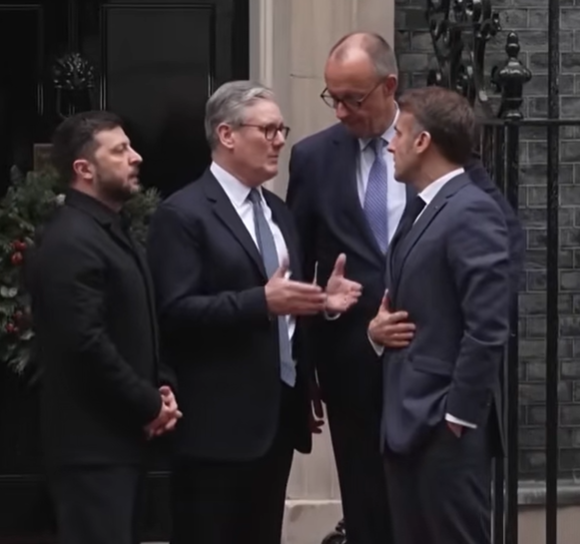
Yesterday, Ukraine President Volodymr Zelenskyy traveled to London to meet with British PM Keir Starmer, German Chancellor Friedrich Merz and French President Emmanuel Macron.
As expected, part of the Zelenskyy meeting with the “coalition of the willing” included a briefing by Ukraine negotiator Rustem Umerov, the secretary of Ukraine’s National Security and Defense Council, who held detailed consultations for three days last week in Miami with Trump’s envoys Steve Witkoff and Jared Kushner.
President Zelenskyy then departed London traveling with his media entourage to Brussels for the next round of discussions with the European Union stakeholders, financiers and politicians. During the trip Zelenskyy told his media stenographers, “Under our laws, under international law — and under moral law — we have no right to give anything away. That is what we are fighting for.”
The U.K, France and Germany support Zelenskyy’s position that he is not going to concede any territory to the Russian Federation, specifically the 30% of the Donbas area in Eastern Ukraine currently at the heart of the physical conflict.
The 30% issue surrounds the Donetsk region in Ukraine, which includes the cities of Kramatorsk and Sloviansk. Russia is currently pushing deep into fortified Ukraine resistance in this region with a population of around 100,000. Zelenskyy claims losing this area would allow Putin to invade the Dnipropetrovsk, Zaporizhzhia and Kharkiv regions.
Historically, this Donbas area was part of a brutal long-term Ukraine civil war between the pro-Russia eastern Ukrainian citizens and the pro-EU western aligned Ukrainian army. Russia’s current position is for Ukraine to cede the entire Donbas to Russia as part of the ceasefire agreement, or Russia will continue forward conflict military operations until successful.
Seeing things through the pragmatic prism of inevitability, President Trump’s view appears to be that this Donbas area will be lost to Russia one way or the other. So, the best scenario to stop the killing is for Ukraine to give up this territory as part of the ceasefire terms. Zelenskyy, with support of the EU, France, Germany and U.K says a firm “no.”
Politico reports that Zelenskyy said in August of this year “it would take Russia four-years to fully occupy the Donbas,” subsequently a lot of killing would take place during this process. President Trump is trying to stop the brutal “killing” part of that dynamic by getting the negotiation to the point of concession, but the EU team view any land area concession as positive affirmation for Russia to continue threatening Europe.
♦ On the ‘Security Guarantee‘ issue, this is where a quagmire is presented by European leaders.
From a pragmatic standpoint a European demilitarized zone, stood up and supported by EU military forces would appear to be the best solution. However, the “coalition of the willing” say they are willing to put security troops into Ukraine, but only if the USA will defend them if attacked by Russia. In essence, quasi-NATO forces on a non-NATO country, that if attacked would draw the entirety of NATO into the conflict, including the United States.
The U.K, France, Germany and EU Commission want a security structure similar to NATO for Ukraine that legally binds the United States to defend their interests if the ceasefire does not hold. President Trump has rejected this construct as yet another way for Europe to pull the U.S into a conflict zone that is not in our vital national security interests.
The ceasefire proposal structured by Trump, Witkoff and Kushner – seemingly supported by Russia, does not permit Ukraine to join NATO; however, EU membership is entirely up to the EU and people of Ukraine to decide. If Ukraine joins the EU, then EU forces alone should provide the security guarantee, not NATO which includes the U.S. and Canada.
(Washington Post) […] Zelensky said Ukraine will not surrender its territory in the eastern Donbas region — not to hasten peace talks, not to satisfy Washington’s push for compromise and not under pressure from Moscow’s continuing military onslaught.
Ukraine and Europe have insisted that a ceasefire be declared along current battle lines, but Russia has refused. Putin has claimed, illegally, to have annexed four entire regions of Ukraine (in addition to Crimea, which Russia seized in 2014) — far more territory than his military forces have been able to occupy.
Some Ukrainian officials held out hope that the negotiations could still bear fruit.
The proposal “is closer to be doable for Ukraine, but not easy and not finished,” said a senior Ukrainian official familiar with recent discussions, who spoke on the condition of anonymity because they were not authorized to comment publicly. (read more)
President Zelenskyy, whose term in office has long expired, departed London with his EU media entourage heading to Brussels. The collective group is trying to figure out how to keep America tied to their stakeholder interests in Ukraine.
The European leaders are manufacturing a construct that is not supported by the vast majority of the citizens within the EU, even within Ukraine itself. Meanwhile back in the USA, congress (House and Senate majorities) supports the position of Ukraine and the EU against the interests of President Trump and the voting majority.
There are trillions at stake.
The ruling class is supporting Zelenskyy, while the killing of the non-ruling class continues on the fields of Ukraine.
Posted originally on CTH on December 8, 2025 | Sundance
Following three days of negotiations in Florida (Thur, Fri, Sat) between President Trump emissaries Steve Witkoff and Jared Kushner, and Ukraine emissaries Rustem Umierov and Andrii Hnatov, the group then held a 2-hour phone call with Ukraine President Volodymyr Zelenskyy.
No substantial progress was reported. However, military officials Umierov and Hnatov then flew to meet Zelenskyy in London where French President Emmanuel Macron, British Prime Minister Keir Starmer and German Chancellor Friedrich Merz are assembled to discuss alternatives to ending the conflict.
Starmer, Macron and Merz form the core of the “coalition of the willing,” an EU group who have unilaterally proclaimed they were willing to send the military of the U.K, France and Germany into Ukraine so long as President Trump would backstop their troops with promises of U.S. intervention if things went badly. Trump would not make that commitment.
Zelenskyy Inc, Macron, Starmer and Merz do not want to end the proxy fight against Russia. Together with the EU leadership of NATO, the coalition of the willing want to retain the conflict. However, the problem for the four leaders is that without strong USA support, the citizens of their EU countries will rise up against them.
Even with NATO missiles and transferred technological assistance, they ultimately need the American military in order to ensure Putin doesn’t squish them. President Trump wants the proxy war to end – loggerheads are reached.
Russian President Vladimir Putin does not seem to be paying too much attention to the bureaucratic speeches and instead is continuing forward advancement [SEE HERE] to secure the territory in Ukraine with or without a negotiated settlement.
The Russian Federation has presented its terms; the Russian terms for cessation are known; the rest is up to the EU, NATO, USA and Ukraine to work out.
At this point the problem is over-talking and FUBAR, or, well, a typically European situation. So, Putin keeps going, more Ukraine troops are killed, while Putin awaits the endless conversations that he predicted would result in more endless conversations. To be fair, Putin’s cold approach appears to be a mostly accurate interpretation of what he expected.
ZELENSKYY – “In recent days, representatives of Ukraine held substantive discussions with envoys of the US President – and now National Security and Defence Council Secretary Rustem Umierov and Chief of the General Staff Andrii Hnatov are en route to Europe. I expect detailed information from them on everything that was said to the American envoys in Moscow, and on the nuances the Americans are prepared to modify in negotiations with us and with the Russians.” (link)
By my count in the past two weeks, Witkoff and Kushner have spent nine days in direct all-day negotiations with various Ukraine officials from various institutions of Zelenskyy’s government, with a one-day trip to Moscow sandwiched between them. Yet, western media continually proclaim the U.S. delegation of Kushner and Witkoff are ignoring the Ukrainians.
This is what I call the ‘paralysis of analysis’, or the part of every negotiation where things get so granular in detail that the larger objective is lost.
While the Ukraine team argues about whether a creek or a railroad track should determine the current point of conflict, another 250 Ukrainian soldiers have their limbs torn from their bodies and lie dead in the mud. Today they will meet in London to argue over telephone pole ownership, while another battalion is fed to the meat grinder.
CNN frames a narrative that President Trump is unsympathetic and frustrated with Zelenskyy:
(VIA CNN) – […] Trump criticized Zelensky on Sunday after talks between US and Ukrainian negotiators over the weekend in Miami ended with unresolved questions over security guarantees, territorial issues and continued concern that the US proposal tilts in Russia’s favor.
“We’ve been speaking to [Russian] President [Vladimir] Putin and we’ve been speaking to Ukrainian leaders, including… President Zelensky, and I have to say that I’m a little bit disappointed that President Zelensky hasn’t yet read the proposal, that was as of a few hours ago,” Trump said. (more)
President Trump is reviewing the issue through the prism of “hours” because he knows that as each hour passes that’s more dead young men…. And FOR WHAT?
Meanwhile, Volodymyr Zelenskyy is traveling around Europe stopping for tea and crumpets with Macron, Starmer and Merz in London today. Think about the upside-down priorities here.
Bread and Circuses – With Servants Patiently Waiting (Dec 6, 2025)
In addition to setting the priorities for the United States focus, the report details the Trump administration perspective on the world as broken down into specific regions. The report is a brutally honest review of the current state of geopolitical benefits, risks and threats as they pertain to vital U.S. interests.
In addition to outlining a critically renewed focus on the Western Hemisphere, the Trump administration also notes the practical position of Europe, as it pertains to NATO and dependency on the U.S.A.
In a brutally honest review of the situation, the Trump administration notes Europe is increasingly losing their own identity. The fear the Europeans express about being vulnerable to Russian strength is hypocritical, in the sense that in practical outcomes the EU is purposefully weakening itself and simultaneously demanding assistance against their own weakness.
[PAGE 25] – American officials have become used to thinking about European problems in terms of insufficient military spending and economic stagnation. There is truth to this, but Europe’s real problems are even deeper.
Continental Europe has been losing share of global GDP—down from 25 percent in 1990 to 14 percent today—partly owing to national and transnational regulations that undermine creativity and industriousness. But this economic decline is eclipsed by the real and more stark prospect of civilizational erasure.
The larger issues facing Europe include activities of the European Union and other transnational bodies that undermine political liberty and sovereignty, migration policies that are transforming the continent and creating strife, censorship of free speech and suppression of political opposition, cratering birthrates, and loss of national identities and self-confidence.
Should present trends continue, the continent will be unrecognizable in 20 years or less. As such, it is far from obvious whether certain European countries will have economies and militaries strong enough to remain reliable allies. Many of these nations are currently doubling down on their present path. We want Europe to remain European, to regain its civilizational self-confidence, and to abandon its failed focus on regulatory suffocation.
This lack of self-confidence is most evident in Europe’s relationship with Russia.
European allies enjoy a significant hard power advantage over Russia by almost every measure, save nuclear weapons. As a result of Russia’s war in Ukraine, European relations with Russia are now deeply attenuated, and many Europeans regard Russia as an existential threat.
Managing European relations with Russia will require significant U.S. diplomatic engagement, both to reestablish conditions of strategic stability across the Eurasian landmass, and to mitigate the risk of conflict between Russia and European states.
It is a core interest of the United States to negotiate an expeditious cessation of hostilities in Ukraine, in order to stabilize European economies, prevent unintended escalation or expansion of the war, and reestablish strategic stability with Russia, as well as to enable the post-hostilities reconstruction of Ukraine to enable its survival as a viable state.
The Ukraine War has had the perverse effect of increasing Europe’s, especially Germany’s, external dependencies. Today, German chemical companies are building some of the world’s largest processing plants in China, using Russian gas that they cannot obtain at home.
The Trump Administration finds itself at odds with European officials who hold unrealistic expectations for the war perched in unstable minority governments, many of which trample on basic principles of democracy to suppress opposition. A large European majority wants peace, yet that desire is not translated into policy, in large measure because of those governments’ subversion of democratic processes. This is strategically important to the United States precisely because European states cannot reform themselves if they are trapped in political crisis.
Yet Europe remains strategically and culturally vital to the United States. Transatlantic trade remains one of the pillars of the global economy and of American prosperity. European sectors from manufacturing to technology to energy remain among the world’s most robust. Europe is home to cutting-edge scientific research and world-leading cultural institutions. Not only can we not afford to write Europe off—doing so would be self-defeating for what this strategy aims to achieve.
American diplomacy should continue to stand up for genuine democracy, freedom of expression, and unapologetic celebrations of European nations’ individual character and history. America encourages its political allies in Europe to promote this revival of spirit, and the growing influence of patriotic European parties indeed gives cause for great optimism.
Our goal should be to help Europe correct its current trajectory. We will need a strong Europe to help us successfully compete, and to work in concert with us to prevent any adversary from dominating Europe.
America is, understandably, sentimentally attached to the European continent — and, of course, to Britain and Ireland. The character of these countries is also strategically important because we count upon creative, capable, confident, democratic allies to establish conditions of stability and security. We want to work with aligned countries that want to restore their former greatness. (continue reading)
Russian Federation President Vladimir Putin does not see a strong Europe; instead, he sees a continent destroying itself and creating vulnerabilities that can easily be exploited.
President Trump is attempting to stop the inevitable conclusion, the outcome created throughout history, when a strong nation state is positioned right next to a vulnerable, fat, lazy and weak-minded coalition of states.
Europe would be wise to listen to President Trump now, because the American people are not willing to put our blood on the line again to protect the EU – ultimately from itself.
I have created this site to help people have fun in the kitchen. I write about enjoying life both in and out of my kitchen. Life is short! Make the most of it and enjoy!
This is a library of News Events not reported by the Main Stream Media documenting & connecting the dots on How the Obama Marxist Liberal agenda is destroying America








 Centinel2012