Posted originally on CTH on March 29, 2026 | sundance
Three days ago, the Financial Times wrote an article framed around the central thesis of the LaRouche PAC, now branded as Promethean Action PAC. The FT article accused Treasury Secretary Bessent of structuring a U.S. Federal Reserve policy disconnected from the framework of the U.K banking and finance model; essentially the article said what Promethean has been claiming about the British banking system and President Trump’s intent.
Treasury Secretary Bessent immediately responded saying the article and its claims were false, “There is much to be said about the storied Bank of England, but any recreation of its operating framework on this side of the Atlantic has never been contemplated.” CTH was waiting to see how the Lyndon LaRouche PAC would react to the Trump administration denial of their central thesis. As expected, the LaRouche group ignored it.
That said, Barbara Boyd, former organizer of “Students for LaRouche” (SLR), put together a video highlighting some of the recent remarks by Secretary Rubio, Secretary Bessent and President Trump that accurately point out how the U.S. is disconnecting America First policy from the European Union/NATO perspective. The upcoming summit between President Trump and Chairman Xi will be very interesting to watch:
While the LaRouche team at Promethean Action PAC are good at following the Trump America-First policy outcomes, the LaRouche team are British-centric in all things related to it. Decoupling the USA from the “special relationship” with the U.K is an outcome of a pragmatic approach toward America First; it is not the intention of the policy.
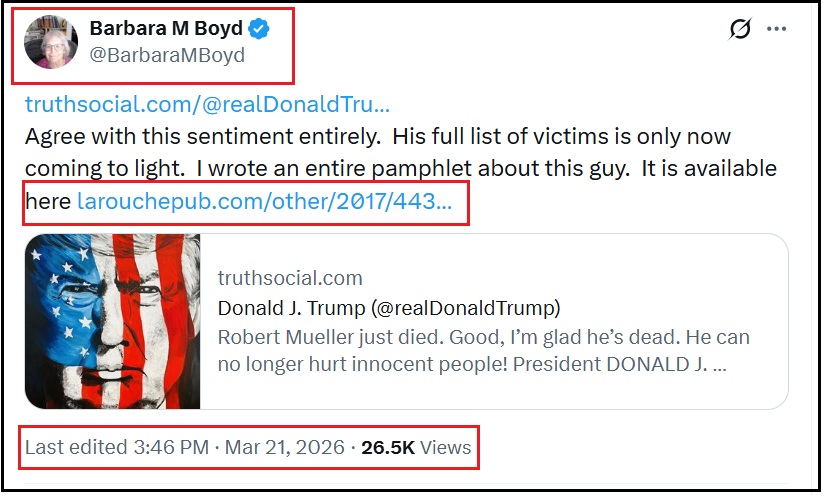
Lastly, each time a LaRouche PAC video is shared, the promoters of Promethean Action PAC try to obfuscate the relationship. It is a fact that Susan Kokinda and Barbara Boyd are life-long LaRouche followers and organizers. A recent tweet shared below will hopefully put this pretending (willful blindness) to rest.
The United Kingdom of Great Britain is a shell of its former self. The City of London no longer has anywhere near the influence being attributed to it and the British monarchy is in a state of freefall.
The bloom is off the ruse.
Perhaps that’s why the PAC had to change vehicles.
However, all of that said, I’m not sure MAGA is prepared to shift support toward Beijing and Chinese Chairman Xi Jinping. Then again, as long as it’s not the British crown, that’s LaRouche for ya.
Take from the information buffet all the stuff that provides value and simultaneously ignore the stuff that will have you seeing black helicopters following your car every day.
Remember, ultimately a Political Action Committee (PAC) is a fundraising vehicle.
Posted originally on CTH on March 25, 2026 | Sundance
The rebranded Lyndon LaRouche PAC has another good outline on the new strategic alliances assembled by President Trump as the ongoing conflict with Iran continues.
Susan Kokinda reviews how the United Kingdom and Europe have been sidelined as President Trump directly negotiates with key stakeholders in the middle east and Asia. Kokinda correctly notes the messaging from Russia indicates a strategic awareness that old systems are fracturing and the potential for new strategic alliances is rising.
“Susan Kokinda argues President Trump has opened a new diplomatic space to de-escalate the Iran conflict by working through a regional roster—Saudi Arabia, Egypt, Turkey, Pakistan, Gulf States, and back channels into Iran—while the U.K., EU, and NATO are absent and increasingly irrelevant. Citing reporting that ministers met in Riyadh and that Egypt, Turkey, and Oman carried messages, she says this “Board of Peace” architecture is isolating Iran and weakening its proxies, pointing to Lebanon’s move against Hezbollah, the Palestinian Authority’s condemnation of Iran, and Hamas considering disarmament. Kokinda links Europe’s exclusion to self-inflicted energy weakness from Green and anti-Russia policies, noting rushed LNG moves and a delayed Russian oil ban vote. She concludes Ukraine’s outlook darkens as Europe and Britain lack leverage, highlighting Zelenskyy’s scramble for support in London and Washington.” WATCH:
Posted originally on CTH on March 22, 2026 | Sundance
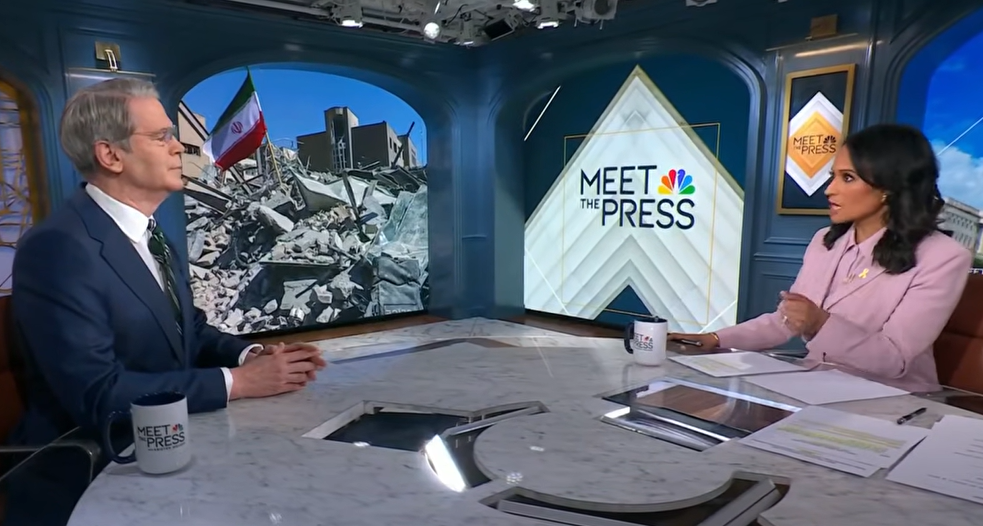
Treasury Secretary Scott Bessent appears on NBC News to outline the purpose and intents of the lifting sanctions as it pertains to Russian and Iranian oil shipments currently in transit. The video and transcript below:
[Transcript] – KRISTEN WELKER: And joining me now is treasury secretary Scott Bessent. Secretary Bessent, welcome back to Meet the Press.
SEC. SCOTT BESSENT: Kristen, good morning.
KRISTEN WELKER: Good morning. Good to have you back. I want to start with the latest of what we’re hearing from President Trump. Let me read you what he posted overnight. He says, “If Iran doesn’t fully open, without threat, the Strait of Hormuz within 48 hours from this exact point in time, the United States of America will hit and obliterate their various power plants, starting with the biggest one first.” Has the president changed his mind about winding down the war, as he said a day earlier, and instead plans to escalate?
SEC. SCOTT BESSENT: I think he said he could wind the war down at any time he wants. And, Kristen, this is the only language the Iranians understand.
KRISTEN WELKER: But this seems to be an escalation, a threat of escalation, and it seems to run counter to his statement that he, in fact, wants to wind down the war.
SEC. SCOTT BESSENT: Again, Kristen, the president’s been very clear from the beginning that the goals are: destroy the Iranian air force and the navy, to completely demolish their missile capabilities, demolish their ability to replenish those capabilities, make sure the Iranians cannot have a nuclear weapon and stop their ability to project power internationally. And the president will take whatever steps it takes to achieve those goals.
KRISTEN WELKER:
Well, you know, I was on the phone with President Trump a week ago. He told me allies were on the way to help secure the Strait of Hormuz. Has the Trump administration abandoned that strategy and now chosen to go it alone?
SEC. SCOTT BESSENT:
Again, what we have done there has been a campaign to -using military assets to soften up the Iranian fortifications along the strait. That’s going to continue until they are completely demolished. And, Kristen, let me tell you, whether it’s this network or the mainstream press, the American people do not have good framing what is going on here. If you were to read what is happening, and I’m sure when Senator Murphy is on, you know, he has come out and said we are losing the war. That is wrong. We have demolished the Iranian capabilities. Their air force is completely destroyed, navy destroyed. And every day we are taking out their missiles, their missile systems, and the factories that build those missiles. And now our- General Caine, Secretary Hegseth, are leading a campaign to destroy all the fortifications along the straits of Hormuz.
KRISTEN WELKER:
Just to put a fine point on this though, is the president in the process of winding down this war or escalating the conflict?
SEC. SCOTT BESSENT:
Again, they are not mutually exclusive. Sometimes you have to escalate to de-escalate, Kristen.
KRISTEN WELKER:
Okay. NBC News is reporting that President Trump is considering sending troops into Iran. Will the administration use troops to secure the Strait of Hormuz or for any other reason, Mr. Secretary?
SEC. SCOTT BESSENT:
Again, as President Trump said during the press break yesterday when he was going out to Marine One, he’s not going to give away what we’re going to do. As President Trump always does, he’s leaving all options on, on the table. We had a very successful bombing campaign against the military installations, Kharg Island, the nexus for all the Iranian oil supply. You know, what could happen with Kharg Island? We’ll see. And again, just to be clear, the command and control system of the Iranian regime is in chaos. This is Hitler’s bunker. Hitler’s dead. Himmler’s dead. Göring is dead. The-most of what you’re seeing are lone wolf activities. The mid-range ICBM that was shot off, these two missiles yesterday, that’s out of desperation, Kristen.
KRISTEN WELKER:
You bring up Kharg Island. I want to ask you about your statement. You said it could become a U.S. asset. What exactly does that mean? Could U.S. troops go into Kharg Island to secure it?
SEC. SCOTT BESSENT:
Again, as I said, all options are on the table.
KRISTEN WELKER:
Okay. So, that’s a possibility.
SEC. SCOTT BESSENT:
All options are on the table.
KRISTEN WELKER:
All right. Let me talk about your announcement this past week. On Friday, the Treasury Department lifted sanctions on Iranian oil stored on tankers, a move that would effectively allow Iran to get more than $14 billion of oil revenue.
SEC. SCOTT BESSENT: I, I –
KRISTEN WELKER: Hold on. Why is the U.S. helping to fund a country that it’s currently at war with, Mr. Secretary–
SEC. SCOTT BESSENT:
Again, Kristen, why don’t we have good facts here? That Iranian oil was always going to be sold to the Chinese. It was going to be sold at a discount. So, which, which is better, Kristen? The uh, which is better? If oil prices spike to $150 and they were getting 70% of that? Or oil prices below $100? It’s better to have them where they are now. And to be clear, we had always planned for this contingency. About 140 million barrels are out on the water. In essence, we are Jiu-Jitsuing the Iranians. We are using their own oil against them. We have a much better line of sight, to be clear, at Treasury, when this oil goes to — if it goes to Indonesia, if it goes to Japan, if it goes to Korea, we have a much better line of sight and are able to block accounts that the oil goes into. When it goes into China it completely gets recycled. So, to be clear, that 14 billion number is grossly overstated.
KRISTEN WELKER:
Let me unpack what you’re just saying. First of all, how much is it? And second of all, I don’t hear you disputing that Iran will get some of the money.
SEC. SCOTT BESSENT:
Iran alway–already gets a huge amount of the money because Iran is the largest sponsor of state terrorism and China has been funding them.
KRISTEN WELKER:
So was always part of the plan to un-sanction Iranian oil?
SEC. SCOTT BESSENT:
Again, we unsanctioned the –at Treasury we plan for all contingencies. We have break-the-glass plans. And to be able — this water — this oil is floating out in Asia, and it is mostly our Asian allies — the U.S. gets virtually no oil from the Gulf. We are energy sufficient. So, when we un-sanction this, rather than the oil going to China, it can go to Japan. It can go to Korea. It can go to Indonesia. It can go to Malaysia –
KRISTEN WELKER:
And it can go to Iran too. I mean, isn’t the point that the sanctions were in place to prevent Iran from getting any of the money. They will have access to some of the –
SEC. SCOTT BESSENT:
No, again–
KRISTEN WELKER:
– money now –
SEC. SCOTT BESSENT:
– Kristen, you’re missing the point. So, please listen to me. They were getting it from China anyway.
KRISTEN WELKER:
Alright. Let me talk about the real-world impact of this because you’re talking about 140 million barrels of Iranian oil, and that’s just a little bit more than what the world uses in one day. How much can that really change prices here at home –
Talk to consumers. How much will it change prices here at home?
SEC. SCOTT BESSENT:
Let me explain. 140 million barrels — about 20 million barrels a day — comes out of the Gulf. About five million has been the uh, repurposed by the Saudis, by the UAE. So, we’re at a 15 deficit. About 1.5 is Iranian oil that comes out. So, we are at between a 10 and 14 million deficit on a daily basis. So, the- if you think about 140 million barrels, that’s between 10 days and two weeks of supply. And one of the reasons, one of the reasons that prices in the U.S. of West Texas crude are below $100 — and we have not seen this massive spike as we did during the beginning of Russia/Ukraine — is because we are well supplied in the market, whether it is the Russian oil, whether it is the Iranian oil, or it is the largest the SPR release in history done by a coalition of 32 countries, 400 million barrels.
KRISTEN WELKER:
Alright. Let’s talk about the Russian oil, which you just raised. The administration did ease oil sanctions on Russia earlier this month. You had initially defended imposing those sanctions, calling Russian exports, quote, “Oil that funds the Russian war machine.” If the point of the sanctions was to stop funding the Russian war machine, why is the administration effectively rewarding Russia now?
SEC. SCOTT BESSENT:
Again, Kristen, you’re missing the point. Which, which is better? Does Russia get more money if oil goes to $150 and they get 70% of that — that’s $105 — or if oil stays below $100, so they’re getting less money? Our analysis shows-our analysis shows that the maximum extra amount that Russia could get would be $2 billion, which is which is one day of the Russian Federation’s budget.
KRISTEN WELKER:
Understood. But they wouldn’t have gotten any of –
SEC. SCOTT BESSENT:
No, no, no–
KRISTEN WELKER:
– that with the sanctions in place –
SEC. SCOTT BESSENT:
Kristen. Kristen, I don’t know, whoever’s –
KRISTEN WELKER:
But would they have gotten –
SEC. SCOTT BESSENT:
No, no, no –
KRISTEN WELKER:
– any of that in place –
SEC. SCOTT BESSENT:
Kristen, whoever does your research, you should get rid of because they were getting it. It was going into China. China was buying over 90% of the Russian oil, and it was –
KRISTEN WELKER:
–But what’s the point of sanctions if not to punish Russia, if not to punish countries?
SEC. SCOTT BESSENT:
Again, the uh, it–we had no ability to do that to China — if China wants to be a bad actor. But we were substantially able to degrade their exports. Their exports have dropped about 25% when the rest of the world isn’t buying it. So, exports are down, but there was a lifeline into China. Now we’ve opened up that to everyone else.
KRISTEN WELKER:
Okay. Just to be clear though. You did defend imposing those sanctions in the first place. Let me ask –
SEC. SCOTT BESSENT:
Just to be clear, it is a maximum of $2 billion. So let’s have good framing on this.
KRISTEN WELKER:
Okay. Let’s talk about the overall cost of this war. The administration’s asking Congress — poised to an additional $200 billion in additional funding for this war. Some Republicans who could cast key votes on this are expressing hesitation or outright opposition. Take a listen to them and then I want to get your reaction on the other side.
[BEGIN TAPE]
FEMALE REPORTER:
Are there any initial red flags for you?
SEN. RICK SCOTT:
No — maybe, it’s a lot of money. I’ll go through it, see what they need.
REP. LAUREN BOEBERT:
I am a no. I’ve already told leadership I am a no on any war supplementals. I am so tired of spending money elsewhere.
[END TAPE]
KRISTEN WELKER:
Should President Trump have gone to Congress on the front end of this war if he was going to ask for Congress’s help now for more funding?
SEC. SCOTT BESSENT:
Again, President Trump was within his authorities under the War Powers Act to initiate this action. And we, we actually now we have plenty of money to fund this war. What we are doing is this is supplemental. President Trump has built up the military, as he did in his first term, as he is now doing in his second term, and he wants to make sure that the military is well-supplied going forward.
KRISTEN WELKER:
Would the administration ever raise taxes in order to fund this war?
SEC. SCOTT BESSENT:
Again, Kristen, terrible framing. I think that the –
KRISTEN WELKER:
Well, it’s just a que– it’s a simple question that I think a lot of people have –
SEC. SCOTT BESSENT:
It’s a ridiculous question.
KRISTEN WELKER:
Well, but –Can you answer it?
SEC. SCOTT BESSENT:
Why would we do that? That the, that we-we have plenty. We have a trillion dollars in this year’s budget for the military. And President Trump, even before the conflict started, had said that he would like to further build out the military.
KRISTEN WELKER:
So, just–is raising taxes under consideration at all –
SEC. SCOTT BESSENT:
Not —
KRISTEN WELKER:
– if you’re saying you have plenty of money?
SEC. SCOTT BESSENT:
Not at all.
KRISTEN WELKER:
Okay. Let’s turn to how all of this is impacting consumers. United Airlines CEO Scott Kirby is now planning, he says, to cut flights and is planning for oil to go as high as $175 a barrel with prices potentially staying above $100 a barrel through 2027. This is according to him. All of this could potentially mean higher prices for consumers. What do you say to Americans who feel they were promised lower costs and now they’re getting the opposite?
SEC. SCOTT BESSENT:
Uh, Kristen, I think the American people understand that any 50 — I’m not going to put a time on it but let’s just pick 50 days of temporary elevated prices, prices will come off on the other side, for 50 years of not having an Iranian regime with a nuclear weapon. The American people are beginning to understand, thanks to President Trump, that there is no prosperity without security.
KRISTEN WELKER:
I heard you say 50 days. Are you saying that prices could start to come down –
SEC. SCOTT BESSENT:
No, no, no, no –
KRISTEN WELKER:
What’s the time frame –
SEC. SCOTT BESSENT:
I was just picking a point. I don’t know whether it’s going to be 30 days. I don’t know whether it’s going to be 50 days. I don’t know whether it’s going to be 100 days. But to have 50 years the, uh, of peace in the Middle East and know that the Iranian regime is defanged because, Kristen, what we had before was the illusion of security. Imagine this regime if they had had another year or two years to build out their missile capabilities. They would’ve built a shield around themselves and it would’ve been impossible to prevent them from getting a nuclear weapon.
KRISTEN WELKER:
All right. I want to ask you on a different topic about a post by President Trump from yesterday responding to the death of former special counsel Robert Mueller. He posted this quote, “Robert Mueller just died. Good, I’m glad he’s dead. He can no longer hurt innocent people!” Do you think it’s appropriate for the president of the United States to celebrate the death of an American citizen, someone who’s a Bronze Star, Purple Heart recipient and who served in Vietnam?
SEC. SCOTT BESSENT:
Kristen, I was with the president in the green room at Davos and there was a video playing of the — what may have been an illegal raid on his home at Mar-a-Lago. They are going through his wife’s wardrobe. And I watched the look in his eye, and I think that neither one of us can understand what has been done to the president and to his family.
KRISTEN WELKER:
But to the question of the president’s post, I mean, Robert Mueller didn’t order that raid. Is it appropriate for the president to celebrate the death of any American citizen –
SEC. SCOTT BESSENT:
Again —
KRISTEN WELKER:
– Mr. Secretary –
SEC. SCOTT BESSENT:
I think that given what has been done to President Trump and his family it is impossible for either of us to understand what he has been through.
KRISTEN WELKER:
So, you don’t think that there’s anything wrong with the post, saying, “Good. Robert Mueller’s dead”
SEC. SCOTT BESSENT:
Again, I think that we should all have a little empathy for what has been done to him and his family.
KRISTEN WELKER:
All right. Treasury Secretary Scott Bessent, thank you as always for being here. Really appreciate it.
Posted originally on CTH on March 14, 2026 | Sundance
President Trump’s latest two messages via Truth Social present an interesting geopolitical approach with multiple enmeshed aspects.
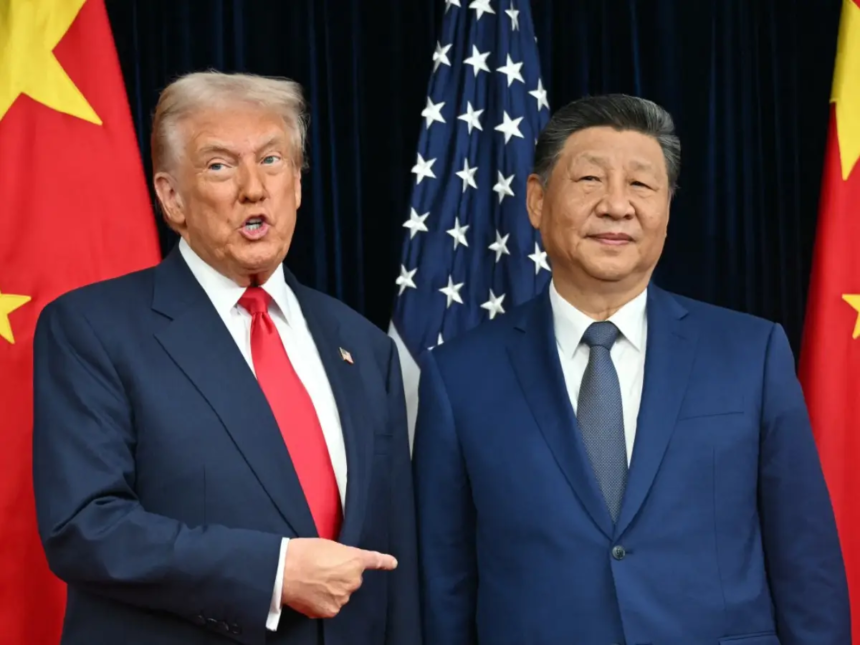
First, some background context is needed. Treasury Secretary Scott Bessent and USTR Jamieson Greer are in Paris to meet with Chinese government officials ahead of a scheduled meeting between Chairman Xi Jinping and President Trump.
The main objective of the pre-summit assembly before President Trump goes to Beijing, is to hammer out the actionable agreement details that can be signed off by Xi and Trump. Bessent and Greer are looking to put a deal together with their Chinese counterparts so that Trump and Xi can announce mutually beneficial outcomes during their summit.
Second, President Trump has already indicated the March 31/April 1 meeting with Xi will be all business. The traditional pomp and splendor will not be present, and Trump will only be visiting Beijing – no sidelines.
Third, Secretary Rubio will be accompanying Trump on this trip to Beijing, which might seem ordinary were it not for the fact that in 2020 China sanctioned and banned Rubio from entering China for criticizing Xinjiang and Hong Kong.
Fourth, there are rumors that President Trump is going to announce a significant weapons deal with Taiwan at some point immediately following the trip. If those rumors are true, it would be a top priority for the Chinese advance team in Paris to stop that from happening.
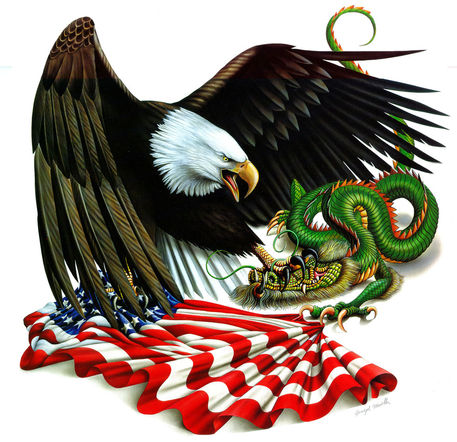
Regardless of what happens in the next few weeks, President Trump will be meeting with Chairman Xi with full Eagle eye confrontation toward the returning dragon stare. There will be no panda mask on this trip whatsoever; this face to face is an apex predator showdown, while the world watches intently.
Everything President Trump does between now and his arrival in Beijing, should be contemplated through this adversarial position. With strong moves in Venezuela and Iran President Trump has already pulled Chairman Xi into the jianshu circle, showing the soul of his blade.
Chairman Xi does not have anything resembling a retreat position. He has a highly focused domestic audience, and the eyes from the Great Hall of the People will be watching intensely.
In the next two weeks we will likely see critical probes of both Trump and Xi’s wills surface in ancillary stories connected to each stakeholder, most likely swirling around the Iran conflict. Do not be surprised if we see all of the advanced USA influence purchasing by China now activated with very specific anti-Trump narratives.
That is the context for President Trump to call out many of the oil dependent countries:
TRUTH SOCIAL – “Many Countries, especially those who are affected by Iran’s attempted closure of the Hormuz Strait, will be sending War Ships, in conjunction with the United States of America, to keep the Strait open and safe. We have already destroyed 100% of Iran’s Military capability, but it’s easy for them to send a drone or two, drop a mine, or deliver a close-range missile somewhere along, or in, this Waterway, no matter how badly defeated they are.
Hopefully China, France, Japan, South Korea, the UK, and others, that are affected by this artificial constraint, will send Ships to the area so that the Hormuz Strait will no longer be a threat by a Nation that has been totally decapitated. In the meantime, the United States will be bombing the hell out of the shoreline, and continually shooting Iranian Boats and Ships out of the water. One way or the other, we will soon get the Hormuz Strait OPEN, SAFE, and FREE! President DONALD J. TRUMP
There is a significant overlay here.
First, any nation that sends supportive military ships into the Strait of Hormuz is openly taking a position against the Iranian regime. China cannot take that position, and President Trump knows it – so he’s calling out the dragon’s alignment for the world to see.
…. If you get oil from the region, come protect your ships while I kill the bad guys…
Remember, Japan has a very limited military, and their post-World War II constitution was blocking them from building one. Changing that position was the goal of Japanese Prime Minister Shinzo Abe, a friend of Trump, and he was traveling throughout Japan with that message when he was assassinated. That objective now falls to the protege’ of Abe, Prime Minister Sanae Takaichi.
Japan is included on that list of countries specifically to antagonize the dragon, with President Trump saying I have a strong industrial friend in your back yard.
For the rest, notice the countries Trump did not name: India, Thailand, Vietnam, Philippines or any of the Asian countries that are dependent on oil from the middle east. Trump is not asking the dependency allies of the United States to participate. Instead, President Trump is calling upon the fake-ally countries that oppose the United States but hide behind a friendly smiling mask.
This is a bold underline for President Trump’s former statement where he publicly doubted the NATO allies would ever come to assist the USA (ie. Greenland), even though they are dependent on the security the USA provides.
In this Iranian conflict, the Europeans are dependent on oil from the middle east, but they will not put their military into the fight even if it secures their own economic future. Opening the Strait of Hormuz benefits the Europeans, but they only want to pontificate grand prose about it; similar to how they pontificated about the threat Iran presented, then lost their supportive tongue when Trump finally did something about it.
A few hours later, President Trump drives home the point:
TRUTH SOCIAL – “The United States of America has beaten and completely decimated Iran, both Militarily, Economically, and in every other way, but the Countries of the World that receive Oil through the Hormuz Strait must take care of that passage, and we will help — A LOT! The U.S. will also coordinate with those Countries so that everything goes quickly, smoothly, and well. This should have always been a team effort, and now it will be — It will bring the World together toward Harmony, Security, and Everlasting Peace!”President DONALD J. TRUMP
Now we wait to see who steps up.
Spoiler Alert – ¹No one will!
¹And that’s the point Trump is making.
I also concur with this point:
Shanaka Anslem Perera: “The coalition call is not about Iran. Iran’s military is destroyed. The coalition call is about the world that emerges after Iran. If America escorts the tankers alone, the Strait reopens under American control and dollar pricing survives. If a coalition escorts them, the Strait reopens under international consensus and the yuan-for-Hormuz proposal dies. If nobody escorts them, the Strait stays closed and China’s shadow fleet is the only commerce moving through it.”
Posted originally on CTH on March 13, 2026 | Sundance
U.S. Trade Representative Jamieson Greer and U.S. Treasury Secretary Scott Bessent are traveling to Paris this weekend to meet with the Chinese trade officials. This meeting is in advance of President Trump’s visit to China for direct face-to-face discussions with Chairman Xi Jinping.
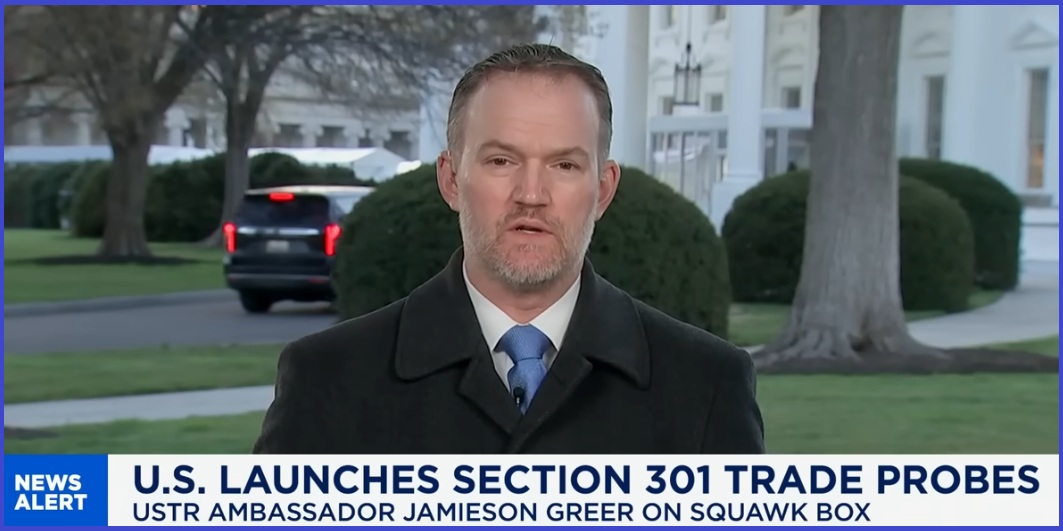
Given the recent events in Venezuela and Iran a lot of groundwork must be taking place for the Trump-Xi meeting. Multiple Chinese interests have been impacted directly. USTR Jamieson Greer discusses those preparatory issues as well as the recent announcement for Section 301 investigations and tariffs. WATCH:
Posted originally on CTH on March 13, 2026 | Sundance |
‘Trump, you magnificent bastard, I read your book!’
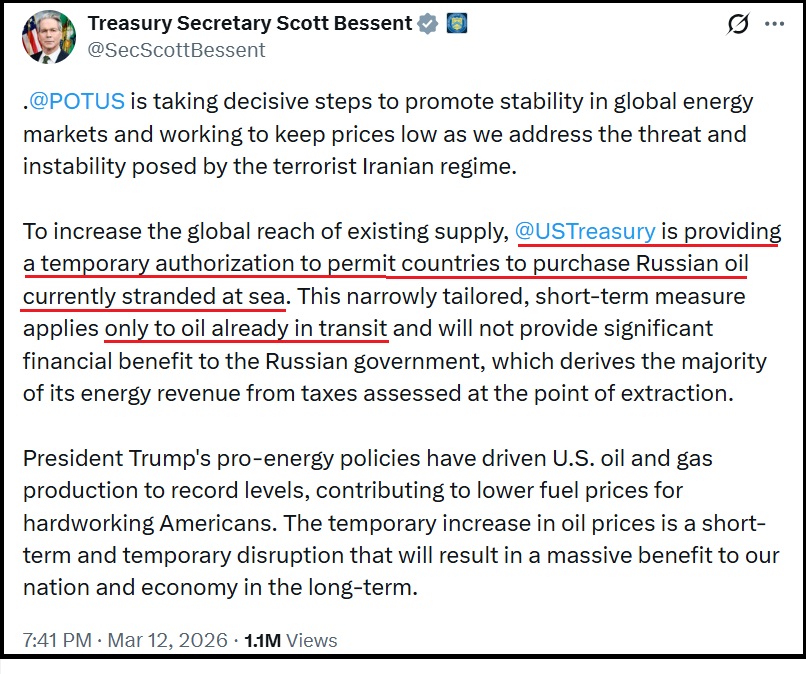
President Trump and Treasury Secretary Scott Bessent are facing mounting criticism for creating a window for Russia to sell oil and gas to the global market via “narrowly tailored, short-term” sanction relief. However, few people are putting the issue into context, and the background here is exceptionally interesting.
According to the terms announced by Secretary Bessent, the license to sell applies solely to Russian crude or petroleum products loaded onto vessels as of March 12 and is valid through midnight Washington time on April 11. [Treasury Notice Here – OFAC Technical Details Here]
The sanction relief license to sell will be done in globally recognized petrodollars and applies only to preexisting oil and petroleum products that are already in transit at sea. However, here’s where it gets very interesting and the ramifications are significant.
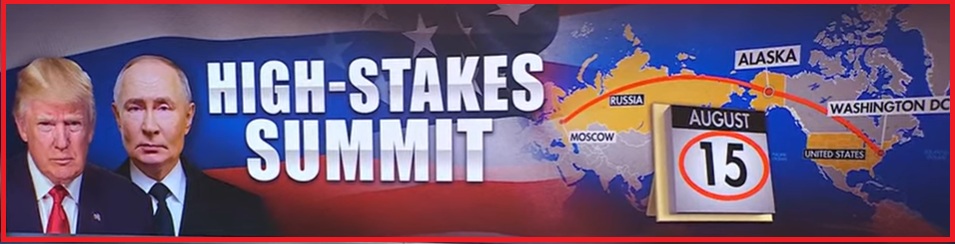
Immediately following the Alaska summit between Russian President Vladimir Putin and President Trump, Russia restarted Arctic-2 LNG terminals and began increasing oil production for storage on ‘floating platforms.’ President Trump met with Putin on August 15, 2025, and the curious increase in Russian production began on August 18, 2025.
In the past six months Russia has been pumping sanctioned oil and gas and storing it on ships and mobile sea platforms, seemingly (at the time) with no customers. Suddenly, against the background of the Iran conflict, all of that previously stored ‘on the water‘ production, now worth double, is authorized for global sale (in petrodollars).
Either Russian President Putin is the luckiest guy in the world, or Russia knew something.
In 2025 what Russia did following the Alaska summit did not make sense; now it does and the ramifications are stunning.
President Trump was looking for a way to organize a strategic partnership with Russia on the issue of energy production but was hampered by the preexisting sanction regime and strong opposition from domestic and international politics.
The ‘coincidental’ timing’ of Trump meeting with Putin and then subsequently Russia producing massive amounts of oil and gas for storage on the water suddenly starts to take on an entirely new light. Did Putin know something was coming, something that would eventually make the Russian over production and ‘on the sea’ storage worth billions.
The implications here are quite remarkable; however, they simultaneously explain most of the behaviors since the Iran confrontation began.
Media reports highlight that Vladimir Putin was asked about a previous joint agreement for military support between Iran and Russia and why Russia did not respond when Iran was attacked. Foreknowledge would explain that reaction.
Additionally, the Russian Federation president never responded to the Trump operation to take down Venezuelan dictator Maduro and seize control over Venezuela’s oil production.
If there was some discussion inferring that a ‘limited sanction relief’ protocol might be possible, that would explain why Russia began storing oil and gas at sea.
This fact pattern would also indicate that President Trump’s decision toward Iran was made at least six months ago, with a set of geopolitical events planned between the Alaska summit and the eventual confrontation with Iran.
TIMELINE: Trump and Putin meet. Three days later Russia begins pumping oil/gas and storing it at sea. President Trump then triggers the Venezuela western hemisphere security operation; Russia stays silent. President Trump then triggers the confrontation with Iran; Russia rejects involvement. And then two weeks after the Iran confrontation begins, Trump removes sanctions on Russian oil/gas “in transit” at sea.
Suddenly all of the Russian produced and stored product ‘on the water’ has greater value and new customers.
Just a coincidence? No way.
The United States needs the oil/gas market stability that Russia can provide.
Venezuela was/is to Trump as Ukraine was/is to Putin.
Posted originally on CTH on March 12, 2026 | Sundance
When the Supreme Court made their ridiculous decision to nullify the import tariffs under the International Emergency Economic Powers Act (IEEPA) use, the high court noted several alternate approaches would not be legally problematic. One of those approaches would be the use of Section 301 trade tariffs.
Yesterday USTR Jamieson Greer quietly announced that a Section 301 review would be taking place for the following countries: China, the European Union, Singapore, Switzerland, Norway, Indonesia, Malaysia, Cambodia, Thailand, Korea, Vietnam, Taiwan, Bangladesh, Mexico, Japan, and India.”
♦ Section 301 tariffs are a trade enforcement mechanism established under the Trade Act of 1974. They allow the U.S. government to impose tariffs on imports from countries that are found to be engaging in unfair trade practices. The Office of the United States Trade Representative (USTR) conducts investigations to determine if a country is violating trade agreements, and if so, it can impose tariffs as a corrective measure {SOURCE}
USTR PRESS RELEASE – WASHINGTON — Today, United States Trade Representative Jamieson Greer announced the initiation of investigations regarding the acts, policies, and practices of various economies under Section 301(b) of the Trade Act of 1974 relating to structural excess capacity and production in manufacturing sectors.
The investigations will determine whether those acts, policies, and practices are unreasonable or discriminatory and burden or restrict U.S. commerce. The economies subject to these investigations are: China, the European Union, Singapore, Switzerland, Norway, Indonesia, Malaysia, Cambodia, Thailand, Korea, Vietnam, Taiwan, Bangladesh, Mexico, Japan, and India.
“The United States will no longer sacrifice its industrial base to other countries that may be exporting their problems with excess capacity and production to us. Today’s investigations underscore President Trump’s commitment to reshore critical supply chains and create good-paying jobs for American workers across our manufacturing sectors,” said Ambassador Greer.
“The Trump Administration’s reindustrialization efforts continue to face significant challenges due to foreign economies’ structural excess capacity and production in manufacturing sectors. Across numerous sectors, many U.S. trading partners are producing more goods than they can consume domestically. This overproduction displaces existing U.S. domestic production or prevents investment and expansion in U.S. manufacturing production that otherwise would have been brought online. In many sectors, the United States has lost substantial domestic production capacity or has fallen worryingly behind foreign competitors.” (read more)
Additionally, Section 232 [Steel and Aluminum examples] of the Trade Expansion Act of 1962 (19 U.S.C. §1862, as amended) authorizes the President to impose trade restrictions—such as a tariff or quota—if the Secretary of Commerce determines, following an investigation, that imports of a good “threaten to impair” U.S. national security. {SOURCE}
Section 232 is currently covering all the steel and aluminum import tariffs.
Section 122 of the Trade Act of 1974 allows the U.S. president to impose tariffs of up to 15% to address “large and serious” balance-of-payments deficits. This authority can be exercised without prior congressional approval for a limited duration of 150 days. After this period, any tariffs must be extended by Congress. {SOURCE}
Section 122 has already been deployed to retain the “baseline reciprocity tariffs.”
USTR Greer is now walking through the process of deploying Section 301 and will eventually become the legal underpinning to replace Section 122 and retain all tariff status without congressional extension needed. Most of this is technical and legal compliance as several of the aforementioned nations have already finalized free trade agreements.
Posted originally on CTH on March 7, 2026 | Sundance
When President Donald Trump and President Vladimir Putin met in Alaska on August 15, 2025, the focus of the geopolitical world was on discussions surrounding Ukraine. Unfortunately, it didn’t take long, merely a few hours, for both the U.S. and Russia to say that no progress was made. However, also noted at the time was both the USA and Russia saying sideline discussions took place surrounding the possibility for a strategic relationship surrounding energy development.
What follows below is a review of the current energy dynamic, specifically surrounding LNG, against the backdrop of the Iran war with a hindsight review of that previous discussion between Putin and Trump.
What most people are missing in their current analysis was something that took place immediately following that Alaska summit six months ago. Something that did not make any sense until now. {GO DEEP PART I HERE}
It absolutely did not make sense that Russia would start producing even more LNG considering the previously imposed western sanctions against them, and the fact that Russia was already overproducing LNG. As noted by analysts at the time:
AUGUST 18, 2025 – Russia’s Arctic LNG 2 export facility, which is sanctioned by the United States, is coming back to life after a year of no activity and is looking for buyers in Asia.
[…] The U.S. and EU sanctions on Russia’s Arctic LNG 2, which was billed as Russia’s flagship LNG project, have effectively frozen the start-up of the export facility in the Gydan Peninsula.
[…] Last year, Russia started shipping LNG from its flagship Arctic LNG 2 project—but not to customers. The shipments were made from the Arctic project to floating storage units either in Russia or in European waters, as potential customers were unwilling to buy the sanctioned LNG. {SOURCE}
In August of 2025, Russia was essentially producing more LNG than they could sell into the available market. Russia was storing the overproduction from Arctic-1 on floating storage units and slowly selling to countries that did not align with the sanctions, specifically China and some Asian buyers. Then suddenly, after the Trump summit, Russia decides to bring Arctic-2 online and produce even more LNG. You can see how this did not make sense.
If they could not even sell all the Arctic-1 LNG output, then why would Russia bring Arctic-2 LNG production online?
That was six months ago.
Suddenly, with the war in Iran being triggered, and with Qatar almost immediately announcing they were shutting down all LNG production, there are dozens of new markets for liquified natural gas. And that current LNG is now worth 50% more than it was when Russia inextricably decided to start producing and storing it.
Apply some hindsight to this timeline. Did Russia know or discover something in August of 2025 that the world would not discover until six months later?
Russia’s behavior in increasing LNG production, then storing that LNG in strategic venues, during a time when there was no reasonable incentive to trigger an LNG output increase, would seem to answer that question in the affirmative.
One thing is certain, all of that previously produced LNG is now worth double what it was when Russia created it, and now the global market is scrambling to get it.
Here is where it gets really interesting….
In October 2025, do you remember me asking why President Trump decided to fly East, to go West to the ASEAN summit in Asia? It just didn’t make sense.
Previously in 2017 when President Trump went to the ASEAN summit, he flew West; Airforce One refueled in Guam. This time in 2025, a few weeks after the meeting with President Putin in Alaska, President Trump flew East, to go West.
Where did he refuel?
That’s correct. President Trump refueled in Qatar, and during the ‘unexpected’ stop he met, yet again, with Qatari leadership.
♦ In May 2025 President Trump traveled to Qatar and had numerous and lengthy conversations, signing multiple strategic defense and trade deals. ♦ In August 2025, President Trump meets with Vladimir Putin, who then begins ramping up production of LNG. ♦ In October 2025, President Trump travels back to Qatar for a curious and unexpected visit.
Less than 36 hours after President Trump began “Operation Epic Fury” Qatar announces they are halting the production of LNG, and as a consequence the price of LNG jumped and a massive supply shift in global trade was created.
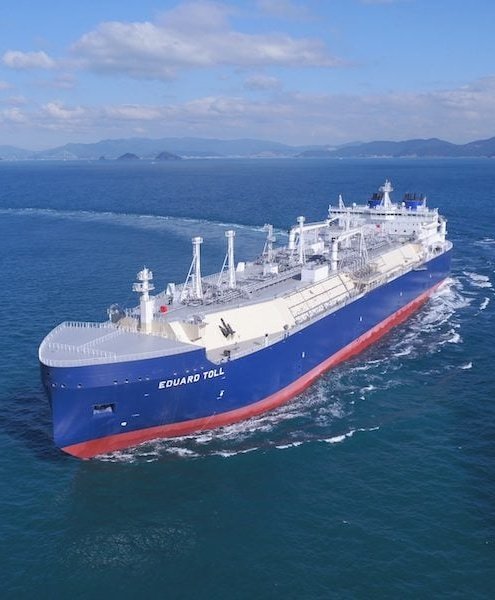
The Financial Times – […] The global battle for gas is underway, with Europe on the front lines. Since Wednesday, March 4, at least four liquefied natural gas (LNG) tankers – factory ships with large, refrigerated tanks used to transport LNG over long distances – suddenly changed course. Initially headed for France, Belgium or Spain from Africa and the United States, they rerouted for Asia, according to data from the maritime analytics company Kpler. (read more)
MOSCOW, March 4 (Reuters) – Russia could halt gas supplies to Europe right now amid a spike in energy prices triggered by the Iran crisis, President Vladimir Putin warned on Wednesday, linking the possible decision to the European Union wanting to ban purchases of Russian gas and liquefied natural gas. (read more)
MOSCOW, March 6 (Reuters)– “Our companies are considering opportunities, without waiting for further restrictions from Europe, to conclude new long-term contracts with our partners and redirect some of the gas from Europe to other countries, including India, Thailand, the Philippines and the People’s Republic of China,” Russian Deputy Prime Minister Alexander Novak said.
Six months ago, following a summit in Alaska with President Trump, President Vladimir Putin began producing and storing LNG at a scale and capacity that did not make sense. Six months later, the now massive Russian inventory is worth twice as much as it was, AND the number of global buyers for the Russian LNG has exploded.
Meanwhile, “while China would suffer from oil outages, a Middle East crisis with disproportionate LNG outages might benefit the PRC. Natural gas accounts for a relatively small share of China’s primary energy consumption, the country enjoys substantial domestic production, and it can tap pipeline imports from Russia, Central Asia, and Myanmar. Significantly, many of the PRC’s competitors or rivals—the European Union, Japan, South Korea, and Taiwan—are substantially or even wholly reliant on LNG imports for their natural gas consumption. Dutch TTF natural gas prices are up more than 50 percent against last Friday’s close, fueling concerns of an energy-induced inflationary spike.”
Where is President Trump scheduled to go next?
WASHINGTON/BEIJING, March 3 (Reuters) – The U.S. military campaign against Iran has put Chinese leader Xi Jinping on the back foot ahead of an expected summit with U.S. President Donald Trump, who for the second time in as many months has turned America’s military against one of Beijing’s close partners.
Trump is set to arrive in Beijing at the end of March following the U.S. capture of Venezuelan President Nicolas Maduro in a risky Caracas raid in January and the U.S.-Israeli air war that on Saturday killed Iran’s Supreme Leader Ayatollah Ali Khamenei, the former leaders of two countries that have been major oil suppliers for China.
[…] Xi now faces the awkward prospect of feting Trump on the world stage or backing out of the proposed March 31 to April 2 meeting. Beijing has yet to confirm the summit dates. (read more)
Posted originally on CTH on March 4, 2026 | Sundance
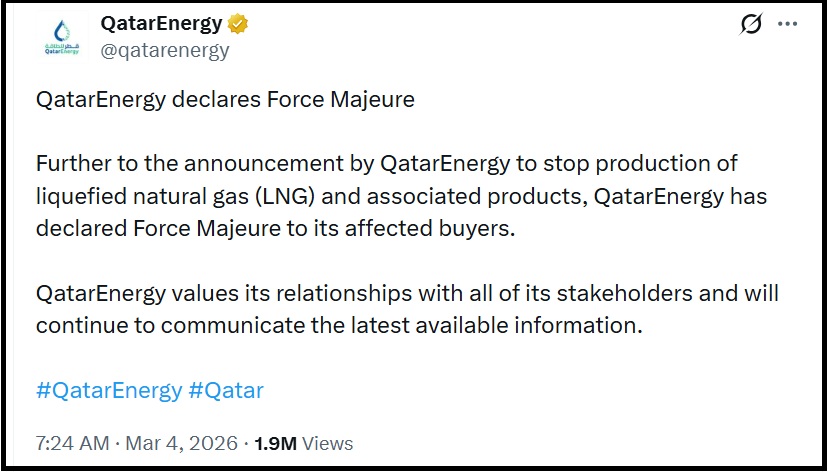
Force Majeure is a common clause in contracts which essentially frees both parties from liability or obligation when an extraordinary event or circumstance beyond the control of the parties, such as a war, strike, riot, crime, epidemic, or sudden legal change prevents one or both parties from fulfilling their obligations under the contract.
People would be well advised to wait a few days when announcements are made before jumping to immediate conclusions. The announcement by Qatar Energy of a force majeure notification did not originate from Qatar’s inability to produce contractual LNG supplies…..
…. two days prior to this announcement, India’s top gas importer Petronet LNG Ltd issued a force majeure notice to Qatar Energy and local buyers because its LNG tanker ships were unable to reach the Ras Laffan load port due to the crisis in the Middle East. Without ships arriving to take the LNG Qatar Energy cannot keep producing.
Qatar Energy operates 14 liquefied natural gas (LNG) trains with a total annual production capacity of 77 million tonnes {SOURCE}. If ships don’t reach the terminals, there’s no need for Qatar Energy to keep pumping and liquifying from well heads. It’s a downstream issue.
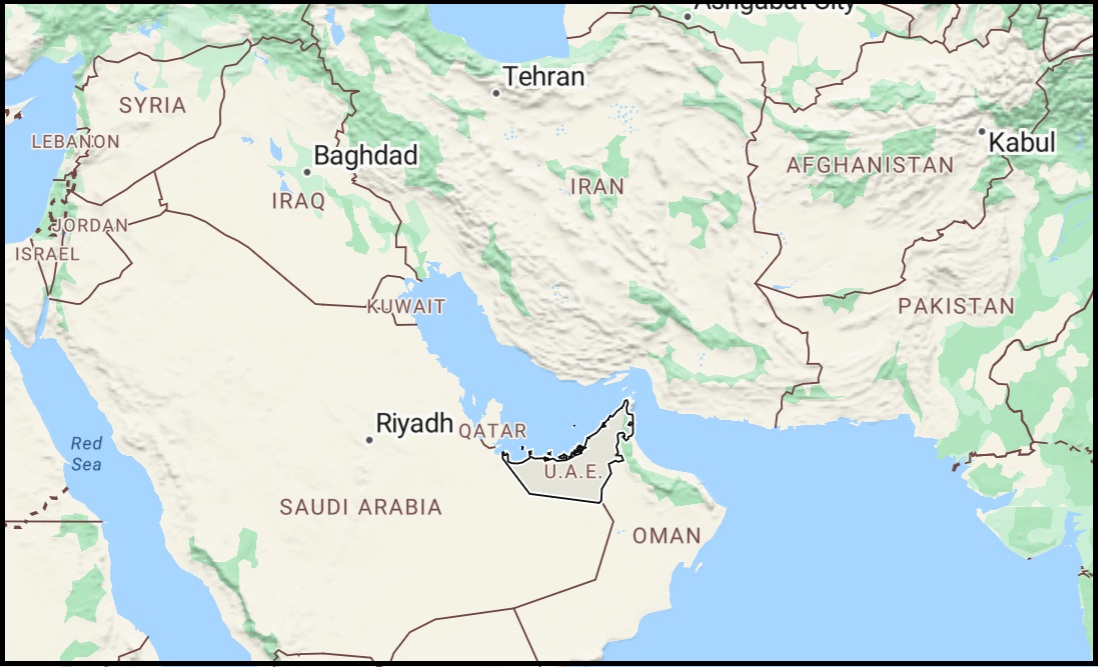
Bahrain made the same announcement for their refined aluminum exports {SOURCE}. Indonesian company Chandra Asri made the same announcement for petrochemicals {SOURCE}. Chevron made the same announcement two days ago after Israel shut down the Leviathan natural gas field {SOURCE}. Thus, we see the ramifications for the entire region around the Iran conflict zone and the downstream destinations (Asia and Europe) for energy products therein.
Dutch shipping company Maersk has also suspended operation for cargo container ships cancelling all bookings between the Indian subcontinent—India, Pakistan, Bangladesh and Sri Lanka—and the Upper Gulf. {SOURCE} German shipping group Hapag-Lloyd made the same decision.
These are not decisions being made due to maritime insurance or reinsurance rates or availability. These are decisions being made by private corporations that go beyond their actuarial risk. They simply don’t want to operate in a region where there is the potential for loss of life or cargo.
This is not solely an insurance issue and people should pause before offering analysis that only considers the financial aspect.
MAERSK -Maersk announced on Wednesday that it is temporarily suspending most cargo reservations in and out of Iraq as security worries mount throughout the Gulf.
The business said that the ban applies to shipments involving many regional nations, including the UAE, Oman, Kuwait, Qatar, Bahrain, and Saudi Arabia.
Maersk said that the measure would stay in effect until further notice. The firm did not disclose any more information on how long the disruption will endure or the scope of the operating effect.
The decision comes as increased tensions and military action in the Gulf area have prompted worries about the safety of maritime routes and logistical operations, hurting commerce flows via many Gulf nations. (LINK)
Susan Kokinda and the Lyndon LaRouche network give their perspective on the British reaction to the U.S. strikes against Iran. The analysis has some value from a review of the historic relationship of the British imperialist policy toward matters of foreign entanglement and the control mechanisms that have historically flowed from the U.K
As a consequence of British government policy much of the Kokinda analysis accurately touches on the root cause of U.K response. However, the emphasis on the modern UK government as the lead of a global control network is not always as severe or complicated as the Lyndon LaRouche network would espouse.
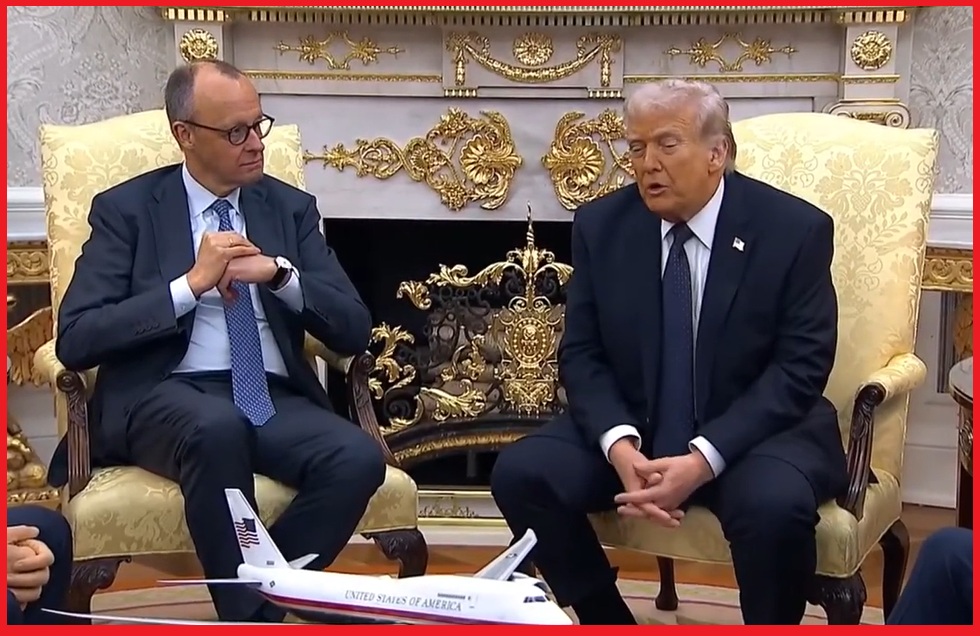
Prior to visiting the White House, German Chancellor Fredrich Merz had just returned from China and gave a press conference in Germany saying Germans need to “work harder” and “ditch the four-day week” to compete.
Merz visit to Shenzhen shocked him, and he is right to be rattled by the cold indifference of Chairman Xi Jinping. This was Merz first visit to meet Chairman Xi in person. A cold and productivity focused Merz just met an even colder and more productivity focused industrial giant.
Merz met the industrial dragon and returned home visibly shook. The Chancellor thought he represented an apex industrial nation. However, he experienced something far more industrial than he ever imagined.
As noted by Nina Schick:“Take Germany’s famous auto industry, 5% of GDP, 800,000 jobs, but losing ground fast. VW’s market share in China has plunged from 24% to 15% in four years. Chinese brands doubled their European market share in 2025 and now outsell Mercedes on the continent. Germany lost 120,000 industrial jobs last year. And cars are just the most visible example.
But it’s not just competition. Germany has some of the highest industrial energy prices in the world, nearly triple what the US pays. After shutting down nuclear and losing cheap Russian gas via Nord Stream, Berlin built its first LNG terminal in 194 days. Now 96% of the LNG arriving at those terminals comes from the US. (That LNG is even more important in light of events in the Gulf….)
The US is Germany’s second-largest trading partner (€240 billion in two-way trade last year.) German auto exports to the US fell 18% in 2025 under tariffs. Merz cannot afford a trade war with Washington. Today, he watched Trump threaten to cut off all trade with Spain, while sitting next to him in the Oval Office. He backed him up.
Now look at how Merz is positioning on Iran. Spain blocked the US from using its bases. Sánchez called the strikes “unjustified.” Starmer hesitated before eventually allowing UK bases for “defensive” strikes. Merz is the first EU leader invited to the White House for a tête-à-tête with Trump.
Days before, he said legal assessments under international law “achieve relatively little” and that now is “not the time to lecture allies.” Compare that to Sánchez insisting Spain’s agreement with the US “must operate within the framework of international law.” From a German chancellor, Merz’s position is seismic.
And none of this is separable from home. Germany’s economy is in its fourth year of industrial contraction. An aging population, a shrinking workforce, sky-high welfare costs, and an immigration debate that’s handing the AfD seats on a plate. Merz needs the US relationship, because it’s one of the levers he has left to keep the economy blowing in the right direction.
All of this points to a Germany that’s understood its critical vulnerabilities and is pursuing a hard-nosed realpolitik in response. To stay industrially competitive, they need American LNG. They need access to US compute and critical hardware. They need EU member states to spend on defense: something Trump has been remarkably effective at unleashing.
The result is an astonishingly pro-Trump German chancellor. In a country where only about 15% of the population views Trump favorably. The question isn’t whether Merz has realistically assessed Germany’s vulnerabilities (he’s starting to see the bigger picture). It’s whether this wins or loses him votes at home. And on that, my guess is it won’t. {LINK}
Fredrich Merz thought he was an apex predator, until he met Xi Jinping.
Suddenly, Merz looks at the unpredictable Trump, an apex predator who swims around Chairman Xi as if it’s just another boring Tuesday, with an entirely new perspective.
Chancellor Merz realizes that this rather unorthodox American President likely possesses the only qualified skillset that can deal with a REAL apex predator like Xi.
Fredrich Merz dismounts his EU high horse and uppishness turns into respect.
Posted originally on CTH on March 4, 2026 | Sundance |
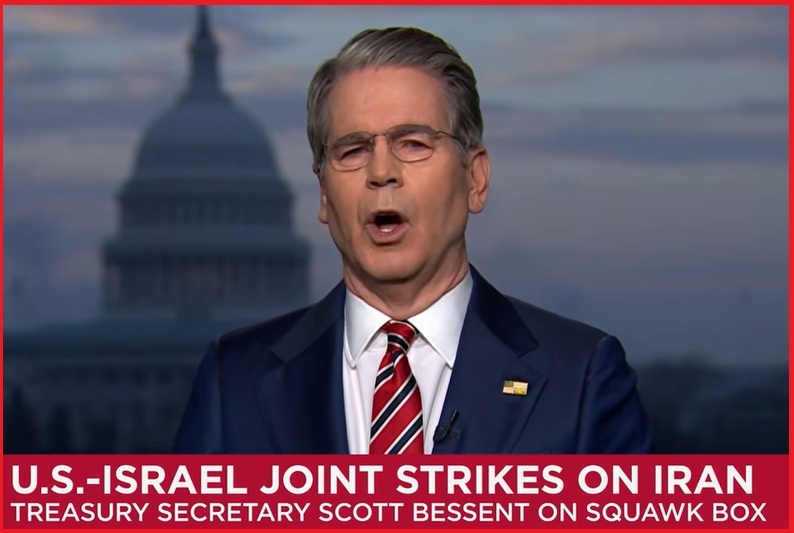
Treasury Secretary Scott Bessent appears on CNBC to discuss the Trump administration policies that were proactively deployed during Operation Epic Fury.
The goal of global financial stabilization is actually part of the strategic planning within the White House, including Treasury, Energy and Interior in alignment with the State Dept., Pentagon and national security agencies. Part of that plan was the announcement for the U.S. to underwrite maritime insurance to ensure a minimal disruption to the global energy markets.
Secretary Bessent discusses the insurance facet at the 3:00 minute mark of the video below. WATCH:
I have created this site to help people have fun in the kitchen. I write about enjoying life both in and out of my kitchen. Life is short! Make the most of it and enjoy!
This is a library of News Events not reported by the Main Stream Media documenting & connecting the dots on How the Obama Marxist Liberal agenda is destroying America





 Centinel2012