
Actually with the way NASA and NOAA treat the temperature data it’s really hard to say so here is a brief analysis that shows the problem.
The following table contains the average anomaly value taken from NASA-GISS table LOTI which I have been putting into a spreadsheet column each month. The values in the table for the year 2010, which is the top row, represent the average of all the published values for the 12 months that numbers are published i.e. January 2010 would have only one value and December 2010 would have 12 values one for each month. For the entire year there would be 78 values for the first year and all seceding years there would be 144 values 12 each published month (January through December) times twelve months. The rows are for a particular year and the columns are the average value for the indicated year, so 2010 has 5 values with 2014 being the lowest
This method may seem a bit odd, and it is, but it is necessary since the numbers for any given month are not a constant and they can move around a lot, both up and down, over time because of the methods that are used to generate the values. In this table 2010 and 2011 do not contain a full twelve month set as I have missing reports. 2013 has a full 144 values and 2014 is a full listing though November of eleven months or 66 values.
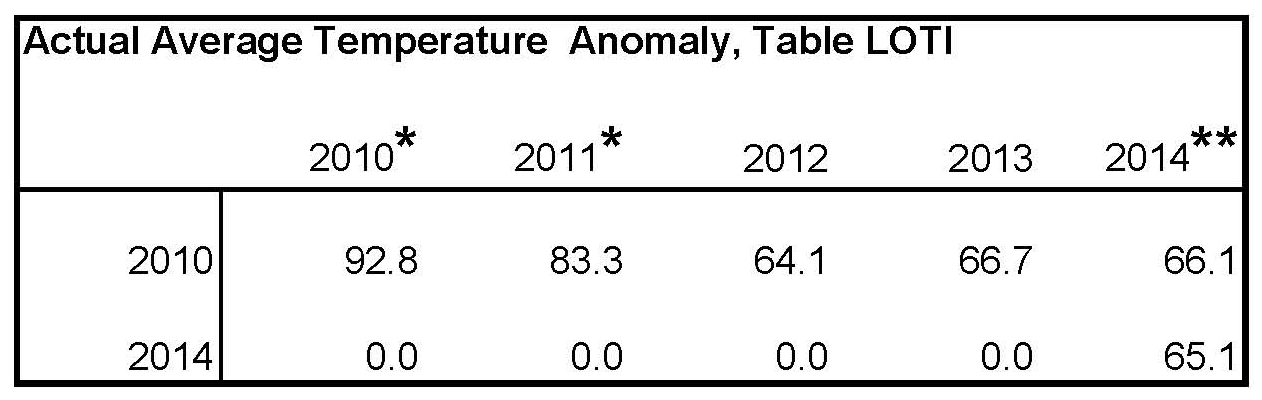
The most interesting aspect of looking at the published values is how the average for 2010 went from in the eighties down to the mid sixties. There was a major revision in the data set in December 2012 which partially shows in the drop in the temperature anomaly from 2010/2011 compared to 2012. 2012 would be higher if a full set of values was available, I only have 8 out of 36. A best guess for those three years would probably be around 80.
A previous study on what happened during that time frame was published here in the section Climate Research on June 13th.
* Only a few values
** Eleven values
Note: If anyone has access to, or knows where I could get, old versions of NASA-GISS table LOTI, I would be interested in talking to you. The following header is on that table.
GLOBAL Land-Ocean Temperature Index in 0.01 degrees Celsius base period: 1951-1980 sources: GHCN-v3 1880-11/2014 + SST: ERSST 1880-11/2014 using elimination of outliers and homogeneity adjustment Notes: 1950 DJF = Dec 1949 – Feb 1950 ; ***** = missing
 Centinel2012