Posted originally on Aug 10, 2026 by Martin Armstrong |
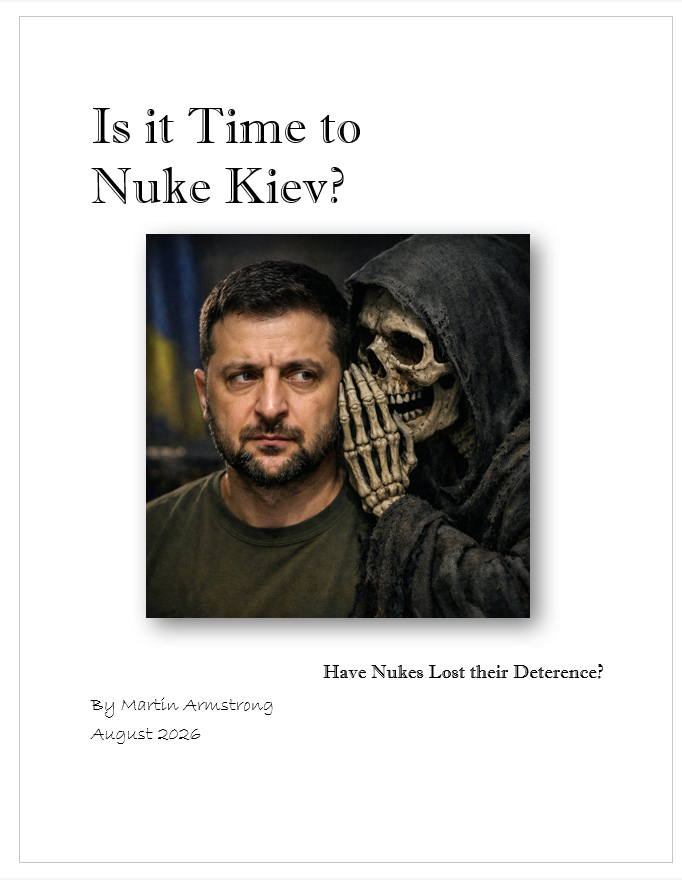
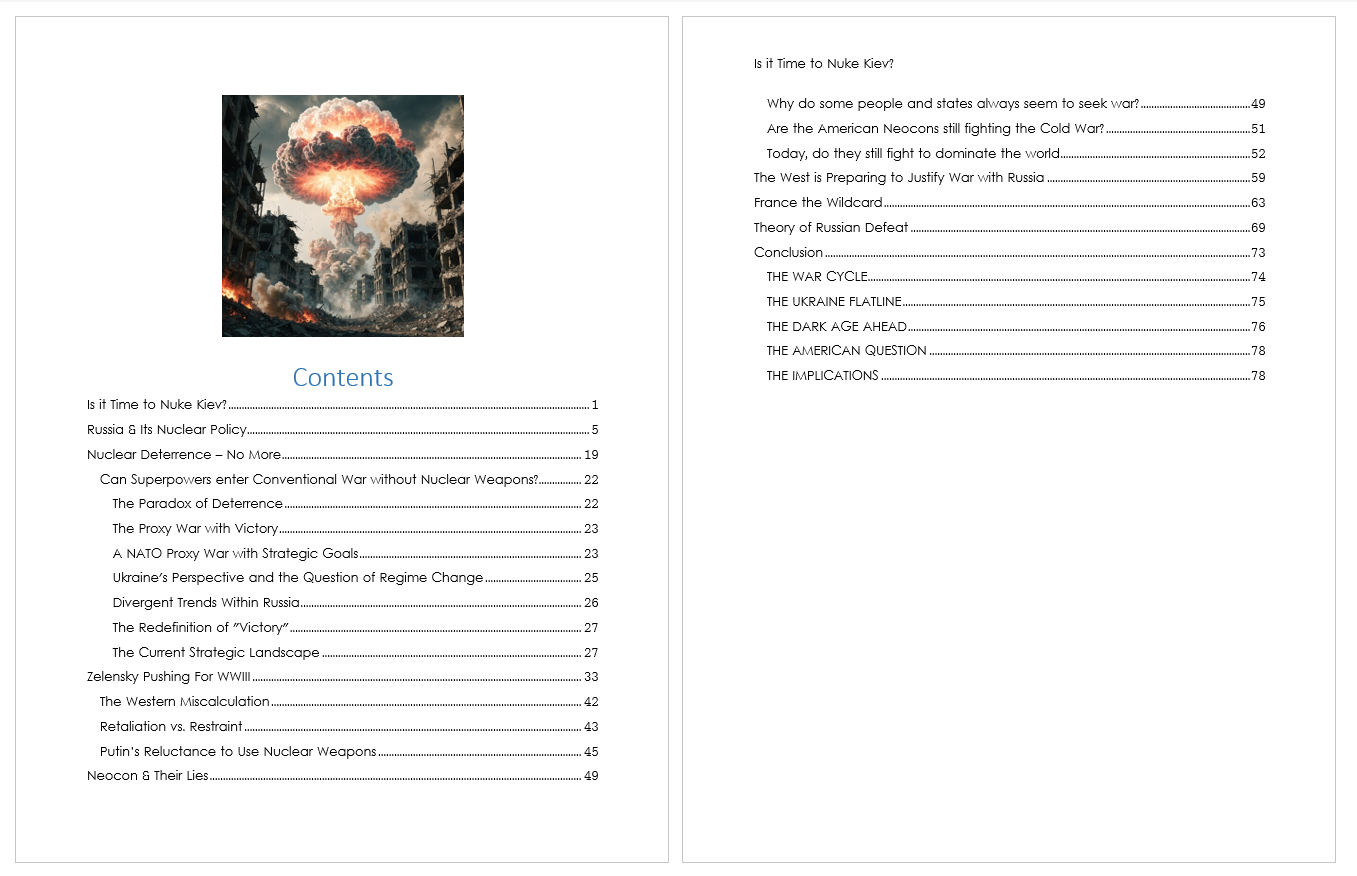
This report is part of the War Cycle looking at the mover and shakers who are determined to send the West into war for their personal glory. The Neocons are still fighting the Cold War and the fact that Communism Collapsed is irrelevant. They didn’t get to shoot anybody so to them, the war is not over. With the Russian elections for the Duma coming in September and Zelensky stepping up attack inside Russia public admitting that he is trying to influence the Russian elections, this is the great miscalculation that is more likely to hurl the West into that fateful World War III that destroys not just Europe, but Western Culture all for personal hatreds. Zelensky has refused to allow any election because he is a poppet of the Neocons and would be voted out of power in the blink of an eye. I warned in 2013 that Ukraine would be where it all begins. When Zelensky took the presidency, I warned that sources were all saying this was the guy hand-picked to start World War III. He has even publicly stated that World War III has begun.
This is a Special Report Normally $500, but because of its importance for a broader audience, we have reduced it to
Posted originally on Aug 10, 2026 by Martin Armstrong |
Governments do not spend years planning nationwide crisis simulations for events they consider impossible. They prepare for scenarios they increasingly believe are plausible. That is what caught my attention about the latest report from Politico Europe. France is reportedly organizing a nationwide tabletop exercise in the second half of 2027 to simulate a catastrophic electrical blackout involving the military, multiple ministries, and the operators of the national power grid. The purpose is to determine how long it would take to restore electricity while maintaining the continuity of the state itself.
This is no longer merely about restoring electricity. The planning documents reportedly focus on preserving “the continuity of the state” and ensuring access to generators, medicines, telecommunications equipment, emergency supplies, law enforcement equipment, and even critical raw materials. Governments only begin making lists like that when they are thinking beyond a temporary inconvenience and toward systemic disruption.
Officials point to several justifications. They cite the massive Spain-Portugal blackout of 2025, cyberattacks against European infrastructure, record-breaking heat, devastating wildfires, and the growing vulnerability of modern electrical grids. Every one of those concerns is legitimate on its own. The problem is that when you begin stacking one crisis upon another, governments naturally begin expanding emergency powers and contingency planning.
People have a dangerous habit of assuming the lights will always come back on. Modern civilization exists because electricity exists. Remove power for several days and grocery stores cannot replenish food. Fuel pumps stop operating. Telecommunications become unreliable. Banking systems slow or cease functioning. ATMs run dry. Water treatment plants struggle. Hospitals switch to backup generators that themselves depend on fuel deliveries. Supply chains that operate with almost no inventory begin breaking down in a matter of days.
Europe has spent years aggressively restructuring its energy system while simultaneously increasing dependence upon digital infrastructure. The more sophisticated society becomes, the more vulnerable it also becomes. Every layer of technology creates another potential point of failure. Whether the cause is cyber warfare, sabotage, cascading technical failures, terrorism, or extreme weather, the result is the same. Society quickly discovers that modern life is built upon assumptions of uninterrupted power.
What interests me most is the timing. Why 2027? Governments generally react to past crises. They seldom dedicate enormous resources preparing for hypothetical national emergencies unless they believe the probability is no longer remote. France is not simply planning another emergency exercise. According to the reporting, this scenario involves the military, energy operators, ministries, and national resilience planners asking how the French state itself would continue functioning during a prolonged nationwide blackout. That is a very different exercise than preparing for a hurricane or localized storm.
Perhaps one should also ask why so many Western governments are simultaneously expanding civil defense programs, encouraging emergency stockpiles, strengthening critical infrastructure planning, and discussing resilience with increasing urgency. These initiatives are emerging across Europe, not in isolation.
Governments rarely invest this much time preparing for events they consider unlikely. Perhaps the most important question is not whether France can survive a blackout simulation. The real question is why European governments increasingly believe these scenarios deserve national rehearsals. When governments begin preparing for the unimaginable, history suggests the unimaginable has often moved much closer than the public realizes.
Posted originally on Aug 10, 2026 by Martin Armstrong |
The standard explanation is that China is buying gold because it wants to destroy the dollar. That makes a dramatic headline, but it confuses diversification with replacement and political ambition with market reality. The People’s Bank of China increased its reported gold reserves by 640,000 fine troy ounces in July, nearly 20 metric tons. Holdings rose from 75.44 million to 76.08 million ounces, marking the largest monthly addition since October 2023 and extending the buying campaign to a twenty-first consecutive month.
The pace has accelerated from 160,000 ounces in March to 480,000 in June and 640,000 in July. China’s gold reserves were valued at $306.35 billion at the end of July, but this remains only a fraction of the country’s total reserve position.
If Beijing believed the dollar was about to disappear, why would it continue to maintain trillions of dollars in foreign-exchange reserves and operate within a world trading system still financed largely in dollars? China is not preparing for a theatrical dollar collapse. It is preparing for a world in which reserves can be frozen, payment systems can be weaponized, and sovereign debt can no longer be treated as politically neutral.
Gold is not another government’s liability, it cannot be defaulted upon by its issuer, and physical bullion held within national control cannot be electronically frozen by a foreign treasury department.
The seizure of Russian assets changed the calculation for every central bank outside the Western alliance. China would be negligent if it ignored that precedent. Beijing has watched Washington restrict access to technology, impose financial sanctions, pressure international banks, and use the dollar-based clearing system as an instrument of foreign policy.
This does not mean China is buying gold because it expects to launch a war tomorrow. It means the political risk attached to foreign reserve assets has increased, and central banks respond to changes in risk long before politicians publicly admit that the rules have changed.
Gold provides insurance against confiscation and monetary fragmentation, but insurance is not the same thing as an operational currency. China still needs dollar liquidity to manage trade, stabilize the yuan, support domestic institutions, and navigate periods of international panic.
This is the part the dollar-collapse crowd refuses to understand. A country can reduce its exposure to U.S. sovereign debt while the dollar simultaneously strengthens against other currencies. Capital does not choose between perfection and failure. It chooses among available alternatives.
During a global crisis, private capital can flee Europe, Japan, emerging markets, and China itself while moving into dollars and gold at the same time. The dollar benefits from liquidity, collateral demand, dollar-denominated obligations, and the depth of American financial markets, while gold benefits from declining confidence in governments and the political neutrality of sovereign reserves.
There is no contradiction. The dollar is the principal currency of the existing financial system, while gold is insurance against the abuse or eventual failure of that system. Nor does China’s accumulation prove that the yuan is ready to replace the dollar. A reserve currency requires more than trade agreements and political declarations. It requires deep and accessible capital markets, reliable convertibility, enforceable property rights, transparent institutions, and confidence that foreign capital can enter and leave without becoming trapped by government decree.
China faces a heavily indebted property sector, pressure on local-government finances, weak domestic confidence, and recurring private demand to move capital abroad. Official gold purchases should not be confused with a vote of confidence in China’s domestic economy. The state is acquiring an external reserve asset while many private holders remain concerned about the yuan, property values, government policy, and the freedom to move capital.
China may buy gold while Chinese private capital seeks dollars, foreign real estate, overseas equities, or any structure that reduces exposure to domestic controls. We should also stop pretending that every increase in central-bank gold holdings automatically drives the market in a straight line. Gold can correct even while China is buying, just as it can rise when official purchases slow.
China’s purchases confirm an existing shift in reserve management that accelerated after sanctions transformed sovereign reserves into political instruments. They do not prove that the dollar will vanish, that the yuan will replace it, or that gold must rise every month.
The weaponization of the dollar encourages nations to accumulate gold while the absence of a credible replacement preserves the dollar’s central role. China is prepared; the models consistently indicate that once the last domino falls, China will be on top.
Posted originally on Aug 10, 2026 by Martin Armstrong |
The July employment report is not the beginning of a new cycle, nor is it some sudden deterioration that appeared without warning. The labor market has been weakening beneath the surface for quite some time, while the headline numbers and constant revisions allowed the financial press to maintain the illusion of resilience.
Nonfarm payrolls declined by 23,000 in July, compared with expectations for an increase of approximately 80,000. Yet the more important figure is not July alone, for May and June were revised downward by a combined 103,000 jobs, reducing average employment growth over the past three months to only 20,000 per month. This is precisely why the initial government number should never be treated as economic truth, since the politically convenient headline receives all the attention while the revisions appear later when the public has already moved on.
The unemployment rate declined from 4.2% to 4.1%, but this does not demonstrate an improving labor market. Labor participation has declined by 0.7 percentage point since January, while the employment-to-population ratio has fallen by 0.5 point, confirming that people are leaving the labor force rather than finding productive employment. The unemployment rate can decline even while the actual employment situation deteriorates when there are fewer labor participants.
Local government education lost 50,000 positions, retail trade lost 19,000, and financial activities lost another 14,000. Health care continued to add jobs, but even there the pace slowed, while manufacturing, construction, information, professional services, transportation, and leisure showed little expansion.
The decline in financial employment is particularly important because that sector has lost 121,000 jobs since May 2025. This reflects a contraction in credit-related activity and rising financing costs, which cannot be separated from the growing sovereign-debt problem.
Wall Street will naturally interpret this report as a reason for the Federal Reserve to abandon a possible September rate increase. That interpretation confuses monetary policy with the business cycle, for lower rates cannot compel businesses to hire when confidence has collapsed, nor can they reverse taxation, regulation, geopolitical uncertainty, or declining consumer purchasing power. If lower interest rates alone created prosperity, Europe and Japan would have produced the strongest economic expansions in modern history.
Wages increased only two cents in July and 3.2% from a year earlier, which is no reprieve for workers grappling with the ever-rising cost of living. Inflation does not need to accelerate every month to destroy purchasing power, because prices that have already risen do not magically return to their previous levels when the official inflation rate slows.
The Federal Reserve is trapped between weakening employment and inflation that remains above its stated target, but this is not merely a monetary policy problem. It is the consequence of fiscal mismanagement, excessive government borrowing, geopolitical instability, and the transfer of capital away from productive private investment toward government debt and politically directed spending. Cutting rates may temporarily support financial assets, but it will not restore confidence in the real economy.
The July report merely confirms what hiring plans, job openings, falling quits, downward payroll revisions, and deteriorating participation have been warning for months. The employment situation has not suddenly turned negative, for the trend was already in motion, and the latest data simply make it more difficult for the government and the financial press to deny what the private sector has understood for some time.
Posted originally on Aug 9, 2026 by Martin Armstrong |
I warned previously that the migration policy of open boarders would become the core issue that would eventually break the EU into pieces. The indigenous people are the minority in most major cities. But the migrants that were allowed in were NOT there to assimulate and blend into European culture. Instead, they brought their own culture with them to effectively transform Europe.
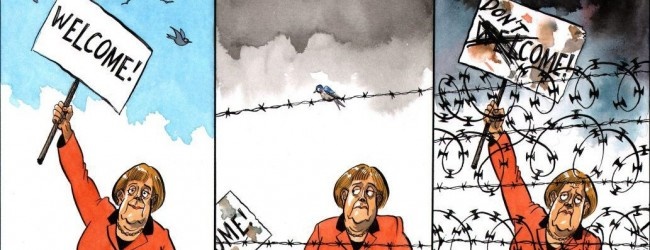
EU migration policy has now raised the risk of violent civil unrest, which could on the one hand appear as a civil war, it has created a severe political crisis that is deeply dividing the bloc. The evidence points to a breakdown of unity, with member states turning on each other and the far-right using the issue to gain power. This all began with Merkel being a hard-ass against bailing out Greece when the criticism of her was building. She then wanted to personally reverse her own image and opened the gates to the Syrian Refugees. That began the downfall of the EU all for her personal vanity.
A Crisis of Unity, Not Civil War The core issue isn’t internal armed conflict of one state against another but a “widening rift” between EU member states over how to handle migration. Recent events, such as the migrant surge into the Spanish enclave of Ceuta, have exposed these fractures.
Instead of showing solidarity, some EU nations blamed Spain for the crisis. Italy even temporarily suspended its open-border Schengen agreement with Spain, and 22 out of 27 EU countries backed a call for firmer action, implicitly criticizing Spain’s approach.
This migration is no longer just an economic or social issue; it has become a sharp political weapon of division. This was demonstrated in the immediate aftermath of the Ceuta crisis, where far-right parties used the event to attack the Spanish government and call for stricter measures.
The severe political fallout is widely attributed to how migration policy has been politicized and used as a tool for electoral gain. The surge in support for far-right parties has clearly eroded the bloc’s capacity for coordinated action. Their success on anti-immigration platforms has forced more centrist parties to adopt similar, tougher stances to retain voters. To the outrage of Brussels, their failed policies and vision have given rock-solid support in Germany to AFD.
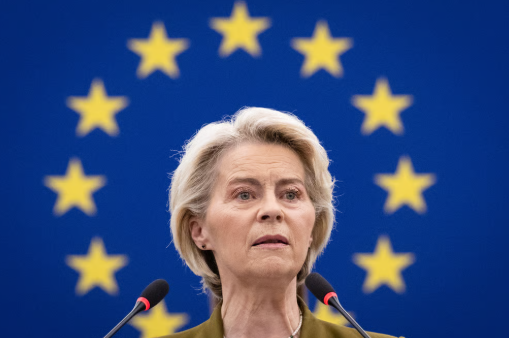
Worse still, they have adopted a policy of interfering in elections from Romania and Italy to Hungary and Germany and we should not forget their shenanigans to prevent Scotland from separating from England. As will any government entity, they will violate whatever law when it come to a threat against their power. After the EU interfered in Hungary to remove Orban, Ursula von der Leyen sought to completely revise the foundation of the EU and repeal the law of the land to retain absolute power.
Ursula von der Leyen, an unelected bureaucrat who has never stood for any public election, has the audacity to call Putin a dictator who at least stands for an election. After she got rid of Viktor Orban, she then has sought to create an absolute dictatorship in Europe. She is calling now for effectively that no single country should block the EU again. She had completely reversed the promise of a majority vote to prevent any single country from dominating another.
What von der Leyen has proposed in response to the situation is moving towards qualified majority voting on foreign policy matters, a reform that would prevent any single nation from vetoing EU decisions. Hungary stood against war with Russia, which the EU is determined to create, but also against the massive influx of migrats that is undermining the very culture of Europe.
Whatever decision she has made has been to destroy European culture. The EU has invested heavily in “externalizing” its borders, relying on third countries like Morocco to stop migrants before they reach Europe. However, this backfired in Ceuta, where it was suggested Morocco may have allowed the surge as leverage in a diplomatic dispute, creating a “new problem” where Europe’s “gatekeeper” holds significant influence.
The EU’s new migration pact, designed to share responsibility, is struggling before it’s even fully implemented. A central part of the plan relies on member states voluntarily relocating at least 30,000 asylum seekers. However, Poland, Austria, Belgium, and Sweden have already refused to accept any, signaling a “painful” path ahead. This deep resistance to burden-sharing is a core reason the policy has become so divisive.
In truth, the EU’s migration policy has backfired in a political sense, leading to deep divisions, a rise in nationalist sentiment, and a crisis of confidence in European solidarity. While the term “civil war” typically applies to an internal political divide like the English or American civil war, it is not accurate for this situation. Here the greater risk is a violent outbreak between the migrants and the indigenous people of Europe. That took place in Philadelphia with the migration of Irish during an economic decline taking jobs from Americans. This is the risk now from 2026 into 2928.
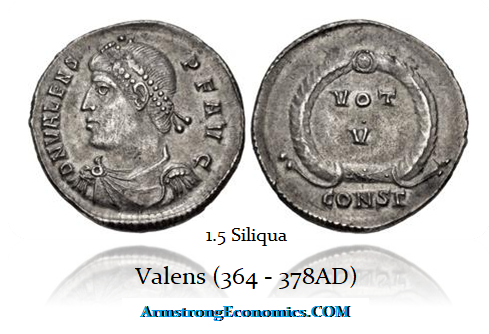
I have warned that this is not a unique forecast. Roman Emperor Valens(364-378AD) let the Goths enter the Roman Empire assuming they would defend Rome against the advancing Huns. He trained the Goths in Roman military tactics, and because they were of a completely different culture, they did NOT assimalate into Roman society. The Goths then turned on the Romans as they were really a separate class in retaliation. Valens met his death on August 9th, 378 AD, in one of the greatest military catastrophes ever suffered by the Roman Legions – the Battle of Aadrianopolis. Hos body was never found. This is the risk that Europe faces – internal conflict between cultures.
The political fallout from the migrant crisis is most visible in how it’s turning EU member states against each other, creating a toxic atmosphere where national interests are consistently prioritized over European solidarity. This will eventually lead to the breakup of the EU as early as 2029 and most certainly it will NOT exist beyond 2032.
Posted originally on Aug 8, 2026 by Martin Armstrong |
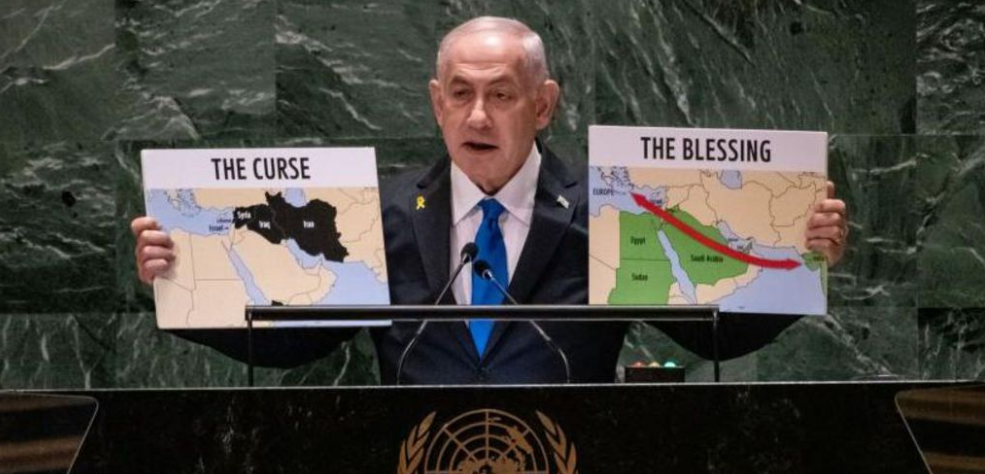
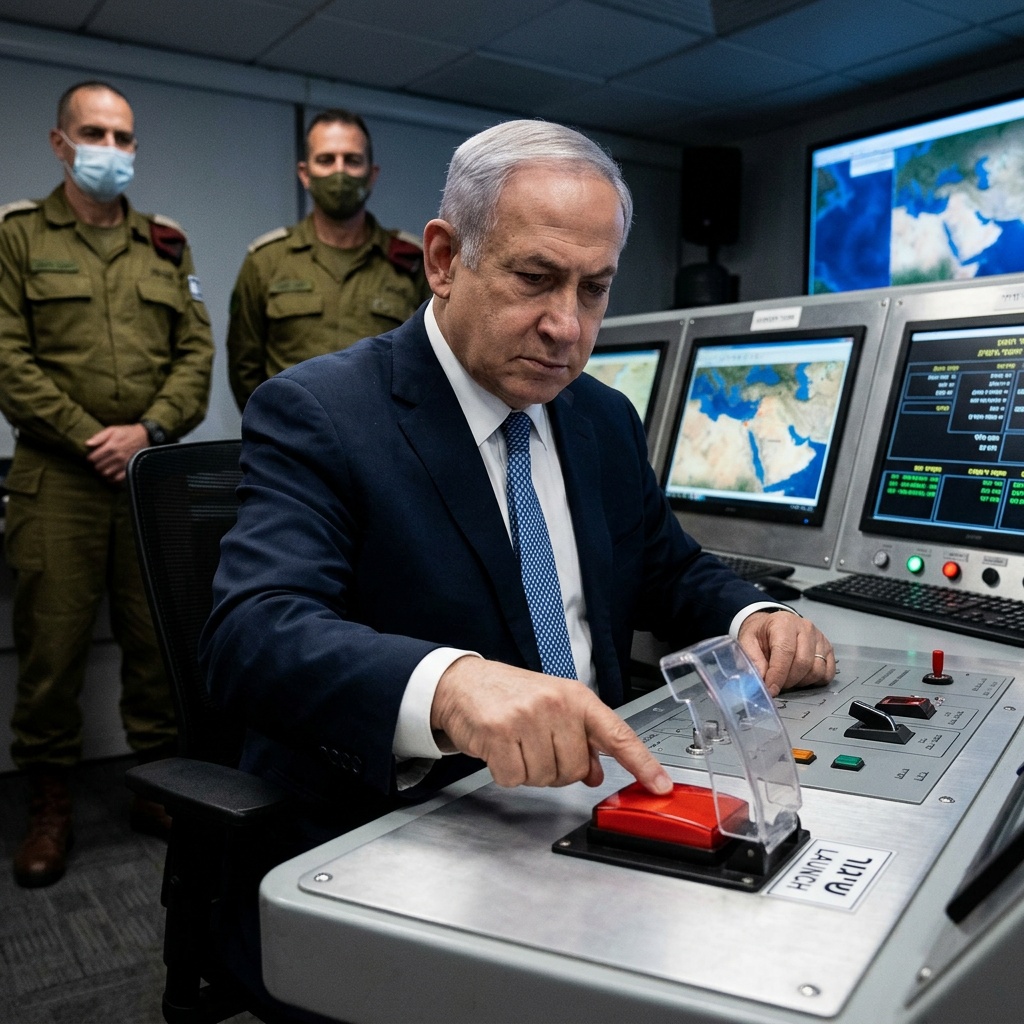
I have reported that Trump was mislead into this unwinnable war with Iran, which has been planning for it since 1979. They had amassed the largest stockpile of balistic missiles and understood the way to fight Israel was to overwhelm their dome defense. Israeli Prime Minister Benjamin Netanyahu is going to run for reelection in October. However, I would not put it past him to pull a Zelensky to retain power. He has implied that he may be considering taking unilateral action to prolong a costly and unwinnable war with Iran, even as Washington and Tehran appear to be close to an interim deal to open the Strait of Hormuz. Trump keeps trying to exit and Netanyahu tries to keep the US in to fund his war.
Iran’s investment in ballistic missiles was a deliberate strategic choice, made in the context of its long-standing tensions with the U.S. and Israel. This decision was driven by the understanding that the way to defeat Israel was to overwhelm its defense and that would take a vast supply to compel Israel to eventually run out of missiles.
There is no evidence that Netanyahu has EVER pursued a peace agreement with Iran. Instead, his decades-long career has been defined by consistent, vocal, and active opposition to diplomatic engagement with Tehran, favoring military and economic pressure to prevent Iran from acquiring nuclear weapons. I have stated many times that the primary directive of a Neocon is to reject any communication with a deemed enemy. There is NEVER a desire of peace. With both sides at each other’s throats, there is no solution militarily. Netanyahu is a threat to Israel the same as Zelensky is a threat to Ukraine. Neither consider the civilians who are killed in the process.
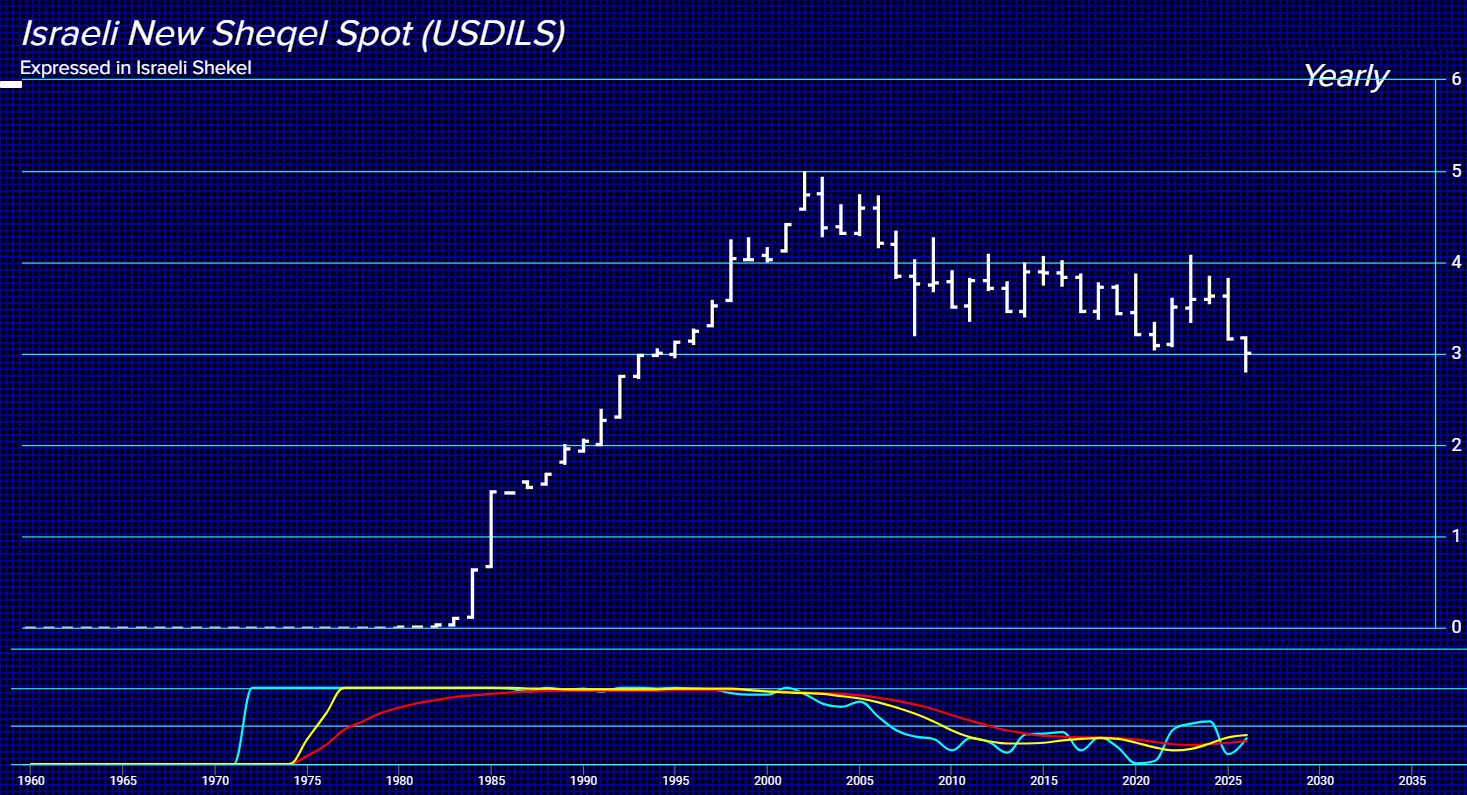
Nonetheless, the shekel reached its weakest point in modern history in May 2002, when the exchange rate hit 4.916 ILS per 1 USD. Since that peak, the currency has generally strengthened. By 2025, the average annual exchange rate was around 3.77 ILS/USD, and in 2026 it has traded significantly lower (stronger shekel), around 2.80-3.00 ILS/USD. This has been driven in part due to the High-Tech and Foreign Investment factors (Capital Flow). Israel has a powerful high-tech sector that attracts massive foreign investment. A significant portion of this investment comes from the US, creating constant demand for shekels.
Then there is the “Nasdaq Effect” and Institutional Hedging. Israeli pension funds and institutional investors hold vast portfolios of US stocks, particularly in technology. To manage currency risk, they engage in “hedging” thereby selling dollars and buying shekels. When US markets, especially the tech-heavy Nasdaq, rise, the value of these portfolios increases, prompting them to buy even more shekels to rebalance their currency exposure. This creates strong, self-reinforcing demand for the local currency.
The Bank of Israel has maintained relatively high interest rates to control inflation. It has been these higher interest rates that have made shekel-denominated assets more attractive to investors, increasing demand for the currency.
The prospects for war introduce geopolitics and that has introduced the “Risk Premium.” The shekel’s trajectory has often been influenced by geopolitics. For instance, the ceasefire following the October 2023 conflicts reduced the “Risk Premium” on Israeli assets, encouraging capital to return and supporting the shekel. However, our computer is warning that renewed geopolitical tensions, such as an escalation with Iran, could cause a sudden “flight to safety” and weaken the shekel.
Consequently, these factors have combined to strength the the shekel for 24 years overall. The Bank of Israel has historically intervened to smooth out extreme volatility, but it appears to be refraining from actively trying to reverse the structural trend of a strong shekel, preferring to let market forces play out. This is where we see things are starting to shift in 2027 and it appears we can see a major shift in trend post-2028.
Netanyahu’s Opposition to the 2015 Nuclear Deal Netanyahu was vehemently opposed to the Joint Comprehensive Plan of Action (JCPOA) negotiated by the Obama administration in 2015. In what was seen as a direct challenge to the U.S. president, Netanyahu accepted an invitation from congressional Republicans to address a joint session of Congress, where he publicly argued the deal would not block Iran’s path to a nuclear weapon but would instead pave the way for it . He spent years campaigning against the agreement and welcomed President Trump’s decision to withdraw from it in 2018 .
Rejection of Any Diplomacy & Advocating Confrontation & Destruction of Iran The evidence shows that Netanyahu’s strategy has consistently been to advocate for maximum pressure and military action over negotiation. In a video after launching a joint war with the U.S. against Iran in 2025, Netanyahu stated the attack “allows us to do what I have been hoping to do for 40 years.” His fixation on Iran as an existential threat has always been his central theme of his political identity.
He reportedly convinced President Trump to rejoin the conflict in June 2025, framing it as a chance to achieve what past administrations had not. As recently as July 2026, Netanyahu expressed skepticism about a potential deal with Iran and opposes any peace deal. When President Trump began negotiating a peace agreement with Iran in 2026, reports indicate Netanyahu actively tried to prevent it. It was reported that Netanyahu planned massive strikes on Iranian energy and infrastructure to derail negotiations but was stopped by President Trump. While Netanyahu did not publicly criticize the deal, admitting to “disagreements” with Trump , he acknowledged he could not stop it from being signed.
Netanyahu’s approach has consistently been one of opposition to diplomatic engagement and a preference for confronting Iran through military and economic pressure. Iran is well aware of this personal animosity and had built an enormous arsenal of balistic missiles. This strategy resulted in Iran holding what is described as the largest ballistic missile stockpile in the Middle East, with estimates ranging from 2,500 to 6,000 missiles of various types.
Preparation for Conflict Beyond the buildup, there is clear evidence that Iran prepared a military plan for a potential U.S. or Israeli attack. The Islamic Revolutionary Guard Corps (IRGC) stated that a military action plan was approved by the late Supreme Leader Ayatollah Ali Khamenei to be executed in the event of an attack. This suggests a high level of preparation for a scenario that ultimately came to pass. Military experts also affirmed that Iran had made significant preparations for a potential conflict with the U.S. and Israel.
This US-Iran war that broke out on February 28 put Iran’s massive missile stockpile to the test. While initial strikes damaged the arsenal, Iran’s ability to preserve and potentially rebuild its capabilities is a major part of the story. U.S. sources initially claimed that up to one-third of the arsenal was destroyed early in the conflict. However, subsequent U.S. intelligence assessments indicated that Iran retained about 70% of its prewar missile stockpile. Reports suggest that Iran used a truce to restore access to damaged underground facilities and may have replenished its stockpile with Russian-made missiles.
Despite significant strikes on its infrastructure, Iran is assessed to have regained operational access to the vast majority of its underground missile sites along the strategic Strait of Hormuz. This indicates that while the war has taken a toll, Iran’s underlying missile infrastructure has proven resilient.
V
In short, Iran’s massive missile buildup appears to be the product of a long-term definitive strategy to prepare for the possibility of a major war with the US and Israel. While the available information does not state the buildup was a plan for the specific war, the presence of a pre-approved military response plan and the subsequent use of these missiles in the conflict demonstrates a clear and sustained level of preparation.
WILL CHINA & RUSSIA STAND SILENT IS ISRAEL SEEK TOTAL DESTRUCTION OF IRAN?
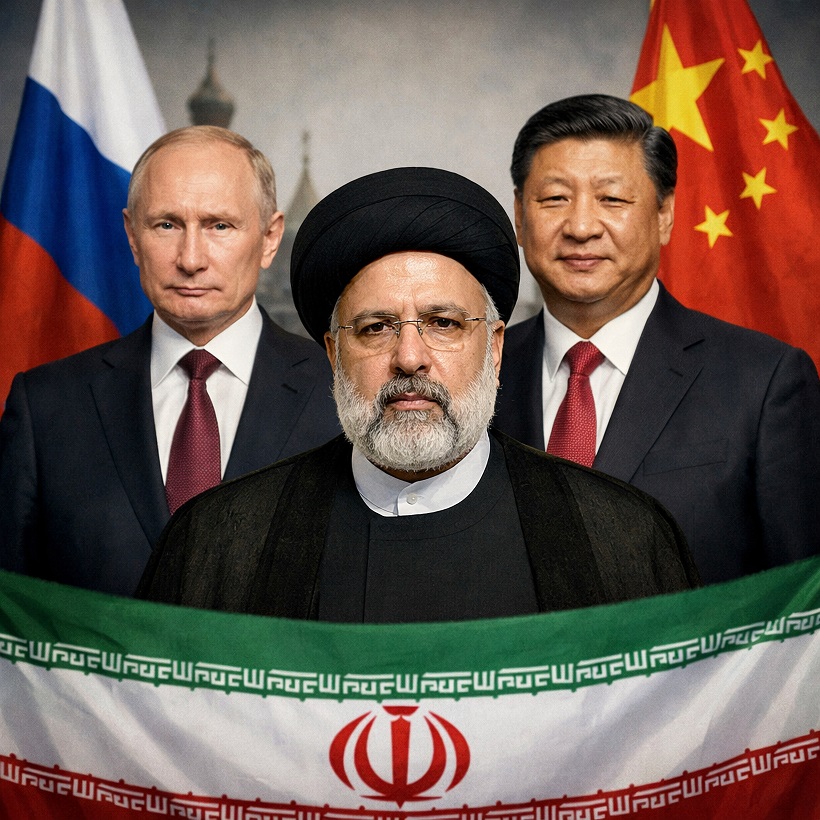
China and Russia have not indicated they would allow Israel to “totally destroy” Iran. On the contrary, they have actively opposed the military strikes and are calling for a ceasefire and a return to diplomatic negotiations. Allowing the “total destruction” of Iran would fundamentally contradict China and Russia’s stated policies. Their actions are aimed at preventing further escalation, which suggests they would not only NOT allow such a scenario but would actively work against it through diplomatic channels. As the Shanghai municipal government’s information office stated, claims that China has “abandoned Iran” are “narratives that not only distort the facts.”
From a realistic perspective, there is NO WAY either Russia or China would allow Netanyahu’s end-game to become reality. It seems that Netanyahu has the same delusions as Zelensky who seeks the destruction of Russia with comments from military leaders pronouncing Moscow will fall. There is absolutely no indication that either Zelensky or Netanyahu will succeed in their end game hgoals.
UNWINNABLE War
While this war has killed about 250 military leaders with the Ayatollah, these tactical gains have not translated into political outcomes. The Iranian regime has not fractured, and its nuclear program has not been dismantled, only set back. Iran has also opened a second front through Hezbollah in Lebanon, sustaining the conflict and then there are the Houthis who have declared a naval blockade against Saudi shipping and have followed through with attacks on oil tankers, effectively creating a crisis for one of the world’s most important shipping lanes.
Iran is built for a prolonged, attritional fight, a lesson reinforced by its experience in the Iran-Iraq War. It has employed a strategy of horizontal escalation, extending the conflict into the economic and political domains where time favors the side absorbing pain. This includes disrupting shipping through the Strait of Hormuz, which has collapsed shipping to roughly 5% of pre-war levels, and targeting the energy infrastructure of Gulf states to create global economic pressure. This dynamic gives Tehran significant leverage, as the economic costs of the war are a major incentive for the US to seek a ceasefire. As I have said, every war game played had Iran taking the Strait of Hormuz. All I can assume is that the plane was Netanyahu’s with the assumption of killing the Ayatollah would end the war in one day like Venezuela. Trump was ill-advised and the question is who escorted Netanyahu into the Situation Room to sell this war to Trump.
This has simply become a War Without End! Without a clear, shared definition of victory between the US and Israel, the war continues without a decisive conclusion in sight. The conflict is settling into a pattern of strikes, pauses, and negotiations that prevent collapse but lead to no final resolution. A war fought without a clear objective and exit strategy, described by an “anti-Powell Doctrine,” risks becoming a “forever war” as the Neocons engaged in with Vietnam, Afghanistan, and Iraq. At least the Korean War was instigated by the North invading the South.
The question of whether the war is “winnable” cannot be answered with a simple yes or no. From a military standpoint, the coalition can achieve tactical victories. However, if the benchmark is forcing Iran into submission or achieving regime change, the evidence points toward a conflict that is unwinnable. Because Iran requires only survival to claim its own victory, the war appears to be a conflict where decisive victory is unattainable.
The Nuclear Option
Netanyahu has not publicly discussed this option deploying tactical nuclear weapons against Iran. However, there remain concerns given his relentless animosity toward Iran. Israel’s nuclear capability is widely believed to be tied to the “Samson Option” doctrine, which is a last-resort deterrent meant only for an existential threat to the state’s survival. The conflict with Iran, has often been characterized as an existential threat to Israel that he has claims goes to the survival of Israel. The problem that he faces is that a tactical nuclear strike might NOT even fully destroy Iran’s deeply buried nuclear facilities. Israel already possesses a range of advanced conventional weapons, including bunker-buster bombs, which could achieve similar objectives without the immense risks of nuclear escalation. President Trump, has publicly dismissed the possibility of an Israeli nuclear strike, stating, “Israel wouldn’t do that.” However, even the USA would resort to that option if confronted with the inevitable loss in a major war with anyone.
I have been often asked about if Robert Maxwell, Epstein’s girlfriend’s father, stole US nuclear secrets and handed them to Israel. The allegations linking Robert Maxwell to a series of intelligence-related activities involving Israel began with claims of Ari Ben-Menashe, a former Israeli intelligence officer. I cannot speak definitively to this allegation. What I do know is that he was part of the “club” and that he agreed that Israel would recognize the coup against Gorbachev in return to allow the Jews in Russia to flee to Israel. I have maintained that nobody wants really to investigate WHY Epstein was engaging in his scheme ising girls to implicate powerful people. I believe they keep the focus on the girls as the victim and avoid the WHY because that leads to an operation nobody wants to expose.
Posted originally on Aug 7, 2026 by Martin Armstrong |
A United Nations proposal would replace the current system of taxing each multinational subsidiary separately with a global unitary tax system. A corporation’s worldwide profits would first be combined into one total and then divided among countries according to a formula measuring where it employs workers and where its customers purchase goods and services. Each country would apply its own corporate tax rate to the portion assigned to it, regardless of where the company legally reported the profit.
Tax Justice Network estimates that this reallocation would produce an additional $500 billion in annual corporate tax revenue worldwide. It would be redistributed among governments, creating major winners while stripping revenue from countries whose economies currently benefit from corporate headquarters, intellectual property, financial services, or low-tax structures.
Ireland would suffer one of the largest losses, surrendering an estimated $11.15 billion annually, or 81.9% of the multinational corporate tax revenue measured by the study. Hong Kong would lose $9.37 billion, or 75.7%; Singapore $8 billion, or 69.2%; Switzerland $5.43 billion, or 42%; the Netherlands $3.16 billion, or 28.4%; and Malta $3.04 billion. Bermuda would lose $489 million, the British Virgin Islands $496 million, Puerto Rico $547 million, Jersey $510 million, and Mauritius $152 million.
These jurisdictions currently tax profits that multinational corporations book within their borders despite having relatively little employment or customer activity there. The UN formula would disregard where those profits are legally reported and redistribute them toward countries where the company’s workers and customers are located.
The UN claims some of these jurisdictions could theoretically recover the lost revenue by taxing their smaller remaining profit base at much higher rates. The study estimates that the Netherlands would need an effective rate of roughly 29% to 33%, compared with its present estimated rate of 13.6%. Switzerland would need approximately 20% to 25%, up from 10.4%, while Singapore would need between 25% and 37%, up from 9.2%.
Those numbers become absurd for economies heavily dependent on profit booking. Ireland would require an effective rate between 68% and 94% to replace the revenue it loses under the various formulas. The Cayman Islands could require between 28% and 162%, while the British Virgin Islands could require anything from 9% to 643%. That is an admission that these jurisdictions could not recover their losses through ordinary taxation without destroying the economic model the UN intends to dismantle.
However, the losers are not limited to traditional tax havens. Japan would lose an estimated $34.09 billion per year, equal to 27.1% of the multinational corporate tax revenue included in the study. Denmark would lose approximately $1.8 billion, or 31.9%, while Saudi Arabia would lose $1.77 billion, or 17.9%.
The report classifies these three as “headquarters-bias” countries. Their multinational corporations report an unusually large share of global profits in the country where the parent company is headquartered, even though much of their employment and sales occurs abroad. Under the UN formula, some of that profit would be exported to foreign governments.
Japan’s result may reflect the concentration of research, intellectual property, engineering, and other high-value functions at Japanese parent companies. Yet the formula gives equal weight to employee headcount and customer location, meaning it may fail to recognize where a product was invented, financed, designed, or developed. A country could spend decades building an advanced industrial and technological base only to be told that much of the resulting profit belongs to whichever foreign country purchased the finished product.
To preserve its existing revenue, Japan would need to increase its effective corporate tax rate from approximately 30.5% to somewhere between 36.3% and 42.6%, depending on the allocation formula. Denmark would need to raise its rate from around 15% to between 25.3% and 38.8%. Saudi Arabia would need to increase its 20% effective rate to between 22.7% and 26%.
Denmark’s projected loss may be influenced by its large shipping industry and tonnage-tax regime. The report notes that $29 billion of A.P. Moller-Maersk’s $30.2 billion in 2022 pretax profit was subject to Danish or foreign tonnage taxation, producing an effective tax rate of only 3%. The proposed formula would allocate more of that profit to countries connected to Maersk’s workers and customers rather than allowing Denmark to retain the advantage of hosting the corporate headquarters.
New Zealand is also projected to lose about $220 million annually, Macao $975 million, Eswatini $22 million, and several smaller island jurisdictions would lose meaningful shares of their present corporate revenue. Some estimates for the smallest jurisdictions are based on thin reporting data and must be treated cautiously, but the direction is clear. This is a redistribution of national taxing rights, not a magical creation of $500 billion from nowhere.
The report attempts to dismiss these losses by telling tax-haven nations to abandon their present economic models, increase their tax rates, invest in education and infrastructure, and diversify into other industries. That is an extraordinary display of bureaucratic arrogance. Unelected organizations are effectively telling sovereign nations that their tax policies, competitive advantages, and development strategies are unacceptable and must be replaced by a model designed in New York.
Globalist institutions do not view countries as independent societies with different resources, cultures, needs, and economic strategies. They view the world as an administrative spreadsheet. If Ireland, Singapore, Switzerland, or a small Caribbean nation loses a major source of revenue, that is treated as an acceptable adjustment so long as the global model produces the desired aggregate result.
This is precisely how these organizations operate. The OECD, IMF, European Union, and United Nations always claim that another layer of coordination will produce fairness, stability, and efficiency. What actually appears is another permanent bureaucracy with committees, reporting mandates, enforcement mechanisms, technical standards, review conferences, and dispute panels.
The treaty language proposed by the Global Alliance for Tax Justice would empower a Conference of the Parties to assess the allocation of taxing rights across all forms of taxation with cross-border effects and adopt additional measures it considers appropriate. It also calls for an international system based on consolidated global profits, an agreed allocation formula, regular reviews, sector-specific rules, and an “effective global minimum corporate tax rate.”
The proposal explicitly says the convention should cover “all types of taxes with transboundary effects.” Once established, the bureaucracy could move into wealth taxes, digital taxes, environmental taxes, financial-transaction taxes, and the taxation of individuals deemed internationally mobile.
These global organizations protect bureaucracy before sovereignty because bureaucracy is their product. They do not produce goods, discover medicine, grow food, or create wealth. They produce regulations, standards, frameworks, and reporting requirements that justify larger budgets and greater authority. Every disagreement becomes evidence that the world needs more coordination, and every failure becomes an excuse to expand the institution that designed the failed policy.
Japan, Ireland, Singapore, Switzerland, Denmark, and the other losing jurisdictions will not be incidental casualties. Their tax bases are being deliberately redistributed under a formula they may not control. The global bureaucracy calls this fairness because it evaluates success by the amount of money transferred into government hands, not by whether individual nations retain the right to govern themselves.
The latest polling from Europe exposes the hypocrisy behind the entire war campaign. Europeans have been frightened into supporting larger military budgets, common European debt, weapons for Ukraine, and an EU defense structure, but when they are asked whether they would personally pick up a rifle, the enthusiasm suddenly disappears. They support war in theory as long as Ukrainians, professional soldiers, or somebody else’s children are forced to die for it.
The European Council on Foreign Relations surveyed 19,481 adults across 15 European countries in May 2026. The results were presented under the absurdly triumphant title “Europeans are ready to defend themselves,” yet the underlying figures tell a far more complicated story. Europeans may be prepared to borrow money and purchase weapons, but most are not prepared to bear the physical cost of the policies they endorse.
The EU’s Spring 2026 Eurobarometer found that 81% support a common European defense and security policy, while 76% believe Russia’s invasion of Ukraine threatens EU security. Another 76% said the EU should continue supporting Ukraine until a “just and lasting peace” is achieved. Those phrases are deliberately vague.
When the questions become personal, the numbers collapse. A recent cross-NATO study involving more than 31,000 respondents found that only 27% of Germans, 25% of Italians, 30% of the Dutch, and 33% of Hungarians and Czechs were willing to fight for their own countries. Sweden reached 66%, Finland 64%, Norway 61%, Lithuania 52%, and Poland 49%, which reflects the enormous geographical and cultural differences that Brussels pretends do not exist.
The ECFR polling likewise found that only about 38% of Europeans said they would personally fight if their country were attacked. Germany fell to just 29%. Asked whether their troops should defend a Baltic NATO member from a Russian attack, support averaged only 39%, while 43% opposed deployment. Sweden and Denmark reached roughly 60% to 62%, but opposition overwhelmed support in Italy, Austria, Switzerland, Hungary, and Romania.
This is the fundamental weakness in NATO’s political theater. Article 5 is presented as an automatic suicide pact, but the treaty does not cause populations to acquire the will to fight merely because politicians sign communiqués. Governments may order troops into battle, yet no alliance can manufacture morale through press conferences.
An admittedly non-representative Euronews online poll received nearly 10,000 responses to the question, “Would you fight for the EU’s borders?” Approximately 75% said no, only 19% said yes, and the remainder were uncertain. A Forsa poll in Germany found that only 16% would “definitely” take up arms if Germany were attacked. Another 22% said they probably would, while 59% said they probably or definitely would not. Among women, unwillingness reached 72%. Yet other polls found majorities supporting some form of military conscription. In other words, many Germans support a draft because they assume it will fall on someone else.
The financial polling exposes the same cowardice. The 2026 ECFR survey found that 47% supported collective European borrowing to finance defense. Support reached 59% in Portugal, 56% in Denmark, 55% in the Netherlands, and 53% in Spain. Borrowing is naturally popular because politicians pretend no one must pay for it.
When respondents were asked whether they would accept cuts to domestic public spending to fund defense, opposition surged to 63% in Italy, 59% in Austria, 56% in Germany, 54% in Spain, and 52% in Denmark. Europeans want the weapons, but they do not want lower pensions, reduced welfare, higher taxes, or fewer government services. They want war financed through debt so the bill can be concealed and transferred to the next generation.
Italy remains the clearest exception. In the May 2026 ECFR poll, 58% of Italians opposed additional military spending while only 28% supported it. Italy also recorded one of the lowest levels of willingness to fight, at roughly 25%. The Italian public understands that a nation carrying enormous public debt cannot borrow its way into another foreign war without eventually destroying its domestic economy.
European voters still view Ukraine favorably, but they do not want direct military responsibility. The ECFR survey found majorities opposed sending national troops into Ukraine even after a peace agreement, including in Germany, France, and Poland. Support for international peacekeeping deployments was weak, reaching only 18% in Denmark, 17% in Finland, 15% in Spain and Portugal, and 11% in Britain under the relevant polling formulation.
They call Ukraine an ally and demand that it continue fighting, but they refuse to send their own sons and daughters. This is precisely the arrangement European leaders prefer. Ukrainians supply the bodies, European taxpayers supply the money, defense contractors receive the contracts, and politicians receive a permanent foreign enemy to blame for every domestic failure.
Posted originally on Aug 7, 2026 by Martin Armstrong |
Russia is now doubling the military content imposed on school children. Beginning September 1, military instruction in the compulsory course called “Fundamentals of Security and Defense of the Motherland” will rise from 20% to 50% of teaching time for students in grades six through eleven. The Russian government is converting the classroom into a military recruitment center.
The program reportedly includes drone operation, engineering instruction, military camps, and preparation for future service. Occupation authorities in Donetsk have approved a ten-year plan extending through 2036, while vocational students in occupied Kherson are being taught to operate, maintain, and repair drones. In occupied Luhansk, children are being absorbed into cadet groups, political organizations, and so-called patriotic movements designed to replace their identity with loyalty to Moscow.
Critics who say I only condemn Zelensky and Europe have not been reading my work closely. EVERY GOVERNMENT IS CORRUPT. Few truly care about future generations. The masses are the disposable great unwashed to be used as their overlords see fit. Granted, many leaders are worse than others, but no one in government is “the good guy” when we are dealing with war. I do believe Putin attempted to extend the olive branch and end this conflict numerous times over, but that is simply impossible since the Western decision-makers believe this conflict can save their nations from the sovereign debt crisis. They are WRONG but there is too much tied into Ukraine at this point for the war to simply end. Kids will learn how to murder their fellow human because that is the world they will be raised in and the skills necessary to propel the machine. At the same time, this will not be a forever indefinite war. The world will not look the same once it is over.
Now the Kremlin is manufacturing a permanent mobilization reserve. The Eastern Human Rights Group warned that the objective is to shape children in both “skills and worldview,” and the inclusion of girls substantially expands the state’s potential manpower pool. A senior Russian lawmaker has even proposed beginning mandatory military training in the fifth grade, demonstrating how far the government is prepared to reach into childhood.
By 2036, many of today’s Kremlin officials will be retired or dead, while the children conditioned in their classrooms will be old enough to fight the next war. Believe me, the Russian oligarchs who want to replace Putin are ready to take this conflict to the next level. This is the ancient crime of government repeated once again—the old create the conflict, conceal their failures beneath patriotism, and send the young to settle the account in blood.
I have created this site to help people have fun in the kitchen. I write about enjoying life both in and out of my kitchen. Life is short! Make the most of it and enjoy!
This is a library of News Events not reported by the Main Stream Media documenting & connecting the dots on How the Obama Marxist Liberal agenda is destroying America