Google’s Debug Project — When Silicon Valley Starts Releasing Insects


Posted originally on Jun 2, 2026 by Martin Armstrong |  
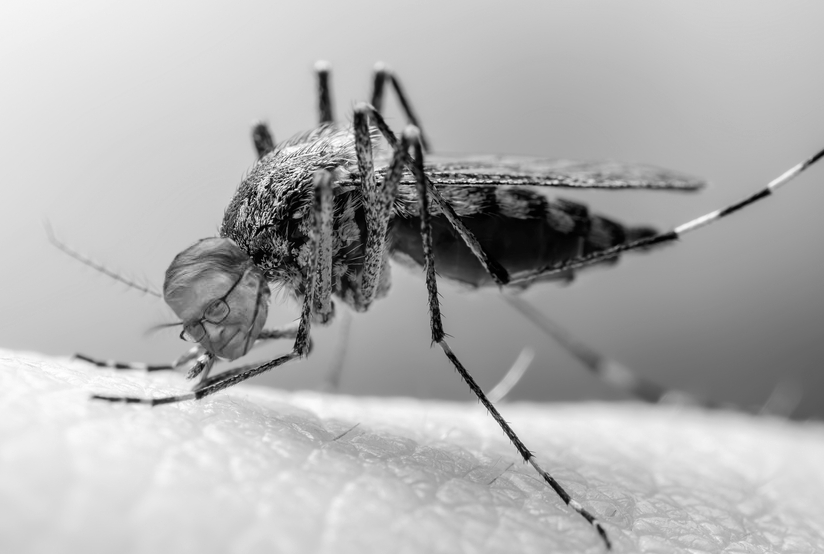
Bill_Gates mosquito

Nobody elected Google to manage the ecosystem. Yet here we are.

Alphabet, Google’s parent company, has quietly spent the better part of a decade developing what it calls the “Debug” project. The latest proposal seeks approval to release tens of millions of laboratory-bred mosquitoes across California and Florida. We are told not to worry because these are the “good” mosquitoes. We are assured they are male mosquitoes and therefore do not bite. We are told they carry a naturally occurring bacteria known as Wolbachia that will interfere with reproduction and reduce mosquito populations.

For generations, governments and corporations have repeatedly assured the public that interventions into nature would be harmless. DDT was once considered a miracle. Countless pesticides were approved before later being restricted. Entire rivers were polluted in the name of progress. Every generation is told that the experts have everything under control until something goes wrong.

What makes this case particularly remarkable is who is behind it. This is not a public health agency. This is not a university research department. This is one of the largest technology companies on earth. The same corporate structure that dominates online advertising, search results, artificial intelligence, data collection, mapping, cloud computing, and digital communications now wants to engineer mosquito populations on a massive scale.
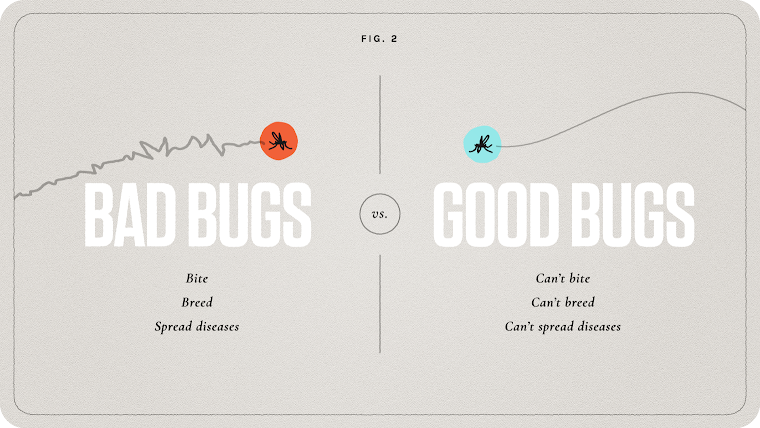
Fig 2: Bad bugs vs. good bugs

The project itself is run by Verily, Alphabet’s life sciences division. Debug combines software engineers, robotics specialists, AI systems, automation experts, and mosquito biologists. They have spent years building automated mosquito factories capable of producing millions of insects per week. Computer vision systems sort male from female mosquitoes while robotic systems manage breeding and deployment. This is industrial-scale biological engineering that will now become a social experiment.

The problem according to Google: “Mosquitoes kill more people than every other animal combined. One species, Aedes aegypti, carries diseases such as dengue, Zika, yellow fever, and chikungunya which make hundreds of millions of people sick every year. And these diseases are spreading faster than ever.”

Their stated objective is to reduce mosquito populations without widespread pesticide use. Studies involving Wolbachia have shown reductions in mosquito populations and lower transmission of certain diseases. Singapore reported reductions in dengue risk exceeding 70% in areas where Wolbachia programs were implemented. The CDC has acknowledged that Wolbachia-based mosquito suppression can reduce target mosquito populations and notes that these mosquitoes are not genetically modified.

Why should the public automatically trust any institution that asks for permission to alter the natural environment on this scale?
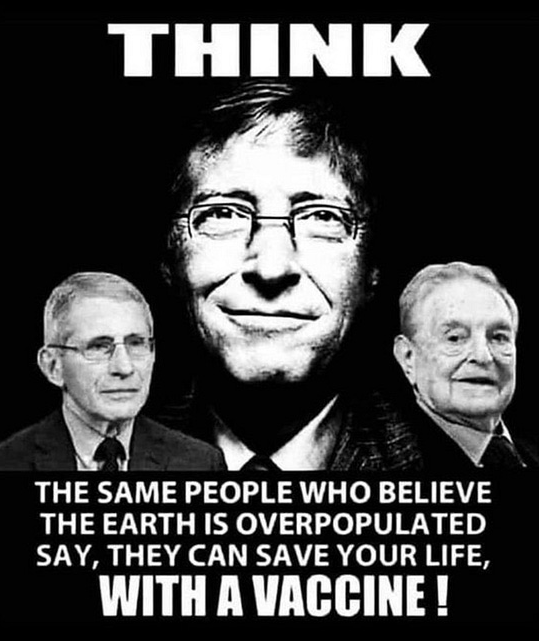
THINK Gates Fauci Soros

This is not the first time modified mosquitos have been released on the population. Bill Gates has been involved in mosquito projects for years, long before Google entered the arena. Through the Bill & Melinda Gates Foundation, he has funded research into both genetically modified mosquitoes and Wolbachia-based mosquito programs designed to suppress malaria, dengue, Zika, and other mosquito-borne diseases. Gates has openly championed the release of engineered mosquitoes, arguing that technology can be used to alter insect populations and reduce disease transmission. The Foundation supported projects involving biotechnology firm Oxitec, which developed genetically modified mosquitoes carrying self-limiting genes intended to collapse wild mosquito populations over time. Gates has also heavily promoted the World Mosquito Program, which breeds millions of Wolbachia-infected mosquitoes and releases them into communities throughout Latin America, Africa, and Asia.

Whether one agrees with these programs or not, what is remarkable is the philosophy behind them. A handful of billionaires, technology companies, and global foundations increasingly view nature itself as something that can be engineered, modified, and optimized. Gates has praised facilities producing more than 30 million mosquitoes per week and has argued that mass releases are necessary to combat future disease outbreaks. Google is now pursuing its own large-scale mosquito deployment through Verily’s Debug project. The public is being asked to trust that these interventions will work exactly as intended, yet history is littered with examples of experts assuring everyone that there was nothing to worry about until unforeseen consequences emerged years later. The issue is no longer simply mosquitoes. It is the growing belief among technocrats that every aspect of the natural world can be redesigned from the top down by unelected institutions operating far beyond public scrutiny.

We are living through a period where public trust has collapsed. Governments concealed information during COVID and unleashed a deadly cocktail of mRNA vaccines on the global population. Pharmaceutical companies received legal protections that ordinary businesses could only dream about. Regulators routinely move through revolving doors into the industries they supposedly oversee. The public has been repeatedly told to trust experts who later turn out to be wrong.

Now the same population is expected to calmly accept the release of tens of millions of engineered insects because another collection of experts says everything is safe.

What could possibly go wrong?

America’s Fruit Has Become a Social Experiment


Posted originally on Jun 2, 2026 by Martin Armstrong |  

Corporate agriculture turned food into a chemistry project. A recent consumer test of Driscoll’s conventional strawberries found 12 pesticide residues, including eight described as PFAS-linked “forever pesticides,” while the organic sample came back non-detect. Why are Americans expected to eat food treated with chemicals that other nations restrict or prohibit?

The USDA will run out and tell you that over 99% of tested foods fall below EPA tolerance levels. That is the same bureaucratic trick they always use. They define the allowable poison, then congratulate themselves when the poison is within the legal limit. The average person does not eat one chemical in isolation. They eat strawberries, spinach, grapes, apples, processed food, contaminated water, and whatever else the industrial food machine has dumped into the supply chain.

The Environmental Working Group ranked strawberries third on its 2026 Dirty Dozen list, noting Americans eat about eight pounds of fresh strawberries per year and with them “dozens of pesticides.” When children are eating these berries, when pregnant women are eating these berries, when families are told fruit is healthy, then the burden should be on these companies to prove the product is clean, not on consumers to become chemists in the grocery aisle.

There are videos circulating the internet of consumers leaving fruit outside overnight only to find it untouched in the morning. The animals won’t eat these substances. Even the bugs are avoiding the very produce on American grocery shelves.

The deeper problem is the farming system itself. California grows around 90% of the strawberries in America. At the state level, strawberry production has relied heavily on fumigants such as 1,3-D and chloropicrin. These chemicals are not harmless fairy dust. 1,3-D has been treated as a cancer-risk chemical, and chloropicrin was once used as a choking agent in war. Reports have shown these fumigants are used near schools and farmworker communities, and regulators have permitted exposure frameworks that critics say protect production more than people.

There should be lawsuits. “FDA approved” means absolutely nothing. It is an absolutely useless agency that is beholden to corporations over the people. Consumers deserve to know what was sprayed, where it was sprayed, what residues remained, what the companies knew, what regulators ignored, and whether labeling created a false sense of safety. If a product is marketed as wholesome, natural, fresh, and safe while containing residues that would not pass standards elsewhere, then the public has every right to demand accountability.

This is about the industrial corruption of food itself. America was once the breadbasket of the world. Now we have allowed monopolized agribusiness, chemical companies, captured regulators, and political cowards to transform the grocery store into a legal poison aisle.

The government will not fix this voluntarily because it never does. The agencies protect the system first and the people second. The only thing that moves these people is exposure, lawsuits, boycotts, and public outrage. If companies want to sell food to American families, then make it clean, prove it is clean, and stop hiding behind tolerance levels written by the same regulatory empire that has failed the public for decades.

A sick population can be easily controlled. They make us sick, prescribe pills, and force a lifetime of prescriptions and medical treatments not covered by greedy insurance companies. Government and corporations profit off our pain. Globalist entities openly discuss controlling the food and water supplies. This is why the World Economic Forum suggested banning individuals from gardening and growing their own food. This is why the likes of Bill Gates and other psychopathic pretend philanthropists are buying farmland and creating synthetic meats that cannot be distinguished from natural meat. Fresh produce and real sources of protein are becoming harder to obtain. Small farms are struggling to stay afloat. What is happening to the food supply should be on the front page of every paper, but these articles make 30-second news clips before they are forgotten. Pay attention to what is happening with the food supply, for they are actively using this as a way to control the population.

The Fed’s Real Stress Test


Posted originally on Jun 2, 2026 by Martin Armstrong |  

JeromePowellFedChair

Jerome Powell is now warning that the Federal Reserve is undergoing a “stress test” and that political interference threatens public confidence in the institution. He stated that “the public would lose faith” if administrations could remove Fed officials over policy disagreements and argued that democratic institutions can be “torn down all too quickly.”

What is interesting is not what Powell said. It is what he did not say.

The Federal Reserve has spent years demanding independence from elected officials while simultaneously expecting the public to trust its judgment after one of the largest inflationary episodes in modern history. Powell himself admitted previously that the Fed was late in recognizing inflation, famously calling it “transitory.”

The real stress test is not whether politicians criticize the Fed. The real stress test is whether the public still believes central bankers know what they are doing.

Throughout history, central banks have always claimed they must remain independent. The argument is simple. Politicians think in election cycles. Central bankers are supposed to think in long-term economic cycles. There is truth in that. If every administration could simply fire central bankers whenever interest rates became politically inconvenient, monetary policy would become nothing more than an extension of campaign strategy. Powell warned that if one administration succeeds in removing Fed officials over policy differences, future administrations will follow the same path.

Governments borrow beyond reason. Debt accumulates for decades. Then central banks are forced into impossible choices. Raise rates and governments struggle to finance their obligations. Cut rates and inflation returns. Every major sovereign debt crisis throughout history eventually places the central bank in the crossfire because there is no solution that satisfies everyone.

The United States national debt continues to expand while interest costs consume an increasing share of federal revenue. Politicians want lower rates because debt service becomes too high, and they falsely believe lower rates will spur confidence. Markets want stability. Savers want protection from inflation and borrowers want cheap credit. Everyone deeply needs to believe in a better tomorrow, or they will panic and hoard for survival. These objectives conflict with one another.

Powell said democratic institutions take years to build and can be destroyed quickly. He is correct. However, public trust is earned through performance. The Federal Reserve’s credibility was damaged not because politicians criticized it. Credibility was damaged when inflation exploded after years of assurances that price pressures were “transitory.”

The larger cycle is what matters. Around the world, confidence in institutions is declining. Governments, courts, media organizations, universities, and central banks are all facing challenges to their authority. Powell himself acknowledged that the Fed is merely one institution among many now facing scrutiny.

Powell sees political pressure as the Fed’s stress test. I would argue the greater stress test is whether citizens still believe the people running these institutions deserve the trust they once commanded.

July 25 Conference in Tampa – Understanding the World Economy


Posted originally on Jun 2, 2026 by Martin Armstrong |  

UWE.Logo_

Understanding the World Economy

An Introduction to Cycles of Confidence

Most people are taught to view the economy through headlines, political debates, and short-term events. Yet beneath the daily noise are long-term cycles that influence markets, governments, business activity, and even society itself.

Join Martin Armstrong for a special educational event designed to introduce attendees to the concept of confidence cycles and how they shape the world around us. This presentation will provide an accessible overview of the theories and observations that have made Martin Armstrong one of the most recognized independent economic thinkers in the world.

This event is not limited to investors, traders, or finance professionals. It is intended for anyone interested in understanding the forces that drive economic change, including students, business owners, retirees, professionals, entrepreneurs, and curious minds seeking a broader perspective on the world economy.

What You’ll Learn:

• The role confidence plays in economic and political change

• How cycles influence markets, governments, and society

• Why economic trends often repeat throughout history

• The interconnected nature of the global economy

• The foundations of Martin Armstrong’s approach to analyzing world events

Important Information:

• This is an educational event only

• No financial advice will be provided

• No market forecasts or investment recommendations will be discussed

• This event is designed as an introduction to the concepts behind cycles of confidence

• The event will not be live-streamed

• Attendance is available exclusively in-person

This event is also an excellent opportunity to introduce friends, family members, or colleagues to Martin Armstrong’s work. If you have ever wanted to share these ideas with someone important in your life, this presentation provides the perfect starting point.

We do not anticipate offering this event again in the foreseeable future. For those interested in gaining a deeper understanding of Martin Armstrong’s theories on the global economy, this may be a unique opportunity.

Learn. Understand. See the Bigger Picture.

Reserve your seat today:
https://armstrongeconomics.ticketspice.com/understanding-world-economy

LearnMoreButton

Zelensky Betrays Poland


Posted originally on Jun 1, 2026 by Martin Armstrong |  

Poland, one of Ukraine’s strongest supporters, is openly condemning Zelensky for glorifying a movement associated with the slaughter of Polish civilians.

Poland absorbed millions of Ukrainian refugees. Poland became the primary logistical hub for Western weapons. Poland spent years standing shoulder to shoulder with Kiev. Then Zelensky signs a decree honoring a military unit tied to the traditions of the UPA, an organization remembered in Poland for massacres that claimed tens of thousands of civilian lives. Depending on the estimates used, the Volhynia massacres and related ethnic cleansing campaigns killed somewhere between 50,000 and 100,000 Poles, including women, children, and entire villages wiped from existence.

People were hacked to death with axes, burned alive, and murdered specifically because they were Polish. The Polish parliament has repeatedly classified the atrocities as genocide. Yet somehow we are supposed to pretend this is merely a misunderstanding.

Polish President Karol Nawrocki has now stated that Zelensky is not acting like someone prepared to join the European family and has even called for stripping him of Poland’s highest state honor. Imagine how furious Polish officials must be to reach that point after everything they have done for Ukraine.

The Western press spent years screaming that anyone who discussed Ukrainian ultranationalist movements was spreading misinformation. Anyone who mentioned the legacy of the Organization of Ukrainian Nationalists, Stepan Bandera, the UPA, or extremist factions inside Ukraine was immediately attacked. Now the permanent president of Ukraine himself is honoring genocidal organizations and suddenly everyone wants to look the other way.

Zelensky presents himself as the champion of democracy while elections remain suspended. He speaks about freedom while opposition parties have been banned. He lectures the world about human rights while draft officers drag men off the streets and force them into military service. He demands endless funding while Ukraine’s population continues shrinking and hundreds of thousands have fled abroad permanently.

What does that say about the man? The truth is that many Western politicians never cared about democracy. They cared about war. Zelensky became a useful idiot because he was the face they needed to sell a conflict to the public. As long as the money kept flowing and the weapons kept moving, uncomfortable questions were pushed aside.

The war cycle is now exposing everything. Governments always lose control of the narrative when conflicts drag on too long. Historical grievances return. Corruption surfaces. Alliances begin cracking. The truth starts leaking through the propaganda.

Poland’s outrage matters because Poland knows this history firsthand. Entire Polish communities disappeared during the massacres. Families still remember what happened. Graves still exist. The blood is real even if politicians would prefer everyone forget it.

The most disturbing aspect of all this is that Zelensky knew exactly what he was doing. Nobody accidentally honors a movement this controversial. Nobody accidentally signs a decree carrying this level of symbolism. This was a deliberate political choice to honor and uphold a genocide. And yet Western leaders who spend every waking moment condemning historical injustices will likely remain silent because acknowledging the truth would undermine the mythology they spent years creating.

The mask is slipping, and the more desperate this war becomes, the harder it will be to hide what has been standing in plain sight all along. ZELENSKY IS A FRAUD.

Canada Slips Into Recession


Posted originally on Jun 1, 2026 by Martin Armstrong |  

How likely is a Canada-wide recession in 2023? | Canadian Mortgage  Professional

Statistics Canada reported that Canadian GDP contracted by 0.1% in the first quarter of 2026 after a revised 1.0% contraction in the fourth quarter of 2025. That marks two consecutive quarters of decline and places Canada in what economists call a technical recession. More importantly, the economy performed dramatically worse than forecasts that had expected growth of roughly 1.5%.

The numbers beneath the surface are even more troubling. Business capital investment fell 0.7% during the quarter. That was not an isolated event. It was the fifth consecutive quarterly decline. When businesses stop investing, they stop hiring. When hiring slows, wage growth weakens. When incomes stagnate, consumption eventually follows. The economy is now moving through that sequence exactly as one would expect.

Government spending dropped 2.5% while domestic demand slipped 0.1%. Imports surged 2.9% while exports edged lower. Vehicle exports were particularly weak as manufacturers continued dealing with trade disruptions and tariff uncertainty. Business confidence has been deteriorating for months.

Household spending managed to rise 0.4%, but consumers cannot carry an economy indefinitely. Governments around the world always assume the consumer is some endless source of growth. The reality is that consumers spend only when they feel secure about employment and future income. Once confidence declines, spending follows.

Canada’s economy grew only 1.7% in all of 2025, the weakest pace since the pandemic period. The Bank of Canada now expects growth to slow further to only 1.2% in 2026.

Youth unemployment has been climbing, business closures remain above historical averages, and investment continues flowing toward the United States despite political tensions. Statistics Canada reported business closure rates running above pre-2020 norms, another indication that small and medium-sized enterprises are struggling under rising costs and economic uncertainty.

What many analysts miss is that recessions are not merely about GDP. They are confidence events. Once businesses begin postponing investment projects, capital starts searching for safer jurisdictions. Canada has spent years increasing regulatory burdens, raising taxes, restricting resource development, and discouraging private investment. At the same time, housing affordability has collapsed, household debt remains among the highest in the developed world, and productivity growth has stagnated.

Canada possesses some of the world’s largest reserves of energy, minerals, farmland, timber, and fresh water. It should be one of the strongest economies in the Western world. Instead, policymakers have spent years trying to engineer growth through government spending while simultaneously undermining the productive sectors that generate wealth.

There are signs of a short-term rebound. Statistics Canada estimates GDP may have increased by 0.4% in April, helped by oil and gas production and manufacturing activity. Yet one month does not reverse a trend. The issue is not whether Canada can produce a positive quarter here or there. The issue is whether businesses believe the future is worth investing in.

Top AI Experts Forbidden to Leave China without Approval


Posted originally on Jun 1, 2026 by Martin Armstrong |  

AI Forecasting Future I put Myself Into It

China is now reportedly requiring leading AI experts at private firms to obtain government approval before traveling internationally. Beijing fears that top researchers could leak sensitive information, defect, or become targets for foreign intelligence agencies as the AI race intensifies. This policy is now expanding beyond government-linked entities directly into the private sector itself. That tells you everything about how seriously Beijing views artificial intelligence strategically.

People still think AI is just about chatbots, search engines, or replacing office jobs. Nonsense. AI is becoming military infrastructure, financial infrastructure, surveillance infrastructure, cyberwarfare infrastructure, and economic infrastructure simultaneously. Whoever dominates AI gains enormous advantages not only economically but also militarily and geopolitically.

China understands this perfectly. That is why Beijing is treating AI talent almost like strategic state assets. During the Cold War, nuclear scientists could not simply move freely because governments feared technological leakage. Now, AI engineers are entering the same category because advanced models increasingly intersect with military targeting systems, drone warfare, cyber operations, financial surveillance, intelligence gathering, and autonomous weapons development.

The United States is doing the exact same thing in a different form. Washington has aggressively restricted semiconductor exports to China, blocked advanced Nvidia AI chips, pressured allies like the Netherlands and Japan to limit lithography technology exports, and expanded investment restrictions tied to Chinese AI firms. The Biden and Trump administrations alike both viewed AI dominance as critical to national security because the geopolitical establishment in Washington now sees China as the primary long-term rival.

The AI race is replacing globalization itself. For decades the world operated under the assumption that economic integration would reduce geopolitical conflict. Instead, the exact opposite happened. Globalization created interdependence, but once relations deteriorated, every dependency became weaponized.

Semiconductors are weapons. Data is a weapon. Software is a weapon. Supply chains are weapons. Rare earth minerals are weapons. Financial systems are weapons. Artificial intelligence is rapidly becoming one of the most valuable strategic assets on earth.

China knows it cannot afford a massive brain drain of elite engineers while competing directly against Silicon Valley and the U.S. defense establishment. Chinese firms like DeepSeek, Alibaba, Tencent, and Baidu are now central players in Beijing’s technological ambitions while the government pours enormous resources into AI development. China already graduates vastly more STEM students annually than the United States, and Beijing understands human capital is now as important as oil reserves were during the 20th century.

The United States helped create much of this situation through sanctions, export controls, financial warfare, and trade restrictions. Once Washington froze Russian reserves and weaponized SWIFT, every major power on earth understood the world had entered a new era where economic systems themselves had become geopolitical battlegrounds.

What we are witnessing is the slow division of the world into competing technological spheres. One side centered around the United States and Western allies. The other increasingly centered around China and alternative systems. AI will sit at the center of this divide because whoever controls advanced AI systems gains advantages across finance, intelligence, defense, medicine, robotics, and industrial production.

The naval arms race before World War I intensified tensions between Britain and Germany. The nuclear arms race defined the Cold War. Now the AI race risks becoming the defining geopolitical competition of the 21st century.

AI may ultimately centralize power further than any technology in human history. Whoever dominates AI infrastructure could potentially dominate information, finance, labor markets, surveillance, and warfare simultaneously.

The Real Reason Russia Would Invade Europe


Posted originally on May 31, 2026 by Martin Armstrong 

Russia the Distraction 3

The press keeps insisting Russia is preparing to invade all of Europe as if Putin wakes up every morning dreaming about inheriting Germany’s industrial collapse and France’s pension protests.

The propaganda has become so absurd that perhaps we should finally discuss the REAL reasons Russia would supposedly invade Europe:

  1. To acquire Germany’s energy policy expertise and finally learn how to shut down functioning nuclear plants while importing expensive energy from everyone else.
  2. To seize Britain’s world-renowned knife-control strategy where criminals ignore the laws while grandmothers get arrested over tweets.
  3. To capture France’s revolutionary spirit, which now mostly consists of setting garbage piles on fire and blocking highways every few months over retirement age increases.
  4. To inherit the European Union’s debt structure because apparently Russia looked at its own sanctions and recession risks and thought, “You know what we really need? Italian debt too.”
  5. To revive the Dutch tulip market and reignite the original speculative bubble. At least tulips are tangible unlike modern sovereign bonds.
  6. To gain control over Europe’s magnificent demographic strategy where birth rates collapse while governments debate banning gas stoves and regulating pronouns.
  7. To seize all of Switzerland’s chocolates, since they’ve already soured their offshore banking.
  8. To experience the thrill of open borders and historic levels of crime in culturally enriched cities.
  9. To inherit Europe’s university system where students graduate with debt, activism experience, and no employable skills whatsoever.
  10. To inherit Europe’s industrial competitiveness, which now largely consists of closing factories and importing products from China while lecturing everyone about carbon emissions.
  11. To govern government’s government by overtaking the European Commission.
  12. To take control of the ECB’s brilliant strategy of printing trillions while pretending inflation was “transitory.”
  13. To secure Europe’s military stockpiles, assuming they can locate them first.
  14. To acquire London real estate prices so inflated they make Manhattan look reasonable.
  15. To learn from Brussels how to regulate artificial intelligence before figuring out how to generate reliable electricity.
  16. To seize Europe’s famous “green economy” where citizens pay some of the highest electricity prices on earth while China builds coal plants by the week.
  17. To inherit NATO procurement systems where a coffee machine probably requires six committees and seventeen consultants before approval.
  18. To finally gain access to Europe’s remaining middle class before they relocate outside of the EU.
  19. To experience firsthand the excitement of driving through fifteen countries while being investigated online for “hate speech” because someone made a joke.
  20. To save the euro before Brussels itself finishes destroying it.

The reality is that the political class in Europe needs Russia psychologically more than Russia needs Europe economically. Fear justifies military spending, centralized power, censorship laws, surveillance expansion, debt issuance, and political unity around failing leadership. Historically governments always need an external threat during periods of internal decline.

Categories:War

Why Iran Can Win


Posted Posted originally on CTH on May 30, 2026 by Martin Armstrong |  

Germany was defeated because we outproduced them 18:1 when Germany wanted the most sophisticated weapons that could not be mass produced. Today, the arrogance of the Neocons have transformed the United States into Germany of WWII. We spend millions in missiles to destroy a $30,000 drone. Iran is using a war of attrition against the US and Israel. I hate to point out that they still have 70%+ of their balistic missiles.

Then China can out produce the United States in a war the same as the US did to Hitler. We have become the arrogant power and assume we just win automatically because we have the most sophisticated weapons. But like Germany, we cannot mass produce them.

Categories:Uncategorized

Russian President Vladimir Putin Responds to Report of Russian Drone Hitting Romanian Residential Complex


Posted originally on CTH on May 29, 2026 | Sundance 

As the story is told, a drone originating from inside Ukraine flew into a Romanian residential complex slightly wounding two people.  When the Romanian government were first asked why they didn’t shoot down or neutralize the drone, Romanian officials said they thought it was a Ukrainian drone on route to Russia – so they did not shoot it down.

Later Romania’s president stated that a drone targeting Ukraine was redirected by a Ukrainian air defense system, which is why it ended up on Romanian airspace. Officially, everyone in Romania now says, it was a Russian drone targeting Ukraine, hit by Ukrainian air defenses over Reni, which redirected its path into Romania.  However, before clarity from both Ukraine and Romania, Russian Federation President Vladimir Putin was asked about it.

President of Russia Vladimir Putin: Good evening.

You had to wait. President Lukashenko and I had a lengthy discussion as we had many issues to discuss.

I am listening. Please, begin.

Anton Morozov: Mr President, here is my question. We understand that you have had a busy visit dedicated to the extensive EAEU agenda. However, news is breaking every minute, and you are probably aware of the story about a drone that flew into Romania.

Vladimir Putin: That is what I have just been told.

Anton Morozov: My question is this: why didn’t the Europeans, who are hyping the rhetoric around this story, shoot down that drone?

Vladimir Putin: You know, this may seem strange, but I only learned about this just before entering the hall. I was informed that something had happened, supposedly involving one of our drones. If you would be so kind as to explain it again, I would be grateful – I am not joking, or being ironic – and I will comment based on what I know.

Anton Morozov: Anton Morozov, TASS. The Europeans talk a lot…

Vladimir Putin: No, no, I understand what they are saying. What drone?

Anton Morozov: Why didn’t they shoot it down? Why didn’t they shoot down the drone they associate with Russia that flew there?

Vladimir Putin: Are you listening to me or not? I do not even understand what you are talking about. Before entering the hall, they told me: “You know, some drone flew into Romania.” I said: “I don’t know. What kind of drone?” So, tell me, what exactly is being reported in the media?

Anton Morozov: They are saying it was ours.

Pavel Zarubin: They are saying that the drone which crashed into a residential building in Romania today was a Russian drone.

Vladimir Putin: Who in Romania is saying it was a Russian drone?

Pavel Zarubin: Many people in Europe are saying so.

Vladimir Putin: “Many people” are nobody. Give me specific names.

Remark: Ursula von der Leyen.

Vladimir Putin: “Ms von der Leyen has not been to Romania. She has not examined the remains of that drone. No one can determine the origin of a particular aircraft until a proper examination has been conducted.

After all, we know that Ukrainian drones have previously flown into Finland, Poland, and the Baltic states. The initial reaction was exactly the same as it is now in Romania: “Help! The Russians are coming, the Russians are attacking.” Then, after a short period of time, it turned out that those incidents had nothing to do with Russian UAVs. They were drones of Ukrainian origin that had gone off course, been affected by electronic warfare, or, due to technical limitations, had ended up there and crashed. I believe that most likely we are dealing with the same situation as well.

However, if they provide us with objective data – as we once did with representatives of the US administration by handing over information and drone fragments from an attempted strike on one of the residences of the President of the Russian Federation to be examined – then let them provide those materials to us. We will conduct an objective investigation, and only then will we be in a position to assess what has actually happened.”