The Rise of AI in Payments Is Not About Convenience


Posted originally on Apr 16, 2026 by Martin Armstrong |  

Credit Cards

Visa has just unveiled a new suite of artificial intelligence tools designed to overhaul how credit card disputes are handled, and once again this is being presented as a simple evolution toward efficiency and improved customer experience, yet when you step back and examine the scale of what is unfolding, this is clearly part of a much broader structural shift within the financial system toward centralization and automation.

The numbers alone should make that obvious, with Visa processing over 106 million disputes globally in 2025, representing a 35% increase since 2019, and that type of exponential growth is not something that can be resolved through incremental improvements, it requires a complete restructuring of how the system functions, which is precisely what Visa is now implementing.

They are introducing six AI-driven tools split between merchants and financial institutions, designed to intercept disputes before they even occur, automate responses, and consolidate the entire process into a unified framework where decisions are guided by network-wide data rather than individual judgment, and once you move into that framework, the human element is steadily removed and replaced by algorithmic consistency.

Every transaction, dispute, and outcome begins to follow the same predictive logic, and that is where the real transformation begins. Once behavior is standardized across a global financial network, control naturally follows.

This is exactly the progression I have warned about for years when discussing the digitization of money, because people continue to look at these developments as isolated improvements rather than understanding that they are components of a much larger system, where transactions become digital, then tracked, then analyzed, and ultimately controlled, and Visa’s expansion into predictive dispute management clearly places the system into that analytical phase moving toward control.

The introduction of AI models removes discretion. Document analysis tools that auto-generate responses eliminate interpretation, and centralized platforms that unify workflows create a single point of oversight, all of which together form the infrastructure necessary for a fully automated financial system where decisions are no longer case-by-case but system-wide.

This ties directly into what I have said about central bank digital currencies, because the real objective behind these systems has never been convenience but visibility, as governments and institutions cannot regulate or control what they cannot see, and once all transactions are processed digitally within centralized frameworks, that visibility becomes absolute.

Visa itself is not a central bank, but it operates at the core of the global payments system, and what is being constructed here is the foundational infrastructure that governments will inevitably leverage as they move toward broader monetary control systems, since a CBDC cannot function without the ability to monitor, analyze, and influence transactions in real time, and this is precisely the type of system being built.

While this is being marketed as a way to simplify disputes or improve efficiency, the broader implication is that the financial system is being transformed into a closed-loop network where every transaction is monitored, analyzed, and ultimately governed by machine logic. This is not the final stage but rather a transition toward a system where control over capital becomes increasingly centralized as confidence in traditional structures continues to decline.


The Lost Transition to Adulthood


Posted originally on Apr 16, 2026 by Martin Armstrong |  

adult children living at home shutterstock

The latest data confirms what has quietly been building for years, and now it is no longer anecdotal but systemic, as roughly 64% of parents with Gen Z children aged 18 to 28 say their adult kids still rely on them financially for housing, money, or basic support, while 56% of those parents admit that this arrangement is putting strain on their own finances, which means we are looking at a generational shift where adulthood itself is being delayed on a scale not seen in modern times.

This is being explained away as an economic problem, with references to high costs of living, weak entry-level wages, and housing affordability, and while those factors are real, they are not the full story because previous generations faced economic hardship as well, yet they still transitioned into independence, and what we are seeing now is not just economic pressure but a breakdown in the cultural expectation of self-sufficiency.

There is a dangerous normalization taking place where parents are no longer helping temporarily but are effectively subsidizing adult lifestyles, and in many cases this support is not minor, with studies showing parents spending well over $1,000 per month on adult children while simultaneously neglecting their own retirement savings, which is creating a cascading financial problem where one generation is undermining its own future to sustain another.

At the same time, nearly half of Gen Z adults describe their financial lives as “messy,” and many are delaying core milestones such as moving out, getting married, or establishing careers, which historically marked the transition into adulthood, and when those milestones are postponed, the entire structure of society shifts because independence is replaced with prolonged dependency.

What is particularly troubling is that this dependence is increasingly being rationalized rather than challenged, because instead of pushing young adults toward independence, the narrative has shifted to accommodating the situation indefinitely, and that is where the long-term damage occurs since cycles are driven not just by economics but by behavior.

I have said many times that when a society begins to lose its work ethic and sense of personal responsibility, it is already entering a phase of decline, because economic systems depend on individuals striving for independence and productivity, and once that incentive weakens, growth slows and stagnation follows.

Roman Game of Thrones


Posted originally on Apr 15, 2026 by Martin Armstrong |  

This AI is getting really amazing

Hungary 3rd Time a Charm?


Posted originally on Apr 15, 2026 by Martin Armstrong |  

Zelensky vs Putin

Zelensky is no different than Netanyahu. Neither one cares about anyone but themselves. The Hungary election was rigged no different than Romania. Zelensky even sent in people to stage big protests paying them with US tax payer’s spoils. He is already pushing to join NATO to wage war against Russia and will try to get NATO to stage nukes in Ukraine. Putin will respond by staging nukes in Iran.

Pro-Ukrainian factions in Brussels are celebrating Hungary’s election results. As the only sound mind trying to prevent war with Russia, they painted Viktor as an ally of Russian President Vladimir Putin, regularly blocking European Union initiatives to fund Ukraine, the most corrupt country in Europe. In his campaign’s last gasp, Viktor tried to save his country and exposed Ukraine as a corrupt faltering economy that it is.

Hungary Parliament

Hungary was devastated after both World War I and World War II, though the nature of the destruction was different in each case. After WWI, the country’s “destruction” was primarily political and territorial with hyperinflation, while after WWII, it was physical and human.

Magyar is looking to rebuild Hungary’s relationship with the EU, removing one obstacle to stronger action against Russia. Magyar is a globalist and will take Hungary into World War III with Russia. He absurdly thinks a third time will be the charm.

Used EV Market Exposes the Cracks


Posted originally on Apr 15, 2026 by Martin Armstrong |  

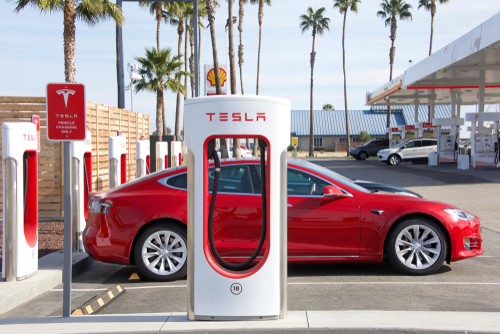
Tesla 1

Reports indicate that a wave of used EVs is beginning to hit the market as leases expire, forcing automakers to rethink how they handle pricing and inventory. What was once sold as the inevitable future is now a dud cause with minimal demand. When those vehicles return to the secondary market, they must compete on price, performance, and practicality, not ideology. That is where the cracks begin to show.

This ties directly into what I have warned about with government attempts to force economic outcomes through policy. The Biden administration pushed aggressively toward electrification under the banner of climate policy and Net Zero, but this was never purely about the environment. It was about directing capital, restructuring industry, and attempting to control long-term consumption patterns. The problem is that markets do not respond to mandates the way politicians expect.

Nearly 4,000 US car dealers warned the Biden Administration that consumer demand would not keep pace with supply. You cannot force consumers into a product they are not ready to adopt, especially in an environment where the cost of living is already rising.

Electric vehicles still account for only about 7–8% of total US vehicle sales, yet federal policy aimed to push that figure toward 50% or more by 2032 through emissions rules that effectively function as mandates. At the same time, EVs remain significantly more expensive, with average transaction prices roughly $8,000 higher than comparable gas vehicles.

Government attempted to accelerate this transition through incentives and mandates. The Inflation Reduction Act introduced tax credits of up to $7,500 per vehicle, effectively subsidizing purchases to stimulate demand. Meanwhile, federal policy called for the entire government fleet to transition to zero-emission vehicles by 2035, impacting hundreds of thousands of vehicles.

You can already see the early signs of that correction in the used EV market. As more vehicles come off lease, prices are under pressure because supply is increasing faster than demand. Automakers are now adjusting strategies, trying to manage resale values and prevent a collapse in pricing. This is the same pattern we have seen in other sectors. When supply is artificially expanded through policy, it eventually overwhelms real demand.

The used car market in general is far beneath the levels witnessed in 2022. EVs are far more difficult to offload. Industry estimates show that more than 300,000 electric vehicles will come off lease in 2026 alone, with projections rising toward 500,000 or more as we move into 2027. This is a surge of supply that the market must absorb whether demand is ready or not.

New EV sales have already dropped 28% year-over-year in early 2026, while used EV sales have risen 12%, reaching nearly 93,500 units in a single quarter. Pricing confirms that shift. Used EV prices have fallen dramatically, in some cases dropping as much as 40% over the past year, and are now within roughly $1,300 of comparable gasoline vehicles. That is a market adjusting to oversupply. When prices fall that quickly, it reflects a mismatch between production and real demand.

Cost, convenience, infrastructure, and reliability all matter more than political objectives. The government will always fail when it attempts to artificially stimulate demand.

China’s Gold Strategy Is a Long-Term Move Against the Monetary System


Posted originally on Apr 15, 2026 by Martin Armstrong |  

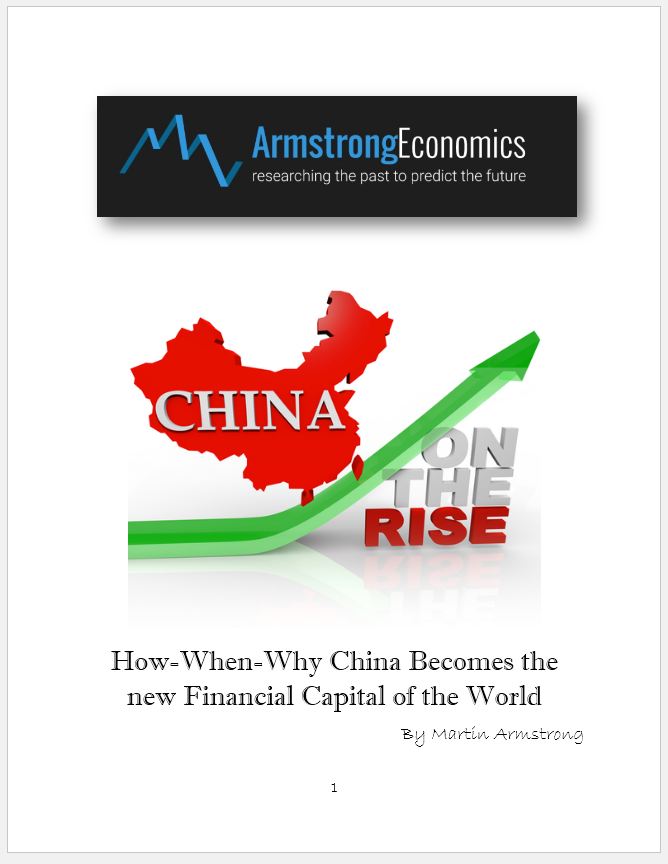
China on the Rise

China is not reacting to events, it is executing a long-term strategy that has been unfolding quietly for years. The latest data confirms that it continues to accumulate gold month after month as part of a deliberate effort to reduce reliance on the existing monetary system. The People’s Bank of China has now extended its gold buying streak to roughly 15–16 consecutive months, bringing total holdings to approximately 2,300 tonnes, which equates to about 74 million ounces and represents close to 10% of its total reserves, placing it among the largest official holders globally.

This steady accumulation is not a short-term hedge against volatility, it is a structural repositioning that reflects a recognition that the global financial system is built on confidence in sovereign debt, particularly US Treasuries, and that confidence is becoming increasingly fragile as global debt levels exceed $310 trillion. China is not making headlines with dramatic announcements, instead it is quietly converting portions of its reserves into gold, which is the only reserve asset that carries no counterparty risk and cannot be sanctioned or frozen in the same way as foreign currency holdings.

At the same time, global trends reinforce this strategy as central banks worldwide have been buying gold at one of the fastest paces in modern history, often exceeding 800 to 1,000 tonnes annually, while the dollar’s share of global reserves has steadily declined from around 66% to roughly 57% over the past decade. This shift is not driven by ideology but by practicality, because as geopolitical tensions rise and financial systems become increasingly fragmented, nations seek assets that provide independence from external control.

China’s approach is methodical and patient, and that is what makes it significant because it is not waiting for a crisis to unfold, it is preparing in advance by building a reserve base that can withstand a loss of confidence in sovereign debt markets. This aligns directly with the broader pattern we are seeing, where central banks are not abandoning the system outright but are quietly hedging against its potential breakdown.

The Great Migration of Capital Within the United States


Posted originally on Apr 14, 2026 by Martin Armstrong |  

U.S. map of states people moved to and left in 2025

What we are witnessing across the United States is not just people relocating. It is the migration of income itself, and the numbers now confirm the scale. According to the latest IRS data, California lost $11.9 billion in adjusted gross income in a single year, while New York lost $9.9 billion. At the same time, Florida gained $20.6 billion, Texas gained $5.5 billion, and states like South Carolina and North Carolina each gained roughly $4 billion. This is not theoretical. This is measurable capital movement, and it is accelerating.

The critical point is that the IRS is not tracking opinions or surveys. It is tracking tax returns. These figures represent actual households, actual income, and actual wealth moving from one jurisdiction to another. The data is based on year-to-year address changes on filed tax returns, capturing both the number of households and the total income they take with them. When billions in adjusted gross income leave a state, that is not just population loss. That is a direct hit to the tax base.

What stands out immediately is the imbalance. Florida alone gained more than $20 billion in income from new residents in just one year, making it the largest beneficiary of domestic migration. In places like Palm Beach County, incoming residents reported average incomes of $178,085 compared to $98,527 for those leaving. That tells you exactly what is happening. This is not a random movement. This is higher-income individuals relocating and concentrating wealth in specific regions.

At the same time, high-tax states are seeing the reverse. The states losing the most income—California, New York, Illinois, New Jersey, and Massachusetts—are also among those with the highest tax burdens. California’s top tax rate sits at 13.3%, while New York City residents can face combined state and local rates approaching 14.8%. When you combine those tax levels with high costs of living, the outcome becomes predictable.

What makes this even more significant is that the migration is being driven disproportionately by higher earners. IRS data consistently shows that households with $200,000 or more in income play an outsized role in net migration flows. In practical terms, that means a relatively small number of people can move a very large amount of taxable income. When they leave, they do not just reduce the population. They reduce revenue potential.

There is also a structural shift underway. States attracting capital tend to share common characteristics: lower taxes, lower housing costs, and policies that encourage development. In fact, analysts note that states gaining wealth are often those increasing housing supply, which helps keep costs down and attracts migration. This is not about ideology. It is about environment.

The longer-term consequence is a divergence in economic trajectories. States gaining income expand their tax base without raising rates. States losing income face a shrinking base and increasing pressure to maintain spending. That creates a feedback loop. As revenue declines, governments look to raise taxes further, which encourages additional outflows.

This is not a short-term trend. IRS migration data has been tracking these flows for decades, and the pattern has become increasingly pronounced in recent years. The rise of remote work has only accelerated what was already in motion by removing geographic constraints that once tied income to location.

What matters here is not just where people are moving. It is why they are moving. When individuals begin to calculate that relocating can save them tens of thousands of dollars annually in taxes alone, the decision becomes economic, not emotional. Once that calculation spreads, the migration becomes systemic.

The United States is effectively undergoing an internal redistribution of capital. Wealth is concentrating in regions that offer favorable conditions, while high-cost, high-tax states are experiencing steady erosion. This is not driven by a single policy or event. It is the cumulative result of incentives.

Governments can debate the causes, but they cannot alter the outcome. Capital moves. It always has. The only difference now is the speed and scale at which it is happening.

Martyrdom and the Psychology of War


Posted originally on Apr 14, 2026 by Martin Armstrong |  

Iran Regime Change

One of the greatest mistakes Western policymakers repeatedly make is assuming that other cultures think the same way they do. They approach international conflicts through a secular lens of power, economics, and negotiation. But when dealing with Iran, they are confronting a political system deeply intertwined with religious ideology. When an Ayatollah or senior clerical leader is killed, the event does not necessarily weaken the movement. In many cases, it strengthens it.

In Shiite Islam, the concept of martyrdom sits at the center of religious identity. The defining event for the Shia world was the death of Imam Hussein at the Battle of Karbala in 680 AD. Hussein, the grandson of the Prophet Muhammad, was killed after refusing to submit to what he regarded as illegitimate rule. His death became the foundational narrative of Shia resistance. To this day, millions commemorate Ashura every year, mourning Hussein’s death and celebrating the idea that righteous martyrdom is preferable to submission to injustice.

This is not merely historical symbolism. The religious narrative reinforces the belief that suffering and sacrifice in the face of oppression ultimately leads to divine justice. The Quran repeatedly praises those who die in the path of God. One verse states that those killed in the cause of God should not be considered dead but alive with their Lord receiving provision (Quran 3:169). Another passage declares that God has “purchased from the believers their lives and their wealth in exchange for Paradise; they fight in the cause of God, kill and are killed” (Quran 9:111). These passages shape a worldview in which death during a struggle against perceived injustice can be interpreted as spiritual victory.

From that perspective, killing a religious leader such as an Ayatollah risks transforming that individual into a symbol of sacrifice. Instead of eliminating the movement, it can reinforce the belief that the struggle itself is righteous. In a secular political system, the death of a leader may weaken an organization. In a religious revolutionary system, it can unify followers under the banner of martyrdom.

The Western mindset approaches assassination very differently. When a leader is killed in the United States or Europe, the reaction is generally political or emotional rather than religious. When President John F. Kennedy was assassinated in 1963, the event shocked the nation and certainly increased patriotism and unity for a time. Yet Americans did not interpret his death as a religious sign or martyrdom that would justify continuing a sacred struggle. It was viewed as a national tragedy, not a divine narrative unfolding.

This difference is profound. Western societies mourn their leaders, investigate the crime, and eventually move forward politically. The death does not typically transform the leader into a theological symbol driving long-term resistance or warfare. In the Shia tradition, however, martyrdom is embedded in religious identity itself. The story of Karbala is reenacted every year precisely to reinforce that belief.

This is why Western policymakers often misunderstand the psychological dynamics of such conflicts. The assassination of leaders like Qassem Soleimani did not collapse Iranian influence in the region. Instead, it triggered massive demonstrations and strengthened the narrative that Iran was engaged in a sacred struggle against external enemies.

When a Shia religious authority is killed, the event is interpreted through the lens of Karbala. The leader becomes another martyr in a long line of figures who died resisting oppression. That narrative carries enormous emotional power. It binds communities together and legitimizes continued struggle.

Politicians in Washington often believe removing a leader will end a conflict. Yet in ideological and religious movements, the opposite frequently occurs. Killing a leader can transform a political confrontation into a moral crusade, reinforcing the belief that the faithful must continue the struggle no matter the cost.

Understanding this cultural and religious framework is essential. Without it, policymakers will continue to miscalculate the consequences of their actions. History repeatedly shows that wars are not fought only with weapons. They are also fought with ideas, beliefs, and narratives that can outlive any individual leader.

France – Farmers and Energy Costs Push Toward Confrontation


Posted originally on Apr 13, 2026 by Martin Armstrong |  

France is once again approaching a familiar breaking point, and energy is at the center of it. Diesel prices across Europe have surged sharply in 2026 as geopolitical tensions in the Middle East disrupted supply routes, pushing Brent crude back above key resistance levels and filtering directly into transport and agricultural costs. In France, non-road diesel, which is critical for farming, has risen substantially over the past year, eroding already thin margins in agriculture. At the same time, electricity costs remain elevated compared to pre-2022 levels, despite government intervention, leaving producers exposed to sustained input inflation.

The agricultural sector has been particularly vocal. France has roughly 400,000 farms, and many operate on margins that cannot absorb double-digit increases in fuel and fertilizer costs. Fertilizer itself is heavily energy-dependent, linking natural gas prices directly to food production costs. When energy rises, food prices follow, and this has already been reflected in EU food inflation, which peaked above 15% in recent cycles and remains structurally elevated. The knock-on effect is that farmers face higher input costs while consumers resist higher prices, compressing profitability from both sides.

Protests are building along these fault lines. Farmer unions and independent groups have threatened renewed blockades of highways, logistics hubs, and wholesale food markets if the government fails to provide further relief. France has a long-standing pattern of escalation where tractors are used to shut down key transport arteries, and authorities are well aware of how quickly localized demonstrations can become national disruptions. Previous rounds of protests have already forced Paris to roll out billions in subsidies and tax concessions, but those measures have not resolved the structural issue, which is energy dependence combined with policy constraints.

The French government continues to attempt targeted relief, including fuel rebates and caps on electricity prices, but these interventions are temporary by design. They do not change the underlying exposure to global energy markets. Once those supports are reduced or removed, the pressure returns immediately. That is why these protests tend to recur in waves rather than dissipate entirely.

Energy costs are no longer viewed as an external shock but as a failure of domestic policy to shield the population from volatility. When that perception takes hold, protests move beyond sector-specific demands and begin to question the direction of national leadership itself.

The Quiet Rise of Capital Controls in America


Posted originally on Apr 14, 2026 by Martin Armstrong 

Capital Controls 2

What most people fail to understand is that governments do not lose control overnight. They lose it gradually, and then they respond in stages. First comes rising debt. Then comes higher taxation. When that fails to produce the expected revenue, the next step is not reform. It is restriction.

We are now entering that phase where governments begin tightening their grip on capital. It starts subtly. Expanded IRS reporting requirements. Increased scrutiny on bank transactions. Lower thresholds for what is considered “suspicious activity.” These are not random policy decisions. They are part of a broader shift toward monitoring and ultimately controlling the movement of money.

The justification is always the same. Prevent tax evasion. Combat financial crime. Ensure fairness. But behind that narrative is a much deeper problem. Governments are facing structural deficits that they cannot resolve through growth alone. When spending exceeds revenue and debt continues to rise, they must either cut spending, raise taxes, or prevent capital from escaping. Historically, they choose the latter two.

We are already seeing early signs of this shift. Discussions around taxing unrealized gains, proposals for wealth taxes, and increased enforcement efforts all point in the same direction. These policies assume that capital is static, but once people begin to move their money or themselves, the response changes. Governments begin looking for ways to stop that movement.

Digital infrastructure is what makes this possible today in a way it never was before. Every transaction is tracked. Every account is monitored. The banking system itself becomes the enforcement mechanism. You no longer need physical barriers when financial barriers can be imposed instantly.

The danger is not a single sweeping policy. It is the accumulation of smaller measures that gradually remove financial freedom. By the time people realize what has changed, the system is already in place.Posted Apr 14, 2026 by Martin Armstrong