ISIS Burns a 1,800 Year-old Judeo-Christian Church in Mosul Iraq Dating Back to Earliest Christians


This is what a lot of the Muslims do — so its no surprise!

Obama desperate to save Hamas from defeat!


Kerry and Ban in truce bid to save Hamas from defeat. Israel holds reply. Cairo won’t amend truce proposal

Re-Post from DEBKAfile Special Report July 21, 2014, 11:59 PM (IDT)

US and UN Secretaries get together on Gaza truce

US and UN Secretaries get together on Gaza truce

Three rival groups are in a tug-o’-war over a ceasefire initiative for the Gaza conflict: The US and UN are pulling one way; Israel, Egypt and Saudi Arabia, the other; and Qatar, Turkey, Hamas and the Palestinian Authority, are trying to manipulate the others.

Monday night, July 21, US Secretary of State John Kerry and UN Secretary General Ban Ki-moon arrived in Cairo to press their case with Egyptian President Abdel-Fatteh El-Sisi: Kerry’s directive was outlined by President Barack Obama a few hours earlier, “to focus on bringing about a ceasefire than ends the fighting and can stop the death of innocent civilians.”
Ban came from Doha, Qatar, as part of a whistle stop tour of Kuwait City, Jerusalem, Cairo, Ramallah and Amman. Upon landing in Cairo, he told reporters: “The violence must stop, it must stop now. I urge all parties to stop violence unconditionally and return to dialogue.”

Reported to be pushing for a long-term ceasefire, the UN Secretary went on to comment that it was impossible to go back to the situation that caused the conflict. He ruled out the “status quo ante” for the Gaza Strip as untenable.

This was an indirect vote of support for Hamas’s terms for a ceasefire, such as ending the blockade on the Gaza Strip and reopening all the crossings.

The UN Secretary had nary a word to say about the Palestinian Islamists’ long record of terrorism, culminating last month in the kidnap and murder of three Israeli teenagers, the shooting of 1,850 rockets at the Israeli population in less than a month and the network of secret tunnels dug especially to burrow under the Israeli border for attacks and kidnappings.
After hearing the two comments, Hamas’ political leader Meshaal Hamas called off the statement he had planned to issue Monday night from his base in Qatar. He saw he had no need to push any further to win the support of the UN and US officials. They were already on his side and he could count on them both to twist Israel’s arm for an early ceasefire to rescue Hamas from defeat before its terrorist machine was completely ravaged by Israeli troops.

Hamas officials also rejected suggestions floated for a long-term humanitarian ceasefire.
Following reports that Cairo had agreed to give in to Hamas demands, Egypt’s Foreign Minister Sameh Shokri said firmly that Cairo is not willing to amend its former truce initiative.

The Egyptian president Abdel-Fattah El-Sisi had won Saudi endorsement for this proposal in two conversations they held in the last few days. It is based essentially on a ceasefire which, if it holds, would be followed by separate Egyptian talks with Israel and Hamas on future arrangements.
This proposal was accepted by Israel and snubbed by Hamas, which continued to shoot rockets instead. Israel reacted four days ago, by sending ground troops into the Gaza Strip to finally dismantle Hamas’ long-running terror machine.

That Hamas stands by its negative response to the Egyptian ceasefire initiative was underscored by Gaza Prime Minster Ismail Haniya in a pre-recorded statement Monday from his hideout: “Hamas will fight with blood before giving up its terms,” he said. “Their [Israel’s] air strikes did not break us, and neither will their ground attacks.”

Hama leaders have grasped that the truce initiatives promoted by Kerry and Ban will essentially allow them to carry on as before with certain benefits thrown in. As of writing this report, the Netanyahu government has not reacted to the web of ceasefire diplomacy being woven. His silence can be interpreted in three ways:
1. Prime Minister Binyamin Netanyahu, who has been running Israel’s campaign against Hamas in close rapport with Saudi King Abdullah and President El-Sisi, is saving his biggest gun – flat rejection of their truce proposals – for use in direct encounters with Kerry and Ban when they arrive in Jerusalem Tuesday, July 22.

2. The IDF needs more time to complete its missions, which are to destroy Hamas’ network of terror tunnels and disarm, or at least degrade, its rocket and military infrastructure.
3.  Netanyahu is keeping his cards close to his chest for a reckoning with Palestinian Authority Chairman Mahmoud Abbas, touted as go-between in the ceasefire bid, over his threat Monday to bring charges of war crimes against Israel before the international court in The Hague and UN institutions, as well as accusations of apartheid.
The prime minister may well stipulate that Kerry and Ban rein in the Palestinian leader before Israel gives its attention to any requests for joining a ceasefire.

Israel plans to take over Gaza, good for them!


Five IDF task forces begin driving into Gaza City. Israel draws up over-plan for control of the Gaza Strip

Re-post from DEBKAfile Exclusive Report July 21, 2014, 10:09 AM (IDT)

The IDF’s Shejaiya operation in the Gaza Strip continues apace, carried forward by five task forces now heading for the center of Gaza City amid casualties on both sides. Sunday, July 20, Israel’s crack Golani Brigades lost 18 fighters, without slowing down, compared with 170 Palestinian fatalities.

debkafile’s military sources report that each task force, the size of half a division, is an integrated amalgam of air, armored, artillery and engineering forces, capable of operating almost autonomously in field combat. The buildup of the last 24 hours has expanded Israel’s fighting strength in the Gaza Strip to a total of 75,000 men, the largest ever fielded in this territory. Because of its scale, Israeli leaders are referring to Defensive Edge as a war rather than an operation.

The battle for Shejaiya waged Sunday burst into public prominence because of the heavy losses suffered by the Golani Brigades, but it is not the largest engagement underway at present. The other ongoing IDF battles, their progress, the units involved and their locations, are kept secret. We can only point to their general locations as being around Beit Hanoun in the north; Zeitun, south of Gaza City and the Shati refugee camp to the north.

More arenas are scheduled to be added to the list of battle zones Monday.

Rather than causing despondency, the high IDF casualty toll Sunday – the highest in a single engagement since the 2006 Lebanon War – has invigorated the fighting forces in the field, making them more determined than ever to get the better of Hamas with all possible speed.

Whereas their orders on Sunday were to advance warily and slowly, meanwhile testing the strength of Hamas resistance and observing their tactics, the tempo went into high gear at dawn Monday, when the troops were told to speed their advance from the outer fringes of Gaza City into its center.

Their performance in Shejaiya and other engagements Sunday deeply impressed Israel’s war leaders and made them confident enough to step up the rate of advance.

This upbeat mood was evident in the comments made Sunday night by Prime Minister Binyamin Netanyahu, Defense Minister Moshe Ya’alon and, from the field, by Chief of Staff Lt. Gen. Benny Gantz. While condoling deeply with the bereaved families of the 18 soldiers who died in combat, they were full of praise for the troops’ performance “in defense of our home” which outdid all expectations.

The following decisions were reached in consequence:

1. Gen. Gantz would stay in the field and lead the forces from there, rather than from staff headquarters in Tel Aviv.

2. The prime minister and defense minister would manage the war, without constant recourse to security cabinet sessions to obtain its approval of every stage of the plan of operation, the final goal of which debkafile has learned, is Israel’s military takeover of the Gaza Strip.

3. As the military operation unfolded, the three war leaders were convinced more than ever that demolishing Hamas’ terror tunnel complex was not optional, any more than wiping out the rocket menace hanging latterly over five million Israelis and, for nearly a decade over the million people living directly in the shadow of the Gaza border. Publicity guidelines were to be built around this conclusion.
International statesmen are flitting busily around regional capitals, including Jerusalem, in search of an opening to broker a ceasefire in Gaza hostilities. UN Secretary General Ban Ki-moon has been holding meetings and US Secretary John Kerry will try and reach the Middle East in the coming days, according to a White House directive – unless he again cancels at the last minute.

According to debkafile’s sources, the requisite political and military conditions for a ceasefire are not yet in place because of a number of circumstances, not least of which is Hamas’ refusal to contemplate a halt.

Israel, for its part, is fighting for the first time in its history with solid Arab backing from the Egyptian-Saudi-United Arab Emirates bloc. So determined are its members to obliterate the Muslim Brotherhood that they have virtually blacklisted Qatar for supporting the Brothers and for patronizing the Palestinian Hamas, regarded as the MB’s paramilitary arm.
This rift has put a spoke in the diplomatic effort to set in motion effective mediation for a Gaza ceasefire predicated on co-opting Qatar.

A bid to make Palestinian Authority chairman Mahmoud Abbas the bridge between the Egyptian-Saudi-UAE grouping and Qatar has likewise foundered. And there isn’t much Secretary Kerry can do if and when he comes over to try his hand.

US President Barack Obama’s suggestion, when he called Netanyahu Sunday, to build a new Gaza ceasefire around the 2012 formula concocted by the US, Egypt, Qatar and Turkey – and accepted by Israel and Hamas – for ending Operation Pillar of Defense, shows him to be cut off from the fundamentally altered diplomatic and military realities of the current Gaza conflict.

He declines to recognize the emergence of a powerful new Arab bloc. It will be necessary to twist the arms of each of its members, Egypt, Saudi Arabia and UAE, to gain their consent for a bid to cut the Israeli offensive short to rescue Hamas from defeat. And even then, they will stall.
And although anti-Israel demonstrations are being staged in some parts of the world, the most violent in Paris, hardly any world governments have openly condemned the Israeli operation – as yet.

The IDF Strategy to take down Hamas


Israel faces perilous, protracted war as IDF expands its operation into Hamas’ urban strongholds

Re-Post from DEBKA file Exclusive Analysis July 20, 2014, 9:59 AM (IDT)

The IDF tried to mitigate the bad news from Hamas warfront by releasing it in sections over Saturday and Sunday, July 19-20. Four soldiers were killed and a score were wounded. Maj. Amotz Greenberg, 45, from Hod Hashorn and Sgt. Adar Bresani, 20, from Nahariya, were shot dead Saturday when their jeep was attacked by Hamas infiltrators bursting out of a tunnel.

On the Gaza battlefield, Paratrooper Staff Sgt. Bana Roval, 20, from Holon, was shot dead by a terrorist from another tunnel, and 2nd Lt, Bar Rahav, 21, from Ramat Yishai, was killed by a missile defense system in a nearby tank.
Hamas is not only bringing its deadly tunnels into play, but also planting small commando units heavily armed with anti-tank rockets across the paths of advancing Israeli armored forces.
Saturday, those commandos fired 10 anti-tank rockets. Without their Windbreaker armor, many tanks would have been destroyed and the casualty toll much higher.

However, most of all, Hamas is fighting to save its tunnel system from systematic destruction by IDF demolition teams. This system was designed to be the Palestinian Islamists’ highest strategic asset, comparable in importance to the IDF’s chain of fortifications along the Syrian border.
Around 16,000 men, around 15 percent of Hamas’ fighting strength, were assigned to the tunnel project in the last five years and substantial funds. The IDF will not be permitted to demolish this flagship project without a savage fight.

The most important conclusion for Israel’s war planners, from the first days of the ground phase of Israel’s Operation Defensive Edge, is that Hamas is standing firm and not cracking, even under the relentless pounding of their military infrastructure by Israeli artillery and air might, and appears determined to fight on.

Its commanders believe they can keep going for another 4 to 6 weeks, while also maintaining a steady hail of rockets against the Israeli population.

This estimate has spurred a major buildup of Israeli military strength for the Gaza operation. Another 50,000 reservists were called up Saturday night and a large number of infantry brigades started moving into the Gaza Strip overnight and will continue to arrive Sunday. The extra forces have made it possible to embark on the second, urban stage of the IDF operation, the breaching of the densely-populated towns.

A different type of combat lies ahead from the project for destroying tunnels. It is tougher and more perilous. But there is no other way to reach Hamas’ command centers and its longest-range rockets.

With this mission still unaccomplished, talk of a ceasefire sounds as though it comes from another planet. Hamas feels strong and confident enough to spurn the Egyptian-Israeli ceasefire proposal, which is firmly backed by Saudi Arabia and the United Arab Emirates. Every attempt to sway its political leader Khaled Meshaal, when he was buttonholed in Kuwait, ran into a blank wall. He summarily rejected invitations from Egypt and the Arab League to travel to Cairo and discuss the cessation of hostilities.

The various international mediation efforts have therefore nowhere to go.

As far as Hamas is concerned, no incentive has been offered tempting enough to persuade its leaders to give up their predestined war on Israel.
US Secretary of State John Kerry changed his mind about visiting the region for the second time this month, when the Obama administration decided to stay out of it and let Egypt handle the crisis. UN Secretary General Ban Ki-moon, who scheduled a visit for Saturday, postponed it indefinitely.

Israel has accordingly won a rare opportunity to deal with Hamas without being stopped short and the enemy saved by international intervention. But although it has wide popular support, this opportunity confronts Israelis with one of the cruelest, costly and drawn-out conflicts in their embattled history.

Convert, pay or die: Iraqi Christians flee Mosul after Islamic State ultimatum


Obama if you are a “real” Christian, and not a Muslim as many claim, then you will do something about this — not go on fund raising jaunts and then take a long vacation! My God man there are thousands of civilians being tormented abused and killed — do something!

Obama Is Trying To Hide It, But This Is What Could Truly Bring America To Her Knees…


I agree 100% with the comments here this issue if not checked VERY soon will lead to WW III.

ISIS surge: Over 270 killed in Syria, former US base stormed in Iraq’s Tikrit


More good news for Obama and Kerry to deal with when Obama gets back from vacation next month!

Obama, Kerry and Hillary can’t seem to negotiate anything can they!


Iran nuclear talks end with deadline extended

Re Post from Yahoo by Simon Sturdee with Jo Biddle in Washington

Catherine Ashton, EU foreign policy chief, and Iranian Foreign Minister Mohammad Javad Zarif give a press statement in Vienna, on July 18, 2014
.

Vienna (AFP) – Marathon talks between Iran and world powers in Vienna ended Saturday after negotiators gave themselves four more months to try and bridge major gaps and strike a historic nuclear deal.

New rounds of talks were expected in the coming weeks, with the date and place yet to be decided, diplomats said.

“While we have made tangible progress on some of the issues and have worked together on a text (for a deal)… there are still significant gaps on some core issues,” lead negotiator and EU foreign policy chief Catherine Ashton told journalists in the early hours of Saturday.

The talks will now continue until November 24, she added.

Under the terms of the extension, the United States said it would unblock some $2.8 billion (2.1 billion euros) in frozen funds, in return for Iran converting a quarter of its 20-percent enriched uranium stocks — which can be used to make a bomb — into fuel.

American officials spoke of resuming talks, perhaps at expert level, in August, with the UN general assembly in September also expected to provide a stage for the next phase of negotiations.

In a statement repeated in Farsi by Iranian Foreign Minister Mohammad Javad Zarif, Ashton said the parties would “reconvene in the coming weeks… with the clear determination to reach agreement… at the earliest possible moment”.

Last November, Iran and the five permanent members of the UN Security Council plus Germany agreed an interim deal under which the Islamic republic froze certain nuclear activities for six months in return for some sanctions relief.

The deadline for a lasting deal was July 20, with the sides having the option of extending.

US Secretary of State John Kerry, who also tried to broker a breakthrough in Vienna earlier this week, said Friday that the extension was “warranted by the progress we’ve made.”

“To turn our back prematurely on diplomatic efforts when significant progress has been made would deny ourselves the ability to achieve our objectives peacefully,” Kerry said.

“A lot of work has been done and we’ve agreed… that we would like to try and complete this process and to take this extra time in order to do that,” Ashton also said in a statement Saturday.

“We are determined to make sure that the agreement is a very good one.”

– Extending breakout –

The final deal would ease fears that despite its denials Iran is seeking to develop nuclear weapons after a decade of atomic expansion.

But it is highly ambitious and fiendishly complex.

The six powers want Iran to dramatically reduce its nuclear programme for a lengthy period of time and agree to more intrusive UN inspections.

This would expand the time needed for Tehran to develop a nuclear weapon, while giving the world ample warning of any such “breakout” push.

The two sides are believed to have narrowed their positions in recent weeks on a few issues such as the Arak reactor, which could give Iran weapons-grade plutonium, and enhanced inspections.

But they remain far apart on the key issue of Iran’s capacities to enrich uranium, a process which can produce fuel for reactors but also the core of a nuclear bomb.

– Unlocking of funds –

The terms of the extension call for Iran to turn medium-enriched uranium into reactor fuel, which will make it “very difficult for Iran to use this material for a weapon in a breakout scenario,” Kerry said.

Although Washington will unblock some of Iran’s funds, “the vast majority of its frozen oil revenues will remain inaccessible,” he added.

Over the past six months, Iranian oil sales have brought in a further $25 billion, on top of the about $100 billion already frozen in accounts around the world, according to US officials.

But both the US and Iran face tough domestic pressure.

US lawmakers, widely supportive of Iran’s arch enemy Israel, have threatened to ramp up sanctions without a sufficiently rigorous agreement.

Iran’s negotiators in turn face pressure from hardliners, who view the United States as the ultimate enemy and oppose any agreement seen as a concession.

French Foreign Minister Laurent Fabius, on a visit to Cairo, said Saturday he hoped that with the new deadline, Iran will “at last make the necessary choices that we expect to reach a complete, credible and lasting agreement.”

His German counterpart Frank-Walter Steinmeier called for Iran to “show it is ready to dispel all doubts” about its nuclear intentions.

The next few months “could be the last and best chance for a long time to end this nuclear argument peacefully,” he warned.

The Iranian exiled opposition in Paris meanwhile slammed the extension as “providing time to the mullahs for further deception.”

Retired 4-star admiral: Benghazi was an Obama false flag that went wrong


Just a reminder of the situation in Benghazi, least we forget for it does make a difference!

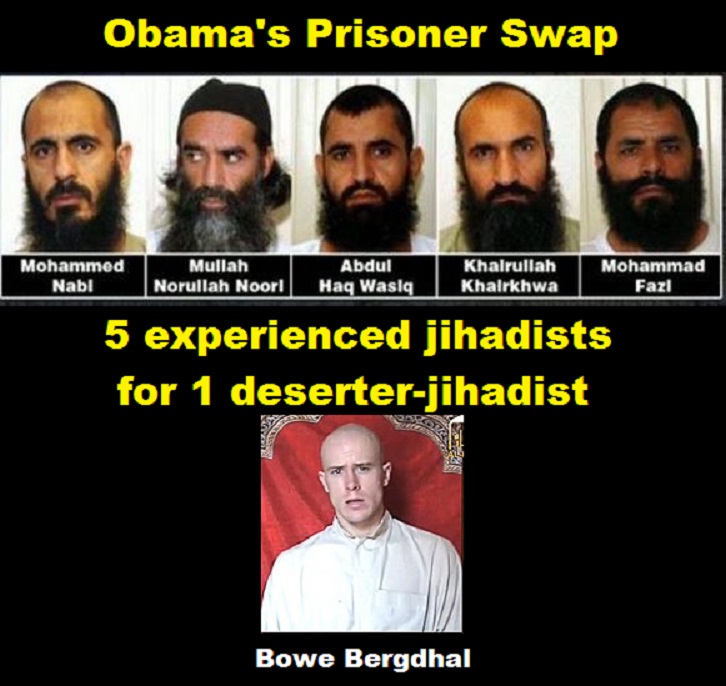
Obama ignored advice of military & CIA against Bergdahl prisoner swap


Almost anyone that served knows how aggrieves this trade was! It was an insult to all of us that served honorably!

StMA's avatarConsortium of Defense Analysts

The Obama administration’s release of five senior Taliban terrorists from Guantanoma Bay in exchange for the Taliban’s freeing of U.S. Army deserter Sgt. Bowe Bergdahl not only is in violation of a federal law (Sec. 1035 of the 2014 National Defense Authorization Act), the prisoner swap also went against explicit advice of senior U.S. military and intelligence leaders.

Bergdahl prisoner swap

FOX News reports, June 6, 2014:

Senior military officials had advised President Obama not to make the Taliban-for-Bergdahl trade, a senior Defense official told Fox News, likening it to “handing over five four-star generals of the Taliban.”

The claim adds to the picture that is emerging about the tense internal debate over whether to proceed with freeing five hardened Taliban leaders from Guantanamo in exchange for Sgt. Bowe Bergdahl’s release.

Sources told Fox News earlier this week that the Obama administration largely bypassed the intelligence community to green-light the…

View original post 460 more words