Charlie Kirk’s Must-Read Book List 📚


Published originally on Rumble By Turing Point USA on November 23, 2025   

Her Answer Is Painful to Watch… 🤦‍♂️👀


Published originally on Rumble By Turing Point USA on November 23, 2025   

Charlie Kirk Dismantles Modern Feminist Arguments 🔥 | Debate Compilation


Published originally on Rumble By Turing Point USA on November 23, 2025   

Trump’s 28-Point Peace Plan


Posted originally on Nov 24, 2025 by Martin Armstrong |  

Armstrong on Peace

Peace is on the table—my detailed outline for ending the Russia-Ukraine-NATO war has been read and received by Moscow and Washington. Peace only emerges when both sides have something to gain and nothing to lose by walking away from war. Washington is listening; the Trump Administration’s 28-point peace plan for Russia successfully changed the narrative to acknowledge that Russia is not the aggressor.

The main stipulation in the peace plan I crafted involves honoring the Minsk Agreement. Washington seems to agree to this stipulation, declaring that Crimea, Luhansk, and Donetsk must be recognized as part of Russia to restore peace. The war began over territory and has continued due to Zelensky’s unwillingness to concede.

Furthermore, Washington has demanded that Ukraine hold elections. Zelensky is prolonging the war to remain in power. He declared himself the indefinite ruler without a single vote cast under martial law. The people of Ukraine want his head. Citizens must be permitted to select the government they want, as anything else is temporary. The West may not interfere in the next election.

I praise the Trump Administration for acknowledging that trade is the greatest way to unite nations. The 28-point plan would lift Russian sanctions and welcome Moscow back into the Western market. Trump is willing to treat Russia as a world power and trading partner rather than an enemy. No one should have any qualms with modern Russia. Russia has not been the aggressor in this situation. A clear-cut agreement was made in 2014, but the EU admittedly had ulterior motives.

Zelensky has until November 27 to accept this proposal. The neocons are in an absolute uproar at the possibility of peace. Kaja Kallas immediately took to the airwaves to announce her veto of the proposal, but neither she nor any of the other neocons has the final say. Millions of lives are at stake. Let’s watch and see how Ukraine and the EU respond this week.

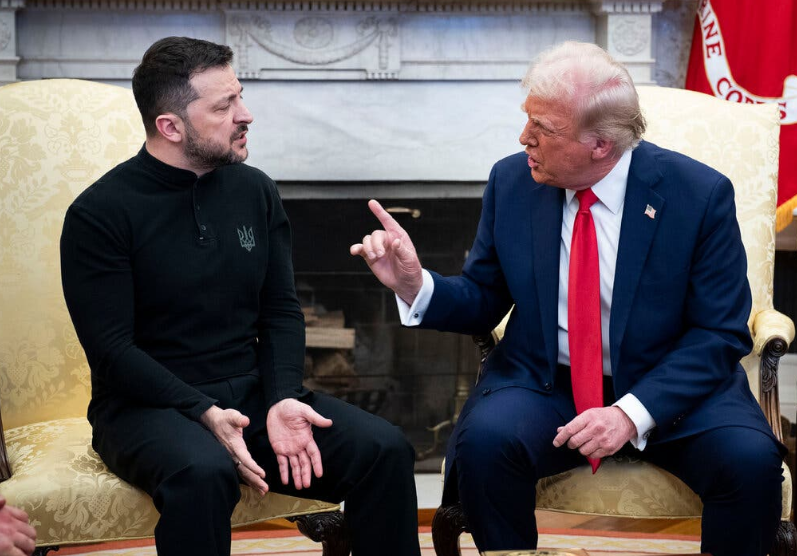
Zelensky Trump scolding him

Below is Trump’s 28-point peace plan:

1. Ukraine’s sovereignty will be confirmed.

2. A comprehensive non-aggression agreement will be concluded between Russia, Ukraine and Europe. All ambiguities of the last 30 years will be considered settled.

3. It is expected that Russia will not invade neighboring countries and NATO will not expand further.

4. A dialogue will be held between Russia and NATO, mediated by the United States, to resolve all security issues and create conditions for de-escalation in order to ensure global security and increase opportunities for cooperation and future economic development.

5. Ukraine will receive reliable security guarantees.

6. The size of the Ukrainian Armed Forces will be limited to 600,000 personnel.

Note: Ukraine’s army currently has 800,000-850,000 personnel, and had around 250,000 beforethe war, according to a Ukrainian official.

7. Ukraine agrees to enshrine in its constitution that it will not join NATO, and NATO agrees to include in its statutes a provision that Ukraine will not be admitted in the future.

8. NATO agrees not to station troops in Ukraine.

Note: NATO countries including France and the U.K. have been working on separate proposals that would include small numbers of European troops on Ukrainian soil after the war. This plan appears to disregard that possibility.

9. European fighter jets will be stationed in Poland.

10. The U.S. guarantee:

The U.S. will receive compensation for the guarantee;

If Ukraine invades Russia, it will lose the guarantee;

If Russia invades Ukraine, in addition to a decisive coordinated military response, all global sanctions will be reinstated, recognition of the new territory and all other benefits of this deal will be revoked;

If Ukraine launches a missile at Moscow or St. Petersburg without cause, the security guarantee will be deemed invalid.

11. Ukraine is eligible for EU membership and will receive short-term preferential access to the European market while this issue is being considered.

12. A powerful global package of measures to rebuild Ukraine, including but not limited to:

The creation of a Ukraine Development Fund to invest in fast-growing industries, including technology, data centers, and artificial intelligence.

The United States will cooperate with Ukraine to jointly rebuild, develop, modernize, and operate Ukraine’s gas infrastructure, including pipelines and storage facilities.

Joint efforts to rehabilitate war-affected areas for the restoration, reconstruction and modernization of cities and residential areas.

Infrastructure development.

Extraction of minerals and natural resources.

The World Bank will develop a special financing package to accelerate these efforts.

13. Russia will be reintegrated into the global economy:

 The lifting of sanctions will be discussed and agreed upon in stages and on a case-by-case basis.

The United States will enter into a long-term economic cooperation agreement for mutual development in the areas of energy, natural resources, infrastructure, artificial intelligence, data centers, rare earth metal extraction projects in the Arctic, and other mutually beneficial corporate opportunities.

Russia will be invited to rejoin the G8.

14. Frozen funds will be used as follows:

$100 billion in frozen Russian assets will be invested in US-led efforts to rebuild and invest in Ukraine;

The US will receive 50% of the profits from this venture. Europe will add $100 billion to increase the amount of investment available for Ukraine’s reconstruction. Frozen European funds will be unfrozen. The remainder of the frozen Russian funds will be invested in a separate US-Russian investment vehicle that will implement joint projects in specific areas. This fund will be aimed at strengthening relations and increasing common interests to create a strong incentive not to return to conflict.

15. A joint American-Russian working group on security issues will be established to promote and ensure compliance with all provisions of this agreement.

16. Russia will enshrine in law its policy of non-aggression towards Europe and Ukraine.

17. The United States and Russia will agree to extend the validity of treaties on the non-proliferation and control of nuclear weapons, including the START I Treaty.

Note: New START, the last major U.S.-Russia arms control treaty, is due to expire in February.

18. Ukraine agrees to be a non-nuclear state in accordance with the Treaty on the Non-Proliferation of Nuclear Weapons.

19. The Zaporizhzhia Nuclear Power Plant will be launched under the supervision of the IAEA, and the electricity produced will be distributed equally between Russia and Ukraine — 50:50.

20. Both countries undertake to implement educational programs in schools and society aimed at promoting understanding and tolerance of different cultures and eliminating racism and prejudice:

Ukraine will adopt EU rules on religious tolerance and the protection of linguistic minorities.

Both countries will agree to abolish all discriminatory measures and guarantee the rights of Ukrainian and Russian media and education. (Note: Similar ideas were incorporated into Trump’s 2020 Israel-Palestine peace plan).

All Nazi ideology and activities must be rejected and prohibited.

21. Territories:

Crimea, Luhansk and Donetsk will be recognized as de facto Russian, including by the United States.

Kherson and Zaporizhzhia will be frozen along the line of contact, which will mean de facto recognition along the line of contact.

Russia will relinquish other agreed territories it controls outside the five regions.

Ukrainian forces will withdraw from the part of Donetsk Oblast that they currently control, and this withdrawal zone will be considered a neutral demilitarized buffer zone, internationally recognized as territory belonging to the Russian Federation. Russian forces will not enter this demilitarized zone.

22. After agreeing on future territorial arrangements, both the Russian Federation and Ukraine undertake not to change these arrangements by force. Any security guarantees will not apply in the event of a breach of this commitment.

23. Russia will not prevent Ukraine from using the Dnieper River for commercial activities, and agreements will be reached on the free transport of grain across the Black Sea.

24. A humanitarian committee will be established to resolve outstanding issues:

All remaining prisoners and bodies will be exchanged on an ‘all for all’ basis.

All civilian detainees and hostages will be returned, including children.

A family reunification program will be implemented.

Measures will be taken to alleviate the suffering of the victims of the conflict.

25. Ukraine will hold elections in 100 days.

26. All parties involved in this conflict will receive full amnesty for their actions during the war and agree not to make any claims or consider any complaints in the future.

27. This agreement will be legally binding. Its implementation will be monitored and guaranteed by the Peace Council, headed by President Donald J. Trump. Sanctions will be imposed for violations.

Note: This is the same general structure Trump proposed to govern the Gaza peace agreement.

28. Once all parties agree to this memorandum, the ceasefire will take effect immediately after both sides retreat to agreed points to begin implementation of the agreement.

Clintons Subpoenaed Over Epstein Ties


Posted originally on Nov 24, 2025 by Martin Armstrong |  

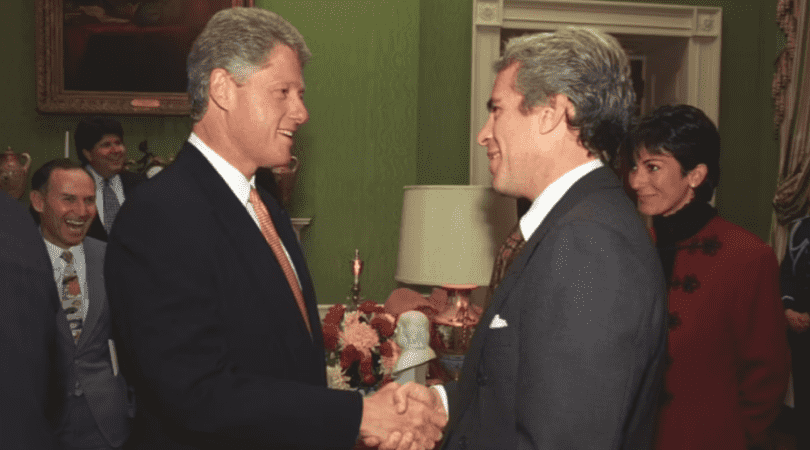
ClintonEpsteinMaxwell

The House Oversight Committee ordered Bill and Hillary Clinton to appear in court for depositions in December regarding their relationship with Jeffrey Epstein and Ghislaine Maxwell. The Clintons have always represented the peak of the political establishment, and with that comes a long trail of scandals. Will the Clintons finally have their day in court?

“Given the admission that your clients possess some relevant information, your position amounts to a demand that the Committee forgo in-person testimony, potentially relevant to its legislative oversight,” the powerful GOP chairman said.

David Kendall, acting attorney for the Clintons, claims the Clintons fully condemn Epstein’s actions and understand the public’s need for transparency. “Former President Clinton and former Secretary Clinton welcome legitimate oversight in this matter that is grounded in fact,” Kendall added, followed by downplaying his clients’ relationship to Maxwell and Epstein.

The committee insisted that the Clintons appear in court. “Additionally, your suggestion that your clients’ testimony would not be relevant to the stated purposes of the Committee’s investigation because the events in question took place outside of the Clintons’ respective official duties misses the Committee’s point,” Comer added. “It is precisely the fact that President Clinton and Secretary Clinton each maintained relationships with Mr. Epstein and Ms. Maxwell in their personal capacities as private citizens that is of interest to the Committee.”

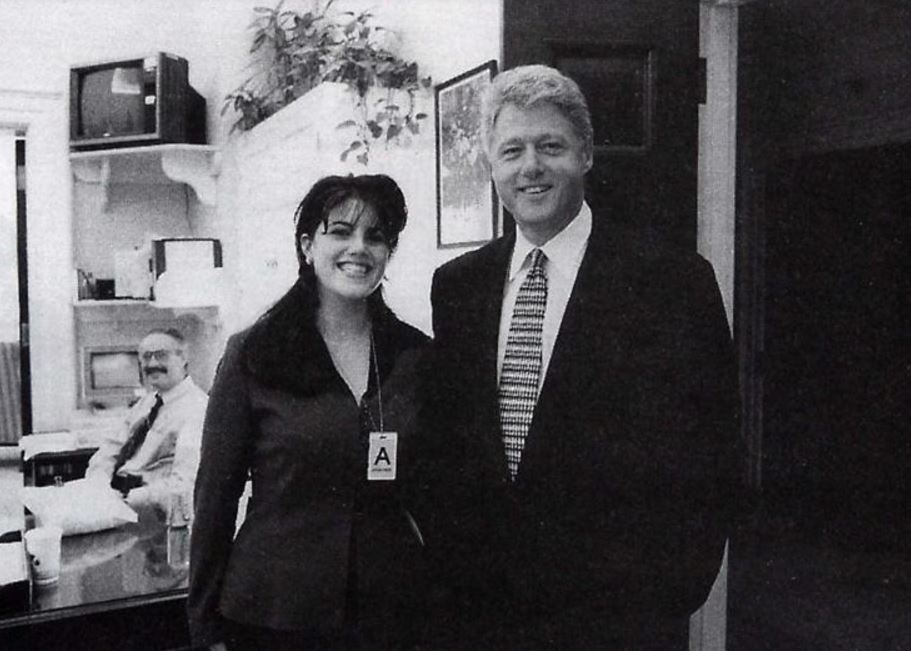
Clinton Bill Monica

Interestingly, the court of public opinion has always been far more interested in personal matters than actual crimes against humanity. Clinton affiliates have a high suicide rate. Bill’s administration was littered with issues from his mishandling of Al-Qaeda to Whitewater and the banking scandal. Haiti, Russia, accepting bribes from Chinese nationals—the list of corruption on a global scale was endless during Bill’s leadership and continued as Hillary took over. Yet, the blood on their hands is less remembered than a stain on a dress. The court of public opinion was most concerned about his affair with Monica Lewinsky.

ClintonEpsteinIsland

The sexual debauchery that took place on Epstein’s island caused a public uproar; the people will not let the government dismiss this case. As for their connection to Epstein, the Clintons used his intricate ties to create RussiaGate and infiltrate not only public perception of Trump but also foreign governments’ perception of Trump. The public is not interested in these matters per se, but they do want to know why the Clintons were personally associated with Epstein and Maxwell. That picture of Bill Clinton hanging on Epstein Island has been viewed worldwide.

Al Capone was arrested for tax evasion. Former Nazi war criminals were arrested in the US for evading immigration officials. And now, the Clintons are being called to answer for lesser crimes that could bring their extensive legacy of destruction to light. The significance of the Clintons being called to testify is not about whether they did or did not engage in wrongdoing at Epstein’s properties. The real significance is that the system is no longer capable of protecting its former kings and queens.

The Legacy of a Cycle


Posted originally on Nov 24, 2025 by Martin Armstrong |  

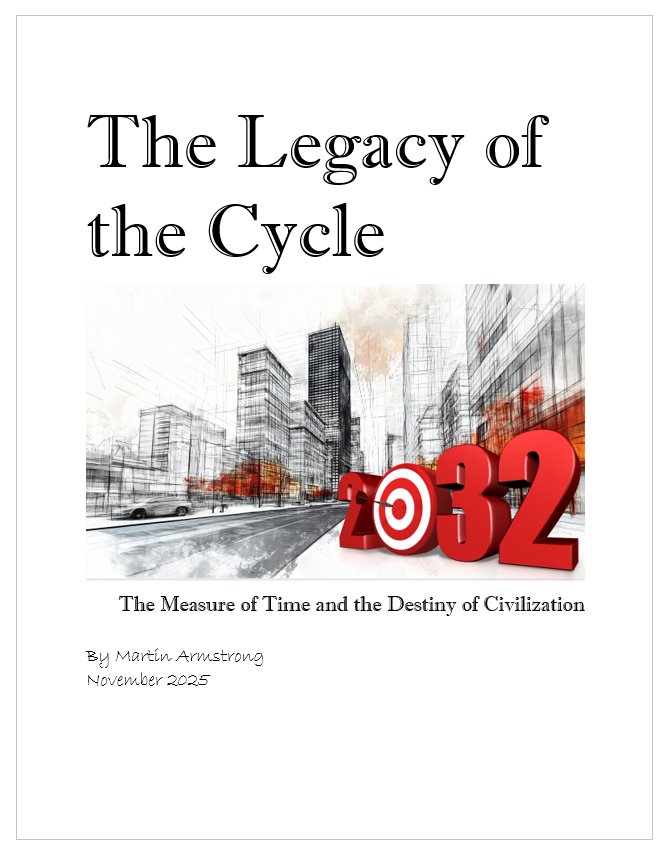
Legacy of the Cycle

Civilization does not move in straight lines; it unfolds in waves. Every rise, every collapse, every revolution is simply the manifestation of the eternal cycle that governs human behavior. People want to believe they are in control, but the truth is that the cycle controls us.

In The Legacy of the Cycle, I examine how the Economic Confidence Model reflects the arc of human history — why empires fall, why republics decay, why societies swing between liberty and authoritarianism. These shifts are not ideological — they are mathematical. The same forces that toppled Rome, Byzantium, the British Empire, and the Soviet Union are in motion again today.

The real question is not whether society is changing, but whether we will understand this moment or repeat the same mistakes. Time is the ultimate judge. The cycle is eternal. Our legacy is determined by whether we respect it or fight against it.

This report is complementary to all WEC ticket holders and attendees. The conference has concluded, but you may still purchase a virtual ticket to receive every special report along with a video of the event.

Sunday Talks: Secretary Scott Bessent -vs- Kirsten Welker


Posted originally on CTH on November 23, 2025 | Sundance 

Treasury Secretary Scott Bessent appears on Meet the Press to debate Kirsten Welker’s formatted corporate media talking points.  The source of most American division is found in the behavior of the media.

Video and Transcript Below:

[TRANSCRIPT] – KRISTEN WELKER: And joining me now is Treasury Secretary Scott Bessent. Secretary Bessent, welcome back to Meet the Press.

Good to see you this morning, Senator.

SEN. MARK WARNER (D-VA), INTELLIGENCE COMMITTEE VICE CHAIR: Good morning, Martha.

RADDATZ: What is your reaction to this peace proposal that is on the table?

WARNER: My reaction is it’s awful. It would make Neville Chamberlain’s giving in to Hitler outside of World War II looks strong in comparison. The fact that this was almost a series of Russian talking points, would require Ukraine to give the — totality of the Donbas, parts they still control, cut back their military forces going forward, never be able to join NATO.

This would be a complete capitulation. And it’s why I think you’re hearing from Congress, both sides, people pushing back. And, obviously, the Europeans feel like they’ve been totally left high and dry.

MARTHA RADDATZ, ABC “THIS WEEK” CO-ANCHOR: You’ve heard the deadline from President Trump, but then him saying that’s not — there’s room for negotiation here, it seems like. So, what do you think happens after today (ph)?

WARNER: I think what happens — it feels like this was a plan that they took almost entirely from the Russians, did no consultation with Congress, no consultation with the Europeans, obviously didn’t read in Zelenskyy and the Ukrainians, and now they’re getting ferocious pushback. So, one more time, Trump is changing his deadline.

Of course, how he picked Thanksgiving to start with, I have no idea. But now it — even with this — some of this back and forth that it’s not really an American plan, or isn’t an American plan, this is the kind of chaos that, unfortunately, represents so much of the Trump foreign policy.

RADDATZ: So, what do you think President Zelenskyy should do? He’s been through this before. It’s kind of back and forth with this White House. They support you. They pull it back. Do you think all of this, this proposal, which seems to heavily favor Russia, is that just a starting point again?

WARNER: Well, I would hope — I would hope so. Again, the Ukrainians have performed magnificently in the field. And they are reinventing the nature of warfare in terms of use — use of drones. To have this proposal forced upon them, I think as Zelenskyy said, Ukrainian dignity versus giving up a partner, I would hope the president would not be so weak as to try to force this plan on the Ukrainian and our other allies. It would, I think, send not only a horrible signal for Europe, but the person who’s watching this probably the most closely is President Xi in China. And if the Americans are willing to throw in their towel so much like this on Ukraine, you can bet that Xi is thinking, this gives him a clearer path in terms of taking Taiwan.

RADDATZ: But what does Zelenskyy do here? If on Thursday the president says, I’m telling you right now, take what we’ve got on the table and — and there will probably be some changes, or we’re done. What — what does Zelenskyy do, just hope that Europe rises and helps him out?

WARNER: Well, let’s — let’s, again, you have overwhelming support still for Ukraine. The last Ukraine aid package had 80 percent of the Congress. I think the president is seeing this one-sided plan kind of blow up in his face with pushback from the Ukrainians, from the Europeans, from members of Congress of his own party. And my hope is, he’ll come back and be a bit more reasonable.

RADDATZ: I want to turn to Venezuela. We’re all watching that this week. What can you tell us about what you think happens now. We’ve got this massive buildup. We’ve got this massive show of force. We have airline who aren’t — that aren’t flying there because of all the activity and the military activity right now.

Do you expect something more to happen?

WARNER: Well, historically, the United States’ intervention in Central America or South America has not always rolled out the way we’d hope. Maduro was a bad guy, frankly, under Biden. When the Venezuelan people voted in overwhelming numbers, Biden should have put more pressure on getting Maduro out then. It was a mistake.

But now, to have this much armed forces, we have not been briefed on any military action that would have been authorized. He keeps putting the word out that maybe he has authorized, maybe he’s not. We are trying to get the answer on that. But there is a real question. You know, to take this big a fleet, bring our largest aircraft carrier, put them there to further blow up boats that they claim have drugs on them, frankly they could have interdicted some of those boats and shown the world that there were drugs.

In terms of Venezuela, the legal opinion about the drug run — drug running doesn’t touch Venezuela at all. So, the president would have to come back and brief us.

RADDATZ: Trump says he’ll be speaking with Venezuelan President Nicolas Maduro. Do you think that is a good idea? And what can you say to him?

WARNER: Because I think the notion that Trump says he’ll talk to anyone, I think that is — I’m not going to critique him on that, if there’s a way to push Maduro out. Remember, our government and fifty other governments, almost all of Western Europe, don’t recognize the Maduro government as legitimate. But it does not feel like there is an organized plan. And coming down again, America only, without any of our other allies in South America or Central America again seems not the right approach to me.

RADDATZ: What could happen short of a show of force? When you have that massive a show of force, it’s almost like, you’re in a position where you have to do something or you might look weak. Short of Maduro saying, OK, I’ll leave, then what does he do?

WARNER: Well, again, that’s the million-dollar question. And as you know, when you’ve got this many forces down there, and you can’t keep the carrier positioned there forever, you also have the chance of an accident happening or a conflict between the Venezuelan air force or some of our planes that might —

RADDATZ: Do you think he wants to go to war with Venezuela? Do you think he wants (INAUDIBLE) —

WARNER: I don’t know. I don’t know. I think he is trying to put outside pressure on Maduro. But by doing it in this kind of America only approach, again without giving any sign to, I think, even his — the Republicans on The Hill what his plans are, I’m not sure is the right way to do foreign policy. You couple this Venezuela misadventure with this desertion of Ukraine and this is not making America safer, and it’s sure not putting America first.

RADDATZ: Thanks very much for joining us, Senator. Always appreciate it.

[End Transcript]

A New Book “Stolen Elections” with Lara Logan, Gary Berntsen and Ralph Pezzullo


Posted originally on CTH on November 23, 2025 | Sundance 

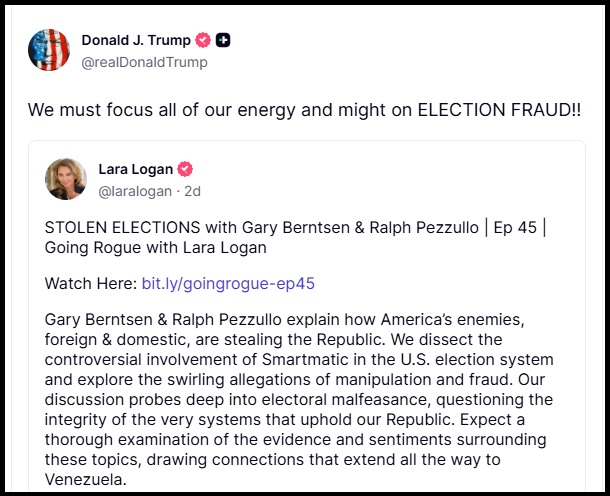
President Trump is calling attention to a recent podcast interview conducted by Lara Logan with Gary Berntsten and Ralph Pezzullo, surrounding the new book “Stolen Elections” as authored by Pezzullo. [TRUTH SOCIAL]

Several people have also sent me information related to this *video interview with strong recommendations to watch it and review the content.   The interview is over 2 hours long, and I know everyone’s time has value. I have only just begun to review the content, but I am sharing for those with interest.  WATCH: 

*Keep in mind, underneath all of the discussion is an intent to sell a book.  Out of respect for those who sent it to me, I will finish watching it.

CHAPTERS:
(0:00:00) – Exposing the True Power Players
(0:04:34) – The Stolen Elections Investigation
(0:10:04) – Foreign Influence
(0:20:12) – Uncovering Election Fraud Networks
(0:30:12) – Persecuted Christians

(0:35:41) – Revealing Evidence
(0:39:42) – Foreign Election Interference
(0:44:13) – Foreign Influence in US Intelligence
(0:58:08) – Global Election Fraud Networks
(1:06:33) – The Cartels’ Global Influence
(1:11:42) – Infiltration of American Institutions
(1:23:04) – Uncovering Election Fraud
(1:31:51) – Chinese Hybrid Warfare in US Elections
(1:44:47) – Investigating Election Fraud Networks
(1:55:24) – Father-Son Diplomatic Bond
(2:01:13) – State Department Covert Actions
(2:10:09) – The Fight to Save America
(2:15:56) – Cartel Connections

[SOURCE]

CIA Senator Elissa Slotkin Attempts to Change Conversation Away from Seditious Video Promotion


Posted originally on CTH on November 23, 2025 | Sundance 

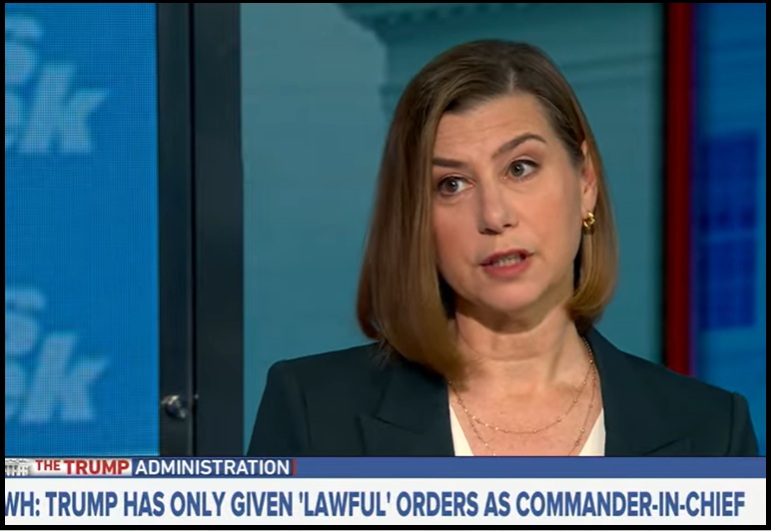
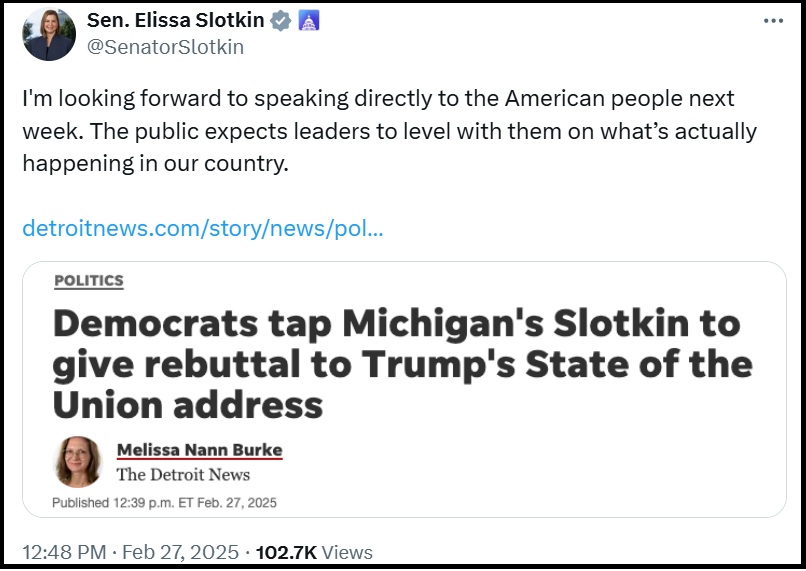
CIA Analyst and Senator, Elissa Slotkin, appears on ABC’s Face the Nation to defend herself from accusations of unlawful conduct following a video she produced telling military and intelligence officers to defy President Trump’s orders.

Senator Slotkin’s behavior is classic tradecraft when she appears in media.

Slotkin claimed the video was intended to draw attention to the unlawful orders that President Trump has used; however, when asked to give an example of a illegal order issued by President Trump, Slotkin nervously admits there aren’t any. WATCH (prompted):

[TRANSCRIPT] – […] RADDATZ: And here’s what White House Press Secretary Karoline Leavitt said about your video.

(BEGIN VIDEO CLIP)

KAROLINE LEAVITT, WHITE HOUSE PRESS SECRETARY: They’re suggesting, Nancy, that the president has given illegal orders, which he has not. Every single order that is given to this United States military by this commander in chief and through this command — chain of command, through the secretary of war is lawful.

(END VIDEO CLIP)

RADDATZ: Is that an accurate statement?

SLOTKIN: So, I think the reason we put that statement out is because the sheer number of, frankly, young officers who are coming to us and saying, I just am not sure. What do I do? You know, I’m in SouthCom and I’m involved in the National Guard. I’m just not sure what do I do? And I think, look, you don’t have to take my word for it. We’ve had report after report of legal officer, JAG officers coming forward and saying, look, I push back on this. I’m not sure that this is legal.

There is such things as illegal orders. That’s why it’s in the Uniform Code of Military Justice. Going back to Nuremberg, right? And it’s just a — it’s a totally benign statement. And if the president is concerned about it, then he should stay deeply within the law. But I think it’s important to know it’s not hypothetical, right?

This president in the last administration, his last administration, asked his secretary of defense and his chairman of the Joint Chiefs to, quote, “shoot at their legs at unarmed protesters in front of the White House that he wanted moved.”

RADDATZ: Actually, I know I know you’re talking about Mark Esper’s book. He didn’t exactly say that. He said the president suggested that, but they were never ordered to do that.

SLOTKIN: And he got out of the Oval Office quickly so that he wasn’t told to actually do it. And I give him a lot of credit for that. I give him a lot of credit.

RADDATZ: I do — so — so, let’s talk right now. Do you believe President Trump has issued any illegal order?

SLOTKIN: To my knowledge, I am not aware of things that are illegal, but certainly there are some legal gymnastics that are going on with these Caribbean strikes and everything related to Venezuela. And I think that’s why —

RADDATZ: And be specific about that. Let me read you what Senator Lindsey Graham said about your video. “You owe it to the men and women in the military to be specific about what you are talking about. What these senators and House members did was unnerving and it was unconscionable to suggest that the President of the United States is issuing unlawful orders without giving an example.”

SLOTKIN: Yeah. So, for me, my primary concern is the use of U.S. military on American shores, on our city — in our cities and in our streets. We’ve seen now the courts overturn the deployment of U.S. military into our streets, including here in Washington, D.C.

When you look at these videos coming out of places like Chicago, it makes me incredibly nervous that we’re about to see people in law enforcement, people in uniformed military get nervous, get stressed, shoot at American civilians. It is a very, very stressful situation for these law enforcement and for the communities on the ground. So, it was basically a warning to say, like, if you’re asked to do something particularly against American citizens, you have the ability to go to your JAG officer and push back.

RADDATZ: And with these service members calling you, couldn’t you have done a video saying just what you just said? If you are asked to do something, if — if you are worried about whether it is legal or not, you can do this. It does imply that the President is having illegal orders, which you have not seen.

SLOTKIN: I think for us, it was just a statement widely, right? We say very quickly and very — to all the folks who come to us, this is the process. Go to your JAG officer, ask them for explanation, for top cover, for their view on things. We do that on a case-by-case basis, but we wanted to speak directly to the volumes of people who had come to us on this.

RADDATZ: And it is very clear that no one should follow an illegal order, but it’s very murky when you look at what is an illegal order. And if you go into morally, ethically, that’s a pretty tough thing to look at and say, how do I navigate this?

SLOTKIN: I don’t — I mean, going back to Nuremberg, right, that, well, they told me to do it, that’s why I murdered people, is not an excuse. If you look at popular culture, like, you watch, you know, A Few Good Men, like we have plenty of examples since World War II in Vietnam, where people were told to follow illegal orders, and they did it, and they were prosecuted for it.

So, the best thing for people to do is go to their JAG officer, their local law enforcement or a legal officer in their unit, and ask for some explanation, ask for help. And that’s what we’ve been advising people to do.

RADDATZ: You are on the Senate Armed Services Committee. What are you seeing in terms of Venezuela? Do you think there will be further action by the president?

SLOTKIN: Well, certainly the sheer size of the military buildup in and around Venezuela. I mean, you have to assume that when superpowers put that much force into an area that they’re going to use it. They brought in aircraft carriers, they brought in F-35s.

I think the cost already is a billion dollars to move all that force into theater. Certainly, if we’re going to actually think about prosecuting some sort of war or military action against the mainland of Venezuela, I would hope that the president would want to have that conversation publicly, bring in the American people who are not looking to get into another war, who are not looking to get into regime change. We had Iraq and Afghanistan. I think people generally on all sides of the aisle are exhausted by war. But just have that conversation, be transparent about it. I think that’s what’s been hard about the strikes in the Caribbean.

Many of us would be supportive of going after drug cartels, but a secret list of secret terrorist organizations, you know, just be transparent with the American public.

RADDATZ: OK, thanks very much for joining us this morning, Senator. We appreciate it.

Sunday Talks – Senator Mark Warner Not Happy with Ukraine Peace Proposal – Video and Transcript


Posted originally on CTH on November 23, 2025 | Sundance 

Sometimes it pays to remind what Marco Rubio said back in February, “Ukraine is a proxy war between the U.S. and Russia.”  From that context the remarks from SSCI Vice-Chair, Senator Mark Warner, make sense.

Warner appears on ABC News ‘This Week’ to denounce the peace proposal now being negotiated in Geneva, Switzerland between Secretary Rubio and the Ukrainian delegation.  Senator Warner makes it clear he will not accept the end to conflict in Ukraine.  Video and Transcript Below:

[TRANSCRIPT] – Senate Intelligence Committee Vice Chair Mark Warner joins me now.

Good to see you this morning, Senator.

SEN. MARK WARNER (D-VA), INTELLIGENCE COMMITTEE VICE CHAIR: Good morning, Martha.

RADDATZ: What is your reaction to this peace proposal that is on the table?

WARNER: My reaction is it’s awful. It would make Neville Chamberlain’s giving in to Hitler outside of World War II looks strong in comparison. The fact that this was almost a series of Russian talking points, would require Ukraine to give the — totality of the Donbas, parts they still control, cut back their military forces going forward, never be able to join NATO.

This would be a complete capitulation. And it’s why I think you’re hearing from Congress, both sides, people pushing back. And, obviously, the Europeans feel like they’ve been totally left high and dry.

MARTHA RADDATZ, ABC “THIS WEEK” CO-ANCHOR: You’ve heard the deadline from President Trump, but then him saying that’s not — there’s room for negotiation here, it seems like. So, what do you think happens after today (ph)?

WARNER: I think what happens — it feels like this was a plan that they took almost entirely from the Russians, did no consultation with Congress, no consultation with the Europeans, obviously didn’t read in Zelenskyy and the Ukrainians, and now they’re getting ferocious pushback. So, one more time, Trump is changing his deadline.

Of course, how he picked Thanksgiving to start with, I have no idea. But now it — even with this — some of this back and forth that it’s not really an American plan, or isn’t an American plan, this is the kind of chaos that, unfortunately, represents so much of the Trump foreign policy.

RADDATZ: So, what do you think President Zelenskyy should do? He’s been through this before. It’s kind of back and forth with this White House. They support you. They pull it back. Do you think all of this, this proposal, which seems to heavily favor Russia, is that just a starting point again?

WARNER: Well, I would hope — I would hope so. Again, the Ukrainians have performed magnificently in the field. And they are reinventing the nature of warfare in terms of use — use of drones. To have this proposal forced upon them, I think as Zelenskyy said, Ukrainian dignity versus giving up a partner, I would hope the president would not be so weak as to try to force this plan on the Ukrainian and our other allies. It would, I think, send not only a horrible signal for Europe, but the person who’s watching this probably the most closely is President Xi in China. And if the Americans are willing to throw in their towel so much like this on Ukraine, you can bet that Xi is thinking, this gives him a clearer path in terms of taking Taiwan.

RADDATZ: But what does Zelenskyy do here? If on Thursday the president says, I’m telling you right now, take what we’ve got on the table and — and there will probably be some changes, or we’re done. What — what does Zelenskyy do, just hope that Europe rises and helps him out?

WARNER: Well, let’s — let’s, again, you have overwhelming support still for Ukraine. The last Ukraine aid package had 80 percent of the Congress. I think the president is seeing this one-sided plan kind of blow up in his face with pushback from the Ukrainians, from the Europeans, from members of Congress of his own party. And my hope is, he’ll come back and be a bit more reasonable.

RADDATZ: I want to turn to Venezuela. We’re all watching that this week. What can you tell us about what you think happens now. We’ve got this massive buildup. We’ve got this massive show of force. We have airline who aren’t — that aren’t flying there because of all the activity and the military activity right now.

Do you expect something more to happen?

WARNER: Well, historically, the United States’ intervention in Central America or South America has not always rolled out the way we’d hope. Maduro was a bad guy, frankly, under Biden. When the Venezuelan people voted in overwhelming numbers, Biden should have put more pressure on getting Maduro out then. It was a mistake.

But now, to have this much armed forces, we have not been briefed on any military action that would have been authorized. He keeps putting the word out that maybe he has authorized, maybe he’s not. We are trying to get the answer on that. But there is a real question. You know, to take this big a fleet, bring our largest aircraft carrier, put them there to further blow up boats that they claim have drugs on them, frankly they could have interdicted some of those boats and shown the world that there were drugs.

In terms of Venezuela, the legal opinion about the drug run — drug running doesn’t touch Venezuela at all. So, the president would have to come back and brief us.

RADDATZ: Trump says he’ll be speaking with Venezuelan President Nicolas Maduro. Do you think that is a good idea? And what can you say to him?

WARNER: Because I think the notion that Trump says he’ll talk to anyone, I think that is — I’m not going to critique him on that, if there’s a way to push Maduro out. Remember, our government and fifty other governments, almost all of Western Europe, don’t recognize the Maduro government as legitimate. But it does not feel like there is an organized plan. And coming down again, America only, without any of our other allies in South America or Central America again seems not the right approach to me.

RADDATZ: What could happen short of a show of force? When you have that massive a show of force, it’s almost like, you’re in a position where you have to do something or you might look weak. Short of Maduro saying, OK, I’ll leave, then what does he do?

WARNER: Well, again, that’s the million-dollar question. And as you know, when you’ve got this many forces down there, and you can’t keep the carrier positioned there forever, you also have the chance of an accident happening or a conflict between the Venezuelan air force or some of our planes that might —

RADDATZ: Do you think he wants to go to war with Venezuela? Do you think he wants (INAUDIBLE) —

WARNER: I don’t know. I don’t know. I think he is trying to put outside pressure on Maduro. But by doing it in this kind of America only approach, again without giving any sign to, I think, even his — the Republicans on The Hill what his plans are, I’m not sure is the right way to do foreign policy. You couple this Venezuela misadventure with this desertion of Ukraine and this is not making America safer, and it’s sure not putting America first.

RADDATZ: Thanks very much for joining us, Senator. Always appreciate it.

[End Transcript]