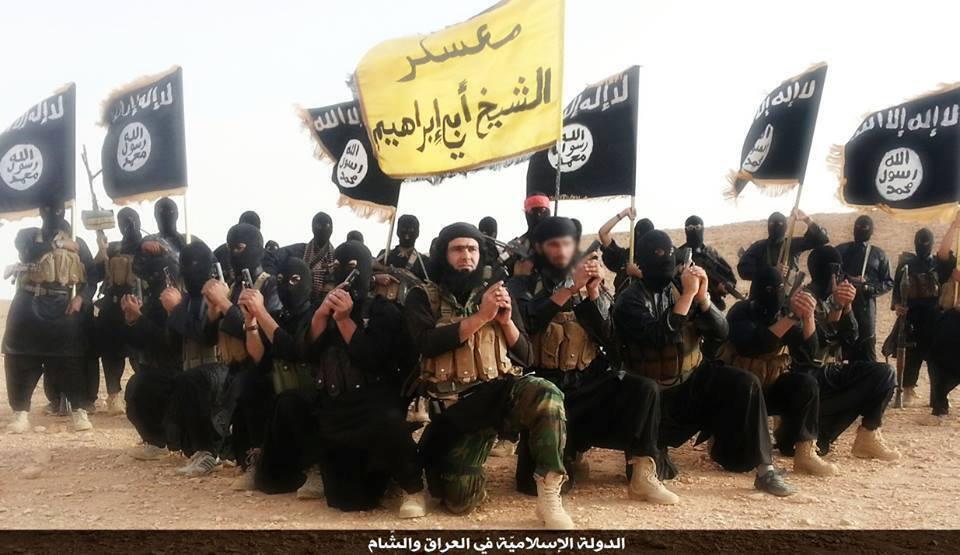
This Is How ISIS Is Building An Airforce


Re-Posted from ZEROHEDGE
Tyler Durden's picture

The Islamic State is nothing if not ambitious. Despite no record of current ‘airplane’ assets in their annual reports, ISIS has begun detaining and forcing Syrian pilots to train militant fighters to fly stolen aircraft. According to CNN Arabic, the pilots (and their planes and helicopters) were abducted when the terrorist group gained control of Tabqa military base. It appears that if beheadings, executions, and whippings are not enough to strike fear into the hearts of the locals, then (just as America is tryiung to do), an air assault will greatly demoralize. We can only imagine how this changes Obama’s strategy (and just where are all the rest of Syria and Iraq’s airplanes stored?)


Via Al Arabiya,

The Islamic State of Iraq and Syria said in a recent tweet it is forcing detained Syrian pilots to train militant fighters to fly stolen aircraft, CNN Arabic reported on Saturday.


In an account reportedly associated with the militant group, ISIS said in a tweet the pilots were abducted when the group gained control over the Tabqa military airbase in Raqqa Province.


ISIS seized the airbase earlier this month. The major airfield houses warplanes, helicopters, tanks and other artillery and ammunition, which were also confiscated by ISIS, according to several media reports.


ISIS did not provide any information about the nature of the training, according to CNN Arabic.

*  *   *

As NYTimes reported,

The fall of the Tabqa air base followed the group’s seizing of two other Syrian military bases and gave it effective control of Raqqa Province, which abuts the Turkish border and whose capital city, Raqqa, has long served as the group’s de facto headquarters.


Photographs posted Sunday on Twitter accounts sympathetic to ISIS showed bearded fighters in the air base, standing next to a destroyed fighter jet and appearing to cut the head off a dead soldier.

*  *  *

Some more of the ‘loot’

Your rating: None Average: 3.6 (7 votes)

The Trouble Is that Obama DOES Have a Strategy


Re-Posted from PJ Media by David P. Goldman August 29th, 2014 – 11:27 am

obama_iran_crossed_fingers_4-20-14-1

Obama’s “we-don’t-have-a-strategy” gaffe was so egregious as to distract attention from the fact that he does indeed have a strategy, which has blown up in his face. His strategy is accommodation with Iran at all costs. As I wrote earlier this month, our ISIS problem derives from our Iran problem: Bashar Assad’s ethnic cleansing, which has displaced 4 million Syrians internally and driven 3 million out of the country, was possible because of Iranian backing. The refugee flood in Iraq and Syria gives ISIS an unlimited pool of recruits. Iraqi Sunni support for ISIS, including the participation of some of Saddam Hussein’s best officers, is a response to Iran’s de facto takeover of Iraq.

Now we have analysts as diverse as Karen Elliott House and Angelo Codevilla proposing that the Saudis should use their considerable air force to degrade ISIS. Unless the U.S. commits its own forces in depth, the Saudis never will do so (unless they are defending their own territory, which ISIS is not stupid enough to attack). It is a sad day when America’s appetite for a fight is so weak that we count on the Saudi monarchy to do our dirty work for us. Codevilla writes:

Day after day after day, hundreds of Saudi (and Jordanian) fighters, directed by American AWACS radar planes, could systematically destroy the Islamic State—literally anything of value to military or even to civil life. It is essential to keep in mind that the Islamic State exists in a desert region which offers no place to hide and where clear skies permit constant, pitiless bombing and strafing. These militaries do not have the excessive aversions to collateral damage that Americans have imposed upon themselves.

That is entirely correct: in that region, air power could drastically weaken ISIS, if not quite eradicate it. It certainly could contain its advances (as fewer than 100 American sorties already have in northern Iraq). But the underlying problem will remain: Iran’s depredations have triggered an economic and demographic catastrophe in the region, and that catastrophe has created the snowball effect we call ISIS.

It may be entirely academic to argue that America should bomb not only ISIS, but also Iran’s nuclear facilities and the bases of its Revolutionary Guards. No Republican candidate I know is willing to argue this in advance of elections. Nonetheless, I repeat what I wrote Aug. 12: “The region’s security will hinge on the ultimate reckoning with Iran.”

On Canada’s Sun TV earlier today, commentator Ezra Levant asked me what Obama will do now. My guess is: very little. The reported Egyptian-UAE attack on Libyan Islamists is a harbinger of the future. Other countries in the region will take matters into their own hands in despair at American paralysis. Russia and China will play much bigger roles. And the new Thirty Year War will grind on indefinitely.

France submits to Islam: 70% expect country to become Islamic


This is the future for most of the EU!

StMA's avatarConsortium of Defense Analysts

ISIS

Jack Moore reports for International Business Times, Aug. 26, 2014, that a new poll by ICM Research found that almost a sixth (16%) of the French population (16%) have a favorable disposition towards the jihadist group ISIS or ISIL (now known as the Islamic State).

The younger the respondent, the more likely they were to have a favorable view of IS, with the youngest age group, the 18-24 year-olds being most favorable.

Worse still, France has witnessed a growing threat of terrorism in recent years as hundreds of young French Muslims are believed to have flocked abroad to fight for jihadist groups in Syria and Iraq, with the potential to return home as radicalized members of society.

ISIL’s territorial ambitions are evident in its name — Islamic State of Iraq and the Levant. Levant today consists of the island of Cyprus, Iraq, Israel, Jordan, Lebanon, Syria, Palestine, and part of southern Turkey. (See “ISIS: the…

View original post 1,011 more words

You Can’t Understand ISIS If You Don’t Know the History of Wahhabism in Saudi Arabia


Knowing history is very important!

Muslim kids make a game out of murder-by-execution


Job training starting young!

ABC: Obama’s Lack Of ISIS Strategy “Creating A Lot Of Concern,” A “Stark Admission”


Hey he just needs to play a few more rounds of golf and maybe take a vacation he has been under a lot of stress taking care of the scandals at the justice department, IRS, VA and the EPA and then all the fund raising my gosh give the poor man a break,

ISIS DETAINS UN PEACEKEEPERS IN GOLAN HEIGHTS


Now this is interesting!

Jihad vs Crusades


Excellent work!

teajr ✓كافر 🇺🇸's avatarConservative Free Thinkers

Whenever you’re dealing with an apologist for Islam, or even a Muslim, and you bring up jihad, almost immediately, they kickback to you: “But what about those terrible crusades? Why they’re the moral justification for jihad and we’re just as bad as they are. So let’s not talk about jihad, okay? Let’s talk about the Crusades.”

Well, what I would like to talk about here, are facts. I created a database of 548 battles that Islam fought: jihad battles against classical civilization. This isn’t even all the battles. It doesn’t include battles Africa, India, Afghanistan and other locations. It’s primarily at data base of the battles against the classical civilization of Rome and Greece.

548 battles are a lot; too many to comprehend. So I created a dynamic battle map with displays of the Mediterranean in 20 year increments. On the display, a white dot designates a battle during the…

View original post 592 more words

Israeli forces caught up in Al Qaeda’s complex toils in both Golan and Gaza


Re-Posted from DEBKAfile Exclusive Analysis August 28, 2014, 11:26 AM (IDT)

The cross-border incident on the Golan Wednesday, Aug. 27, in which an Israeli officer was injured by stray fire from the fighting between Syrian army and rebel forces near Quneitra, put this battle zone on the front pages. However, debkafile’s military sources report that this incident, fought by only 300 combatants on each side backed by 10 tanks, had no real military importance for the Syrian conflict at large. The Syrian army, helped by Iran and Hizballah, is winning and the rebel side is crumbling.

The battle for Qoneitra, fought 200 meters from the Israeli border, is much more important as a touchstone in quite a different setting, that concerns not only Israel but the complicated US posture against the many-headed Al Qaeda peril in the Middle East.

The US, Jordan and Israel are quietly backing the mixed bag of some 30 Syrian rebel factions which Tuesday, Aug. 26, seized control of the Syrian side of the Quneitra crossing, the only transit point between Israeli and Syrian Golan. However – here comes the rub – Al Qaeda elements have permeated all those factions.

The crossing is foirmally under the control of UNDOF, an international peacekeeping force, which too is falling apart as contingents are recalled by their governments. Damascus hit back at the rebels Thursday, Aug. 28, by sending the Syrian air force to destroy the new rebel positions. This was a flagrant contravention of Israel-Syrian armistice agreements. The Israeli air force might have been justified in scrambling to combat the Syrian air incursion, but was not ordered to do so.

This appeared to contradict a fact which Israel has kept very dark: The 30 or so Syrian rebel offensive to wrest Quneitra would have stood no chance without Israel’s aid – not just in medical care for their injured, but also in limited supplies of arms, intelligence and food. Israel acted as a member, along with the US and Jordan, of a support system for rebel groups fighting in southern Syria. Their efforts are coordinated through a war-room which the Pentagon established last year near Amman. The US, Jordanian and Israeli officers manning the facility determine in consultation which rebel factions are provided with reinforcements from the special training camps run for Syrian rebels in Jordan, and which will receive arms.

All three governments understand perfectly that, notwithstanding all their precautions, some of their military assistance is bound to percolate to Al Qaeda’s Syrian arm, Jabhat Al-Nusra, which is fighting in rebel ranks. Neither Washington or Jerusalem or Amman would be comfortable in admitting they are arming Al Qaeda’s Nusra Front in southern Syria.

And not only Nusra: It turned out in this week’s incident that some of the rebel fighters come from the terrorist group Ansar Beit al-Maqdis, a coalition of Al Qaeda contingents based in the Egyptian Sinai Peninsula and Gaza Strip. Another piece of this dissonant jigsaw is Al Maqdis’ close alignment for its violent operations with the Palestinian Hamas ruling Gaza, with which Israel has just been locked in a deadly 50-day war.

Wednesday night, at his news conference to sum up that war, Prime Minister Binyamin Netanyahu included in his list of Israel’s diplomatic successes, the winning over of world opinion to the perception that Hamas and Al Qaeda belong to the same family of terrorists and share the same fundamentalist ideology, which must be fought.
As he spoke, Al Qaeda fighters, intermingled with Syrian rebel factions, fetched up just yards from Israel’s northern border fence.

debkafile’s military sources say that Washington, Amman and Jerusalem can expect to keep the embarrassing fact fairly quiet only until the first black Al Qaeda flag is raised over a rebel position at the Quneitra crossing or a captured Syrian post opposite the line of Israeli positions on the Golan. Israel will then face a new dilemma on this sensitive front, which will take some explaining.

Israel-Hamas truce deal in effect from Tuesday 7 p.m. Heavy Palestinian barrage last minute kills 2 Israelis


Re-Posted from DEBKAfile Exclusive Analysis August 26, 2014, 7:27 PM (IDT)

Prime Minister Binyamin Netanyahu and Egyptian President Abdel-Fatteh El-Sisi were able to bring Hamas leaders in the Gaza Strip to accept an unlimited ceasefire in hostilities in effect from 7 p.m. Tuesday, Aug. 26, based on the 2012 deal. Netanyahu did not ask for his ministers’ endorsement, knowing he did not have majority support in the cabinet. Hamas violated all eleven agreed during during the 50-day Gaza conflict.

Up to the last minute, Hamas kept up heavy rocket and mortar fire, causing two Israeli deaths and injuring seven people, three seriously, in an Eshkol District kibbutz. It is too soon to tell whether Hamas will honor the deal during the month’s run-up to negotiations on a durable truce accord to be brokered by Egypt.
There is no certainty that Israel and Hamas deal were not presented with different drafts for approval by Egypt, which will require nimble footwork from Cairo diplomats to bridge at some point, or that Operation Defensive Edge is indeed over.
debkafile reported earlier Tuesday.

Battered by Hamas’ escalating rocket and mortar assaults, Israelis are again tossed on the uncertain waters of an imminent ceasefire which never materializes. This illusion is propagated again by Prime Minister Binyamin Netanyahu and Egyptian President Abdel-Fatteh El-Sisi. Washington has also been enlisted to the effort by drafting a resolution for the UN Security Council. It was tabled at the request of the White House with quiet backing from Netanyahu for the purpose of blocking the European measure, which is backed by Qatar, one of the Hamas’ few supporters and host to its political leader Khaled Meshaal.

Why is President Barack Obama standing behind Egypt and Israel this time?

His reasoning is complicated. Netanyahu and El-Sisi, who speak regularly and discreetly by phone, have been persuaded by their intelligence services that Meshaal is an impediment – not just to a temporary ceasefire, but to any sort of accommodation for ending the Gaza conflict. They are convinced that all the Palestinian factions, including Hamas-Gaza, would go for an end to the war, in the hope of a Gaza deal leading to a settlement between Israel and Palestinian Authority Chairman Mahmoud Abbas.
Those intelligence analysts cling to the hypothesis that Hamas-Gaza really wants to end the war, and this assumption dominates top-level thinking in Jerusalem and Cairo, in the face of all Hamas’ actions to the contrary in 50 days of escalating Hamas warfare up until Tuesday, Aug. 26.

This dichotomy leaves Israelis increasingly confused and uncertain about how to conduct their lives, especially in the areas closest to the Gaza Strip, which have been largely depopulated by non-stop Hamas short-range rocket and mortar fire.
The theory found a champion this week in an unexpected quarter: Khaled al-Batsh, one of the top men of Islamic Jihad, the pro-Iranian Palestinian terrorist movement which is Hamas’ most active partner in the offensive against Israel.

He suddenly announced he was in favor of a truce.

Lest he be suspected of overnight conversion to peace-lover, debkafile’s intelligence services turns to another hidden aspect of the Gaza conflict for an explanation: The Palestinian group’s patrons, Iran and Hizballah, are working hard to paint their ally Syrian President Bashar Assad as the only force in the Middle East capable of fighting the Islamic State of Iraq and Syria – IS. If their proposition is accepted, they will reciprocate by bringing about a halt in the Gaza hostilities. They would also be able to show themselves in the light of the real forces of peace and moderation in the region.
The US-Egyptian-Israeli line therefore hinged on the presumption that a deal introducing Tehran to the Gaza equation would be beneficial, because Meshaal, who relies heavily on Iranian support, would not be able to spurn an Iranian demand to stop the fighting in Gaza.

But this math has not panned out.  Meshaal showed his nerves were strong enough to withstand the potion mixed for him in Washington, Jerusalem, Cairo, Ramallah. He not only stuck to his guns against ending the Gaza conflict, he outmaneuvered them all by enlisting Hamas’ secretive military chief Muhammed Deif to this end. The object of an Israeli targeted assassination on Aug. 19, Meshaal said that Deif had survived the attack and they were in close contact.

Whether he spoke the truth or not cannot be determined at this point. But by bandying Deif’s name and claiming he too was flat against a ceasefire, Meshaal set a clear course for the war to continue, irrespective of efforts to bring about a truce in the fighting. Deif’s word in the movement is law, which no Hamas member would dare defy.

So, at this point, all the schemes and machinations for ending the Gaza crisis by diplomacy are in deadlock, debkafile’s intelligence and military sources report.

The two options remaining to the leaders of Egypt and Israel are: 1) Unable to break Khaled Meshaal’s will, they must find a way to persuade Hamas-Gaza that it is in their best interests to defy, or even sack, him. 2)  To apply military pressure that is beyond Hamas’ capacity to resist – i.e., effective IDF ground action – to stop the fighting by sheer force.

Of course, if the Hamas political chief were to surprise everyone by caving in and accepting a truce, that would be a third option. But there are no signs of this happening. His movement continued meanwhile to signal its true intentions in no uncertain terms Tuesday, Aug. 26, Day 50 of the Gaza conflict, by unveiling a new 340mm rocket with an extra large warhead which crashed down on a private home in Ashkelon, injuring 59 people – the largest number of casualties by any single rocket so far. Two houses were leveled and dozens more damaged.

And so Hamas Gaza graphically belied the hypothesis of its intentions which guide – or misguide – Washington, Jerusalem and Cairo.