Posted originally on CTH on January 13, 2026 | Sundance
Chopper pressers are the best pressers. President Trump delivers impromptu remarks departing the White House to deliver a speech in Detroit. WATCH:
.


Chopper pressers are the best pressers. President Trump delivers impromptu remarks departing the White House to deliver a speech in Detroit. WATCH:
.
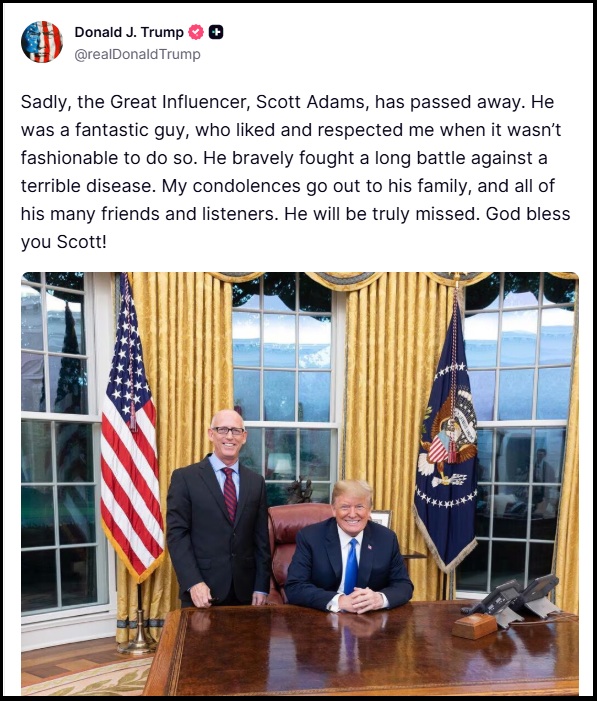
Scott Adams, a beloved cartoonist, author and influential voice within the larger Trump community passed away today after a hard-fought battle with prostate cancer, he was 68 years old.
His ex-wife Shelly Adams confirmed his death, saying he had been receiving hospice care for the past several weeks. Scott Adams announced in May 2025, that he had aggressive prostate cancer and that he probably had only a few months to live.
Shelly Adams announcement video is below {Direct Rumble Link}:
Episode 3071 CWSA – The Scott Adams School 01/13/26
(NYT) – Scott Raymond Adams was born on June 8, 1957, in Windham, N.Y., in the Catskill Mountains. His father, Paul, was a postal worker. His mother, Virginia (Vining) Adams, was a real estate broker and an assembly-line worker. In a quiet household where Scott was the middle child, he was a wisecracker. (read more)

[SOURCE]
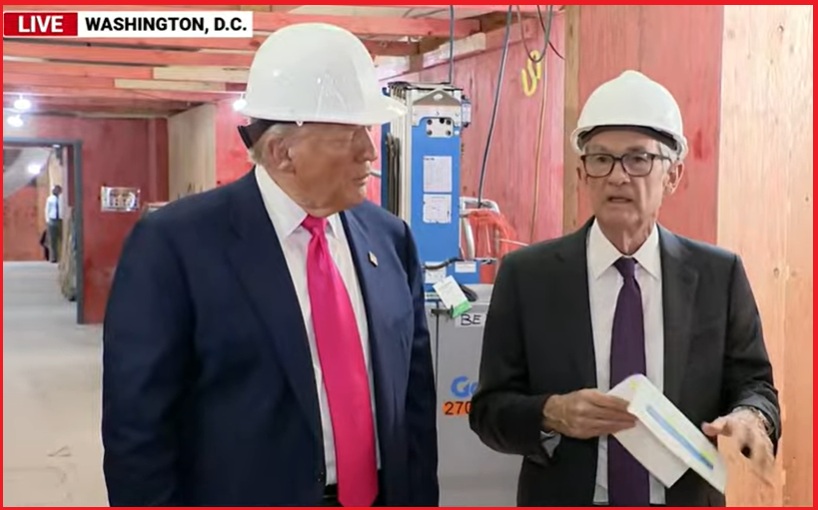
National Economic Council Director Kevin Hassett appears on CNBC to discuss the current status of the Trump economy. Obviously, the first question to Hassett surrounds the announcement by Fed Chairman Jerome Powell that he is under a grand jury investigation.
Director Hassett rightly notes the DOJ is independently investigating the issues of Powell as a result of both a Senate Banking Committee (Tim Scott) and House criminal referral for misleading and false testimony related to the construction of the FED building in Washington DC. Both the decisions by the Federal Reserve and the Dept of Justice are not outcomes of President Trump’s decision making. Secondly, Hassett is considered a candidate to replace Powell in May, so it would be inappropriate for him to make any comments. WATCH:
.


Regardless of how you feel about the Federal Reserve Board, I think we would all agree the construct of an autonomous central bank is outside the boundaries of our constitutional framework. Factually, the Sea Island financial group set up the Federal Reserve as a system of control over the U.S. economy that was completely unnecessary.
That same ultra-constitutional mindset of omnipotent power permeates the recent statements by FED Chair Jerome Powell, who now attempts to evade a Dept of Justice investigation by hiding behind the ruse of his non-elected office.
Last year, facing ridiculous cost overruns, Congress questioned Powell over the insane spending proposal by Powell for a new office building. Chairman Powell characterized the construction changes, that escalated the cost of the project from $1.9 billion to $2.5 billion, as ‘minor modifications.’ That’s $2.5 billions of taxpayer money.
A referral to the Dept of Justice was made [SEE HERE] following Powell’s testimony. Things got ugly quickly when President Trump, a builder and renovator himself, took exception with the scale and scope of the ridiculous spending plan.
In an effort to both use his office as a defense, and simultaneously weaponize the power of his position, Jerome Powell waits until Sunday evening to announce he is being investigated by the DOJ [SEE HERE], and then he claims it is political targeting.
.
[Transcript] – “Good evening.
On Friday, the Department of Justice served the Federal Reserve with grand jury subpoenas, threatening a criminal indictment related to my testimony before the Senate Banking Committee last June. That testimony concerned in part a multi-year project to renovate historic Federal Reserve office buildings.
I have deep respect for the rule of law and for accountability in our democracy. No one—certainly not the chair of the Federal Reserve—is above the law. But this unprecedented action should be seen in the broader context of the administration’s threats and ongoing pressure.
This new threat is not about my testimony last June or about the renovation of the Federal Reserve buildings. It is not about Congress’s oversight role; the Fed through testimony and other public disclosures made every effort to keep Congress informed about the renovation project. Those are pretexts. The threat of criminal charges is a consequence of the Federal Reserve setting interest rates based on our best assessment of what will serve the public, rather than following the preferences of the President.
This is about whether the Fed will be able to continue to set interest rates based on evidence and economic conditions—or whether instead monetary policy will be directed by political pressure or intimidation.
I have served at the Federal Reserve under four administrations, Republicans and Democrats alike. In every case, I have carried out my duties without political fear or favor, focused solely on our mandate of price stability and maximum employment. Public service sometimes requires standing firm in the face of threats. I will continue to do the job the Senate confirmed me to do, with integrity and a commitment to serving the American people.
Thank you.”
Most Americans do not understand what the Federal Reserve Bank does, let alone grasp the concept of how the Federal Reserve construct has been weaponized against their economic interests.
Ultimately, at the core of the issues with the FED is the need for power and control by those who exist in the strata of high finance and banking; essentially, the originating assembly we call the Sea Island group. This group, in synergy with the Federal Reserve, operates to control the U.S. government through monetary policy. There is no other reason for the group to exist.
There’s no reason why banking (interest) rates cannot be localized, determined by each financial institution according to their specific area of focus, and the control of capital outflows determined at a level closest to the Main Street enterprise.
For decades a growing number of voices have been against the FED control over U.S. monetary policy. However, the independent fiat of the FED is defended by all the beneficiaries of the controlled financial system.
Jerome Powell has consistently been politicizing his office through the use of policy. Now, he is claiming to be the victim of politicization, because he is being subjected to the same investigative rules that would apply to any other financial institution head who was guilty of fraud and/or mismanagement.
Dept of Homeland Security Secretary Kirsti Noem appears on CNN to discuss the Minneapolis ICE shooting and the “domestic terrorism” that is taking place against Immigration and Customs Enforcement officers.
Within the interview Secretary Noem emphasizes the activists working to disrupt federal ICE officials are conducting domestic terrorist operations. The leftist media are going bananas over Noem’s description of the anarchists’ activity.
.
Secretary Noem also appeared on Fox News with Maria Bartiromo to answer questions about threats of impeachment.
.

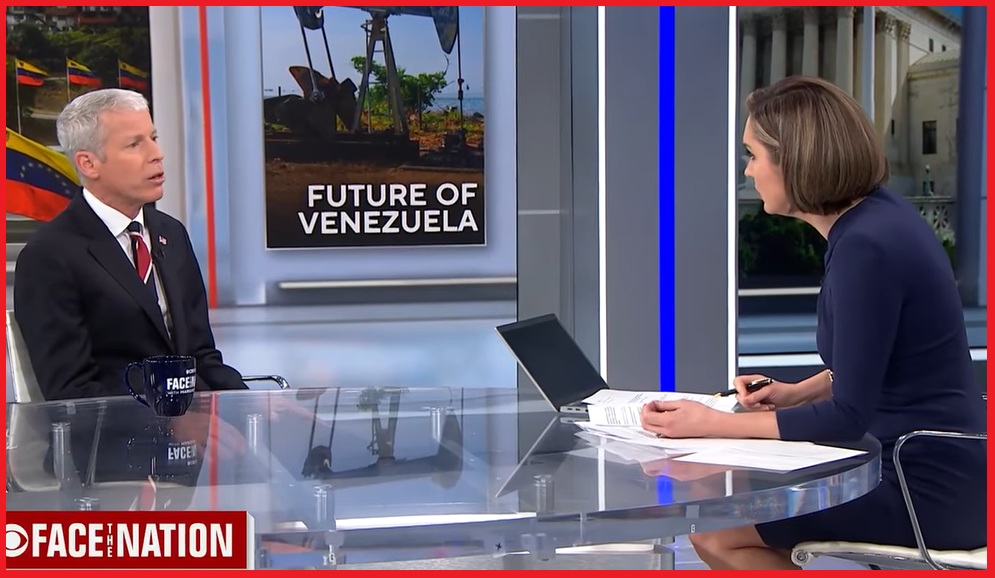
Energy Secretary Chris Wright appears on Face the Nation to discuss the current and future plans for oil production in Venezuela, while explaining how the current mechanism to sell the oil is operating.
[Transcript] – MARGARET BRENNAN: This morning, President Trump vowed that Venezuela now has the military protection of the US. This comes just one week after he said the US would run that country. Meanwhile, Venezuelan opposition leader Maria Corina Machado is expected to travel to Washington to meet with President Trump this week. For his part, Mr. Trump and his team met with dozens of US oil executives late last week, urging them to commit $100 billion to boost oil production there. Joining us now to discuss it all is the United States Secretary of Energy, Chris Wright, good to have you here in person.
SECRETARY CHRIS WRIGHT: Thanks for having me, Margaret.
MARGARET BRENNAN: Before I ask you about Venezuela, very quickly, these protests in Iran, not this country reliant on oil to keep its government-controlled economy afloat. The President has been briefed on military options. What is the US willing to do to help?
SEC. CHRIS WRIGHT: Certainly the President has been very outspoken about wanting to have freedom and rule of law and capitalism and great relations with the United States return. So we’ll see. I think his moral support has been strong. Certainly, he’s taken a strong stance against the mullahs in Iran in disabling their nuclear program. I think the people in Iran are rising up because they feel there’s a strong America that has their back. I won’t go into the specifics there, but we wish them well, and we’d love to see a free and democratic Iran again.
MARGARET BRENNAN: Will there be more interdictions of vessels carrying Iranian oil? Any more activity on that front?
SEC. CHRIS WRIGHT: I won’t reveal any change in position there.
MARGARET BRENNAN: Okay, let me ask you about Venezuela,
SEC. CHRIS WRIGHT: Yes.
MARGARET BRENNAN: where you have been very focused and very central to the President’s policy. The President said that Venezuela now has the United States, the most powerful military in the world, to protect them. To protect them, we will. Is the United States military providing security guarantees for American companies?
SEC. CHRIS WRIGHT: We’re not doing that right now, but what we, what he means, is we’re changing the game for what’s happening in the ground in Venezuela. Venezuela has purchased $20 billion of Russian weapons. They got Cuban mercenaries there. They supply oil to Cuba. They, they harbor the Hezbollah’s headquarters for the Western Hemisphere. Venezuela has been a very dangerous, very destabilized place going down the tubes. And with the United States influence now by controlling the sale of their oil and therefore the flow of funds into the country, we think we’re going to, we will see relatively rapid change, improvement on the ground in Venezuela. This is a process. We’re only eight days into the process, but it’s off to a strong start.
MARGARET BRENNAN: Well, it’s off to a quick start. You had the oil executives at the White House just Friday. That the President, excuse me, the State Department yesterday had a security alert I want to ask you about because it specifically cited the risk to Americans in Venezuela, and it said armed militias are setting up roadblocks, searching vehicles for evidence of US citizenship or support for the US. The man who runs those militias is Diosdado Cabello, who is the Minister of the Interior. Is he ordering the hunting of Americans?
SEC. CHRIS WRIGHT: Not that we are aware of, but we should be cautious. Look, this is, as they say, eight days into a change into a change of leadership there. The interim authorities are trying to establish power. Collectivos have been running wild over, over Venezuela for, for over a decade. So, yeah, you’re not going to–
MARGARET BRENNAN: Right. Well he controls them.
SEC. CHRIS WRIGHT: He does.
MARGARET BRENNAN: So is he safe in his position? Because right now the administration seems to be working with him.
SEC. CHRIS WRIGHT: We need to work with the people that have the guns today to ultimately move the country to a representative government and a better station. But what you’ve got to prevent in the mean term is a collapse of the nation. And I think the strong moves we’re making right now is to influence the people with the guns today, which is part of a process.
MARGARET BRENNAN: And you’re not concerned he’s going to undermine the more business minded President Delcy Rodriguez?
SEC. CHRIS WRIGHT: Oh, of course we’re worried about things like that. We need to get stability among the leadership in Venezuela. So yes, of course we’re concerned about those things.
MARGARET BRENNAN: So tell me broadly, is the Trump administration’s goal here to acquire the state oil company, PDVSA, and to run it. Are you going to put Americans on the board? How is this going to work?
SEC. CHRIS WRIGHT: Well, again, it’s a process. The first thing to do is to reduce the damage to the United States, the inflow of guns and criminals and immigrants and drugs into the United States, the destabilizing of a key part of the Western Hemisphere. We need to stop that. That’s why we’ve entered into Venezuela. Certainly, part of the way to improve Venezuela and to improve the Western Hemisphere and improve the lives of Americans is to get their very corrupt 25 years in decline, oil industry back going again.
MARGARET BRENNAN: Does that mean the United States government is going to run it? The president says we’re going to run the country. Are we running this as like as an American state owned oil company essentially?
SEC. CHRIS WRIGHT: No. Today we are running the sale of their crudes. You know, we have a quarantine around their ability to ship oil outside of Venezuela. All of that goes through American crude marketers, and then that crude goes out into the market. We collect those funds and bring them back to Venezuela to better the lives of Americans and Venezuelans. But in the long run, what will happen with Venezuelan oil resources? Yeah, of course, quite likely you’ll see American companies’ expanded presence there. You’ll see growing production. Of course, you’re going to see more American involvement in there. But exactly how that’s going to work, that’s going to unfold over time.
MARGARET BRENNAN: So back in November, us, Judge backed a bid by an American hedge fund to purchase Citgo Petroleum. The Treasury still has to approve that deal. The hedge fund is actually run by a big Trump donor, Paul Singer. Do you want to preserve Venezuelan ownership of Citgo? Do you want to have America have a financial stake in it, like Trump bought a big portion of an intel company, do you want to own portions of oil companies?
SEC. CHRIS WRIGHT: Again, that’s going to be up to American businesses. That’s certainly a very real possibility. The Citgo sale is part of, is part of bringing redress to creditors of the United States for the Venezuelan Government. And of course, one, one of the capital providers in that transaction is a hedge fund provider you just mentioned. There’s lots of American investors and American refining entrepreneurs that are involved in that so to take Venezuelan owned refineries that are in the United States and legally through an auction process, transfer them to American owners and American entrepreneurs in the refining business. I think that’s fantastic.
MARGARET BRENNAN: There’s concern about corruption here, though. Will there be Americans installed on these boards? And how do you respond to these allegations that some Trump donors are going to get preferential treatment?
SEC. CHRIS WRIGHT: I can assure you that is absolutely not the case. Absolutely not the case. Think of what President Trump has done for the American oil and gas industry. He’s driven down the price of oil. He’s dramatically reduced–
MARGARET BRENNAN: There’s an over supply of oil. And now you’re going to put more on the market.
SEC. CHRIS WRIGHT: Exactly. That’s not- That’s not good for American oil and gas companies.
MARGARET BRENNAN: Because it makes it less profitable for them to actually go and invest in drill, baby, drill.
SEC. CHRIS WRIGHT: Exactly. Democrats and President Biden are fantastic for American oil and gas companies because they try to restrict the supply to something that’s essential to life, which only has one possible impact, which is to drive up prices and grow profitability. So President Trump is no, is no helper to the oil and gas industry. And certainly there’s no corruption, preferential placement of people. There’s none of that. I can assure you of that. I’m in the center of this.
MARGARET BRENNAN: How are you going to decide the contracts? Is the Treasury going to approve the Citgo dominance there in that–
SEC. CHRIS WRIGHT: That went through a large auction to buy it.
MARGARET BRENNAN
Are you going to brief to Congress the decisions you’re making about which firms get access?
SEC. CHRIS WRIGHT: Absolutely. All that was an auction open to all American firms. There were many bidders, including the coalition of bidders you mentioned. We want those assets to get as much money as possible, to go back to the creditors of the Venezuelan Government. And we want American refinery assets owned by Americans that are going to increase the throughput, drive down the price of gasoline in America.
MARGARET BRENNAN: Okay. So Secretary Rubio said there’s a three point plan, stabilize, rehabilitate, transition. This sounds indefinite, even when you heard some of those oil executives, Chevron’s leadership, they’re already in Venezuela, we should say, said it will take 18 to 24 months to even increase oil production by 50%. So how long is this American involvement? Because he’s saying there, it’s at least a year and a half, two years.
SEC. CHRIS WRIGHT: They’ve been there for 100 years, and likely, Chevron’s going to be there 50 years from now.
MARGARET BRENNAN: But the United States government, how long does that role continue?
SEC. CHRIS WRIGHT: You heard the third part of Rubio’s question, which is transition. We want to bring a representative government to the people of Venezuela. I think then you’ll see the full sovereignty back to the government of Venezuela. We don’t have a legitimate government of Venezuela today. We’d like to move and get there, but America–
MARGARET BRENNAN: Is there a timeline?
SEC. CHRIS WRIGHT: 25 years, this country has gone in decline. President Trump out of the box, creative intervention has allowed us to change the game. But, yeah, I don’t know the timeline of that. It’s not weeks, it’s more months. Could be a year or two could be more.
MARGARET BRENNAN: Okay. Secretary Wright, thank you for your time today.
Border Czar Tom Homan appears on NBC to discuss the Minneapolis, Minnesota ICE shooting and the subsequent protests which have been organized to achieve maximum civil disorder.
.

It appears that Minnesota Governor Tim Walz is about to discover what happens when you anger the Treasury Secretary, who happens to be the IRS Commissioner. WATCH (Prompted):
.
I first read and listened to the following account a few days ago and hesitated to share the story because what was described sounded surreal. However, White House Press Secretary Karoline Leavitt has also shared these details giving the account some level of potential authenticity that did not exist before.
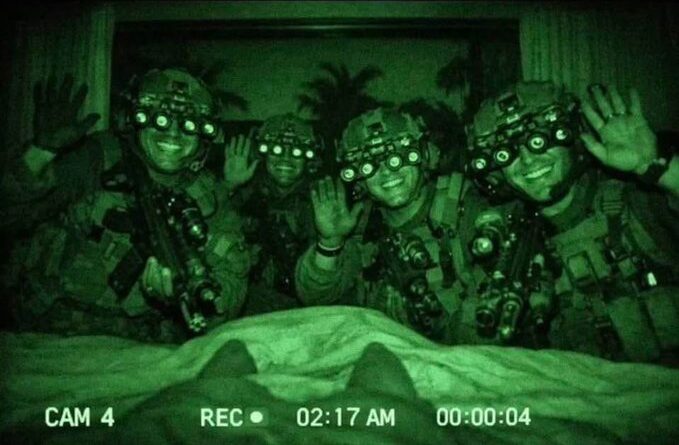
What is described about the attack on the compound of Nicolas Maduro is quite remarkable. All electronic countermeasures, including radar were rendered ineffective after initial U.S. military strikes.
Then a wave of drones moved in and began targeting specific infrastructure. Then a network of Venezuelan aircraft was destroyed on the ground. Then the helicopters arrived and the technology with the U.S. soldiers’ weapons was unlike anything the Cuban/Venezuelan military had ever encountered.
Maduro was being protected by approximately 300 armed soldiers. One of Maduro’s guards survived with injuries and gave an account in Spanish [LINK] that was also shared in English translation [LINK] The original video is below the transcript.
[TRANSCRIPT] – This account from a Venezuelan security guard loyal to Nicolás Maduro is absolutely chilling—and it explains a lot about why the tone across Latin America suddenly changed.
Security Guard: On the day of the operation, we didn’t hear anything coming. We were on guard, but suddenly all our radar systems shut down without any explanation. The next thing we saw were drones, a lot of drones, flying over our positions. We didn’t know how to react.
Interviewer: So what happened next? How was the main attack?
Security Guard: After those drones appeared, some helicopters arrived, but there were very few. I think barely eight helicopters. From those helicopters, soldiers came down, but a very small number. Maybe twenty men. But those men were technologically very advanced. They didn’t look like anything we’ve fought against before.
Interviewer: And then the battle began?
Security Guard: Yes, but it was a massacre. We were hundreds, but we had no chance. They were shooting with such precision and speed… it seemed like each soldier was firing 300 rounds per minute. We couldn’t do anything.
Interviewer: And your own weapons? Didn’t they help?
Security Guard: No help at all. Because it wasn’t just the weapons. At one point, they launched something—I don’t know how to describe it… it was like a very intense sound wave. Suddenly I felt like my head was exploding from the inside. We all started bleeding from the nose. Some were vomiting blood. We fell to the ground, unable to move.
Interviewer: And your comrades? Did they manage to resist?
Security Guard: No, not at all. Those twenty men, without a single casualty, killed hundreds of us. We had no way to compete with their technology, with their weapons. I swear, I’ve never seen anything like it. We couldn’t even stand up after that sonic weapon or whatever it was.
Interviewer: So, do you think the rest of the region should think twice before confronting the Americans?
Security Guard: Without a doubt. I’m sending a warning to anyone who thinks they can fight the United States. They have no idea what they’re capable of. After what I saw, I never want to be on the other side of that again. They’re not to be messed with.
Interviewer: And now that Trump has said Mexico is on the list, do you think the situation will change in Latin America?
Security Guard: Definitely. Everyone is already talking about this. No one wants to go through what we went through. Now everyone thinks twice. What happened here is going to change a lot of things, not just in Venezuela but throughout the region. {SOURCE}

.
President Trump, President Zelenskyy and the CIA continue to deny any involvement on the drone attack against Russian Federation President Vladimir Putin’s state residence. However, Russia has released evidence from the drones that were shot down including the guidance and targeting systems.
Someone launched the drones from Ukraine and targeted them at Putin’s residence to send a message. There is considerable debate online about it, but if President Trump and Volodymyr Zelenskyy are speaking truthfully, the most likely suspect who launched the drones was British intelligence inside Ukraine. Then again, if the CIA was factually involved, everyone would have to deny it.

In retaliation for the December 29th attack, yesterday Russia fired a hypersonic Oreshnik missile and counterattack drones directly into the heart of Kiev, Ukraine.
The use of the Oreshnik missile comes just hours after Russian President Putin asserted publicly that Ukraine, Europe and NATO have no defenses against the hypersonics.
President Zelenskyy said the Russian attack involved 242 drones, 13 ballistic missiles, one Oreshnik missile and 22 cruise missiles. However, as with all things Zelenskyy, this dramatic claim seems to be slightly exaggerated.
Russia claims they targeted key electricity infrastructure as well as the production facilities for building drones in Kiev which are collocated in residential areas.
Images of the hypersonic missile warheads hitting their targets is shown at left. Much of Kiev is now without power and electricity.
The Russian Defense Ministry said, “in response to the terrorist attack by the Kiev regime on the residence of the President of the Russian Federation in Novgorod region, launched on the night of 29 December 2025, the Russian Armed Forces launched a massive strike with high-precision long-range ground- and sea-based weapons including the Oreshnik mobile ground-based medium-range missile system as well as attack unmanned aerial vehicles at critically important facilities on the territory of Ukraine. All the assigned targets have been hit. Production facilities of unmanned aerial vehicles that were used during the terrorist attack as well as power infrastructure enterprises that supported the defense industry of Ukraine have been damaged.”
Moscow appears ambivalent to the demands of the EU/NATO as they pertain to a ceasefire, and it appears the Kremlin has comprehensively rejected the European 20-point peace plan solution based on President Putin’s rejection of the ‘security guarantees’ as outlined by EU leadership.
Statement from Russia: “The document turned out to be extremely far from a peace settlement. The declaration is not aimed at achieving a lasting peace and security but rather at continuing the militarisation, escalation and further conflict aggravation.
Its core element is the deployment of “a multinational force” on Ukrainian territory that the coalition will have to form to contribute to the “rebuilding” of the Ukrainian armed forces and “support deterrence” [against Russia] following the cessation of the hostilities.
The document also includes clauses on further consolidation of Ukraine’s and NATO’s military industrial sectors.
As clarified by British Prime Minister Keir Starmer and French President Emmanuel Macron, who signed the corresponding trilateral statement along with Zelensky, London and Paris plan to establish their own military bases in Ukraine post-ceasefire and build weapon and military equipment storage facilities.
The Russian Foreign Ministry warns that the deployment of military units and the setting-up of military facilities, storages and other Western infrastructure on Ukrainian territory will be qualified as foreign intervention that directly threatens the security of Russia and other European countries.
All such units and facilities will be considered as legitimate military targets for the Russian Armed Forces.
Warnings to this effect have been repeatedly made at the highest level and remain relevant.
We also reaffirm that a peaceful resolution of the conflict is solely possible through the elimination of its root causes, the re-establishment of Ukraine’s neutral non-aligned status, its demilitarisation and denazification, and Kiev’s observance of the language, cultural and religious rights and freedoms, including those of ethnic Russians, Russian-speaking people, and members of ethnic minorities, and through the recognition of the current territorial realities that emerged as a result of the peoples’ exercised right to self-determination.
All these goals will, undoubtedly, be achieved either by political and diplomatic means or in the course of the special military operation, in which the Russian Armed Forces are maintaining full initiative on the battlefield.
The new militarist declarations of the so-called Coalition of the Willing and the Kiev regime are forming a true Axis of war.
Its participants’ plans are becoming increasingly more dangerous and destructive for the future of the European continent and its residents, who are also forced by Western politicians to pay for such ambitions out of their own pockets.” {SOURCE}
President Trump was asked about the current status during his meeting with oil executives on Friday:
On the positive side, it is good to remember the U.S. has now established strong diplomatic ties for deconfliction between the U.S. and Russia. The Europeans and many within the U.S. congress want and demand escalated conflict with Russia, President Trump does not.
The “coalition of the willing” (Brussels, Great Britian, Canada, France, Germany and Australia) cannot reasonably go to war with Russia without the assistance of the United States. President Trump does not want to involve us in the growing quagmire either in Ukraine or any of the various ancillary venues the EU are promoting.
Italian Prime Minister Giorgia Meloni has recently joined with French President Emmanuel Macron to say perhaps it is time for the EU to engage directly with Vladimir Putin. The EU has a position, a 20-point plan, that is not supported by President Trump because it is contingent upon American involvement.
Perhaps it is time for the EU to take responsibility for their own diplomatic efforts and figure out a solution. In the interim, President Putin continues taking apart Ukraine bit by bit.
I have created this site to help people have fun in the kitchen. I write about enjoying life both in and out of my kitchen. Life is short! Make the most of it and enjoy!
De Oppresso Liber
A group of Americans united by our commitment to Freedom, Constitutional Governance, and Civic Duty.
Share the truth at whatever cost.
De Oppresso Liber
Uncensored updates on world events, economics, the environment and medicine
De Oppresso Liber
This is a library of News Events not reported by the Main Stream Media documenting & connecting the dots on How the Obama Marxist Liberal agenda is destroying America
Australia's Front Line | Since 2011
See what War is like and how it affects our Warriors
Nwo News, End Time, Deep State, World News, No Fake News
De Oppresso Liber
Politics | Talk | Opinion - Contact Info: stellasplace@wowway.com
Exposition and Encouragement
The Physician Wellness Movement and Illegitimate Authority: The Need for Revolt and Reconstruction
Real Estate Lending
 Centinel2012