Posted originally on CTH on May 31, 2025 | Sundance
Next week on Thursday, German Chancellor Friedrich Merz is scheduled to travel to Washington DC and meet with President Donald Trump in the White House. Considering the importance of Germany to the EU economy and subsequent trade relationship with the U.S, this meeting with Merz will likely be the most important discussion toward a possible U.S-E.U. trade agreement.
Germany is the largest economy within the EU and the core industrial base of the European Union. The number one issue for the German people is their economic status: everything else circles around this priority.
Having spent time in Hamburg, Bremen, Dresden and Frankfurt, it is very clear to me the German people are very focused on work and their vocations. Germans overall, take their economic standing very personally and seriously.
Inasmuch as Merz may have to represent the interests of the larger EU in his approach, he will undoubtedly be focused on what is in Germany’s best interest, with all else second.
For President Trump this specific German interest creates a unique facet of leverage within the larger EU trade discussion. Because the German economy is so vital, whatever terms Germany decides are the core terms the EU will manifest in their trade and tariff negotiations.
I predict we will hear a talking point from Merz, in generally German snark, something akin to a proposal for a zero-tariff base on the import and export of heavy industrial goods (machinery) for both Germany and the USA. I say in general German snark because passive-aggressive Chancellor Merz knows the U.S. is currently not in a position to sell Germany heavy industrial goods, and that’s entirely what President Trump is trying to recreate with the trade/tariff policy.
WASHINGTON DC – German Chancellor Friedrich Merz will travel to Washington next week to meet United States President Donald Trump for the first time since taking office earlier this month.
The leaders will meet in the White House on Thursday and are expected to discuss the war in Ukraine, the Middle East and trade policy, German government spokesperson Stefan Kornelius said in an emailed statement.
Merz will travel to the U.S. capital a day ahead of the meeting, according to broadcaster n-tv. The meeting will be followed by a lunch and a press conference, according to the report. (read more)
Recently Merz has also walked further forward in his support for Ukraine, including his willingness to provide missiles and approve their use for strikes into the Russian mainland. On this issue Merz is in a tenuous place domestically. The German people care more about their economic status than they do supporting Ukraine as a proxy war against the Russian Federation.
In addition to the trade and Ukraine issues, Chancellor Merz is also in conflict with the Trump administration as it pertains to cultural and political expressions of free speech in Germany.
The oppressive German system of politics has been ramping up a more oppressive footing toward the nationalistic voices inside the country. The opposition (AfD) who does not support the EU status vociferously enough, is now a target of the German political machine.
Both Vice President JD Vance and Secretary of State Marco Rubio have publicly called out the German government for oppressive positions against their own citizens. Merz has pushed back against Rubio and Vance by telling them to stay out of German politics.
This will be an interesting meeting to watch closely next week.
Posted originally on CTH on May 31, 2025 | Sundance
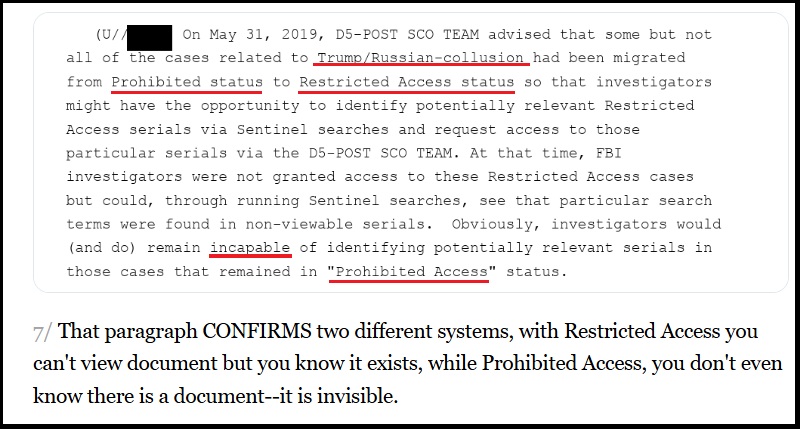
As previously noted, Senate Judiciary Chairman Chuck Grassley released some of the FBI investigative files related to a congressional referral of Nellie Ohr for false testimony to congress. Within the Grassley release the declassified FBI investigative notes show that Trump-Russia files were compartmentalized, allowing control over access to them by the FBI Director and FBI Deputy Director.
The 7th floor level classification within the FBI’s Sentinel record-keeping system was previously unknown, and now people are starting to ask questions about what other information may be filed yet invisible due to the classification designation of “Prohibited Access.”
The Sentinel record-keeping system allows FBI officials and investigators to review and research the status of investigations both past and current. The Sentinel system is also the information system that is searched for responsive documents to legal cases and FOIA inquires. The Sentinel system contains all the information used by the FBI.
Within the Sentinel system there are “Restricted Access” files that are used to control who can view the file information. The FBI official can see the file but cannot access the information within it without a higher clearance level. However, now people are discovering there is a “Prohibited Access” designation that makes the file invisible to searches or queries and is controlled by the FBI Director and FBI Deputy Director.
Margot Cleveland is asking some good questions about how the use of the “Prohibited Access” designation may circumvent the FBI’s legal requirements (brady material) and FOIA searches. [SEE HERE] However, I would also note this approach hides information not only from congress and from the public, but also from the Executive branch itself. The DNI wouldn’t even know what information exists.
Additionally, we can expand the overall issue to highlight this same approach at work in various other governmental agencies. This is one of the reasons I refer to the agencies within government more aptly as information “silos.”
The same “secrecy filtering” system outlined in the FBI Sentinel system, “restricted access” (visible but needing a higher clearance) vs “prohibited access” (totally invisible) exists in other govt systems.
The NSA, DHS and CIA contain the same issue, information hidden and kept secret. This is the core reason I have historically called them “silos.”
The same ‘what the heck’ realization encountered with the FBI file keeping, as noted by the Grassley revelations, extends far beyond the FBI.
This is also why I have said the Intelligence Community has created a “caste system” within the surveillance and information space.
Now do you see why elements of the IC, and by extension their political enablers, were going bananas about DOGE access?
Simmer on it for a moment, because it gets worse.
Right now, like right now while you are reading this, the same framework is being applied to the DHS surveillance network, where “restricted access” and “prohibited access” (invisible) are being applied to PEOPLE.
Our government, via Palantir, is currently building the domestic identity surveillance system, where every identity will be stored. However, within the storage, and by extension the parameters of the surveillance search results, there will be people who are defined by placing their identity in the “prohibited access” category.
Great job realizing the secrecy ramifications of the issue within the FBI and their exploitation therein. Now extend that realization to the ramifications for us of other silos doing the same.
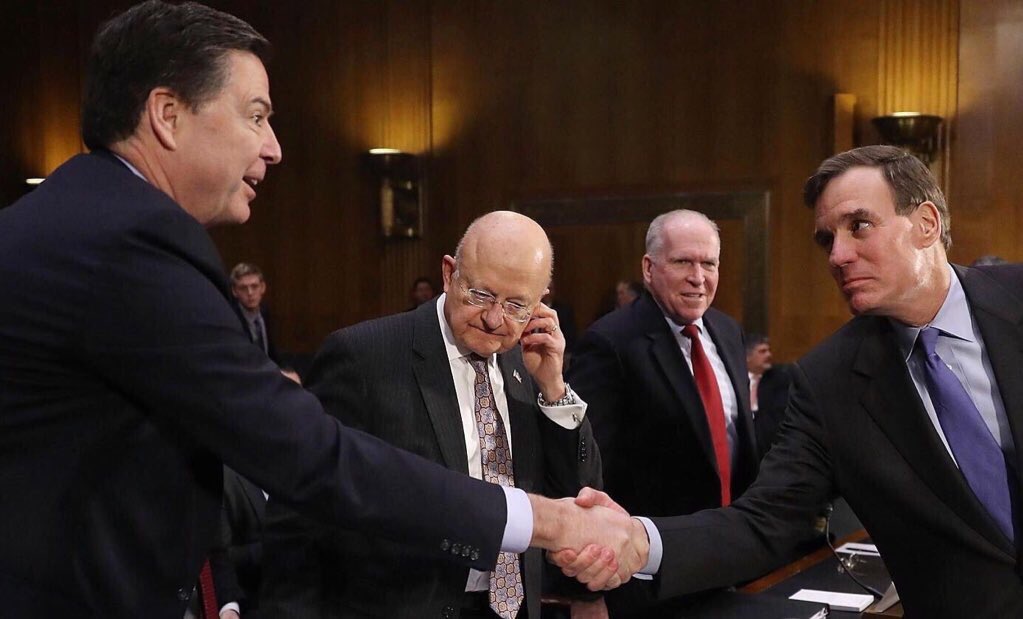
I was told in August 2020 that the FBI investigative file into James Wolfe leaking the Carter Page FISA application, is in the “prohibited access” tier of the FBI because it outlines Senate Select Committee on Intelligence Vice-Chairman Mark Warner participating and directing the leak. That was how/why SSCI Security Director James Wolfe was never charged with leaking a TSCI classified file.
Is the President of the United States really in charge of the executive branch, when the agencies can easily hide information from him?
Posted originally on CTH on May 31, 2025 | Sundance
Self-interested Wall Street analysts and leftist economic ‘experts’ once again proven wrong. It is almost impossible to find any financial data review written objectively by media. Everything is skewed with a negative tone, yet the data clearly shows -just like 2017- President Trump’s MAGAnomic policy benefits are starting to surface.
News pundits said President Trump’s tariff policies would skyrocket prices. In reality the yearly inflation rate [BLS data] has dropped to 2.1%, the lowest in four years. Core prices (removing food and energy) rose 2.5% from a year earlier, below the March figure of 2.7%, and the lowest in more than four years.
Meanwhile personal incomes tripled expectations coming in at 0.8% for the month of April. “Personal income surged 0.8% well ahead of the forecast for 0.3%.” Then comes the predictable. The trade deficit dropped by 46% in the month of April.
[…] The goods trade gap contracted 46.0% to $87.6 billion last month, the Commerce Department’s Census Bureau said on Friday. Goods imports decreased $68.4 billion to $276.1 billion. Exports of goods increased $6.3 billion to $188.5 billion. (source)
Companies front-loaded their orders from China in February and March, causing imports to skyrocket and a massive skew in the GDP data. As expected in April there are fewer orders because the goods were already received in the first quarter, imports drop in half.
Despite increased tariffs we are likely to see a replay of pricing parity similar to 2017 as companies benefit from lowered energy prices, lower fuel costs, lower Transporation and lower warehousing costs. Simultaneously, export companies who rely on access to the U.S. market will attempt to offset any tariff price as applied. Those combined savings can, likely will, offset increased tariffs on arriving goods.
Consumers benefit from lower gasoline costs, lower overall electricity costs and increased demand for labor within a growing economy that puts natural upward pressure on wages.
SUMMARY of Friday: Personal income jumped 0.8% this month, tripling expectations. The US trade deficit has been cut almost in half, the largest single-month narrowing of the deficit on record. U.S. core inflation falls to the lowest level in 4 years. The Supreme Court gives President Trump the green light to reverse Biden’s immigration influx of Venezuelans/Cubans/Haitians/Nicaraguans. And Volkswagen announced they are making a “massive” investment in the U.S to avoid tariffs.
(NY POST) – Volkswagen is holding “fair” and “constructive” talks with the United States government on tariffs and wants to make further investments in the country, CEO Oliver Blume told German newspaper Sueddeutsche Zeitung.
Several foreign companies have announced new US investments in response to President Donald Trump’s import tariffs, but German carmakers have been more cautious about committing more resources to what is their biggest export market.
Volkswagen’s Audi brand, which has no production in the United States, is planning to produce some models in there, although the brand has said that the plan pre-dates the Trump administration. (link)
I have created this site to help people have fun in the kitchen. I write about enjoying life both in and out of my kitchen. Life is short! Make the most of it and enjoy!
This is a library of News Events not reported by the Main Stream Media documenting & connecting the dots on How the Obama Marxist Liberal agenda is destroying America







 Centinel2012